38
Activity
Immediate
Predecessor
Time
(days)
Earliest
Start
Earliest
Finish
Latest
Start
Latest
Finish
Slack
A
—
2
0
2
0
2
0
B
A
4
2
6
2
6
0
C
A
2
2
4
6
8
4
D
5
6
8
2
E
B
6
6
6
0
F
8
1
G
E
9
12
21
12
21
0
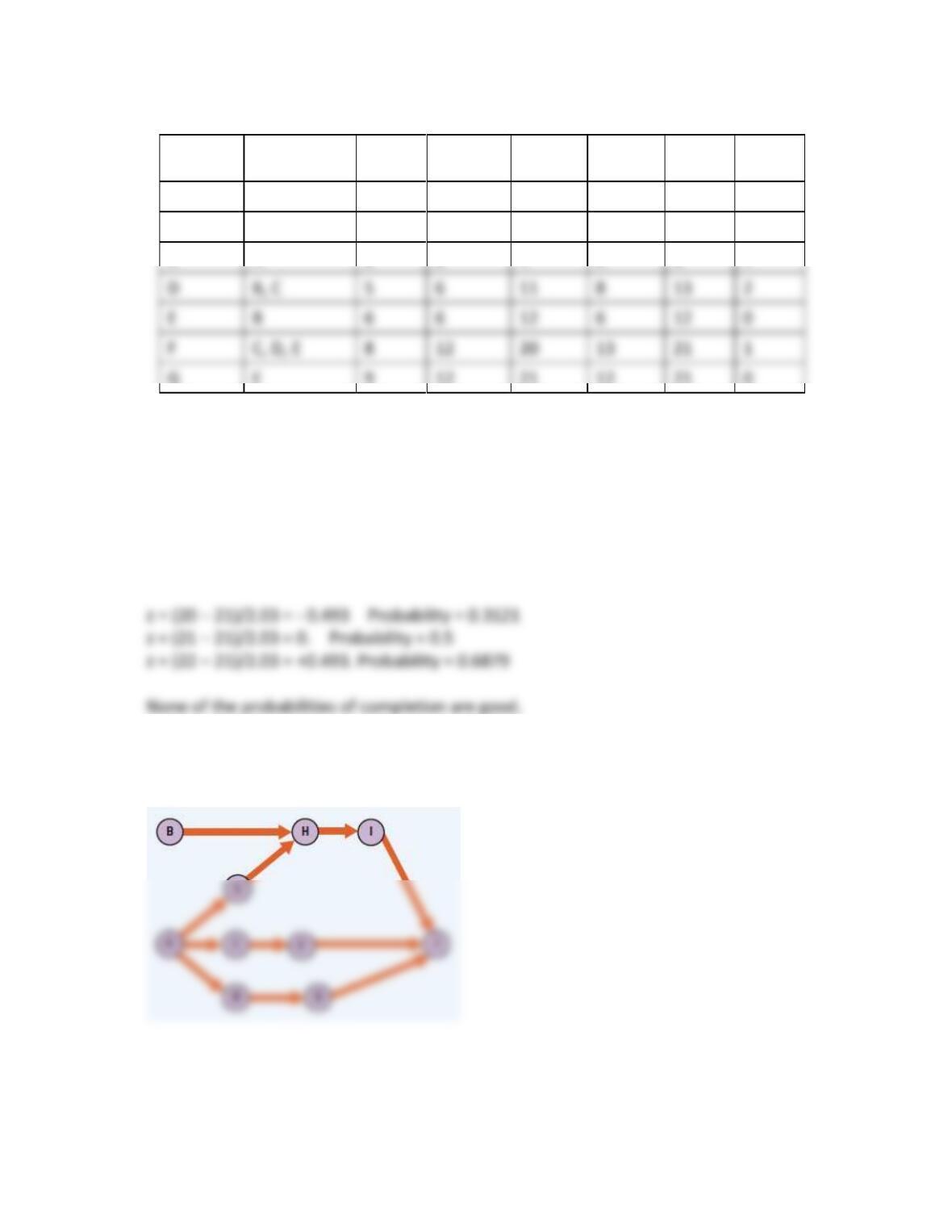
Critical path is A-B-E-G; completion time is 21 months.
c. What is the probability of completion in 20, 21, and 22 weeks?
The expected completion time for the critical path is 21 months; the variance along the
critical path is 4.11, so the standard deviation is 2.03. (See Appendix A that shows the
cumulative standard normal distribution areas for –3.9z to +3.9z.)
54. LCD Software must complete the project defined by the following network in 22 weeks.
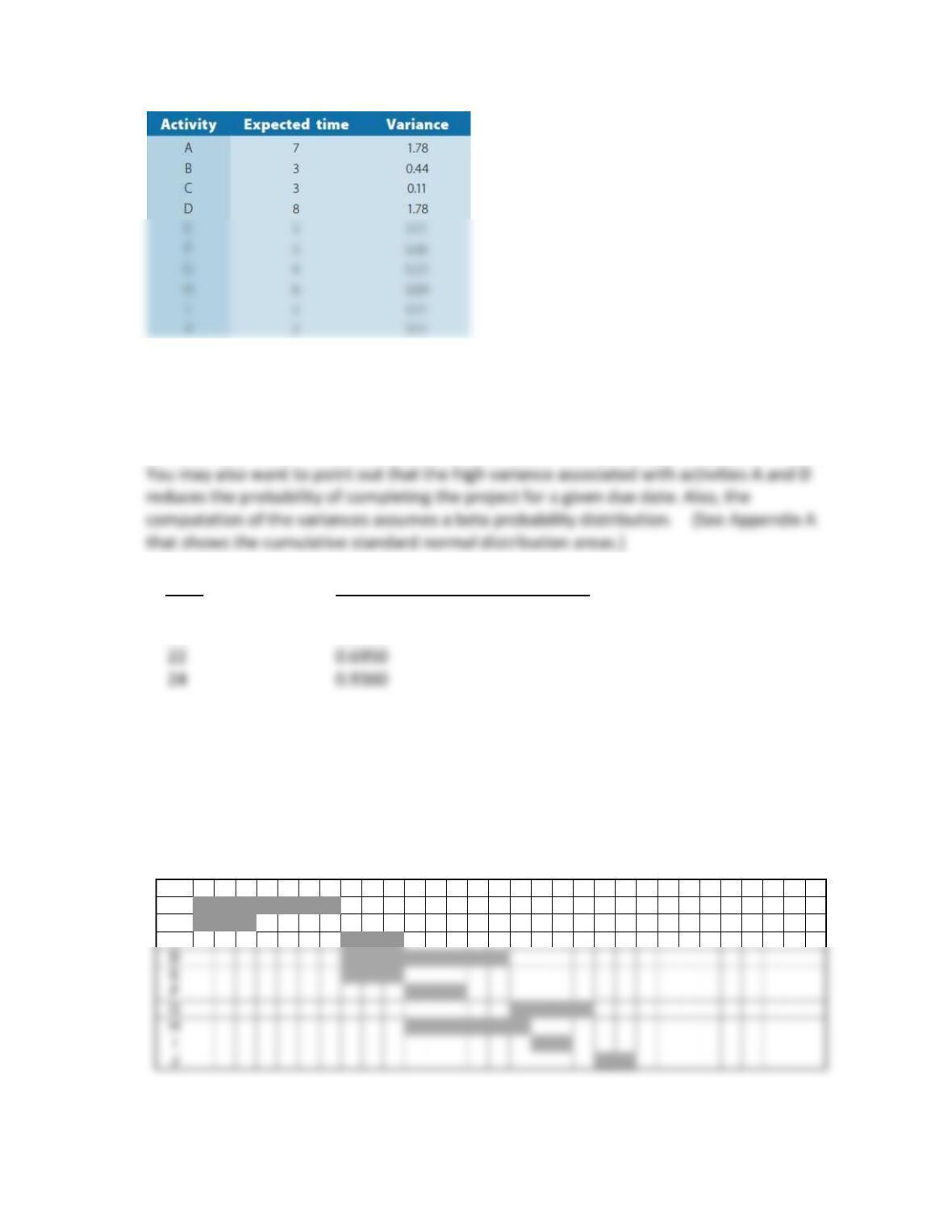
The expected times and the activity variances are shown in the table below.
39
a. Find the critical path(s) and compute the probability of completing the project by weeks
18, 20, 22, and 24.
Critical path = A-D-G-J. Total project completion time is 21 weeks with a probability of
completion of 0.50. The variance of critical path is 3.92 and the standard deviation = 1.98.
Time Probability of completion by time
18 0.0643
20 0.3050
The PERT analysis indicates only a 0.5 probability of completing the project on time. A two
week delay and a project completion time of 23 weeks greatly improves the probability of
completion to .94. Reducing the variance of the time estimates in activities A and D would
also increase the probabilities of completion.
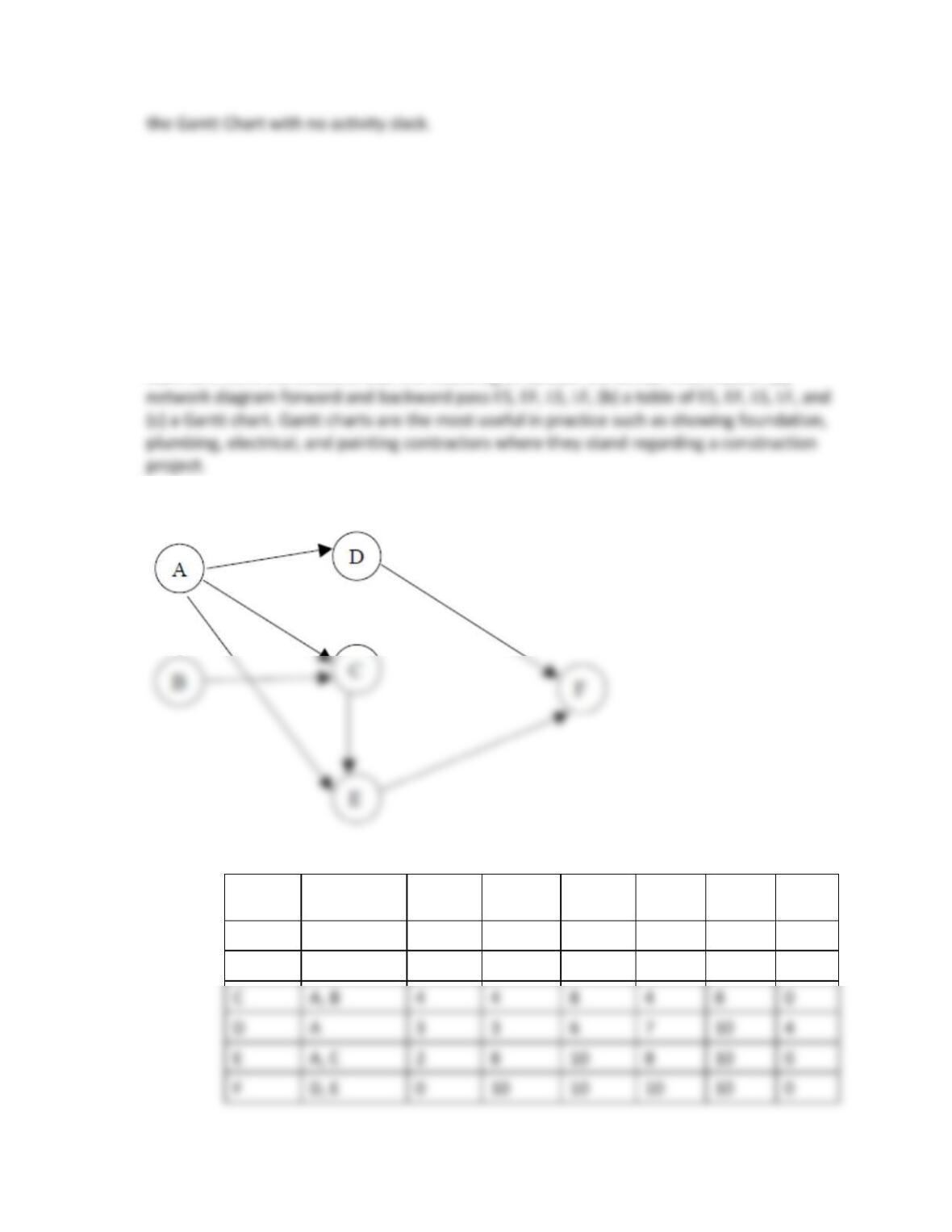
b. Draw a Gantt Chart for the project.
Students should draw a Gantt Chart manually and make sure they “see” the critical path on
Time 1 2 3 4 5 6 7 8 9 10 11 12 13 14 15 16 17 18 19 20 21 22 23 24 25 26 27 28 29 30
A
B
40
EXCEL-BASED PROBLEMS
For these problems, you may use Excel or the templates in MindTap to assist in your analysis.
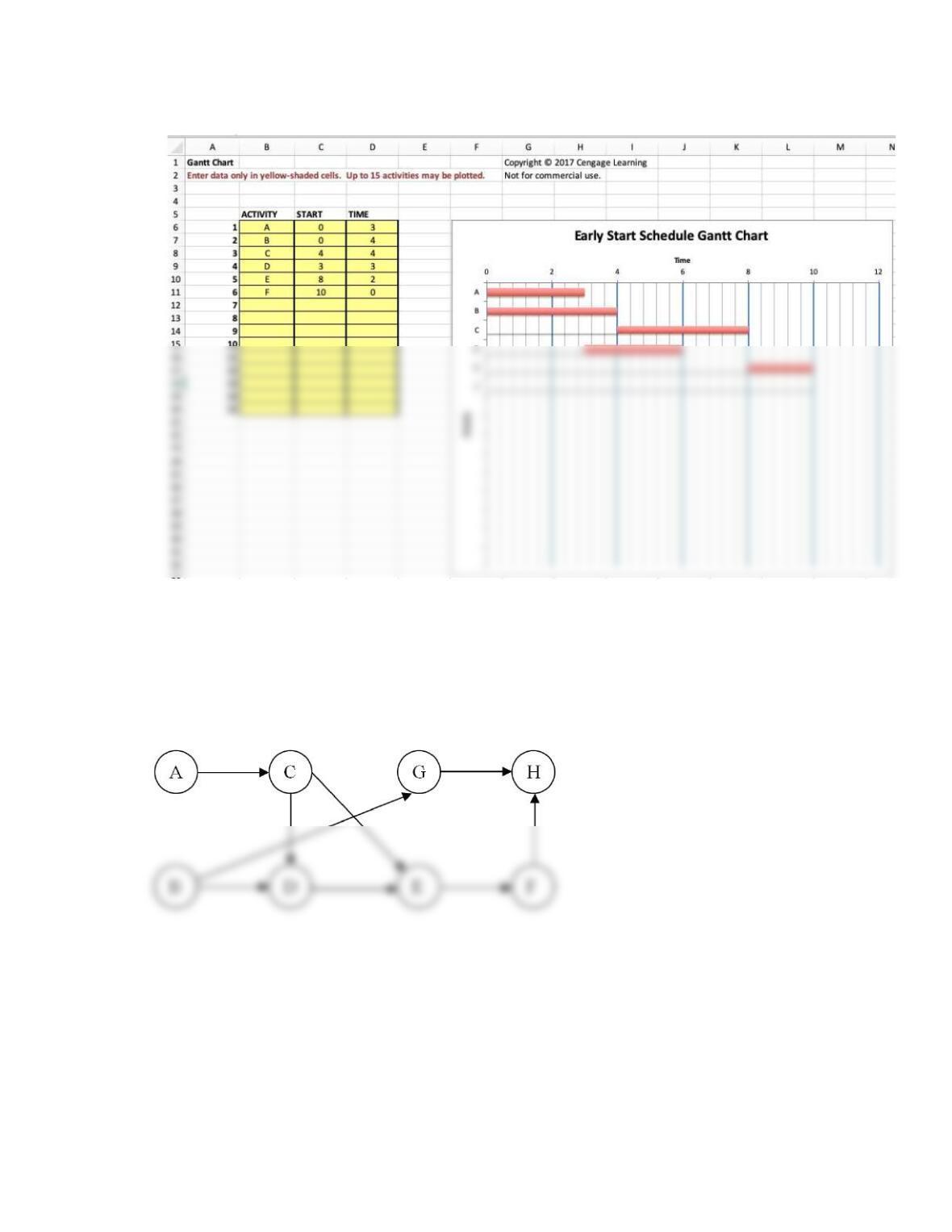
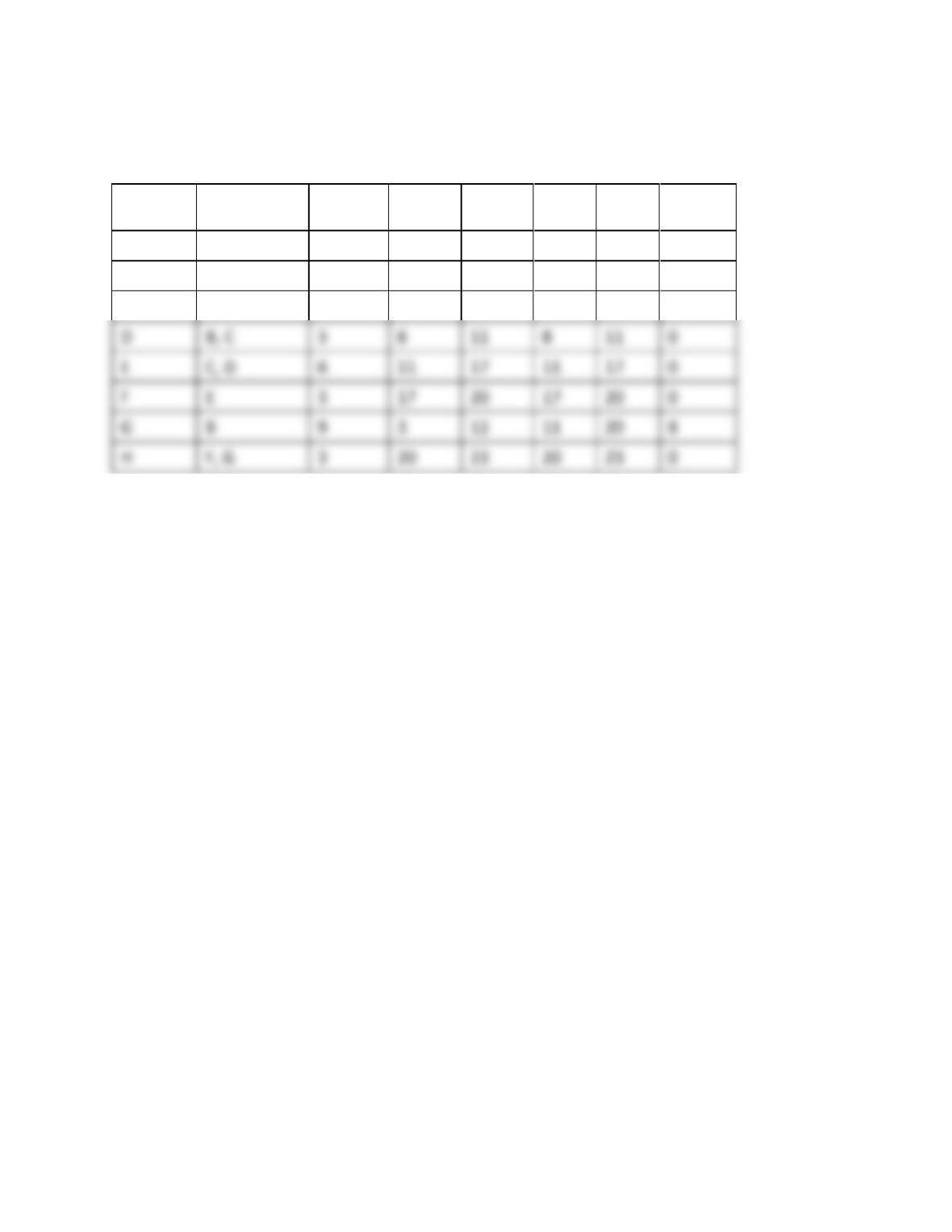
55. Use the Excel template Gantt Chart to develop a Gantt chart for the early start schedule for
the wedding project in problem 36 in the Computational Problems and Exercises section.
Explain and trace the project’s critical path(s).
The Gantt chart created with the Gantt Chart Excel template is shown below. You might
Activity
Immediate
Predecessor
Time
(weeks)
Earliest
Start
Earliest
Finish
Latest
Start
Latest
Finish
Slack
A
—
3
0
3
1
4
1
B
—
4
0
4
0
4
0
C
A, B
4
4
8
4
8
0
D
A
3
3
6
7
4
E
A, C
2
8
8
0
41
Critical path is B-C-E-F
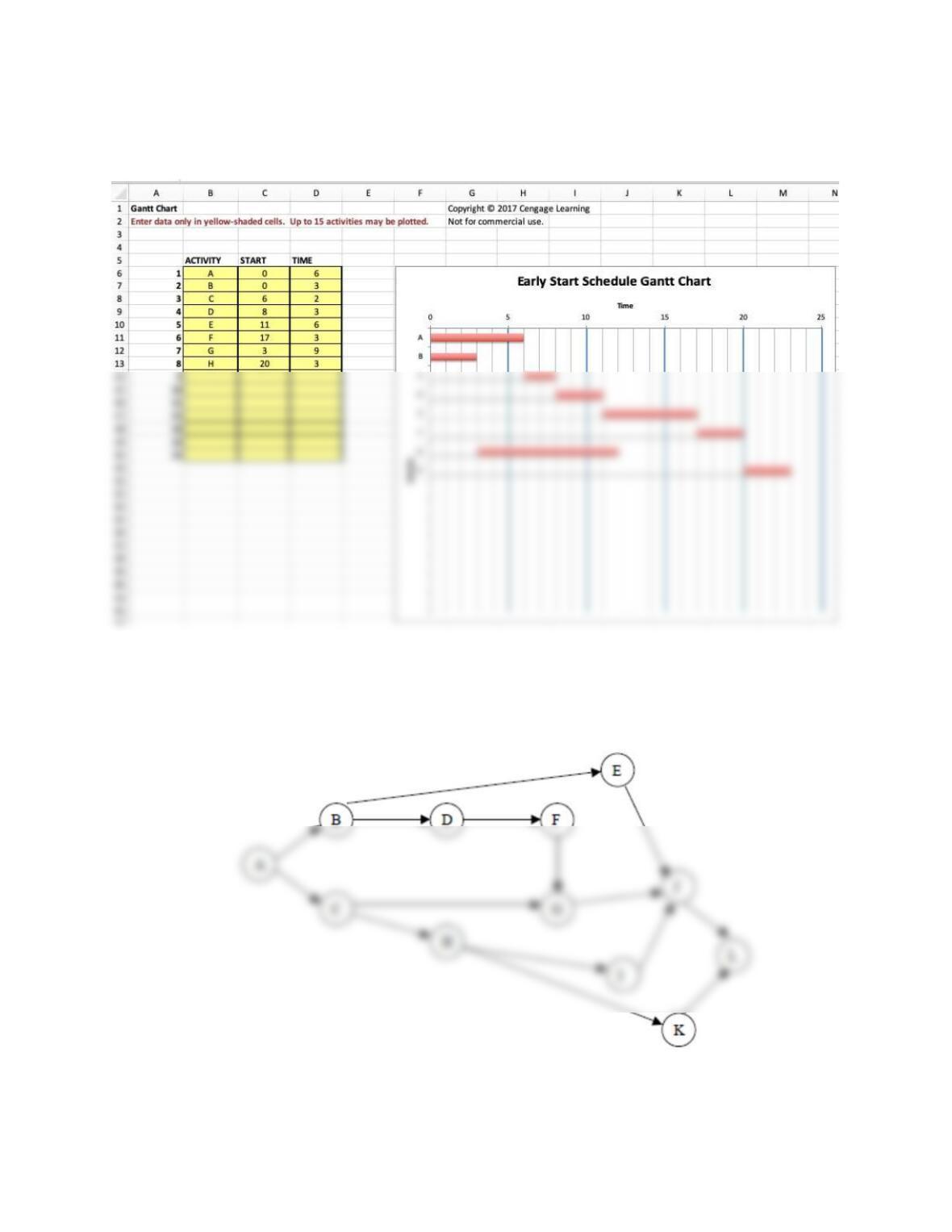
56. Use the Excel template Gantt Chart to construct an early-start Gantt chart for the
computer-system installation project described in problem 39. As a project manager,
where would you focus your attention, given your analysis?
42
Activity
Immediate
Predecessor
Time
(days)
Earliest
Start
Earliest
Finish
Latest
Start
Latest
Finish
Slack
A
—
6
0
6
0
6
0
B
—
3
0
3
5
8
5
C
A
2
6
8
6
8
0
D
B, C
3
8
8
0
E
C, D
6
0
F
E
3
0
G
B
9
3
8
H
F, G
3
0
43
Critical path is A-C-D-E-F-H. Focus on ensuring that critical activities remain on schedule.
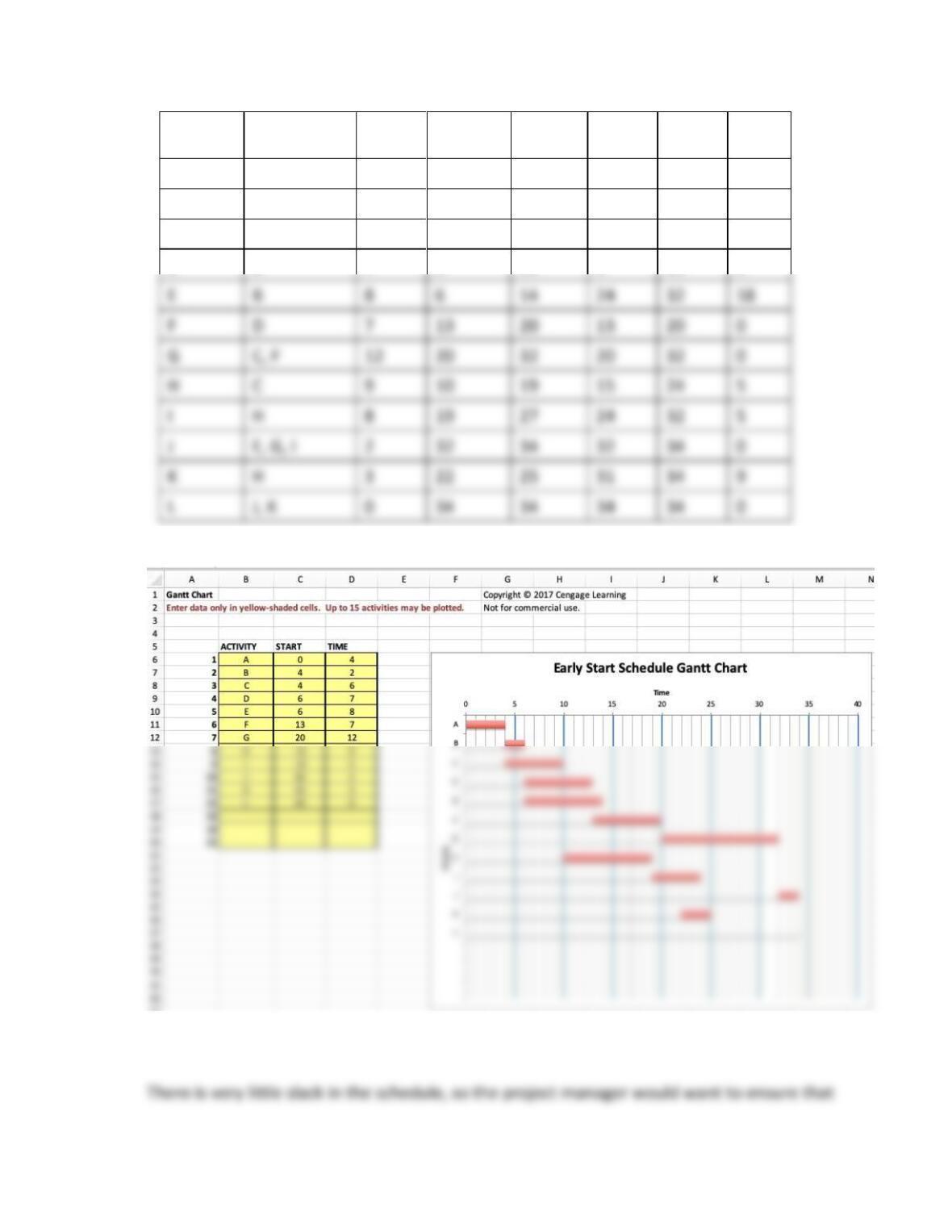
57. Use the Excel template Gantt Chart to construct a Gantt chart for the early-start schedule
found in problem 41 in the Computational Problems and Exercises section, Rozales
Manufacturing Co. Explain and trace the project’s critical path(s).
Here, L is the ending (dummy) activity with zero time.
44
Activity
Immediate
Predecessor
Time
(days)
Earliest
Start
Earliest
Finish
Latest
Start
Latest
Finish
Slack
A
—
4
0
4
0
4
0
B
A
2
4
6
4
6
0
C
A
6
4
10
9
15
7
D
B
7
6
13
6
13
0
E
B
8
6
F
D
7
13
20
13
20
0
G
12
20
32
20
32
0
H
C
9
5
I
H
8
19
27
24
32
5
J
2
32
34
32
34
0
K
H
3
9
L
J, K
0
34
34
34
34
0
Critical path is A-B-D-F-G-J-L
45
Teaching Note: University Medical Center
Overview
University Medical Center needs to move from its existing facility to a new and larger facility
five miles away from its current location. Due to construction delays, however, much of the
new equipment ordered for installation in the new hospital was delivered to the old hospital
Case Questions for Discussion:
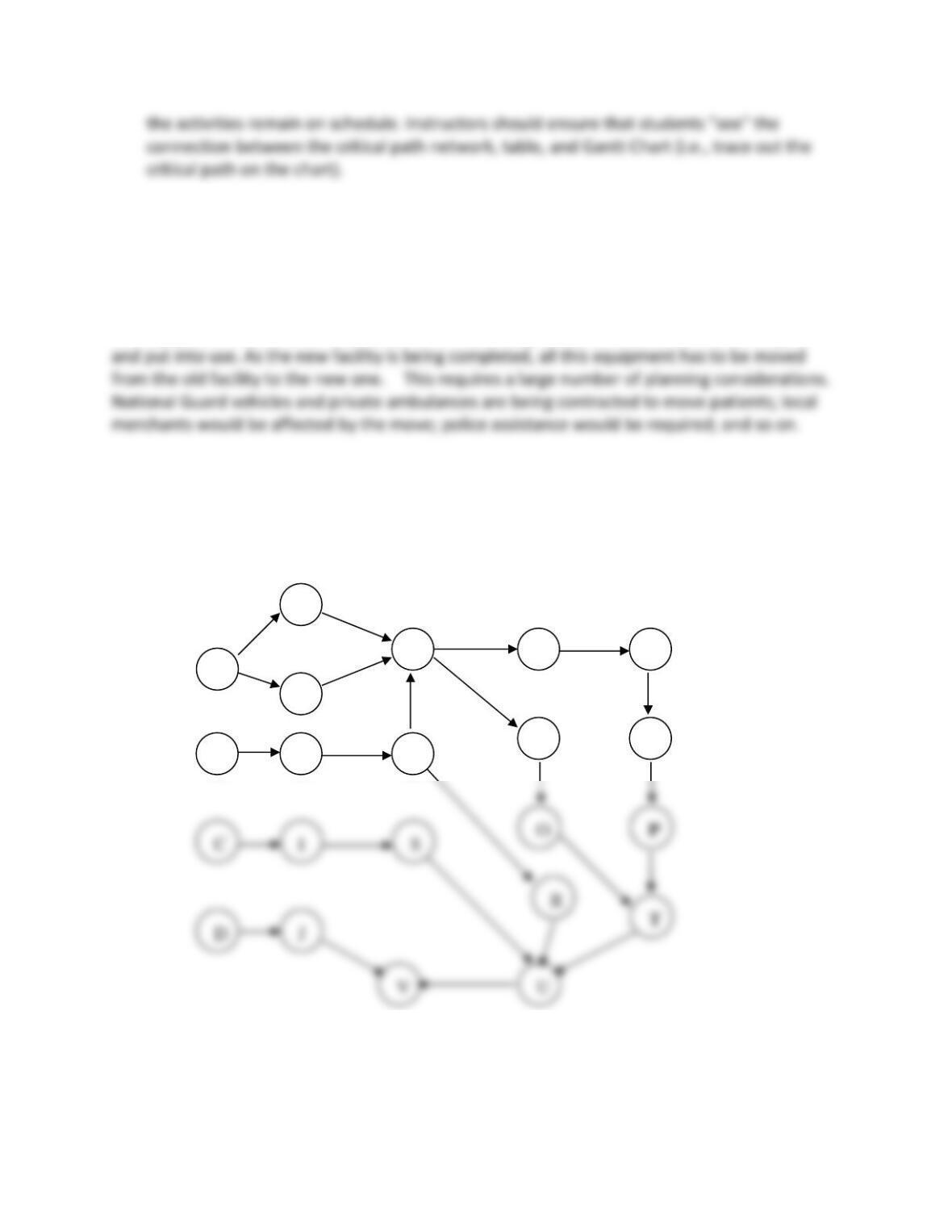
1. Develop a network for this project.
D
J
P
T
U
V
One approach is to ask several students to show their network using an overhead or Power
Point slide or draw on the board and see if they match. If the networks do not match what
are the implications? Of course, even one mistake with an arrow can totally change the
critical path, etc. If the network is wrong, managers could be focused on non-critical work
A
E
B
F
G
H
K
L
M
O
N

46
2. It is important to realize that the activities shown above need to be broken down into
more detail for actual implementation. For example, for the activity “patient move,”
managers have to determine which patients to move first (for example, intensive care),
the equipment that would have to be in place to support each class of patient, and so on.
Discuss what types of sub-activities might have to be accomplished in an expanded
network. You need not draw this expanded network, however.
Two issues are important to discuss here. One is the degree of detail desired in the “work
breakdown structure.” One team could define this project with 20 activities while another team
might use 75 detailed activities. A second issue is at what level of work structure detail is
needed to effectively manage the project. The modeler has two design choices: (1) define a
3. Use the information to find the critical path and the project completion time.
Summarize your findings in a report to the hospital administrator.
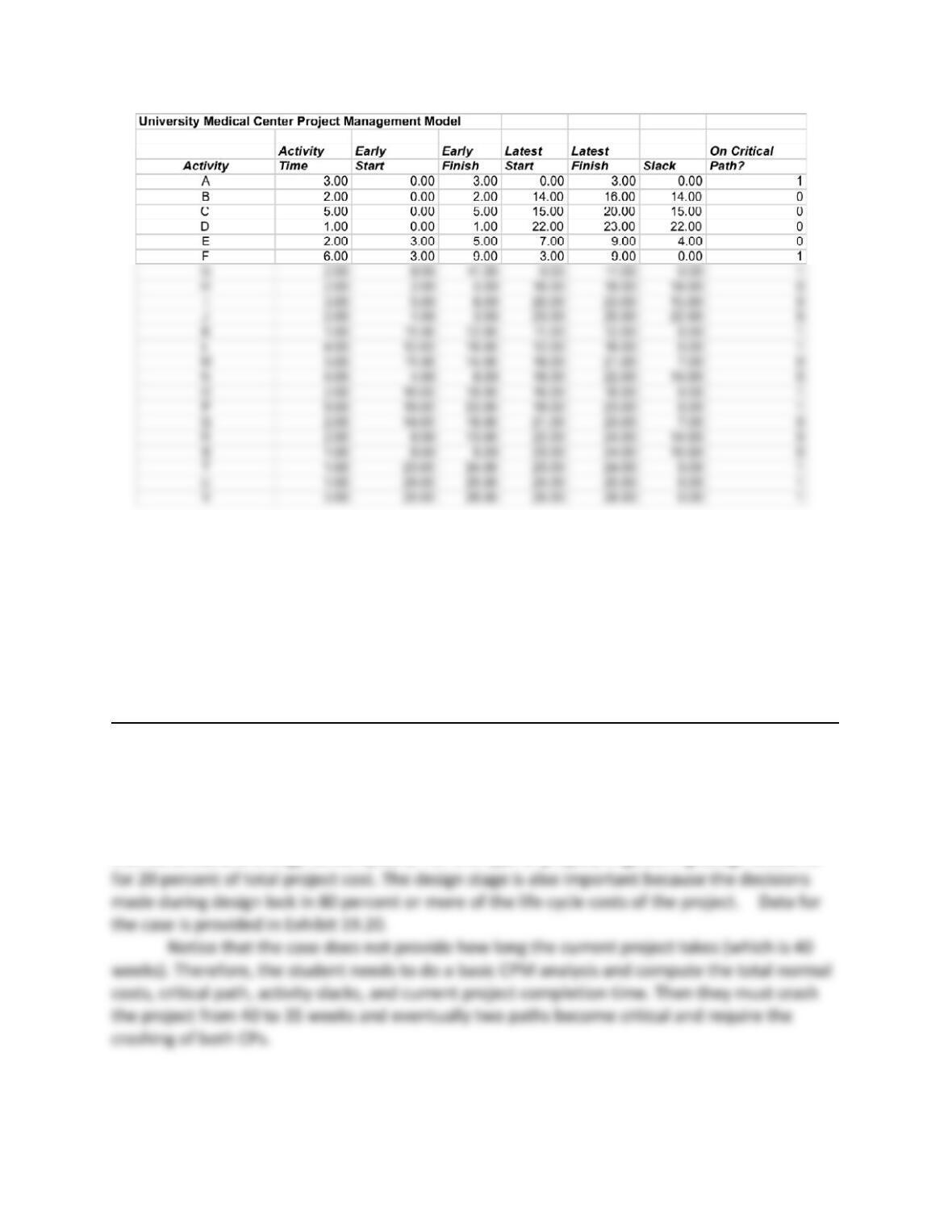
See project network in part a and the spreadsheet below.
47
The critical path is A-F-G-K-L-O-P-T-U-V with a completion time of 28 days. You might also ask
students questions such as (a) Where is the most slack time (activities D and J) and the
implications? (b) What if you worked on the CP? (c) What activity would you most like to
work? Why? (if a slacker activities D and J) (d) How would you know if you had enough trucks
for the move? (briefly explain CPM with resource planning) (e) Would you spend money to
speed up activities D and J? Why or why not?
Teaching Note: Alternative Water Supply
Overview
The objective of the project is to design a fully functional surface water intake that is protective
of the environment, will last at least 30 years, and will have a low life cycle cost (i.e. capital,
48
Case Questions for Discussion:
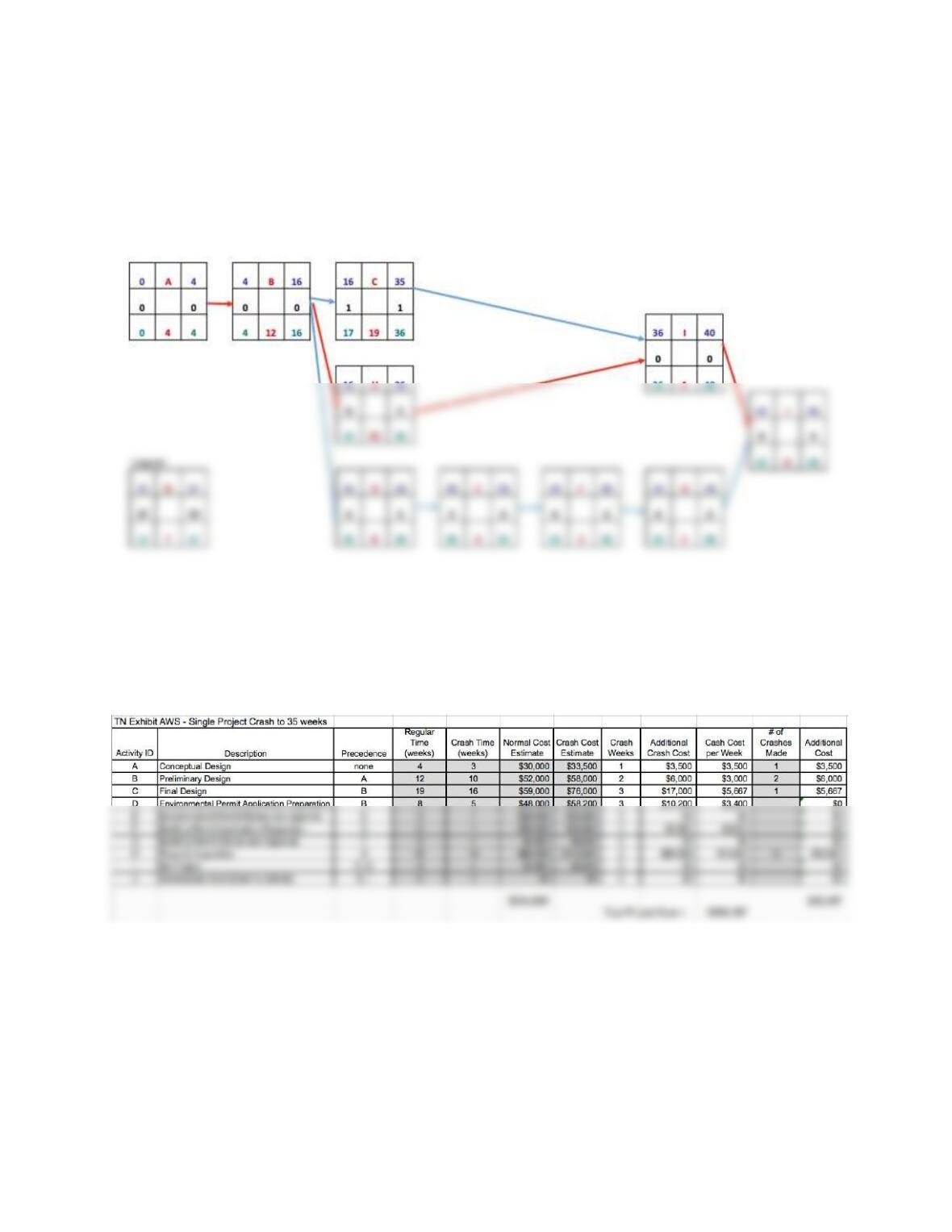
1. Draw the project network diagram and determine the normal time to complete the
project, activity slack times, the critical path(s), and total project costs (i.e., baseline your
project) using Critical Path Method.
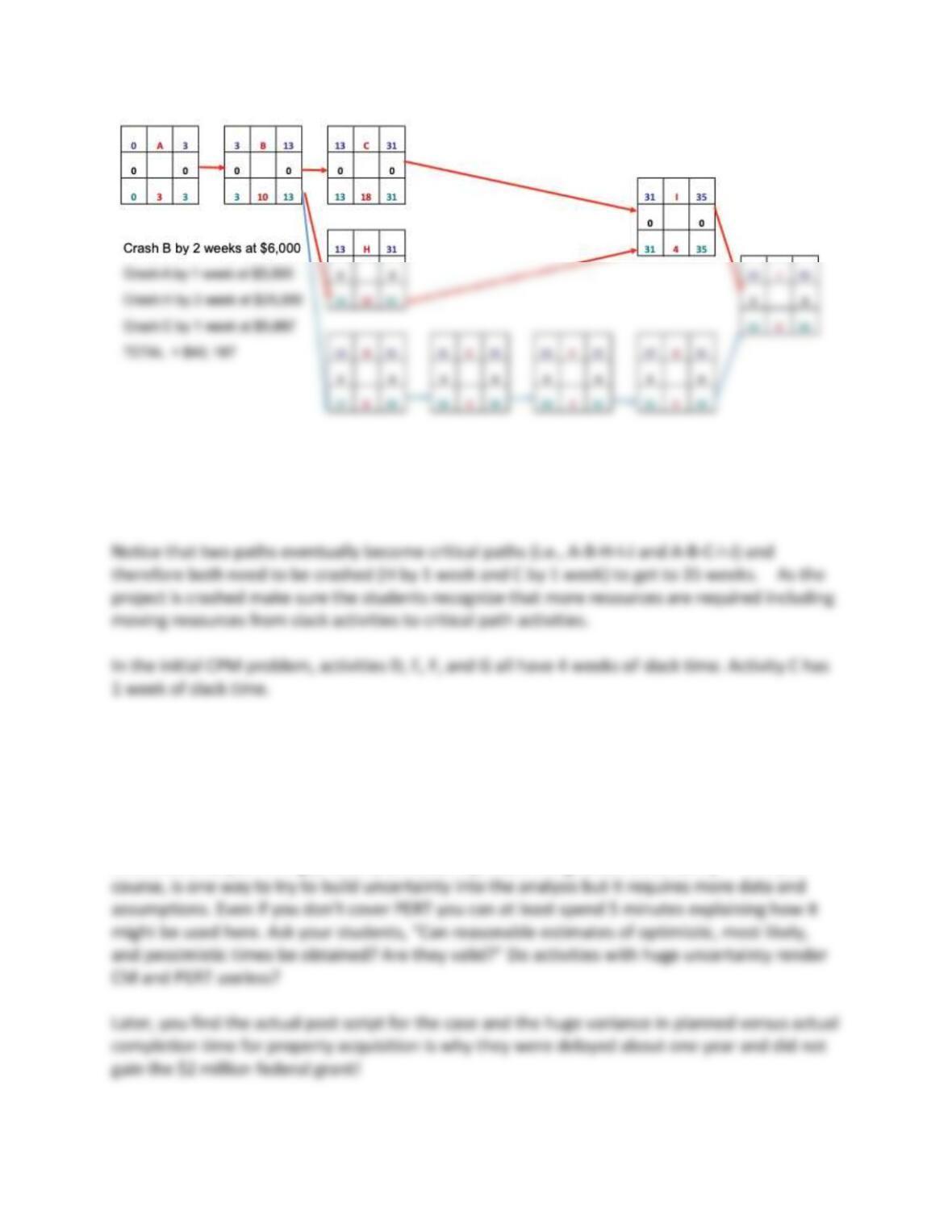
2. Determine the best way to crash the project to complete it in 35 weeks with revised
activity slack times, critical path(s), and total project costs. Provide reasoning as to how
all crashing decisions were made.
49
The total cost to achieve a 35 weeks project completion date is $404,167 by crashing A by 1
week, B by 2 weeks, H by 2 weeks, and C by 1 week. Total crash costs are $40,167 and total
normal plus crash costs are now $404,167.
3. Activity times with the greatest uncertainty are Activities D, E, and H. Describe
conceptually how you could model this uncertainty in activity times. (You do not have the
necessary data to actually do this numerically.)
The sole objective of this question is to highlight the issue for students of what can the modeler
do if the uncertainty of the activity time is highly uncertain. Property acquisition (H) and
environmental permitting (D and E) activities represent the greatest uncertainty. PERT, of

50
4. What are your final recommendations?
• Crash the project to 35 weeks as previously defined so as not to lose the opportunity for
$2 million dollars of federal grant money.
• The total cost of the 35 week project is $404,167.
Other case issues
A short discussion of the actual water resource project and its impact on the environment
might be in order. Economic, environment, and social sustainability issues are involved in the
project. Ask the students to briefly describe each.
Integrative Case: Hudson Jewelers
A complete teaching note for all chapters is available in the Instructor Resources online.
Instructors should read the entire case and most of the case assignments at the end of each
chapter. Then decide if you want to assign all or part of the case questions.
Chapter 19 Case Question for Discussion:
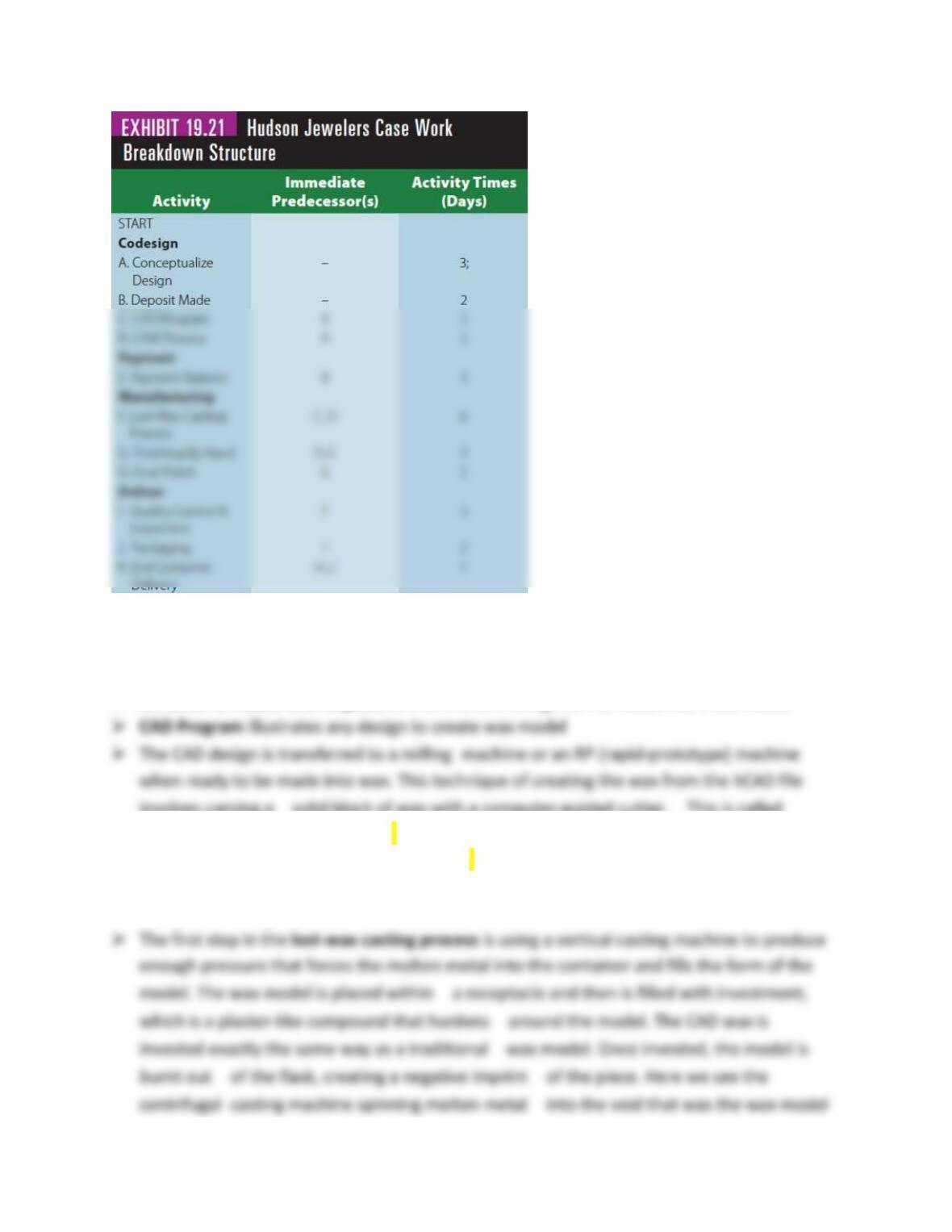
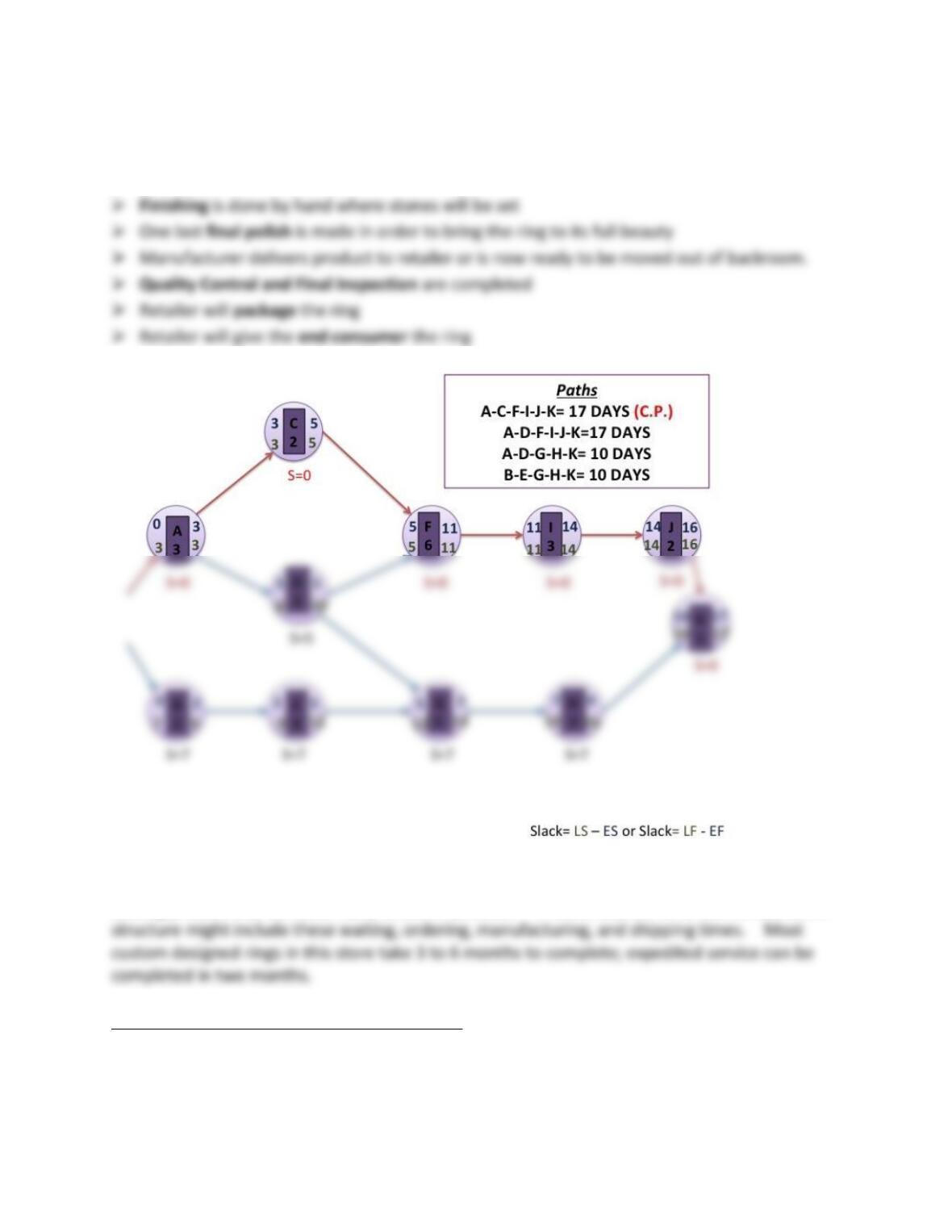
1. Exhibit 19.21 shows the project work activities for designing custom jewelry using
computer aided design (CAD). Draw the network diagram and determine the project
completion time, critical path(s), activity slack times, and a Gantt chart for the project.
Summarize your insights. What other types of work activities might be included in a
more comprehensive work breakdown structure?
51
One student defined the table of activities and defined them as follows:
➢ Conceptualize Design by establishing goals, ideas, and budgets
➢ An Order is Placed with deposit so that the CAD design can be made into a wax model
involves carving a
solid block of wax with a computer-guided cutter.
This is called
Computer Aided Milling, or CAM.
➢ Once wax model receives payment balance, the ring will be ready to experience the
manufacturing process
➢ Design Model is given to manufacturer or taken to backroom.
52
(the
wax is lost in the process, hence the name). The ring is now in metal
and will
continue to completion using
traditional hand finishing techniques
(ChristopherDuquet.com).
What is missing is actual waiting times at many of these activities such as the CAM or the
casting process that can take many weeks in practice. A more realistic CPM work break down
Other possible student work activities include:
• First Store Visit & Consultation
• Complimentary Jewelry Consultation
• CAD Demonstration

53
• Price Quote and Negotiation
• Actual Production
o CAD Final Design Sent to Manufacturer
o Wax Model and molds
o Pour Metal
• Delivery Promise
• Secure Shipping to Store
• Customer Store Pick-up
• Post-sale Follow-up