
1
Instructor’s Manual – OMSC2 – Collier/Evans – C19 Project Management
Chapter 19 – Teaching Note Overview
This chapter introduces students to project management, including the key issues associated
with managing projects, the Critical Path Method (CPM), time-cost trade-off decisions, and
Project Evaluation and Review Technique (PERT).
Questions and problems are provided in four categories:
1. Review questions
2. Discussion questions and experiential activities
The chapter has three cases:
1. University Medical Center is the first case study. It focuses on a medical center moving to a
2. Alternative Water Supply — Single Project asks students to evaluate a sustainability project
3. The integrative case study, Hudson Jewelers with case assignment questions in all chapters,
requires students to draw the project network, and do a basic CPM analysis.
KEY TERMS
Activities are discrete tasks that consume resources and time.
Arcs are arrows in a project network that define precedence relationships between activities.

2
Crash time is the shortest possible time in which the activity can realistically be completed.
The critical path is the sequence of activities that takes the longest time and defines the total
project completion time.
Immediate predecessors are those activities that must be completed immediately before an
activity may start.
A project network consists of a set of circles or boxes called nodes, which represent activities,
and a set of arrows called arcs, which define the precedence relationships between activities.
A schedule specifies when activities are to be performed.
REVIEW QUESTIONS
1. Define a project and provide a non-manufacturing or non-construction example.
A project is a temporary and often customized initiative that consists of many smaller tasks
2. Discuss the three key factors of the project-planning process.
3
All project-management decisions involve three factors: time, resources, and cost. Project
3. What are the four major steps in the project-planning process?
The four steps are:
• Project Definition. Identifying the activities that must be completed and the sequence
required to perform them.
4. Describe the role of the project manager. What skills should he or she possess?
Project managers must be able to build an effective team, motivate them, provide advice
and support, align the project with the firm’s strategy, and direct and supervise the
the end of the chapter titled Project Managers Need Many Skills.
5. Identify and discuss three contributors and impediments to project success.
Exhibit 19.2 summarizes several of these factors.
6. Define and give an example of an immediate predecessor.

Immediate predecessors are those activities that must be completed immediately before
7. What do arcs, and nodes represent in a project network?
A project network consists of a set of circles or boxes, called nodes, which represent
8. What information do you need to collect to conduct a basic CPM model and analysis?
You need the normal time to complete each activity and a description of the precedence
relationships.
9. Define critical path. Describe, in your own words, the procedure for finding a critical path.
The critical path (CP) is the longest path(s) through the project network; activities on the
10. Define and explain the following terms: normal time, crash time, earliest start time, earliest
finish time, latest start time, and latest finish time.
Normal time is the usual time required to perform an activity; crash time is the time an
11. Define slack time and how is it computed. How is it used in project scheduling and why is it
important?
Slack time is computed as ST = LS – ES = LF – EF. Activities with positive slack may be delayed
by the slack time without affecting the project completion time and critical path.
12. Discuss the importance of project control and monitoring.
Because of the uncertainty of task times, unavoidable delays, or other problems, projects

5
13. Explain the usefulness of Gantt charts to a manager.
Gantt charts enable the project manager to know exactly what activities should be
14. How do you construct a left- or right-shifted Gantt chart?
15. Explain the concept of crashing in project management. What issues must a project
manager wrestle with in making crashing decisions?
Crashing a project refers to reducing the total time to complete the project to meet a
revised due date. This is usually done by adding additional resources to selected activities.
16. Explain how to compute the crash cost per unit of time.
17. Explain how to evaluate the effect of uncertainty of activity times on the total project
completion time.
PERT allows us to investigate the effects of uncertainty of activity times on the project
18. Explain the PERT concepts of optimistic time, most probable time, and pessimistic time
estimates. How would you estimate these times for a specific activity?
When activity times are uncertain, they are often treated as random variables with
associated probability distributions. Usually three-time estimates are obtained for each
activity:
1. Optimistic time (a)—the activity time if everything progresses in an ideal manner.

6
19. How is the expected time and variance of each activity computed using PERT.
We use equations 19.2 and 19.3 to compute these times and variances.
20. Describe the logic of computing the probability of completing a project.
Exhibit 19.18 and Solved Problems 19.6 and 19.7 present examples of computing such
DISCUSSION QUESTIONS AND EXPERIENTIAL ACTIVITIES
21. Prepare a job profile for a newspaper or on-line advertisement for a project manager.
Students might find examples in the local paper or on-line.
22. Identify at least five additional examples of projects that are not cited in this chapter.
Students might identify the following “projects” — waste management, building a solar
23. Exhibit 19.2 lists a number of impediments to project success. How might you minimize
or eliminate these impediments?
The objective of this question is to illustrate that project management is much more than
24. Research and write a short paper (two pages maximum) on the skills needed to be a
successful project manager.

7
25. The local chapter of the Project Management Institute is planning a dinner meeting with a
nationally known speaker, and you are responsible for organizing it. How could the
methodology discussed in this chapter help you?
First you must define the work breakdown structure such as major activities like contact
26. Perhaps the most well-known software for project management is Microsoft ProjectTM.
Investigate its capabilities and write a short paper (2 pages maximum) that describes its
features.
27. Develop a small example consisting of no more than ten activities and illustrate the ideas,
rules, and mechanics of forward and backward passes through the project network to
compute the critical path.
Students should be encouraged to make the example realistic to a problem they are
28. Find an application of project management in your own life (e.g., in your home, fraternity,
or business organization). List the activities and events that comprise the project and draw
the precedence network. What problems did you encounter in doing this?

8
This is designed to get students thinking about applying project management techniques.
29. Crashing in the Critical Path Method (CPM) assumes that the cost of crashing an activity is
linearly proportional to the amount of time the activity is crashed; that is, the rate of cost
increase is constant (see Exhibit 19.12). Is this a reasonable assumption? Why or why not?
How might the concepts of economies and diseconomies of scale help to address this
issue?
Fixed activity costs and learning curve effects, for example, can alter the assumption of
30. The calculations in PERT allow you to determine the probability that as project will be
completed. Suppose you calculate that the probability a project will be completed by a
target deadline is only 0.25. What steps might you take if you were the project manager?
Would your decisions be different if the probability was calculated as 0.75? Would you be
willing to take a 25% risk of failing to complete the project on time?
First, check the integrity of your project input data including precedence relationships. Are
they correct? If the probability and methods are correct, then major management action is
COMPUTATIONAL PROBLEMS AND EXERCISES
These exercises require you to apply the formulas and methods described in the chapter. The
problems should be solved manually.
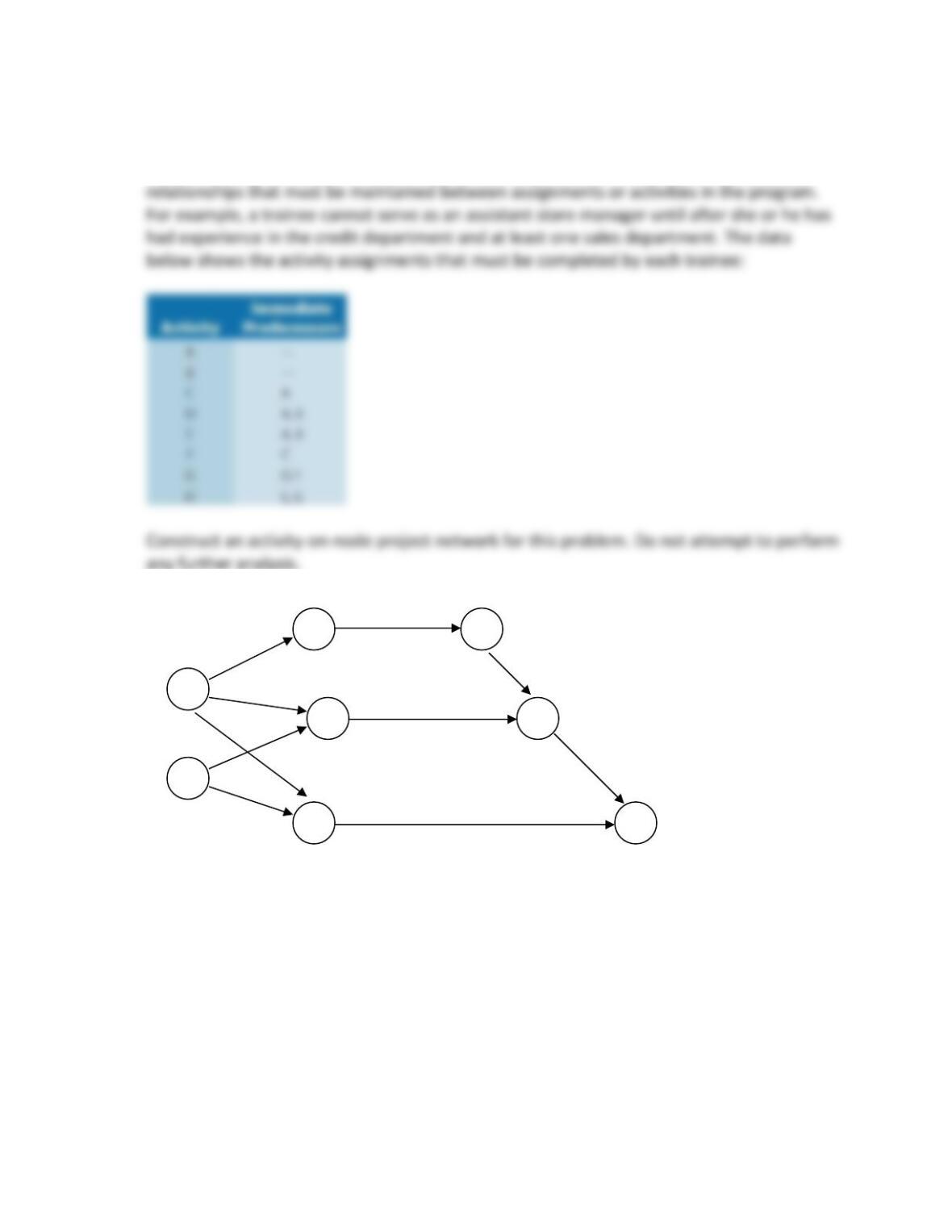
31. The county government has decided to redo the street you live on and plans to block the
street off which causes you and your neighbor’s considerable inconvenience. The project
has three parallel paths defined as follows: (i) path A-B-C-H to install street lights and
9
32. The Mohawk Discount Store chain is designing a management-training program for
individuals at its corporate headquarters. The company would like to design the program
so that the trainees can complete it as quickly as possible. There are important precedence
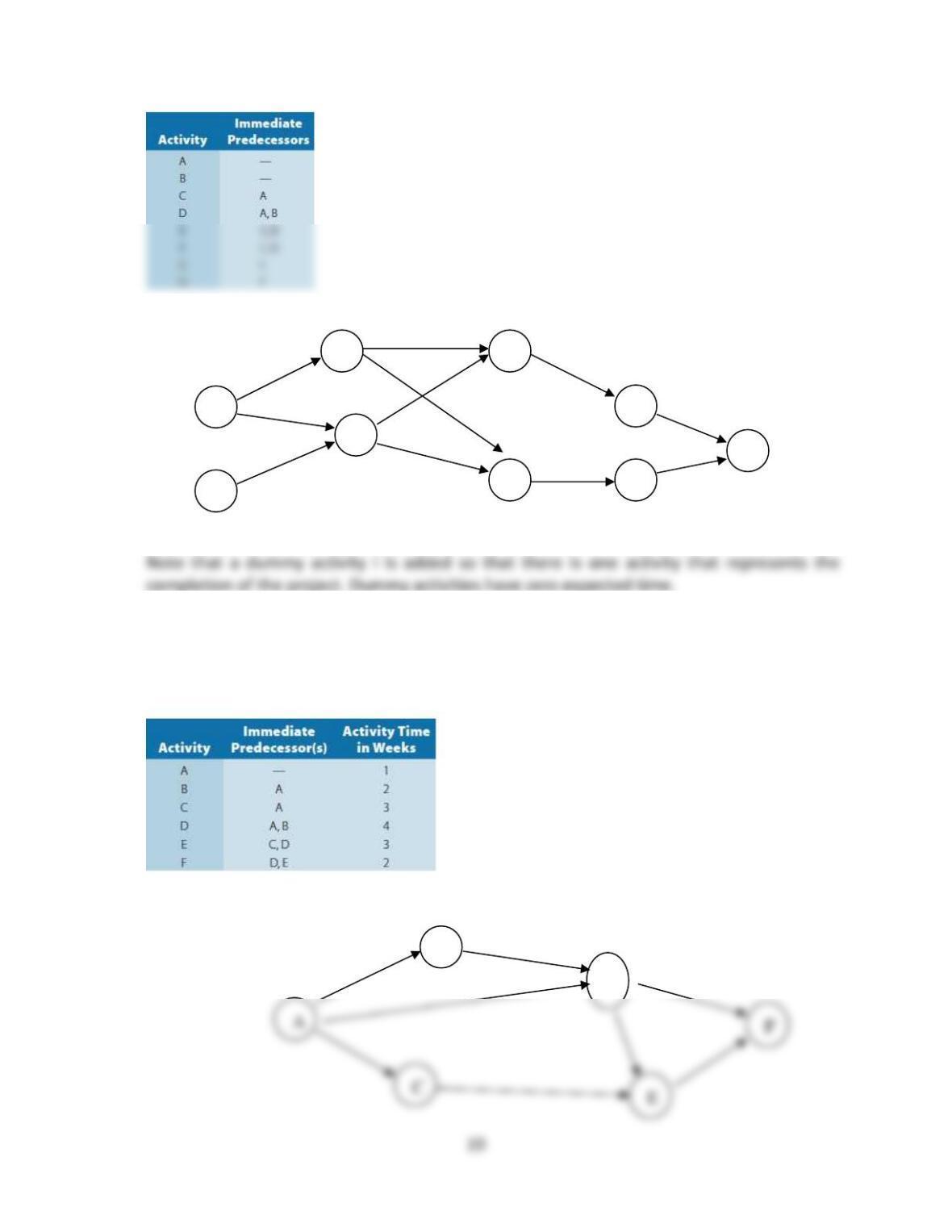
33. Construct a project network for the activities listed below. Do not attempt to perform any
further analysis.
A
E
F
D
C
B
G
H
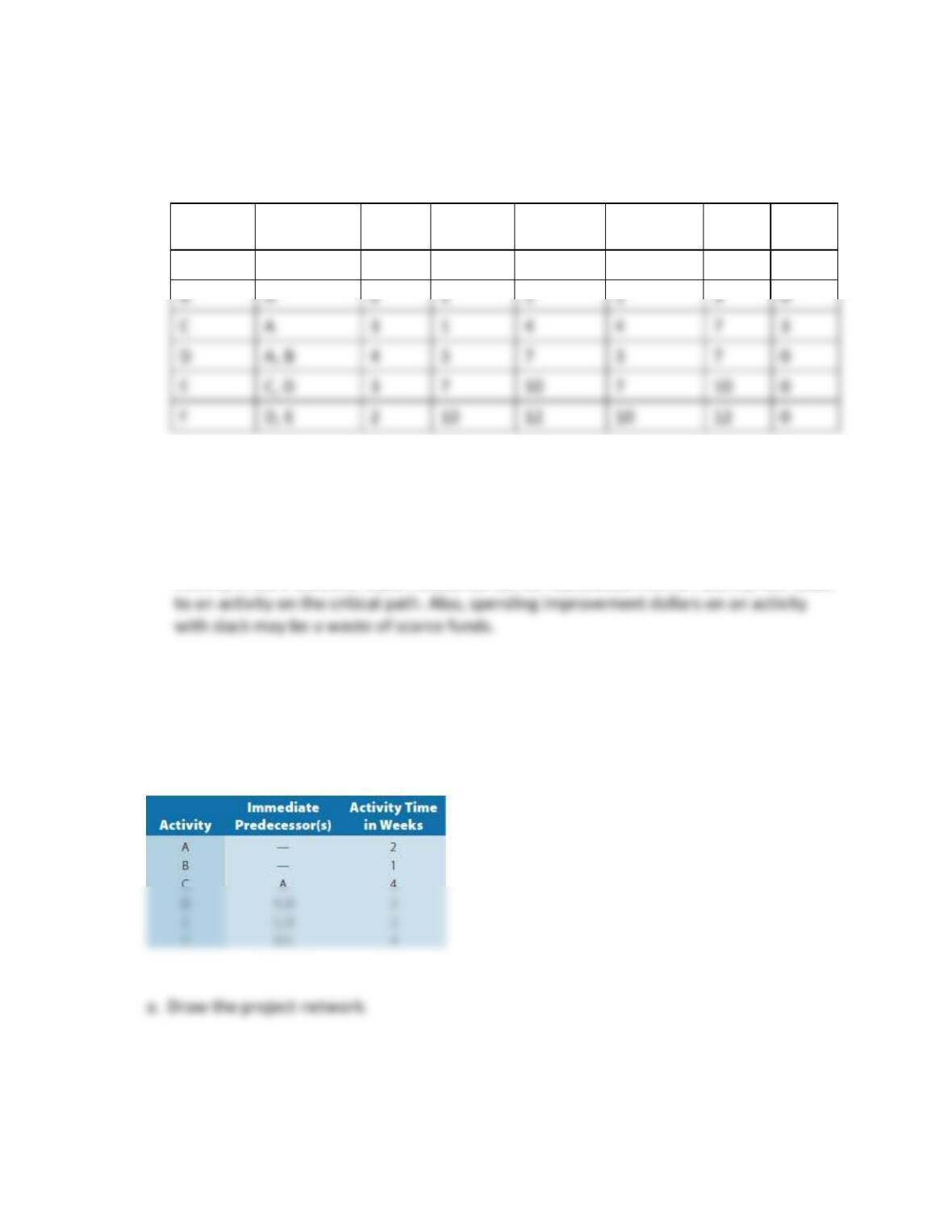
34. You are in charge of a new initial public offering (IPO) on the NASDAQ stock exchange for a
major bank. You have defined the project with the following characteristics. You expect to
be promoted if this project and offering goes well.
a. Draw the project network.
A
F
E
D
C
B
G
H
I
D
B
11
b. What is the earliest completion time for this project?
12 weeks
Activity
Immediate
Predecessor
Time
(weeks)
Earliest
Start
Earliest
Finish
Latest
Start
Latest
Finish
Slack
A
None
1
0
1
0
1
0
B
A
2
1
3
1
3
0
D
A, B
4
3
7
3
7
0
E
C, D
3
7
7
0
Two critical paths are A-B-D-F and A-B-D-E-F with times of 12 weeks
c. What is the largest amount of slack that any activity in this project has? Why is slack
important?
35. You are in charge of the advertising program for the Boston Red Sox baseball team during
their spring training season in Fort Myers, Florida. You have defined the advertising
program as a project with the following characteristics. The goal is to fill all stadium seats
during the spring training season, or you may not have this job next year—the pressure is
on!
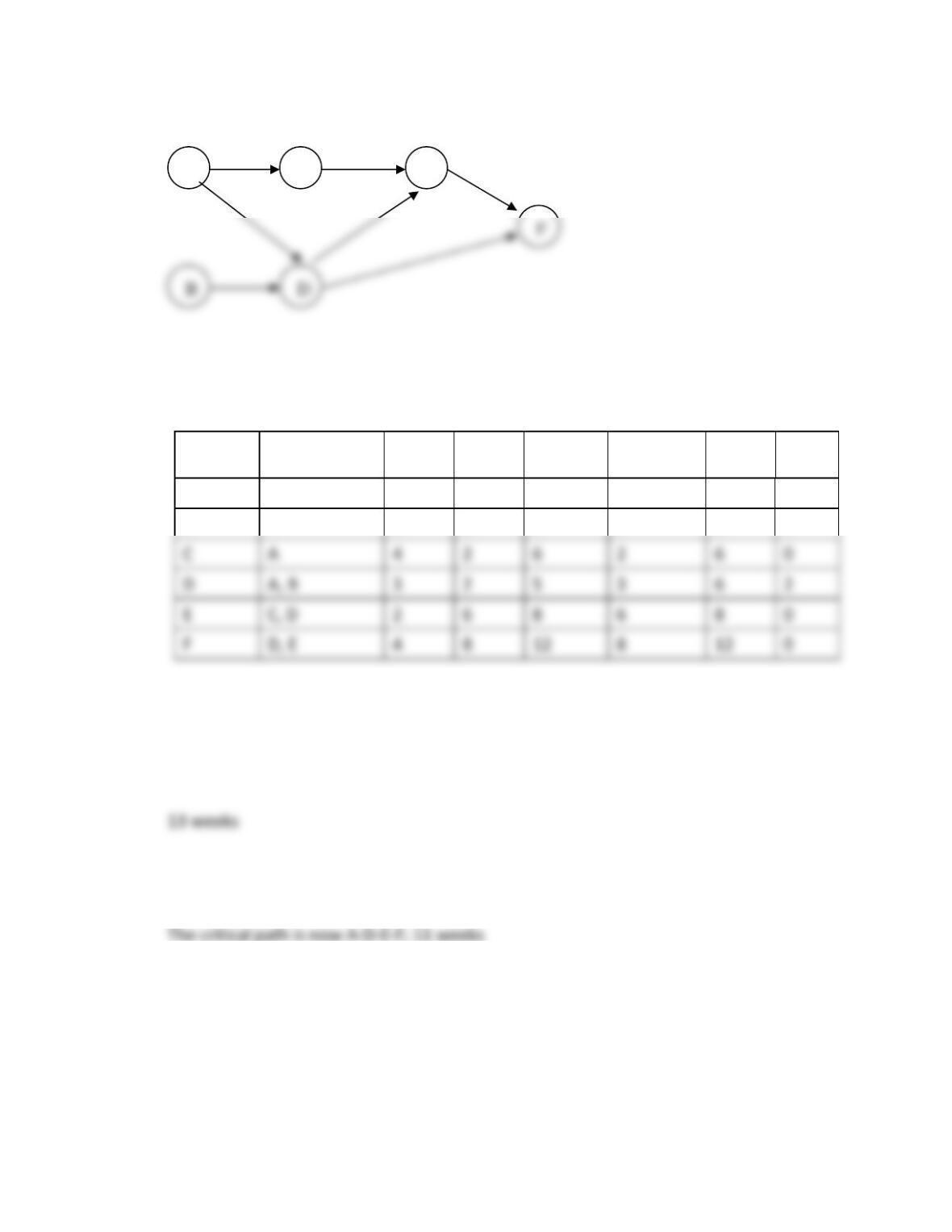
12
b. What is the earliest completion time for this advertising project?
A-C-E-F is the critical path; 12 weeks
Activity
Immediate
Predecessor(s)
Time
(weeks)
Earliest
Start
Earliest
Finish
Latest
Start
Latest
Finish
Slack
A
—
2
0
2
0
2
0
B
—
1
0
1
2
3
2
C
A
4
2
6
2
6
0
D
A, B
3
2
5
3
6
2
E
C, D
2
6
8
6
8
0
c What activity has the largest amount of slack? How many weeks is it?
Activity B (2 weeks)
d. If activity D is delayed two weeks, what is the revised earliest completion time?
e. If activity C in the original problem is crashed from four to two weeks, what is the
revised critical path and project completion time?
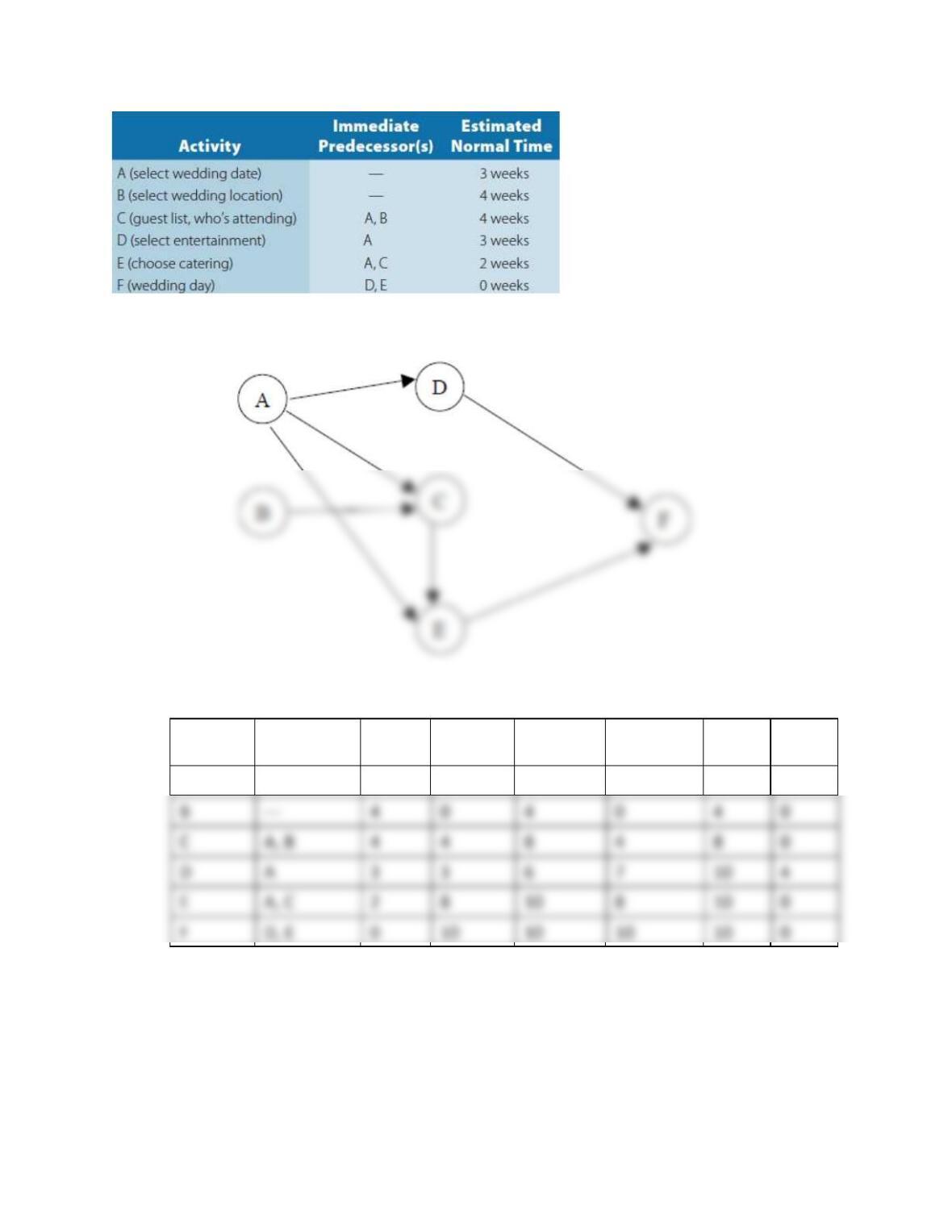
36. Mary is planning her wedding and develops the following preliminary information.
A
C
E
B
D
F
13
a. Draw the network for this project.
b. Identify the critical path(s)?
Activity
Immediate
Predecessor
Time
(weeks)
Earliest
Start
Earliest
Finish
Latest
Start
Latest
Finish
Slack
A
—
3
0
3
1
4
1
D
A
3
3
6
7
4
Critical path is B-C-E-F
c. What is the project completion time?
10 weeks
14
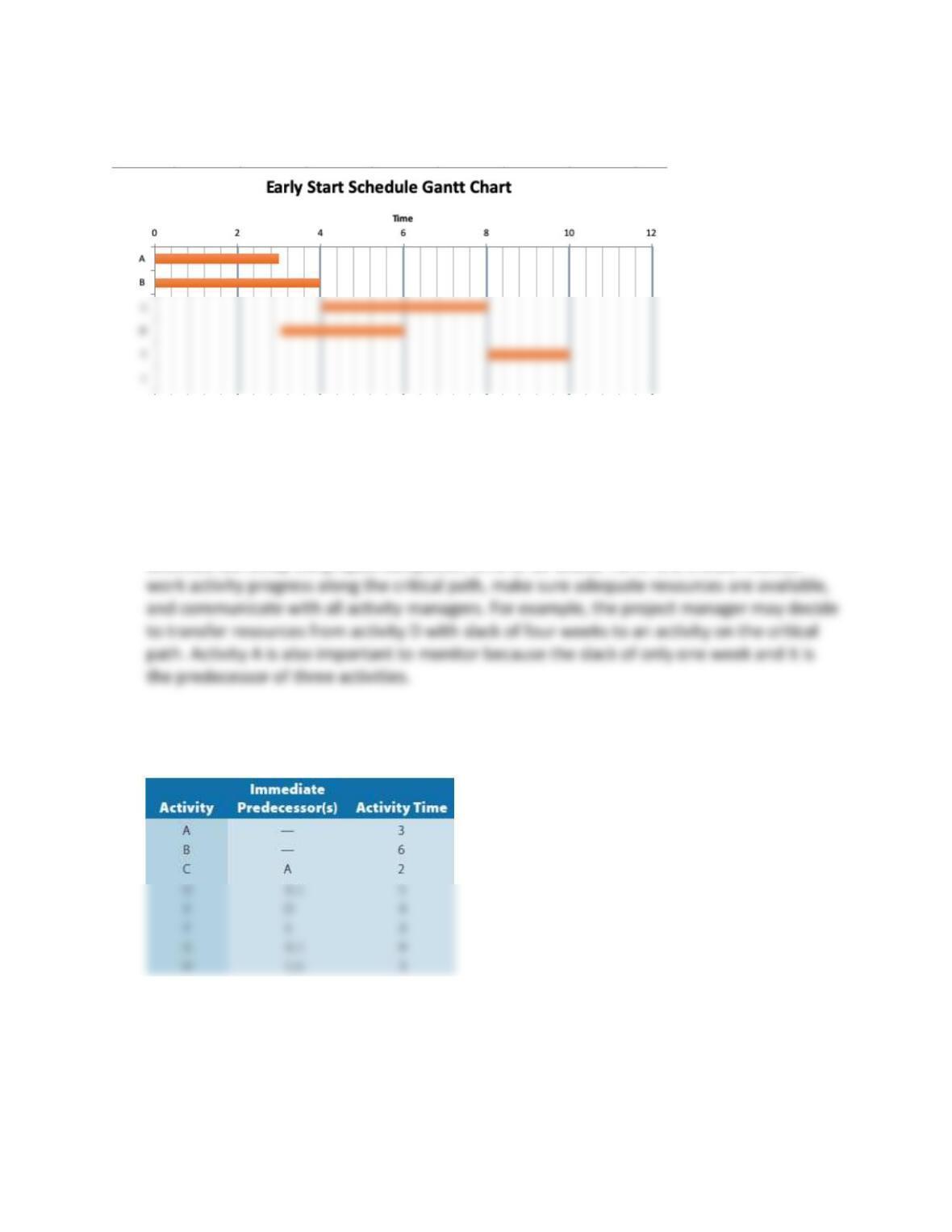
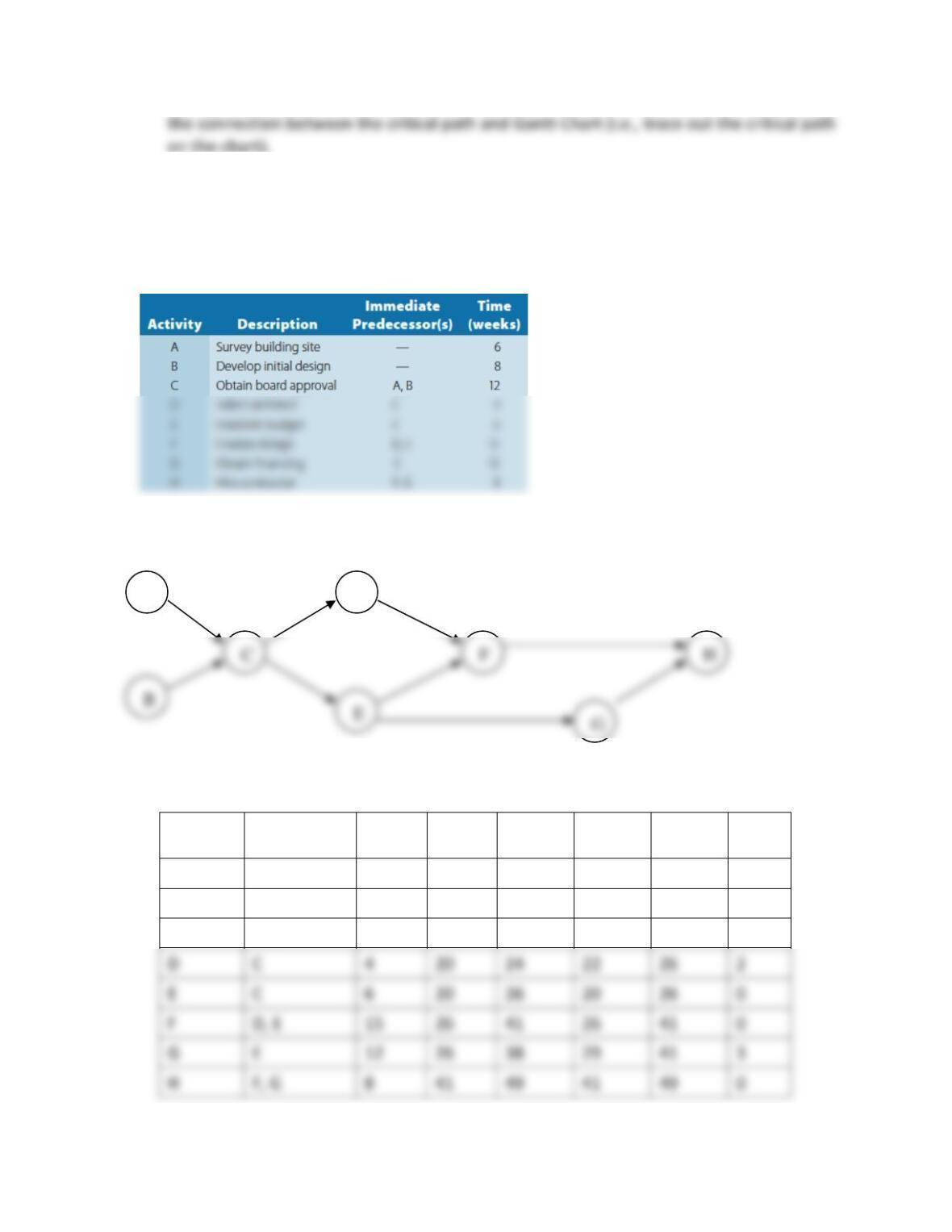
d. Construct an early start date Gantt chart.
Students should be able to draw this manually using graph paper.
e. As a project manager, where would you focus your attention given your analysis?
The critical path (B-C-E-F) should be the manager’s focus. Any delay along the critical path
37. A computer-system installation project consists of eight activities. The immediate
predecessors and activity times in weeks are shown below.
a. Draw the network for this project.
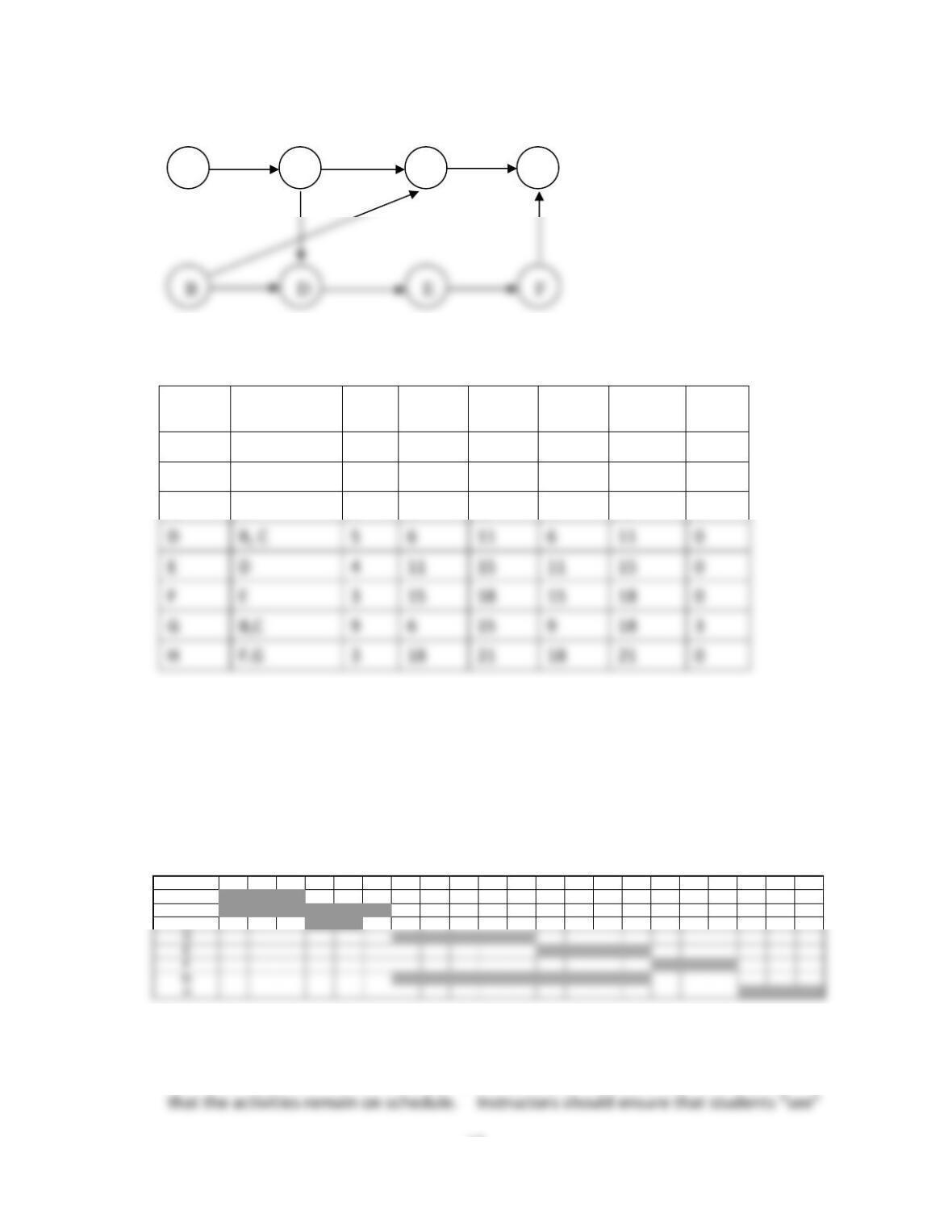
15
b. Identify the critical path(s).
Activity
Immediate
Predecessor
Time
(days)
Earliest
Start
Earliest
Finish
Latest
Start
Latest
Finish
Slack
A
—
3
0
3
1
4
1
B
—
6
0
6
0
6
0
C
A
2
3
5
4
6
1
D
B, C
5
6
6
0
E
D
4
0
F
E
3
0
G
B,C
9
6
9
3
H
F.G
3
0
Critical path is B-D-E-F-H.
c. What is the project completion time?
Project completion time is 21.
d. Construct an early-start date Gantt chart.
e. As a project manager, where would you focus your attention given your analysis?
There is very little slack in the schedule, so the project manager would want to ensure
Time 1 2 3 4 5 6 7 8 9 10 11 12 13 14 15 16 17 18 19 20 21
A
B
A
C
G
H
B
D
E
F
16
38. Colonial State College is considering building a new athletic complex on campus. The
complex would provide a new gymnasium for intercollegiate basketball games, expanded
office space, classrooms, and intramural facilities. The activities that would have to be
completed before beginning construction are listed below.
a. Develop a network for this project.
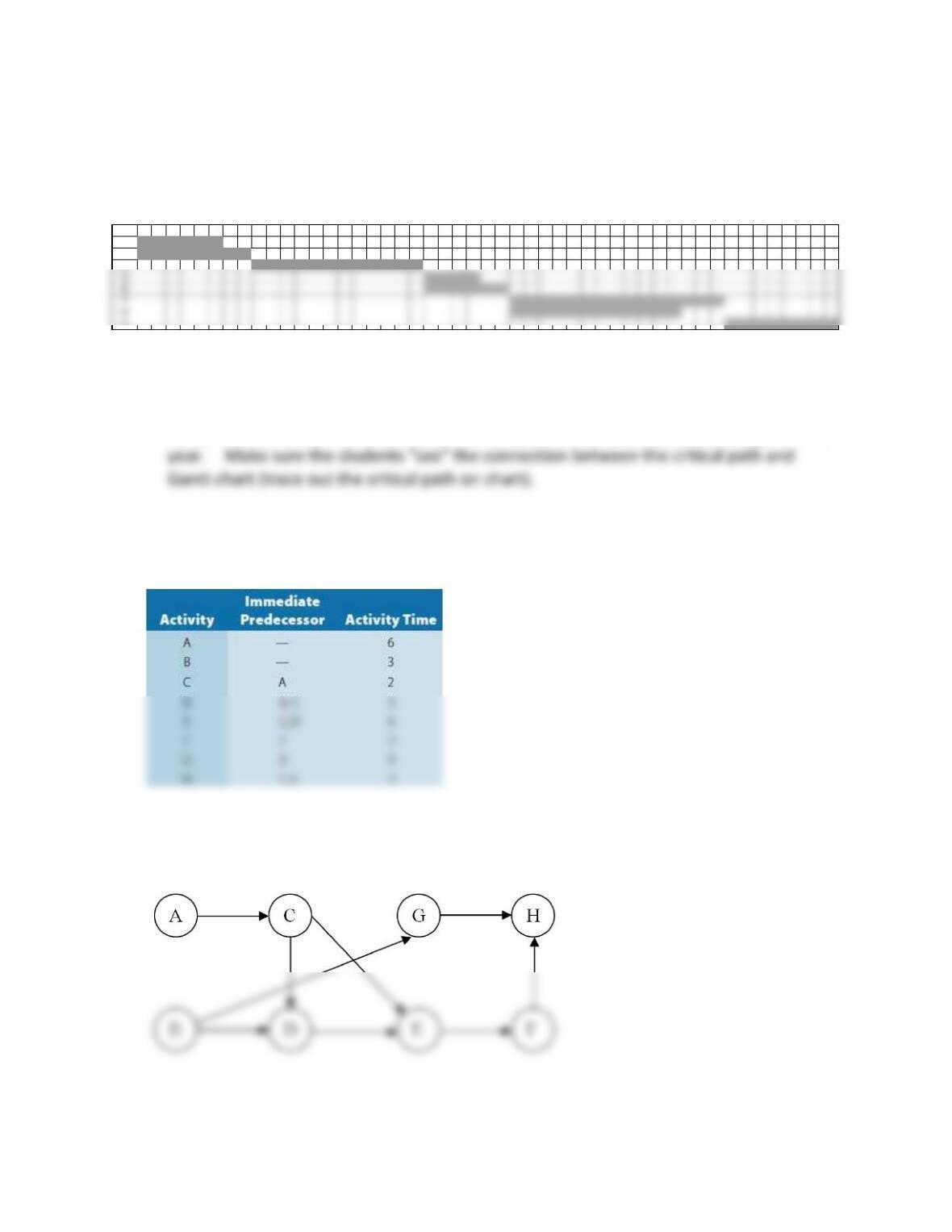
G
b. Identify the critical path(s).
Activity
Immediate
Predecessor
Time
(days)
Earliest
Start
Earliest
Finish
Latest
Start
Latest
Finish
Slack
A
—
6
0
6
2
8
2
B
—
8
0
8
0
8
0
C
A, B
12
8
20
8
20
0
E
C
6
20
26
20
26
0
F
15
26
41
26
41
0
A
D
17
Critical path is B-C-E-F-H
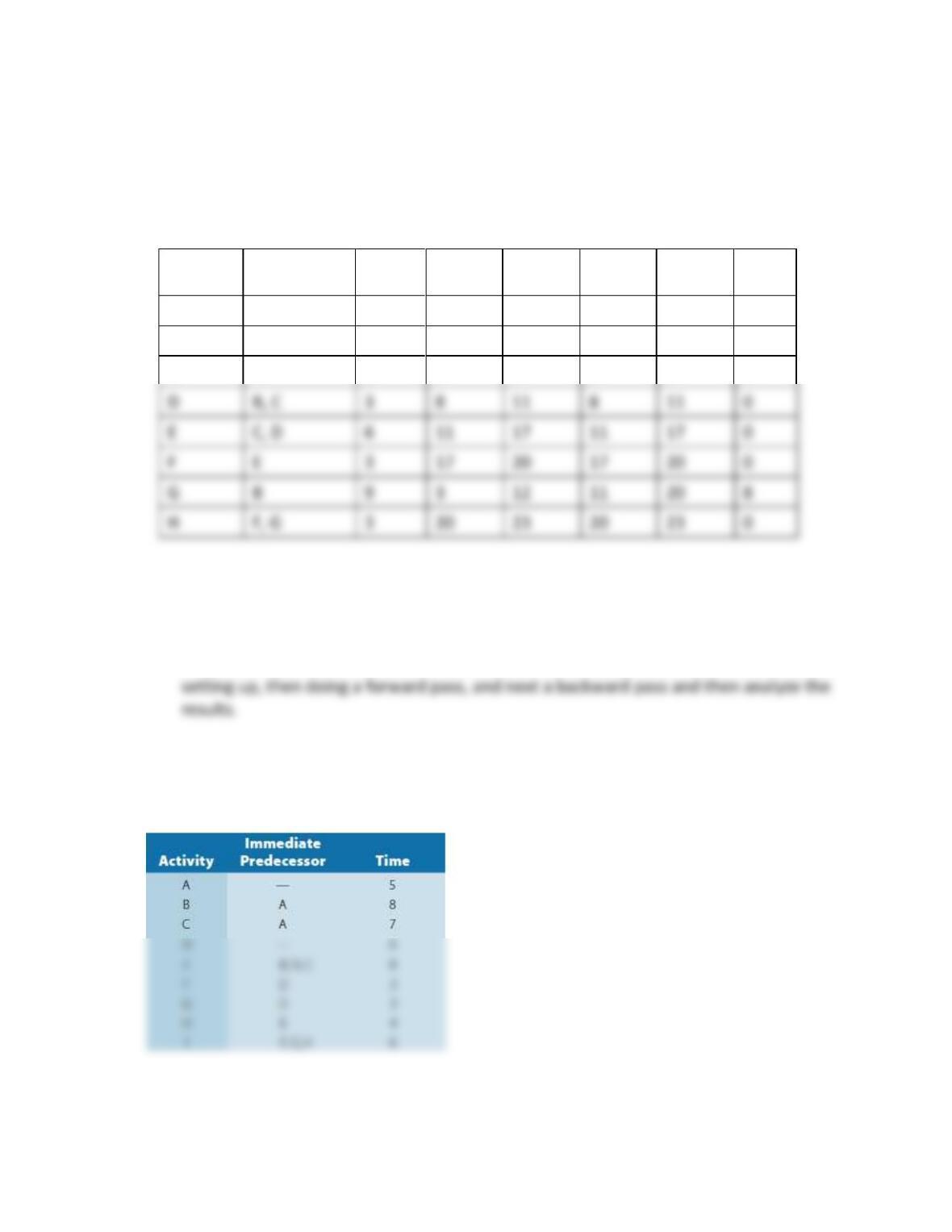
c. Construct an early-state date Gantt chart.
d. Does it appear reasonable that construction could begin one year after the decision to
begin the project? What is the project completion time?
Completion time is 49 weeks, so that it is reasonable that construction can begin in one
39. A computer-system installation project consists of eight activities. The immediate
predecessors and activity times in weeks are shown below.
a. Draw the network for this project.
Time 1 2 3 4 5 6 7 8 9 10 11 12 13 14 15 16 17 18 19 20 21 22 23 24 25 26 27 28 29 30 31 32 33 34 35 36 37 38 39 40 41 42 43 44 45 46 47 48 49
A
B
H
18
b. Identify the critical path(s).
Activity
Immediate
Predecessor
Time
(days)
Earliest
Start
Earliest
Finish
Latest
Start
Latest
Finish
Slack
A
—
6
0
6
0
6
0
B
—
3
0
3
5
8
5
C
A
2
6
8
6
8
0
D
B, C
3
8
8
0
E
C, D
6
0
F
E
3
0
G
B
9
3
8
H
F, G
3
0
Critical path is A-C-D-E-F-H.
c. What is the project completion time?
Project completion time is 23. We work one or more CPM problems on the board, first
40. Environment Recycling, Inc. must clean up a large automobile tire dump under a state
environmental cleanup contract. The tasks, durations (in weeks), costs, and predecessor
relationships are shown as follows:
a. Draw the project network.
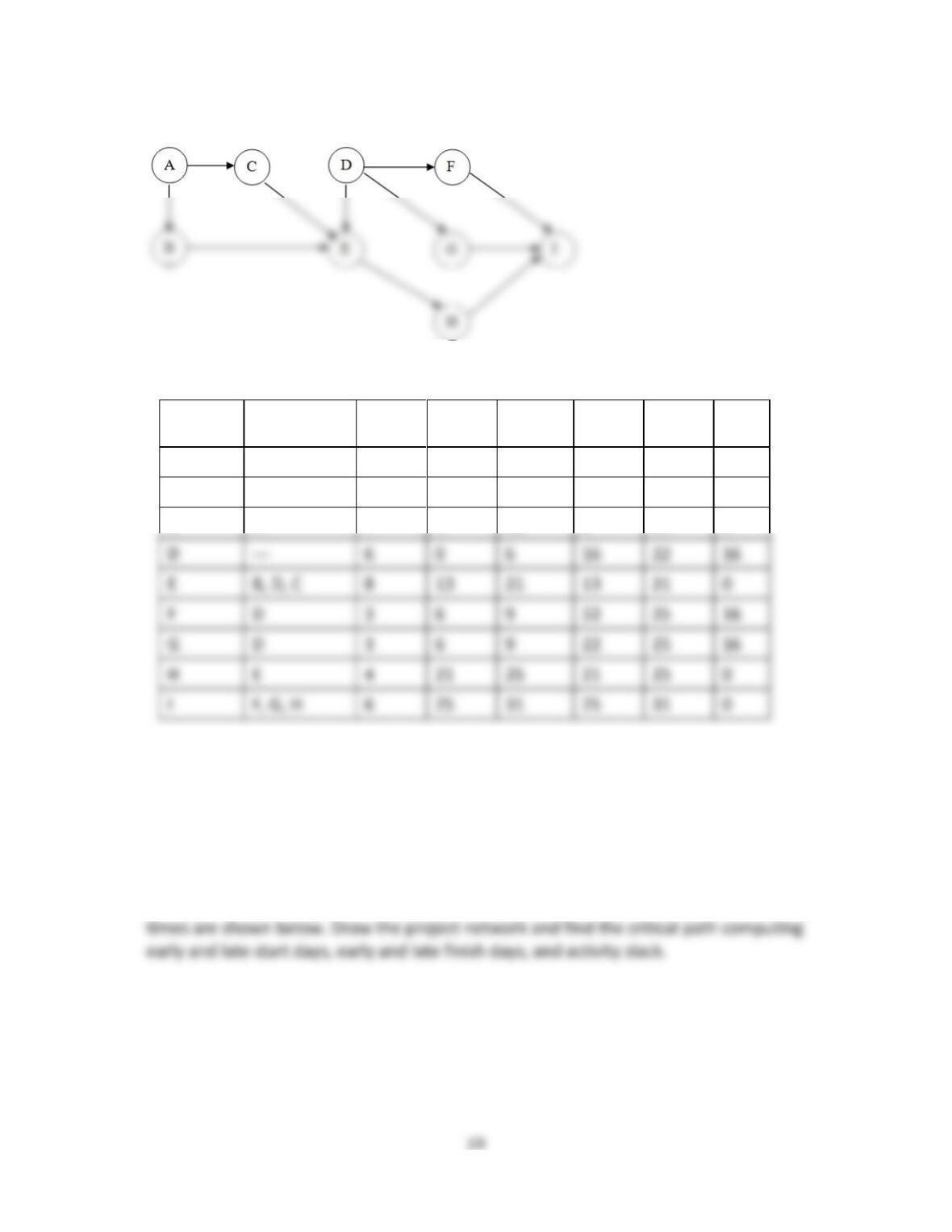
b. Identify the critical path(s).
Activity
Immediate
Predecessor
Time
(days)
Earliest
Start
Earliest
Finish
Latest
Start
Latest
Finish
Slack
A
—
5
0
5
0
5
0
B
A
8
5
13
5
13
0
D
—
6
0
6
16
22
16
E
8
13
21
13
21
0
H
E
4
21
25
21
25
0
Critical path is A-B-E-H-I
c. What is the total project completion time?
Completion time = 31.
41. Rozales Manufacturing Co. is planning to install a new flexible manufacturing system. The
activities that must be performed, their immediate predecessors, and estimated activity
20