Schermerhorn Exploring Management 5th edition Instructor’s Manual
Multiple-Choice Questions
1. An entrepreneur who thrives on uncertainty displays _____________
(d) action orientation
2. _____________is a personality characteristic common among entrepreneurs.
(a) External locus of control
3. When a new business is quick to capture a market niche before competitors, this is
_____________
4. Almost_____________% of U.S. businesses meet the definition of “small business.”
5. A small business owner who wants to pass the business to other family members after retirement
or death should prepare a _____________plan.
6. A common reason new small businesses often fail is _____________
7. A pressing problem faced by a small business in the birth or start-up stage is _____________
(d) getting management professional skills
8. A venture capitalist that receives an ownership share in return for investing in a new business is
9. In _____________financing, the business owner borrows money as a loan that must be repaid.
Schermerhorn Exploring Management 5th edition Instructor’s Manual
Short-Response Questions:
16. What is the relationship between diversity and entrepreneurship?
Entrepreneurship is rich with diversity. It is an avenue for business entry and career success
that is pursued by many women and members of minority groups. Data show almost 40% of
17. What major challenges are faced at each life cycle stage of an entrepreneurial firm?
18. What are the advantages of a limited partnership form of ownership?
19. What is the difference, if any, between a venture capitalist and an angel investor?
Integration and Application Questions:
20.
You have a great idea for an Internet-based start-up business. A friend advises you to clearly
link your business idea to potential customers and then describe it well in a business plan. “You
won’t succeed without customers, she says, and you’ll never get a chance if you can’t attract
financial backers with a good business plan.” Questions: What questions will you ask and
answer to ensure that you are customer-focused in this business? What are the major areas that
Schermerhorn Exploring Management 5th edition Instructor’s Manual
you would address in your initial business plan?
The friend is right—it takes much forethought and planning to prepare the launch of a new
business venture. In response to the question of how to ensure that you are really being
customer-focused in the new start-up, I would ask and answer the following questions to frame
Self-Assessment 18: Entrepreneurship Orientation
Instructions
Answer each of the following questions.
1. What portion of your college expenses did you earn (or are you earning)?
2. In college, your academic performance was/is
3. What is your basic reason for considering opening a business?
4. Which phrase best describes your attitude toward work?
5. How would you rate your organizing skills?
6. You are primarily a(n)
7. You are faced with a challenging problem. As you work, you realize you are stuck. You will
most likely
8. You are playing a game with a group of friends. You are most interested in
9. How would you describe your feelings toward failure?
Schermerhorn Exploring Management 5th edition Instructor’s Manual
5. Choose one of the entrepreneurship plans from among your teammates and be prepared to
share and explain it as well with the class at large.
Team Project 18: Community Entrepreneurs
Entrepreneurs are everywhere. Some might live next door, many own and operate the small
business of your community, and you might even be one.
Question
Who are the entrepreneurs in your community and what are they accomplishing?
1. Read the local news, talk to your friends and other locals, and think about where you
3. Contact as many of the entrepreneurs as possible and interview them. Try to learn how
they got started, why, what they encountered as obstacles or problems, and what they
4. Analyze your results for class presentation and discussion. Look for patterns and
5. Consider writing short cases that summarize the “founding stories” of the entrepreneurs
you find especially interesting.
Practice Critical Thinking: Crowdfunding -The New Mother of Angel
Investors
Answering the fundamental question of how to get financing presents one of the greatest
challenges to entrepreneurs intent on following their dream of business independence. Even
Case discussion questions and suggested answers:
1. DISCUSSION
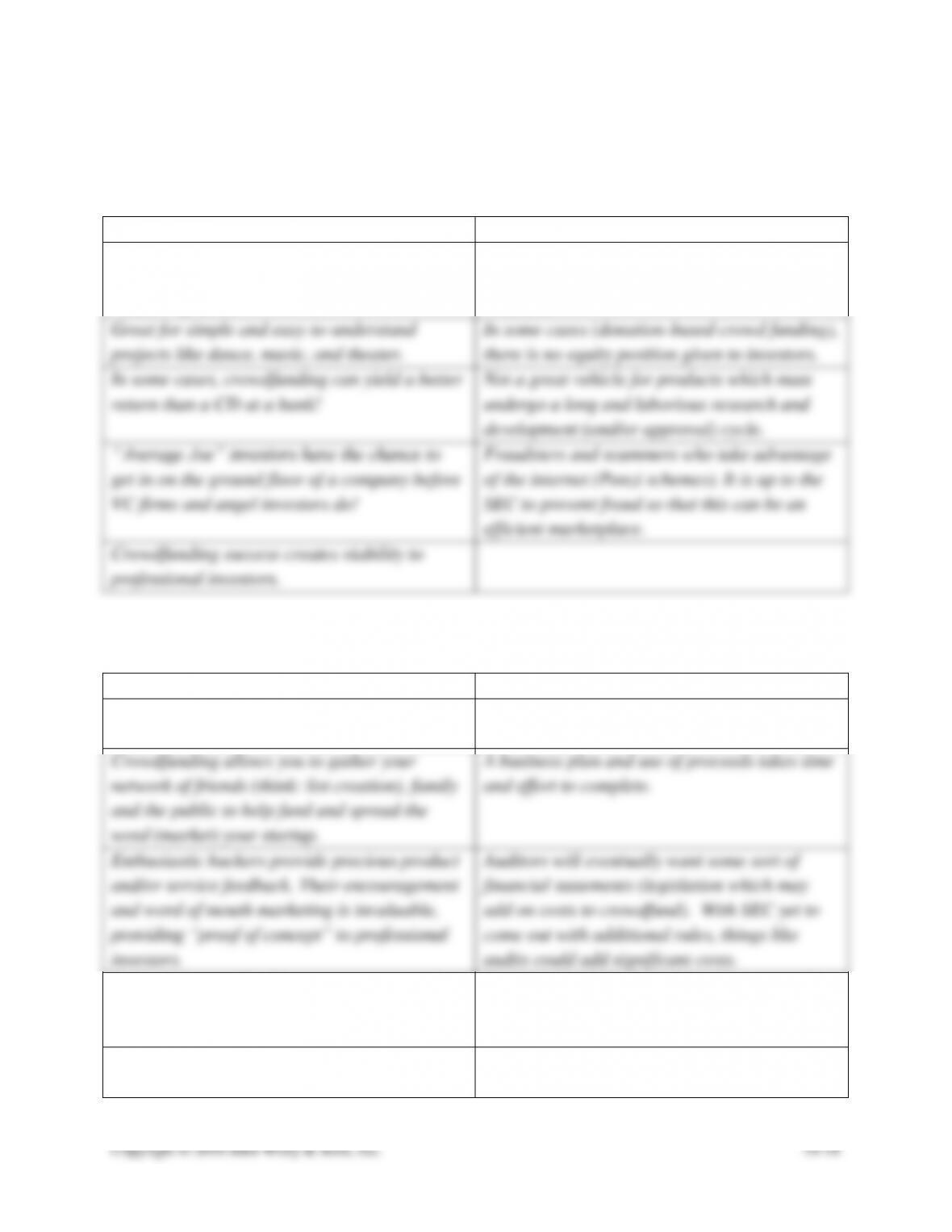
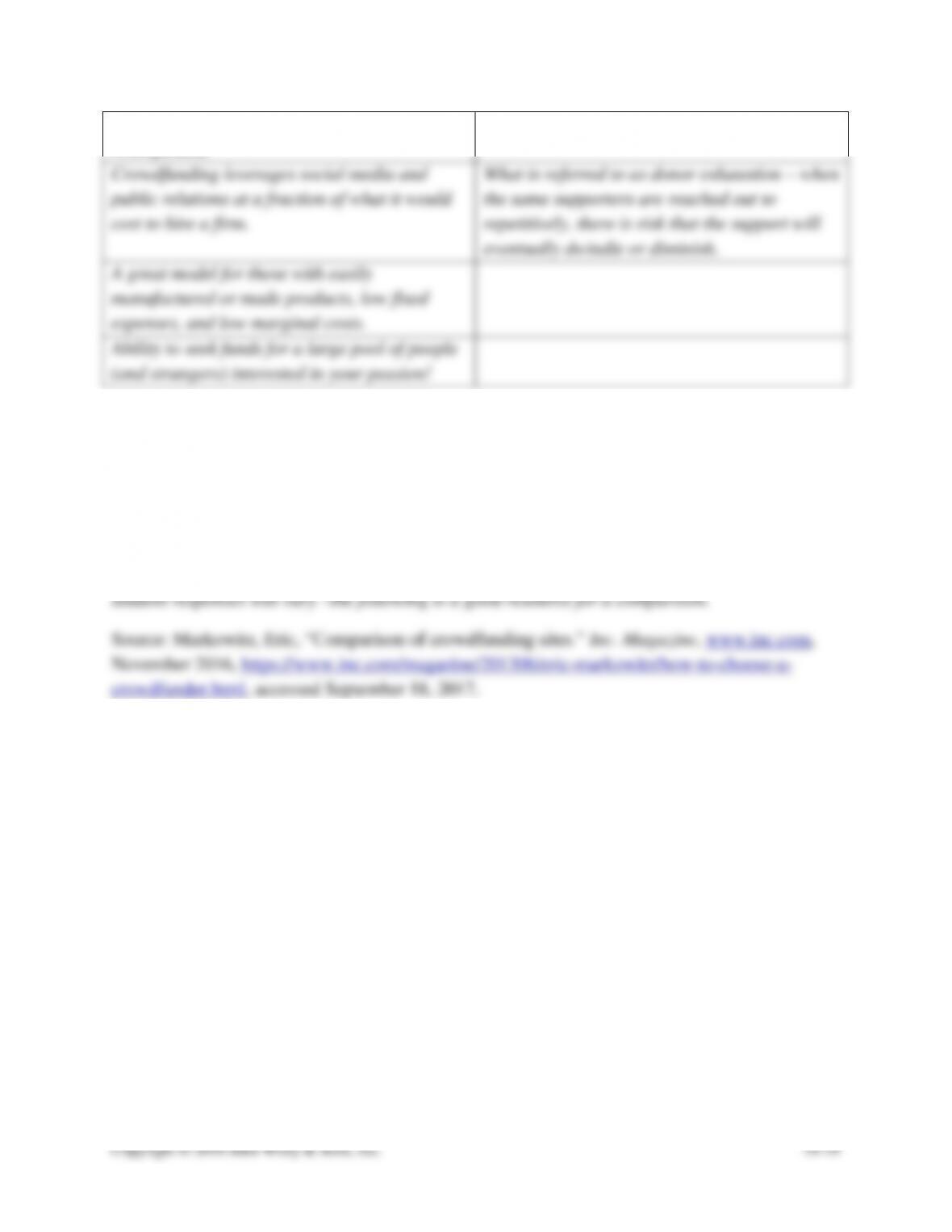
What are the pros and cons of crowdfunding? Look at it first from the perspective of the
entrepreneur who needs the money. Look at it also from the side of the potential investor.
Schermerhorn Exploring Management 5th edition Instructor’s Manual
What are the risks each might face? Is crowdfunding a good option for them, or is it mainly a
way for the owners of the crowdfunding sits to make money for themselves?
Investor:
Pros
Cons
Rewards-based crowdfunding gives an investor
some sort of reward – even if it is just a
“token” of sorts.
As an investor, some crowdfunding websites
require that a goal is met before funds are
released.
Great for simple and easy-to-understand
projects like dance, music, and theater.
In some cases (donation-based crowd funding),
there is no equity position given to investors.
In some cases, crowdfunding can yield a better
return than a CD at a bank!
Not a great vehicle for products which must
undergo a long and laborious research and
development (and/or approval) cycle.
“Average Joe” investors have the chance to
get in on the ground floor of a company before
VC firms and angel investors do!
Fraudsters and scammers who take advantage
of the internet (Ponzi schemes). It is up to the
SEC to prevent fraud so that this can be an
efficient marketplace.
Crowdfunding success creates viability to
professional investors.
Entrepreneur:
Pros
Cons
No equity given up with donation-based
crowdfunding.
Risk of intellectual property theft by putting
your concept on the world wide web.
Crowdfunding allows you to gather your
network of friends (think: list creation), family
and the public to help fund and spread the
word (market) your startup.
A business plan and use of proceeds takes time
and effort to complete.
Enthusiastic backers provide precious product
and/or service feedback. Their encouragement
and word of mouth marketing is invaluable,
providing “proof of concept” to professional
investors.
Auditors will eventually want some sort of
financial statements (legislation which may
add on costs to crowdfund). With SEC yet to
come out with additional rules, things like
audits could add significant costs.
Not only is crowdfunding a great way to raise
money, but its exposure on a crowdfunding site
builds market presence.
For non-donation sites, gifts, prizes, rewards,
and product pre-orders are required.
Predetermine interest in your product/service
through pre-selling — by building an early
You must deliver what you promised to your
investors. This can be a problem for overly
Schermerhorn Exploring Management 5th edition Instructor’s Manual
audience willing to try and support your
concept/idea.
ambitious entrepreneurs.
Crowdfunding leverages social media and
public relations at a fraction of what it would
cost to hire a firm.
What is referred to as donor exhaustion – when
the same supporters are reached out to
repetitively, there is risk that the support will
eventually dwindle or diminish.
A great model for those with easily
manufactured or made products, low fixed
expenses, and low marginal costs.
Ability to seek funds for a large pool of people
(and strangers) interested in your passion!
2. PROBLEM SOLVING
(a) As a potential investor, you want to take advantage of crowdfunding to put some excess
cash to work. Investigate at least three possible crowdfunding sites that you might use.
Which would you choose and why? (b) As an entrepreneur who needs money for a new
start-up, you want to take advantage of crowdfunding. Investigate at least three
crowdfunding sites that you might use. Which would you choose and why?
.
3. FURTHER RESEARCH Perform additional research to learn more about the status and
implications of Kickstarter, AngelList, Indiegogo, and other crowdfunding sites. Does
one seem to have an advantage? Is the “no equity” model of Kickstarter proving more
popular than the “with equity” alternatives legitimated by the JOBS Act? Do a quick
industry analysis. Who’s doing what, why, and with what results? What does the future
hold for crowd-funding as a financing alternative for small start-ups and entre-preneurial
ventures? After considering the JOBS Act and the crowdfunding industry as a whole,
what advice would you offer to small investors attracted to crowdfunding as a way of
becoming venture capitalists?
Student answers will vary.

Schermerhorn Exploring Management 5th edition Instructor’s Manual
Backers/supporters
Opponents
Emerging growth companies will be
exempt from a host of rules regarding
disclosure, reporting and governance.
Opponents believe that rescinding analyst
research restrictions would create
continued conflict of interest. In other
words, analysts would be promoting their
investment banking clients.
Businesses with under $1 billion in revenue
who would be exempt from regulations
required with initial public offerings (IPOs)
or going public.
Companies would be able to “test the
waters” by promoting public offerings with
information which critics believe is
incomplete.
Companies would be allowed to operate for
five years without an independent test or
audit of their control measures.
Many of the investor protections (think:
Sarbanes Oxley) put in place as a result of
debacles like Enron and Worldcom, would
be gutted.
Companies, with little oversight, would be
able to use crowdfunding to raise capital of
up to $2 million.
Opponents, concerned with rules meant to
protect investors, are concerned that
analysts are allowed to “mislead” investors
by talking up stocks. Talking up stocks
leads to winning more investment banking
business while creating a conflict of
interest (similar to that of the mortgage
backed securities crisis).
Companies would be able to “test the
waters” by promoting public offerings with
information which critics believe is
incomplete.
Opponents are concerned that executives
will not be held accountable for
misrepresentations when going public. Full
disclosure and financial results would not
have to be disclosed. This could harm the
average investor, unaware of the details of
a prospectus.
Supporters of the bill point to a falloff in
initial public offerings—a result of
regulation and oversight which is too strict.
With looser regulation, small businesses
would consider IPO prospects more often.
Rescinding analyst research restrictions
would give small startups, ignored by Wall
Street, more visibility.
“Main Street” investors will now have a
chance to become equity investors in
companies of their choice.
Major features of the act: The act changes the landscape for financing American small businesses
by easing security regulations to encourage funding. When conducted by a licensed broker–
Schermerhorn Exploring Management 5th edition Instructor’s Manual
Suggested Team Exercise for Chapter 18
Assign teams the task of developing a small business that you delegate. They should
2) The SBA site has very useful link to sample real business plans provided by the SBA as a free
service /reference. Each team should select a different business plan to review and present
that plan to the class as if they were presenting it to a bank. Every member should be
required to participate. They should use Power Point slides and, of course, cite the SBA
website as their source.
Additional Team Activity
An additional assignment for the class is to have teams of students provide their concept for a
business that they think would be a success using the Internet. As part of this concept, they