Hitt 13e Case Teaching Notes
Case 18: The Wells Fargo Banking Scandal
Case Synopsis
Wells Fargo may have weathered the banking crisis of 2008 rather well, but that doesn’t mean
it hasn’t had its share of failures and scandals. The biggest scandal to date broke in September
2016, when the Consumer Financial Protection Bureau revealed it was fining Wells Fargo $185
million for unethical, illegal practices. Investigators had discovered that over the course of
several years, bank employees had been opening fake accounts and credit cards, using millions
of customers’ names without their authorization. The suit brought to light a problem that the
bank had been aware of internally but failed to address.
In this largely commoditized industry, one of the few growth strategies available to Wells
Fargo’s commercial banking division was a practice known as “cross–selling.” Under direction
from CEO John Stumpf, COO Timothy Sloan, and community banking head Carrie Tolstedt,
bankers and tellers were directed to sell new products to existing customers as much as
possible. For example, a customer with a checking account was encouraged to open a savings
account, a credit card, and so on. Externally, competitors were astonished at Wells Fargo’s
ability to cross-sell, but internally employees described the pursuit of cross-selling as
customers and employees. The scandal continued for months as top-level managers were
called before Congress to explain their actions.
Learning Objectives
• Define strategic competitiveness, strategy, competitive advantage, above–average returns,
and the strategic management process. (Chapter 1)
• Define an agency relationship and managerial opportunism and describe their strategic
implications. (Chapter 10)
• Explain the use of three internal governance mechanisms to monitor and control managers’
• Describe the importance of strategic leaders in managing the firm’s resources. (Chapter 12)
• Explain what a firm does to sustain an effective culture. (Chapter 12)
• Describe what strategic leaders can do to establish and emphasize the need for everyone to
demonstrate ethical practices in their firms. (Chapter 12)
• Discuss the importance and use of organizational controls. (Chapter 12)
Strategic Issues and Suggested Discussion Questions & Answers
1. How did the three internal corporate governance mechanisms work—or fail to work—
at Wells Fargo?
While corporate governance mechanisms are designed to monitor the actions of top-level
managers—not those of low-level employees—it seems that the board of directors could have
been more diligent in monitoring Wells Fargo’s organizational culture and performance for
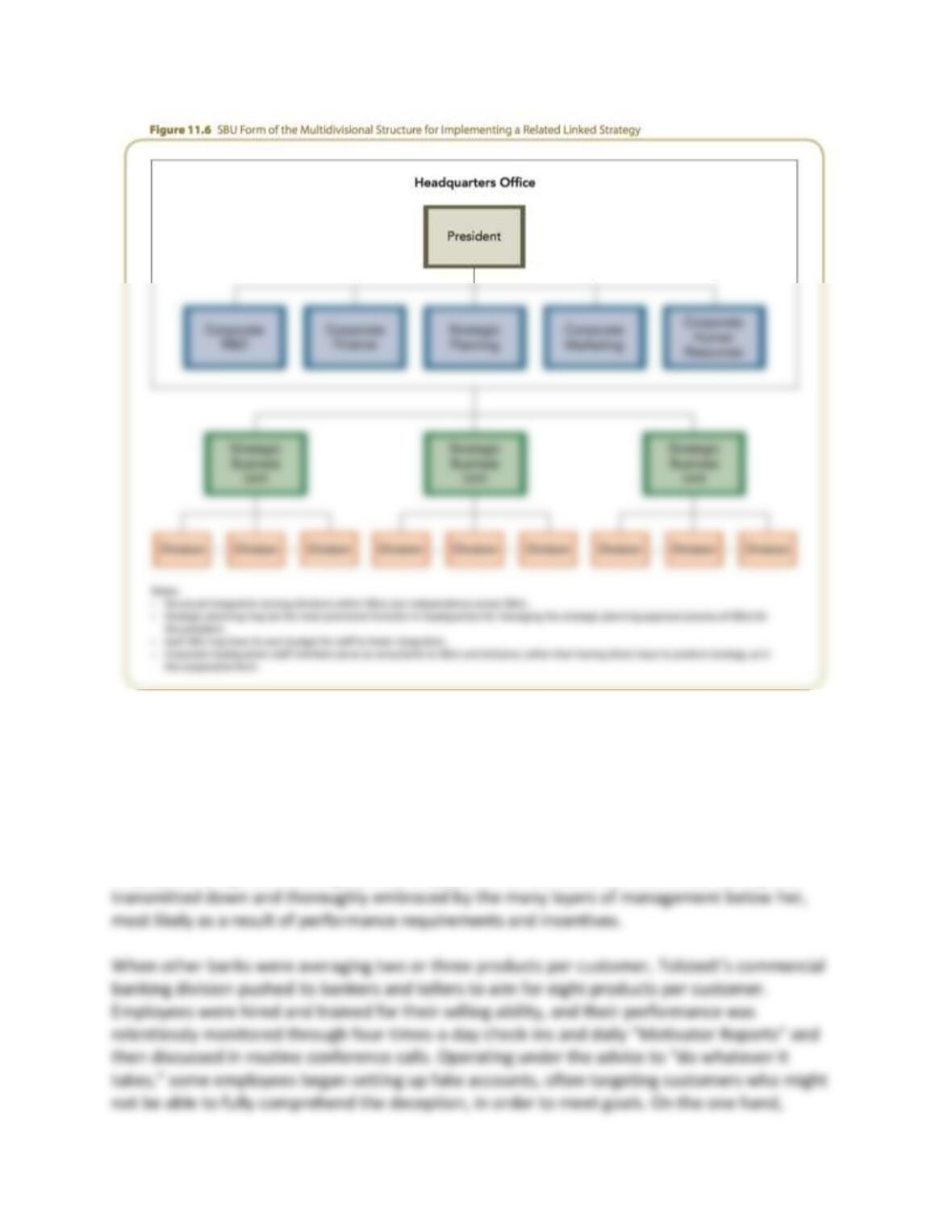
2. Describe the organizational structure used by Wells Fargo. Do you think this structure
could have contributed to the employees’ illegal behavior in any way?
Wells Fargo is divided into a number of strategic business units: commercial banking, wholesale
banking, investment banking, wealth management, insurance brokering, loan servicing, and
3. Describe Community Banking President Carrie Tolstedt’s management style. How did
her leadership abilities influence the corporate culture in the commercial banking
division? What do you think of her use of organizational controls?
Tolstedt is described as having a “tireless work ethic and obsessive attention to detail.”
Obsessive is probably the right word to describe the numerous systems she set up to track
employees’ progress toward goals, and it appears that her obsession with cross-selling was
4. Several years before the CFPB investigation made Wells Fargo’s illegal cross-selling
practices public knowledge, top-level managers became aware of the problem. What
actions did they take to stop this behavior? Why do you think the practice persisted,
even after the firm tried to end it?
Wells Fargo began to address the suspected problem with research, using data analytics to
determine how many accounts were unfunded or inactive. Some of these were legitimate
accounts, but the firm knew that many would turn out to be fictitious. With that in mind, the
5. What was Wells Fargo’s strategy for recovering from this scandal? Do you think it was
sufficient and effective?
Wells Fargo wanted to send a clear message to the public that senior leadership would be held
accountable for the situation. CEO John Stumpf was forced to resign and forfeit his unvested
equity, an amount of $41 million. Carrie Tolstedt, who was already set to retire at the end of
the year, left the company immediately and forfeited her severance and bonus pay. The firm
Additional Resources
Reuters’s company profile gives in-depth background on Wells Fargo’s current financials,
leadership, valuation, news, and more:
In September 2018, CNN Business reported on Wells Fargo’s continuing problems in the
aftermath of the scandal:
In May 2019, Zacks Equity Research featured this report on the vetting of Wells Fargo’s new
CEO candidate:
In August 2018, CBS News interviewed one of Wells Fargo’s employee whistleblowers: