Chapter 18
Long-Term Debt Financing
Lecture Outline
Financing to Match the Inflow Currency
Using Currency Swaps to Execute the Matching Strategy
Using Parallel Loans to Execute the Matching Strategy
Debt Denomination Decision by Subsidiaries
Debt Decision in Host Countries with High Interest Rates
Debt Denomination to Finance a Foreign Project
Long-Term Debt Financing ❖ 2
Chapter Theme
Should the MNC choose bonds as a medium to attract long-term funds, a currency for denomination
must be chosen. This is a critical decision for the MNC. While there is no clear-cut solution, this chapter
Topics to Stimulate Class Discussion
1. Why would U.S. firms consider issuing bonds denominated in a foreign currency?
2. What are the desirable characteristics related to a currency’s interest rate (high or low) and value
(strong or weak) that would make the currency attractive from a borrower’s perspective?
POINT/COUNTER-POINT:
Will Currency Swaps Result in Low Financing Costs?
POINT: Yes. Currency swaps have created greater participation by firms that need to exchange their
currencies in the future. Thus, firms that finance in a low interest rate currency can more easily establish
an agreement to obtain the currency that has the low interest rate.
COUNTER-POINT: No. Currency swaps will establish an exchange rate that is based on market forces. If
a forward rate exists for a future period, the swap rate should be somewhat similar to the forward rate. If it
was not as attractive as the forward rate, the participants would use the forward market instead. If a
forward market does not exist for the currency, the swap rate should still reflect market forces. The
exchange rate at which a low-interest currency could be purchased will be higher than the prevailing spot
rate, since otherwise MNCs would borrow the low-interest currency and simultaneously purchase the
currency forward so that they could hedge their future interest payments.
WHO IS CORRECT? Use the Internet to learn more about this issue. Which argument do you support?
Offer your own opinion on this issue.
Answers to End of Chapter Questions
1. Floating-Rate Bonds.
a. What factors should be considered by a U.S. firm that plans to issue a floating rate bond
denominated in a foreign currency?
Long-Term Debt Financing ❖ 3
b. Is the risk of issuing a floating rate bond higher or lower than the risk of issuing a fixed rate
Eurobond? Explain.
c. How would an investing firm differ from a borrowing firm in the features (i.e., interest rate and
currency’s future exchange rates) it would prefer a floating rate foreign currency-denominated
bond to exhibit?
ANSWER: An investing firm prefers a bond denominated in a currency that is expected to appreciate
2. Risk From Issuing Foreign Currency-Denominated Bonds. What is the advantage of using
simulation to assess the bond financing position?
3. Exchange Rate Effects.
a. Explain the difference in the cost of financing with foreign currencies during a strong-dollar
period, versus a weak-dollar period for a U.S. firm.
b. Explain how a U.S.-based MNC issuing bonds denominated in euros may be able to offset a
portion of its exchange rate risk.
4. Bond Offering Decision. Columbia Corp. is a U.S. company with no foreign currency cash flows. It
plans to either issue a bond denominated in euros with a fixed interest rate, or a bond denominated in
U.S. dollars with a floating interest rate. It estimates its periodic dollar cash flows for each bond.
Which bond do you think would have greater uncertainty surrounding these future dollar cash flows?
Explain.
5. Borrowing Combined with Forward Hedging. Cedar Falls Co. has a subsidiary in Brazil, where
local interest rates are high. It considers borrowing dollars and hedging the exchange rate risk by
Long-Term Debt Financing ❖ 4
selling the Brazilian real forward in exchange for dollars for the periods in which it would need to
make loan payments in dollars. Assume that forward contracts on the real are available. What is the
limitation of this strategy? ?
6. Financing That Reduces Exchange Rate Risk. Kerr, Inc., a major U.S. exporter of products to
Japan, denominates its exports in dollars and has no other international business. It can borrow
dollars at 9 percent to finance its operations or borrow yen at 3 percent. If it borrows yen, it will be
exposed to exchange rate risk. How can Kerr borrow yen and possibly reduce its economic exposure
to exchange rate risk?
7. Exchange Rate Effects. Katina, Inc., is a U.S. firm that plans to finance with bonds denominated in
euros to obtain a lower interest rate than is available on dollar-denominated bonds. What is the most
critical point in time when the exchange rate will have the greatest impact?
8. Financing Decision. Ivax Corp. (based in Miami) is a U.S. drug company that has attempted to
capitalize on new opportunities to expand in Eastern Europe. The production costs in most Eastern
European countries are very low, often less than one-fourth of the cost in Germany or Switzerland.
Furthermore, there is a strong demand for drugs in Eastern Europe. Ivax penetrated Eastern Europe by
purchasing a 60 percent stake in Galena AS, a Czech firm that produces drugs.
a. Should Ivax finance its investment in the Czech firm by borrowing dollars from a U.S. bank that
would then be converted into koruna (the Czech currency) or by borrowing koruna from a local
Czech bank? What information do you need to know to answer this question?
ANSWER: Ivax would need to consider the interest rate in the U.S. versus the interest rate when
borrowing koruna (the Czech currency). It would also need to consider the potential change in the
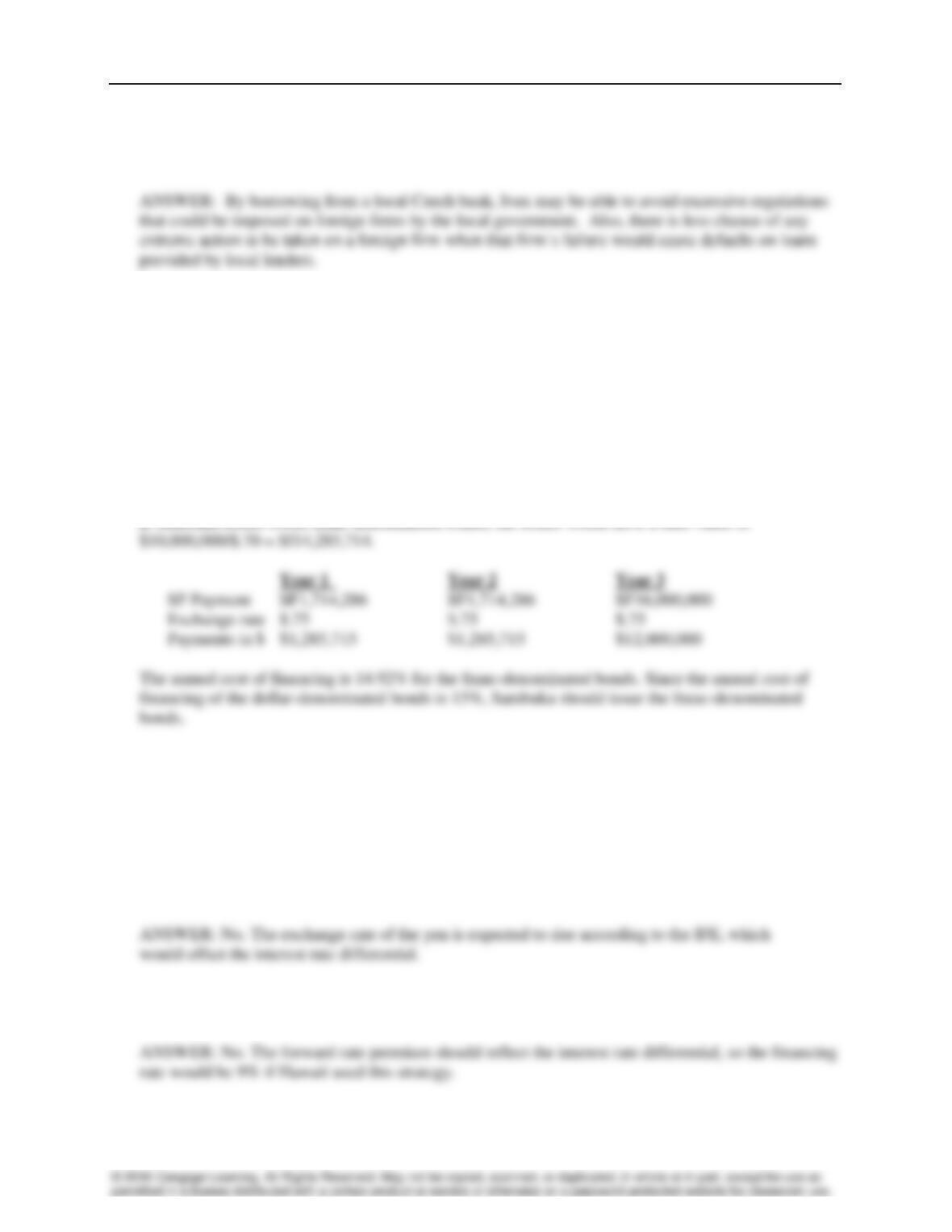
b. How can borrowing koruna locally from a Czech bank reduce the exposure of Ivax to exchange
rate risk?
Long-Term Debt Financing ❖ 5
c. How can borrowing koruna locally from a Czech bank reduce the exposure of Ivax to political
risk caused by government regulations?
Advanced Questions
9. Bond Financing Analysis. Sambuka, Inc. can issue bonds in either U.S. dollars or in Swiss francs.
Dollar-denominated bonds would have a coupon rate of 15 percent; Swiss franc-denominated bonds
would have a coupon rate of 12 percent. Assuming that Sambuka can issue bonds worth $10,000,000
in either currency, that the current exchange rate of the Swiss franc is $.70, and that the forecasted
exchange rate of the franc in each of the next three years is $.75, what is the annual cost of financing
for the franc-denominated bonds? Which type of bond should Sambuka issue?
ANSWER:
If Sambuka issues Swiss franc-denominated bonds, the bonds would have a face value of
10. Bond Financing Analysis. Hawaii Co. just agreed to a long-term deal in which it will export products
to Japan. It needs funds to finance the production of the products that it will export. The products will
be denominated in dollars. The prevailing U.S. long-term interest rate is 9 percent versus 3 percent in
Japan. Assume that interest rate parity exists, and that Hawaii Co. believes that the international
Fisher effect holds.
a. Should Hawaii Co. finance its production with yen and leave itself open to the exchange rate
risk? Explain.
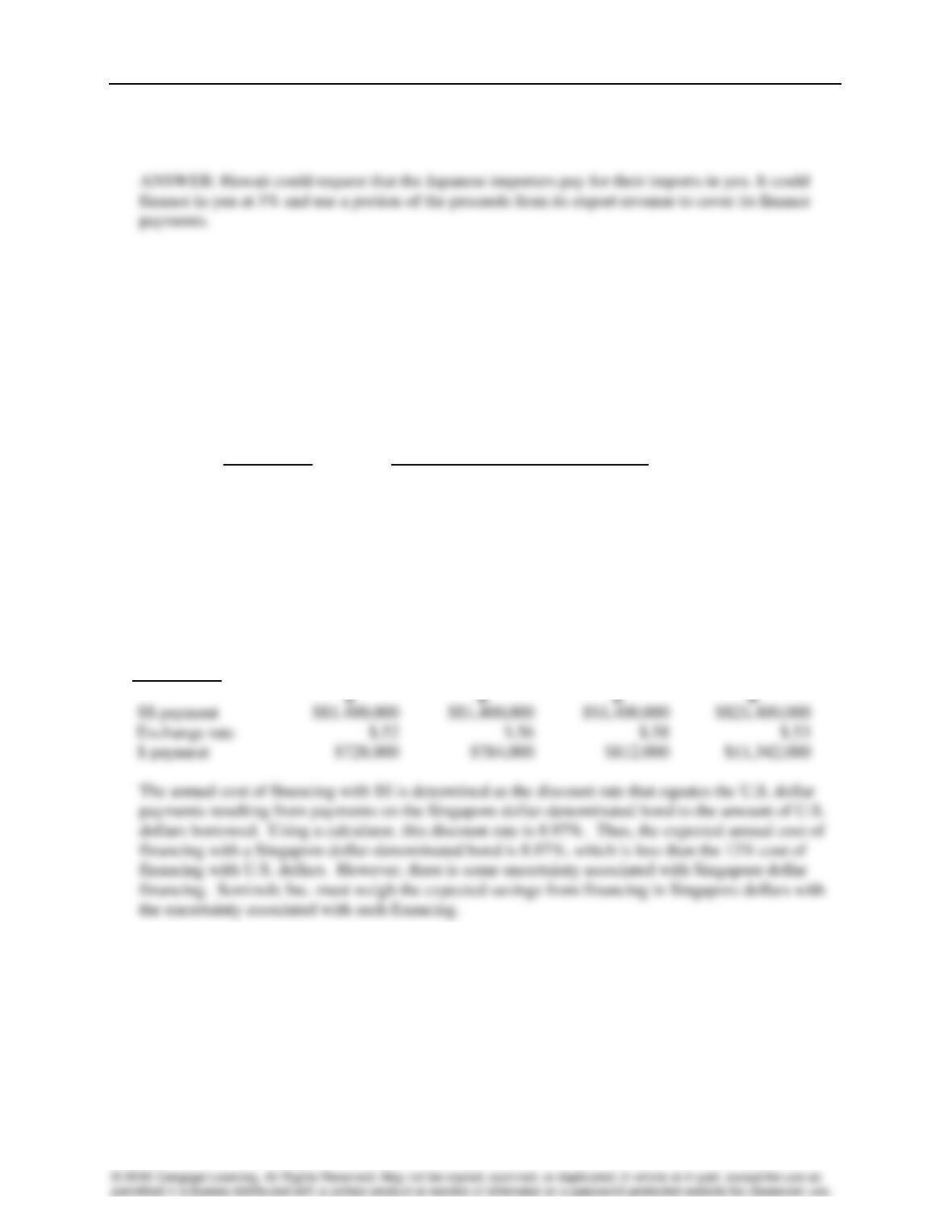
b. Should Hawaii Co. finance its production with yen and simultaneously engage in forward
contracts to hedge its exposure to exchange rate risk?
Long-Term Debt Financing ❖ 6
c. How could Hawaii Co. achieve low-cost financing while eliminating its exposure to exchange
rate risk?
11. Cost of Financing. Assume that Seminole, Inc., considers issuing a Singapore dollar-denominated
bond at its present coupon rate of 7 percent, even though it has no incoming cash flows to cover the
bond payments. It is attracted to the low financing rate, since U. S. dollar-denominated bonds issued
in the United States would have a coupon rate of 12 percent. Assume that either type of bond would
have a four-year maturity and could be issued at par value. Seminole needs to borrow $10 million.
Therefore, it will either issue U. S. dollar denominated bonds with a par value of $10 million or bonds
denominated in Singapore dollars with a par value of S$20 million. The spot rate of the Singapore
dollar is $.50. Seminole has forecasted the Singapore dollar’s value at the end of each of the next
four years, when coupon payments are to be paid:
End of Year Exchange Rate of Singapore Dollar
1 $.52
2 .56
3 .58
4 .53
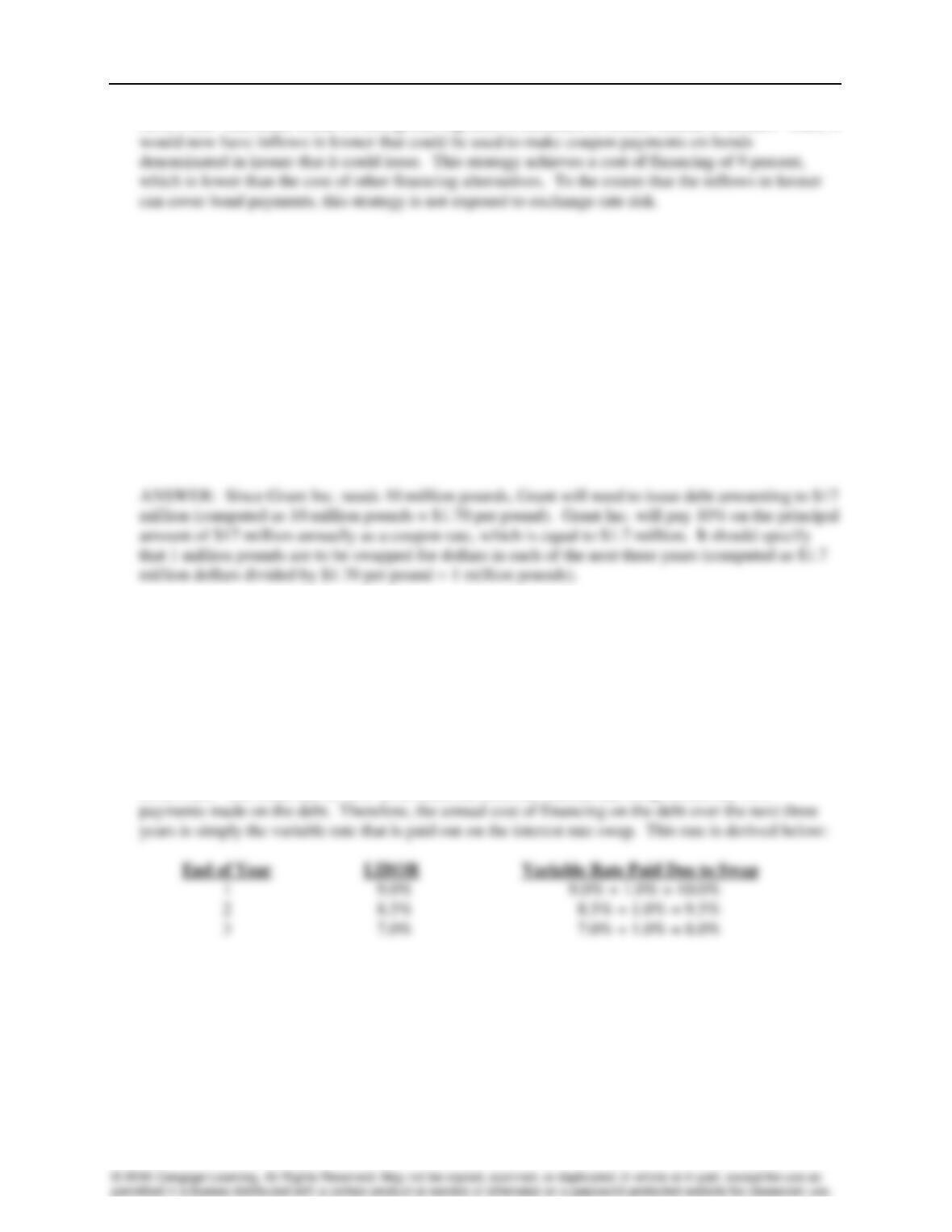
Determine the expected annual cost of financing with Singapore dollars. Should Seminole, Inc., issue
bonds denominated in U.S. dollars or Singapore dollars? Explain.
ANSWER:
End of Year:
1
2
3
4
12. Interaction Between Financing and Invoicing Policies. Assume that Hurricane, Inc., is a U.S.
company that exports products to the U.K., invoiced in dollars. It also exports products to Denmark,
invoiced in dollars. It currently has no cash outflows in foreign currencies, and it plans to issue bonds
in the near future. Hurricane could likely issue bonds at par value in (1) dollars with a coupon rate of
12 percent, (2) Danish kroner with a coupon rate of 9 percent, or (3) pounds with a coupon rate of 15
percent. It expects the kroner and pound to strengthen over time. How could Hurricane revise its
invoicing policy and make its bond denomination decision to achieve low financing costs without
excessive exposure to exchange rate fluctuations?
Long-Term Debt Financing ❖ 7
ANSWER: Hurricane could invoice goods exported to Denmark in kroner instead of dollars. Thus, it
13. Swap Agreement. Grant, Inc., is a well-known U.S. firm that needs to borrow 10 million British
pounds to support a new business in the United Kingdom. However, it cannot obtain financing from
British banks because it is not yet established within the United Kingdom. It decides to issue dollar-
denominated debt (at par value) in the U.S., for which it will pay an annual coupon rate of 10%. It
then will convert the dollar proceeds from the debt issue into British pounds at the prevailing spot rate
(the prevailing spot rate is one pound = $1.70). Over each of the next three years, it plans to use the
revenue in pounds from the new business in the United Kingdom to make its annual debt payment.
Grant, Inc., engages in a currency swap in which it will convert pounds to dollars at an exchange rate
of $1.70 per pound at the end of each of the next three years. How many dollars must be borrowed
initially to support the new business in the United Kingdom? How many pounds should Grant, Inc.,
specify in the swap agreement that it will swap over each of the next three years in exchange for
dollars so that it can make its annual coupon payments to the U.S. creditors?
14. Interest Rate Swap. Janutis Co. has just issued fixed rate debt at 10 percent. Yet, it prefers to
convert its financing to incur a floating rate on its debt. It engages in an interest rate swap in which it
swaps variable rate payments of LIBOR plus 1% in exchange for payments of 10%. The interest
rates are applied to an amount that represents the principal from its recent debt issue in order to
determine the interest payments due at the end of each year for the next three years. Janutis Co.
expects that the LIBOR will be 9% at the end of the first year, 8.5% at the end of the second year, and
7% at the end of the third year. Determine the financing rate that Janutis Co. expects to pay on its
debt after considering the effect of the interest rate swap.
ANSWER: The fixed rate of 10% to be received from the interest rate swap offsets the 10%
15. Financing and the Currency Swap Decision. Bradenton Co. is considering a project in which it will
export special contact lenses to Mexico. It expects that it will receive 1 million pesos after taxes at the
end of each year for the next 4 years, and after that time its business in Mexico will end as its special
patent will be terminated. The peso’s spot rate is presently $.20. The U.S. annual risk-free interest rate
is 6% while Mexico’s annual risk-free interest rate is 11%. Interest rate parity exists. Bradenton Co.
uses the one-year forward rate as a predictor of the exchange rate in one year. Bradenton Co. also
presumes that the exchange rates in each of the years 2 through 4 will also change by the same
Long-Term Debt Financing ❖ 8
percentage as it predicts for year 1. Bradenton searches for a firm with which it can swap pesos for
dollars over each of the next 4 years. Briggs Co. is an importer of Mexican products. It is willing to
take the 1 million pesos per year from Bradenton Co. and will provide Bradenton Co. with dollars at
an exchange rate of $.17 per peso. Ignore tax effects.
Bradenton Co. has a capital structure of 60% debt and 40% equity. Its corporate tax rate is 30%. It
borrows funds from a bank and pays 10% interest on its debt. It expects that the U.S. annual stock
market return will be 18% per year. Its beta is .9. Bradenton would use its cost of capital as the
required return for this project.
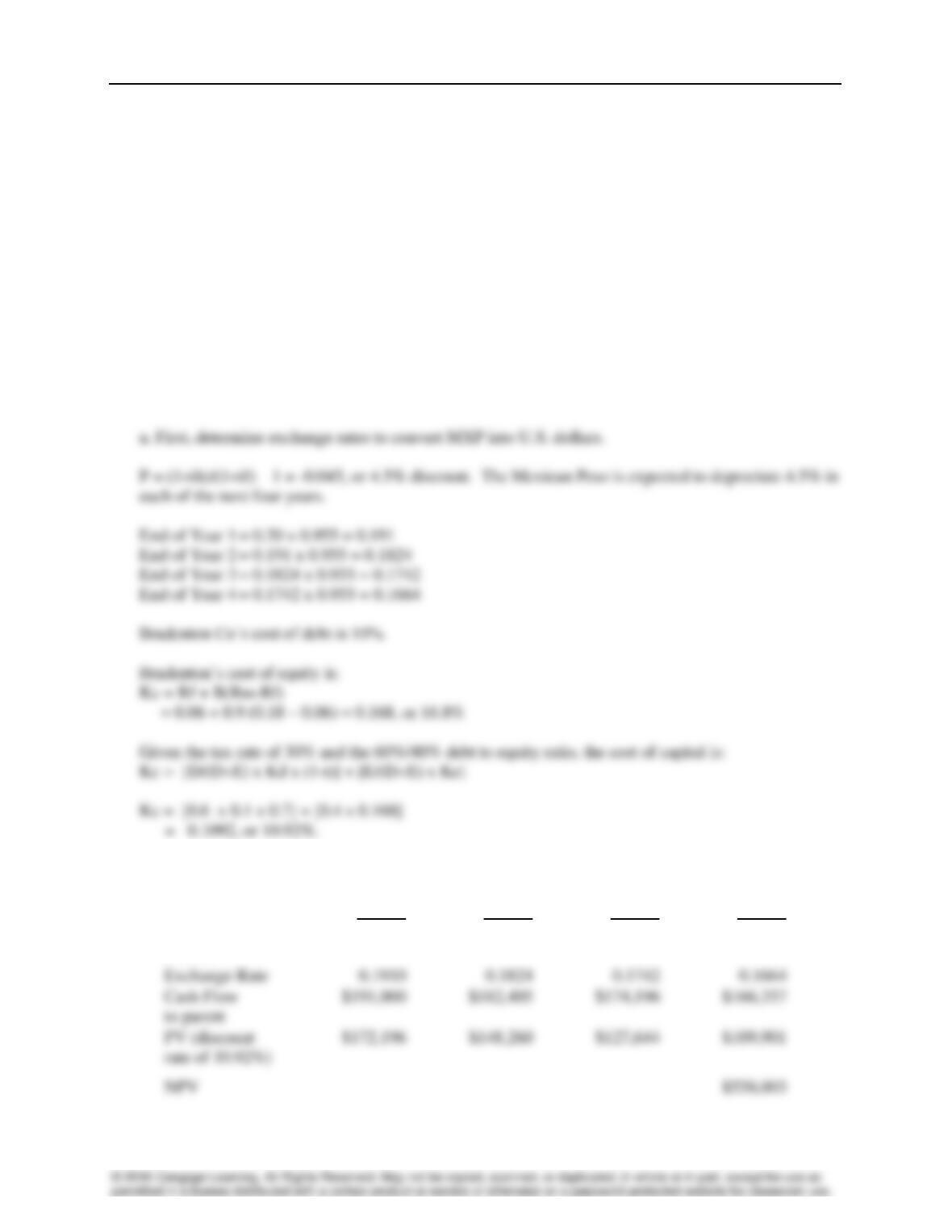
a. Determine whether the NPV of this project if Bradenton engages in the currency swap.
b. Determine the NPV of this project if Bradenton does not hedge the future cash flows.
ANSWER:
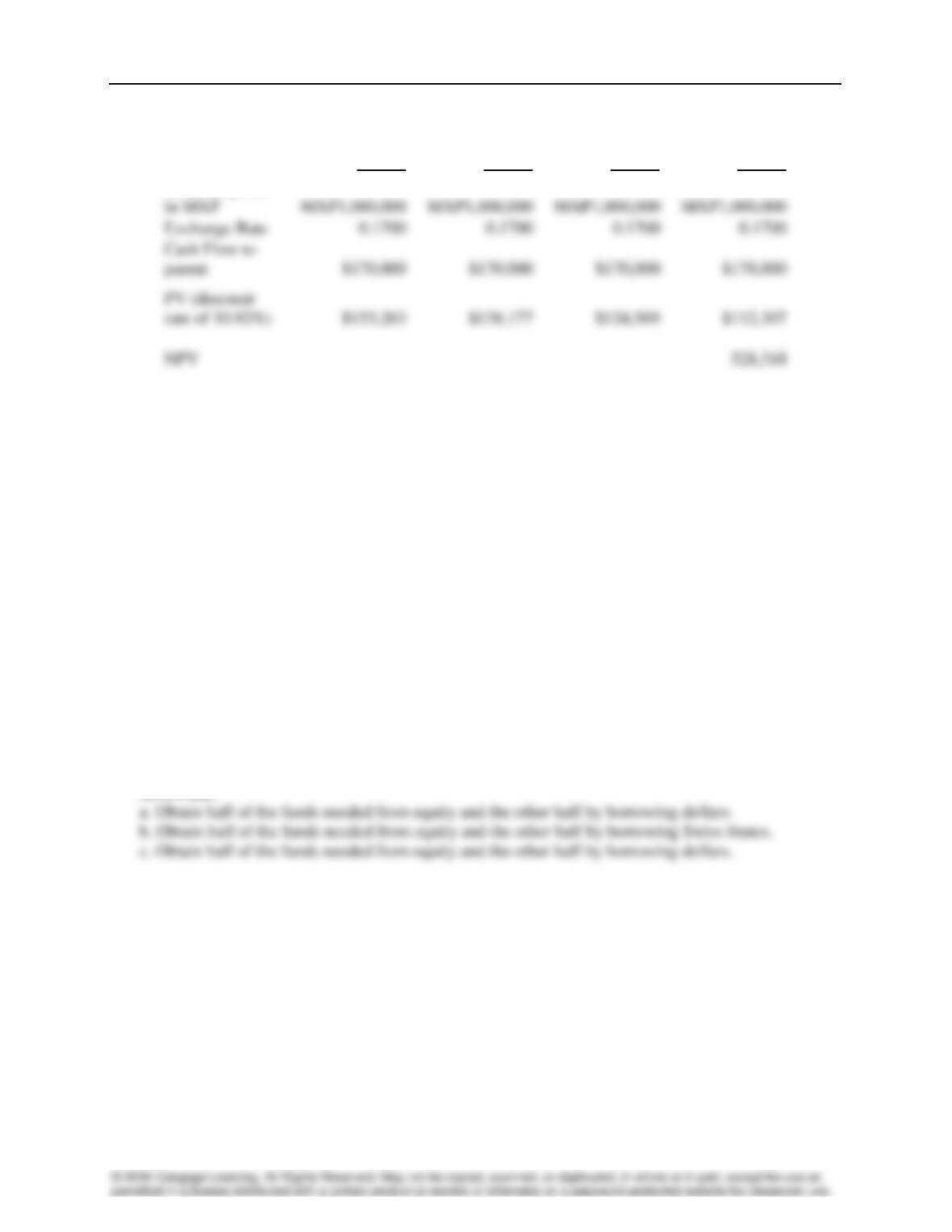
a) No hedge
Year 1
Year 2
Year 3
Year 4
After tax profit
in MXP
MXP1,000,000
MXP1,000,000
MXP1,000,000
MXP1,000,000
Long-Term Debt Financing ❖ 9
b) Swap
Year 1
Year 2
Year 3
Year 4
Cash Flow to
PV (discount
After tax profit
16. Financing and Exchange Rate Risk. The parent of Nester Co. (a U.S. firm) has no international
business but plans to invest $20 million in a business in Switzerland. Since the operating costs of this
business are very low, Nester Co. expects this business to generate much cash flows in Swiss francs
that will be remitted to the parent each year.
Nester will finance half of this project with debt. It has these choices for financing the project:
* obtain half of the funds needed from parent equity and the other half by borrowing dollars
* obtain half of the funds needed from parent equity and the other half by borrowing Swiss francs
* obtain half of the funds that are needed from parent equity and obtain the remainder by borrowing
an equal amount of dollars and Swiss francs
The interest rate on dollars is the same as the interest rate on Swiss francs.
a. Which choice will result in the most exchange rate exposure?
b. Which choice will result in the least exchange rate exposure?
c. If the Swiss franc was expected to appreciate over time, which financing choice would result in the
highest expected net present value?
ANSWER:
17. Financing and Exchange Rate Risk. Vix Co. (of the U.S.) presently serves as a distributor of
products by purchasing them from other U.S. firms and selling them in Europe. It wants to purchase a
manufacturer in Thailand that could produce similar products at a low cost (due to low labor costs in
Thailand) and export the products to Europe. The operating expenses would be denominated in Thai
currency (the baht). The products would be invoiced in euros. If Vix Co. can acquire a manufacturer,
it will discontinue its existing distributor business. If Vix Co. purchases a company in Thailand, it
expects that its revenue might not be sufficient to cover its operating expenses during the first 8 years.
It will need to borrow funds for an 8-year term to ensure that it has enough funds to pay all of its
operating expenses in Thailand. It can borrow funds denominated in U.S. dollars, in Thai baht, or in
euros. Assuming that its financing decision will be primarily intended to minimize its exposure to
exchange rate risk, which currency should it borrow? Briefly explain.
Long-Term Debt Financing ❖ 10
18. Financing and Exchange Rate Risk. Compton Co. has a subsidiary in Thailand that produces
computer components. The subsidiary sells the components to manufacturers in the U.S. The
components are invoiced in U.S. dollars. Compton pays employees of the subsidiary in Thai baht and
makes a large monthly lease payment in Thai baht. Compton financed the investment in the Thai
subsidiary by borrowing dollars from a U.S. bank. Compton has no other international business.
a. Given the conditions, is Compton affected favorably or unfavorably, or not affected by depreciation
of the Thai baht? Briefly explain.
b. Assume that interest rates in Thailand declined recently, so Compton subsidiary considers
obtaining a new loan in Thai baht. Compton would use the proceeds to pay off its existing loan from a
U.S. bank. Will this form of financing increase, reduce, or have no impact on its economic exposure
to exchange rate movements? Briefly explain.
19. Selecting a Loan Maturity. Omaha Co. has a subsidiary in Chile that wants to borrow from a local
bank at a fixed rate over the next 10 years.
a. Explain why Chile’s term structure of interest rates (as reflected in its yield curve) might cause the
subsidiary to borrow for a different term to maturity.
b. If Omaha is offered a more favorable interest rate for a term of 6 years, explain the potential
disadvantage compared to a 10-year loan.
c. Explain how the subsidiary can determine whether to select the 6-year loan versus the 10-year loan.
ANSWER
20. Project Financing. Dryden Co. is a U.S. firm that plans a foreign project in which it needs
$8,000,000 as an initial investment. The project is expected to generate cash flows of 10 million euros
in one year, after the complete repayment of the loan (including the loan interest and principal). The
project has zero salvage value and is terminated at the end of one year. Dryden considers financing
this project with:
*all U.S. equity,
*all U.S. debt (loans) denominated in dollars provided by U.S. banks,
*all debt (loans) denominated in euros provided by European banks, or
*half of funds obtained from loans denominated in euros, and half obtained from loans denominated
in dollars.
Which form of financing will cause the project’s NPV to be the least sensitive to exchange rate risk?
Solution to Continuing Case Problem: Blades, Inc.
1. Given that Blades expects to use the cash flows generated by the Thai subsidiary to pay the interest
and principal of the notes, would the effective financing cost of the baht-denominated notes be
affected by exchange rate movements? Would the effective financing cost of the yen-denominated
notes be affected by exchange rate movements? How?
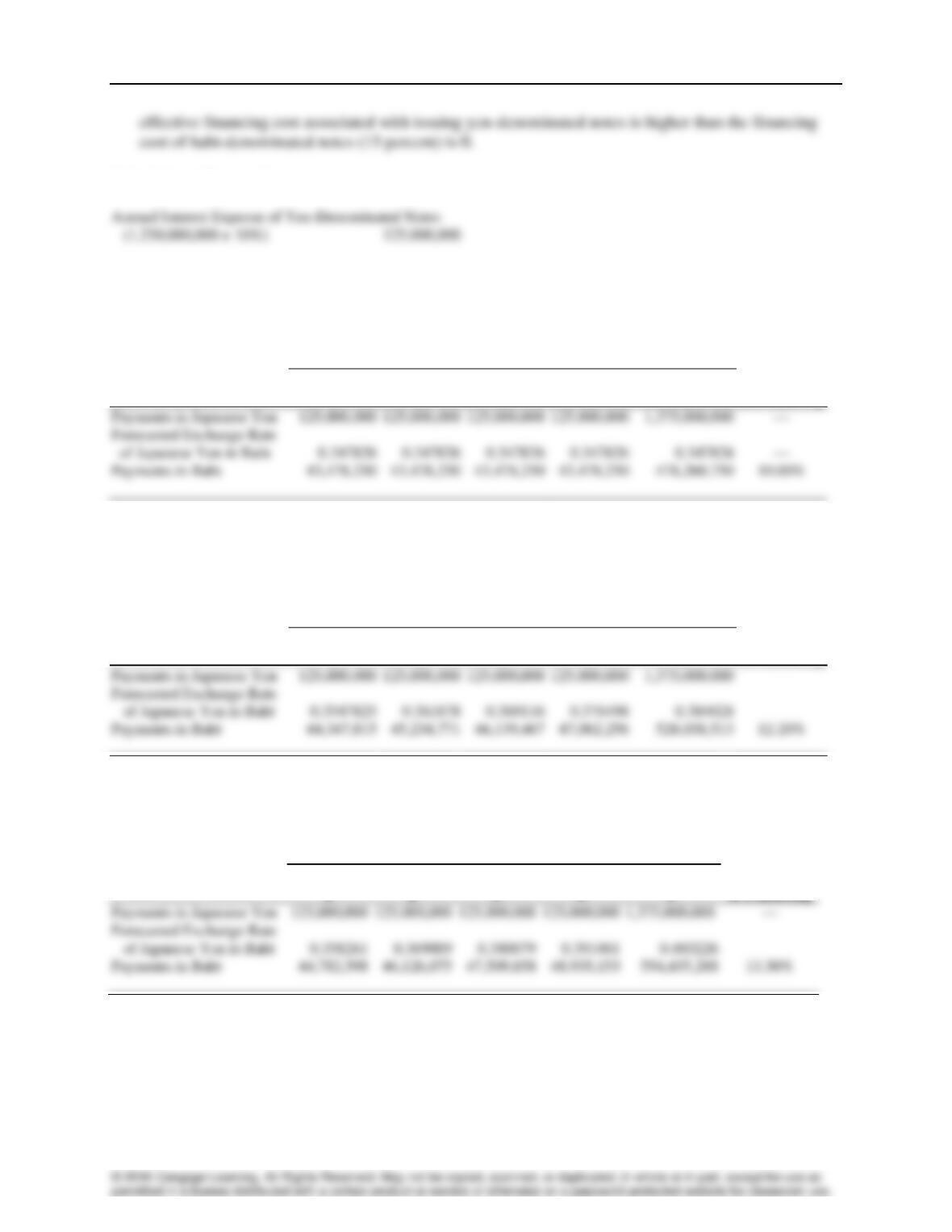
2. Construct a spreadsheet to determine the annual effective financing percentage cost of the yen-
denominated notes issued in each of the three scenarios for the future value of the yen. What is the
probability that the financing cost of issuing yen-denominated notes is lower than the cost of issuing
baht-denominated notes?
Long-Term Debt Financing ❖ 12
Calculation of Interest Expense:
Annual Interest Expense of Yen-Denominated Notes
(1) Yen Value Changes
by 0 Percent Annually
Relative to the Baht
End of
Year:
Annual Cost
1
2
3
4
5
of Financing
Payments in Japanese Yen
Payments in Baht
(2) Yen Value Changes
by 2 Percent
Annually Relative
to the Baht
End of
Year:
Annual Cost
1
2
3
4
5
of Financing
Payments in Japanese Yen
Payments in Baht
(3) Yen Value Changes
by 3 Percent Annually
Relative to the Baht
End of
Year:
Annual Cost
1
2
3
4
5
of Financing
Payments in Japanese Yen
1,375,000,000
Payments in Baht
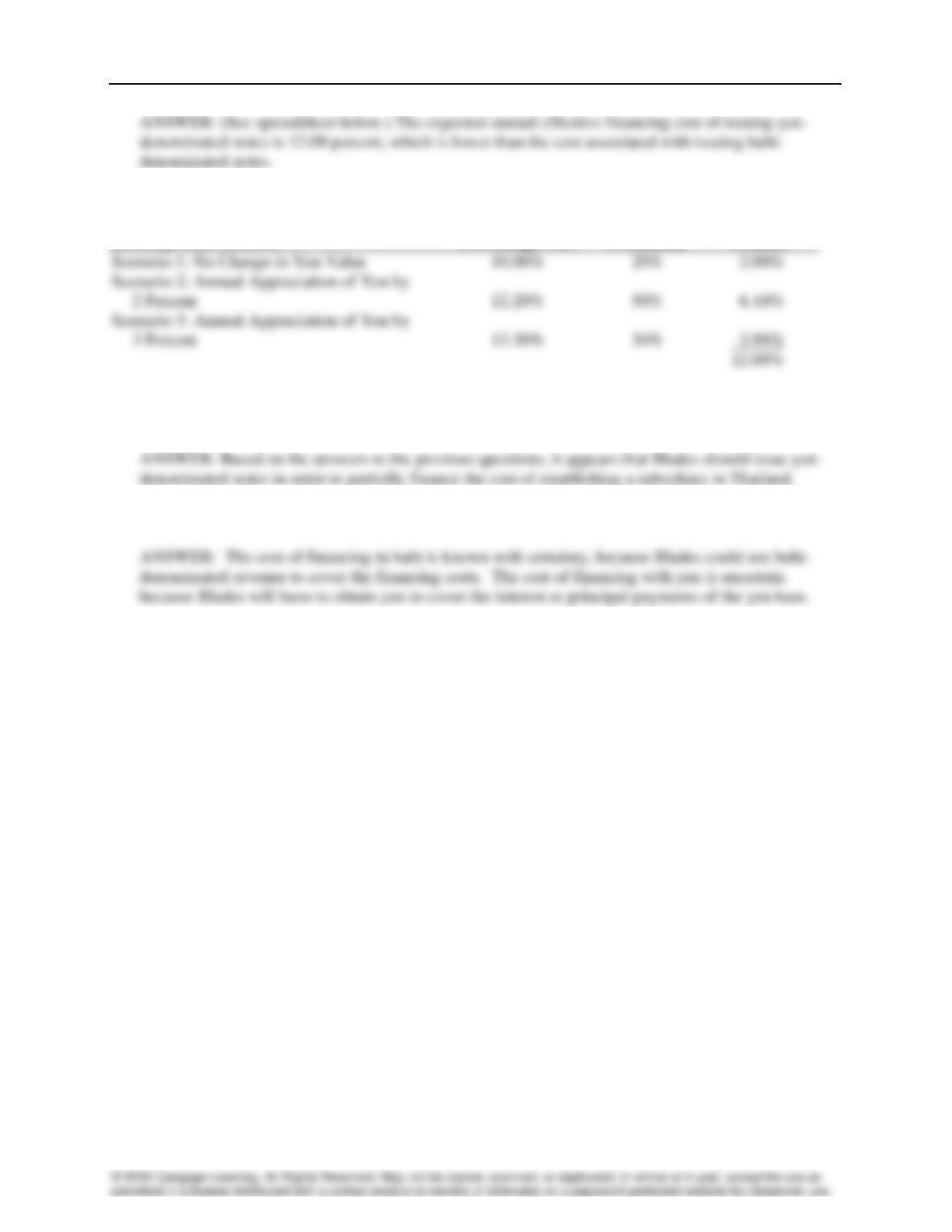
3. Using a spreadsheet, determine the expected annual effective financing percentage cost of issuing
yen-denominated notes. How does this expected financing cost compare with the expected financing
cost of the baht-denominated notes?
Long-Term Debt Financing ❖ 13
(1)
(2)
(3) = (1) × (2)
Exchange Rate Scenario
Effective Financing
Percentage Cost
Probability
Product
Scenario 1: No Change in Yen Value
2.00%
4. Based on your answers to the previous questions, do you think Blades should issue yen- or baht-
denominated notes?
5. What is the tradeoff involved?
Solution to Supplemental Case: Devil VCR Corporation
a. It can reduce its exposure to exchange rate risk, because it could convert the proceeds of the bond
into pounds to cover future production expenses and could use a portion of the revenue in
Singapore dollars each year to pay its coupon payments to bondholders.
b. This approach would increase Devil VCR’s exchange rate risk, because it already has expenses in
pounds and no revenue in pounds.
c. This approach would not reduce the exchange rate risk resulting from the exporting program,
because it is not offsetting the revenue received in Singapore dollars.
Small Business Dilemma
Long-Term Financing Decision by the Sports Exports Company
The Sports Exports Company continues to focus on producing footballs in the U.S. and exporting them to
the United Kingdom. The exports are denominated in pounds, which has continually exposed the firm to
exchange rate risk. It is now considering a new form of expansion where it would sell specialty sporting
goods in the U.S. If it pursues this U.S. project, it would need to borrow long-term funds. The dollar-
denominated debt has an interest rate that is slightly lower than the pound-denominated debt.
1. Jim Logan, owner of the Sports Exports Company, needs to determine whether dollar-denominated
debt or pound-denominated debt would be most appropriate for financing this expansion, if he does
expand. He is leaning toward financing the U.S. project with dollar-denominated debt, since his goal
is to avoid exchange rate risk. Is there any reason why he should consider using pound-denominated
debt to reduce exchange rate risk?
2. Assume that Jim decides to finance his proposed U.S. business with dollar-denominated debt if he
does implement the U.S. business idea. How could he use a currency swap along with the debt to
reduce the firm’s exposure to exchange rate risk?

Long-Term Debt Financing ❖ 15
Part 4 — Integrative Problem
Long-Term Asset and Liability Management
Gandor Company is a U.S. firm that is considering a joint venture with a Chinese firm to produce and sell
DVDs. Gandor will invest $12 million in this project, which will help to finance the Chinese firm’s
production. For each of the first three years, 50 percent of the total profits will be distributed to the
Chinese firm, while the remaining 50 percent will be converted to dollars to be sent to the U.S. The
Chinese government intends to impose a 20 percent income tax on the profits distributed to Gandor. The
Chinese government has guaranteed that the after-tax profits (denominated in yuan, the Chinese currency)
can be converted to U.S. dollars at an exchange rate of CHY1 = $.20 per unit and sent to Gandor
Company each year. At the present time, no withholding tax is imposed on profits sent to the U.S. as a
result of joint ventures in China. Assume that even after considering the taxes paid in China, an
additional 10 percent tax imposed by the U.S. government on profits received by Gandor Company.
After the first three years, all profits earned are allocated to the Chinese firm.
The expected total profits resulting from the joint venture per year are as follows:
Year
Total Profits from Joint
Venture (in yuan, CHY)
1
CHY60 million
2
CHY80 million
3
CHY100 million
Gandor’s average cost of debt is 13.8 percent before taxes. Its average cost of equity is 18 percent.
Assume that the corporate income tax rate imposed on Gandor is normally 30 percent. Gandor uses a
capital structure composed of 60 percent debt and 40 percent equity. Gandor automatically adds 4
percentage points to its cost of capital when deriving its required rate of return on international joint
ventures. Though this project has particular forms of country risk that are unique, Gandor plans to
account for these forms of risk within its estimation of cash flows.
Gandor is concerned about two forms of country risk. First, there is the risk that the Chinese government
will increase the corporate income tax rate from 20 percent to 40 percent (20 percent probability). If this
occurs, additional tax credits will be allowed, resulting in no U.S. taxes on the profits from this joint
venture. Second, there is the risk that the Chinese government will impose a withholding tax of 10
percent on the profits that are sent to the U.S. (20 percent probability). In this case, additional tax credits
will not be allowed, and Gandor will still be subject to a 10 percent U.S. tax on profits received from
China. Assume that the two types of country risk are mutually exclusive. This is, the Chinese
government will adjust only one of its taxes (the income tax or the withholding tax), if any.
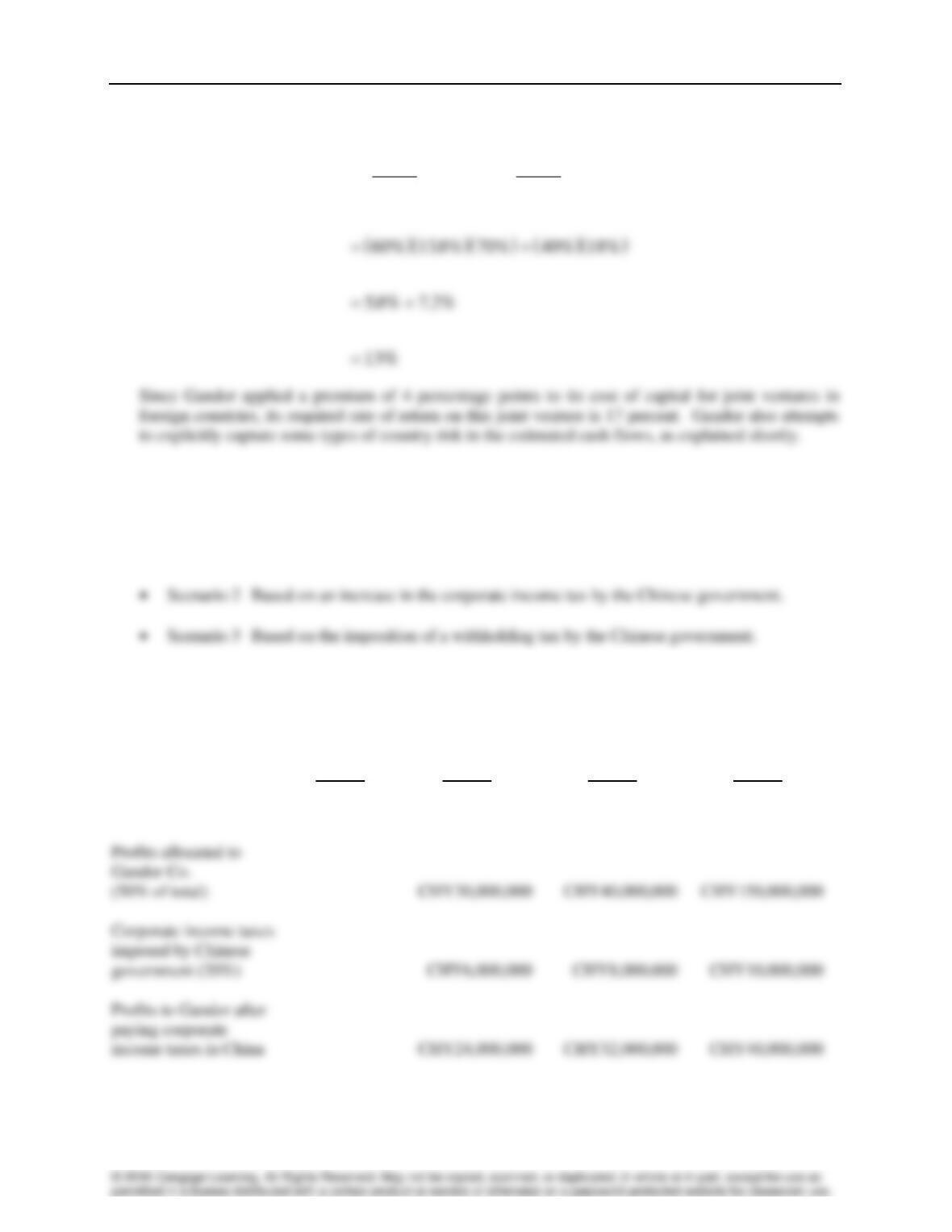
1. Determine Gandor’s cost of capital. Also, determine Gandor’s required rate of return for the joint
venture in China.
Long-Term Debt Financing ❖ 16
ANSWER: Gandor’s weighted average cost of capital is:
( )
kc
D
D E kd1 t E
D E ke
=+
− + +
2. Determine the probability distribution of Gandor’s net present values for the joint venture.
Capital budgeting analyses should be conducted for these scenarios:
• Scenario 1 Based on original assumptions.
SCENARIO 1: BASED ON ORIGINAL ASSUMPTIONS
(Probability = 60%)
Year 0
Year 1
Year 2
Year 3
Total profits
(in CHY)
CHY60,000,000
CHY80,000,000
CHY100,000,000
Gandor Co.
imposed by Chinese
government (20%)
CHY10,000,000
paying corporate
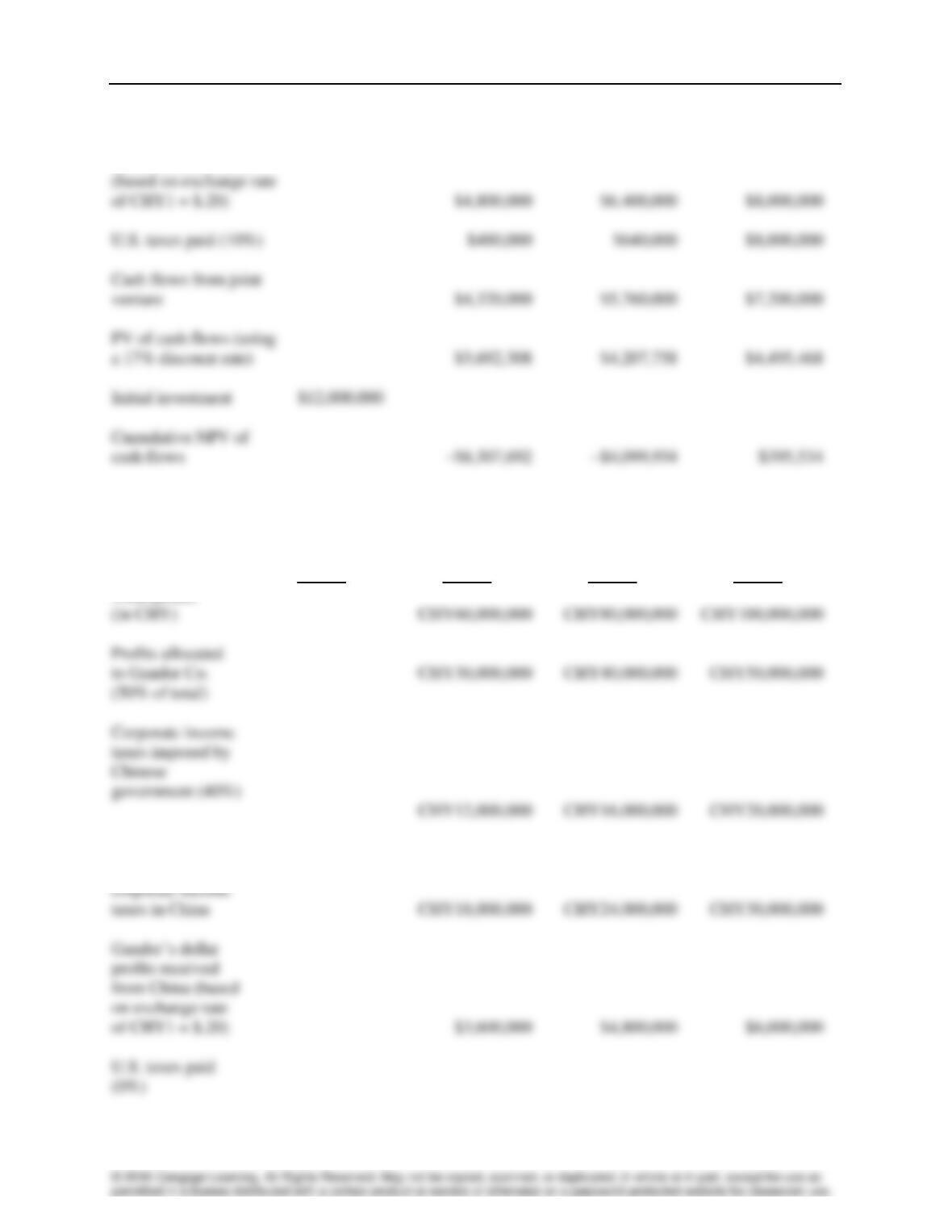
Long-Term Debt Financing ❖ 17
(based on exchange rate
Cash flows from joint
PV of cash flows (using
Gandor’s dollar profits
received from China
SCENARIO 2: BASED ON INCREASE IN CORPORATE INCOME TAX BY CHINESE GOVERNMENT
(Probability = 20%)
Year 0
Year 1
Year 2
Year 3
Profits allocated
to Gandor Co.
Corporate income
government (40%)
Total profits
from China (based
on exchange rate
Profits to Gandor
after paying
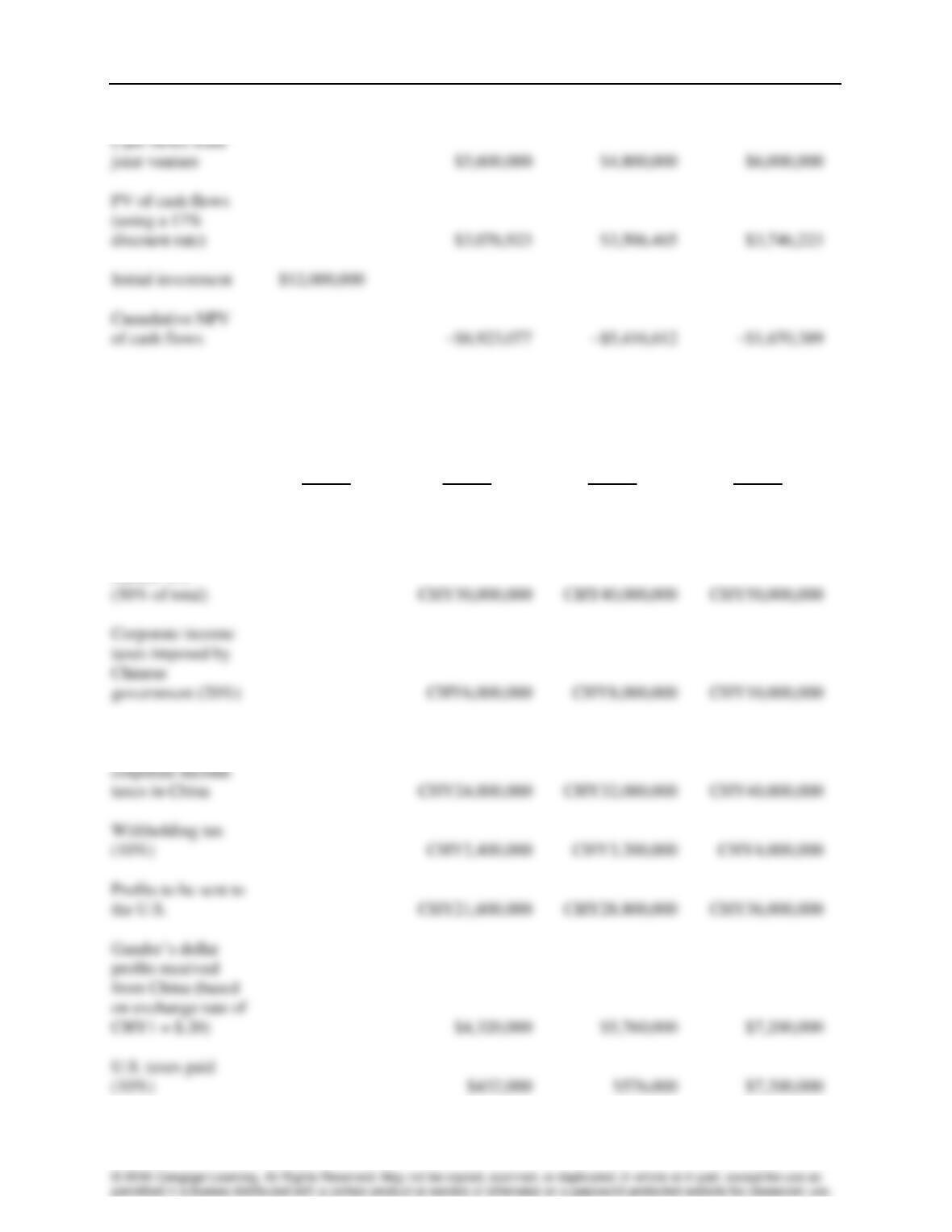
Long-Term Debt Financing ❖ 18
Cash flows from
PV of cash flows
(using a 17%
discount rate)
Initial investment
Cumulative NPV
of cash flows
SCENARIO 3: IMPOSITION OF A WITHHOLDING TAX BY CHINESE GOVERNMENT
(Probability = 20%)
Year 0
Year 1
Year 2
Year 3
Total profits
(in CHY)
CHY60,000,000
CHY80,000,000
CHY100,000,000
taxes imposed by
Chinese
Profits allocated to
Gandor Co.
corporate income
the U.S.
CHY21,600,000
CHY28,800,000
CHY36,000,000
profits received
from China (based
on exchange rate of
Profits to Gandor
after paying
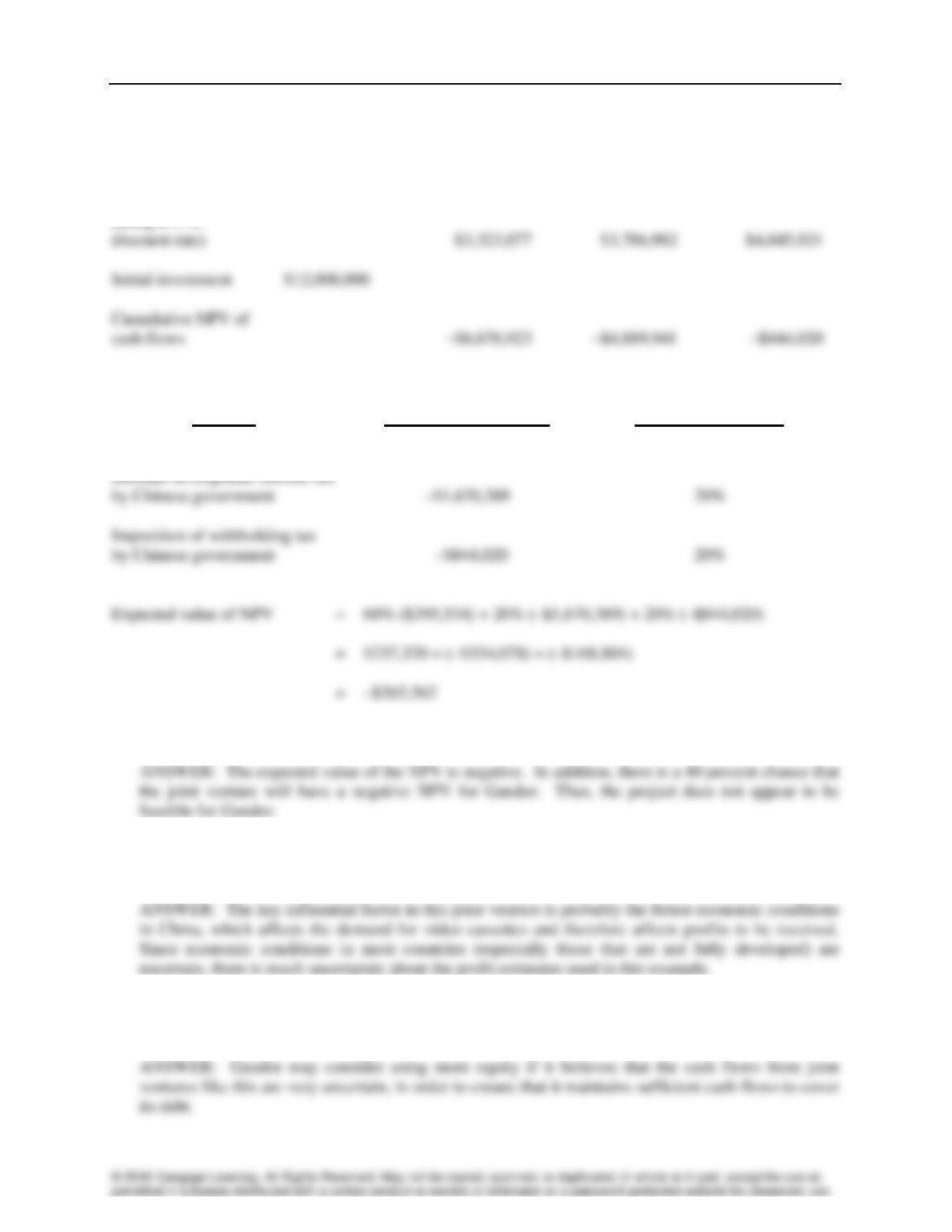
Long-Term Debt Financing ❖ 19
Cash flows from
joint venture
$3,888,000
$5,184,000
$6,480,000
(using a 17%
Cumulative NPV of
PV of cash flows
SUMMARY OF SCENARIOS
Scenario
NPV for This Scenario
Probability that This
Scenario Will Occur
Original scenario
$395,534
60%
Increase in corporate income tax
by Chinese government
20%
by Chinese government
20%
3. Would you recommend that Gandor participate in the joint venture? Explain.
4. What do you think would be the key underlying factor that would have the most influence on the
profits earned in China as a result of the joint venture?
5. Is there any reason for Gandor to revise the composition of its capital (debt and equity) obtained from
the U.S. when financing joint ventures like this?

6. When Gandor was assessing this proposed joint venture, some of its managers of recommended that
Gandor borrow the Chinese currency rather than dollars to obtain some of the necessary capital for its
initial investment. They suggested that such a strategy could reduce Gandor’s exchange rate risk. Do
you agree? Explain.