Instructor’s Manual – OMSC2 – Collier/Evans – C18 Lean Operating Systems
This chapter introduces students to concepts of lean, including the principles of lean operating
systems, types of waste they address, lean tools and approaches, Lean Six Sigma, application of
lean principles in manufacturing and service organizations, and just-in-time operating systems.
Instructors may wish to assign Supplement B: Decision Analysis and Supplement C: Break-even
Analysis to assist students in understanding the calculations used in decision analysis and break-
even problems.
Questions and problems are provided in three categories:
1. Review questions
The chapter has three cases:
1. Kempfer Furniture, Inc. is the first case study. It requires students to evaluate a chaotic, small
3. The integrative case study, Hudson Jewelers, with case assignment questions in all chapters,
requires students to research lean principles for diamond mining and designing a virtual jewelry
store or a street corner kiosk.
KEY TERMS
The 5Ss are derived from Japanese terms: seiri (sort), seiton (set in order), seiso (shine), seiketsu
(standardize), and shitsuke (sustain).
Batching is the process of producing large quantities of items as a group before they
A pull system operates with employees at a given operation going to the source of required parts,
such as machining or subassembly, withdrawing the units as they need them.
A push system produces finished-goods inventory in advance of customer demand, using a
forecast of sales.
Single Minute Exchange of Dies (SMED) refers to the quick setup or changeover of tooling and
fixtures in processes so that multiple products in smaller batches can be run on the same
equipment.
Visual controls are indicators for operating activities that are placed in plain sight of all
employees so that everyone can quickly and easily understand the status and performance of the
work system.
REVIEW QUESTIONS
1. What is lean enterprise?
Lean enterprise refers to approaches that focus on the elimination of waste in all forms,
2. Explain the four fundamental objectives of lean operating systems.
Lean operating systems have four basic principles:
3. What are the benefits of adopting lean operating systems?
Proponents of lean operating systems cite many benefits, including reductions in cycle
4. What are the “5Ss”? Why are they important to becoming lean?
The 5Ss are derived from Japanese terms: seiri (sort), seiton (set in order), seiso (shine),
seiketsu (standardize), and shitsuke (sustain).
• Sort refers to ensuring that each item in a workplace is in its proper place or identified
as unnecessary and removed.
5. What benefits do visual controls have for lean operating systems?
Visual controls are indicators for operating activities that are placed in plain sight of all
employees so that everyone can quickly and easily understand the status and performance
6. Explain the importance of short setup times in a lean environment. What approach is used
to reduce setup times?
Short setup times enable a manufacturer to have frequent changeovers and move toward
single-piece flow, thus achieving high flexibility and product variety. Reducing setup time
7. Define a transfer batch and single piece flow. Why are they important?
A transfer batch is part of the original batch (lot) size that is completed at one workstation
and moved to the next downstream workstation. Single-piece flow is the concept of
ideally using batch sizes of one.
8. How does quality improvement support lean enterprise?
Lean operating systems cannot function if raw materials are bad, processing operations are
not consistent, or machines break down. Poor quality disrupts work schedules and reduces
9. Explain the role of total productive maintenance in lean operating systems.
Total productive maintenance (TPM) is focused on ensuring that operating systems will
perform their intended function reliably. The goal of TPM is to prevent equipment failures
10. What is Lean Six Sigma? Why are lean and Six Sigma concepts highly complementary?
Lean Six Sigma is the integration of lean concepts with Six Sigma quality improvement
tools. For example, lean systems assume high quality output so as to maintain an
11. Explain the difference between push and pull systems. What advantages do pull systems
have over push systems?
Traditional factories use a push system, which produces finished goods inventory in
advance of customer demand using a forecast of sales. Parts and subassemblies are
“pushed” through the operating system based on a pre-defined schedule that is
independent of actual customer demand. In a pull system, employees at a given operation
12. What is a kanban? Explain how a Kanban system operates.
A Kanban is a flag or a piece of paper that contains all relevant information for an order:
part number, description, process area used, time of delivery, quantity available, quantity
delivered, production quantity, and so on. See Exhibit 17.8 for an illustration of how a
Kanban system operates. The Kanban system begins when the customer buys or uses the
13. Describe some of the key features of good JIT systems.
See Exhibit 18.5.
14. What is the role of suppliers in JIT systems?
Suppliers must be able to meet rigid schedules and provide small batches of parts on a
strict delivery schedule. This often requires suppliers to be close to JIT plants.
15. Does a high alpha value (say = 2 or 3) in Equation 1812 negate the benefits of a
Kanban/JIT operating system? Explain.
In general, the answer is yes since this policy variable doubles or triples Kanbans and
16. Define Takt time and why it is important?
Takt time is the production rate for one good or service based on the rate of sales. Takt
DISCUSSION QUESTIONS AND EXPERIENTIAL ACTIVITIES
17. Provide some examples of different types of waste in an organization with which you are
familiar, such as an automobile repair shop or a fast-food restaurant.
In a fast food restaurant, for example, we often see overproduction (food sitting under hot
lamps with no immediate sale), customer waiting, incorrect and under- and over cooked
18. Some companies use a technique called heijunka, which is a Japanese term that refers to
production smoothing in which the total volume of parts and assemblies are kept as
constant as possible. Research and write a short paper (2 pages max) about this technique
and how it relates to lean principles. Try to illustrate a case study of a company that has
used it.
In this example, the shift starts at 7 a.m. and kanban are withdrawn by a material handler
every 20 min. for distribution to the pacemaker point along the value stream. (In a lean
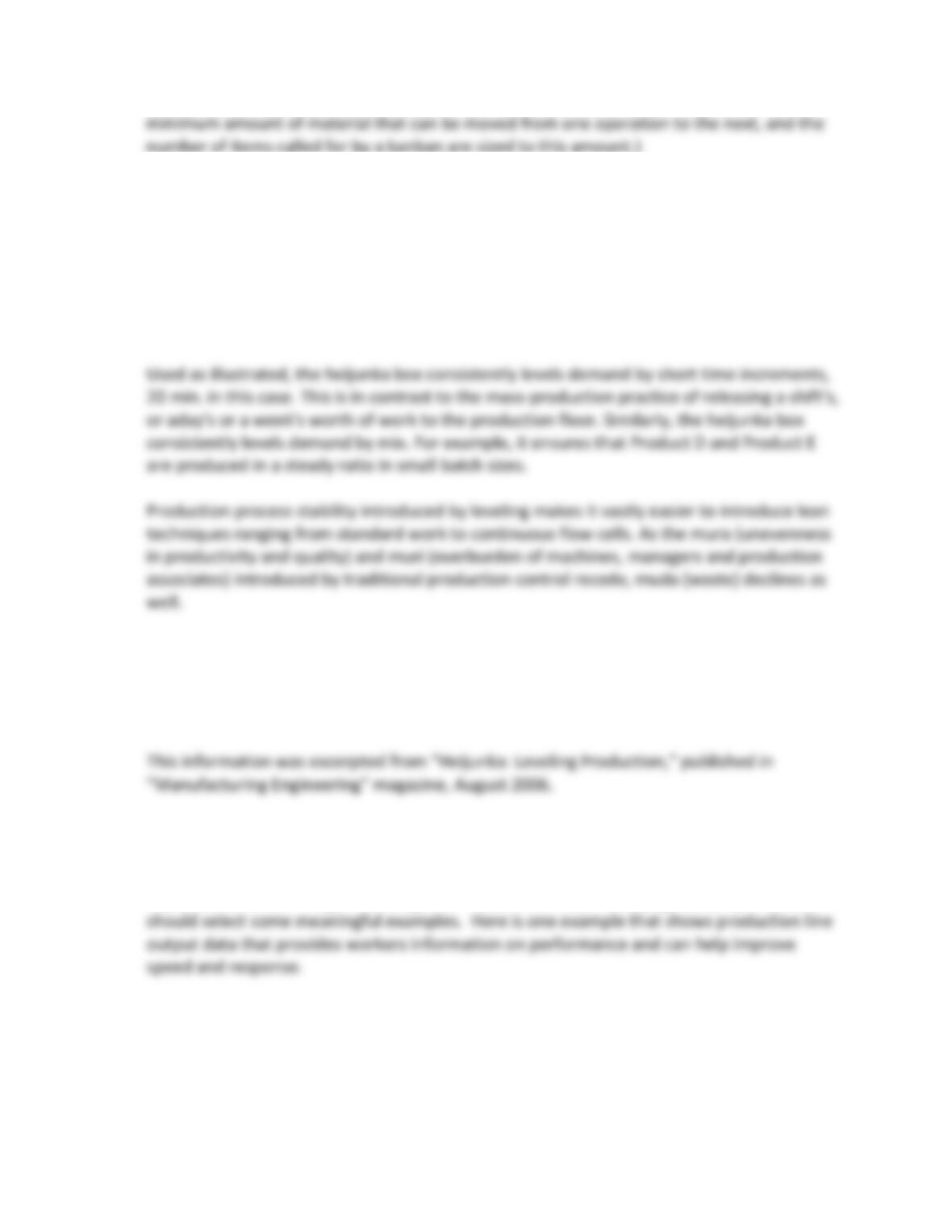
In the case of Product A, the pitch is 20 min., and there is one kanban in the slot for each
time interval. However, the pitch for Product B is 10 min., so there are two kanban in each
slot. Product C has a pitch of 40 min., so there are kanban in every other slot. Products D
and E share a production process with a pitch of 20 min. and a ratio of demand for Product
D versus Product E of 2:1. Therefore, there is a kanban for Product D in the first two
intervals of the shift, and a kanban for Product E in the third interval, and so on in the same
sequence.
When every process is leveled by volume and mix, it is a different world for employees —
who are no longer overburdened; for customers — who get better products on the date
promised; and for manufacturers — who get to keep the money saved when muda, mura
and muri are all reduced.
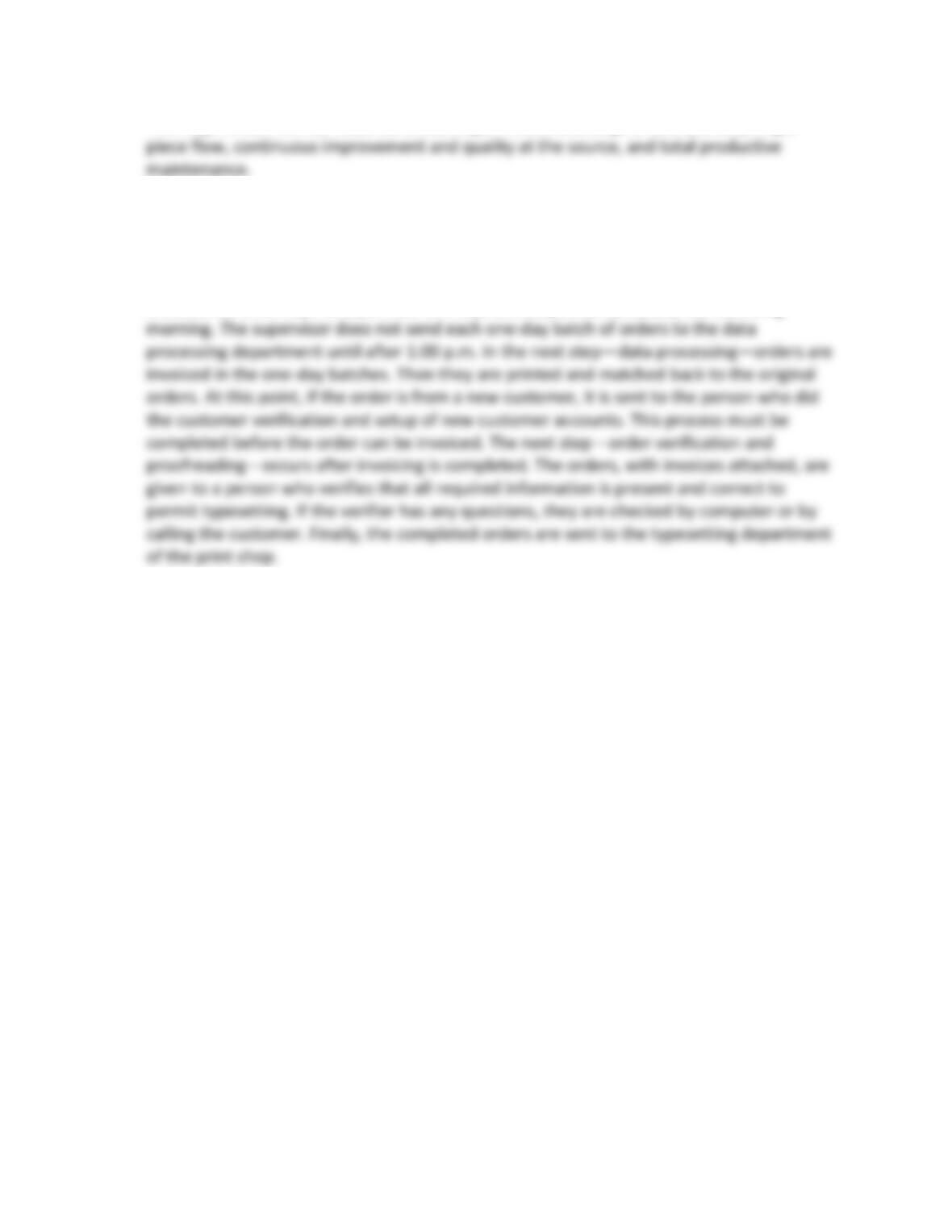
19. Search the Internet for images of visual controls. Select five of them and explain how they
contribute to achieving one of the four principles of lean operating systems.
If you search under Images on Google for “visual controls,” many pages pop up. Students
Here is another (health care) focused on improving quality:
20. What types of “setups” do you perform in your work or school activities? How might you
reduce the setup times?
Some examples might be gathering all materials needed to study for an exam, booting up a
computer and locating all necessary files to do an assignment, or making up a schedule for
21. Choose one of the lean tools and approaches from Section 18-2 of this chapter and
Research and write a short paper (2 pages maximum) on how organizations use this tool
and provide specific examples.
This might entail the 5s, visual controls, single minute exchange of dies (SMED), single
22. A catalog order-filling process can be described as follows: [modeled after an example in
Soren Bisgaard and Johannes Freiesleben. “Six Sigma and the Bottom Line,” Quality
Progress, Vol. 37, No. 9, September 2004, 57-62.] Telephone orders are taken over a 12-
hour period each day. Orders are collected from each person at the end of the day and
checked for errors by the supervisor of the phone department, usually the following
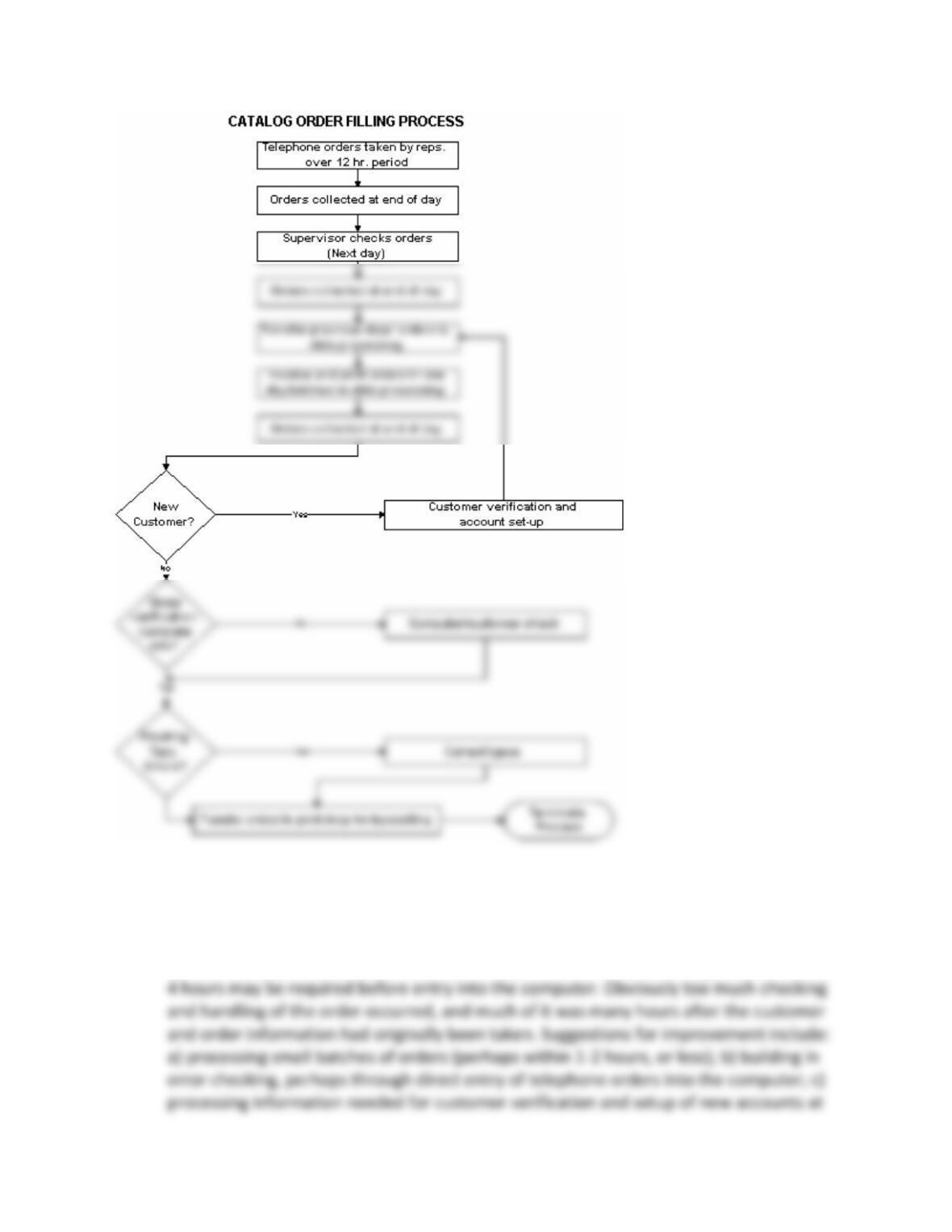
a. Develop a flowchart for this process (see Chapter 7).
One example is given next.
b. Identify opportunities for improving the process using lean principles.
The most serious problem from the standpoint of customer service is the potential for a
12-hour delay before an order reaches the supervisor for error checking, and another 3–
23. A team at a hospital studied the process of performing a diagnostic CT scan. The current
process can be described as follows.
The CT tech enters a “send for patient” request into a computer when the CT is available
for the next patient. The computer prints a request for transport and an orderly is assigned
to take the patient for the scan. The orderly walks to radiology and gets the ticket and
Draw a flowchart of this process, identify the value-added and non-value-added activities,
and describe how lean thinking can be applied to shorten the throughput time to perform
the CT scan.
Lean Principles
Value & Non-Value Added Discussion Issues
Eliminate Waste
Why print out a hard copy scan ticket? Why not read scan ticket
from hand held device or PC? Why does process require a
patient bed transfer (two beds)? Why not take bed in room (no
Reduce Cost
Partially electronic and paper based information flows that
need improvements. Are two beds necessary? Labor intensive
process with much waiting in practice.
24. Compare the lean service system of Southwest Airlines to a full service airline such as
United Airlines or British Airways on the following: (a) airplane boarding process, (b) cabin
service, (c) ticket transfer to other Southwest flights, (d) frequent flyer program, (e)
baggage handling, (f) seat assignment system, and (g) service encounters.
Operating System
Southwest
Full Service Airline
Boarding process
Stand in line in A.B, and C boarding
priority zones
First class boards first,
board by assigned seat
rows
Cabin service
No in-flight meals due to shorter
Frequent flyer program
Simple free flight after 8 paid
flights but loyalty program (with
points) being implemented
Complex point systems and
rewards
Seat assignment
No assigned seats but A, B, C group
System to assign seats
games, tell jokes — flight
boarding, etc.
professional
In-flight meals especially on
25. Do you think applying operations management concepts and methods such as Six Sigma
and lean principles can reduce U.S. health care costs? Explain. Provide examples that show
how OM can help the U.S. health care industry.
The resounding answer is yes. There are many examples of waste in the U.S. health care
system that currently is 15 to 18 percent of Gross Domestic Product (GDP). If this
26. Research and write a short paper (two pages maximum) on applications of the 5S
principles in service organizations, such as a hospital. If possible, provide some pictures
that illustrate the results of using the 5S principles.
A Google search of “5s hospitals” reveals over 6 million hits, and of course, the 5s is part of
implementing lean systems in hospitals. The Lean Enterprise Institute (www.lean.org), for
example, provides case studies on dental labs, hospitals, pharmacies, insurance, etc.
One excerpt from Quality Digest, “Athens Hospital Improves Processes by Implementing
Lean in Laboratory,” Georgia Institute of Technology, is as follows:
27. Search the Internet for manufacturing or service tours similar to the ones in this chapter.
Classify their practices according to the four lean principles in a manner similar to the
examples.
The text describes Timken and Southwest Airlines using the four basic lean principles:
1. elimination of waste
2. increased speed and response
28. Research and briefly describe one or two lean initiatives in service organizations and then
make an argument for or against adopting lean principles in service businesses. What is
different about applying lean in a factory versus a service situation? Describe your findings
in a two-page paper.
Starbucks is a good example of trying to adopt lean principles in a service business with
mixed results. The CEO noted, “The majority of cost reductions we’re achieved come from
a new way of operating and serving our customers. Over the quarter, we began to rollout
29. Interview a manager at a local company that uses JIT. Report on how it is implemented and
the benefits the company has realized.
Many companies use JIT so it should not be difficult to find one. Suppliers, original
30. Research JIT practices and how they impact purchasing. How do you think JIT systems
affect purchasing functions and practices? Answer this question in a short paper of no
more than two typed pages.
JIT practices make purchasing a much more demanding job. Fast transport time, frequent