31. Research and write a short paper on the impact of global supply chains on JIT.
Use Exhibit 18.5 to focus student attention. You can ask the students “How do each of
these JIT characteristics and best practices work when the supply chain is global?”
Long global supply chains are problematic for JIT success and require more global buffer
inventories, longer lead times, disaster planning, and dual sourcing to reduce risks, and so
on. If you Google “JIT global sourcing” you reveal about 800,000 hits so there is plenty of
information for the students. One article that you might find interesting is:
COMPUTATIONAL PROBLEMS AND EXERCISES
These exercises require you to apply the formulas and methods described in the chapter. The
problems should be solved manually.
32. Esplanade Marine Parts, Inc. wants to produce parts in batches of 100 parts. Each part must
be processed sequentially from workstation A to B.
a. How many seconds is required to produce the batch under the assumptions of batch
processing?
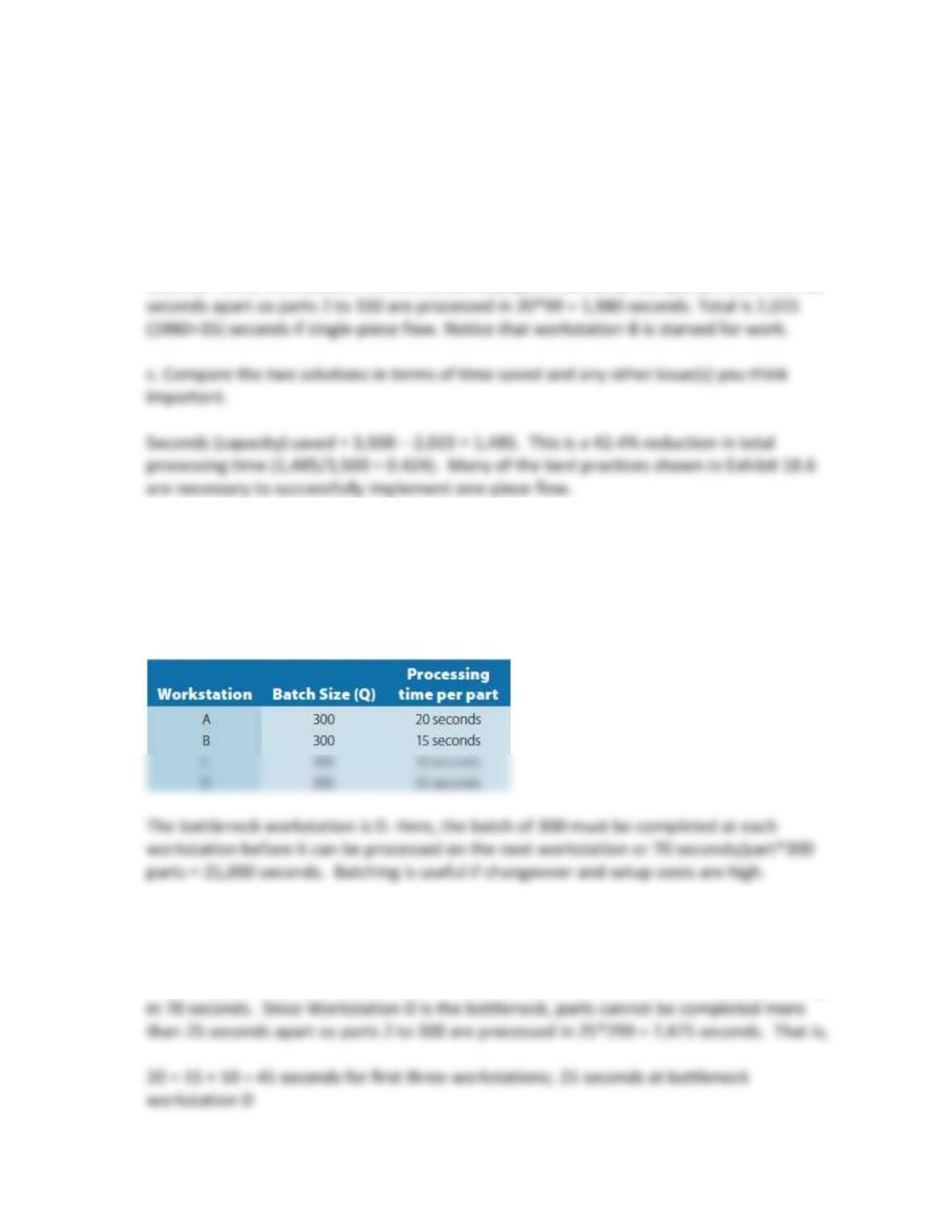
seconds/part*100 parts = 3,500 seconds. Batching is useful if changeover and setup costs
are high.
b. How many seconds is required to produce the batch under the assumptions of single–
piece flow processing?
The first part completes Workstations A in 20 seconds and then moves to B, finishing in 35
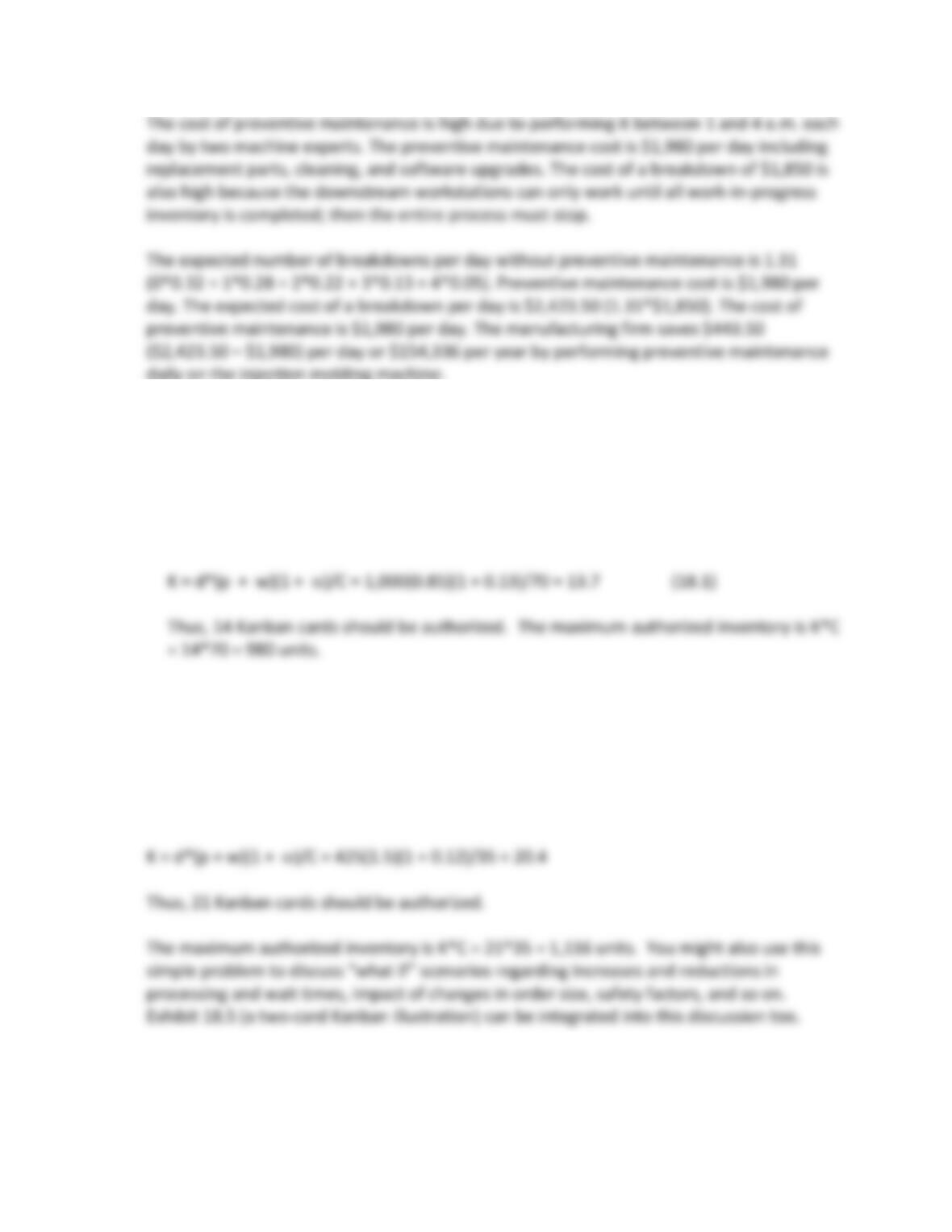
33. CDC Discrete Fabricators wants to produce parts in batches of 300 parts. Each part must be
processed sequentially from workstation A to B to C to D.
a. How many seconds is required to produce the batch under the assumptions of batch
processing?
b. How many seconds is required to produce the batch under the assumptions of single–
piece flow processing?
The first part completes Workstations A to C in 45 seconds and then moves to D, finishing

c. Compare the two solutions in terms of time saved and any other issue(s) you think
important.
Seconds (capacity) saved = 21,000 – 7545 = 13,455. This is a 64% reduction in total
34. A Florida lottery machine and printer at Store #8302 operates 360 days a year. If the
machine does not work and breaks down, it costs the Florida Lottery Commission $2,000
The expected number of breakdowns per day without preventive maintenance is 0.997
(0*0.333 + 1*0.333 + 2*0.333). Preventive maintenance cost is $670 per day. The expected
35. A plastic injection molding machine operates 348 days a year. It is the bottleneck
workstation in a process that produces plastic housed wall clocks. Industrial engineers
collected data on the probability of machine breakdowns, the costs of preventive
maintenance, and the cost of a breakdown.
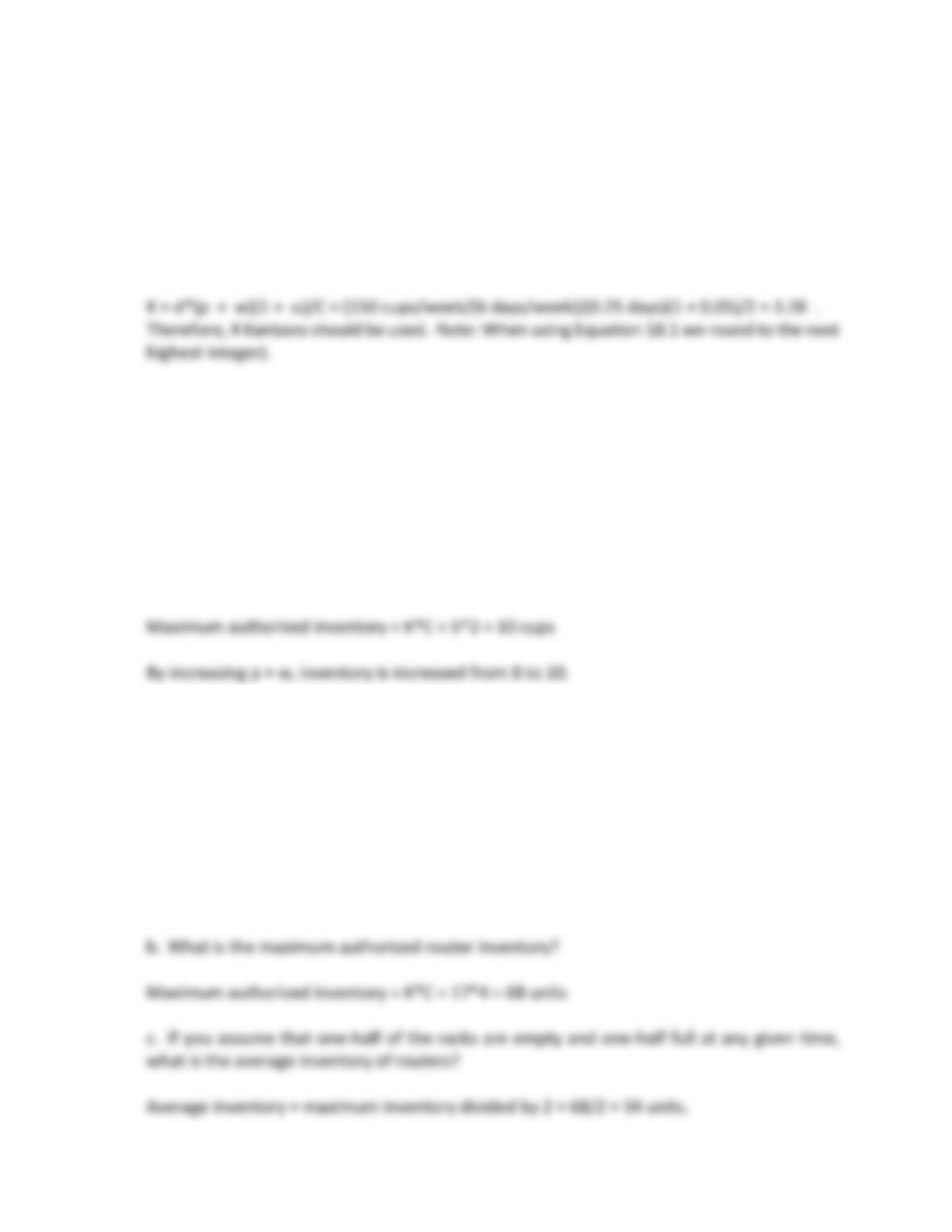
36. Bracket Manufacturing uses a Kanban system for a component. Daily demand is 1000
units. Each container has a combined waiting and processing time of .85 days. If the
container size is 70 and the alpha value () is 13%, how many kanban card sets should be
authorized? What is the maximum authorized inventory?
Using Equation 18.1 we have
37. Tooltron Manufacturing uses a Kanban system for a component. Daily demand is 425 units.
Each container has a combined waiting and processing time of 1.5 days. If the container
size is 35 and the alpha value () is 12 percent, how many kanban card sets should be
authorized? What is the maximum authorized inventory?
Using Equation 18.1 we have
38. Lou’s Bakery has established that JIT should be used for chocolate chips due to the high
probability of the kitchen heat melting the chips. The average demand is 150 cups of
chocolate chips per week. The average setup and processing time is 1/4 day. Each
container holds exactly two cups. The current safety stock factor is 5 percent. The baker
operates six days per week.
a. How many Kanbans are required for the bakery?
Using Equation 18.1 we have (note that setup and processing time is in days and demand is
in weeks):
b. What is the maximum authorized inventory?
Maximum authorized inventory = K*C = 4*2 = 8 cups
c. If the average setup and processing time is increased to 3/8ths of a day due to a process
change, what are the answers to (a) and (b)?
K = d*(p + w)(1 + )/ C = (150 cups/week/(6 days/week))*(0.375 days)*(1 + .05) = 4.9, or 5
Kanbans
39. Due to rapid changes in technology, a telecommunications manufacturer decides to
produce a router using just-in-time methods. Daily demand for the router is 17 units per
day. The routers are built on racks that hold four at a time (i.e., the container size). Total
processing and waiting time is 3.75 days. The process manager wants a safety factor of
only 5 percent.
a. How many Kanbans are required?
K = d*(p + w)(1 + )/C = (17 units/day)(3.75 days)(1 + 0.05)/4 = 16.7 or 17 Kanbans
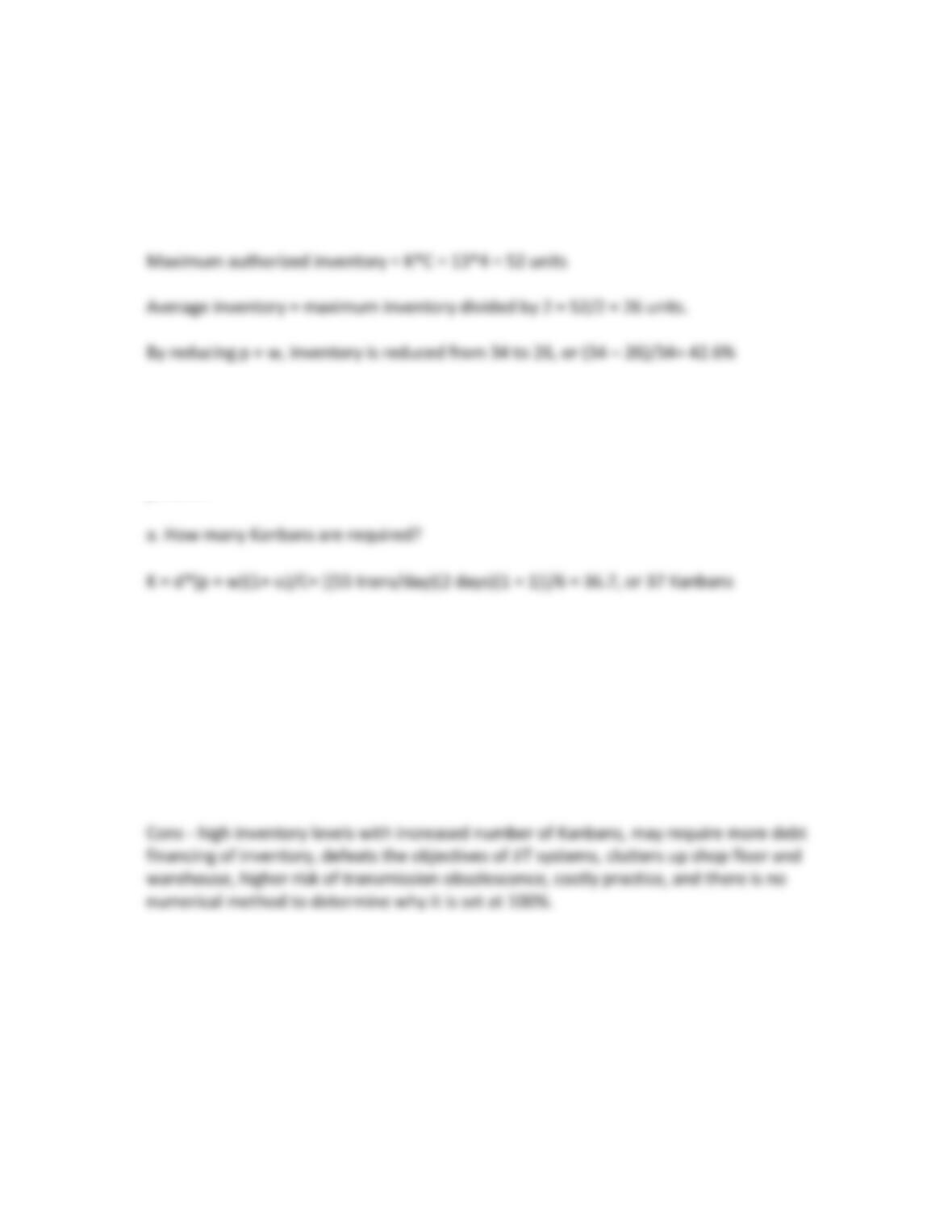
d. What are the answers to a to c if due to process improvements the total processing and
waiting time is reduced from 3.75 to 2.75 days?
K = d*(p + w)(1 + )/C = [(17 units/day)(2.75 days)(1 + 0.05)]/4 = 12.3 or about 13 Kanbans
40. An automobile transmission manufacturer is considering using a JIT approach to
replenishing its stock of transmissions. Daily demand for transmission #230 is 55
transmissions per day and they are built in groups of six transmissions. Total assembly and
waiting time is two days. The supervisor wants to use an alpha value (α) of 1, or 100
percent.
b. What is the maximum authorized inventory?
Maximum authorized inventory = K*C = 37*6 = 222 transmissions
c. What are the pros and cons of using such a high alpha value ()?
Pros – provides safety stock for emergency situations and process breakdowns, keeps
internal and external customers and suppliers happy, not really JIT.
41. A pillow assembly line consists of five stages arranged in series. The first workstation stuffs
the pillow with filler material. The second workstation sews the pillowcase and the third
stage places the pillow in a clear plastic sleeve. The fourth workstation places the pillow in
a box of three for shipping and seals the box. The fifth workstation places labels on the box
for shipping. Pillows are low value yet high cubic volume, so inventory holding cost is high.
In fact, the operations managers use a JIT lean assembly line and attempt to only produce
what they can sell. The assembly line works two shifts/day, 8 hours/shift minus 1 hour for
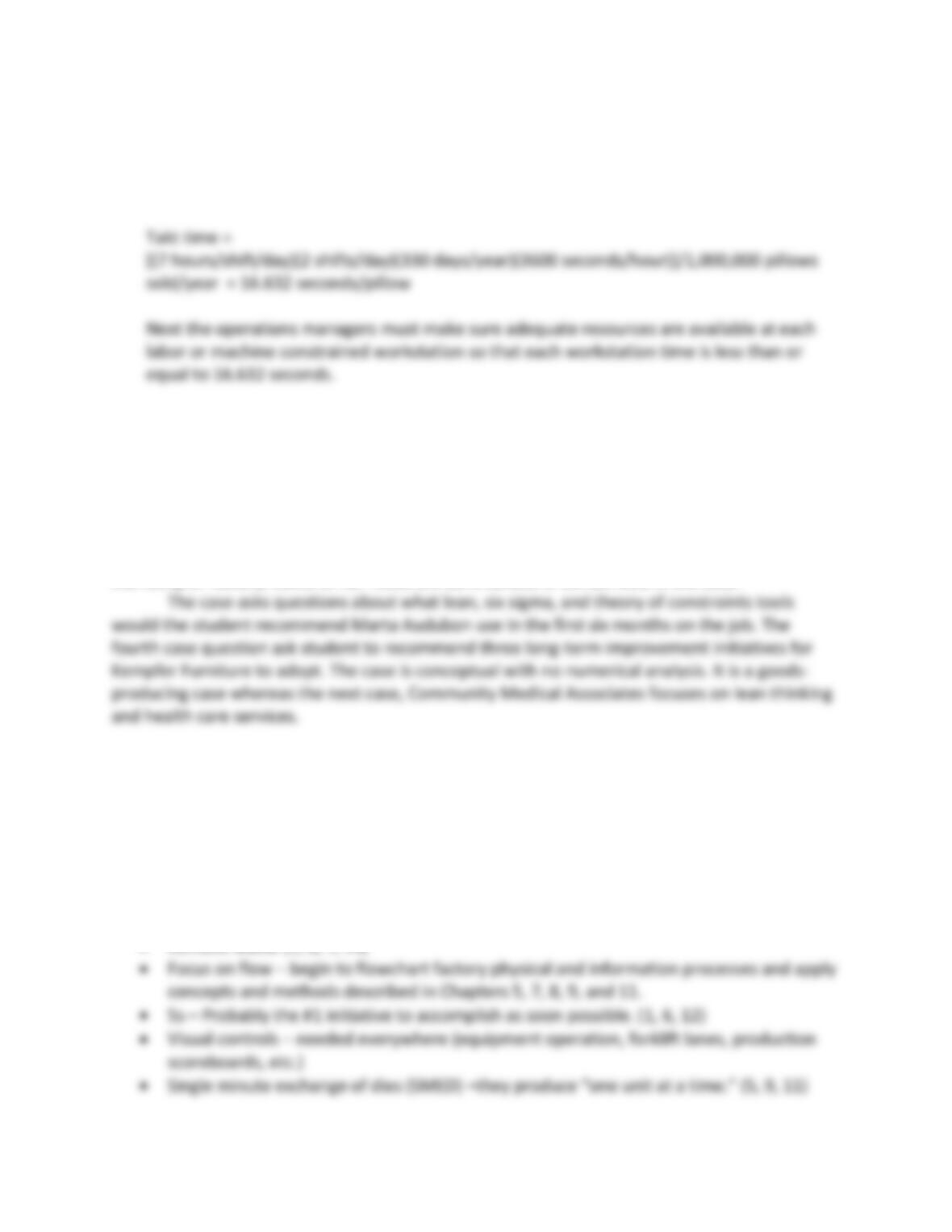
breaks and food, and 330 days per year. Annual demand is 1,000,000 pillows. What is the
Takt time in seconds? How is your answer used?
Takt time = Available time per time period/Market demand rate per time period (18.2)
Teaching Note: Kempfer Furniture, Inc.
Overview
A small furniture manufacturer located in South Carolina is close to bankruptcy. They hire a
person who had been Director of Lean Operations at Honda Manufacturing in Marysville, Ohio.
As the new Operations & Logistics Manager at Kempfer she begins to evaluate the situation at
Case Questions for Discussion:
1. Identify three lean tools you would recommend Kempfer Furniture immediately use.
Explain the benefits of usin ghtem
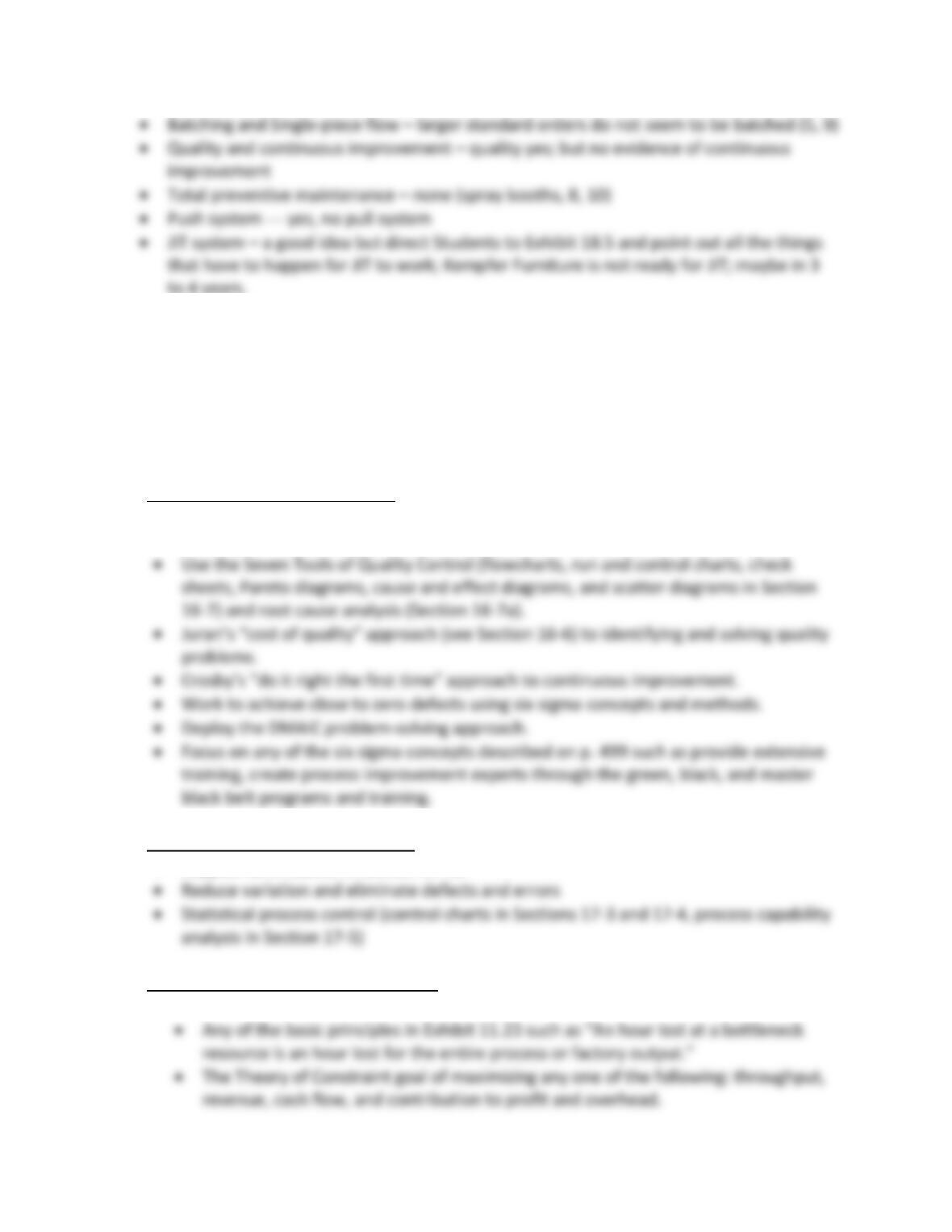
Lean tools that apply are summarized as follows with the numbers that follow citing Marta’s
notes. This question focuses on lean tools and concepts.
2. Recommend three Six Sigma or Theory of Constraints methods and tools that would help
turn this firm around. Explain your reasoning for choosing them.
Six Sigma is covered in Chapters 16 and 17 while the Theory of Constraints is described in
Chapter 11. For comparing Six Sigma, lean, and the theory of constraints, see Section 18-6.
The following are a few of the concepts and methods students may cite in their answers.
Chapter 16 Quality Management
• Quality of conformance is a way to begin measuring and monitoring quality.
• Deming’s Plan, Do, Study and Act (PDSA) approach to quality improvement.
Chapter 17 Quality Control and SPC
• Supplier certification in Section 17-1a
Theory of Constraints (in Section 11-6)
• Where’s the bottleneck?
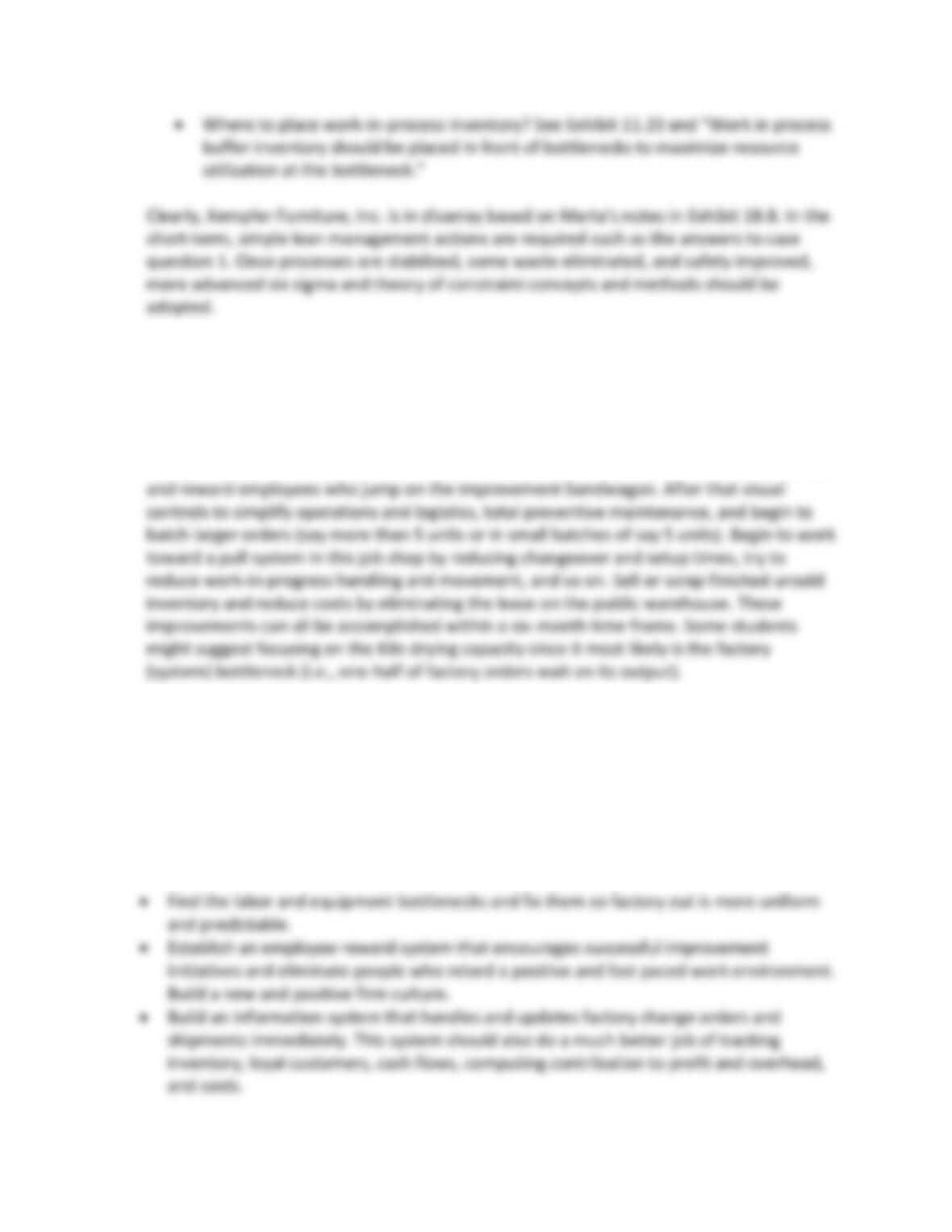
3. Develop a ten-step improvement implementation plan to be completed and led by Marta
Tompkins in the first six months. Justify this plan based on the facts of the case.
Student will develop many different short-term implementation plans. The first initiative
that needs to be done immediately is train all employees on the 5s and clean up the
workplace. Put tools in order, standardize work practices and procedures, and train, train,
4. Recommend three longer-term improvement initiatives to be accomplished after the
first six months. Describe each initiative in no more than three sentences (i.e., a short
paragraph).
A few long-term improvement initiatives might include the following.
• Set up a focused assembly line type factory for standard furniture and a job shop for
custom orders. Or only do customer orders and raise process.
Teaching Suggestions
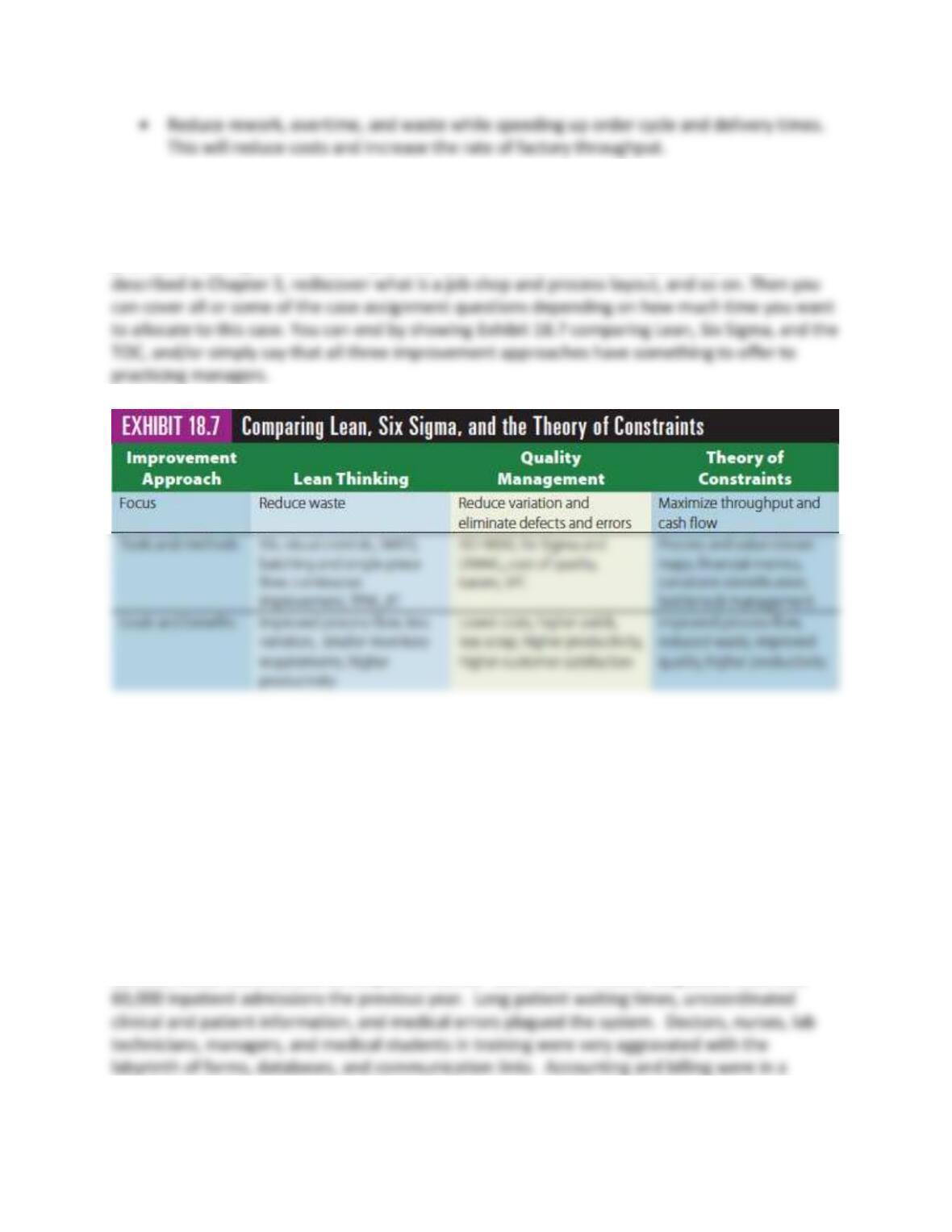
Begin by asking the class “How would they rank order Kempfer Furniture’s competitive
priorities?” During this discussion you may have to review the five competitive priorities
Note to Instructors: If you Google lean, six sigma, or theory of constraints success stories or
failures, you will be exposed to unhappy or happy corporate stories. Some organizations that
adopted any of these improvement initiatives are highly successful (Dupont, Ford) while others
are out of business (Circuit City, Albertsons) or struggling financially (General Electric,
Motorola).
Teaching Note: Community Medical Associates
Overview
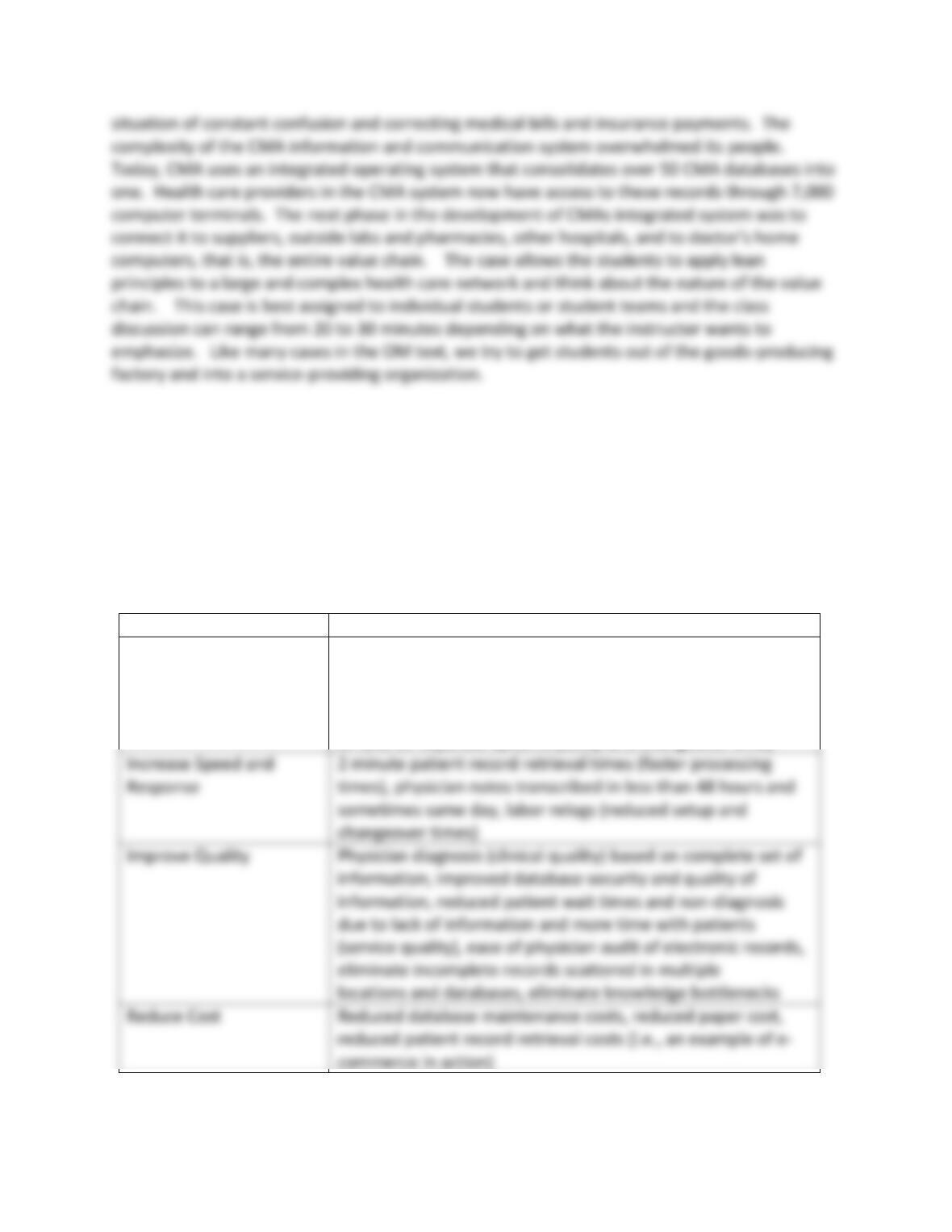
Community Medical Associates (CMA) is a large urban health care system with two hospitals, 25
satellite health centers, and 56 outpatient clinics. CMA had 1.5 million outpatient visits and
Case Questions for Discussion:
1. Explain how CMA used the four principles of lean operating systems to improve
performance.
One objective of this question is to have students apply lean principles to a complex health care
situation. The table below highlights some of the answers to this question. Most students or
student teams develop a table similar to the one below.
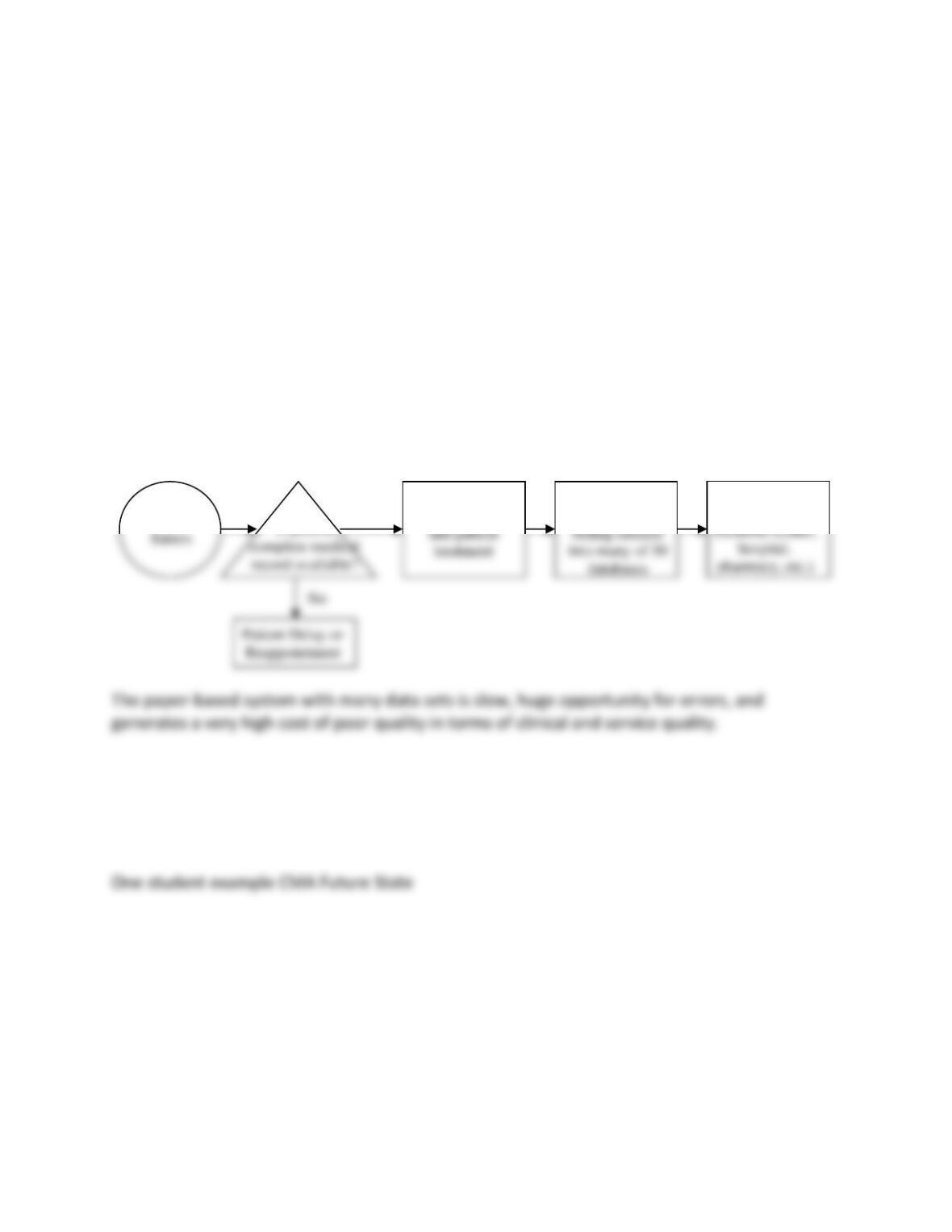
Lean Principles
CMA Examples
Eliminate Waste
Consolidate 50 databases into one (actual to ideal), new
database reduced paper usage by one-half, transcription
labor, less space for filing cabinets, labor relogs, eliminate
some hand-written physician notes, physicians and staff log
Example: Kaiser Permanente implemented a $4 billion e-health care system for their services.
They note in one sentence “Handicapped by a paper-based information non-system that just
about every other industry has left behind, health care is in a massive communication morass
that cries out for technological intervention and help.”
2. Using information from the case, sketch the original paper-based value chain and
compare it to a sketch of the modern electronic value chain, which uses a common
database. Explain how the performance of both systems might compare.
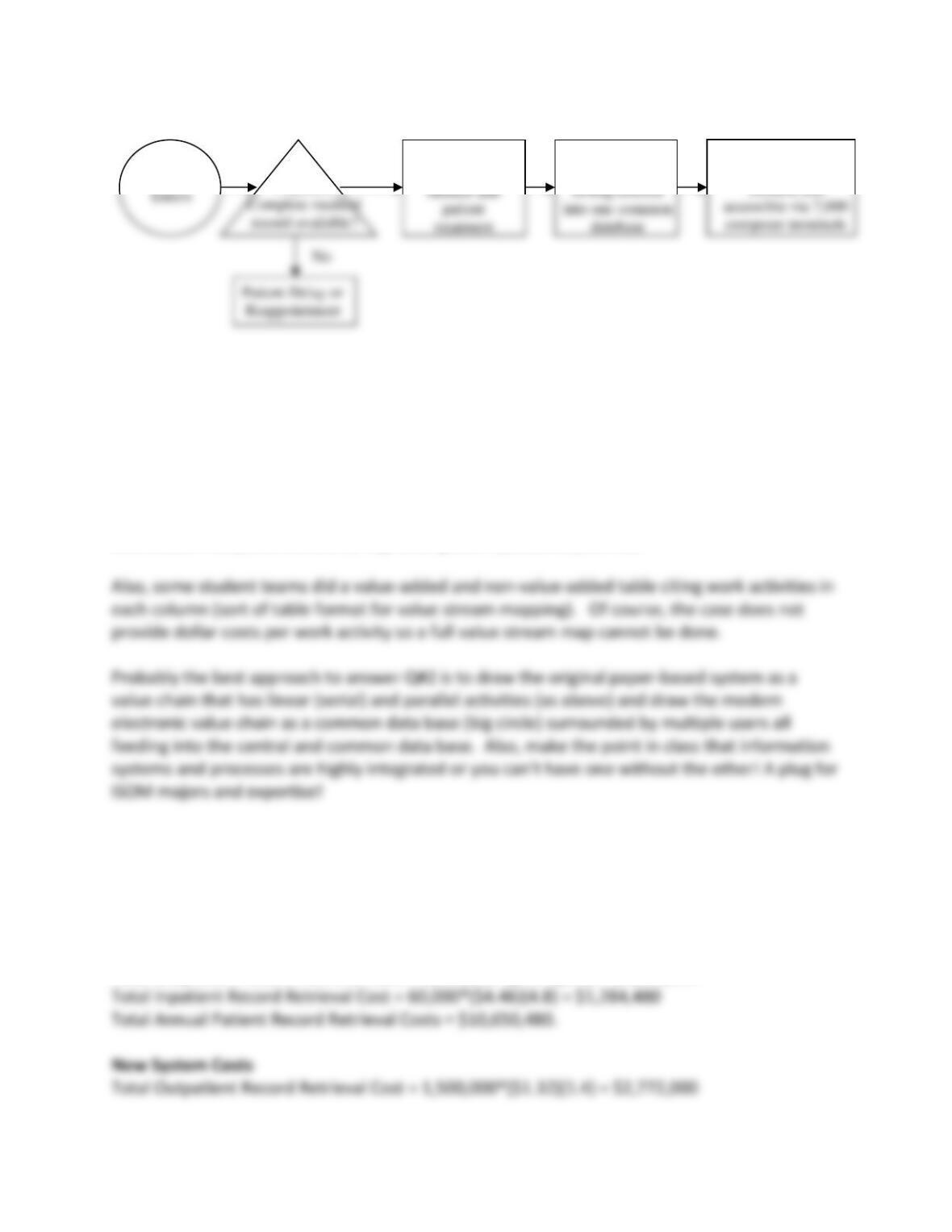
Students will draw many different structures based on their background and experience. Two
example student flowcharts are shown below. Students will also draw a broader view of the
value chain based on Exhibits 2.1, 2.2, and 2.3. Both narrow and broad views of CMA’s value
chain can be discussed.
One student example CMA Current State
Some students will draw the paper-based system in a series fashion and then draw the future
state with a central hospital database as the hub and all else connected to the hub in a circle.
Others use the pre- and post-production framework of Chapter 2 to define before and after
states.
Patient
Physician hand
written notes
Yes
Medical records,
insurance and
Medical files
stored in multiple
Connecting the CMA system to pharmacies, suppliers, home health care firms, other out–of–
network clinics and hospitals, and insurance firms in the value chain are examples of
synchronizing more parts of the value chain.
One undergraduate student team wrote below their diagrams “The performance of the value
chain was improved by eliminating hand-written notes, combining all the databases into one
centralized system, and storing patient files electronically so that all information could be
accessed at one time by all medical facilities and service-providers, allowing for faster
information flow, and therefore, improved patient (customer) service.”
3. What is the total annual record retrieval cost savings with the old (paper–based) versus
new (electronic) systems?
The numbers in OM3 have been changed from previous OM editions.
Old System Costs
Total Outpatient Record Retrieval Cost = 1,500,000*($4.46)(1.4) = $9,366,000
Patient
Physician notes
Electronically
Yes
Medical records,
insurance and
Patient medical
files stored in one
4. Does this CMA improvement initiative have any effect on sustainability? If so, how? If
not, why?
Yes, reducing waste such as less paper and transport and energy costs, for example, are
categories of environmental sustainability (see Exhibit 1.6). Social sustainability is also
5. Using lean principles, can you simultaneously improve the speed and quality while
reducing waste and costs? What are the trade-offs? Explain your reasoning.
The principles of Six Sigma, Lean, Cost of Quality, Continuous Improvement, and so on, all argue
for simultaneous improvements, so the answer is yes. See, for example, Quality is Free, by
Philip Crosby, for example. Another issue is how does the new information system improve
patient security and privacy or does it?
Teaching Plan
Review the case and discuss each question for discussion.
Integrative Case: Hudson Jewelers
A complete teaching note for all chapters is available in the Instructor Resources online.

Chapter 18 Case Questions for Discussion:
1. Write a short paper (maximum of two pages) on how the four principles of lean operating
systems are applied to diamond mining.
Lean operating systems have four basic principles:
1. elimination of waste,
Students will research diamond mining and discover two major types of mining as follows:
Diamond mining – continuous flow for underground mines with big tunneling machines
grinding out the soil and conveyers bringing the alluvial materials to the surface. This type of
Mining Productivity Metrics – carat yield per alluvial ton, alluvial ton processed per day,
machine excavating tonnage, carats per cubic meter, tonnage per truck, tonnage dug per
shovel, gem carat weight per alluvial ton,
2. If you were to design a jewelry store based only upon the four principles of lean
operating systems – elimination of waste, increased speed and response, improved
quality, and reduced cost – what would it look like? Incorporate OM concepts and
methods used throughout this textbook, such as mission and strategy, competitive
priorities, process type, service guarantees, supply chain, and so on as appropriate, into
your discussion.
This question may result in a student-designed virtual jewelry store or a street corner kiosk. You
could use this question for a course project. Make sure you set a page limit!