
Solutions for Chapter 17: Questions and Problems
CHAPTER 17
PROFESSIONAL MONEY MANAGEMENT,
ALTERNATIVE ASSETS, AND INDUSTRY ETHICS
Answers to Questions
1. Private management and advisory firms typically develop a personal relationship with
their clients, getting to know the specific investment objectives and constraints of each.
The collection of assets held can then be tailored to the special needs of the client.
Conversely, a mutual fund (investment company) offers a general solution to an
investment problem and then markets that portfolio to investors who might fit that
profile.
Special attention comes at a cost and for that reason private management firms are used
2. Based on Exhibit 17.2, there has been a rapid increase in the number of large asset
3. After the initial public sale of units in the investment company the open-end fund will
continue to sell new units to the public at the NAV with or without a sales charge and
will redeem (buy back) fund units at the NAV. In contrast, the closed-end fund does not

Solutions for Chapter 17: Questions and Problems
4. A load fund charges a fee for the sale of units (front end load) and/or redeeming units
5. You definitely should care about how well a mutual fund is diversified. One of the main
advantages of a mutual fund is instant diversification, so it truly is important. Given the
6. As an investor, it is the net return that is important because these are the returns that you
derive. The net return for a fund is the return after all research and management costs.
7. It is questionable whether good performance will continue during two successive short–
8. Managers are often compensated with a base salary and a bonus that depends on the
performance of their portfolios relative to those of their peers. Therefore, a manager with
9. Soft dollars are generated when a manager commits the investor to paying a brokerage
commission that is higher than the simple cost of executing a stock trade in exchange for
the manager receiving additional bundled services from the broker. One example would
Solutions for Chapter 17: Questions and Problems
– 134 –
CHAPTER 17
Answers to Problems
2. Load fund = ($1,000 – $80) × 1.15 = $1,058.00
Represents a 5.80% growth
3. Period NAV Premium/Discount Market Price Annual Return
0 $10.00 0.0 $10.00
1 11.25 -5.0 10.69 6.9%
3(a). Using the above data, the arithmetic average return per year is 3.65%. On an annual
compounded (geometric average) basis, the average annual return is 3.42%.
3(c). Ignoring commission, shares were purchased $10.69 and sold at 10.08, a return of –
5.7%
3(d). Change is NAV is $9.85 – $11.25 = $-1.40; the percentage change is $-1.40 / 11.25
= -12.44%
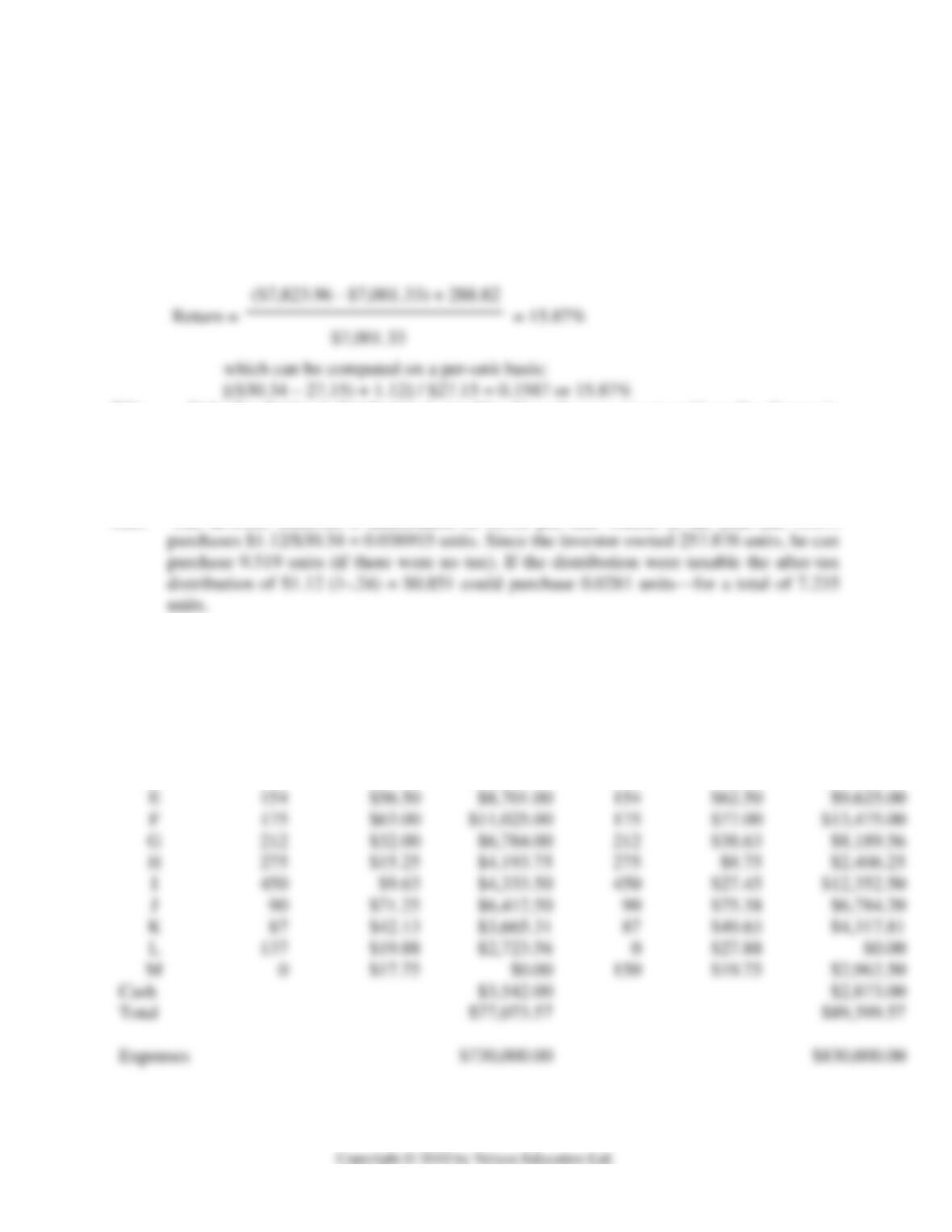
4(a). Client 1 Client 2
.0100 × 5,000,000 = 50,000 .0100 × 5,000,000 = 50,000
Solutions for Chapter 17: Questions and Problems
– 135 –
4(c). Costs of management do not increase at the same rate as the managed assets because
substantial economies of scale exist in managing assets.
5.(a). Beginning value = $27.15 × 257.876 = $7,001.33
Capital gain & dividends = $1.12 × 257.876 = 288.82
Ending value = $30.34 × 257.876 = 7,823.96
5(b). Only the dividend distribution is taxable; the units are not yet sold so the change in
NAV does not represent a taxable (realized) gain or loss:
[($30.34 – 27.15) + 1.12(1 – 0.24)] / $27.15
= 4.04 / $27.15 = 0.1488 or 14.88%
5(c). The investor received a distribution of $1.12 per unit which, at the year-end NAV,
6.
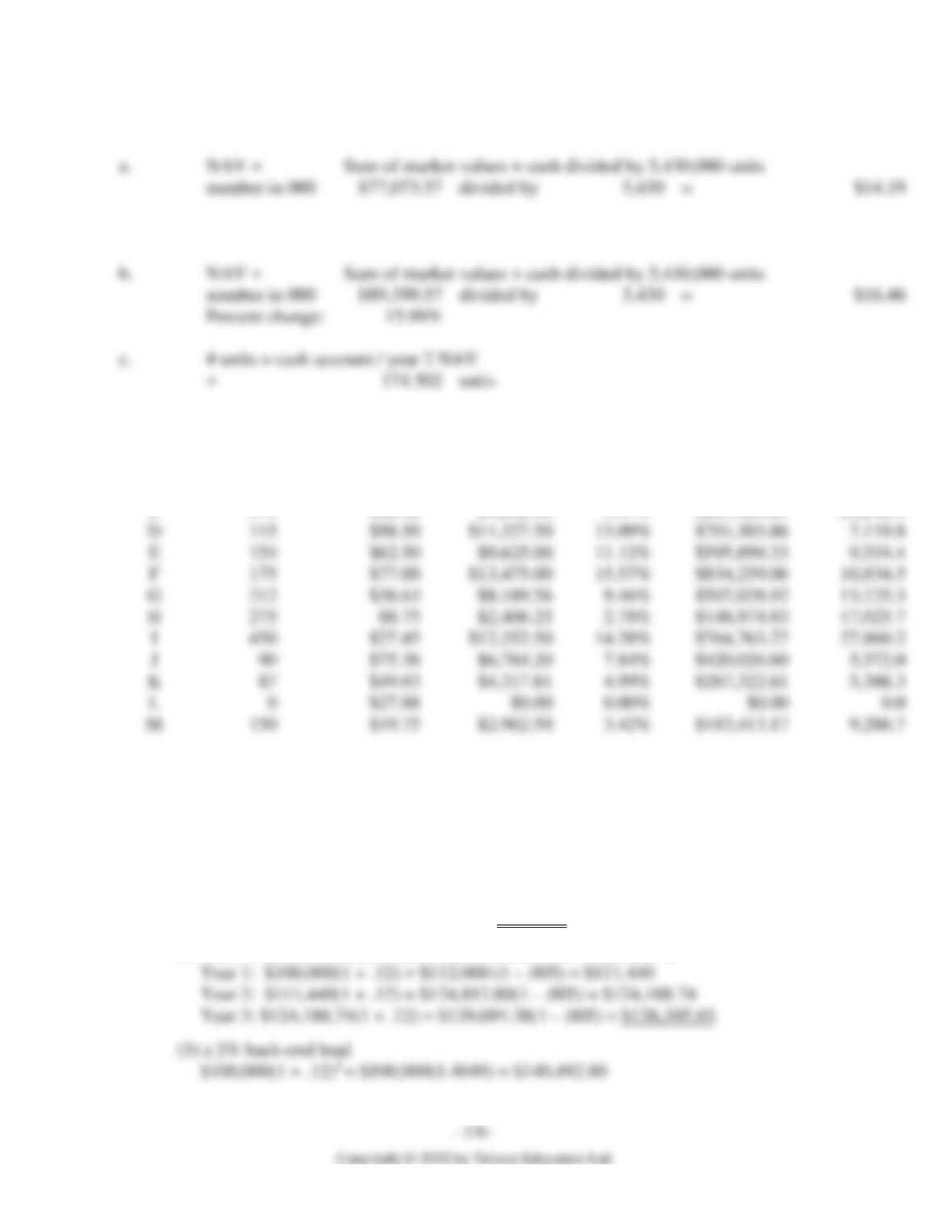
Year 1
Year 2
Stock
Shares (000)
price
MV (000)
Shares (000)
price
MV (000)
A
100
$45.25
$4,525.00
100
$48.75
$4,875.00
B
225
$25.38
$5,710.50
225
$24.75
$5,568.75
C
375
$14.50
$5,437.50
375
$12.38
$4,642.50
D
115
$87.13
$10,019.95
115
$98.50
$11,327.50
E
154
$56.50
$8,701.00
154
$62.50
$9,625.00
F
175
$63.00
$11,025.00
175
$77.00
$13,475.00
G
212
$32.00
$6,784.00
212
$38.63
$8,189.56
H
275
$15.25
$4,193.75
275
$2,406.25
450
$4,333.50
450
$27.45
$12,352.50
$71.25
$6,412.50
90
$75.38
$6,784.20
K
$42.13
$3,665.31
87
$49.63
$4,317.81
L
137
$19.88
$2,723.56
$27.88
$17.75
150
$19.75
$2,962.50
Cash
$3,542.00
$2,873.00
Total
$77,073.57
$89,399.57
Expenses
$730,000.00
Solutions for Chapter 17: Questions and Problems
NAV =
Sum of market values + cash divided by 5,430,000 units
number in 000
$77,073.57
divided by
=
$14.19
b.
NAV =
Sum of market values + cash divided by 5,430,000 units
number in 000
$89,399.57
divided by
=
$16.46
Percent change:
# units = cash account / year 2 NAV
Note: NAV is (market value of assets – liabilities) /# units. Expenses are not included in this calculation
d.
Year 2
Dollars to
Number of
Shares (000)
price
MV (000)
% holding
be sold
shares sold
A
100
$48.75
$4,875.00
5.63%
$301,819.14
6,191.2
B
225
$24.75
$5,568.75
6.44%
$344,770.33
13,930.1
C
375
$12.38
$4,642.50
5.37%
$287,424.69
23,216.9
D
115
$98.50
$11,327.50
13.09%
$701,303.86
7,119.8
154
$62.50
$9,625.00
11.12%
$595,899.33
9,534.4
175
$77.00
$13,475.00
15.57%
$834,259.06
10,834.5
G
212
$38.63
$8,189.56
9.46%
$507,028.92
13,125.3
H
275
$8.75
$2,406.25
2.78%
$148,974.83
17,025.7
450
$27.45
$12,352.50
14.28%
$764,763.27
27,860.2
$75.38
$6,784.20
7.84%
$420,020.80
5,572.0
K
$49.63
$4,317.81
4.99%
$267,322.61
5,386.3
$27.88
0.00%
M
150
$19.75
$2,962.50
3.42%
$183,413.17
9,286.7
Total value, shares only
$86,526.57
100.0%
$5,357,000.00
Amount to liquidate:
$16.31
x
500,000
=
$8,230,000
Less cash:
8,230,000
minus
2,873,000
=
$5,357,000
7(a). (1) 3% front-end load = $100,000 (1 – .03) = $97,000
$97,000 (1 + .12)3 = $97,000(1.4049) = $136,278
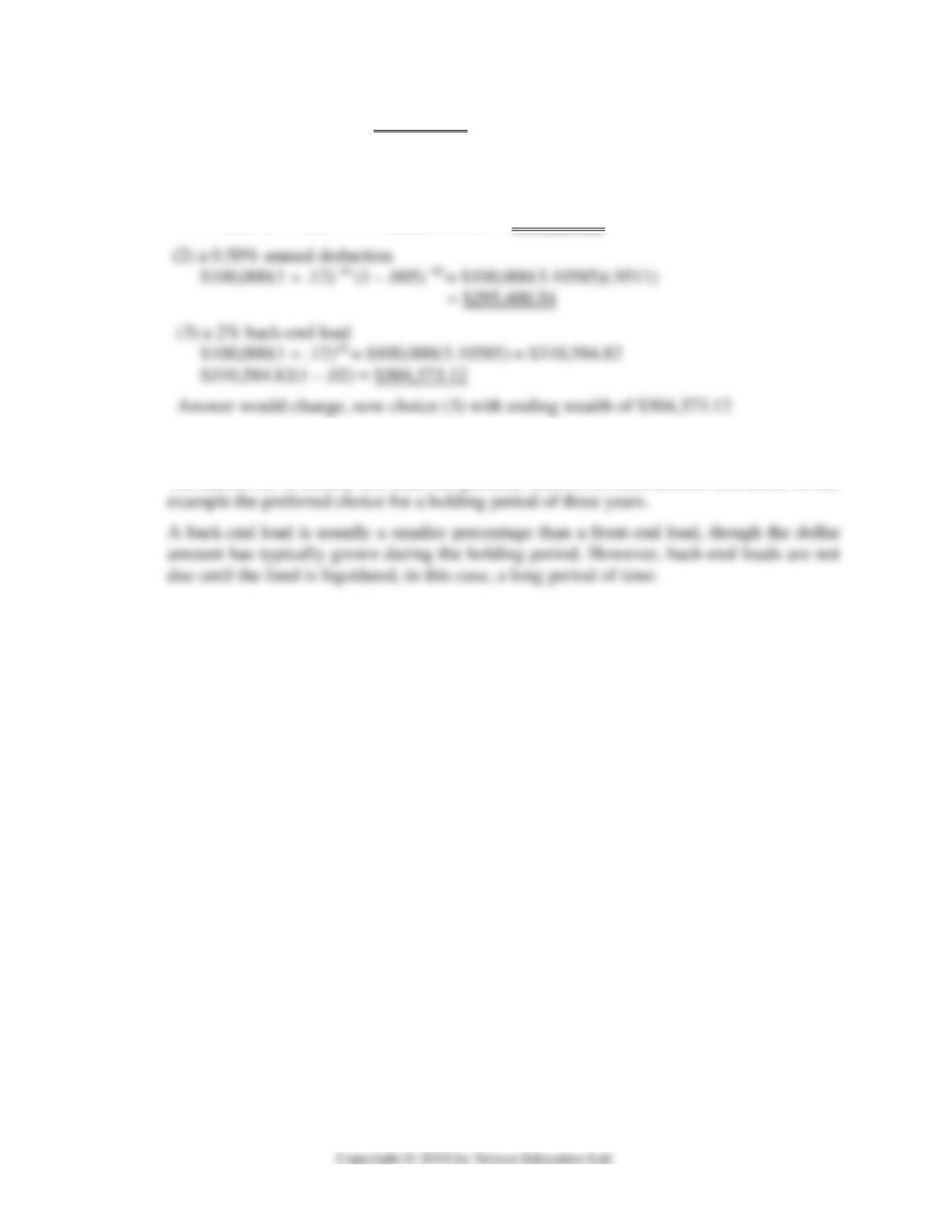
(2) a 0.50% annual deduction (assumed to be deducted at year-end)
Solutions for Chapter 17: Questions and Problems
– 137 –
$140,492.80(1 – .02) = $137,682.94
Choice (2) with ending wealth of $138,395.93
7(b). (1) 3% front-end load = $100,000 (1 – .03) = $97,000
$97,000 (1 + .12)10 = $97,000(3.10585) = $301,267.28
7(c). A front-end load takes the money out right away, thus reducing your initial deposit.
The annual fee is usually less than one percent, which is a small amount and based on the