
CHAPTER 17
Annuities
I. SUGGESTED CLASSROOM TIME: 60–80 MINUTES
II. CHAPTER OVERVIEW
Annuities are important contracts sold by life insurers, and they are becoming even more
important with their increasing use in funding Individual Retirement Accounts (IRAs),
pension plans, and other investments that offer tax-deferred earnings. The annuity
contract, in many respects, may be seen as the opposite of the life insurance contract.
III. LECTURE OUTLINE
A. Introduction—Annuities allow for efficient asset accumulation and estate liquidation.
The annuity contract protects annuitants from “living too long” or “living beyond a
person’s financial means.” Based on insurance principles, annuity distribution requires
prefunding and the pooling of a large number of similar exposures. Individuals dying
early may leave their savings to people living longer periods of time.
B. Definitions
1. Annuity (life income)—a regular stream of payments that can be guaranteed for
life—a life income annuity sold by insurers
C. Use of Annuities and Suitability Issues
1. When retirement income is needed that cannot be outlived

156 Chapter 17/Annuities
2. When managing money is not desired; the insurer provides this service
3. Various tax-deferral plans including IRAs and 403(b) (TSA) plans
D. Classification of Annuities
1. Method of premium payment
a. Single premium
2. Beginning of benefits—when the annuity payout begins
a. Immediate annuity: premium is paid and payments begin on the next annuity
payment date.
b. Deferred annuity: a long lapse may exist between the beginning of premium
3. Promises purchased
a. Straight life income (“pure” or “simple”): “Till death do us part” payments stop
at death with no other promise. Maximizes rent per premium dollar and makes
4. Number of annuitants
a. Single life covers one life

Chapter 17/Annuities 157
E. The Effect of Age and Gender on Annuity Benefits
1. Age: Older people should get higher rent per premium dollar than younger people
because payments should last for a shorter period.
F. Taxation of Annuities
1. Withdraw prior to liquidation—before age 59 1/2 typically—tax on previously
untaxed amount and 10 percent penalty on entire amount withdrawn. Penalty does
G. Appendix: Recent Developments in Variable Annuity Guarantees
IV. ANSWERS TO REVIEW QUESTIONS
1. How do most Americans qualify for annuity payments? Most Americans
acquire life-time annuity protection and qualify for annuity payments as a result of
2. Identify the three sources of funds used to pay annuity benefits. Annuity
benefit payments are composed of three elements: 1) A liquidation of the original
principal (premium) paid to the insurer by the annuitant; 2) compound interest earned

158 Chapter 17/Annuities
3. Describe adverse selection with respect to an annuity. How is adverse
selection related to the fact that the annuity mortality table shows lower
mortality at any specified age than do life insurance tables? “Adverse
4. Define the following terms: single premium immediate annuity; single
premium deferred annuity; and annual premium deferred annuity. A
deferred annuity is one in which the benefits are not received until some time after the
premiums have been paid. In other words, with this payment plan, there will be a
5. Give some reasons for and against purchasing a refund annuity. A cash
refund annuity provides for a cash payment to be made to a beneficiary if the annuitant
fails to receive annuity payments equal in amount to the premium paid. The size of the
6. How does a cash refund annuity differ from an installment-refund
annuity? The cash refund annuity and the installment refund annuity differ in how
Chapter 17/Annuities 159
7. Which will provide a larger monthly payment to a male annuitant age 65:
an annuity, five years certain, or an installment-refund annuity? Assume
the same amount of money is available for each purchase. An annuity five
years certain guarantees payments for five years or until the death of the annuitant,
8. Why do some insurers treat female annuitants as if they were male
annuitants of a younger age? Since females tend to live longer (on the average)
than males, annuity rates should be lower for females. That is, the amount paid is
9. Describe a structured settlement. What is its purpose? A structured
settlement generally arises out of negligence cases. In these instances, instead of the
10. What circumstances favor the purchase of a pure annuity over an annuity
twenty-years-certain? What circumstances favor an annuity twenty-years-
certain over a pure annuity? A pure annuity would be indicated for people who
have no dependents or whose dependents have income resources of their own. This

160 Chapter 17/Annuities
11. Illustrate the difference between a joint-life annuity and a joint-and-
survivor annuity. A joint annuity continues payments only until the first of the two
12. Briefly explain the purpose of a variable annuity and the financial theory
that underlies it. The variable annuity is supposed to provide a relatively constant
amount of purchasing power during a period of inflation. That is, the annuity payment
13. Has the theory underlying variable annuities been proved right or wrong
during the last several decades? In, approximately, the 60-year period in which
variable annuities have been available, the theory underlying the variable annuity has
14. Describe a financial circumstance in which owning a variable annuity
would not be a good idea. A variable annuity would probably not be a good idea for
15. What are the consequences of Stevie Ray withdrawing all his funds from
an annuity as a lump sum of cash before liquidation? Steve is 42 years old.
If an annuity owner withdraws funds during the accumulation period, the withdrawal
16. Describe the exclusion ratio and its purpose. The exclusion ratio is the amount
paid for an annuity divided by the expected return from the annuity. The purpose is to

Chapter 17/Annuities 161
calculate the amount of each annuity payment that is considered investment income
V. ANSWERS TO OBJECTIVE QUESTIONS
1. The definition of an annuity insurance policy is a
2. An annuitant makes one payment to the insurer 15 years before he retires. At
retirement, the insurer pays the annuitant a lifetime income on a monthly basis. This
transaction is an example of a
3. If an annuitant withdraws funds from an annuity during the early years of the
accumulation period and receives less than the contract’s prewithdrawal value, this
result is likely due to a(n)
4. If an annuity contract contains a promise to continue payments until the second of two
deaths, it is called a
5. The period when the insurer makes payments to the annuitant is called: the

162 Chapter 17/Annuities
6. Which of the following annuities would pay the highest monthly income for $1,000
premium, holding all other factors constant?
7. An annuity that does not have fixed payments during liquidation is the
8. Which of the following statements is true?
VI. IDEAS FOR INSTRUCTORS AND TEACHING METHODS
1. In approaching the need for annuity products, we present the prospect of living for
2. Discuss the different types of annuities and talk about the different types of family
situations in which they would be particularly useful. In which family situations would
they not be useful?
3. Discuss the applicability of mutual funds or other financial instruments as a substitute
for the life annuity contract. What are the pros and cons of using the life income
annuity versus these other financial instruments?
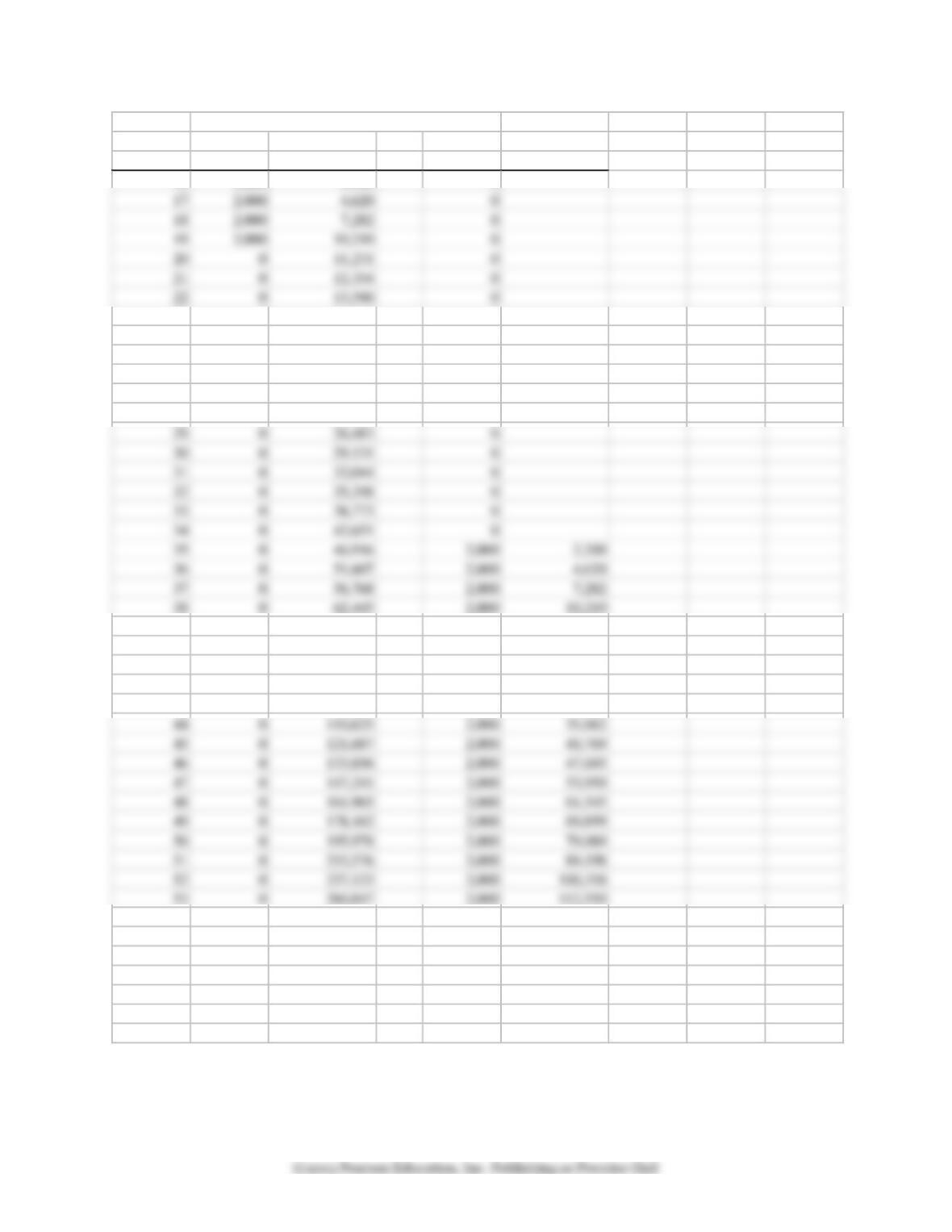
4. Use an electronic spreadsheet to demonstrate the power of the time value of money.
16. Each payment is made at the beginning of the year. (See the results on the next
page.) This illustrates the power of compounding. It is always better to start earlier
than later on a savings program.
Chapter 17/Annuities 163
ACCUMULATED SAVINGS AT 10%
Annual Accumulated Annual Accumulated
Age Deposit Amount Deposit Amount
16 2,000 2,200 0
23 0 14,949 0
24 0 16,444 0
25 0 18,088 0
26 0 19,897 0
27 0 21,886 0
28 0 24,075 0
39 0 68,689 2,000 13,431
40 0 75,558 2,000 16,974
41 0 83,114 2,000 20,872
42 0 91,425 2,000 25,159
43 0 100,568 2,000 29,875
54 0 286,932 2,000 126,005
55 0 315,625 2,000 140,805
56 0 347,187 2,000 157,086
57 0 381,906 2,000 174,995
58 0 420,096 2,000 194,694
59 0 462,106 2,000 216,364
60 0 508,317 2,000 240,200