Kinicki/Williams, Management, 9e: Chapter 16 Control Systems and Quality Management: Techniques for
Enhancing Organizational Effectiveness
16-i
Chapter 16
Control Systems and Quality
Management
Techniques for Enhancing
Organizational Effectiveness
CHAPTER CONTENTS
Management in Action Case 45
Legal/Ethical Challenge Case 48
Career Corner Group Exercises 62
Uber Continuing Case 65
Manager’s Hot Seat Videos 66
Application-Based Activity 68
Kinicki/Williams, Management, 9e: Chapter 16 Control Systems and Quality Management: Techniques for
Enhancing Organizational Effectiveness
TEACHING RESOURCE MANUAL: A GUIDE TO IMPLEMENTATION
The purpose of the Teaching Resource Manual (TRM) is to support you in the delivery of your
chosen curriculum in either a face-to-face or online classroom formats. It also was created to
help you address some of the following challenges in higher education:
• Addressing the inability to measure student comprehension prior to major assignments
such as a midterm or project.
• Overcoming the inability to tailor your lecture to the topics that students find difficult.
• Increasing student engagement by providing opportunities for them to apply the
So What Assets Can I Choose From?
Generally, a typical class session for any course comprises three “touch points:” before, during,
and after class. For a face-to-face course, your class session would normally be the day you
lecture to students. For an online course, the class session would be when you recorded the
lecture or when the live lecture is streamed on the Web.
Our teaching resources fall into 16 categories: SmartBook 2.0, Click and Drag Exercises, iSeeIt
Animated Videos, Self-Assessments, Case Analyses, Video Cases, Example and Practical Action
Assigning SmartBook 2.0 and Connect® Exercises
SmartBook 2.0, (In Connect®, click on Performance / Reports / Assignment Results. Here you
can choose SmartBook and choose the assignment you wish to view reports for.) The following
reports are available through SmartBook 2.0:
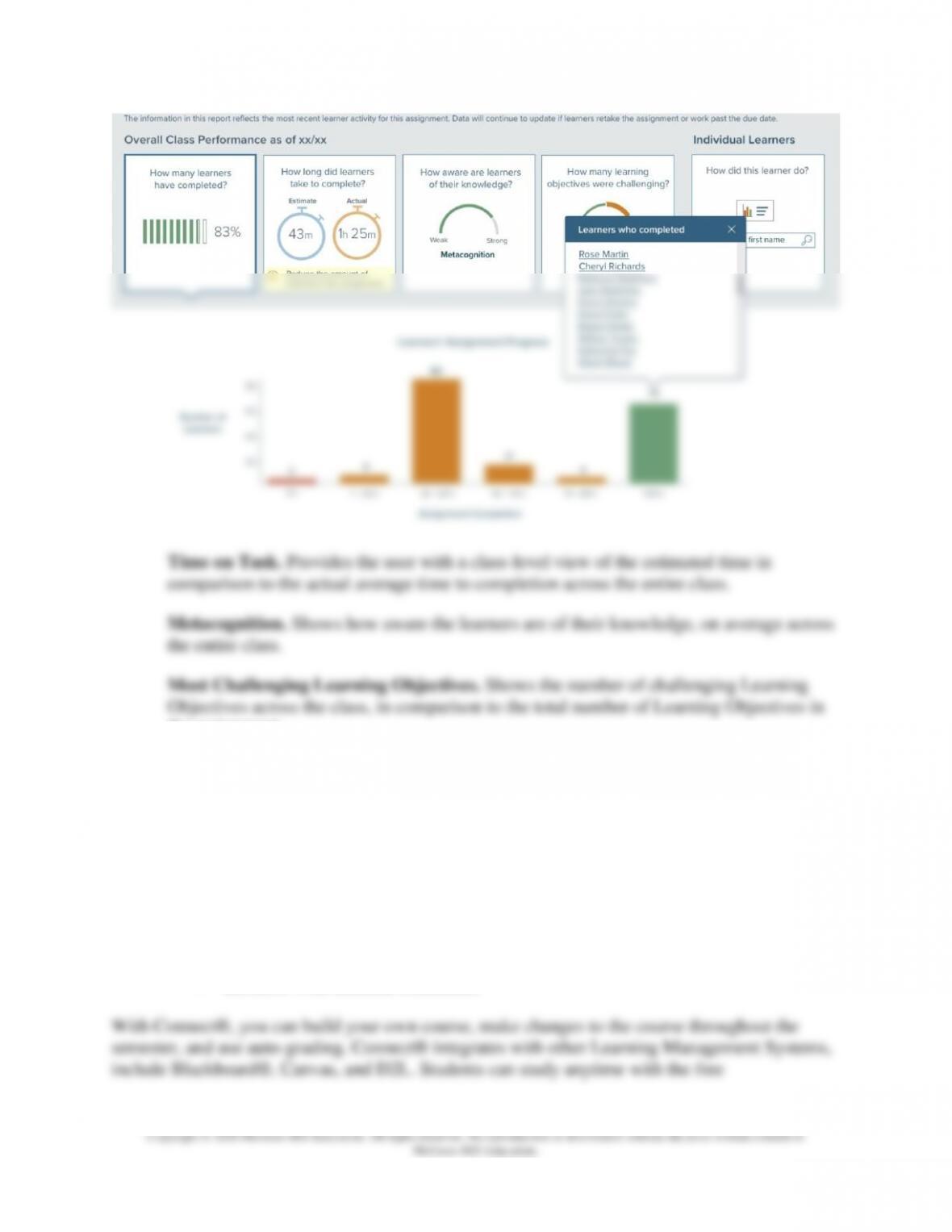
Instructor Dashboard. Click on one of the tiles from Assignment Completion, Time on
Task, Metacognition, Most Challenging Learning Objectives, and Individual Learners.
Kinicki/Williams, Management, 9e: Chapter 16 Control Systems and Quality Management: Techniques for
Enhancing Organizational Effectiveness
16–iii
Copyright © 2020 McGraw-Hill Education. All rights reserved. No reproduction or distribution without the prior written consent of
McGraw-Hill Education.
Time on Task. Provides the user with a class-level view of the estimated time in
comparison to the actual average time to completion across the entire class.
Metacognition. Shows how aware the learners are of their knowledge, on average across
the entire class.
Most Challenging Learning Objectives. Shows the number of challenging Learning
Objectives across the class, in comparison to the total number of Learning Objectives in
the assignment.
Individual Learner Report. System provides all the assignment data available for that
specific student at that point in time, showing a breakdown of all questions answered in
each of the following categories:
• Correct with high confidence
• Incorrect with high confidence
• Correct with low confidence
• Incorrect with low confidence
• Correct with medium confidence
• Incorrect with medium confidence
Kinicki/Williams, Management, 9e: Chapter 16 Control Systems and Quality Management: Techniques for
Enhancing Organizational Effectiveness
16–iv
ReadAnywhere app, create personalized study plans, and Connect®’s Calendar and Report tools
will help keep them on track.
Connect® gives you a wide array of flexibility in making assignments and creating grading
policies. You may choose to:
• assign as many assignments as appropriate.
• determine point values for each question/application exercise individually.
• make available multiple attempts per assignment with options of accepting the highest
from giving the correct answers to other students while the application exercise is still
available.
So When Do I Assign Each Type of Teaching Resource?
Wouldn’t it be wonderful if you could transition from simply assigning readings, lecturing, and
Kinicki/Williams, Management, 9e: Chapter 16 Control Systems and Quality Management: Techniques for
Enhancing Organizational Effectiveness
16-v
Before Class
The learning goals we have for students determines our assignments before, during and after
class. For example, you may want to focus on mastering content, applying content, or using
content to solve problems. Alternatively, you may want to achieve all three goals.
Connect® offers a host of additional pre-class assignments to choose from if your goal is
mastery of content. They include SmartBook 2.0, Click and Drag Exercises, iSeeIt! Animated
Videos, Self-Assessments, Case Analyses, Video Cases, Example and Practical Action Boxes,
Management in Action Cases, Legal/Ethical Challenge Cases, Uber Continuing Case, and
Manager’s Hot Seat Videos. Case Analyses, Click and Drag Exercises, and Video Cases are
ascertain student competency, use the reporting function of SmartBook 2.0, where you can view
general results of their performance.
Additionally, Connect® exercises, such as Case Analyses, Click and Drag Exercises, and video
cases, offer students a second exposure to important sections of the chapter after their completion
of a SmartBook 2.0 assignment.
Finally, you can use iSeeIt Animated Videos to emphasize content we have found difficult for
students to understand. These animated videos were developed to further unpack in brief, yet
During Class
The TRM offers a host of additional materials and experiential activities you can use to bring
chapter content to life.
Kinicki/Williams, Management, 9e: Chapter 16 Control Systems and Quality Management: Techniques for
Enhancing Organizational Effectiveness
16–vi
If your goal is content mastery and you are utilizing SmartBook 2.0, you can plan class activities
If your goal is to create an engaging learning environment filled with student discussion and
interactions, we provide multiple resources. First, each major heading in a chapter contains
suggested discussion starter questions. These open-ended questions are likely to foster student
discussion and engagement. We also provide additional activities (i.e., experiential exercises) for
every Example and Practical Action box.
If your goal is to provide for additional application of material, the TRM breaks down the
textbook Management in Action cases and legal/ethical challenges by providing questions and
After Class
After the face-to-face class session, or online lecture, you can assign Connect® exercises as
homework to further reinforce the material covered in the textbook and lecture. You may also
want to assign an iSeeIt! Animated Video if you notice that students are struggling with a
particular topic, even after class. Students can also be assigned the continuing case for each
chapter, which includes assignable multiple-choice and essay-based questions. To further gauge
student comprehension, you can also assign a quiz or exam. The quiz banks in Connect® focus
Kinicki/Williams, Management, 9e: Chapter 16 Control Systems and Quality Management: Techniques for
Enhancing Organizational Effectiveness
16-vii
A Special Focus on Career Readiness
The ninth edition has a new strategic focus on career readiness. The authors’ goal is to provide
you the information and teaching resources needed to develop students’ career readiness
competencies desired by employers. The authors provide you the following information and
resources:
• Chapter 1 introduces the concept of career readiness and identifies the competencies
desired by employers.
• Career Corner sections in each chapter link chapter content to career readiness
Material in the TRM related to career readiness will have the following icon:
CAREER
READINESS
Kinicki/Williams, Management, 9e: Chapter 16 Control Systems and Quality Management: Techniques for
Enhancing Organizational Effectiveness
16-viii
CAREER READINESS-BASED PERSONAL DEVELOPMENT PLAN
This ninth edition of Management: A Practical Introduction includes a new strategic theme
around the concept of career readiness in order to address the employers’ complaints of
graduating students not possessing the needed skills to perform effectively. We deeply care about
this issue and hope that this new feature will assist instructors develop their students’ career
readiness.
Asking students to create a career readiness development plan is one straightforward way to
We believe that creation of the plan is the desired end result for this course. Working the plan is
expected to happen after your class is over.
It is strongly recommended that you grade students’ plans. This enables you to assess whether
students are on the right track and provides the incentive students need to thoroughly complete
their plans. Angelo has found that students do not put much effort into the plan if there are no
rewards. He has allocated anywhere from 5 to 10 percent of his overall grade to this assignment.
It is recommended that you only grade the logic, thoroughness, and feasibility of the plan rather
than the follow-through because execution occurs at a later point in time.
The instructor’s and students’ instructions for drafting a personal development plan are
located in the Chapter 1 TRM.
CAREER
READINESS
Kinicki/Williams, Management, 9e: Chapter 16 Control Systems and Quality Management: Techniques for
Enhancing Organizational Effectiveness
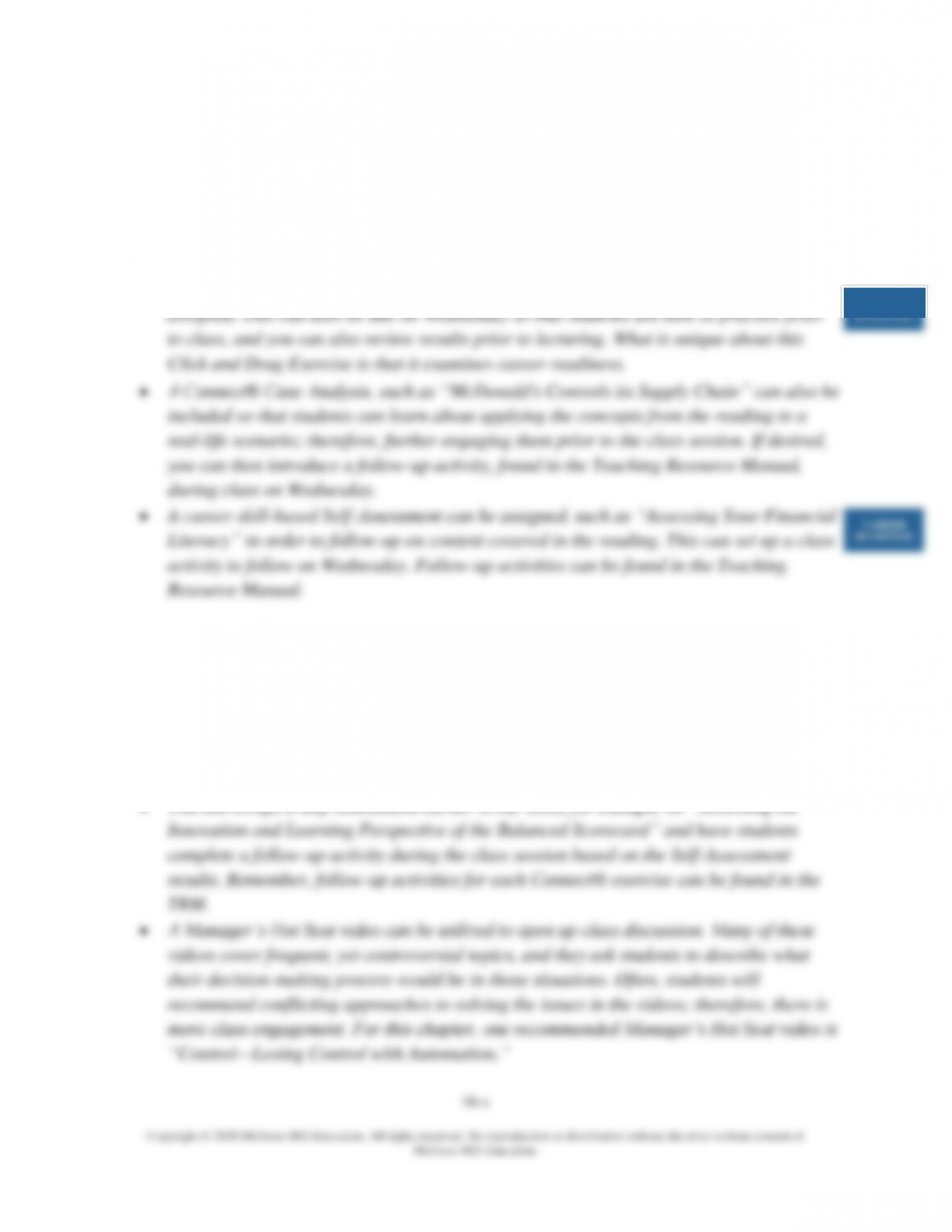
SUGGESTED RESOURCES ACROSS TEACHING TOUCH POINTS MATRIX
Type of Asset
Before-Class/Lecture
During-Class/Lecture
After-Class/Lecture
SmartBook 2.0
Click and Drag Exercises
iSeeIt! Animated Videos
Self-Assessments
Case Analyses
Video Cases
Example and Practical
Action BoxesM
Group Exercises/Career
CAREER
READINESS
CAREER
READINESS
Kinicki/Williams, Management, 9e: Chapter 16 Control Systems and Quality Management: Techniques for
Enhancing Organizational Effectiveness
Before Class (before Wednesday)
• Assign Chapter 16 in SmartBook 2.0, making it due Tuesday evening so that reporting
can be reviewed prior to the lecture on Wednesday. The lecture can be customized based
on what concepts in the chapter students are struggling most with, as can be seen in the
reporting function of SmartBook 2.0 by going to “Reporting” then clicking the
“LearnSmart” tab.
• A Click and Drag Exercise, such as one on “Tips for Managing Your Career,” can be
During Class (on Wednesday)
• You can deliver a short, yet effective, lecture and focus on areas that students are really
struggling with. This can be done by reviewing the reporting from SmartBook 2.0 and
any assigned Connect® exercises, such as the recommended Click and Drag Exercise
and Case Analysis. If students are struggling with a particular learning objective, you
can then tailor the lecture and/or class activities to address those challenging concepts.
• You can assign a Self-Assessment earlier in the week, for example on “Assessing the
CAREER
Kinicki/Williams, Management, 9e: Chapter 16 Control Systems and Quality Management: Techniques for
Enhancing Organizational Effectiveness
16–xi
• If time allows, and you would like to dive into real situations, you can discuss an
Example box from the text titled “Steps in the Control Process: What’s Expected of UPS
Drivers?” There is an additional in-class activity in the TRM.
After Class (after Wednesday)
• You can assign a Connect® exercise, such as the continuing case on Uber, to reinforce
student comprehension of material and to also test application of concepts.
• Students can experience a real-life simulation that assesses critical-thinking and
problem-solving skills by playing the Application-Based Activity on power and influence.

Kinicki/Williams, Management, 9e: Chapter 16 Control Systems and Quality Management: Techniques for
Enhancing Organizational Effectiveness
16-1
LEARNING OBJECTIVES
16.2 Explain how successful companies implement controls.
16.4 Describe financial tools managers should know.
16.6 Identify barriers to effective control and ways managers can overcome them.
16.8 Discuss the process for managing career readiness and review five tips for managing your
career.
Kinicki/Williams, Management, 9e: Chapter 16 Control Systems and Quality Management: Techniques for
Enhancing Organizational Effectiveness
16-2
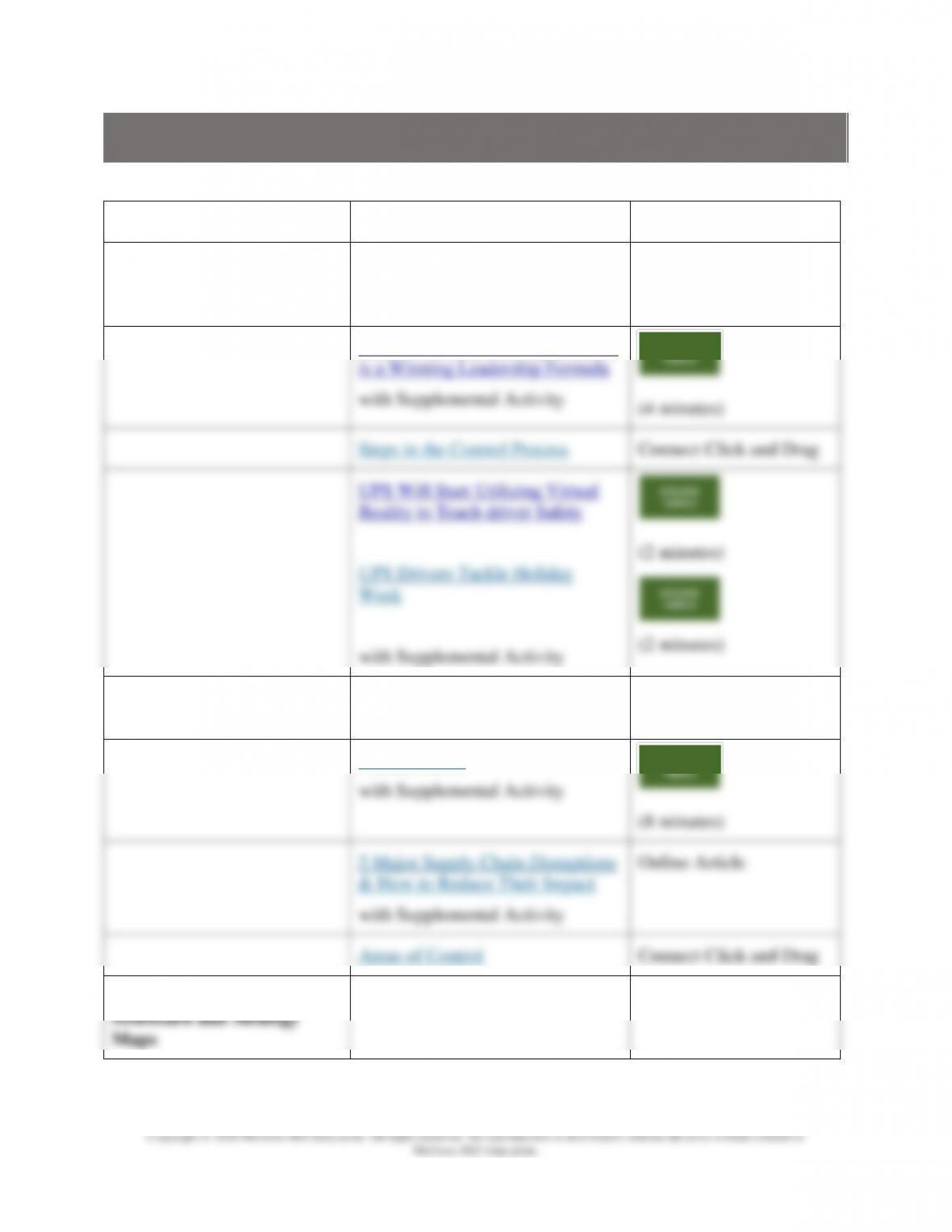
TEACHING RESOURCES
Section
Title
Resource Type
16.1: Control: When
Managers Monitor
Performance
Sonos CEO Says “Caring Candor”
is a Winning Leadership Formula
with Supplemental Activity
(4 minutes)
Steps in the Control Process
Connect Click and Drag
UPS Will Start Utilizing Virtual
Reality to Teach driver Safety
UPS Drivers Tackle Holiday
Week
with Supplemental Activity
(2 minutes)
(2 minutes)
16.2: Levels and Areas of
Control
Tunnel Vision
with Supplemental Activity
(8 minutes)
5 Major Supply Chain Disruptions
& How to Reduce Their Impact
with Supplemental Activity
Online Article
Areas of Control
Connect Click and Drag
16.3: The Balanced
Scorecard and Strategy
Maps
ONLINE
VIDEO
ONLINE
VIDEO
ONLINE
VIDEO
ONLINE
VIDEO
Kinicki/Williams, Management, 9e: Chapter 16 Control Systems and Quality Management: Techniques for
Enhancing Organizational Effectiveness
16-3
The Explainer: The Balanced
Scorecard
with Supplemental Activity
(3 minutes)
The Balanced Scorecard
Connect Click and Drag
Assessing the Innovation &
Learning Perspective of the
Balanced Scorecard
with Self-Assessment Activity
Self-Assessment
Applying the Balanced Scorecard
Group Exercise
McDonald’s Controls Its Supply
Chain
Connect Case Analysis
16.4: Some Financial Tools
for Control
Money Talks
with Supplemental Activity
(4 minutes)
Companies Pay Workers to Get
Savvier with Money
Assessing Your Financial Literacy
with Self-Assessment Activity
Self-Assessment
Control at Threadless
Connect Video Case
16.5: Total Quality
Management
The Land of Legos
with Supplemental Activity
(5 minutes)
PDCA Cycle
Connect Click and Drag
ONLINE
VIDEO
ONLINE
VIDEO
ONLINE
ARTICLE
CAREER
READINESS
ONLINE
VIDEO
Kinicki/Williams, Management, 9e: Chapter 16 Control Systems and Quality Management: Techniques for
Enhancing Organizational Effectiveness
Serving and Leading with a
Quality Mindset
with Supplemental Activity
(16 minutes)
Enhance the Guest Experience
with Supplemental Activity
(5 minutes)
Core TQM Principles
Connect Click and Drag
Companies in 2018
with Supplemental Activity
Assessing Your Satisfaction with
Your College or University
Experience
with Self-Assessment Activity
Self-Assessment
Exploring Total Quality
Management—TQM
Group Exercise
TQM Tools, Techniques, and
Standards
Connect Click and Drag
16.6: Managing Control
Effectively
Confessions of a Recovering
Micromanager
Why You’re Micromanaging, and
How to Stop
with Supplemental Activity
Barriers to Control
Connect Click and Drag
(12 minutes)
ONLINE
VIDEO
VIDEO
ARTICLE
ONLINE
VIDEO
CAN BE
USED
ONLINE
16-5
16.7: Managing for
Productivity
Physics of Productivity
with Supplemental Activity
(5 minutes)
16.8: Career Corner:
Managing Your Career
Readiness
Your Blueprint for Career
Advancement Needs Updating
with Supplemental Activity
(4 minutes)
Tips for Managing Your Career
Connect Click and Drag
Embracing Proactive Learning
Career Corner Group
Exercise
Comprehensive Materials
Is Tesla Out of Control?
Textbook Management in
Action
Is GPS Tracking of Employee
Actions an Effective Form of
Management Control?
Textbook Legal/Ethical
Challenge
Controlling Uber
Uber Continuing Case
Control—Losing Control with
Automation
Manager’s Hot Seat
ONLINE
VIDEO
ONLINE
VIDEO
ONLINE
ARTICLE
CAREER
READINESS
CAREER
READINESS

Kinicki/Williams, Management, 9e: Chapter 16 Control Systems and Quality Management: Techniques for
Enhancing Organizational Effectiveness
16-6
Managerial Control: A Turbulent
Ride
Application-Based
Activity
Please note Harvard Business Review articles are subscription-based or accessible via hbsp.harvard.edu as
examination copy. Also note that resources like The Wall Street Journal will require a paid subscription.
CAN BE
USED
ONLINE
Kinicki/Williams, Management, 9e: Chapter 16 Control Systems and Quality Management: Techniques for
Enhancing Organizational Effectiveness
16-7
OVERVIEW OF THE CHAPTER
16.1 Control: When Managers Monitor Performance
16.2 Levels and Areas of Control
This section describes three levels of control—strategic, tactical, and operational—and
16.3 The Balanced Scorecard and Strategy Maps
16.4 Some Financial Tools for Control
16.5 Total Quality Management
Total quality management (TQM) is dedicated to continuous quality improvement,
16.6 Managing Control Effectively
16.7 Managing for Productivity
The purpose of a manager is to make decisions about the four management functions—

16-8
16.8 Career Corner: Managing Your Career Readiness
Kinicki/Williams, Management, 9e: Chapter 16 Control Systems and Quality Management: Techniques for
Enhancing Organizational Effectiveness
CLASSROOM OUTLINE
Manage U: Using a Mentor to Exercise Control in Your Career
Mentoring is the process of forming and maintaining intensive and lasting developmental
relationships. Mentors are willing to coach their mentees throughout the passages of their
careers. To make your mentoring collaborations successful for both you and your mentor, start
by setting specific goals you want to achieve in the relationship and from your interactions. You
need to know what you want and go after it. Next, you want to come prepared for all your
Possible Topics for Discussion:
• A mentoring relationship is a two-way street. When you reach out to a potential mentor,
what can you offer in return for the coaching and expertise? Make a list of ideas,
16.1 Control: When Managers Monitor Performance
POWERPOINT SLIDES:
#3 Control: When Managers Monitor Performance
#4 Why Is Control Needed?