Chapter 16 – Control Systems & Quality Management: Techniques for Enhancing Organizational Effectiveness
16–39
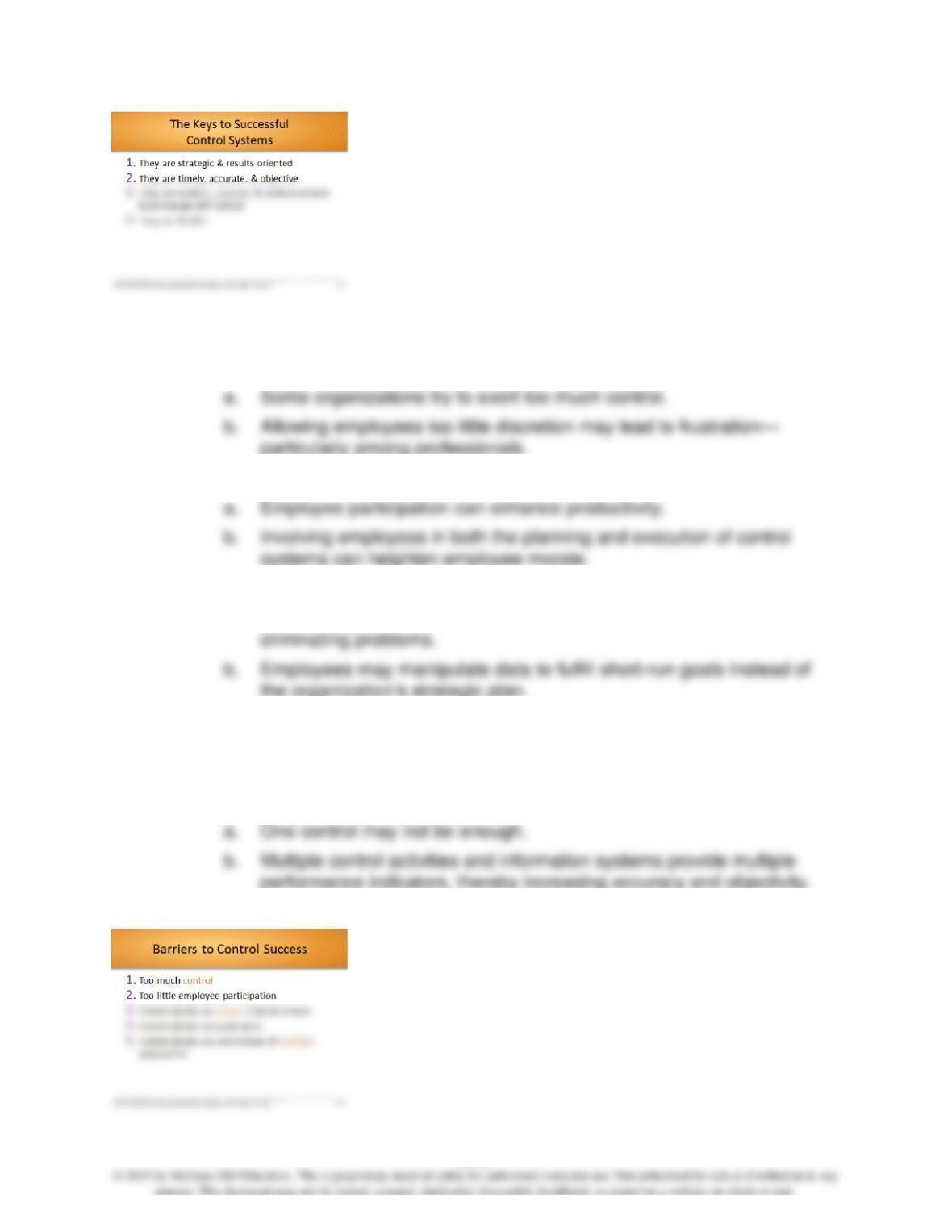
B. Among the barriers to control success are:
1. Too much control
2. Too little employee participation
3. Overemphasis on means instead of ends
a. Control systems are not ends in themselves but the means to
4. Overemphasis on paperwork
a. One barrier is management emphasis on getting reports done while
neglecting other performance activity.
5. Overemphasis on one instead of multiple approaches.

Chapter 16 – Control Systems & Quality Management: Techniques for Enhancing Organizational Effectiveness
16–40
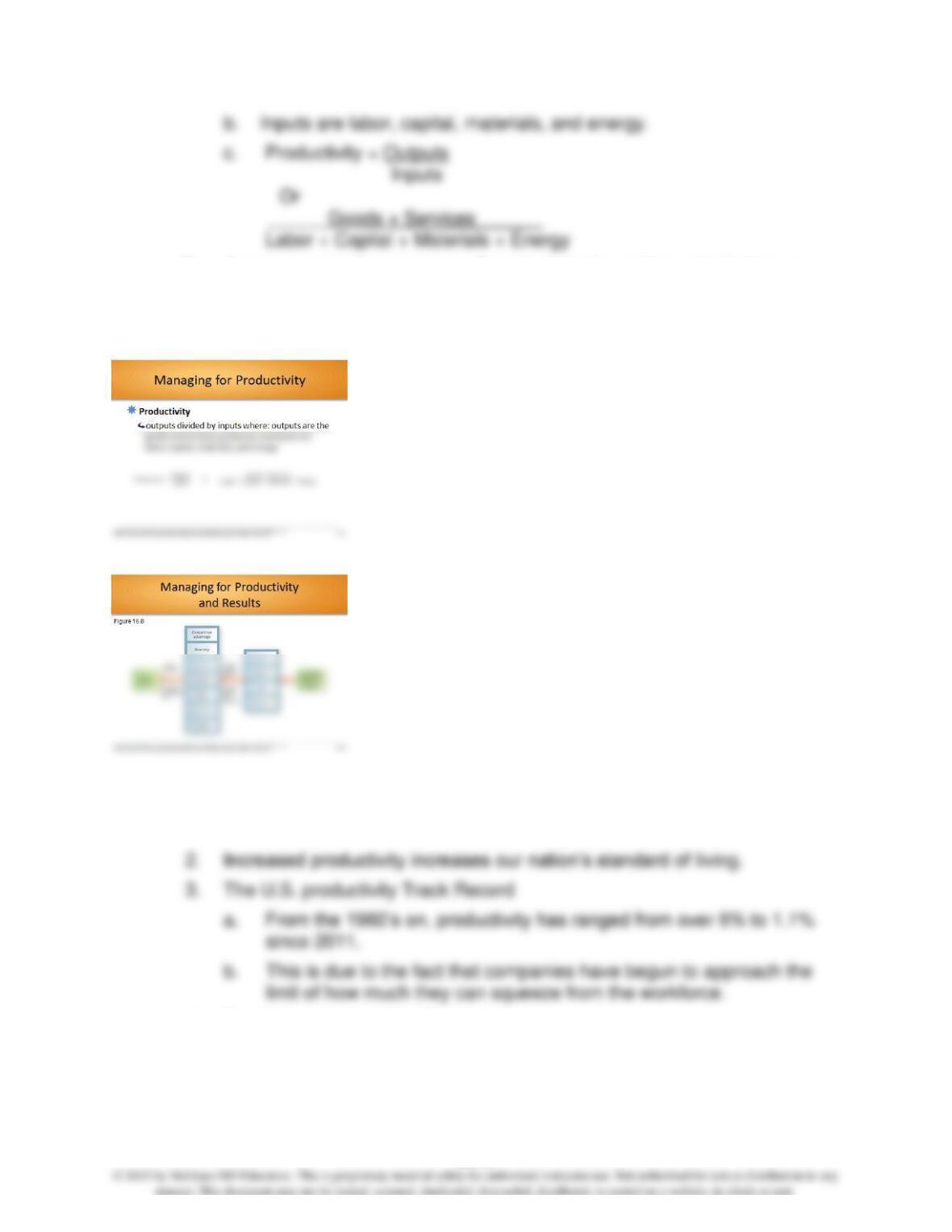
Section 16.7 discusses productivity. Productivity is defined by the formula of outputs
divided by inputs for a specified period of time. Productivity is important because it
determines whether the organization will make a profit or even survive.
One way that you could begin your coverage of these topics is to have the students
read the Wall Street Journal article “Big Data Cuts Buildings’ Energy Use.” The article
Possible Topics for Discussion:
• Describe how managers can influence productivity.
• Provide three specific suggestions as to how your company (or a previous one)
Major Idea Outline:
A. Managers in the 21st century will operate in a complex environment and will
need to deal with seven challenges: managing for competitive advantage,
diversity, globalization, information technology, ethical standards, sustainability
and your own happiness and life goals.
B. What Is Productivity?
1. Productivity is defined by the formula of outputs divided by inputs for a
specified period of time.
a. Outputs are all the goods and services produced.
16.7 Managing for Productivity (pp. 540-541)
How do managers influence productivity?
Chapter 16 – Control Systems & Quality Management: Techniques for Enhancing Organizational Effectiveness
16–41
2. A manager can increase overall productivity by making substitutions or
increasing the efficiency of any one element: labor, capital, materials, or
energy.
C. Why Increasing Productivity Is Important
1. Productivity determines whether the company makes a profit.
4. The Role of Information Technology
a. Most economists think recent productivity growth is the result of huge
investment in information technology.

Chapter 16 – Control Systems & Quality Management: Techniques for Enhancing Organizational Effectiveness
16–42
A. Find your passion and follow it.
1. Find something you love to do, and do it vigorously.
D. Fine-tune your soft skills—your people skills.
1. The workplace is not an area where lone individuals make their silent
contributions.
2. Get feedback on your interpersonal skills and develop a plan for
improvement.
Epilogue: The Keys to Your Managerial Success (pp. 542-
543)
What are eight keys to personal managerial success?

Chapter 16 – Control Systems & Quality Management: Techniques for Enhancing Organizational Effectiveness
16–43
Chapter 16 – Control Systems & Quality Management: Techniques for Enhancing Organizational Effectiveness
16–44
16.1 Why is control such an important managerial function?
There are six reasons why control is needed: (1) to adapt to change and
16.2 How do successful companies implement controls?
Successful companies consider the different levels of management that
16.3 How can three techniques—balanced scorecard, strategy maps, and
measurement management—help me establish standards and measure
performance?
To establish standards, managers often use the balanced scorecard, which
provides a fast but comprehensive view of the organization via four indicators: (1)
16.4 Financial performance is important to most organizations. What are the
financial tools I need to know about?
Financial controls include budgets, financial statements, ratio analysis, and
audits. A budget is a formal financial projection. The most important budget-
CHALLENGE: MAJOR QUESTIONS
Chapter 16 – Control Systems & Quality Management: Techniques for Enhancing Organizational Effectiveness
16–45
16.5 How do top companies improve the quality of their products and services?
Top companies implement total quality management or TQM. Several
techniques are available for improving quality. First, employee involvement can
16.6 What are the keys to successful control, and what are the barriers to
control success?
Successful control systems have four common characteristics: (1) They are
16.7 How do managers influence productivity?
Managers can influence productivity in many ways. Managers make decisions
about the four management functions—planning, organizing, leading, and

Chapter 16 – Control Systems & Quality Management: Techniques for Enhancing Organizational Effectiveness
16–46
Chapter 16 – Control Systems & Quality Management: Techniques for Enhancing Organizational Effectiveness
1. Which of the six reasons that control is needed are apparent in this case?
Explain.
For UPS, control is needed because of change and uncertainty. Abell may
2. To what extent does the process Scott Abell uses to manage shipments of
packages during holiday periods follow the control process shown in Figure
16.3? Discuss.
Abell sets certain standards, especially while working with some of the top UPS
3. If you were charged with creating a balanced scorecard for Scott Abell, what
SMART goals (see Chapter 5), would you use as standards to assess
performance in the four categories in your scorecard? Develop one SMART
goal for each scorecard category.
Here is an example for each scorecard category:
MANAGEMENT IN ACTION: UPS Relies on Sophisticated Control Systems
to Manage Package Deliveries
Chapter 16 – Control Systems & Quality Management: Techniques for Enhancing Organizational Effectiveness
16–48
4. To what extent does UPS use the PDCA process? Explain your rationale.
UPS generally plans, does, checks and acts. Abell plans shipments ranging
from turkeys to commercial packages for UPS during the holidays by making
sure that resources are properly allocated, and internal processes are in place
5. Which of the keys to successful control systems are being used by UPS?
Explain.
UPS’s control systems are strategic and results oriented. They are built so that
6. What are the most important takeaways from this case? Discuss.
It is important to understand that large organizations (i.e., UPS), especially at
peak times, are responsible for making sure that systems are closely controlled
Chapter 16 – Control Systems & Quality Management: Techniques for Enhancing Organizational Effectiveness
16–49
Should Companies Be Allowed to Administer Untested Drugs on People with
Ebola?
The Ebola outbreak in West Africa has killed over 1,000 people as of August 2014. The
What is your view about the application of untested drugs on humans?
1. I think it is okay in very limited cases, and the Ebola outbreak is one of them. I
also believe that patients need to be informed that they are being treated with
untested drugs and that there are risks. People can make their own informed
decisions.
Drastic times call for drastic measures. In times when a lot of people are losing
2. I do not think it’s a good idea because it creates a slippery slope of deciding
when it is appropriate to use experimental drugs on people. Who makes the
call?
The doctor and the patient make the call, just like many other procedures. A
3. I don’t like the idea because it would motivate manufacturers to produce products
before completing the proper amount of experimental testing.
Manufacturers should not be able to make these decisions; it should be up to
LEGAL/ETHICAL CHALLENGE

Chapter 16 – Control Systems & Quality Management: Techniques for Enhancing Organizational Effectiveness
16–50
4. Invent other options.
Students can be creative here. Is there a way to speed up the testing process in
Chapter 16 – Control Systems & Quality Management: Techniques for Enhancing Organizational Effectiveness
Group Exercise #1: Applying the Balanced Scorecard
Objectives
• To gain practice at creating a balanced scorecard.
• To consider how a balanced scorecard can be used to manage over time.
Introduction
The goal of this exercise is to examine how the balanced scorecard is used to assess
Instructions
1. Give a brief lecture on the balanced scorecard.
2. Break students into groups of 5 and use the following situation as a context for
3. Give groups 30 minutes to brainstorm different measures that may be used to
evaluate the effectiveness of your College/School of Business in terms of the four
categories contained in a balanced scorecard. Ask groups to come up with at least
4. While the groups are working, write the four balanced scorecard categories across
the top of the blackboard/whiteboard. Reconvene the class and ask a
Questions for Discussion
1. What did you find hard and easy about this exercise?
2. Why is a balanced scorecard important to any organization?
GROUP EXERCISES

Chapter 16 – Control Systems & Quality Management: Techniques for Enhancing Organizational Effectiveness
16–52
3. How would a dean or any manager use a scorecard throughout the year to
Chapter 16 – Control Systems & Quality Management: Techniques for Enhancing Organizational Effectiveness
16–53
Group Exercise #2: Exploring Total Quality Management – TQM
Objectives
• To discover how companies are using TQM principles.
Introduction
The overall purpose of this exercise is to explore how real companies are using Total
Instructions
1. Give a lecture on TQM.
2. Give students the following directions for the individual portion of this exercise:
• Pick a company you would like to research. Example: Southwest Airlines,
Starbucks, UPS, Microsoft, etc.
• Locate this company’s website.
• Explore the company’s site and look for evidence of TQM principles. Look for
3. Give students the following directions for the group portion of this exercise:
• Break into groups of 3 or 4.
4. Once each group completes Step 2, lead a class discussion by asking someone
from each group to go to the board and list their group’s findings.
Chapter 16 – Control Systems & Quality Management: Techniques for Enhancing Organizational Effectiveness
16–54
Questions for Discussion
In preparation, put the following on the blackboard/whiteboard.
People Orientation Improvement Orientation
1. What trends do you see across companies?
Chapter 16 – Control Systems & Quality Management: Techniques for Enhancing Organizational Effectiveness
16–55
Out of Control at Fannie Mae
Teaching Objective: Use the financial situation of two large secondary mortgage
companies to illustrate the value of the control function in a changing, uncertain
environment.
Summary: Fannie Mae and Freddie Mac are major companies in the secondary
mortgage market. They are unique because they are public, shareholder-owned
Questions:
1. Faced with a changing and uncertain environment, large financial losses, and
devalued stock, Fannie Mae’s management saw opportunities. How?
Answer: Control systems help managers anticipate, monitor, and react to
2. How does this case illustrate strategic control by Fannie Mae’s top executives?
Answer: Management planned to issue stock to raise an additional $6 billion in
3. What did ratio analysis show about Fannie Mae and Freddie Mac? Why was this
situation accepted by management and shareholders?
Answer: The debt management ratio for the companies showed that their capital
Additional videos directly related to the textbook can be found in the Connect
Instructor’s Manual.
VIDEO CASE

Chapter 16 – Control Systems & Quality Management: Techniques for Enhancing Organizational Effectiveness
16–56
There are no Manager’s Hot Seat Exercise(s) for this chapter.
MANAGER’S HOT SEAT