Country Risk Analysis ❖ 12
ANSWER:
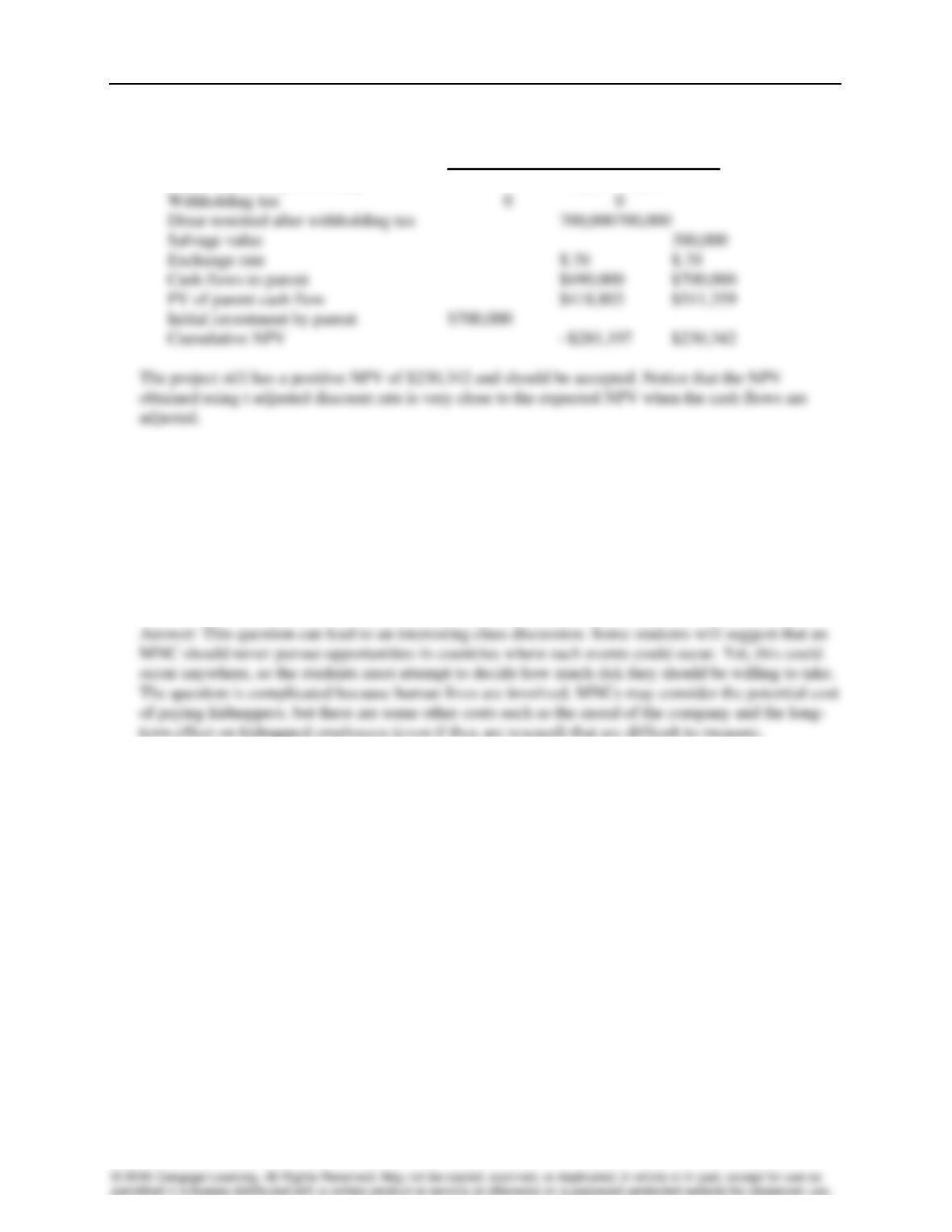
Year 0 Year 1 Year 2
Dinar remitted by subsidiary 700,000 700,000
21. The Risk and Cost of Potential Kidnapping. In 2004 following the war in Iraq, some MNCs
capitalized on opportunities to rebuild Iraq. However, in April 2004, some employees were kidnapped
by local militant groups. How should an MNC account for this potential risk when it considers direct
foreign investment (DFI) in any particular country? Should it avoid DFI in any country in which such
an event could occur? If so, how would it screen the countries to determine which are acceptable? For
whatever countries the MNC is willing to consider, should it adjust its feasibility analysis to account
for the possibility of kidnapping? Should it attach a cost to reflect this possibility or increase the
discount rate when estimating the net present value? Explain.
22. Integrating Country Risk and Capital Budgeting. Tovar Co. is a U.S. firm that has been asked to
provide consulting services to help Grecia Company (in Greece) improve its performance. Tovar
would need to spend $300,000 today on expenses related to this project. In one year, Tovar will
receive payment from Grecia, which will be tied to Grecia’s performance during the year. There is
uncertainty about Grecia’s performance and about Grecia’s tendency for corruption.
Tovar expects that it will receive 400,000 euros if Grecia achieves strong performance following the
consulting job. However, there are two forms of country risk that are a concern to Tovar Co. There is
an 80 percent chance that Grecia will achieve strong performance. There is a 20 percent chance that
Grecia will perform poorly, and in this case, Tovar will receive a payment of only 200,000 euros.
While there is a 90 percent chance that Grecia will make its payment to Tovar, there is a 10 percent
chance that Grecia will become corrupt, and in this case, Grecia will not submit any payment to
Tovar.
Assume that the outcome of Grecia’s performance is independent of whether Grecia becomes corrupt.
The prevailing spot rate of the euro is $1.30, but Tovar expects that the euro will depreciate by 10
percent in one year, regardless of Grecia’s performance or whether it is corrupt.
Country Risk Analysis ❖ 13
Tovar’s cost of capital is 26 percent. Determine the expected value of the project’s net present value.
Determine the probability that the project’s NPV will be negative.
ANSWER:
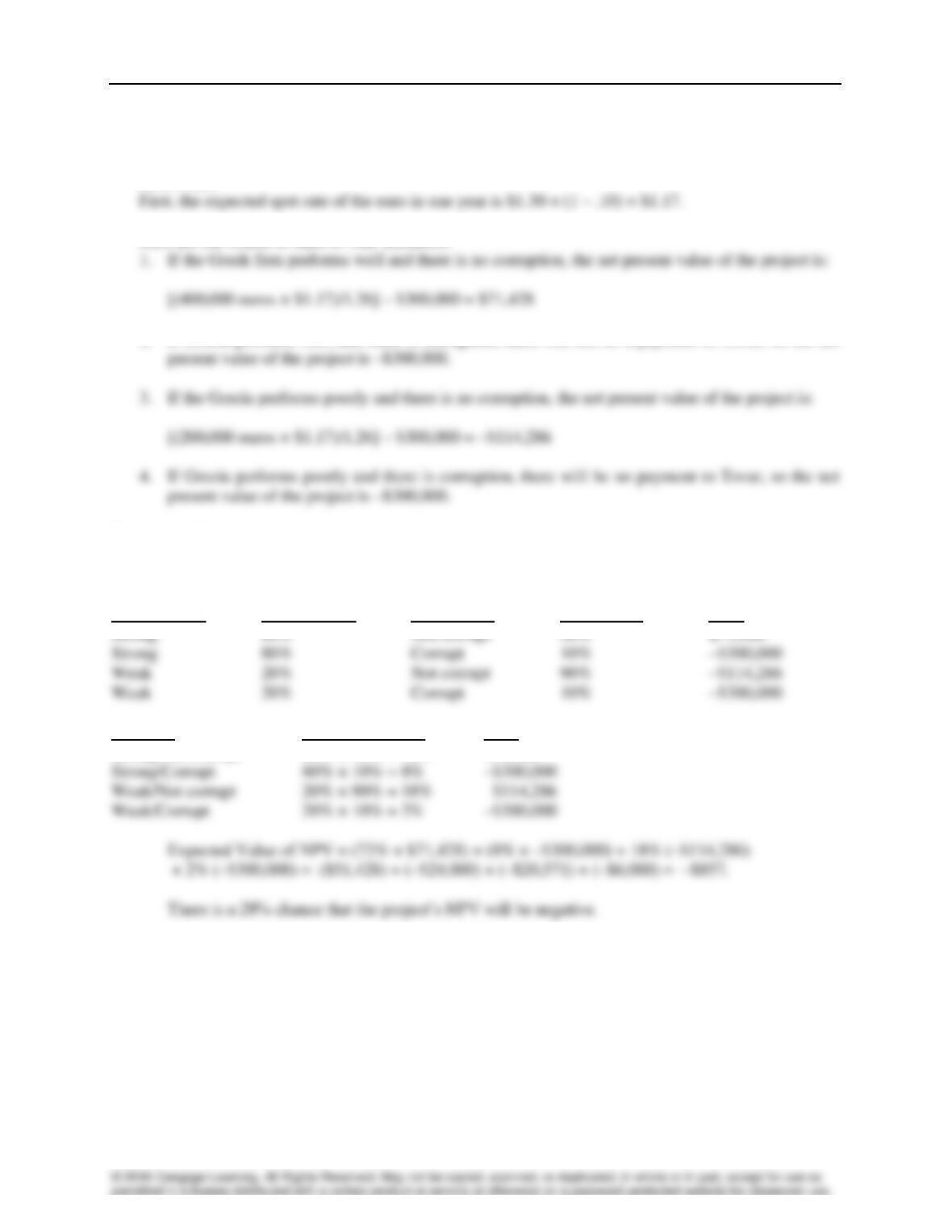
Here are the results of each of four scenarios:
2. If Grecia performs well and there is corruption, there will not be a payment to Tovar, so the net
Summary of Scenarios:
Scenario
Regarding
Performance
Probability
Regarding
Performance
Scenario
Regarding
Corruption
Probability
Regarding
Corruption
NPV
Strong
80%
Corrupt
10%
20%
Corrupt
10%
Scenario
Joint probability
NPV
Strong/Not corrupt
80% × 90% = 72%
$71,428
Weak/Not corrupt
20% × 90% = 18%
23. Capital Budgeting and Country Risk. Wyoming Co. is a non-profit educational institution that
wants to import educational software products from Hong Kong and sell them in the U.S. It wants to
assess the net present value of this project since any profits it earns will be used for its foundation. It
expects to pay HK$5 million for the imports. Assume the existing exchange rate is HK$1 =$.12. It
would also incur selling expenses of $1 million to sell the products in the U.S. It would be able to sell
the products in the U.S. for $1.7 million. However, it is concerned about two forms of country risk.
First, there is a 60% chance that the Hong Kong dollar will be revalued to be worth HK$1 = $.16 by
the Hong Kong government. Second, there is a 70% chance that the Hong Kong government imposes
a special tax of 10% on the amount that U.S. importers must pay for Hong Kong exports. These two
Country Risk Analysis ❖ 14
forms of country risk are independent, meaning that the probability that the Hong Kong dollar will be
revalued is independent of the probability that the Hong Kong government will impose a special tax.
Wyoming’s required rate of return on this project is 22%. What is the expected value of the project’s
net present value? What is the probability that the project’s NPV will be negative?
ANSWER:
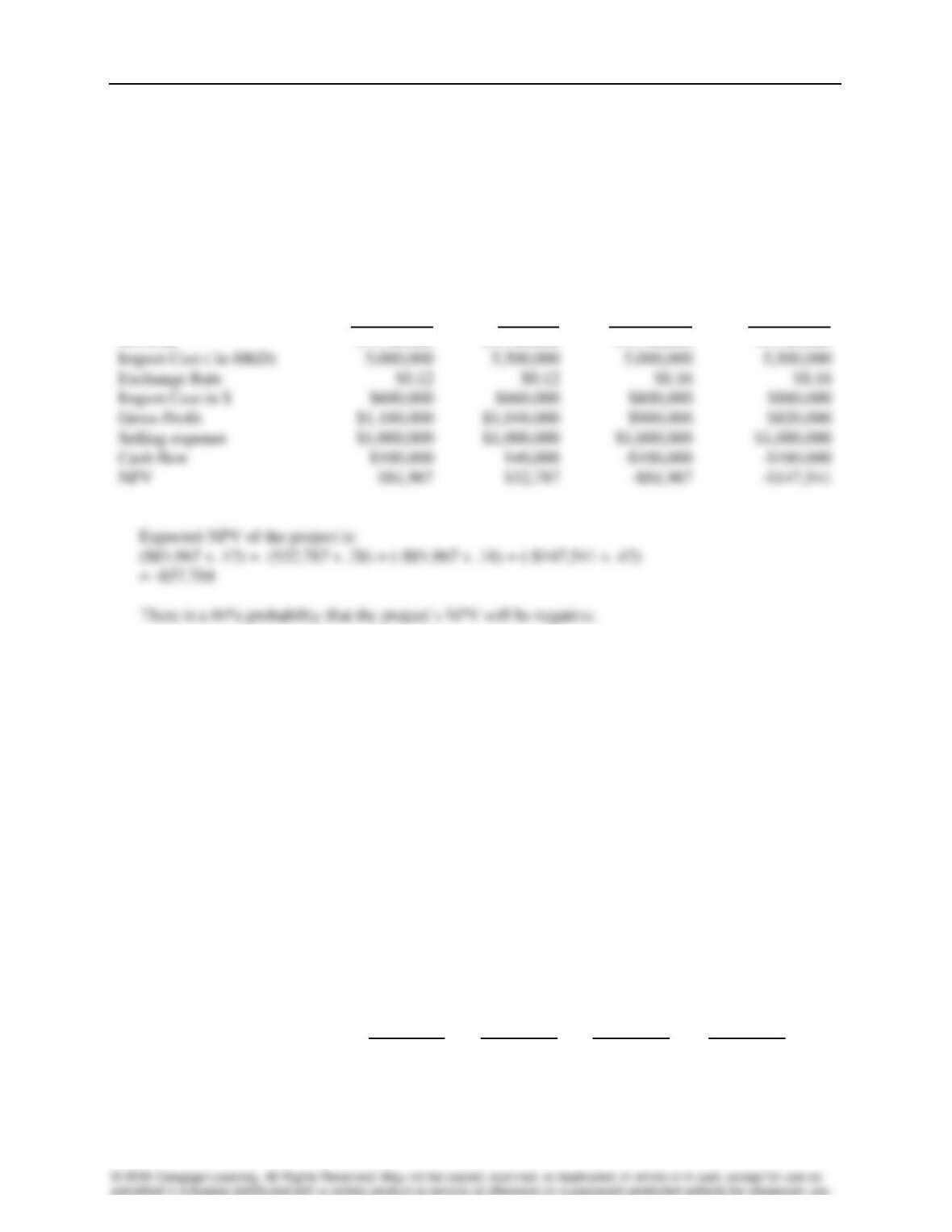
Scenario 1:
No tax or
exchange rate
adjustment
Scenario 2:
10% tax
Scenario 3:
exchange rate
adjustment
Scenario 4:
10% tax and
exchange rate
adjustment
Revenue
$1,700,000
$1,700,000
$1,700,000
$1,700,000
Import Cost ( in HKD)
Exchange Rate
Import Cost in $
Gross Profit
$1,100,000
$1,040,000
Selling expense
Cash flow
NPV
24. Accounting for Country Risk of a Project. Kansas Co. wants to invest in a project in China, It
would require an initial investment of 5,000,000 yuan. It is expected to generate cash flows of
7,000,000 yuan at the end of one year. The spot rate of the yuan is $.12, and Kansas thinks this
exchange rate is the best forecast of the future. However, there are 2 forms of country risk.
First, there is a 30% chance that the Chinese government will require that the yuan cash flows earned
by Kansas at the end of one year be reinvested in China for one year before it can be remitted (so that
cash would not be remitted until 2 years from today). In this case, Kansas would earn 4% after taxes
on a bank deposit in China during that second year.
Second, there is a 40% chance that the Chinese government will impose a special remittance tax of
400,000 yuan at the time that Kansas Co. remits cash flows earned in China back to the U.S.
The two forms of country risk are independent. The required rate of return on this project is 26%.
There is no salvage value. What is the expected value of the project’s net present value?
ANSWER
30%
40%
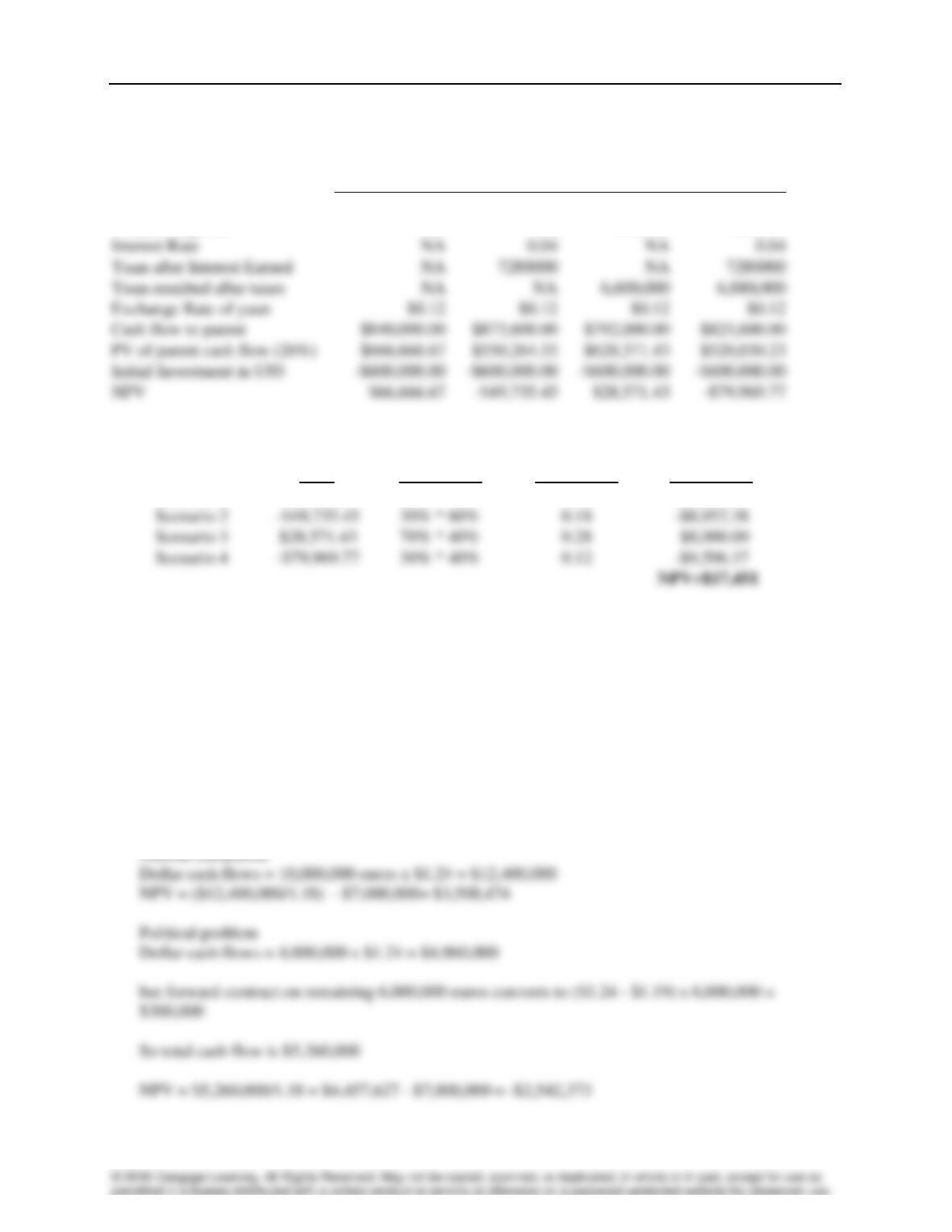
Scenario 1
Scenario 2
Scenario 3
Scenario 4
Country Risk Analysis ❖ 15
No country
risk
Remittance
must be
invested for
1 year
400,000
Yuan
remittance
tax
Both
country
risks
Yuan remitted by subsidiary
7,000,000
7,000,000
7,000,000
7,000,000
Withholding Tax
NA
NA
400,000
400,000
Yuan after Interest Earned
NA
NA
7280000
Yuan remitted after taxes
NA
NA
6,600,000
6,880,000
Cash flow to parent
PV of parent cash flow (26%)
NPV
$66,666.67
$28,571.43
NPV
Probability
Probability
NPV x
Probability
Scenario 1
$66,666.67
70% * 60%
0.42
$28,000.00
Scenario 3
$28,571.43
70% * 40%
0.28
Scenario 4
30% * 40%
0.12
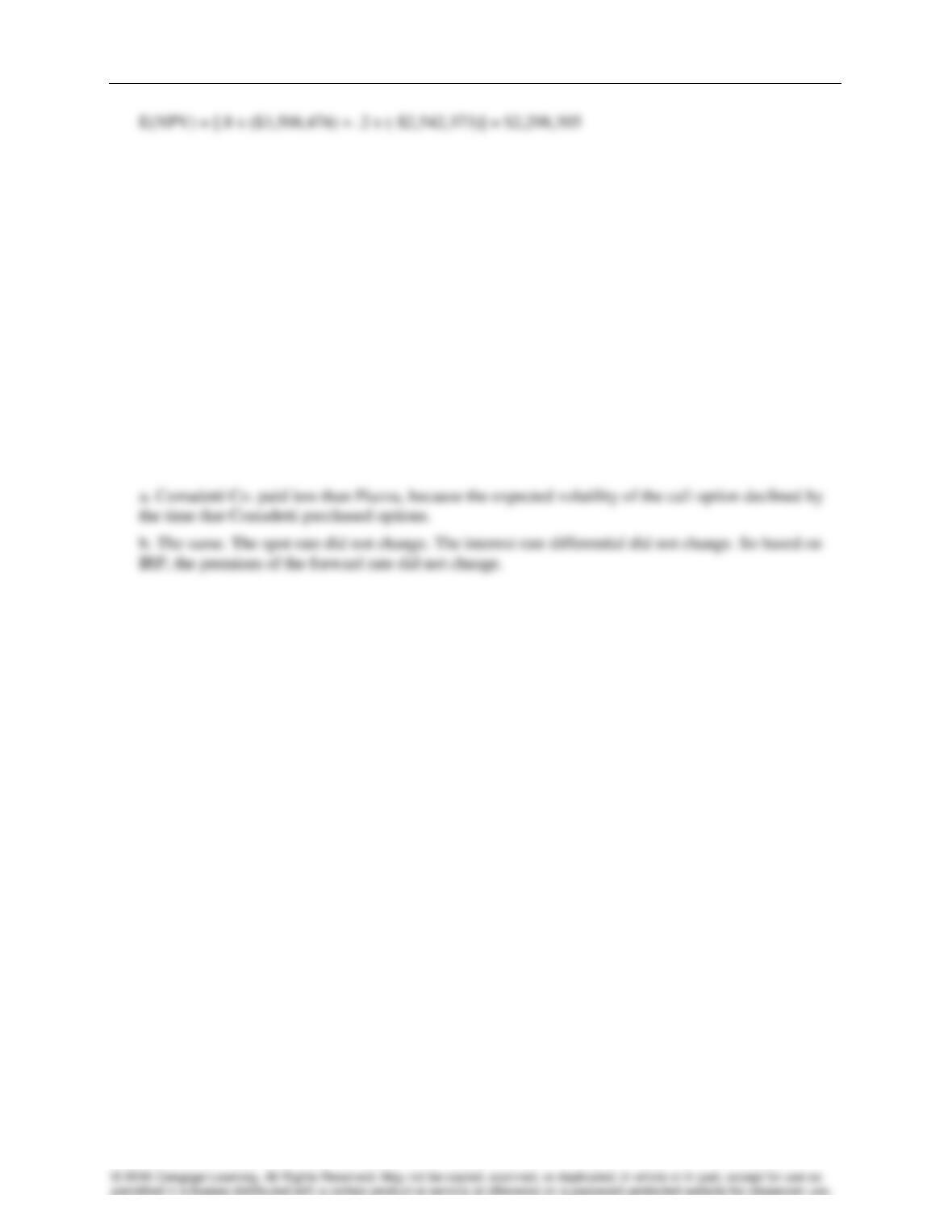
25. Accounting for Country Risk of Projects. Slidell Co. (a U.S. firm) considers a foreign project in
which it expects to receive 10 million euros at the end of this year. It plans to hedge receivables of 10
million euros with a forward contract. Today, the spot rate of the euro is $1.20, the one-year forward
rate of the euro is presently $1.24, and the expected spot rate of the euro in one year is $1.19. The
initial outlay is $7 million. Slidell has a required return of 18%.
There is a 20% chance that political problems will cause a reduction in foreign business, such that
Slidell would only receive 4 million euros at the end of one year. Determine the expected value of
the net present value of this project.
ANSWER
Country Risk Analysis ❖ 16
26. Political Risk and Currency Derivative Values. Assume that interest rate parity exists. At 10:30
a.m., the media reported news that the Mexican government political problems were reduced, which
reduced the expected volatility of the Mexican peso against the dollar over the next month. However,
this news had no effect on the prevailing one-month interest rates of the U.S. dollar or Mexican peso,
and also had no effect on the expected exchange rate of the Mexican peso in one month. The spot rate
of the Mexican peso was $.13 as of 10 a.m. and remained at that level all morning.
a. At 10 a.m., Piazza Co. purchased a call option at the money on 1 million Mexican pesos with a
December expiration date. At 11:00 a.m., Corradetti Co. purchased a call option at the money on 1
million pesos with a December expiration date. Did Corradetti Co. pay more, less, or the same as
Piazza Co. for the options? Briefly explain.
b. Teke Co. purchased futures contracts on 1 million Mexican pesos with a December settlement date
at 10 a.m. Malone Co. purchased futures contracts on 1 million Mexican pesos with a December
settlement date at 11 a.m. Did Teke Co. pay more, less, or the same as Malone Co. for the futures
contracts. Briefly explain.
ANSWER:
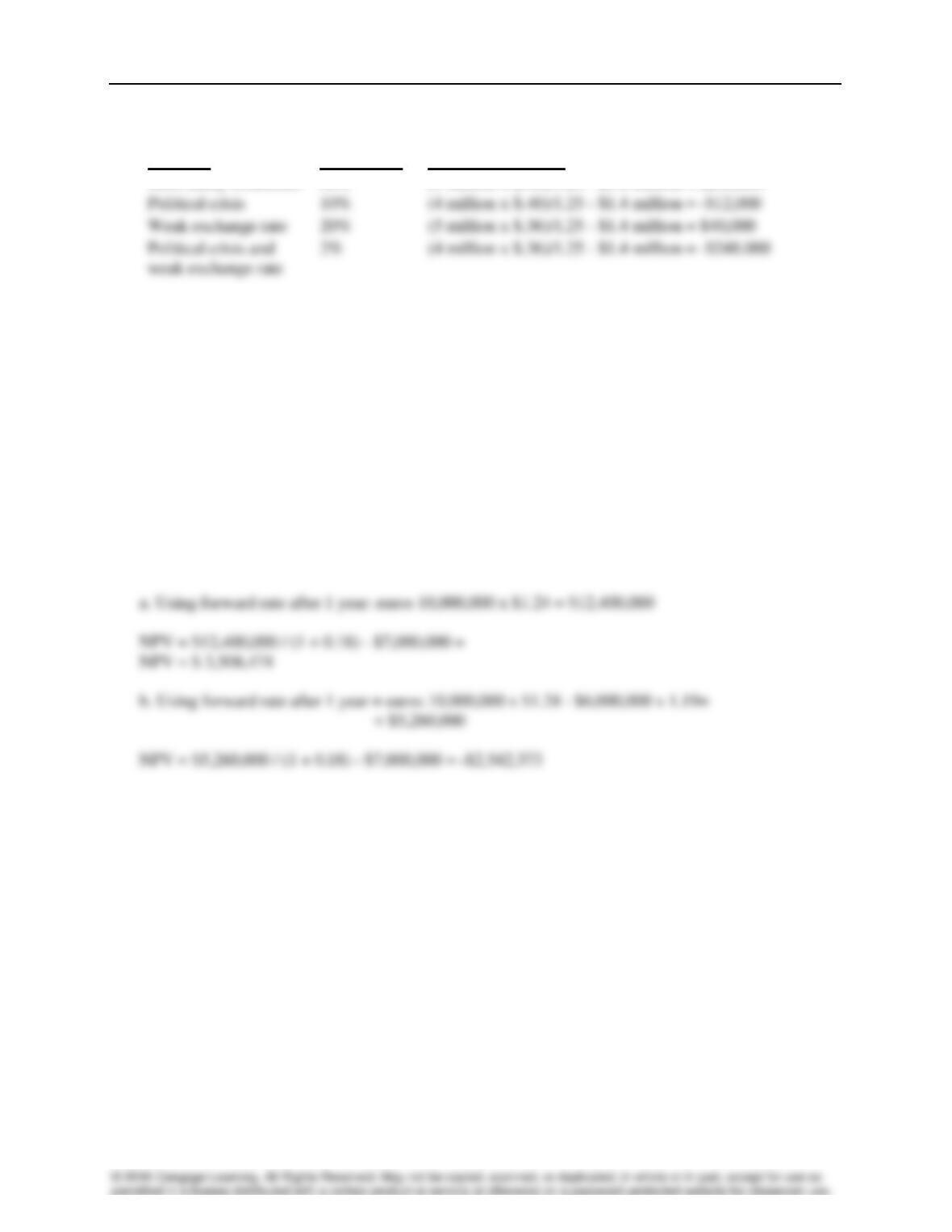
27. Political Risk and Project NPV. Drysdale Co. (a U.S. firm) is considering a new project that
would result in cash flows of 5 million Argentine pesos in one year under the most likely economic
and political conditions. The spot rate of the Argentina peso in one year is expected to be $.40 based
on these conditions. However, it wants to also account for the 10% probability of a political crisis in
Argentina, which would change the expected cash flows to 4 million Argentine pesos in one year. In
addition, it wants to account for the 20% probability that the exchange rate may only be $.36 at the
end of one year. These two forms of country risk are independent. Drysdale’s required rate of return
is 25% and its initial outlay for this project is $1.4 million. Show the distribution of possible
outcomes for the project’s net present value (NPV).
Country Risk Analysis ❖ 17
ANSWER:
Scenario
Probability
NPV of Cash flows
Most likely conditions
68%
(5 million x $.40)/1.25 – $1.4 million = $200,000
Political crisis
10%
(4 million x $.40)/1.25 – $1.4 million = -$12,000
Weak exchange rate
20%
(5 million x $.36)/1.25 – $1.4 million = $40,000
28. Country Risk and Project NPV. Atro Co. (a U.S. firm) considers a foreign project in which it
expects to receive 10 million euros at the end of one year. While it realizes that its receivables are
uncertain, it decides to hedge receivables of 10 million euros with a forward contract today. As of
today, the spot rate of the euro is $1.20, while the one-year forward rate of the euro is presently $1.24,
and the expected spot rate of the euro in one year is $1.19. The initial outlay of this project is $7
million. Atro has a required return of 18%.
a. Estimate the NPV of this project based on the expectation of 10 million euros in receivables.
b. Now estimate the NPV based on the possibility that country risk could cause a reduction in foreign
business, such that Atro Co. only receives 4 million euros instead of 10 million euros at the end of
one year. Estimate the net present value of the project if this form of country risk occurs.
ANSWER:
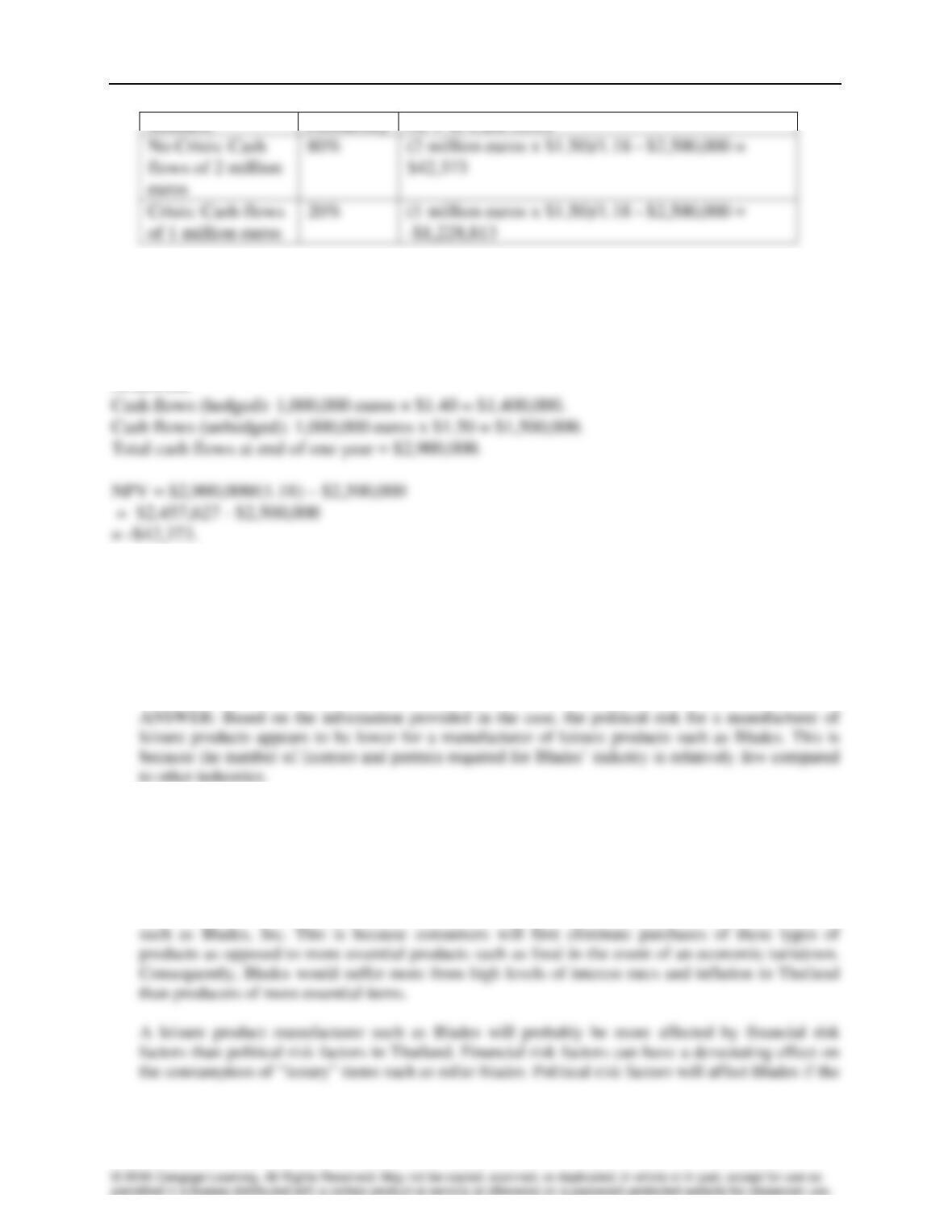
29. Accounting for Political Risk and the Hedging Decision.
a. Duv Co. (a U.S. firm) is planning to invest $2.5 million in a project in Portugal that will
exist for one year. Its required rate of return on this project is 18%. It expects to receive
cash flows of 2 million euros in one year from this project. The spot rate of the euro in one
year is expected to be $1.50. The one-year forward rate of the euro is presently $1.40. Duv
Co. wants to account also for the 20% probability of a crisis in Portugal. If this crisis
occurs, Duv would reduce its expected cash flows to 1 million euros in one year. Duv Co.
does not plan to hedge its expected cash flows. Show the distribution of possible outcomes
for the project’s estimated net present value (NPV), including the probability of each
possible outcome.
ANSWER:
Country Risk Analysis ❖ 18
Scenario
Probability
NPV of Cash flows
euros
of 1 million euros
-$1,228,813
b. Now assume that Duv plans to hedge the cash flows that it believes it will receive if a crisis in
Portugal occurs. However, it decides not to hedge additional cash flows that it would receive if
the crisis does not occur. Estimate what the net present value (NPV) of the project will be based
on the hedging strategy described here, and assuming that a crisis in Portugal does not occur.
ANSWER
Solution to Continuing Case Problem: Blades, Inc.
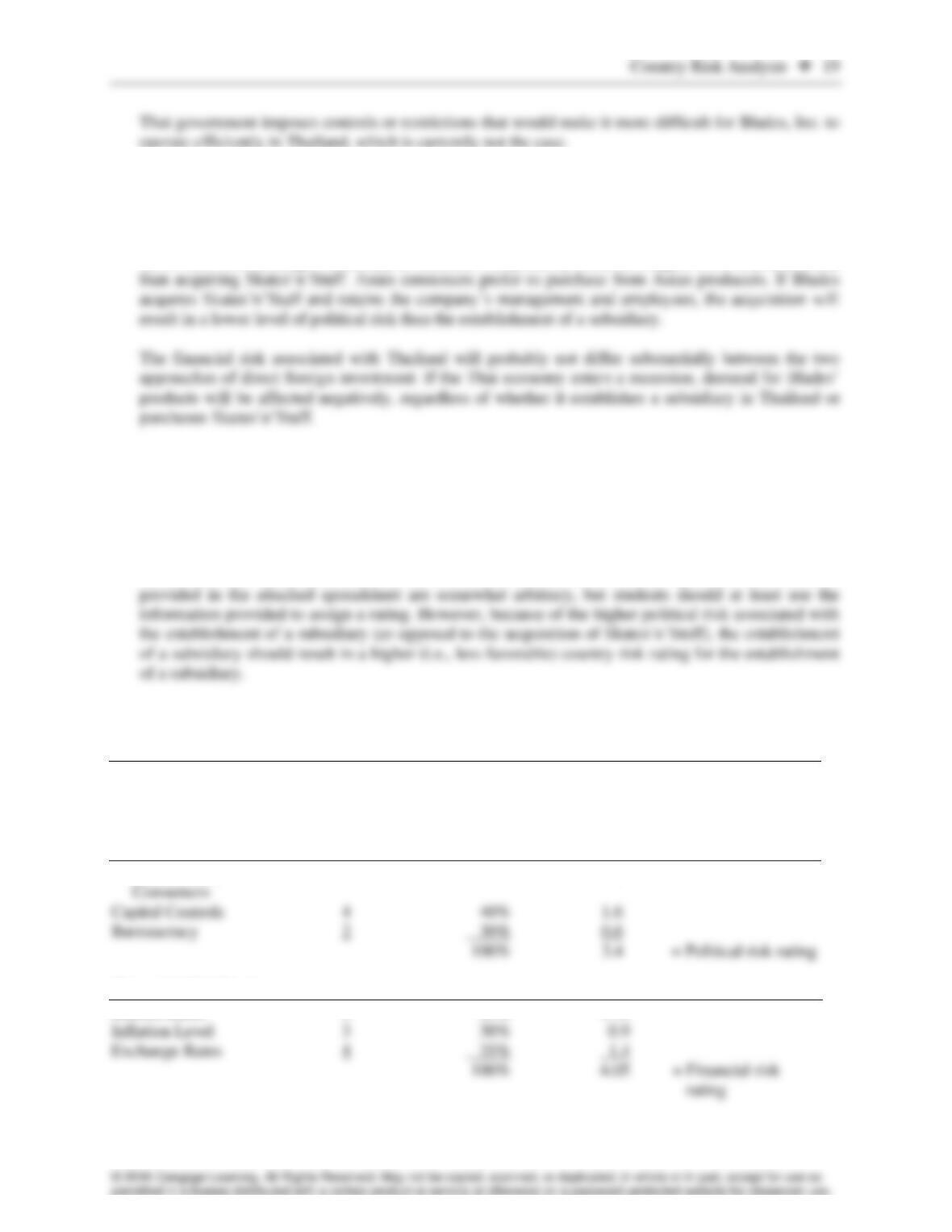
1. Based on the information provided in the case, do you think the political risk associated with Thailand
is higher or lower for a manufacturer of leisure products such as Blades as opposed to, say, a food
producer? That is, conduct a micro-assessment of political risk for Blades, Inc.
2. Do you think the financial risk associated with Thailand is higher or lower for a manufacturer of
leisure products such as Blades as opposed to, say, a food producer? That is, conduct a micro–
assessment of financial risk for Blades, Inc. Do you think a leisure product manufacturer such as
Blades will be more affected by political or financial risk factors?
ANSWER: The level of financial risk in Thailand is higher for a manufacturer of leisure products
3. Without using a numerical analysis, do you think establishing a subsidiary in Thailand or acquiring
Skates’n’Stuff will result in a higher assessment of political risk? Of financial risk? Substantiate your
answer.
ANSWER: Establishing a subsidiary in Thailand will probably result in a higher level of political risk
4. Using a spreadsheet, conduct a quantitative country risk analysis for Blades, Inc., based on the
information Ben Holt has provided for you. Use your judgment to assign weights and ratings to each
political and financial risk factor and determine an overall country risk rating for Thailand. Conduct
two separate analyses for (a) the establishment of a subsidiary in Thailand and (b) the acquisition of
Skates’n’Stuff.
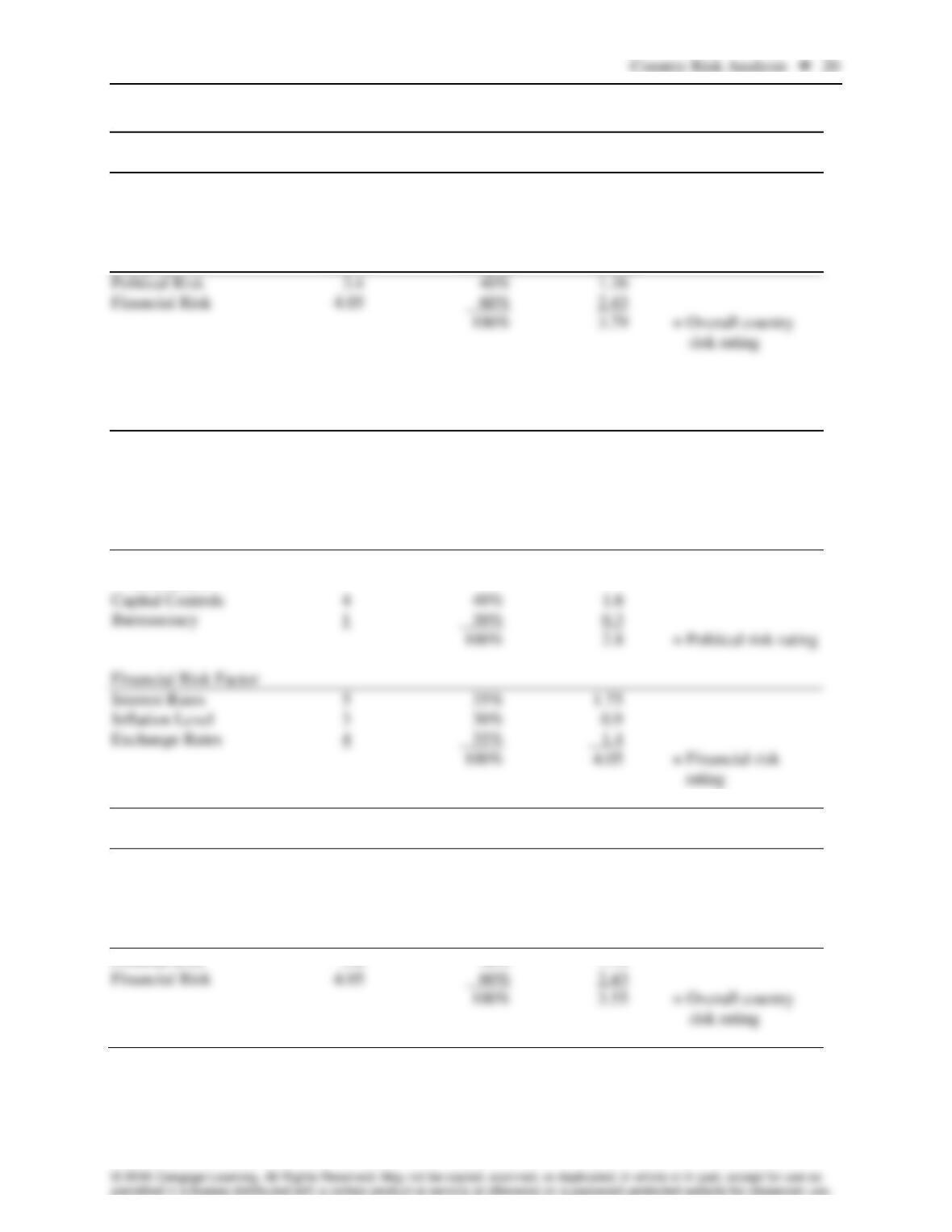
ANSWER: (See spreadsheet below.) There is no one correct answer to this question. The estimates
(1) Establishment of a Subsidiary in Thailand
(1)
(2)
(3)
(4) = (2) × (3)
Rating Assigned
Weight Assigned
by Blades to
by Blades to
Weighted
Factor (within a
Factor According
Value
Political Risk Factor
range of 1-5)
to Importance
of Factor
Consumers
Bureaucracy
2
30%
Attitude of Thai
4
30%
1.2
Financial Risk Factor
Interest Rates
5
35%
1.75
(1)
(2)
(3)
(4) = (2) × (3)
Weight Assigned
Rating as
by Blades to
Category
Determined
Above
Each Risk
Category
Weighted
Rating
Financial Risk
4.05
60%
2.43
risk rating
(2) Acquisition of Skates’n’Stuff
(1)
(2)
(3)
(4) = (2) × (3)
Rating Assigned
Weight Assigned
by Blades to
Factor (within a
by Blades to
Factor According
Weighted
Value
Political Risk Factor
range of 1-5)
to Importance
of Factor
Attitude of Thai
Consumers
3
30%
0.9
Bureaucracy
30%
0.3
Interest Rates
35%
1.75
Exchange Rates
35%
1.4
(1)
(2)
(3)
(4) = (2) × (3)
Weight Assigned
Rating as
by Blades to
Category
Determined
Above
Each Risk
Category
Weighted
Rating
Political Risk
2.8
40%
1.12
100%
3.55
= Overall country
5. Which method of direct foreign investment should utilize a higher discount rate in the capital
budgeting analysis? Would this strengthen or weaken the tentative decision of establishing a
subsidiary in Thailand?
Country Risk Analysis ❖ 21
Solution to Supplemental Case: King, Incorporated
a. There are several government-related issues to consider. Some of these issues are listed below:
1. Will Bulgaria’s government allow the firm to establish the subsidiary? Or will it require that
King, Inc. participate in a joint venture with the government? This issue is relevant because it
could affect the risk and return of the project.
2. What is the corporate tax rate to be charged on profits earned by King, Inc. in Bulgaria?
3. What is the withholding tax rate to be imposed on profits remitted to the parent of King, Inc.?
5. Will Bulgaria require King, Inc. to incur any additional expenses for environmental reasons?
6. What is the government’s monetary and fiscal policy? Any effect that these policies have on
7. What are the political relations between Bulgaria and other Eastern Bloc countries? Will
King, Inc. be able to transport the products produced in Bulgaria to other countries without
b. The demand could be affected by:
1. The economies of the various Eastern Bloc countries (not just Bulgaria) that are targeted for
2. Consumer preferences for the food products; King, Inc. must assess consumer preferences in
c. The cost of production could be affected as follows:
1. Changes in wage rates in Bulgaria would affect the labor cost incurred by King, Inc.
Country Risk Analysis ❖ 22
Small Business Dilemma
Country Risk Analysis at the Sports Exports Company
The Sports Exports Company produces footballs in the U.S. and exports them to the United Kingdom. It
also has an ongoing joint venture with a British firm that produces some sporting goods for a fee. The
Sports Exports Company is considering the establishment of a small subsidiary in the United Kingdom.
1. Under the current conditions, is the Sports Exports Company subject to country risk?
2. If the firm does decide to develop a small subsidiary in the United Kingdom, will its exposure to
country risk change? If so, how?