1. What are the problems facing the hospital’s dietary food service?
Problems/symptoms include: lack of a quality culture and attitude, wrong food to patient,
2. What is the cost to the hospital of a minor versus major service upset or failure?
Minor upset such as rude tray delivery employee, cold food, tray never picked up, etc.
Moderate upsets such as food not delivered at all, fight between tray delivery personnel
and patient or patients’ families, etc.
3. What does the value chain look like? Describe features of each area. Provide examples of
opportunities for errors at each stage of the value chain.
The chart below summarizes the flow from suppliers to patients (the stages along the value
chain) and the key features of each area.
Suppliers
Purchasing
Doctors/Nurses
Patient
Services
Food
Production
Tray
Assembly
Tray
Delivery
Patient
Fresh
food
Bulk
purchase
Correct diet
specs
Manage
Changes
Types of
Cooks
Shift
schedules
Team
captain
Patient
Monitor
Timely
Delivery
State
contracts
Monitor
accuracy
Sequence
trays
Dieticians
Assembly
line(s)
Delivery
aids
Taste
Food
quality
Private
vendors
Check delivery
New
patients
Batch sizes
Product
mix
By room
& floor
Accuracy
Physical
goods
Order
generation
surgery
Shift
schedules
Special
diet cook
Schedules
Order
receipt
Discharges
Loading
docks
Loader
accuracy
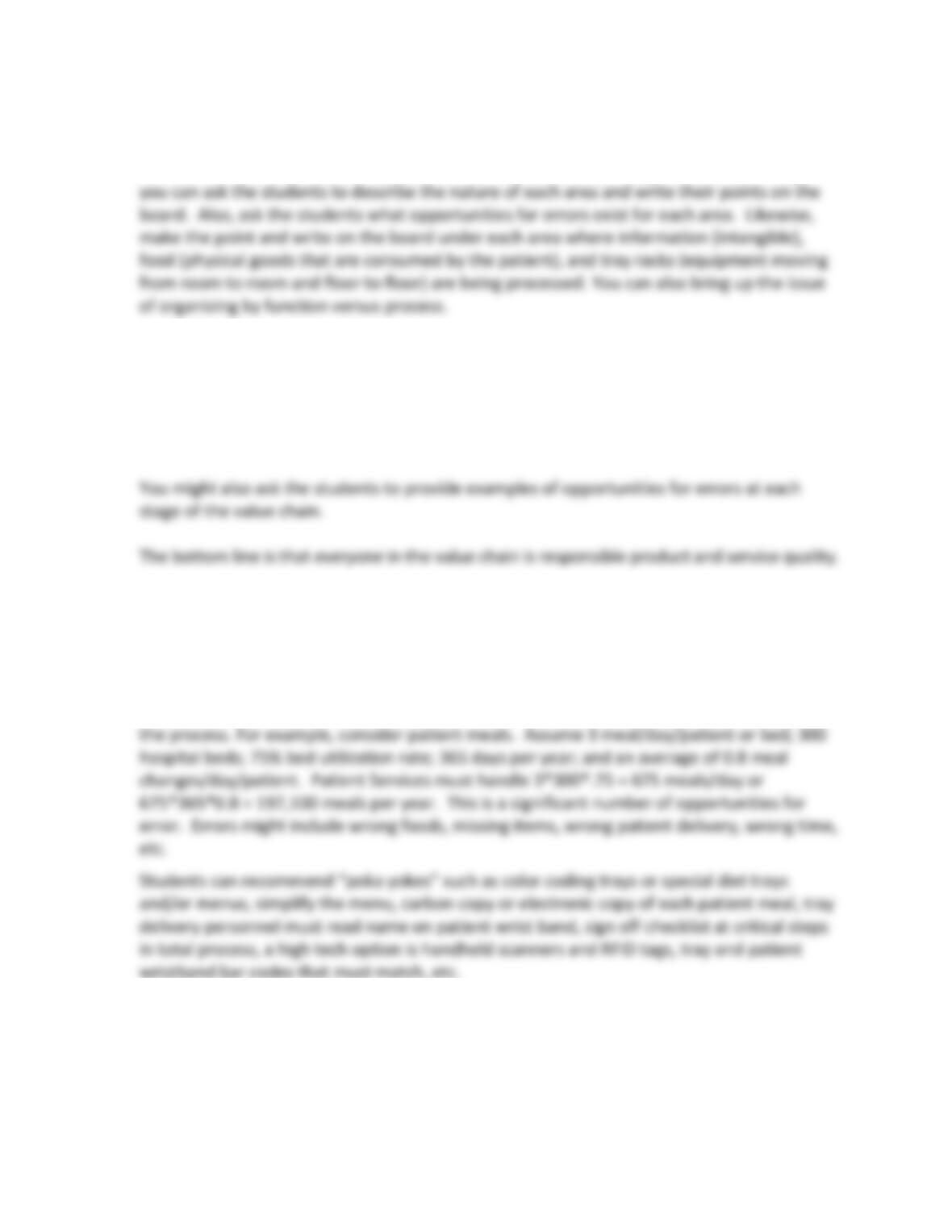
Such a chart is one way to organize this discussion. You might also draw a flowchart of the
value chain with major areas of responsibility listed below each stage. Below each stage
4. Who is responsible for quality?
The conclusions from this case module are that (a) hospital dietary food service is a complex
set of processes and information flows—that is a value chain, (b) there are thousands of
opportunities for error per area, and (b) everyone in the value chain is responsible for quality.
5. Select a process and discuss how to mistake proof it and improve process performance.
You do not have time to discuss all processes as described in the case and previous teaching
note discussion. Therefore, pick out one or two processes and describe its inputs,
resources, outputs/outcomes, opportunities for errors, and how you might mistake proof
6. How do we turn this dietary food service around? What are your recommendations?
One way to organize this 10-minute discussion is (a) short term actions you would
recommend to take in the next week, and (b) long-term actions over the next year or two.
Short term actions include immediate meeting to establish sign offs for each major stage of
Teaching Plan
There are many different ways to teach this case, but one suggested approach is to discuss the
following, drawing upon the information and examples provided above:
(1) What are the problems facing the hospital’s dietary food service?
(2) What is the cost to the hospital of a minor versus major service upset or failure?
(3) What does the value chain look like? Describe features of each area. Provide examples of
It is OK to skip one or more of the value chain views and some of the case questions to shorten
class discussion.
Sunshine Enterprises
Overview
An entrepreneur, Abby Martin, must make short- and long-term decisions about how to
manage and grow her restaurant business. The short-term issue is how to handle an extra $25
tip on a customer’s bill the customer says he did not authorize. The long-term decision is
The case presents the following information w/r to possible causes of the $25 tip service upset.
• The customer is responsible to tip properly, add the bill and tip correctly, write legibly,
retain the second receipt, and drink alcohol responsibility.
The credit card company, a third party provider in this value chain, is responsible to provide
records of the electronic transaction, help resolve the issue, and issue a debt or credit to the
customer and/or restaurant if needed.
Case Questions for Discussion:
1. Draw a cause-and-effect diagram for the possible causes of the $25 tip service upset.
Select one possible root cause from your diagram and explain how you would investigate and
fix it.
The cause-and-effect diagram (not shown) should have at least four major branches –
customer, employee, manager, and credit card Company with appropriate sub-branches. The
fishbone diagram provides a “framework for root cause analysis.” Students may add other sub–
2. What is the average value of a loyal customer (VLC) at Abby’s restaurants (see Chapter 2,
Section 2-2b)? What is the best way to increase revenue given your VLC analysis?
If you do not cover Chapter 2 then skip this assignment question. There is more VLC analysis
here than you should expect from the students.
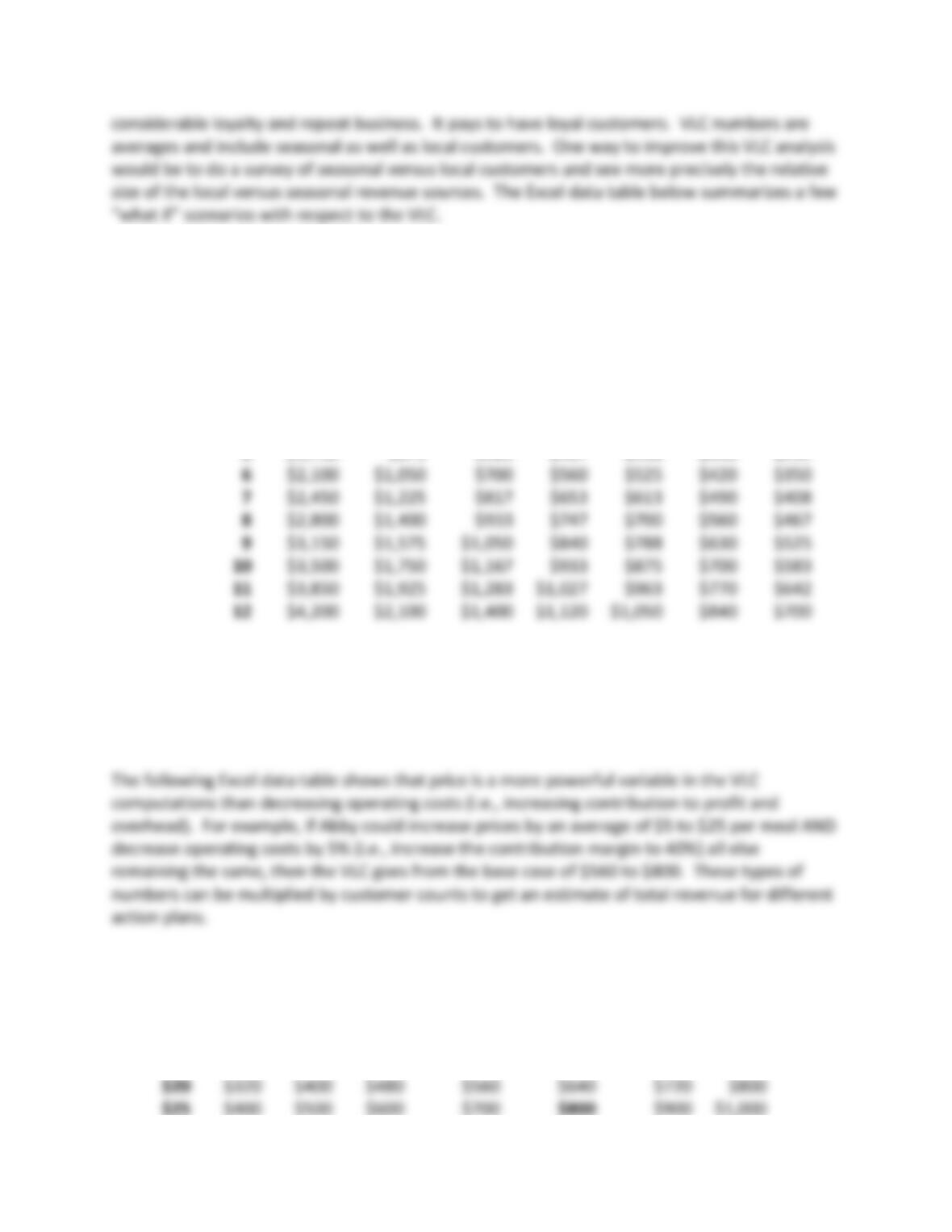
Example Data Table “What Ifs” w/r to Repurchase Frequency
and Customer Defection Rate
0.02
0.04
0.06
0.075
0.08
0.1
0.12
1
$350
$175
$117
$93
$88
$70
$58
2
$700
$350
$233
$187
$175
$140
$117
3
$1,050
$525
$350
$280
$263
$210
$175
4
$1,400
$700
$467
$373
$350
$280
$233
5
$1,750
$875
$583
$467
$438
$350
$292
6
$2,100
$1,050
$700
$560
$525
$420
$350
7
$2,450
$1,225
$817
$653
$613
$490
$408
8
$2,800
$1,400
$933
$747
$700
$560
$467
9
$3,150
$1,575
$1,050
$840
$788
$630
$525
$3,500
$1,750
$1,167
$933
$875
$700
$583
$3,850
$1,925
$1,283
$963
$770
$642
One lesson from this type of analysis is at one visit per year and a 12% customer defection rate
the VLC is only $58 while at 12 visits per year and a defection rate of only 2% the VLC jumps to
$4,200. It pays to provide excellent food and service quality as captured by these two VLC
variables, and of course, service management skills are needed to do this. Great food and
service payoff!
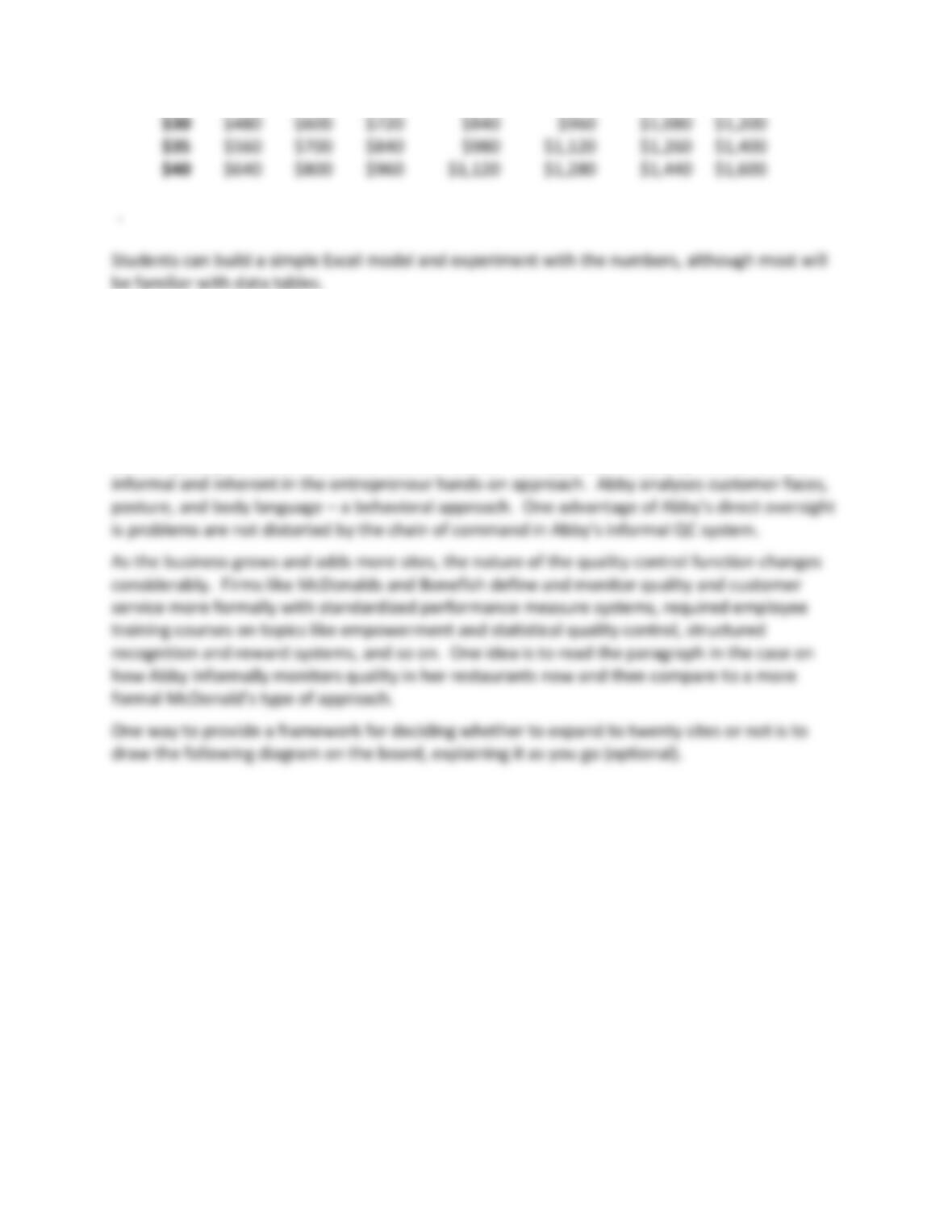
Example Data Table “What-Ifs” w/r to Price and Contribution Margin
0.2
0.25
0.3
0.35
0.4
0.45
0.5
$10
$160
$200
$240
$280
$320
$360
$400
$15
$240
$300
$360
$420
$480
$540
$600
3. Critique the current “informal” quality control system. What changes and improvements
do you recommend if Sunshine expands to 20 restaurants?
The current quality control system is typical of entrepreneurs with a limited number of sites.
They focus on face-to-face interaction with customers and employees, and audit food and
service quality, as well as sales and financial results. The approach to quality control is more
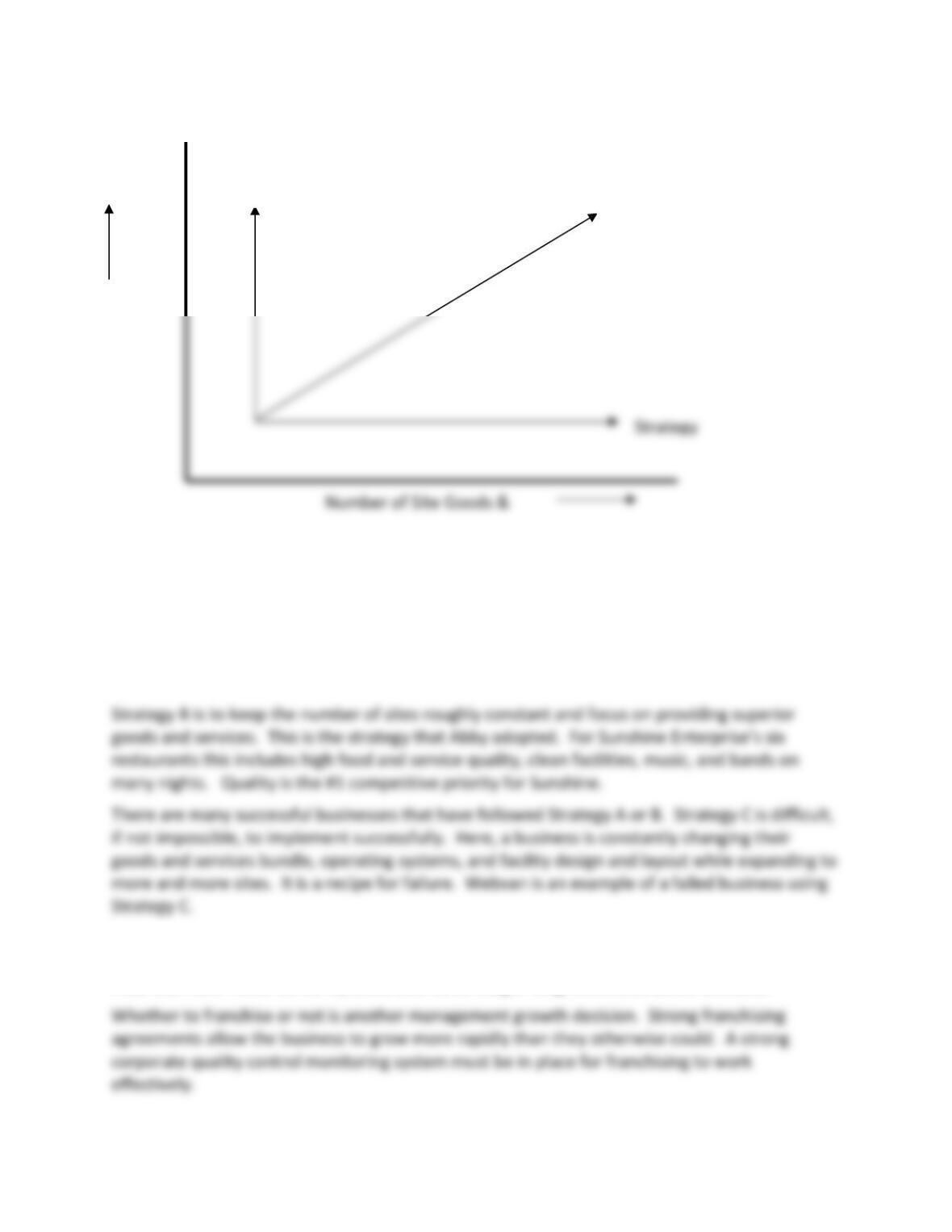
Strategy A is to keep the number of goods and services roughly constant and expand the
number of sites. McDonald’s and others fit this general strategy using a great deal of
standardization in all their systems (accounting, operations, training, human resource
management, marketing, equipment and facility design, and so on). Once the goods and
services bundle is basically set including facility design and layout, this is a “cookie cutter”
approach to growth.
Quality control is quite different for an organization with hundreds or thousands of sites. The
small entrepreneurial business uses a more informal approach whereas larger organizations
must use much more formal systems such as at Burger King, McDonald’s, and Outback.
Strategy A
Strategy C
Number of
4. What are your short- and long-term recommendations? Explain your rationale for these
recommendations.
Students must decide exactly how to handle the service upset, whether to expand or not and
by how much, and what is the best way to increase restaurant revenues.
Short-term Actions
• Resolve the $25 tip service upset (how, step by step, who does what and when).
• Disseminate what was learned w/r to the $25 tip upset to all six restaurant sites.
Long-term Actions
• Hire secret diners to audit restaurant performance – food and service quality.
• Develop written procedure manuals and job descriptions and performance
standards especially if they expand.
Postscript
The short-term service upset was solved by the following action (service recovery) plan. (1) The
restaurant manager investigated the $25 tip error and found the waiter had miss-typed it in the
register. (2) The manager credits the customer’s credit card for $22.50. (3) The customer was
called and the manager apologized, obtained the customer’s address and mailed him a free
lunch/dinner coupon. (4) The waiter was a core member of their staff and the manager
standardized, marketing and advertising would need a corporate and local emphasis, and
operating and training policies and programs would need to be standardized. It was best to
focus on a fixed set of business sites and do the very best with building customer loyalty and
increasing revenue, and build capability for the next business cycle upturn.
Integrative Case: Hudson Jewelers
Chapter 16 Case Question for Discussion:
1. What “cost of quality” criteria (i.e., prevention, appraisal, internal failure, and external failure
costs) might be included in an analysis at the following stages of a global diamond supply chain—
mining, cutting and polishing centers, and retail jewelry store? Explain. Explain and provide
examples.
The challenge of this question is to “apply” the textbook cost of quality concepts to this
industry. The four quality cost criteria times three stages of the diamond value chain results in
12 cost of quality situations to evaluate.
• Prevention costs are those expended to keep nonconforming goods and services from being
made and reaching the customer.
Diamond Mining Cost of Quality Examples
Prevention costs
• Equipment maintenance (drilling and excavating machines, trucks, shovels, conveyors,
etc.)
• Technical mining expertise to avoid cave ins and explosions
Appraisal costs
• Regulatory inspections and drills
Internal-failure costs
• Yield on carats per alluvial ton decrease (not a productive mine)
External-failure costs
• Explosions and accidents (legal and liability claims)
Diamond Cutting and Polishing Cost of Quality Examples
Prevention costs
• Master and regular diamond cutter training and expertise
• Cross-check diamond design and cutting plans
Appraisal costs
• In house appraisals
Internal-failure costs
• Cutter errors and failures
• Rework costs
External-failure costs
• Diamond and jewelry manufacturer
Retail Jewelry Store Cost of Quality Examples
Prevention costs
• Staff service management training
• Staff CAD training and expertise
Appraisal costs
• Stone appraisal expertise
• Proofing final CAD jewelry co-designs
Internal-failure costs
• Customer claims
• Rework
External-failure costs
• Returns for a total or partial refund
• Customer dissatisfaction with final co-designed jewelry (stop process)