Chapter 16
Country Risk Analysis
Lecture Outline
Political Risk Characteristics
Attitude of Consumers in the Host Country
Actions of Host Government
Blockage of Fund Transfers
Currency Inconvertibility
War
Bureaucracy
Corruption
Financial Risk Characteristics
Economic Growth
Measuring Country Risk
Techniques to Assess Country Risk
Incorporating Country Risk in Capital Budgeting
Adjustment of the Discount Rate
Adjustment of the Estimated Cash Flows
Analysis of Existing Projects
Preventing Host Government Takeovers
Use a Short-term Horizon
Rely on Unique Supplies or Technology

Country Risk Analysis ❖ 2
Chapter Theme
This chapter attempts to acquaint the student with various forms of risk that must be considered by a
multinational corporation. Methods used to assess country risk are defined. It should be emphasized that
country risk is often difficult to assess. Furthermore, it may change over time. A firm should incorporate
the country risk assessment in its decision of whether to begin (or continue) business in a particular
country. If it decides to conduct business there, it should continue to assess country risk as it decides
whether to expand in that country.
Topics to Stimulate Class Discussion
1. How would you rate the country risk of the U.S.? Would your rating change if you lived in a foreign
country? Why?
2. Some people say that you cannot separate the political and financial risk of a country. What does this
mean?
3. If you use a country risk rating system based on a scoring range of 0 to 100 (100 representing a very
safe country), and Country Z earns a score of 77, are you going to invest in that country? Explain
your answer. The point is to realize that the ratings are subjective, and it would help to consider a
probability distribution of possible outcomes before finalizing a decision.
POINT/COUNTER-POINT:
Does Country Risk Matter for U.S. Projects?
POINT: No. U.S.-based MNCs should consider country risk for foreign projects only. A U.S.-based MNC
can account for U.S. economic conditions when estimating cash flows of a U.S. project or deriving the
required rate of return on a project, but it does not need to consider country risk.
COUNTER-POINT: Yes. Country risk should be considered for U.S. projects. Country risk can indirectly
affect the cash flows of a U.S. project. Consider a U.S. project in which supplies are produced and sent to
a U.S. exporter. The demand for the supplies will be dependent on the demand for the exports over time,
and the demand for exports over time may be dependent on country risk.
WHO IS CORRECT? Use the Internet to learn more about this issue. Which argument do you support?
Offer your own opinion on this issue.
Answers to End of Chapter Questions
1. Forms of Country Risk. List some forms of political risk other than a takeover of a subsidiary by the
host government, and briefly elaborate on how each factor can affect the risk to the MNC.
Identify common financial factors for an MNC to consider when assessing country risk. Briefly
elaborate on how each factor can affect the risk to the MNC.
Country Risk Analysis ❖ 3
ANSWER: Forms of political risk include the possibility of (1) blocked funds, (2) changing tax laws,
2. Country Risk Assessment. Describe the steps involved in assessing country risk once all relevant
information has been gathered.
3. Uncertainty Surrounding the Country Risk Assessment. Describe the possible errors involved in
assessing country risk. In other words, explain why country risk analysis is not always accurate.
4. Diversifying Away Country Risk. Why do you think that an MNC’s strategy of diversifying
projects internationally could achieve low exposure to overall country risk?
5. Monitoring Country Risk. Once a project is accepted, country risk analysis for the foreign country
involved is no longer necessary, assuming that no other proposed projects are being evaluated for that
country. Do you agree with this statement? Why or why not?
6. Country Risk Analysis. If the potential return is high enough, any degree of country risk can be
tolerated. Do you agree with this statement? Why or why not? Do you think that a proper country
risk analysis can replace a capital budgeting analysis of a project considered for a foreign country?
Explain.
7. Country Risk Analysis. Niagara, Inc., has decided to call a well-known country risk consultant to
conduct a country risk analysis in a small country where it plans to develop a large subsidiary.
Niagara prefers to hire the consultant since it plans to use its employees for other important corporate
Country Risk Analysis ❖ 4
functions. The consultant uses a computer program that has assigned weights of importance linked to
the various factors. The consultant will evaluate the factors for this small country and insert a rating
for each factor into the computer. The weights assigned to the factors are not adjusted by the
computer, but the factor ratings are adjusted for each country that the consultant assesses. Do you
think Niagara, Inc. should use this consultant? Why or why not?
8. Micro-Assessment. Explain the micro-assessment of country risk.
9. Incorporating Country Risk in Capital Budgeting. How could a country risk assessment be used to
adjust a project’s required rate of return? How could such an assessment be used instead to adjust a
project’s estimated cash flows?
10. Reducing Country Risk. Explain some methods of reducing exposure to existing country risk, while
maintaining the same amount of business within a particular country.
11. Managing Country Risk. Why do some subsidiaries maintain a low profile as to where their parents
are located?
12. Country Risk Analysis. When NYU Corp. considered establishing a subsidiary in Zealand, it
performed a country risk analysis to help make the decision. It first retrieved a country risk analysis
performed about one year earlier, when it had planned to begin a major exporting business to Zenland

Country Risk Analysis ❖ 5
firms. Then it updated the analysis by incorporating all current information on the key variables that
were used in that analysis, such as Zenland’s willingness to accept exports, its existing quotas, and
existing tariff laws. Is this country risk analysis adequate? Explain.
13. Reducing Country Risk. MNCs such as Alcoa, DuPont, Heinz, and IBM donated products and
technology to foreign countries where they had subsidiaries. How could these actions have reduced
some forms of country risk?
14. Country Risk Ratings. Assauer Inc. would like to assess the country risk of Glovanskia. Assauer has
identified various political and financial risk factors, as shown below.
Political Risk Factor Assigned Rating Assigned Weight
Blockage of fund transfers 5 40%
Bureaucracy 3 60%
Financial Risk Factor Assigned Rating Assigned Weight
Interest rate 1 10%
Inflation 4 20%
Exchange rate 5 30%
Competition 4 20%
Growth 5 20%
Assauer has assigned an overall rating of 80 percent to political risk factors and of 20 percent to
financial risk factors. Assauer is not willing to consider Glovanskia for investment if the country risk
rating is below 4.0. Should Assauer consider Glovanskia for investment?
ANSWER:
15. Effects of September 11. Arkansas Inc. exports to various less developed countries, and its
receivables are denominated in the foreign currencies of the importers. It considers reducing its
exchange rate risk by establishing small subsidiaries to produce products. By incurring some
expenses in the countries where it generates revenue, it reduces its exposure to exchange rate risk.
Since September 11, 2001, when terrorists attacked the U.S., it has questioned whether it should
restructure its operations. Its CEO believes that its cash flows may be less exposed to exchange rate
risk but more exposed to other types of risk as a result of restructuring. What is your opinion?
Country Risk Analysis ❖ 6
Advanced Questions
16. How Country Risk Affects NPV. Hoosier, Inc., is planning a project in the United Kingdom. It
would lease space for one year in a shopping mall to sell expensive clothes manufactured in the U.S.
The project would end in one year, when all earnings would be remitted to Hoosier, Inc. Assume that
no additional corporate taxes are incurred beyond those imposed by the British government. Since
Hoosier, Inc., would rent space, it would not have any long-term assets in the United Kingdom, and
expects the salvage (terminal) value of the project to be about zero.
Assume that the project’s required rate of return is 18 percent. Also assume that the initial outlay
required by the parent to fill the store with clothes is $200,000. The pretax earnings are expected to
the £300,000 at the end of one year. The British pound is expected to be worth $1.60 at the end of
one year, when the after-tax earnings are converted to dollars and remitted to the United States. The
following forms of country risk must be considered:
• The British economy may weaken (probability = 30%), which would cause the expected pretax
earnings to be £200,000.
• The British corporate tax rate on income earned by U.S. firms may increase from 40 percent to 50
percent (probability = 20 percent).
These two forms of country risk are independent. Calculate the expected value of the project’s net
present value (NPV) and determine the probability that the project will have a negative NPV.
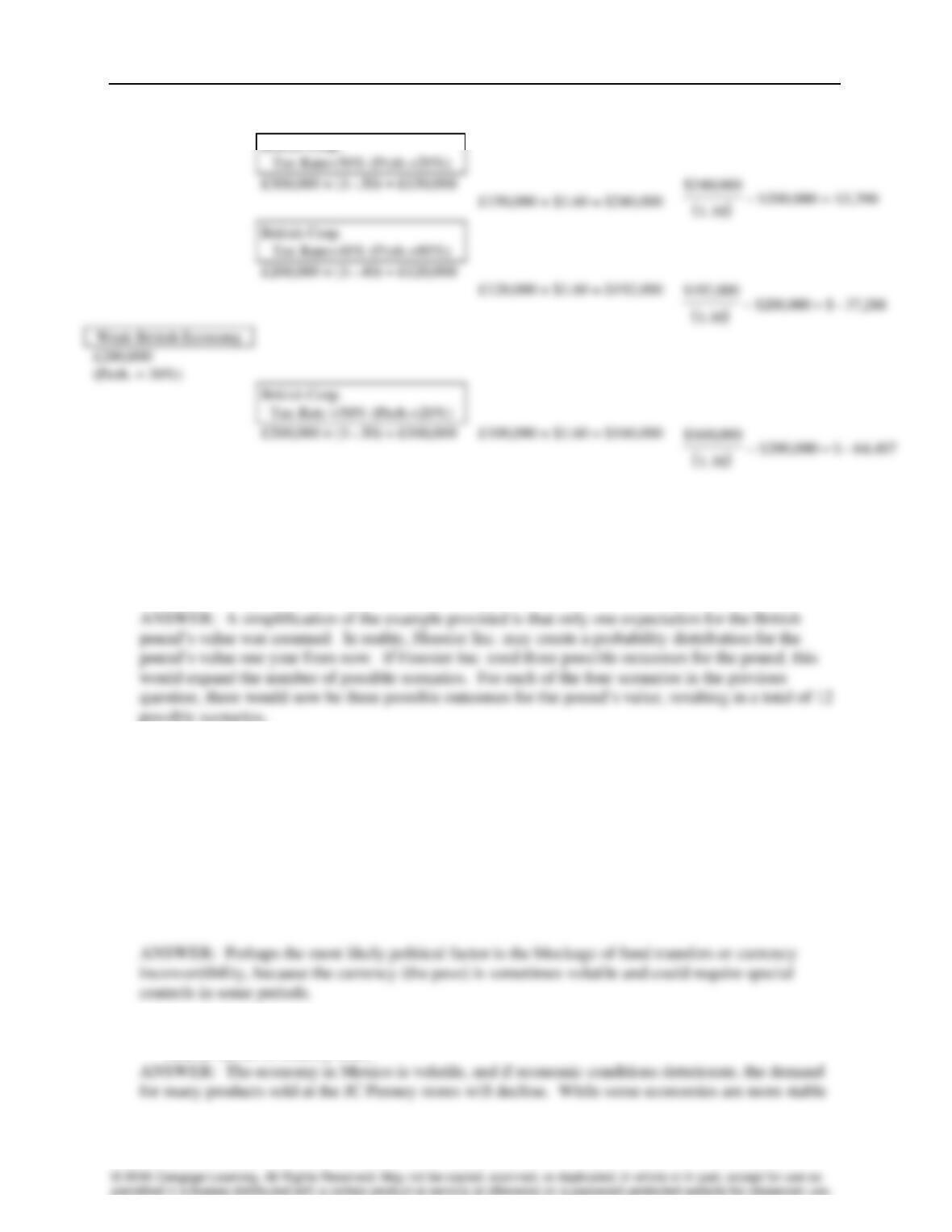
ANSWER: Sensitivity analysis can be used to measure the net present value under each possible
scenario, as shown in the attached exhibit. There are four possible scenarios. The most favorable
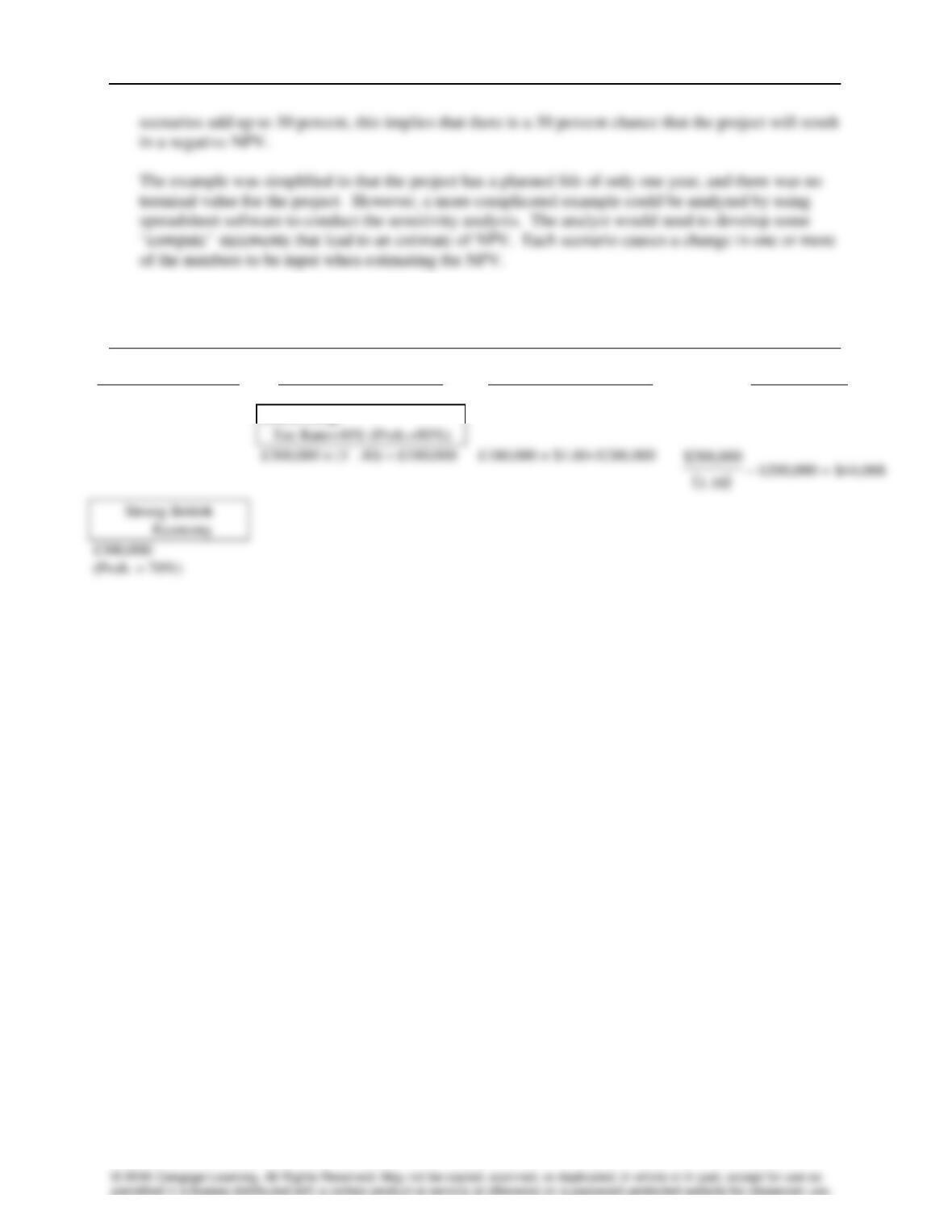
Country Risk Analysis ❖ 7
EXHIBIT FOR QUESTION 16
Pretax Pound Earnings
After-Tax Pound Earnings
After-Tax Dollar Earnings
Estimated NPV
British Corp.
Country Risk Analysis ❖ 8
17. How Country Risk Affects NPV. Explain how the capital budgeting analysis in the previous
question would need to be adjusted if there were three possible outcomes for the British pound along
with the possible outcomes for the British economy and corporate tax rate.
18. J.C. Penney’s Country Risk Analysis. Recently, JC Penney decided to consider expanding into
various foreign countries; it applied a comprehensive country risk analysis before making its
expansion decisions. Initial screenings of 30 foreign countries were based on political and economic
factors that contribute to country risk. For the remaining 20 countries where country risk was
considered to be tolerable, specific country risk characteristics of each country were considered. One
of JC Penney’s biggest targets is Mexico, where it planned to build and operate seven large stores.
a. Identify the political factors that you think may possibly affect the performance of the JC Penney
stores in Mexico.
b. Explain why the JC Penney stores in Mexico and in other foreign markets are subject to financial
risk (a subset of country risk).
Country Risk Analysis ❖ 9
c. Assume that JC Penney anticipated that there was a 10 percent chance that the Mexican
government would temporarily prevent conversion of peso profits into dollars because of political
conditions. This event would prevent JC Penney from remitting earnings generated in Mexico
and could adversely affect the performance of these stores (from the U.S. perspective). Offer a
way in which this type of political risk could be explicitly incorporated into a capital budgeting
analysis when assessing the feasibility of these projects.
d. Assume that JC Penney decides to use dollars to finance the expansion of stores in Mexico.
Second, assume that JC Penney decides to use one set of dollar cash flow estimates for any
project that it assesses. Third, assume that the stores in Mexico are not subject to political risk.
Do you think that the required rate of return on these projects would differ from the required rate
of return on stores built in the U.S. at that same time? Explain.
e. Based on your answer to the previous question, does this mean that proposals for any new stores
in the U.S. have a higher probability of being accepted than proposals for any new stores in
Mexico?
19. How Country Risk Affects NPV. Monk, Inc. is considering a capital budgeting project in Tunisia.
The project requires an initial outlay of 1 million Tunisian dinar; the dinar is currently valued at $.70.
In the first and second years of operation, the project will generate 700,000 dinar in each year. After
two years, Monk will terminate the project, and the expected salvage value is 300,000 dinar. Monk
has assigned a discount rate of 12 percent to this project. The following additional information is
available:
• There is currently no withholding tax on remittances to the U.S., but there is a 20 percent chance
that the Tunisian government will impose a withholding tax of 10 percent beginning next year.
Country Risk Analysis ❖ 10
• There is a 50 percent chance that the Tunisian government will pay Monk 100,000 dinar after two
years instead of the 300,000 dinar it expects.
• The value of the dinar is expected to remain unchanged over the next two years.
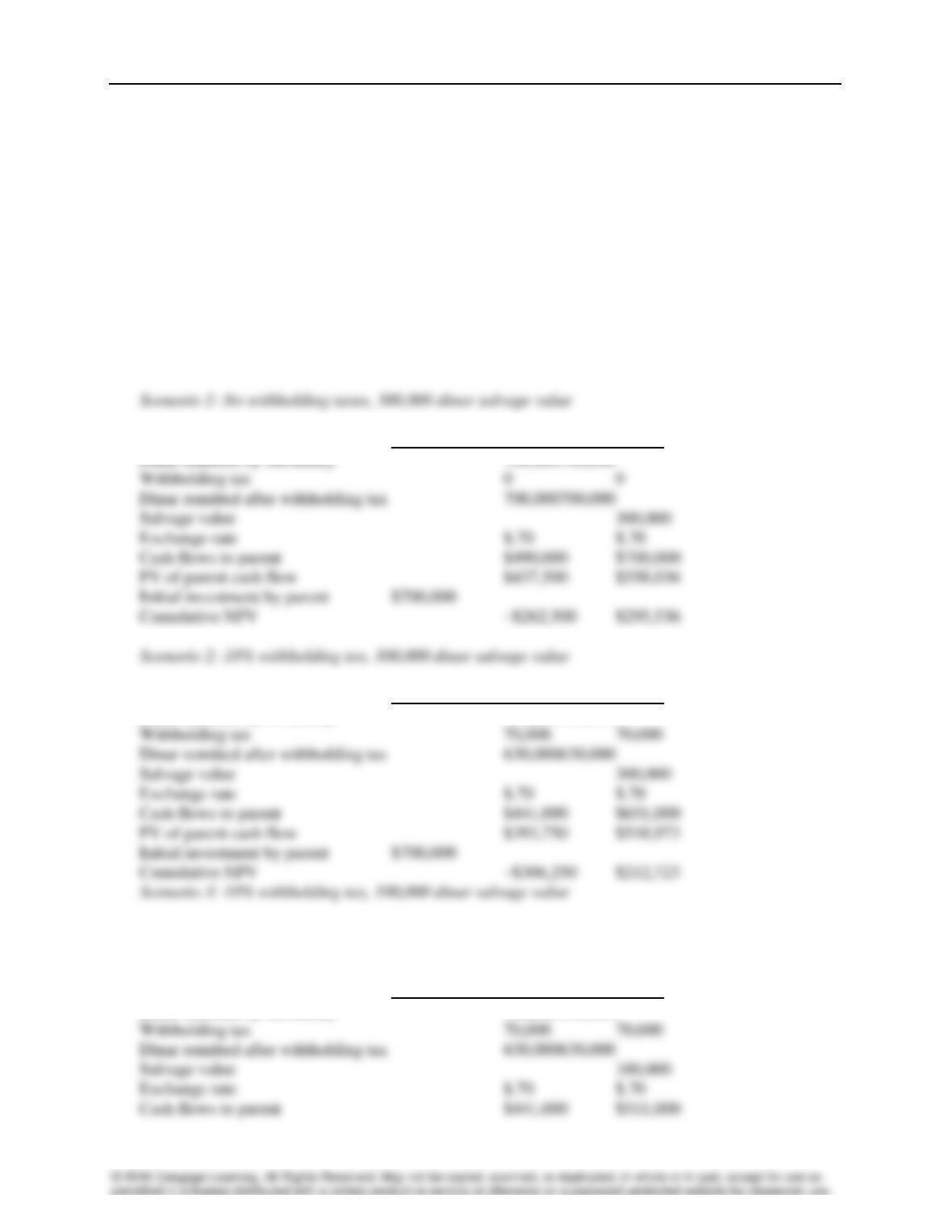
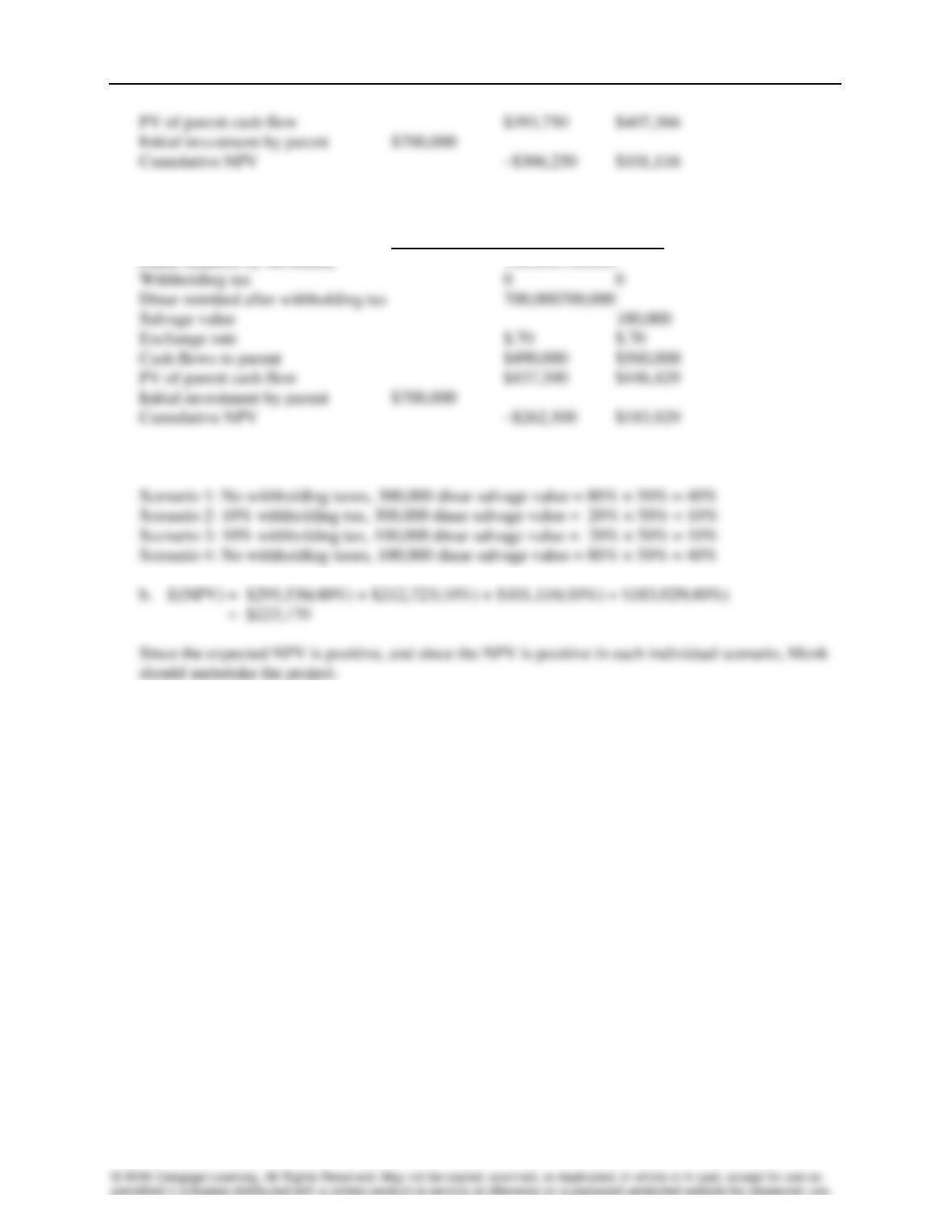
a. Determine the net present value (NPV) of the project in each of the four possible scenarios.
b. Determine the joint probability of each scenario.
c. Compute the expected NPV of the project and make a recommendation to Monk regarding its
feasibility.
ANSWER:
a.
Year 0 Year 1 Year 2
Year 0 Year 1 Year 2
Dinar remitted by subsidiary 700,000 700,000
Year 0 Year 1 Year 2
Dinar remitted by subsidiary 700,000 700,000
Country Risk Analysis ❖ 11
Scenario 4: No withholding taxes, 100,000 dinar salvage value
Year 0 Year 1 Year 2
Dinar remitted by subsidiary 700,000 700,000
a. The joint probabilities for the four cases are shown below:
20. How Country Risk Affects NPV. In the previous question, assume that instead of adjusting the
estimated cash flows of the project, Monk had decided to adjust the discount rate from 12 percent to
17 percent. Reevaluate the NPV of the project’s expected scenario using this adjusted discount rate.