Chapter 16 – Control Systems & Quality Management: Techniques for Enhancing Organizational Effectiveness
16–21
D. Measurement Management: “Forget Magic”
1. One survey identified two types of organizations: measurement-managed
and non-measurement-managed.
2. The study’s data point to four mechanisms that contribute to the success
of measurement-managed firms:
3. The four most frequent barriers to effective measurement are:
a. Objectives are fuzzy.
4. Some areas are easier to measure than others; however professionals are
establishing quantifiable goals for even hard to measure areas.

Chapter 16 – Control Systems & Quality Management: Techniques for Enhancing Organizational Effectiveness
16–22
(Correct answer is A)
Group Exercise #1: Applying the Balanced Scorecard
There is a group exercise available at the end of this manual that provides students
with the opportunity to gain practice at creating a balanced scorecard.
Exercise Objectives
Section 16.4 discusses financial controls, which include budgets, financial statements,
ratio analysis, and audits. One way that you could begin your coverage of these topics
Possible Topics for Discussion:
• Discuss the advantages and disadvantages of fixed versus variable budgets.
16.4 Some Financial Tools for Control (pp. 525–528)
Financial performance is important to most organizations. What are the
financial tools I need to know about?
Chapter 16 – Control Systems & Quality Management: Techniques for Enhancing Organizational Effectiveness
16–23
• Describe the various types of financial ratios that can be used when conducting a
Major Idea Outline:
A. Financial controls are needed to monitor financial performance.
B. Budgets: Formal Financial Projections
1. A budget is a formal financial projection.
a. A budget states an organization’s planned activities for a given period
2. Two budget approaches: zero-based and incremental.
a. Zero based (ZBB) forces each department to start from zero in
projecting funding needs, but is no longer favored.
b. Incremental budgeting allocates increased or decreased funds to a
3. Fixed versus variable budgets
Chapter 16 – Control Systems & Quality Management: Techniques for Enhancing Organizational Effectiveness
16–24
a. A fixed budget allocates resources on the basis of a single estimate
of costs.
C. Financial Statements: Summarizing the Organization’s Financial Status
1. A financial statement is a summary of some aspect of an organization’s
financial status.
2. A balance sheet summarizes an organization’s overall financial worth—
assets and liabilities—at a specific point in time.
a. Assets are the resources that an organization controls, and consist of
Chapter 16 – Control Systems & Quality Management: Techniques for Enhancing Organizational Effectiveness
16–25
d. Liabilities are claims, or debts, by suppliers, lenders, and other
nonowners of the organization against a company’s assets.
3. The income statement: picture of organization’s financial results for a
specified period of time.
a. The income statement summarizes an organization’s financial
D. Ratio Analysis: Indicators of an Organization’s Financial Health
1. Managers often use ratio analysis—the practice of evaluating financial
ratios—to determine an organization’s financial health.
2. Liquidity ratios indicate how easily an organization’s assets can be
converted into cash.
Chapter 16 – Control Systems & Quality Management: Techniques for Enhancing Organizational Effectiveness
16–26
E. Audits: External versus Internal
1. Audits are formal verifications of an organization’s financial and
operational systems. Audits are of two types: external and internal.
2. An external audit is a formal verification of an organization’s financial
accounts and statements by outside experts.
SELF-ASSESSMENT 16.2 (p. 528)
Assessing Your Financial Literacy
Go to connect.mheducation.com and take Self-Assessment 16.2.
Student Questions:
1. Where do you stand in terms of financial literacy?
Student responses will differ based on survey results. Some students may be
Chapter 16 – Control Systems & Quality Management: Techniques for Enhancing Organizational Effectiveness
16–27
2. Look at the statements you got incorrect, and identify the specific aspects of
financial knowledge that you may be lacking.
3. What can you do to improve your financial literacy? Be specific.
Generally, students should educate themselves on the different topics
Section 16.5 discusses Total Quality Management or TQM. TQM is dedicated to
continuous quality improvement, training, and customer satisfaction. Two core
principles are people orientation and improvement orientation. Some techniques for
improving quality are employee involvement, benchmarking, outsourcing, reduced cycle
time, and statistical process control.
students to read only the article or also ask them to read the professional commentary.
Article Citation:
Seijts, J., Horenfeldt, C., & Blanchard, K. (2015). Who should take the fall? Harvard
Possible Topics for Discussion:
• Discuss the total quality management principles and tools that are used at your
company (or a previous one).
16.5 Total Quality Management (pp. 529-536)
How do top companies improve the quality of their products or services?
Chapter 16 – Control Systems & Quality Management: Techniques for Enhancing Organizational Effectiveness
16–28
Major Idea Outline:
A. The Malcolm Baldrige National Quality Award was created by Congress to be
the most prestigious recognition of quality in the U.S.
1. In the early 1980’s, surveys showed that three-fourths of Americans
2. Many quality improvements in Japanese products came from American
3. W. Edward Deming’s challenge, known as Deming management,
proposed ideas for making organizations more responsive, more
democratic, and less wasteful and included four principles:
a. Quality should be aimed at the needs of the consumer.
Chapter 16 – Control Systems & Quality Management: Techniques for Enhancing Organizational Effectiveness
16–29
B. Core TQM Principles: Deliver Customer Value and Strive for Continuous
Improvement
1. Total quality management (TQM) is defined as a comprehensive
approach—led by top management and supported throughout the
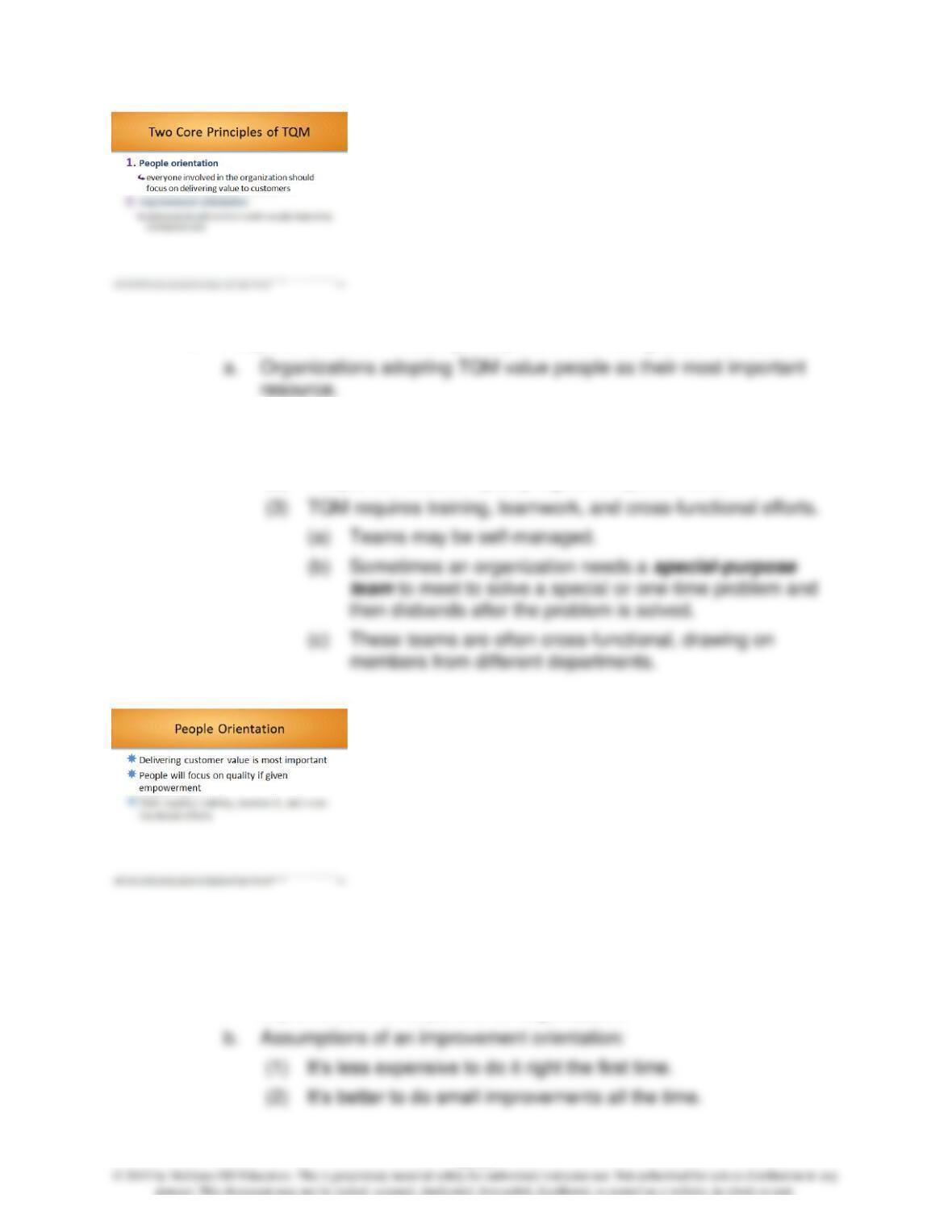
b. These may be summarized as two core principles of TQM:
(1) People orientation—get everyone involved with the organization
focused on delivering value to customers, and
Chapter 16 – Control Systems & Quality Management: Techniques for Enhancing Organizational Effectiveness
16–30
2. People orientation—focusing everyone on delivering customer value
b. Assumptions of the people orientation:
(1) Delivering customer value is most important.
(2) People will focus on quality if given empowerment.
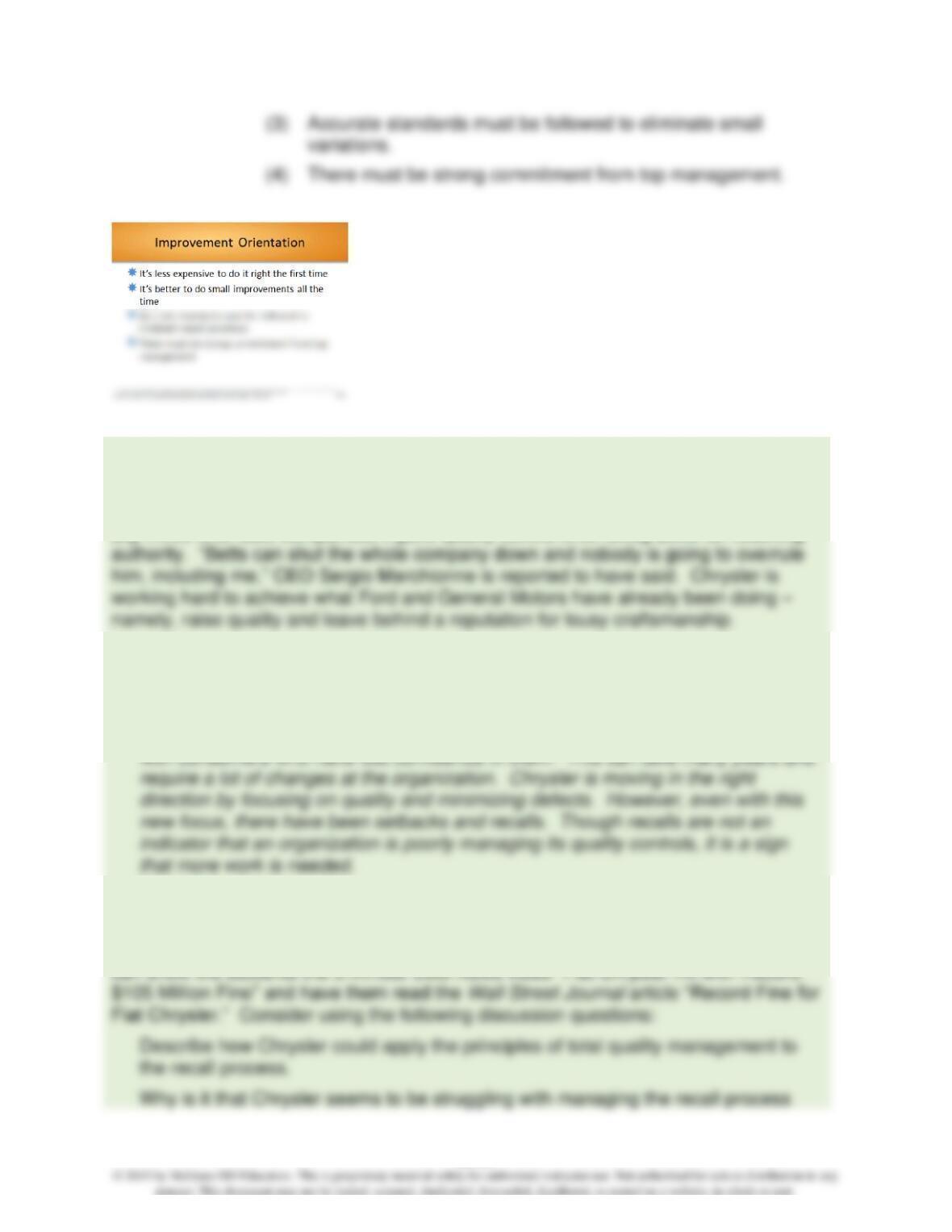
3. Improvement orientation—focusing everyone on continuously improving
work processes.
a. Continuous improvement is defined as ongoing small, incremental
improvements in all parts of an organization.
Chapter 16 – Control Systems & Quality Management: Techniques for Enhancing Organizational Effectiveness
16–31
Interactive Classroom Material:
EXAMPLE: Is Chrysler’s New Quality Strategy Working? (p. 532)
When Italian carmaker Fiat SpA took control of the Chrysler Group, the third of the
Big Three U.S. auto companies, it gave quality control chief Doug Betts far-reaching
YOUR CALL
It’s easy for a company to lose its reputation. How long do you think it takes to
get it back? Is Chrysler there yet, in your opinion?
Large, popular companies have more challenges associated with making good
Additional Activities:
One way to build on this Example is to profile the fact that Fiat Chrysler was assessed
a record fine in July 2015 for lapses in the recall process for millions of vehicles. You
Chapter 16 – Control Systems & Quality Management: Techniques for Enhancing Organizational Effectiveness
16–32
but yet is making huge strides in improving its production process?
Is this information about Chrysler likely to impact your car-buying preferences in
the future? Explain your point of view.
Article Citation
Spector, M. (2015, July 27). Record fine for Fiat Chrysler. Wall Street Journal Online.
C. Applying TQM to Services
1. There are differences between products and services:
a. Manufacturing industries provide tangible products; service industries
provide intangible products.
SELF-ASSESSMENT 16.3 (p. 533)
Assessing Your Satisfaction with Your College or University
Experience
Go to connect.mheducation.com and take Self-Assessment 16.3.
Student Questions:
1. What is your level of satisfaction? Are you surprised by the results?
Responses will differ based on individual assessment results. Some students
2. Based on your scores, identify three things that your college or university
might do to improve student satisfaction. Be specific.
Chapter 16 – Control Systems & Quality Management: Techniques for Enhancing Organizational Effectiveness
16–33
3. Are students really customers? Explain your rationale.
Additional Activities:
You can also consult the Connect Instructors Manual for the post-assessment activity
and corresponding PowerPoint slides used for this Self-Assessment in Connect. In
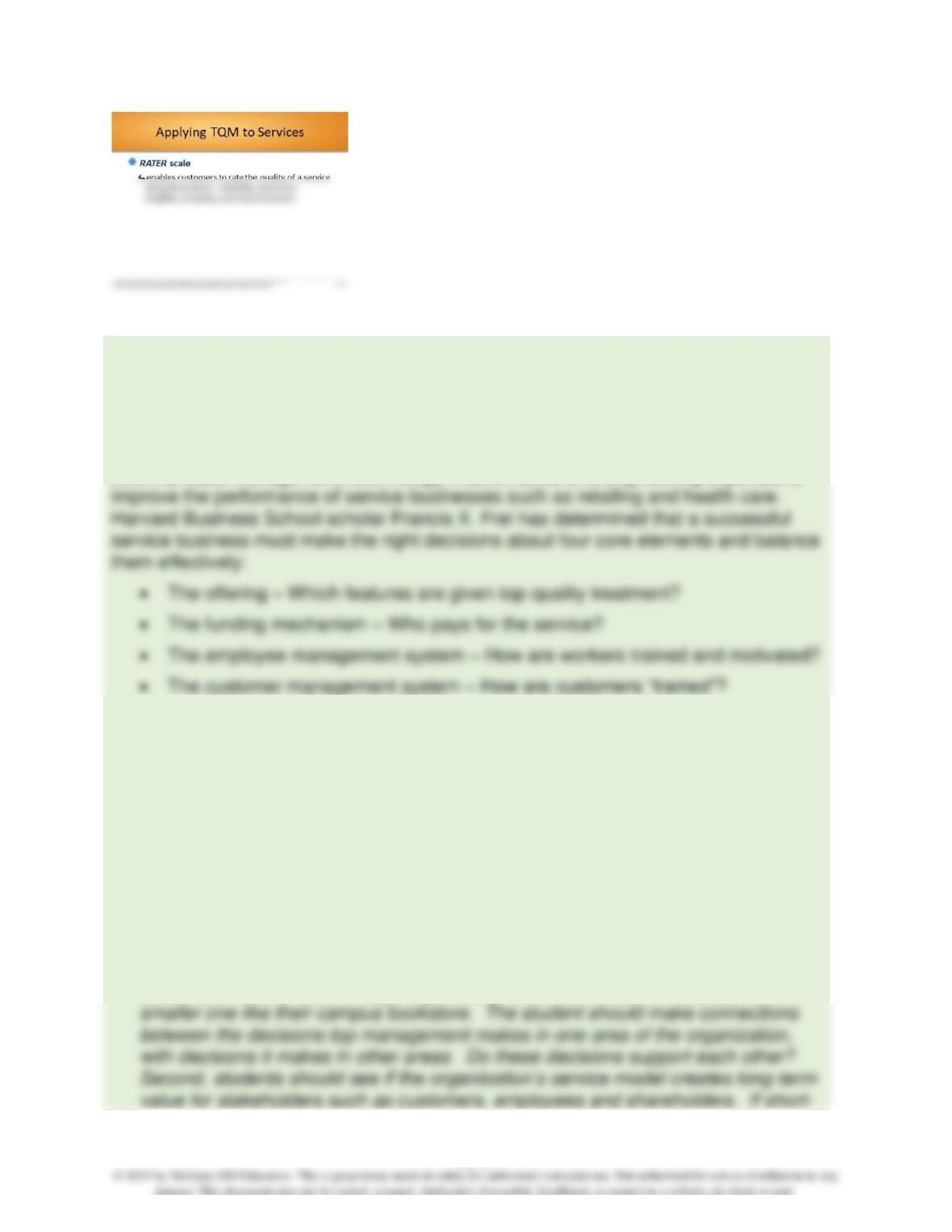
e. The RATER scale enables customers to rate the quality of a service
along five dimensions:
(1) Reliability – ability to perform the desired service dependably,
accurately and consistently
(2) Assurance – employees’ knowledge, courtesy, and ability to
convey trust and confidence
Chapter 16 – Control Systems & Quality Management: Techniques for Enhancing Organizational Effectiveness
16–34
Interactive Classroom Material:
EXAMPLE: What Makes a Service Company Successful? Four Core Elements
(p. 534)
With services now employing more than 75% of American workers, universities are
bringing more research attention to what is being called “services science.” This is a
field that uses management, technology, mathematics, and engineering expertise to
YOUR CALL
Pick a services company you’re familiar with. In integrating the four core
features, a service company needs to determine the following:
• Are the decisions it makes in one area supported by those it makes in the
other areas?
• Does the service model create long-term value for customers,
employees, and shareholders?
• Is the company trying to be all things to all people or specific things to
specific people?
• How do you think the company you picked rates?
Students should choose a large organization such as Amazon or Starbucks, or a
Chapter 16 – Control Systems & Quality Management: Techniques for Enhancing Organizational Effectiveness
16–35
Additional Activities:
One way to build on this Example is to have the students watch the Harvard Business
Review video “When to Disappoint Your Customers.” In this 5-minute video, Frances
Frei explains why trying to offer great customer service so often backfires. Consider
using the following discussion questions:
Explain why, in order for a company to be great at something, it needs to be bad
at something else. Why is this lesson perhaps harder for service firms to realize
than manufacturing firms?
D. Some TQM Techniques
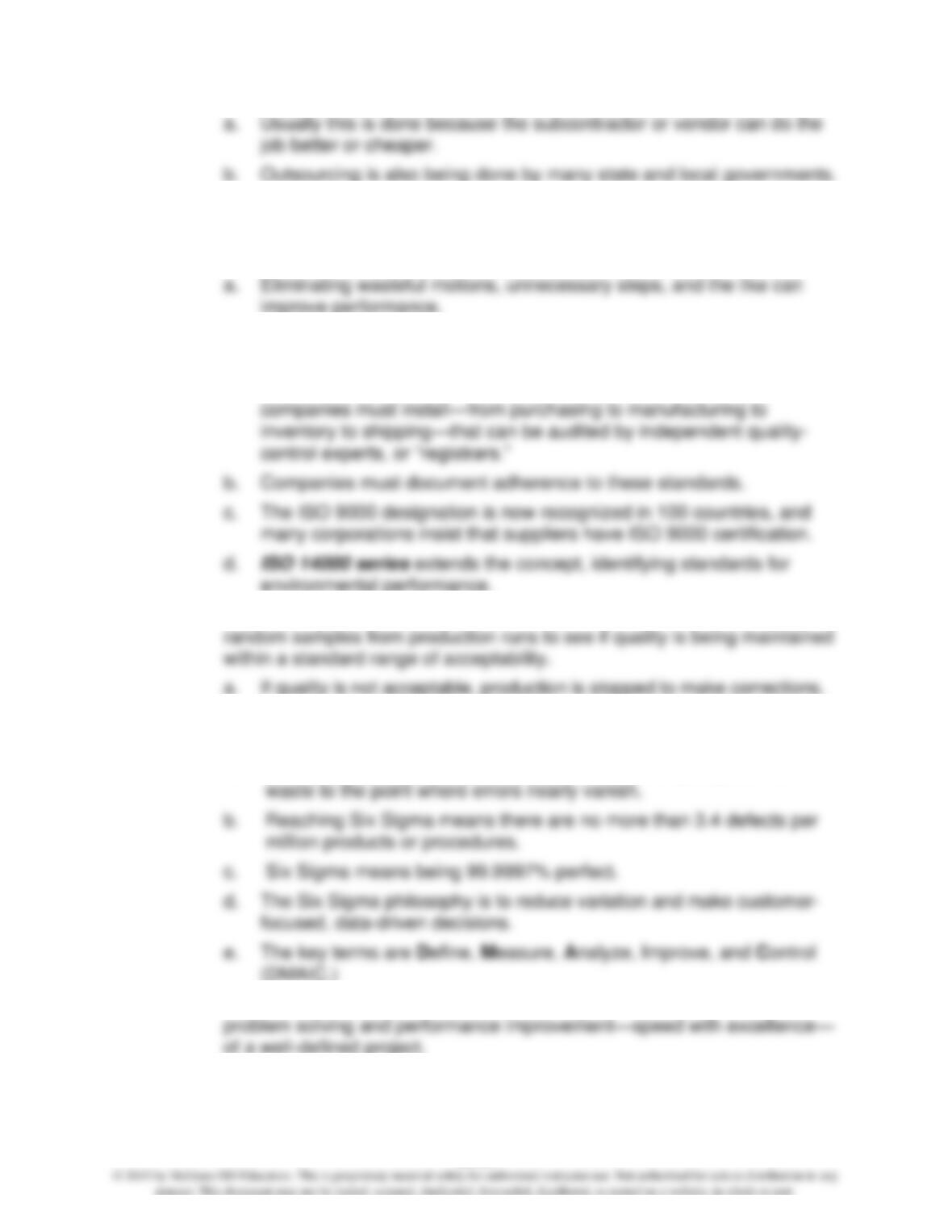
1. Tools and techniques for improving quality include: benchmarking,
outsourcing, reduced cycle time, ISO 9000 and ISO 14000, statistical
process control and Six Sigma.
2. Benchmarking is a process by which a company compares its
performance with that of high performing organizations.
Chapter 16 – Control Systems & Quality Management: Techniques for Enhancing Organizational Effectiveness
16–36
(1) Known as privatization, governments subcontract services such
as fire protection, correctional services, and medical services.
4. Reduced cycle time is the reduction in steps in a work process.
5. The International Organization for Standardization (ISO) created a set of
quality standards known as the 9000 series.
a. The ISO 9000 series consists of quality-control procedures
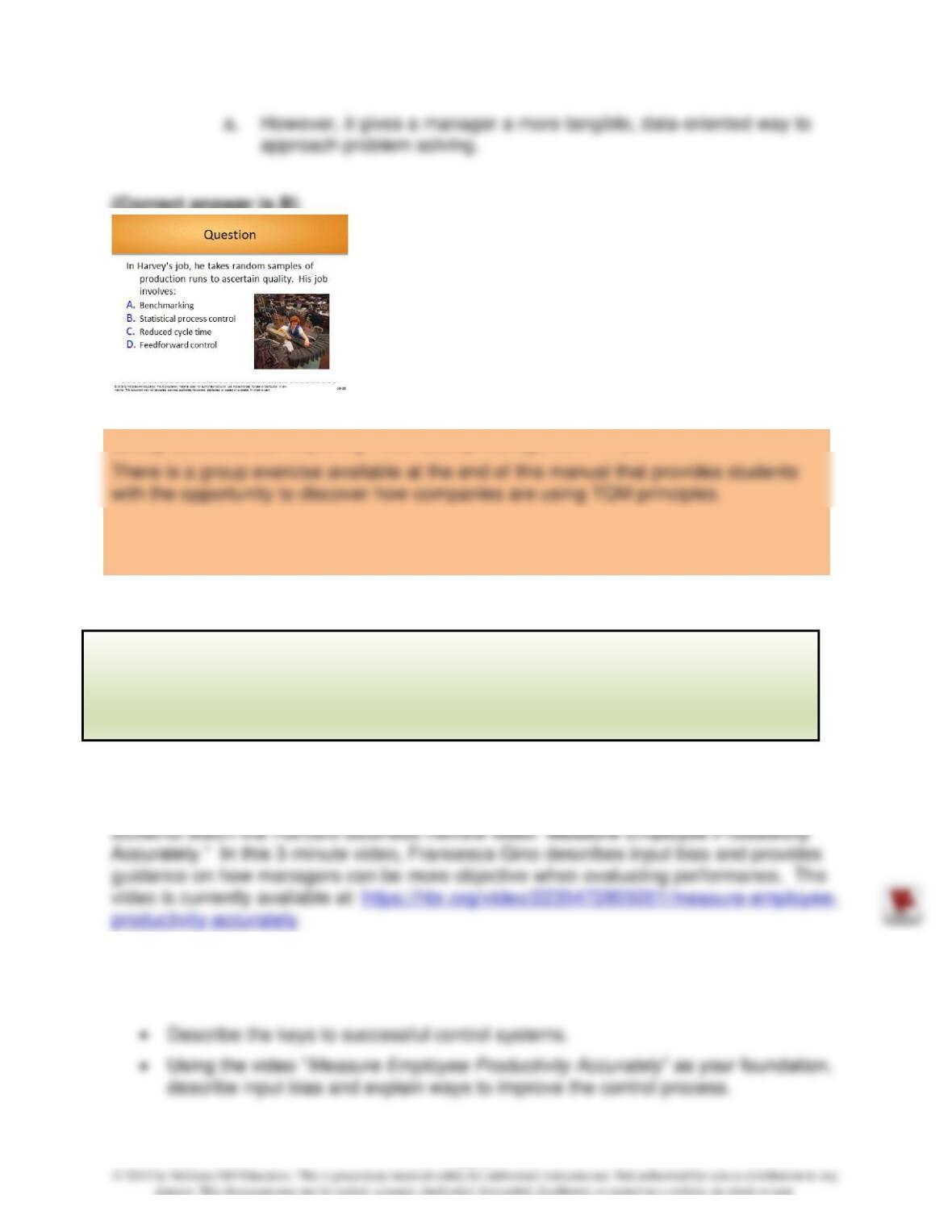
6. Statistical process control is a statistical technique that uses periodic
7. Six Sigma is a rigorous statistical analysis process that reduces defects in
manufacturing and service-related processes.
a. A company using Six Sigma attempts to improve quality and reduce
8. A recent approach is known as lean Six Sigma, which focuses on
9. Six Sigma and lean Six Sigma cannot compensate for human error or
control events outside a company.
Chapter 16 – Control Systems & Quality Management: Techniques for Enhancing Organizational Effectiveness
16–37
(Correct answer is B)
Group Exercise #2: Exploring Total Quality Management – TQM
Exercise Objective
• To discover how companies are using TQM principles.
Section 16.6 discusses four keys to successful control and five barriers to successful
control. One way that you could begin your coverage of these topics is to have the
Possible Topics for Discussion:
• Describe barriers to control success that you have observed at your company (or
a previous one).
16.6 Managing Control Effectively (pp. 537-539)
What are the keys to successful control, and what are the barriers to
control success?
Chapter 16 – Control Systems & Quality Management: Techniques for Enhancing Organizational Effectiveness
Major Idea Outline:
A. Successful control systems have a number of common characteristics:
1. They are strategic and results oriented.
a. Control systems support strategic plans and are concentrated on
2. They are timely, accurate, and objective—Good control systems should:
a. Be timely—meaning when needed.
b. Be accurate—meaning correct.
(1) Accuracy is paramount if decision mistakes are to be avoided.
c. Be objective—meaning impartial.
(1) Objectivity means control systems are impartial and fair.
3. They are realistic, positive, and understandable and encourage self-
control: Control systems should:
a. Be realistic – They should incorporate realistic expectations.
4. They are flexible – Control systems must leave room for individual
judgment.