Kinicki/Williams, Management, 9e: Chapter 16 Control Systems and Quality Management: Techniques for
Enhancing Organizational Effectiveness
16–49
EXAMPLE: Adidas Cares About Fair Labor Practices
This example details how Adidas controls labor conditions throughout its supply chain network
of about 800 independent factories in 55 countries. Without adequate controls, Adidas would not
be able to ensure adherence to its supply chain code of conduct. As a result of its efforts, Adidas
has won high praise from the Fair Labor Association.
YOUR CALL
1. How do you think Adidas’ fair labor practices affect its employees, local communities, and the
brand as a whole?
2. Has your image of Adidas changed now that you’ve read about its practices?
Student responses will vary. You could consider asking them why they currently choose the
brands they purchase, and if knowing more about the ethical stands of companies would change
their purchasing decisions.
ADDITIONAL ACTIVITIES
Adidas could have a disaster on its hands if their controls failed and customers found out their
affiliated manufacturers were engaging in unethical labor practices. Adidas’ controls are
intended to avoid such a disaster. One way to build on this example is by looking at other
potential supply chain disasters and how having strong plans and controls already in place can
help companies mitigate the effects. Have your students read the September 2018, Industry Star
company/companies affected by it reacted, and the outcome for them. As a second part of the
activity, have the students analyze whether or not the company/companies had any obvious
controls in place prior to the disaster. Did they seem to be prepared? If so, were the controls
adequate? How could they have been improved? If the company did not have controls in place,
what kinds of controls might have mitigated the disaster?
ONLINE

1. How do you feel about the importance of controls now compared to before reading this
chapter and researching these potential supply-chain disasters?
2. Your text discuss six areas of control. Which type of control or combination of controls do
you feel are most important?
3. Imagine you are just starting a business. How much attention would you place on designing
controls? Which would you start with?
EXAMPLE: Hyundai Takes on the Luxury Car Market
This Example shows how Hyundai Motor Co. is now second only to Kia in initial quality of its
luxury sedan, Genesis. The Example demonstrates the importance of attention to quality. Genesis
originally was a quality failure. It was only after the company changed its approach to quality
that Genesis became a leading luxury vehicle surpassing BMX, Lexus, and Porsche.
YOUR CALL
1. Hyundai still trails Kia in the J.D. Power quality rankings. What do you think the company
can do to improve even more?
2. Is it a coincidence that two South Korean automakers have topped the quality rankings?
ADDITIONAL ACTIVITIES
One way to build on this Example is to ask your students to watch Garry Moise’s TEDx talk
relationship between an individual’s quality mindset and an organization’s performance. He
points out that effective leaders serve with a quality mindset and points to four tools inherent in
the quality mind set. The first is Vision. We need a vision of the impact we want to make on the
ONLINE

Kinicki/Williams, Management, 9e: Chapter 16 Control Systems and Quality Management: Techniques for
Enhancing Organizational Effectiveness
16–51
Edward Deming proposed four principles to improve quality. Discuss how the quality mindset
can contribute to the achievement of each of these principles.
Do you believe you have a quality mindset? Whether you answer is yes, no, or somewhat, how
could you apply it to your job as a student?
Could a university (or a high school, junior high, or grammar school) benefit from encouraging
its administrators and teachers to adopt a quality mindset? What types of improvements would
you expect to see?
EXAMPLE: Kaizen Principles in Action
This Example describes how two U.S. organizations (Herman Miller and Studio 904), as well as
a UK restaurant chain (Wagamama), are utilizing Kaizen methods.
YOUR CALL
Some recommended tips for implementing Kaizen methods include actively looking for
unconventional ideas thinking about how to do something instead of why it can’t be done and
avoiding both excuses and perfection. Do you think this is good advice for Herman Miller,
Studio 904, Wagamama, and Boeing? Why or why not?
ADDITIONAL ACTIVITIES
for Oracle, the 5-minute video provides a behind-the-scenes view of how Wagamama has used
technology to improve the customer experience. Consider using the following discussion
questions:
1. Wagamama has plans for international expansion. How might national differences or culture
impact how customers define quality restaurant service?
3. Based on how you have seen technology implemented at other restaurants, provide
recommendations for how Wagamama could further improve the customer and employee
experience using technology.
Return.
Kinicki/Williams, Management, 9e: Chapter 16 Control Systems and Quality Management: Techniques for
Enhancing Organizational Effectiveness
EXAMPLE: Service Excellence
This Example examines two organizations considered leaders in customer experience and
satisfaction: Nordstrom and Trader Joe’s. Nordstrom is dedicated not only to in store customer
satisfaction, but also to online customer satisfaction believing they must excel at both. Trader
Joe’s intensely focuses on customers’ needs and rapidly satisfying them.
YOUR CALL:
Do you think Nordstrom’s and Trader Joe’s approaches to customer service can compete with
online shopping? Why or why not?
Most students will agree that the in-store experience at these two companies can compete
favorably with online shopping. Each store is capable of offering value not available online,
ADDITIONAL ACTIVITIES

Kinicki/Williams, Management, 9e: Chapter 16 Control Systems and Quality Management: Techniques for
Enhancing Organizational Effectiveness
16–53
TEXTBOOK PRACTICAL ACTIONS
No Practical Actions in this chapter.

Kinicki/Williams, Management, 9e: Chapter 16 Control Systems and Quality Management: Techniques for
Enhancing Organizational Effectiveness
16–54
SELF-ASSESSMENTS
SELF-ASSESSMENT 16.1
Assessing the Innovation & Learning Perspective of the Balanced Scorecard
This survey was designed to assess the innovation and learning perspective of the balanced
scorecard.
STUDENT QUESTIONS
1. Where does the company stand in terms of commitment to innovation and learning? Are you
surprised by the results?
2. Use the three highest and lowest scores to identify the strengths and weaknesses of this
company’s commitment to innovation and learning.
3. Based on your answer to Question 2, provide three suggestions for what management could do
to improve its commitment to innovation and learning.
Management should first invest in improving its performance evaluation systems and tie
SUPPLEMENTAL ACTIVITY
Students should be placed into one of four groups based on Self-Assessment scores. There
should be a good mix of different scores in each group.
Each group should be assigned a balanced scorecard perspective. They should create a fictional

Kinicki/Williams, Management, 9e: Chapter 16 Control Systems and Quality Management: Techniques for
Enhancing Organizational Effectiveness
16–55
SELF-ASSESSMENT 16.2 CAREER READINESS
Assessing Your Financial Literacy
This survey was designed to assess students’ financial literacy.
STUDENT QUESTIONS
1. Where do you stand in terms of financial literacy?
2. Look at the statements you got incorrect and identify the specific aspects of financial
knowledge that you may be lacking.
3. What can you say during an interview to demonstrate that you possess financial literacy? Be
specific.
SUPPLEMENTAL ACTIVITY
Instructor can open class discussion by asking the following questions:
1. Why is financial literacy important in today’s world?
2. What can happen if you do not have an understanding of essential financial elements?
3. How can one go about educating himself or herself on financial concepts?
CAREER
READINESS

Kinicki/Williams, Management, 9e: Chapter 16 Control Systems and Quality Management: Techniques for
Enhancing Organizational Effectiveness
16–56
SELF-ASSESSMENT 16.3
Assessing Your Satisfaction with Your College or University Experience
This survey was designed to assess the extent to which students are satisfied with their college
experience.
STUDENT QUESTIONS
1. What is your level of satisfaction? Are you surprised by the results?
2. Based on your scores, identify three things that your college or university might do to improve
student satisfaction. Be specific.
3. Are students really customers? Explain your rationale.
Students are surely customers. Though many of the academic subjects taught are not customized
for students, the entire academic experience, from the classroom, to the library, to the cafeteria,
SUPPLEMENTAL ACTIVITY
Students should be placed into groups based on their Self-Assessment scores. Low experience
satisfaction scorers should be placed together, and high experience satisfaction scorers should be
placed together.
Kinicki/Williams, Management, 9e: Chapter 16 Control Systems and Quality Management: Techniques for
Enhancing Organizational Effectiveness
16–57
GROUP EXERCISES
GROUP EXERCISE #1: APPLYING THE BALANCED SCORECARD
Objectives
Introduction
The goal of this exercise is to examine how the balanced scorecard is used to assess an
Instructions
1. Give a brief lecture on the balanced scorecard.
2. Break students into groups of five and use the following situation as a context for creating a
3. Give groups 30 minutes to brainstorm different measures that may be used to evaluate the
effectiveness of your college/school of business in terms of the four categories contained in a
4. While the groups are working, write the four balanced scorecard categories across the top of
the blackboard/whiteboard. Reconvene the class and ask a representative from one of the
Questions for Discussion
1. What did you find hard and easy about this exercise?
2. Why is a balanced scorecard important to any organization?
3. How would a dean or any manager use a scorecard throughout the year to manage? What
Source: A. Johnson & A. Kinicki, Group and Video Resource Manual: An Instructor’s Guide to
an Active Classroom (New York, NY: McGraw-Hill/Irwin, New York, NY, 2006), pp. 438-439.
Tips for large and online classes:
Large classes: Groups may need to be larger, which means providing them with 40 minutes
instead of 30 minutes in order to brainstorm. If time is limited, question 1 above may need to be
eliminated.
GROUP EXERCISE #2: EXPLORING TOTAL QUALITY MANAGEMENT—TQM
Objectives
● To discover how companies are using TQM principles.
Introduction
Instructions
2. Give students the following directions for the individual portion of this exercise:
● Pick a company you would like to research. Example: Southwest Airlines, Starbucks,
UPS, Microsoft, etc.
● Locate this company’s website.
Kinicki/Williams, Management, 9e: Chapter 16 Control Systems and Quality Management: Techniques for
Enhancing Organizational Effectiveness
16–59
Copyright © 2020 McGraw-Hill Education. All rights reserved. No reproduction or distribution without the prior written consent of
McGraw-Hill Education.
o For example: People Orientation: At Coca-Cola, it strives to be a great place to work
where people are inspired to be the best they can be. Improvement Orientation: Coca-
Cola’s plan is to be a responsible citizen that makes a difference by helping build and
support sustainable communities.
3. Give students the following directions for the group portion of this exercise:
● Break into groups of three or four.
4. Once each group completes Step 2, lead a class discussion by asking someone from each
group to go to the blackboard/whiteboard and list their group’s findings.
Questions for Discussion
In preparation, put the following on the blackboard/whiteboard.
1. What trends do you see across companies?
2. What did you learn about TQM from this exercise?
3. Do you think companies will become more or less concerned about TQM in the 21st
century?
Kinicki/Williams, Management, 9e: Chapter 16 Control Systems and Quality Management: Techniques for
Enhancing Organizational Effectiveness
CAREER CORNER GROUP EXERCISES
EMBRACING PROACTIVE LEARNING
Learning Objective
• To increase students’ proactive behavior.
Introduction
Instructions
The primary purpose of this exercise is improving student’s proactive behavior regarding their
career readiness. This exercise focuses students’ attention on the long-term aspects of career
management and has 2 parts. First, students discuss their career aspirations and create a chart
outlining the key KSAOs needed to attain their career goals. They then use the chart to propose a
set of activities needed to achieve their career goals. These activities constitute the proactivity
needed to propel students’ career readiness.
Students will need to access the Internet for this exercise. A copy of the Career Readiness
KSAOs is included at the end of this exercise.
1. Start the activity by having the students watch:
CAREER
READINESS
Kinicki/Williams, Management, 9e: Chapter 16 Control Systems and Quality Management: Techniques for
16–61
Copyright © 2020 McGraw-Hill Education. All rights reserved. No reproduction or distribution without the prior written consent of
McGraw-Hill Education.
their ten-year aspirations. Students can go to the Occupational Handbook for assistance on this:
Bureau of Labor Statistics: Occupational Handbook.
4. Have each group create a chart containing the needed KSAOs at different levels of
5. Ask each group to complete the chart by identifying specific activities they should engage in
in advance of their 5-year and 10-year plans. These activities should address the following
questions:
a. How will you keep informed?
b. How will you build your network?
c. How will you monitor the business environment?
d. How can you anticipate change and disruption?
6. Ask 2 or 3 groups to present their charts to the class.
7. Facilitate a class discussion by asking some or all of the following questions:
• What is the point of proactive behavior?
Kinicki/Williams, Management, 9e: Chapter 16 Control Systems and Quality Management: Techniques for
Enhancing Organizational Effectiveness
16–62
KSAO Handout
Return.
Kinicki/Williams, Management, 9e: Chapter 16 Control Systems and Quality Management: Techniques for
Enhancing Organizational Effectiveness
16–63
UBER CONTINUING CASE
Chapter 16: Controlling Uber
This part of the Uber continuing case focuses on Chapter 16 and covers principles related to the
control function of management. This continuing case’s real-world application of management
knowledge and skills is designed to help you develop critical thinking ability and realize the
practical power of sound managerial skills for solving problems in your job and career.
The case includes five multiple-choice questions and two essay-based questions. The essay-
based questions can also be used in-class to spur discussion:
1.
Using the balanced scorecard framework and the Uber case information provided for this
chapter, explain the customer perspective with specific examples.
The balanced scorecard framework specifically asks for goals and the connected
measures from four different perspectives. The customer perspective asks, “How do
2. Based on the first three steps of Deming’s PDCA cycle, explain how Uber carried out
releasing the new app for drivers.
The first three steps of the PDCA cycle are Plan, Do, and Check (the fourth step, Act, is
least informed by the information provided in the case information for this chapter). The
Kinicki/Williams, Management, 9e: Chapter 16 Control Systems and Quality Management: Techniques for
Enhancing Organizational Effectiveness
16–64
MANAGER’S HOT SEAT
CONTROL—LOSING CONTROL WITH AUTOMATION
I. Introduction
Appsung has developed the 15th edition of its popular H-Line mobile device and has started
manufacturing. The phone went on sale last week, but Appsung can’t keep up with demand. A
couple of managers are meeting on the production line to discuss the issues the company is facing.
II. Learning Objectives
2. Analyze the effects of different types of control.
4. Assess the importance of quality management.
5. Analyze the barriers to control success.
III. Scenario Description:
Scene Set-up: Leo is approached in his office by Amy and Mike.
Scene Location: Leo’s Office
Profile:
Leo Manheim – Plant Manager
Amy Steele – Senior Director of Operations
Mike Turner – Director of Sales and Marketing
Summary: The video starts with Leo being approached by Amy and Mike. Both of them
IV. Discussion of Theory
• Steps in the control process
Kinicki/Williams, Management, 9e: Chapter 16 Control Systems and Quality Management: Techniques for
Enhancing Organizational Effectiveness
16–65
Copyright © 2020 McGraw-Hill Education. All rights reserved. No reproduction or distribution without the prior written consent of
McGraw-Hill Education.
o Leo is following the steps in the control process, but his corrective action may not
be the most efficient. Leo is also not looking at revising standards, which is
causing an issue for other departments like sales and marketing.
• Control types
• Balanced scorecard
o The four perspectives of the balanced scorecard are covered by Amy and Mike.
Leo has not been paying much attention to those.
• Control levels
• Quality management
o Leo believes he is producing a superb product, but he is not focusing on
continuous improvement and the utilization of accurate standards.
• Barriers to control success
o Leo believes the asks by Amy and Mike are going to backfire
Kinicki/Williams, Management, 9e: Chapter 16 Control Systems and Quality Management: Techniques for
Enhancing Organizational Effectiveness
16–66
APPLICATION-BASED ACTIVITY
MANAGERIAL CONTROL: A TURBULENT RIDE
I. Introduction
Alliance Airlines has had a horrible past two years. The airline’s on-time rating has plummeted,
causing passenger frustration worldwide. Airline executives were hoping things had turned
around last year, but poor on-time performance seems to still be plaguing Alliance. Leadership is
now meeting to find out what happened and how to resolve the issue before the company’s
sagging revenues cause it to go bankrupt. As the CEO of Alliance, students are tasked with
making decisions on how to move forward to address the issue.
II. Learning Objectives
2. Diagnose control-based problems at an organization.
3. Demonstrate how corrective action can be utilized to remediate problems at an
organization.
III. Scoring Dimensions
The following theoretical concepts from the chapter are covered and scored in the simulation:
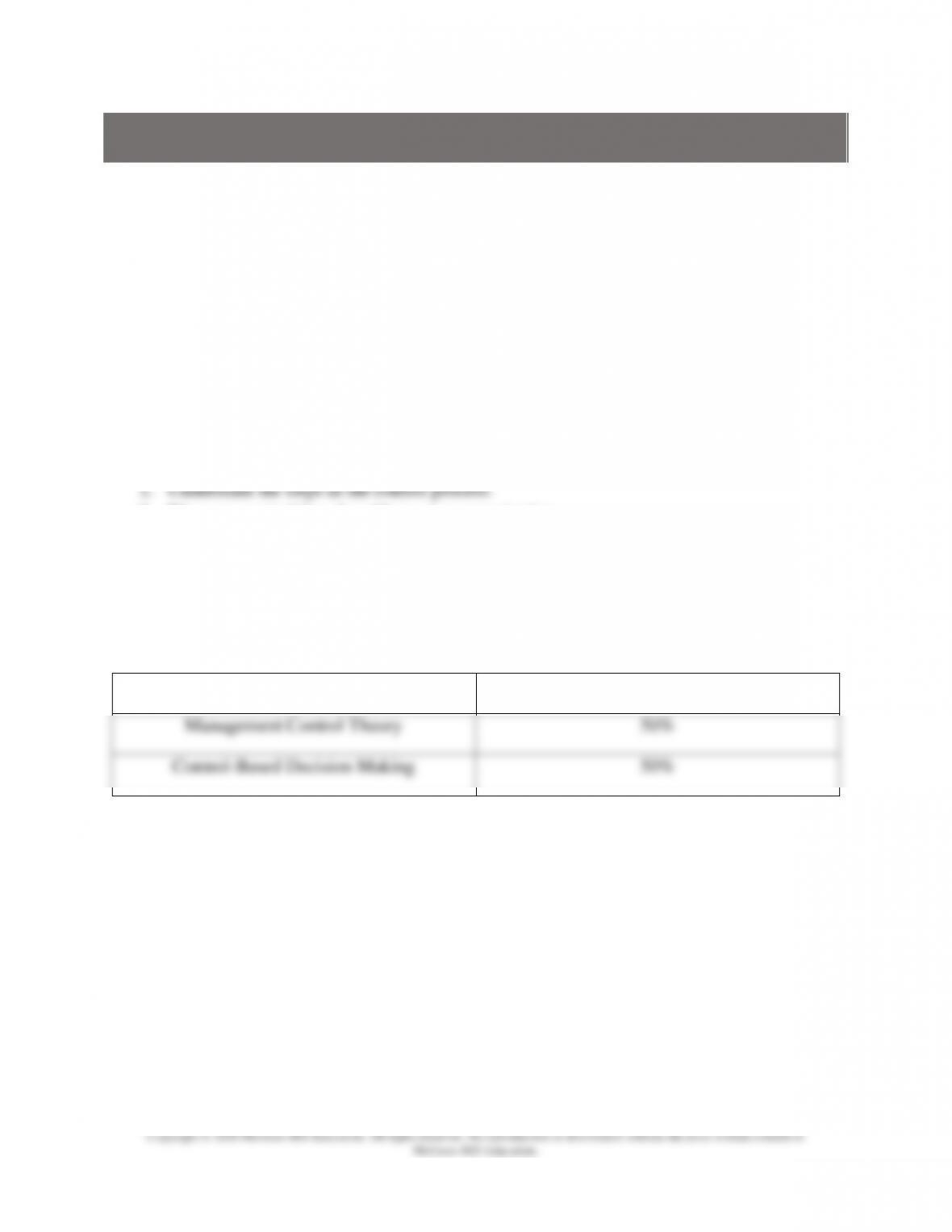
Theoretical Concepts
Percentage of Simulation
Management Control Theory
50%
Control-Based Decision Making
50%
IV. Follow-up Activity
Students can be assembled into groups of 4 to 5 in order to create an Alliance Airlines Total
Quality Management Program. The one-page program should cover the following from the
textbook:

Kinicki/Williams, Management, 9e: Chapter 16 Control Systems and Quality Management: Techniques for
Enhancing Organizational Effectiveness
Students should expand on these four areas as they relate to an airline. Each area should have 2-3
Online classes: Students can be placed in discussion groups and provided with the above-
mentioned four TQM principles. Each group can then develop their own Alliance Airlines Total
Quality Management Program and email out to the entire class for review.
CAN BE
USED
ONLINE