Chapter 16 – Control Systems & Quality Management: Techniques for Enhancing Organizational Effectiveness
16-1
1
16
Chapter
Control Systems & Quality
Management
Techniques for Enhancing Organizational
Effectiveness
Major Questions the Student Should Be Able to Answer 2
Mapping the Class: Chapter Outline 3
Overview of the Chapter 4
Classroom Outline 6
CHAPTER CONTENTS
Chapter 16 – Control Systems & Quality Management: Techniques for Enhancing Organizational Effectiveness
16-2
16.1 Control: When Managers Monitor Performance
MAJOR QUESTION: Why is control such an important managerial function?
16.4 Some Financial Tools for Control
MAJOR QUESTION: Financial performance is important to most organizations. What
are the financial tools I need to know about?
16.5 Total Quality Management
MAJOR QUESTION: How do top companies improve the quality of their products and
services?
MAJOR QUESTIONS THE STUDENT SHOULD BE ABLE TO ANSWER
Chapter 16 – Control Systems & Quality Management: Techniques for Enhancing Organizational Effectiveness
16-3
16.1 Control: When Managers Monitor Performance
• Why Is Control Needed?
• Steps in the Control Process
16.2 Levels and Areas of Control
16.3 The Balanced Scorecard, Strategy Maps, and Measurement
Management
• The Balanced Scorecard: A Dashboard-like View of the Organization
16.4 Some Financial Tools for Control
• Budgets: Formal Financial Projections
16.5 Total Quality Management
• Deming Management: The Contributions of W. Edwards Deming to Improved
16.6 Managing Control Effectively
16.7 Managing for Productivity
• What Is Productivity?
MAPPING THE CLASS: CHAPTER OUTLINE
Chapter 16 – Control Systems & Quality Management: Techniques for Enhancing Organizational Effectiveness
16.1 Control: When Managers Monitor Performance
Controlling is monitoring performance, comparing it with goals, and taking
corrective action. There are six reasons why control is needed: 1) to adapt to
16.2 Levels and Areas of Control
There are three levels of control: strategic, tactical, and operational. There are
16.3 The Balanced Scorecard, Strategy Maps, and Measurement
Management
To establish standards, managers often use the balanced scorecard, which
16.4 Some Financial Tools for Control
Financial controls include budgets, financial statements, ratio analysis, and
audits.
16.5 Total Quality Management
Total quality management (TQM) is dedicated to continuous quality
16.6 Managing Control Effectively
There are four keys to successful control. First, control systems should be
strategic and results oriented. Second, control systems should be timely,
OVERVIEW OF THE CHAPTER
Chapter 16 – Control Systems & Quality Management: Techniques for Enhancing Organizational Effectiveness
16-5
16.7 Managing for Productivity
Productivity is defined by the formula of outputs divided by inputs for a specified
Chapter 16 – Control Systems & Quality Management: Techniques for Enhancing Organizational Effectiveness
16-6
The Manager’s Toolbox: Improving Productivity: Going beyond Control
Techniques to Get the Best Results
This Toolbox describes some technique for improving productivity. One suggestion is to
establish a base point of performance, set specific goals to exceed that base, and then
measure progress on goal obtainment. The measurement results can be used to
modify the goals or work processes. Another technique is to use new technology, but
steps.
Possible Topics for Discussion:
• In what ways do you think you’ll have to become a champion of adaptation?
Section 16.1 introduces the control function of management. Controlling is monitoring
performance, comparing it with goals, and taking corrective action. This section
describes six reasons why control is needed and four steps in the control process.
Possible Topics for Discussion:
• Discuss the reasons why control is an important managerial activity.
CLASSROOM OUTLINE
16.1 Control: When Managers Monitor Performance (pp.
512-516)
Why is control such an important managerial function?
Chapter 16 – Control Systems & Quality Management: Techniques for Enhancing Organizational Effectiveness
16-7
Major Idea Outline:
A. Control is making something happen the way it was planned to happen.
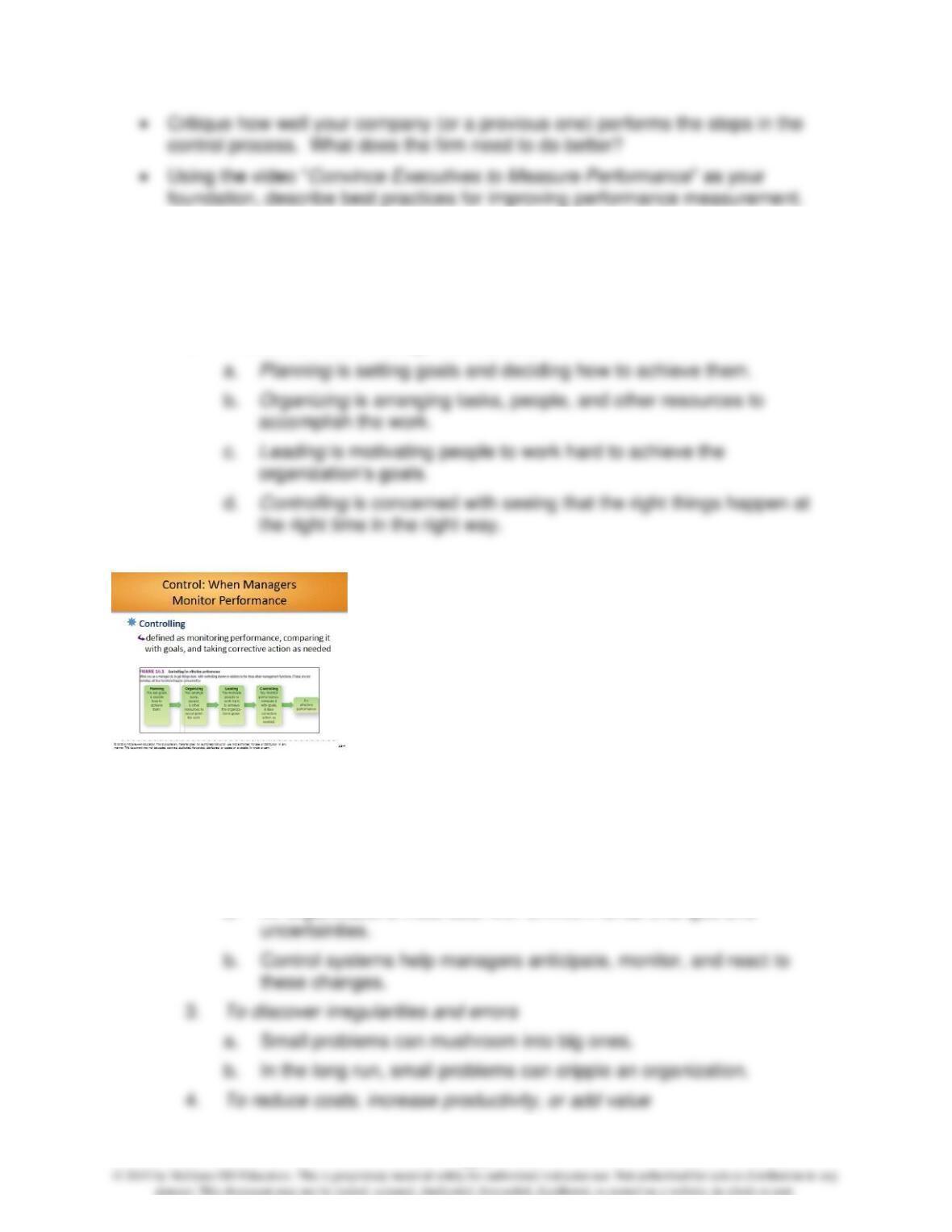
1. Controlling is defined as monitoring performance, comparing it with
goals, and taking corrective action as needed.
2. This is the fourth management function.
B. Why Is Control Needed?
1. Lack of control mechanisms can lead to problems for both managers and
companies. There are six reasons why control is needed:
2. To adapt to change and uncertainty
a. All organizations must deal with environmental changes and
Chapter 16 – Control Systems & Quality Management: Techniques for Enhancing Organizational Effectiveness
a. Control systems can reduce labor costs, eliminate waste, increase
output, and increase product delivery cycles.
b. Controls can help add value to a product.
5. To detect opportunities
a. Controls can alert managers to opportunities that might go unnoticed.
C. Steps in the Control Process
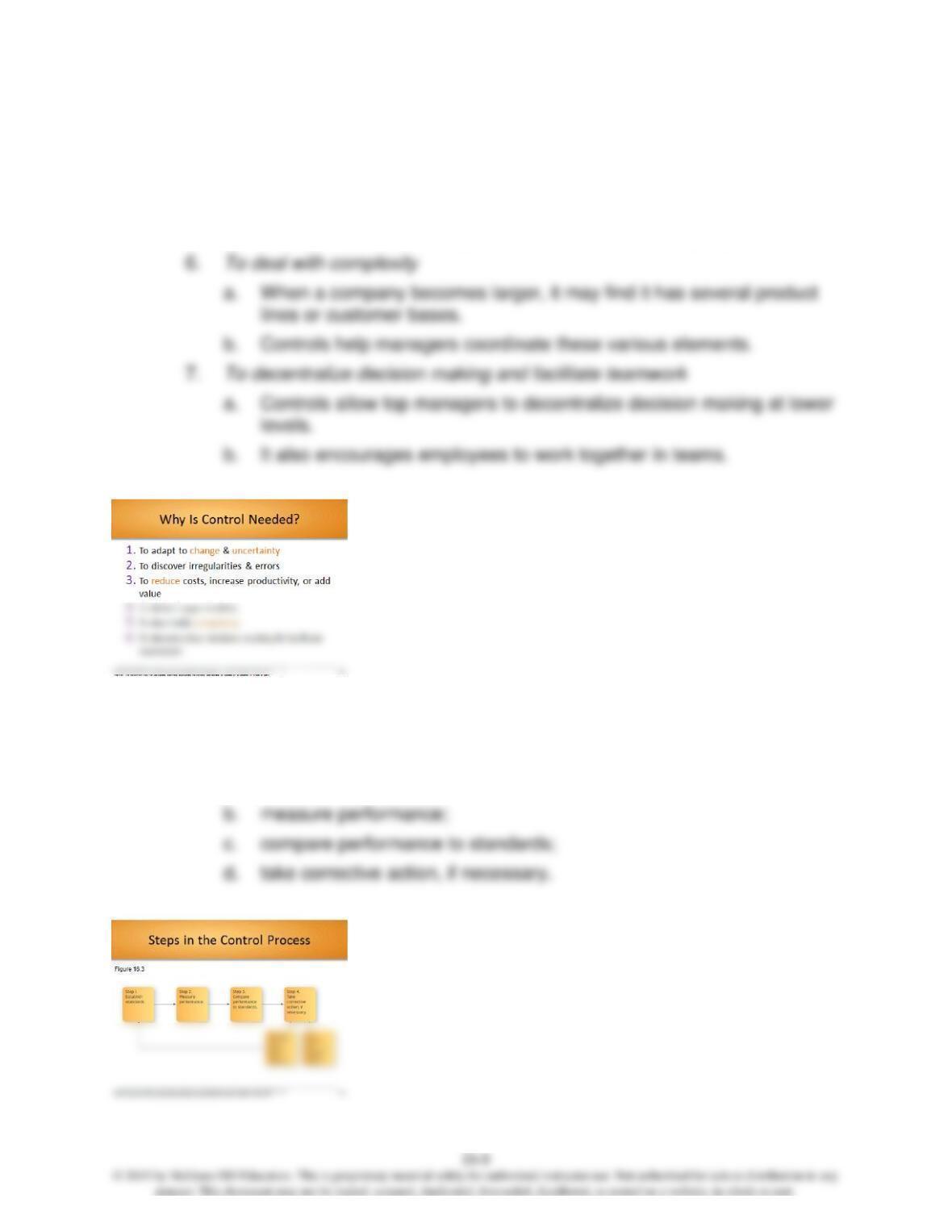
1. The four control process steps are
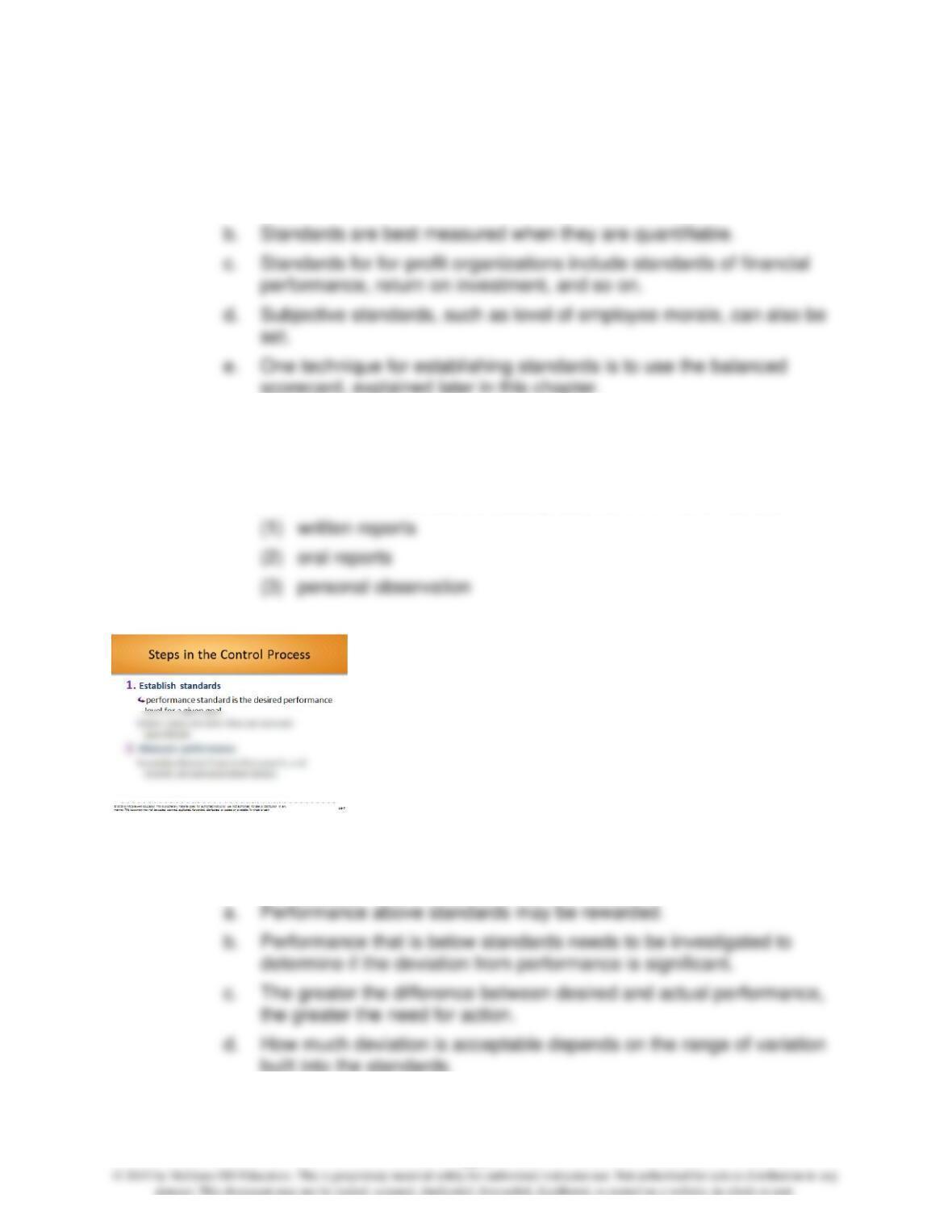
a. establish standards;
Chapter 16 – Control Systems & Quality Management: Techniques for Enhancing Organizational Effectiveness
16-9
2. Establish standards: “What is the outcome we want?”
a. A control standard, or performance standard or simply standard, is
the desired performance level for a given goal.
scorecard, explained later in this chapter.
3. Measure performance: “What is the actual outcome we got?”
a. The second step is to measure performance, such as by number of
products sold, units produced, or cost per item.
b. Performance measures are usually obtained from three sources:
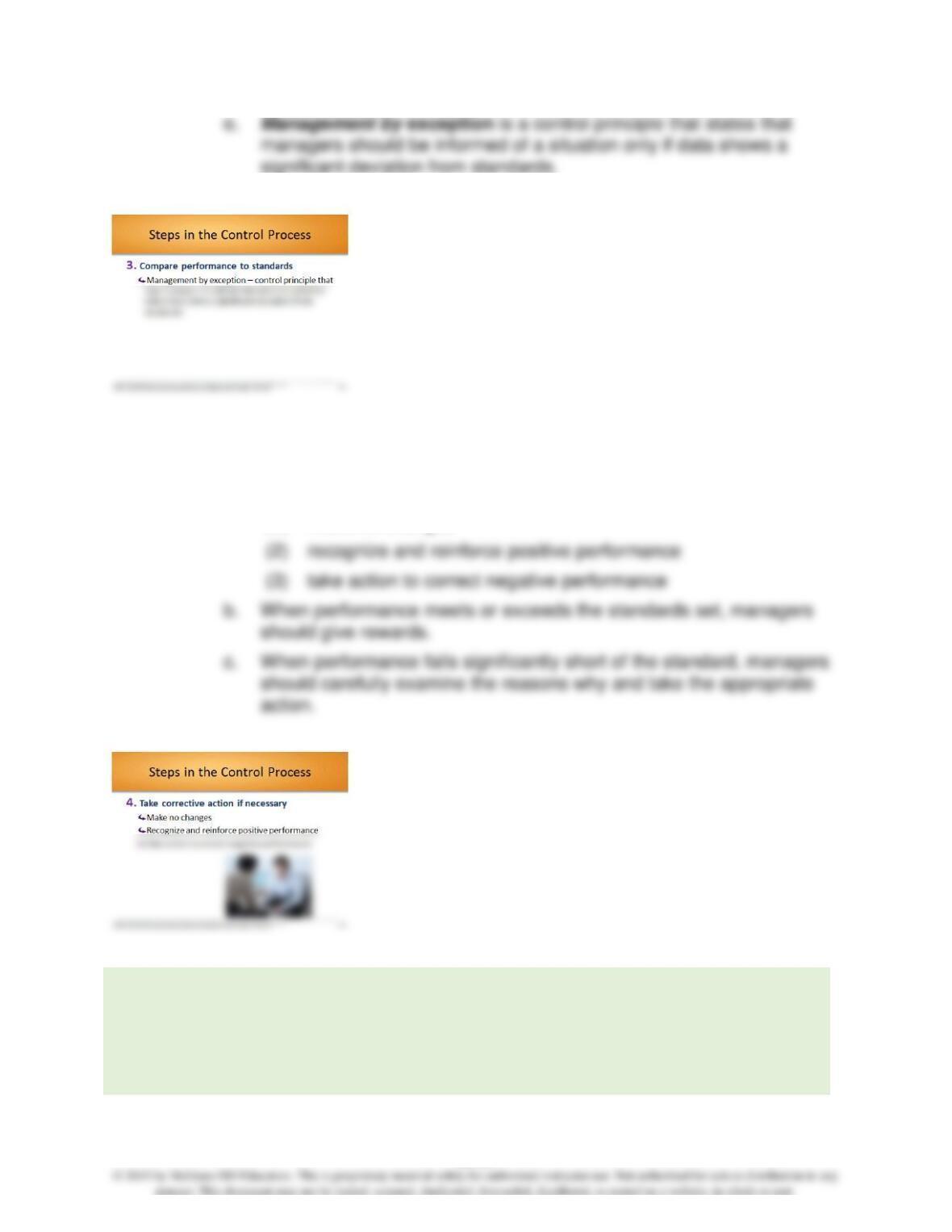
4. Compare performance to standards: “How do the desired and actual
outcomes differ?”
Chapter 16 – Control Systems & Quality Management: Techniques for Enhancing Organizational Effectiveness
16–10
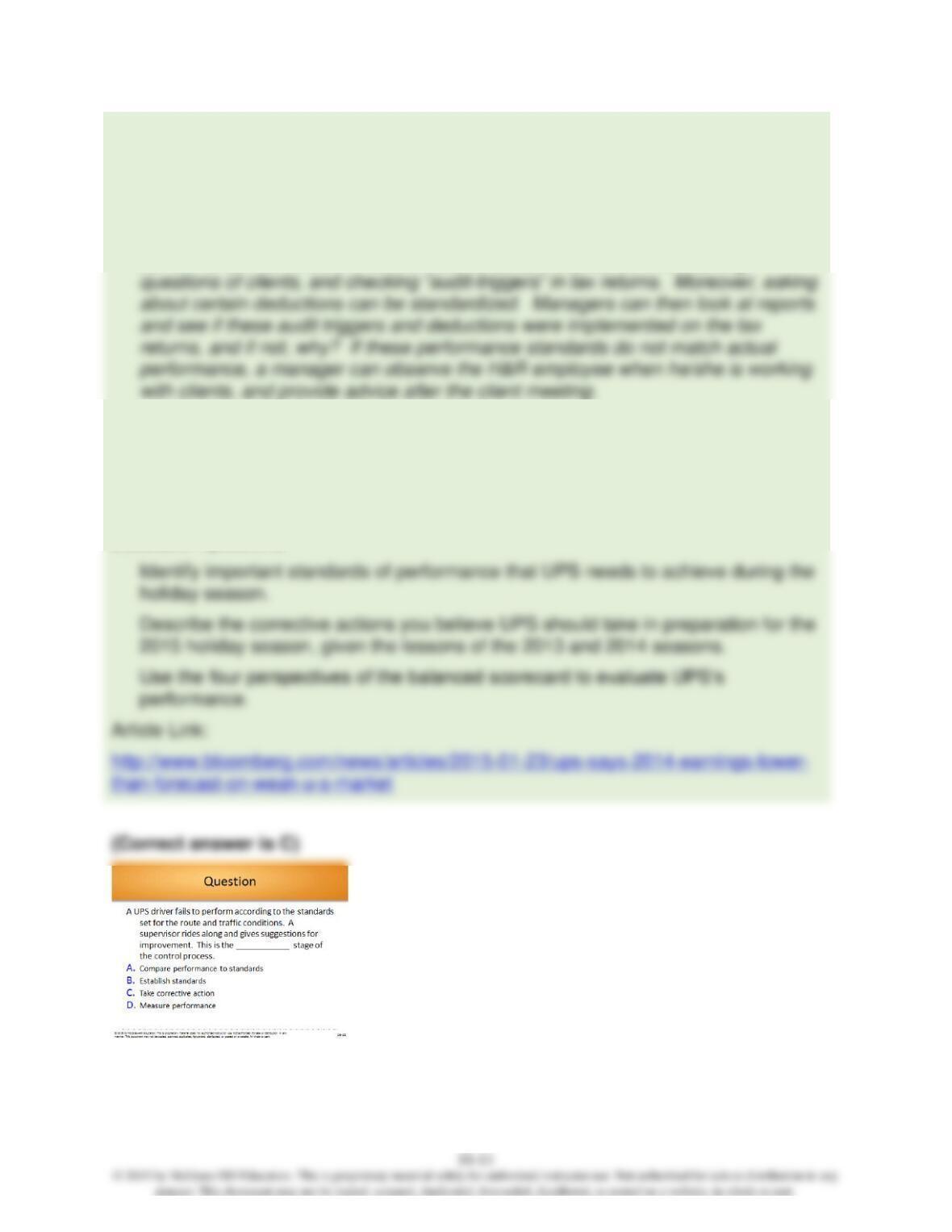
5. Take corrective action, if necessary: “What changes should we make to
obtain desirable outcomes?”
a. There are three possibilities:
(1) make no changes
Interactive Classroom Material:
EXAMPLE: Steps in the Control Process: What’s Expected of UPS Drivers? (p.
516)
UPS employs 99,000 drivers and provides training for “340 Methods” on how to
perform their jobs. Graduates of the program are eligible to do a job that pays an
Chapter 16 – Control Systems & Quality Management: Techniques for Enhancing Organizational Effectiveness
average of $74,000 annually.
YOUR CALL
Do you think the same kinds of controls could be established for, say, filling
out tax forms for H&R Block?
The same kinds of controls, with a slight variation, can be established for filling out
tax forms for H&R Block. There should be certain standards when asking
Additional Activities:
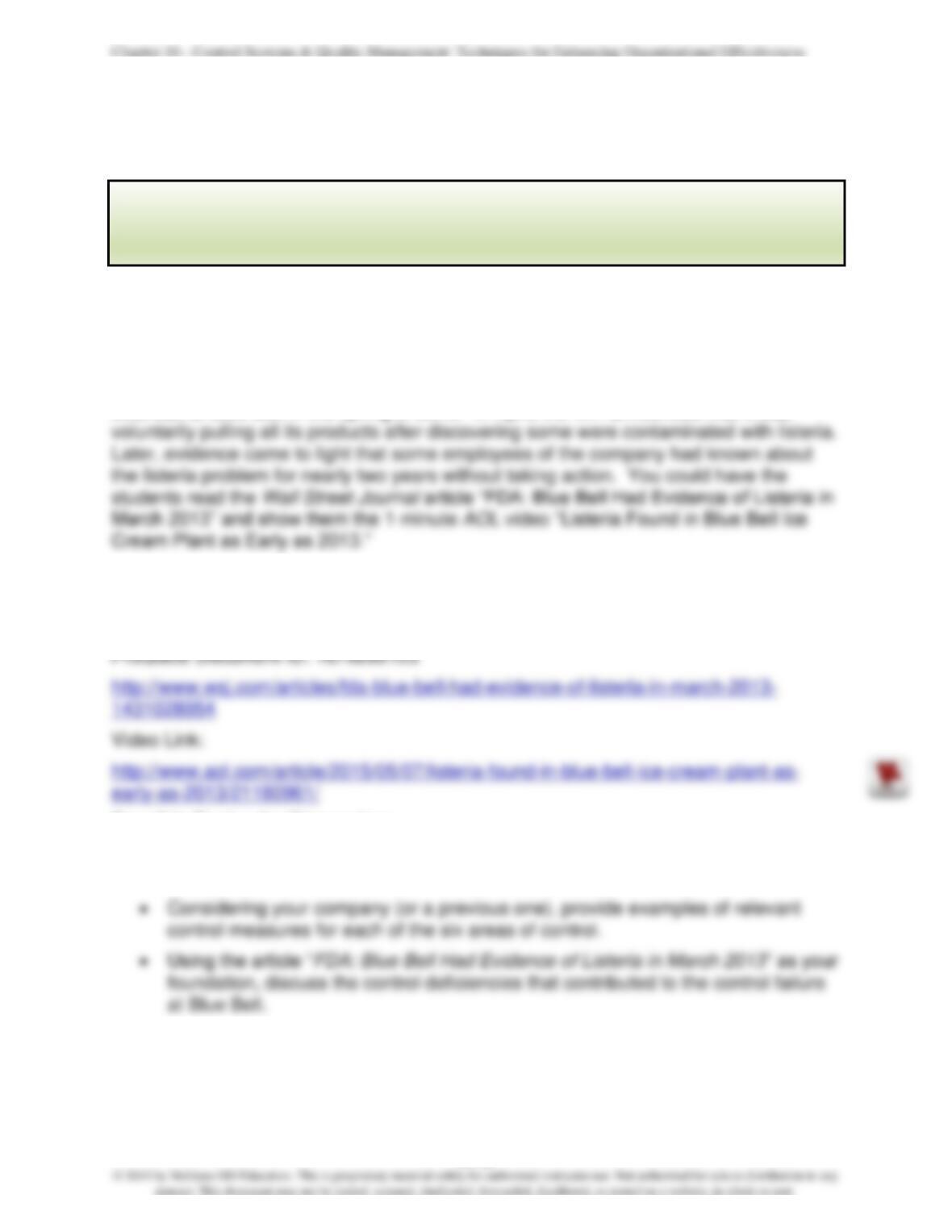
One way to build on this Example is to have the students read the Bloomberg article
“UPS Prepared Too Well for Holiday Rush and Paid the Price.” This article profiles
the announcement by UPS that higher costs related to peak-season deliveries would
negatively impact the firm’s earnings per share. Consider using the following
discussion questions:
16–12
Section 16.2 describes three levels of control—strategic, tactical, and operational—and
six areas of control: physical, human, informational, financial, structural (bureaucratic
and decentralized), and cultural.
One way that you could begin your coverage of these topics is to profile the listeria
outbreak at Blue Bell in the spring of 2015. In April, the firm announced that it was
Article Citation:
Newman, J. (2015, May 8). FDA: Blue Bell had evidence of listeria in March 2013. Wall
Street Journal Online.
Possible Topics for Discussion:
• Considering your company (or a previous one), describe the key strategic,
tactical, and operational control issues facing the firm.
Major Idea Outline:
A. Levels of Control: Strategic, Tactical, and Operational
16.2 Levels & Areas of Control (pp. 517-519)
How do successful companies implement controls?
Chapter 16 – Control Systems & Quality Management: Techniques for Enhancing Organizational Effectiveness
16–13
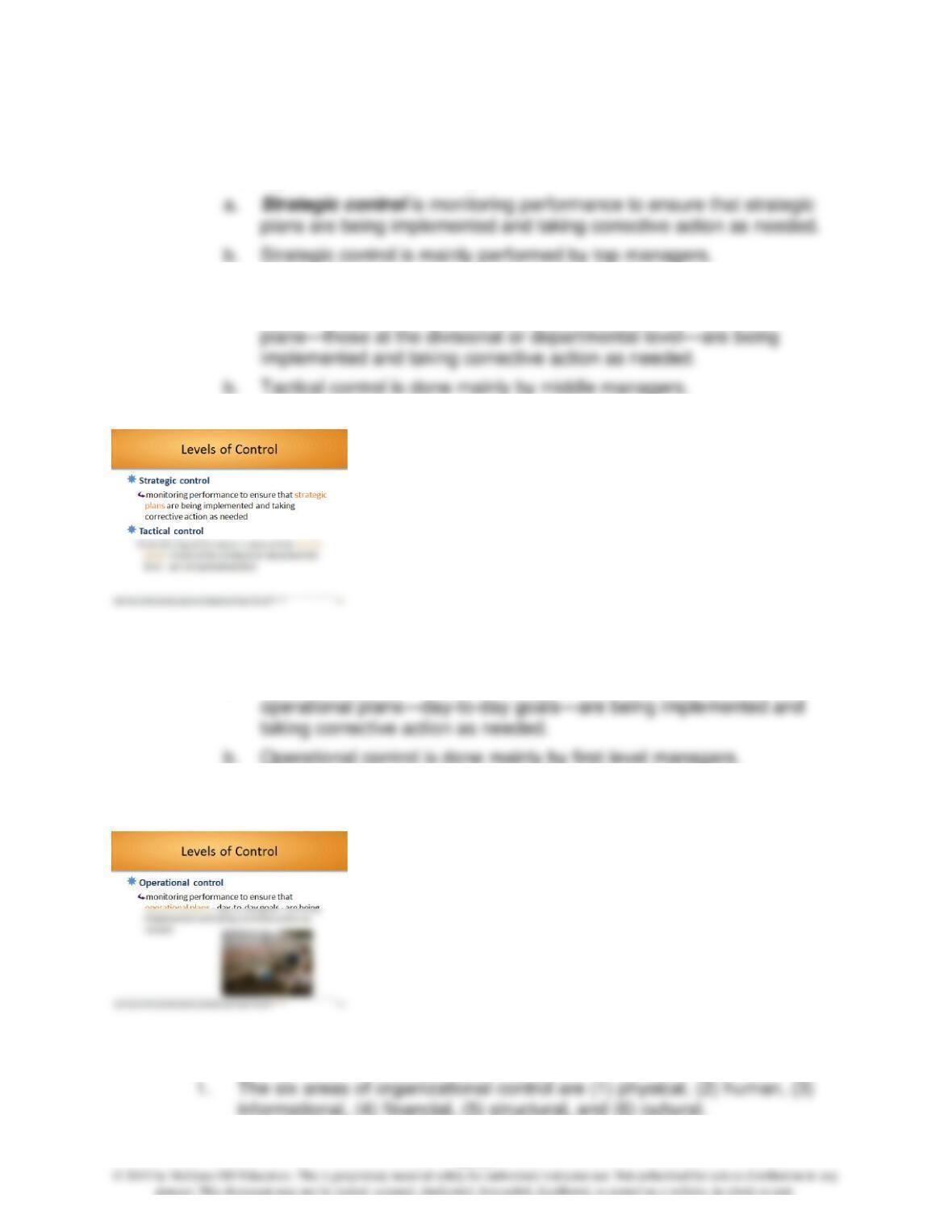
1. There are three levels of control, which correspond to the three principal
managerial levels.
2. Strategic control by top managers
3. Tactical control by middle managers
a. Tactical control is monitoring performance to ensure that tactical
4. Operational control by first-level managers
a. Operational control is monitoring performance to ensure that
5. The three levels frequently interact.
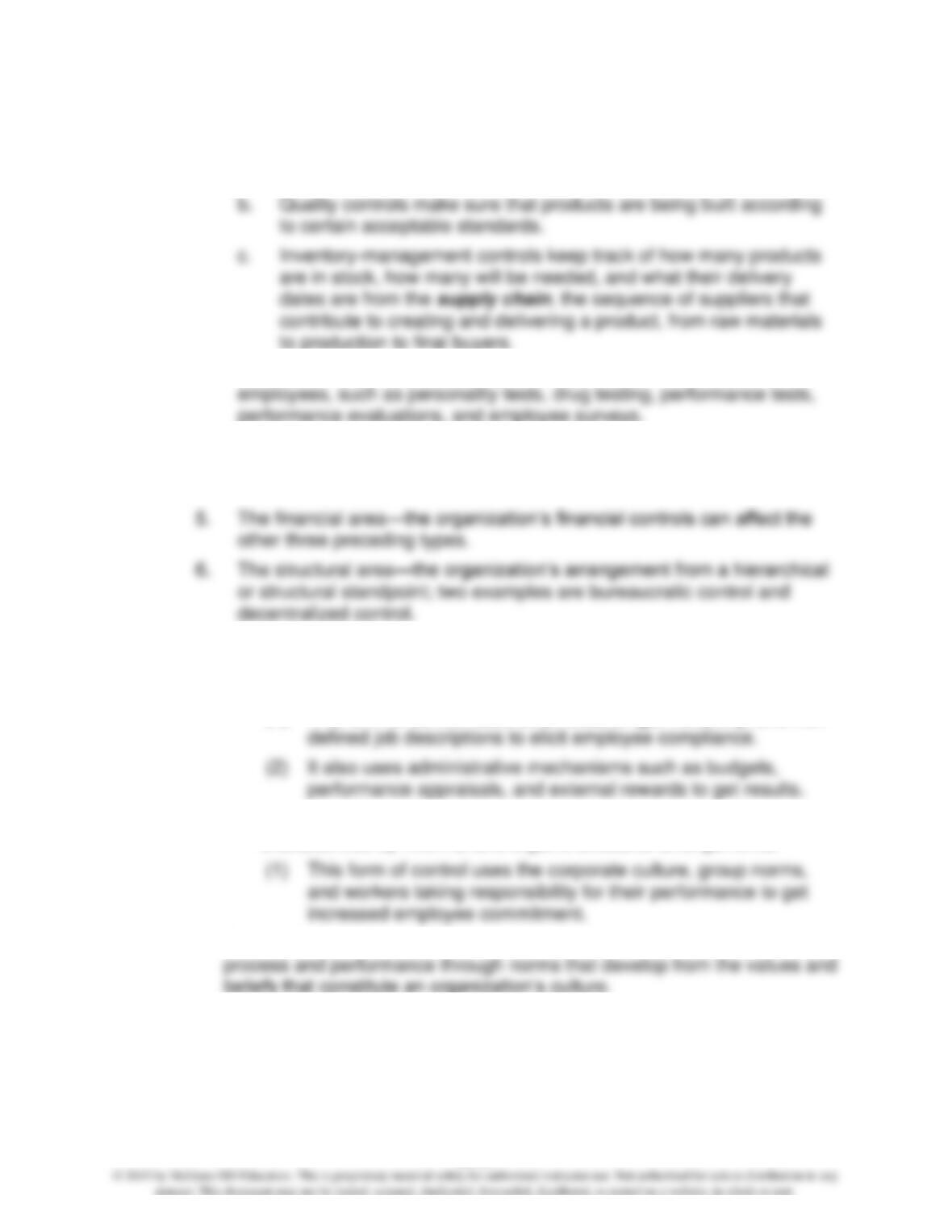
B. Six Areas of Control
Chapter 16 – Control Systems & Quality Management: Techniques for Enhancing Organizational Effectiveness
16–14
2. The physical area includes buildings, equipment, and tangible products.
a. Equipment controls monitor the use of computers, cars, and other
machinery.
3. The human resources area includes controls used to monitor
4. The informational area includes controls of information resources, such
as production schedules, sales forecasts, and environmental impact
statements.
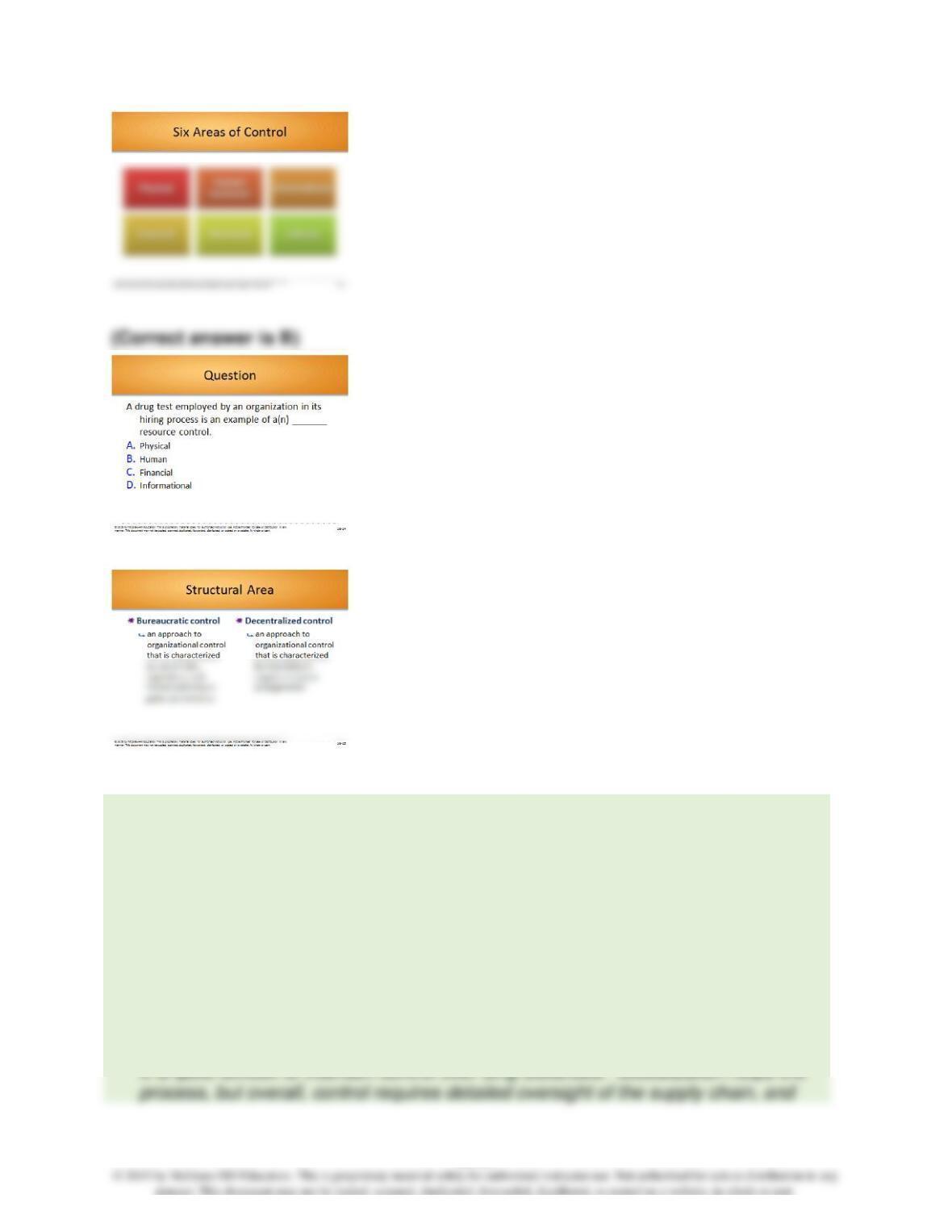
a. Bureaucratic control is an approach to organizational control that is
characterized by use of rules, regulations, and formal authority to
guide performance.
(1) This form of control uses strict rules, a rigid hierarchy, and well-
b. Decentralized control is an approach to organizational control that is
characterized by informal and organic structural arrangements.
7. The cultural area is an informal method of control that influences the work
Chapter 16 – Control Systems & Quality Management: Techniques for Enhancing Organizational Effectiveness
16–15
Interactive Classroom Material:
EXAMPLE: Supply-Chain Journey: The Tale of a Couch (p. 518)
A Discovery Channel documentary about modern China, The People’s Republic of
Capitalism, traces the supply-chain path of a sofa. (See Figure 16.4.) This was an
expensive Pratt sofa made and sold by Ethan Allen, the American furniture maker
headquartered in Danbury, Connecticut.
YOUR CALL
How difficult do you think it is to maintain control when operating supply
chains over such long distances? Could this be a reason why some American
managers have pulled manufacturing back from overseas?
Chapter 16 – Control Systems & Quality Management: Techniques for Enhancing Organizational Effectiveness
16–16
to this decision.
Additional Activities:
One way to build on this Example is to have the students read the Wall Street Journal
article “U.S. Ports See Costly Delays as Cargo Ships, Volumes Grow.” This article
profiles the supply chain management challenges created by shipping delays at ports.
There is a corresponding video on the wsj.com website that you can play for the
students. Consider using the following discussion questions:
Discuss how congestion at U.S. ports is likely to impact the control process for
retailers.
Section 16.3 discusses the balanced scorecard, which provides four indicators for
progress. A visual representation of the balanced scorecard is the strategy map.
16.3 The Balanced Scorecard, Strategy Maps,
& Measurement Management (pp. 520-524)
How can three techniques—balanced scorecard, strategy maps, and
measurement management—help me establish standards and measure
performance?
Chapter 16 – Control Systems & Quality Management: Techniques for Enhancing Organizational Effectiveness
Possible Topics for Discussion:
• Discuss barriers to effective measurement that can complicate the control
process. Why do you think not all firms are measurement-managed?
Major Idea Outline:
A. The textbook describes the importance of evidence-based management—the
use of real-world data in decision making.
1. The dashboard is an easy to read graphics listing information for sales,
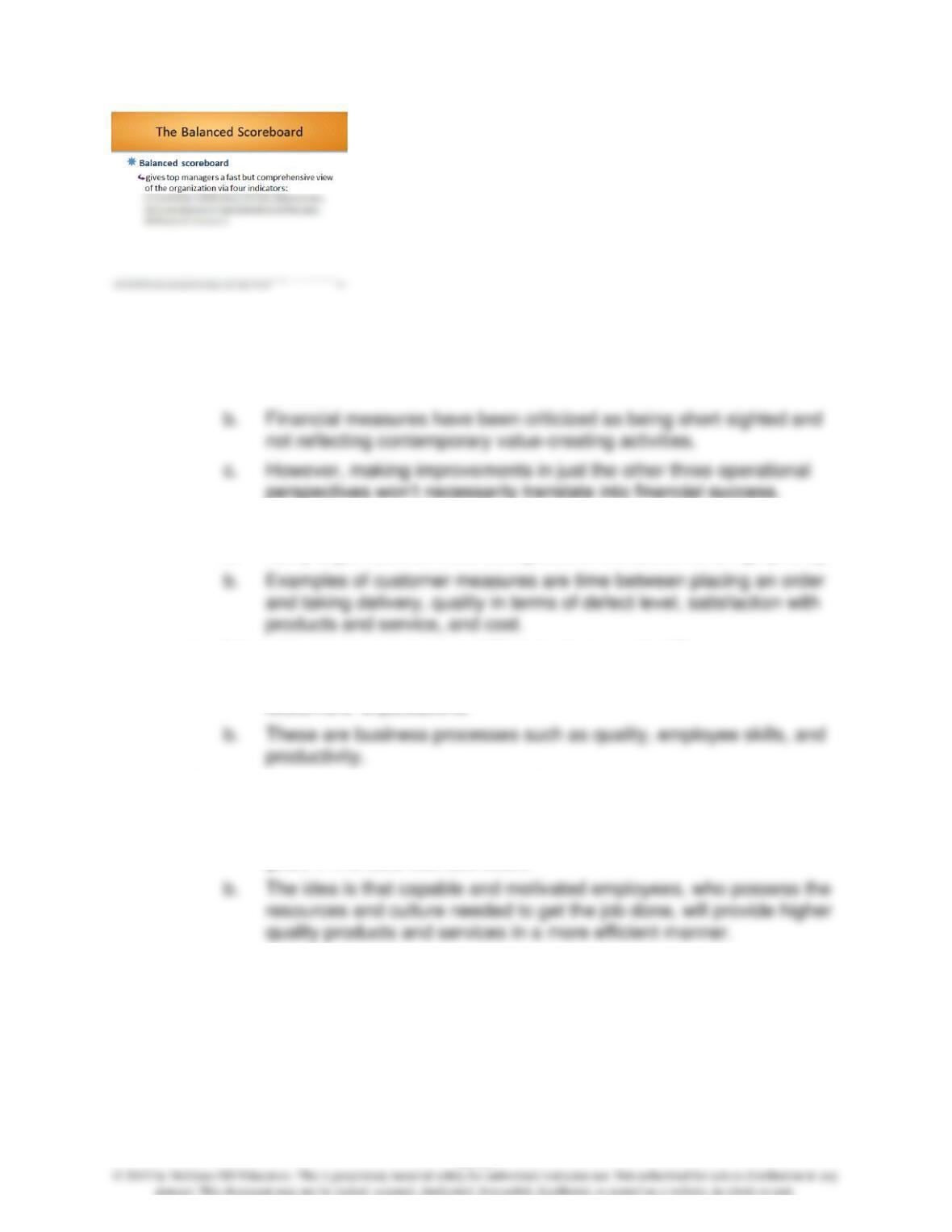
B. The Balanced Scorecard
1. Robert Kaplan and David Norton developed the balanced scorecard.
a. The balanced scorecard gives top managers a fast but
comprehensive view of the organization via four indicators:
(1) customer satisfaction
Chapter 16 – Control Systems & Quality Management: Techniques for Enhancing Organizational Effectiveness
16–18
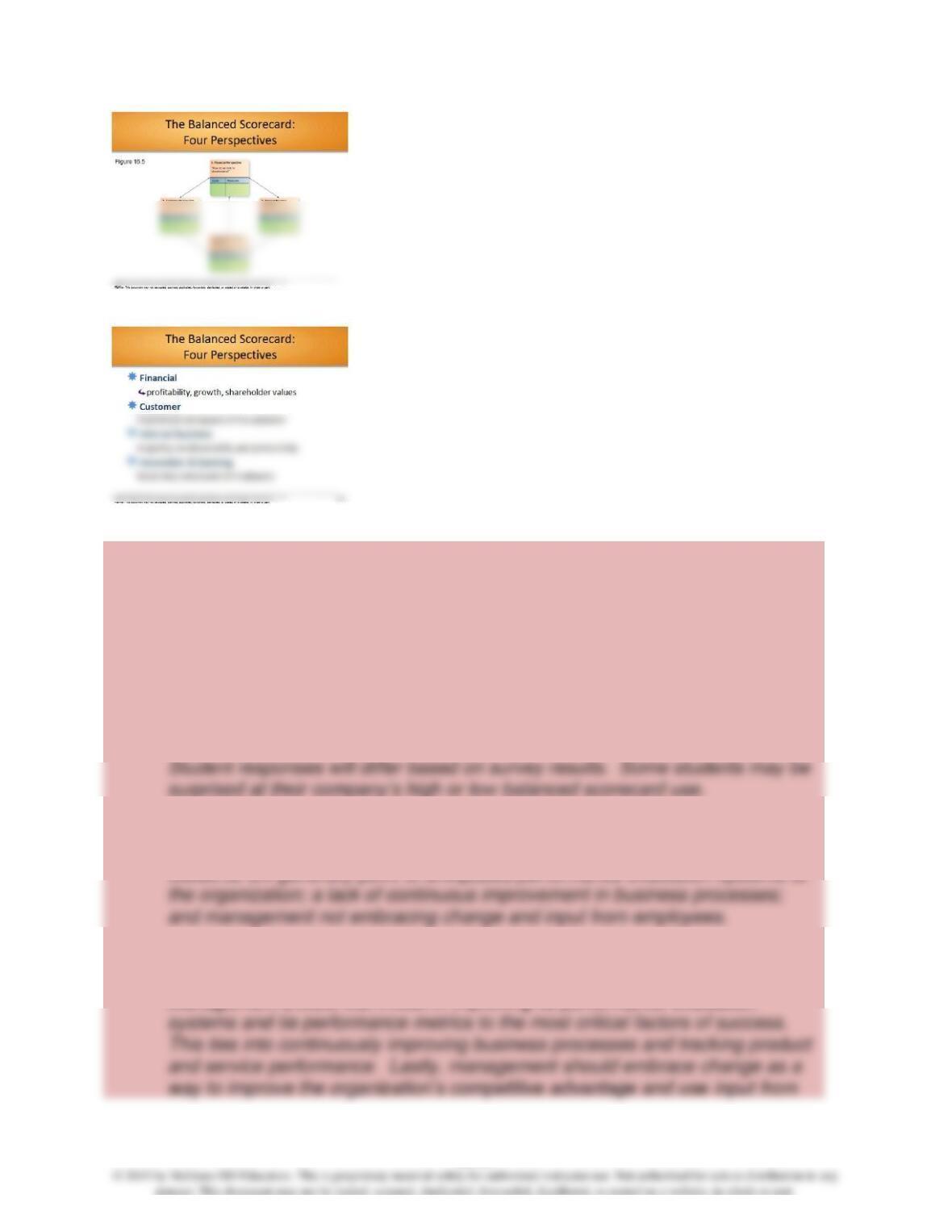
2. Financial perspective: ‘‘How do we look to shareholders?’’
a. Typical financial goals involve profitability, growth, and shareholder
values.
perspectives won’t necessarily translate into financial success.
3. Customer perspective: ‘‘How do customers see us?’’
a. Many organizations make taking care of the customer a high priority.
4. Internal business perspective: ‘‘What must we excel at?’’
a. This part translates what the company must do internally to meet its
customers’ expectations.
5. Innovation and learning perspective: ‘‘Can we continue to improve and
create value?’’
a. Learning and growth of employees is the foundation for all other
goals in the balanced scorecard.
Chapter 16 – Control Systems & Quality Management: Techniques for Enhancing Organizational Effectiveness
16–19
SELF-ASSESSMENT 16.1 (p. 522)
Assessing the Innovation & Learning Perspective of the Balanced
Scorecard
Go to connect.mheducation.com and take Self-Assessment 16.1.
Student Questions:
1. Where does the company stand in terms of commitment to innovation and
learning? Are you surprised by the results?
2. Use the three highest and lowest scores to identify the strengths and
weaknesses of this company’s commitment to innovation and learning.
3. Based on your answer to Question 2, provide three suggestions for what
management could do to improve its commitment to innovation and learning.
Management should first invest in improving its performance evaluation
Chapter 16 – Control Systems & Quality Management: Techniques for Enhancing Organizational Effectiveness
16–20
human capital, or employees, to be innovative and learning.
Additional Activities:
You can also consult the Connect Instructors Manual for the post-assessment activity
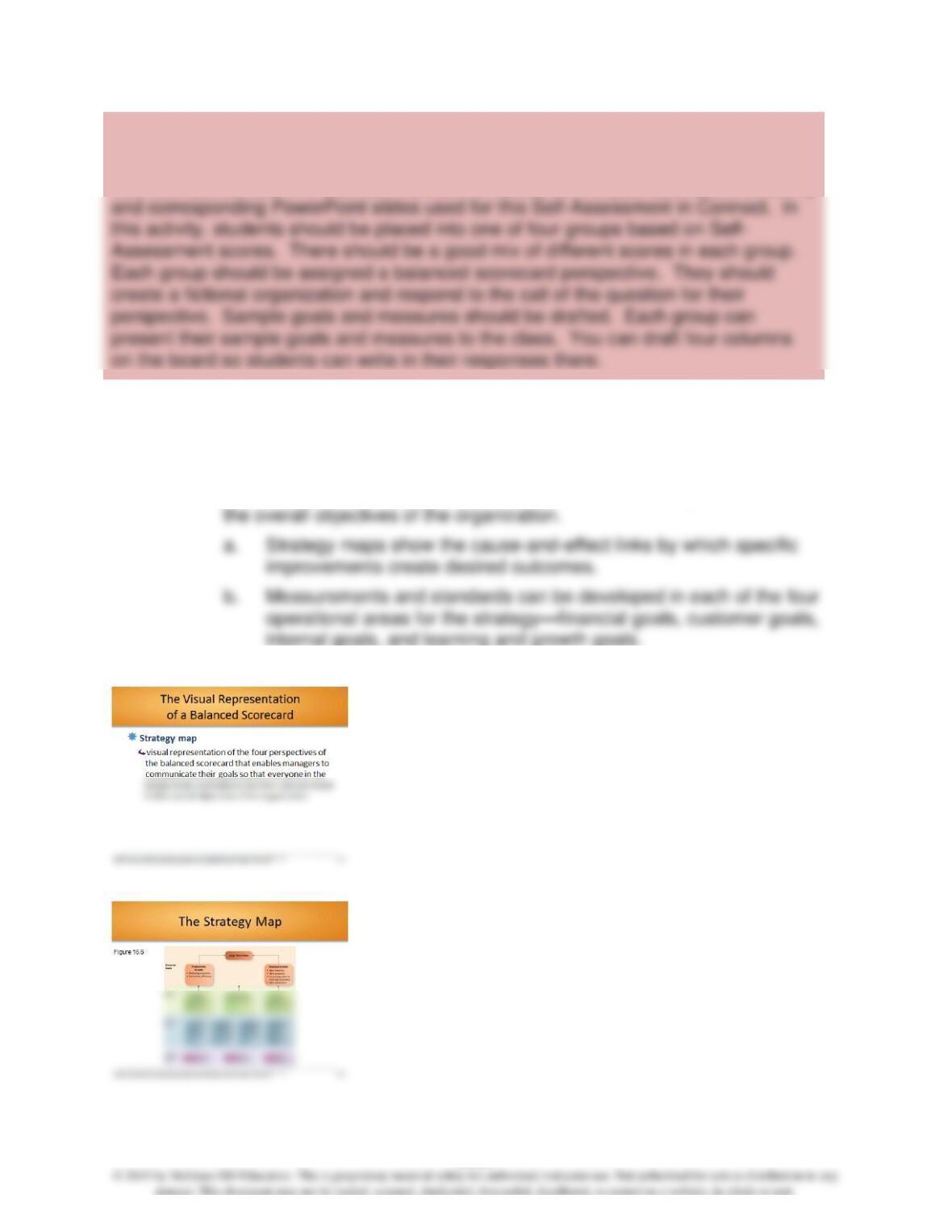
C. Strategy Map: Visual Representation of a Balanced Scorecard
1. A strategy map is a visual representation of the four perspectives of the
balanced scorecard that enables managers to communicate their goals so
that everyone in the company can understand how their jobs are linked to