15-1
Chapter 15
Managing Global Systems
Learning Objectives
1. What major factors are driving the internationalization of business?
2. What are the alternative strategies for developing global businesses?
Chapter Outline
15.1 The Growth of International Information Systems
15.2 Organizing International Information Systems
15.3 Managing Global Systems
15.4 Technology Issues and Opportunities for Global Value Chains
Computing Platforms and Systems Integration
Connectivity
Software Localization
Key Terms
The following alphabetical list identifies the key terms discussed in this chapter. The
page number for each key term is provided.
Business driver`, 15-4
Legitimacy, 15–16
Cooptation, 15–16
Multinational, 15-9
Domestic exporter, 15-9
Software localization, 15–21
Franchisers, 15–9
15-2
Teaching Suggestions
The opening case, “L’Oreal’s Global Makeover,” demonstrates that a global company
has the same information system requirements as a domestic company, just on a larger,
more complex, scale. The company operates in 130 companies around the world and has
42 manufacturing sites dealing with thousands of different recipes for its products. That
Its new system, ISIS (Integrated Solution for Industrial Systems) consolidates all
transactional processing, financial controls, and purchasing into one database. ISIS runs
at the company’s central data center in Montpellier, France. The system guides factory
operators through each product recipe to ensure uniformity and compliance.
Section 15.1, “The Growth of International Information Systems” Figure 15-1 is an
excellent example of the globalization of businesses and industries. This figure shows
how one product, the Apple iPhone, involves operations in seven different countries
around the world. That’s possible only through advanced networks and information
systems like the one Apple uses. Students might find it interesting to trace common
15-3
Section 15.2, “Organizing International Information Systems” It’s important for
students to understand that a company’s corporate headquarters isn’t always located in
the United States as many people assume. There are many instances of companies whose
corporate headquarters are located in foreign countries and simply have local or regional
Section 15.3, “Managing Global Systems” Take all the problems and challenges that a
domestic company faces in designing, building, and managing its information technology
infrastructure and magnify them on a global scale. The subsection “A Typical Scenario:
Disorganization on a Global Scale” describes the more common situation occurring in
Interactive Session: Organizations: Hasbro Develops a Global Systems Strategy
Case Study Questions
1. What problems was Hasbro having with its legacy SAP/R3 enterprise resource
planning (ERP) system installed in the 1990s and how did it affect its operations
and global strategy?
With 6,000 employees, two manufacturing plants in different countries, and offices in
15-4
2. What management, organization, and technology issues did Hasbro address in
order to implement a new global systems strategy?
Management: Hasbro moved to a unified SAP implementation that upgraded its
enterprise resource planning software. Its “Way to Work” initiative would create a
3. Describe Hasbro’s new global systems and the problems they solved. How did
they improve operations and management decision making?
The company now has the best tools available for quickly accessing and analyzing
trending and sales data. Hasbro enjoys improved analysis of its point-of-sale data to
gain a clearer understanding of who its customers are and how their spending patterns
Section 15.4, “Technology Issues and Opportunities for Global Value Chains” Many
students may assume that all countries have the same technology and telecommunications
infrastructure as the United States. Many students are also under the impression that the
United States leads the world in technology usage and advanced applications. Spend
Interactive Session: Management: CombineNet ASAP Helps Primark Manage Its
Global Supply
Case Study Questions
1. Why is supply chain management so important at a company such as Primark?
Primark has 156 stores in the United Kingdom, 38 stores in Ireland, 27 in Spain, 7 in
2. What set of business conditions prompted Primark to look into upgrading its
supply chain management system?
Primark was pressured into maintaining ultra-low prices even after an increase in the
value added tax in the United Kingdom, rising labor costs in China, and unpredictable
3. What problems was Primark having managing its suppliers and global supply
chain?
The company’s third-party logistics service provider did not extend beyond
comparing bids between competing shippers and it could not help Primark with
15-6
4. How did the CombineNet ASAP software provide a solution to these problems?
CombineNet ASAP software is a Web-based supply chain execution system used to
optimize all supply chain processes. It can process requests for information, requests
for proposals, and E-auction bidding. It incorporates “if–then” algorithms into the
5. How does the CombineNet ASAP software improve supply chain execution for
Primark?
CombineNet ASAP software allows Primark to coordinate with carriers to optimize
Review Questions
1. What major factors are driving the internationalization of business?
List and describe the five major dimensions for developing an international
information systems architecture.
According to Figure 15-2, the five major factors are the need to:
• Understand the global business environment in which your firm is operating.
Describe the five general cultural factors leading toward growth in global
business and the four specific business factors. Describe the interconnection
among these factors.
According to Table 15-1, the five general cultural factors are:
15-7
The specific business factors are :
• Global markets: Patterns of consumption of goods are becoming similar
These factors are interrelated. The spread of global communications has led to the
emergence of a global culture and global social norms. This, in turn, has led to the
development of global markets. Emerging global technologies make possible the
List and describe the major challenges to the development of global systems.
According to Table 15-2, the general challenges are:
• Cultural particularism—regionalism, nationalism, language differences,
different standards for electronic data interchange, email, and
Explain why some firms have not planned for the development of international
systems.
For some companies, the competition has not been powerful enough yet to drive them
toward developing international systems. Other companies lack the global strategy
2. What are the alternative strategies for developing global businesses?
Describe the four main strategies for global business and organizational
structure.
Referencing Table 15-3, there are four main strategies.
• Domestic exporter: Heavy centralization of corporate activities in the home
country of origin. Production, sales, marketing, finance, and other such
3. How can information systems support different global business strategies?
Describe the four different system configurations that can be used to support
different global strategies.
According to Figure 15-3 there are four different system configurations:
15-9
coordinated fashion across all units.
4. What are the challenges posed by global information systems and management
solutions for these challenges?
List and describe the major management issues in developing international
systems.
The major management issues in developing international systems are listed in Table
Identify and describe three principles to follow when organizing the firm for
global business.
According to Figure 15-4, a sensible strategy is to reduce agency costs by developing
Identify and describe three steps of a management strategy for developing and
implementing global systems.
Step 1: A company must define its core business processes before it can build an
information system that supports them.
1. Define a short list of critical core business processes by conducting a
Step 2: Identify the core systems to coordinate centrally. Keep the list to an absolute
minimum. By dividing off a small group of systems as absolutely critical, the
opposition to a transnational strategy is divided. You can appease those who
15-10
Define cooptation and explain how it can be used in building global systems.
Cooptation is defined as bringing the opposition into the process of designing and
implementing the solution without giving up control over the direction and nature of
5. What are the issues and technical alternatives to be considered when developing
international information systems?
Describe the main technical issues facing global systems.
Hardware, global software, and telecommunications are the main technical issues.
Hardware issues arise because the firm needs to standardize the computer hardware
Identify some technologies that will help firms develop global systems.
The main hardware and telecommunications issues are systems integration and
connectivity. The choices for integration are to go either with a proprietary
15-11
organizational frameworks.
Discussion Questions
1. If you were a manager in a company that operates in many countries, what
criteria would you use to determine whether an application should be developed
as a global application or as a local application?
There are many general cultural factors and specific business factors to consider. The
growth of cheap international communication and transportation has created a world
2. Describe ways the Internet can be used in international information systems.
Companies can use the Internet for international communication by creating global
intranets and extranets. Companies can also use the Internet to create virtual private
Hands-On MIS Projects
Management Decision Problems
1. United Parcel Service: UPS has been expanding its package delivery and logistics
services in China, serving both multinational companies and local businesses. UPS
drivers in China need to use UPS systems and tools such as it handheld Driver
Information Acquisition Device for capturing package delivery data. UPS wants to
make its WorldShip, CampusShip, and other shipping management services
accessible to Chinese and multinational customers via the Web. What are some of the
international systems issues UPS must consider in order to operate successfully in
China?
15-12
UPS is likely to face these international systems issues:
• User interfaces: Which language will be used, Chinese or English? The
Chinese language has far more interpretations than the English language. The
2. Selling tennis rackets outside the United States: Your company manugactures and
sells tennis rackets and would like to start selling outside the United States. You are
in charge of developing a global Web strategy, and the first countries you are thinking
of targeting are Brazil, China, Germany, Italy, and Japan. Using the statistics in the
CIA World Factbook, which of these countries would you target first? What criteria
would you use? What other considerations should you address in your Web strategy?
What features would you put on your Web site to attract buyers from countries you
target?
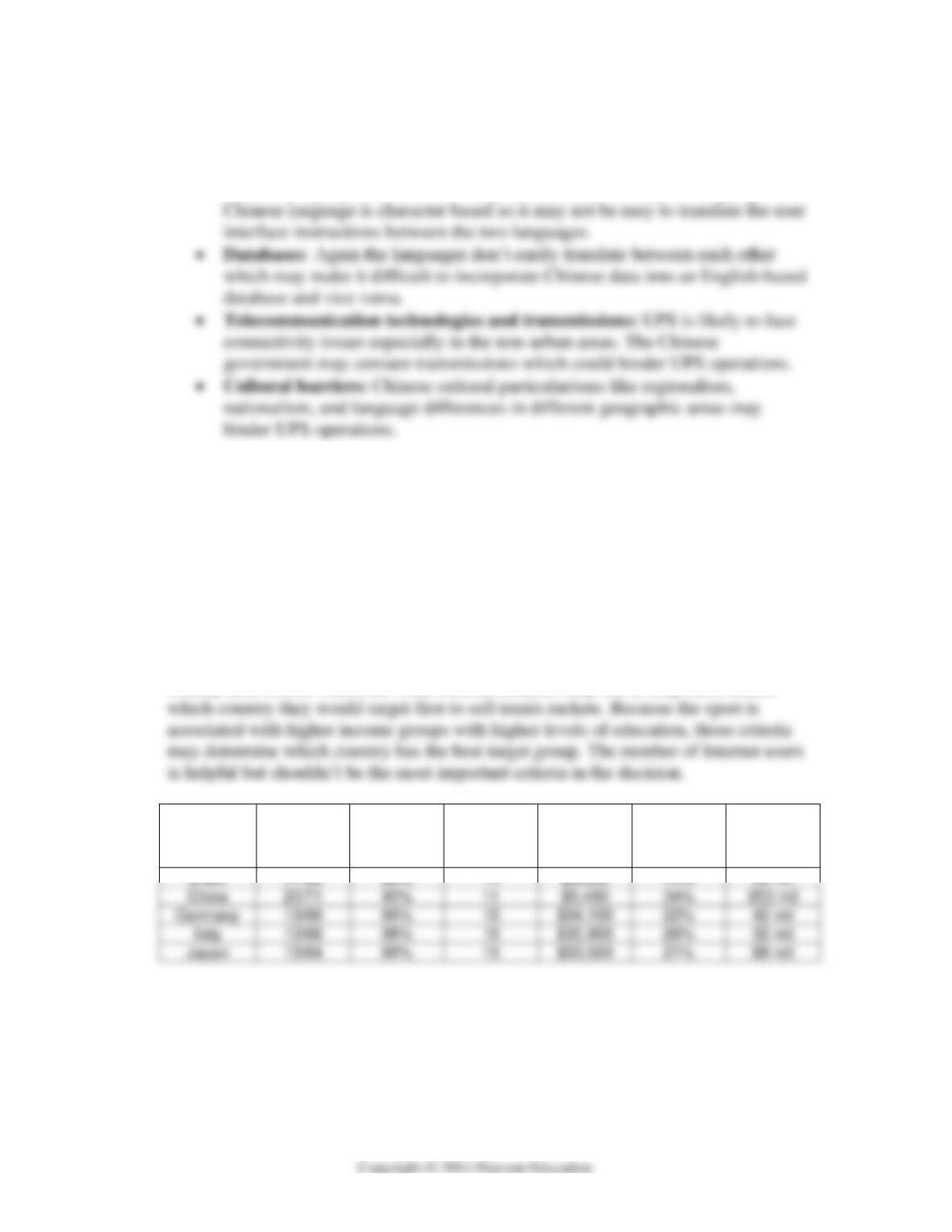
Statistics below are copied from the CIA World Factbook online that’s updated bi–
weekly (Dec 2008). These are some criteria students may use to help them decide
Country
Age
Structure
0–14years
/15–64 years
Literacy
Rates Over
15 yrs can
read & write
Education
Levels
# of years in
school
GDP per
capita
Household
incomes by
% share
highest 10%
Internet
users
Other considereations to address in the Web strategy may include language translations
for the user interface and database, cultural factors, and the availability and costs of
Internet connections.
15-13
Achieving Operational Excellence: Building a Job Database and Web Page for an
International Consulting Firm
Software skills: Database and Web page design
Business skills: Human resources internal job postings
KTP Consulting operates in various locations around the world. KTP specializes in
1. What type of data should be included in the KTP job vacancies database?
2. What information should not be included in this database?
3. Based on your answers to these questions, build a job vacancies database for
Students must first be reminded that before coding ever begins, it is the responsibility of
the developer to fully understand the task at hand, the company’s needs, and the external
business environment. The second step is to plan for the development of the Web
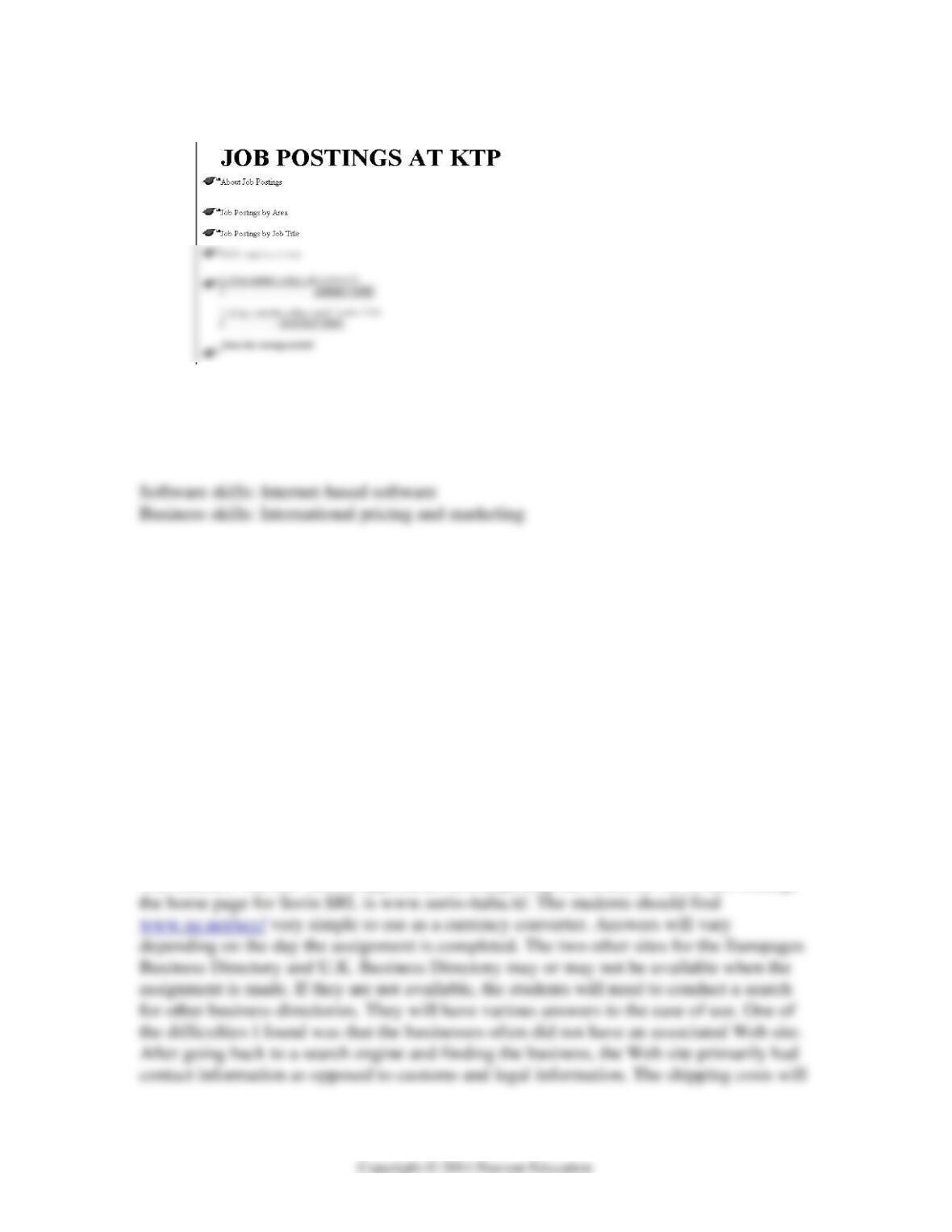
Data that should be included in the database are: area name; geographic location,
contact person and phone number, hours per week, position title, necessary qualifications,
and required experience.
15-14
Improving Decision Making: Conducting International Marketing and Pricing
Research
You are in charge of marketing for a U.S. manufacturer of office furniture that has
decided to enter the international market. You have been given the name of Sorin
SRL, a major Italian office furniture retailer, but your source had no other
information. You want to test the market by contacting this firm to offer it a specific
desk chair that you have to sell at about $125. Using the Web, locate the information
needed to contact this firm and to find out how many European euros you would
need to get for the chair in the current market. One source for locating European
companies is the Europages Business Directory (www.europages.com). In addition,
consider using the Universal Currency Converter Web site (www.xe.net/ucc/), which
determines the value of one currency expressed in other currencies. Obtain both the
information needed to contact the firm and the price of your chair in their local
currency. Then locate and obtain customs and legal restrictions on the products you
will export from the United States and import into Italy. Finally, locate a company
that will represent you as a customs agent and gather information on shipping costs.
The students will use various approaches in completing this exercise. As of this writing,
15-15
vary greatly depending on the mode of shipping, the shipping point of departure, and the
value of the currency on the day of the shipment.
Video Cases
Collaboration andTeamwork: Identifying Technologies for Global
Business Strategies
With a group of students, identify an area of information technology and explore
how this technology might be useful for supporting global business strategies. For
instance, you might choose an area such as digital telecommunications (e.g., email,
wireless communications value added networks), enterprise systems, collaborative
work group software, or the Internet. It will be necessary to choose a business
scenario to discuss the technology. You might choose, for instance, an automobile
parts franchiser or a clothing franchise, such as the Limited Express, as example
businesses. Which applications would you make global, which core business
processes would you choose, and how would the technology be helpful? If possible,
use Google Sites to post links to Web pages, team communication announcements,
and work assignments; to brainstorm; and to work collaboratively on project
documents. Try to use Google Docs to develop a presentation of your findings for
the class. Use Google Sites to post the results on the team’s Web site.
For many companies, staying competitive means they must keep up with emerging
technologies. This project should help students think along those lines, as well as orient
them toward the emerging relevance of global strategies. This text contains many
15-16
Some of these systems may already exist in that company, and the students can easily
come up with more. Students should present their answers to the class, explaining the
system and its underlying technology. They must be careful to relate the technology to
the global strategy and to a business scenario to carry out that strategy.
Case Study: Sherwin Williams Paints the World
1. What management problems and challenges typical of global companies was
Sherwin-Williams experiencing? What management, organization, and
technology factors were responsible for those problems?
Management: International profits accounted for less than 20 percent of Sherwin-
Williams’s revenues. It needed to broaden its revenue base by entering new overseas
markets.
2. How did Sherwin-Williams’ new global systems support its business strategy?
How effective was the solution chosen by the company?
The new system defined, centralized and coordinated Sherwin-Williams product,
vendor, and customer data, enabling non-conflicting data to flow from one business
process to another. A centralized approach team is both cost and operationally
efficient.
3. What steps did Sherwin-Williams take to make sure that its global systems
implementation was successful?
After the company began its first implementation in Mexico in 2005, the IT team
completed an implementation, got feedback from users, made necessary changes, and
learned from the experience before moving on to the next country or application. That