CHAPTER 15
Basic Elements of Individual Behavior in
Organizations
Part V of the book covers the third basic managerial function, the leading process.
Part V consists of five chapters. Chapter 15 introduces basic elements of individual behavior in
organizations. Chapter 16 covers employee motivation and Chapter 17 is devoted to leadership.
Interpersonal processes and communication are the topics of Chapter 18. Chapter 19 covers group and
team processes in organizations.
CHAPTER SUMMARY
Chapter 15 covers the basic elements of individual behavior in organizations. The major topics covered in
LEARNING OBJECTIVES
After covering this chapter, students should be able to:
1. Explain the nature of the individual–organization relationship.
2. Define personality and describe personality attributes that affect behavior in organizations.
The opening cases profiles Bernie Madoff, the infamous Wall Street financier who used his impression
management skills to concoct a Ponzi scheme that defrauded his investors to the tune of $50 billion. The
case interviews psychologists who study such people, particularly such people who are in the business
world.
Discussion Starter: Have students talk about bosses they have had in the working career. What
qualities did the good bosses have? The bad? Were any of them psychopaths or narcissists? Scott
Chapter 15: Basic Elements of Individual Behavior in Organizations
LECTURE OUTLINE
I. UNDERSTANDING INDIVIDUALS IN ORGANIZATIONS
A. The Psychological Contract
A psychological contract is the overall set of expectations held by an individual with respect to
what he or she will contribute to the organization and what the organization, in return, will
provide to the individual.
Management Update: The Wall Street Journal has a weekly column in the “Marketplace” section
titled “In the Lead.” These columns offer interesting vignettes of corporate leaders at various levels in
organizations.
Teaching Tip: Discuss with your students the nature of the psychological contract that exists between
you as the instructor and them as students.
Discussion Starter: Solicit student ideas regarding unusual or novel individual contributions and/or
organizational inducements that might be part of a psychological contract.
B. The Person–Job Fit
Person–job fit is the extent to which the contributions made by the individual match the
inducements offered by the organization.
There are several possible reasons for an imperfect person–job fit.
3. Each individual is unique.
Group Exercise: Have small groups of students discuss with one another what they would consider to
be a “perfect” job. Ask them to identify the similarities and differences among the various jobs
suggested.
C. The Nature of Individual Differences
Individual differences are personal attributes that vary from one person to another.
Individual differences may contribute to or detract from the job depending on the
circumstances.
Cross-Reference: Note the role of organization culture, as described in Chapter 6, in helping define
Discussion Starter: Ask students if they can recall any instances in which they observed one person
Chapter 15: Basic Elements of Individual Behavior in Organizations
II. PERSONALITY AND INDIVIDUAL BEHAVIOR
Personality is the relatively permanent set of psychological and behavioral attributes that distinguish
one person from another.
A. The “Big Five” Personality Traits
Contemporary researchers suggest that there are five fundamental personality traits (called the
“big five”) that characterize many people in organizations.
1. Agreeableness refers to a person’s ability to get along with others.
Cross-Reference: Note that in Chapter 14 we discussed how some organizations attempt to measure
the personality of job applicants as part of the selection process.
Group Exercise: Ask students to discuss with each other how they might see themselves on each of
the “big five” traits.
Discussion Starter: Ask students to speculate as to how easy or hard it might be to measure these five
personality traits with a questionnaire.
B. The Myers-Briggs Framework
Based on the work of Carl Jung, this framework assesses personality along four key dimensions.
1. Extroversion (E) versus Introversion (I). Extroverts like to be around other people, while
Teaching Tip: Direct students to the interpersonal skill-building exercise for this chapter for more
information about the Myers-Briggs framework and for an online assessment tool.
C. Other Personality Traits at Work
1. Locus of control refers to the degree to which an individual believes that behavior has a
direct impact on the consequences of that behavior.
a) Internal locus of control is a belief that success or failure results from one’s own
behavior.
Extra Example: Most successful top managers appear to have an internal locus of control.
Chapter 15: Basic Elements of Individual Behavior in Organizations
2. Self-efficacy is an individual’s beliefs about her or his capabilities to perform a task.
3. Authoritarianism is the extent to which an individual believes that power and status
differences are appropriate within hierarchical social systems like organizations.
Discussion Starter: Ask students to identify jobs for which different levels of authoritarianism might
be more or less appropriate.
5. Self-esteem is the extent to which a person believes that he or she is a worthwhile and
deserving individual.
6. Risk propensity is the degree to which an individual is willing to take chances and make
risky decisions.
Discussion Starter: Ask students to comment on their relative level of risk propensity. Ask them to
D. Emotional Intelligence
Yet another way to think about personality at work is the concept of emotional intelligence or
EQ. Persons with high EQ seem to be more successful and effective at work. There are
five dimensions of EQ.
1. Self-awareness refers to a person’s capacity for being aware of how they are feeling.
III. ATTITUDES AND INDIVIDUAL BEHAVIOR
Attitudes are complexes of beliefs and feelings that people have about specific ideas, situations, or
other people. Attitudes are made up of three components.
The affective component reflects feelings and emotions that an individual has toward a situation.
Extra Example: Select a given attitude that a student might hold (e.g., a positive attitude toward a
particular academic department). Illustrate its three parts (e.g., I like that department; the professors do
a good job, and the courses they teach are relevant; I will take another course from that department).
The conflict that individuals may experience among their own attitudes is called cognitive
dissonance.
Chapter 15: Basic Elements of Individual Behavior in Organizations
Extra Example: Students may experience cognitive dissonance as part of their academic programs.
For example, when they begin taking courses in their intended major, they may decide that they do not
like that field after all. Ask students if they have ever experienced anything like this.
A. Work-Related Attitudes
1. Job satisfaction or dissatisfaction is an attitude that reflects the extent to which an
individual is gratified by or fulfilled in his or her work.
Group Exercise: Have students think of attitudes that they have held for a long time, and then discuss
what might be necessary to get them to change those attitudes. Also ask them to identify attitudes that
they have changed and to note why those changes took place.
B. Affect and Mood in Organizations
1. Some people seem to have a general attitude set called positive affectivity, which results
in them being upbeat and optimistic, having an overall sense of well-being, seeing things
Discussion Starter: Ask students to identify and discuss characters from popular television shows who
seem to have a lot of positive and/or negative affectivity.
IV. PERCEPTION AND INDIVIDUAL BEHAVIOR
Perception is the set of processes by which an individual becomes aware of and interprets
information about the environment.
A. Basic Perceptual Processes
1. Selective perception is the process of screening out information that we are
Extra Example: Note that if the morning newspaper had featured a headline story about a big increase
Discussion Starter: Ask students to identify specific examples, other than those in the text, to illustrate
positive and negative examples of selective perception and stereotyping.
B. Perception and Attribution
Attribution is a mechanism through which we observe behavior and then attribute causes to it.
2. Consistency is the extent to which the same person behaves in the same way at different
times.
3. Distinctiveness is the extent to which the same person behaves in the same way in other
situations.
V. STRESS AND INDIVIDUAL BEHAVIOR
A. Stress is an individual’s response to a strong stimulus. This stimulus is called a stressor. Stress
can be either beneficial or detrimental.
Teaching Tip: Students can easily relate to the topic of stress.
B. Stress generally follows a cycle referred to as the General Adaptation Syndrome, or GAS. The
Discussion Starter: Ask students whether they consider themselves to be Type A or Type B.
Cross-Reference: Note that the Type A/B distinction parallels the discussion of individual differences
earlier in this chapter. That is, if we did not have this separate section on stress, we could have
discussed Type A/B along with locus of control, self-esteem, and the other personality-based
differences.
D. Causes and Consequences of Stress
1. Causes of stress fall into one of four categories.
a) Task demands are associated with the task itself.
Extra Example: When an executive reported for work at the U.S. Bank of Washington on a holiday,
he noted that he was the one-hundredth manager to sign in for work that day—a holiday when the bank
was officially closed.
Extra Example: While stress can initiate workplace violence, the fact that violence has occurred
subsequently increases stress for other employees.
2. There are several likely consequences of stress.
Chapter 15: Basic Elements of Individual Behavior in Organizations
b) Psychological consequences of stress include sleep disturbances, depression, family
problems, and sexual dysfunction.
c) Medical consequences of stress include heart disease, stroke, headaches, backaches,
ulcers, and skin conditions.
E. Managing Stress
1. People manage stress through exercise, relaxation, time management, and support
groups.
Extra Example: Prayer and meditation are increasingly being used by individuals to manage stress.
VI. CREATIVITY IN ORGANIZATIONS
Creativity is the ability of an individual to generate new ideas or to conceive of new perspectives on
existing ideas.
A. The Creative Individual
Several characteristics often exemplify creative individuals.
1. A creative environment during childhood often fosters individual creativity.
skills.
Discussion Starter: Ask students to assess their own creativity and/or the creativity of people they
know.
Teaching Tip: Stress for students that these individual characteristics tend to be generalizations, not
rigid requirements that someone must meet to be deemed creative.
B. The Creative Process
The creative process often follows four distinct stages
1. Preparation occurs when an individual is getting ready to be creative and can include
education and experiences.
Chapter 15: Basic Elements of Individual Behavior in Organizations
Teaching Tip: Point out for students that the adage “sleep on it” often refers to the incubation process.
3. Insight is the spontaneous breakthrough that allows the discovery of a solution. It may
emerge gradually or suddenly.
4. Verification follows breakthrough and is used to determining the validity of the insight.
Discussion Starter: Ask students for examples of how they achieved creativity through these four
stages.
C. Enhancing Creativity in Organizations
VII. TYPES OF WORKPLACE BEHAVIOR
Workplace behavior is a pattern of action by the members of an organization that directly or
indirectly influences organizational effectiveness.
A. Performance Behaviors
Cross-Reference: Note that the methods of performance evaluation discussed in Chapter 13 focus
primarily on measuring workplace behaviors.
B. Withdrawal Behavior
Another important type of work-related behavior is that which results in withdrawal.
1. Absenteeism occurs when an individual does not show up for work.
2. Turnover occurs when people quit their jobs.
Discussion Starter: Ask students who have quit one or more previous jobs to recall what caused them
to do so.
C. Dysfunctional Behavior
Teaching Tip: Stress for students that citizenship goes beyond strict productivity.
Chapter 15: Basic Elements of Individual Behavior in Organizations
Extra Example: Note that the person making the highest grade on a test may be the top performer.
minutes while you finish an important point. This individual may be a better organizational citizen.
END OF CHAPTER QUESTIONS
Questions for Review
1. What is a psychological contract? List the things that might be included in individual contributions.
List the things that might be included in organizational inducements.
A psychological contract is the overall set of expectations held by an individual with respect to what
and learning.
2. Describe the three components of attitudes and tell how the components are related. What is
cognitive dissonance? How do individuals resolve cognitive dissonance?
Attitudes are made up of an affective, or emotional, component; a cognitive, or intellectual,
conflict. To resolve cognitive dissonance, individuals typically revise one or more attitudes.
3. Identify and discuss the steps in the creative process. What can an organization do to increase
employees’ creativity?
The steps in the creative process are (1) preparation—getting ready to be creative; (2) incubation—
experimentation and mistakes are not punished.
4. Identify and describe several important workplace behaviors.
Performance behaviors are the total set of work-related behaviors that the organization expects the
Questions for Analysis
5. Organizations are increasing their use of personality tests to screen job applicants. What are the
advantages and disadvantages of this approach? What can managers do to avoid some of the
potential pitfalls?
Personality testing can increase the person–job fit, providing benefits to the organization. However,
Chapter 15: Basic Elements of Individual Behavior in Organizations
6. As a manager, how can you tell that an employee is experiencing job satisfaction? How can you tell
that employees are highly committed to the organization? If a worker is not satisfied, what can a
manager do to improve satisfaction? What can a manager do to improve organizational
commitment?
Job satisfaction is likely to be expressed through low turnover and absenteeism, conformance to
7. Managers cannot pay equal attention to every piece of information, so selective perception is a fact
of life. How does selective perception help managers? How does it create difficulties for them? How
can managers increase their “good” selective perception and decrease the “bad”?
Selective perception can aid in the decision-making process by reducing the amount of information,
Questions for Application
8. Write the psychological contract you have in this class. In other words, what do you contribute, and
what inducements are available? Ask your professor to tell the class about the psychological
contract that he or she intended to establish with the students in your class. How does the
professor’s intended contract compare with the one you wrote? If there are differences, why do you
think the differences exist? Share your ideas with the class.
This question makes a good experiential exercise. Contributions made by students usually include
9. Assume that you are going to hire three new employees for the department store you manage. One
will sell shoes, one will manage the toy department, and one will work in the stockroom. Identify
the basic characteristics you want in each of the people, to achieve a good person–job fit.
The shoe salesperson may need to be especially friendly, courteous, outgoing, and willing to work
Chapter 15: Basic Elements of Individual Behavior in Organizations
10. Describe a time when someone displayed each one of the Big Five personality traits at either a very
high or a very low level. For example, tell about someone who appeared to be highly agreeable or
highly disagreeable. Then tell about the outcomes that person experienced as a result of displaying
that particular personality trait. Do the outcomes seem logical; that is, do positive personality traits
usually lead to good outcomes and negative traits to bad ones? Explain your answer.
END OF CHAPTER EXERCISES
Building Effective Interpersonal Skills
I. Purpose
This exercise introduces students to the Meyers-Briggs personality type framework and then uses
those concepts to consider personal relationships between individuals with differing characteristics.
II. Format
Completion of the online test should be done by individuals and will require about 30 minutes
outside of class. The follow-up questions may be used as a written assignment or as the basis for an
in-class discussion.
III. Follow-Up
After the students have determined their four-letter code, help them to discover their two-letter
personality type based on the following rule. If the student’s code has an “S,” look at the last letter
and choose either “SP” or “SJ.” If the student’s code has an “N,” look at the third letter and choose
either “NT” or “NF.”
Reproduce the following pages for students and hand them out after they have completed the
questionnaire.
Teaching Tip: Point out to students that, as a manager, it is just as important to understand the
A. How easy is to measure personality?
Students will agree that personality is difficult to measure. Some will point out that self-
reported answers to written questions may not reflect one’s true character, either by intent or
ignorance, or do the influence of temporary moods. Also, the interpretation of results depends
on the personality of the interpreter, confusing and diluting the power of the tests. In addition,
The following information is adapted from Keirsey, David and Marilyn Bates, Please Understand Me.
Chapter 15: Basic Elements of Individual Behavior in Organizations
SP—the “Artisan”
SP’s are likely to be drawn to professions such as athlete, pilot, soldier, police, firefighter, artist,
population of the world are SP’s.
Strengths as a Manager: As managers, SP’s are practical. They observe, identify problems, and suggest
answers quickly. SP managers are adaptable and flexible, and they welcome change. They are in touch
with reality. SP managers are efficient. They are skilled in fixing problems but also in realizing which
battles are not worth fighting.
Weaknesses as a Manager: SP managers want action, not talk, which can lead them to neglect the role
SJ—the “Guardian”
SJ’s are likely to be drawn to professions such as teaching, ministry, accounting, management, insurance,
banking, public office holder, nursing, museum management, and historian. They want to preserve
tradition and maintain social order. Their word is “Duty.” They try to be of service to other people and
enjoy security. About 38% of the population of the world are SJ’s.
Strengths as a Manager: SJ managers, above all, value stability. They make decisions easily. They are
Weaknesses as a Manager: SJ managers are impatient with delays. They may make decisions too
quickly, basing their choices on what’s worked in the past, without considering each situation’s unique
circumstances. They are slow to notice changes, they and often preserve policies that are no longer
needed or are ineffective. To others, SJ’s may seem unimaginative or rigid.
NT—the “Rational”
NT’s are likely to be drawn to professions such as scientist, computer scientist, engineering, research,
technical trades, financial analyst, economist, technical writer, architect, and inventor. They are driven to
learn more and gain better skills, and they push themselves until they achieve perfection. Their word is
“Competence.” They enjoy solving problems. About 12% of the population of the world are NT’s.
Strengths as a Manager: NT managers are the architects of change. They are interested in fundamentals,
Weaknesses as a Manager: NT managers excel at planning but not at implementation. As perfectionists,
they usually feel that their plans are not executed correctly. Their preference for abstraction can cause
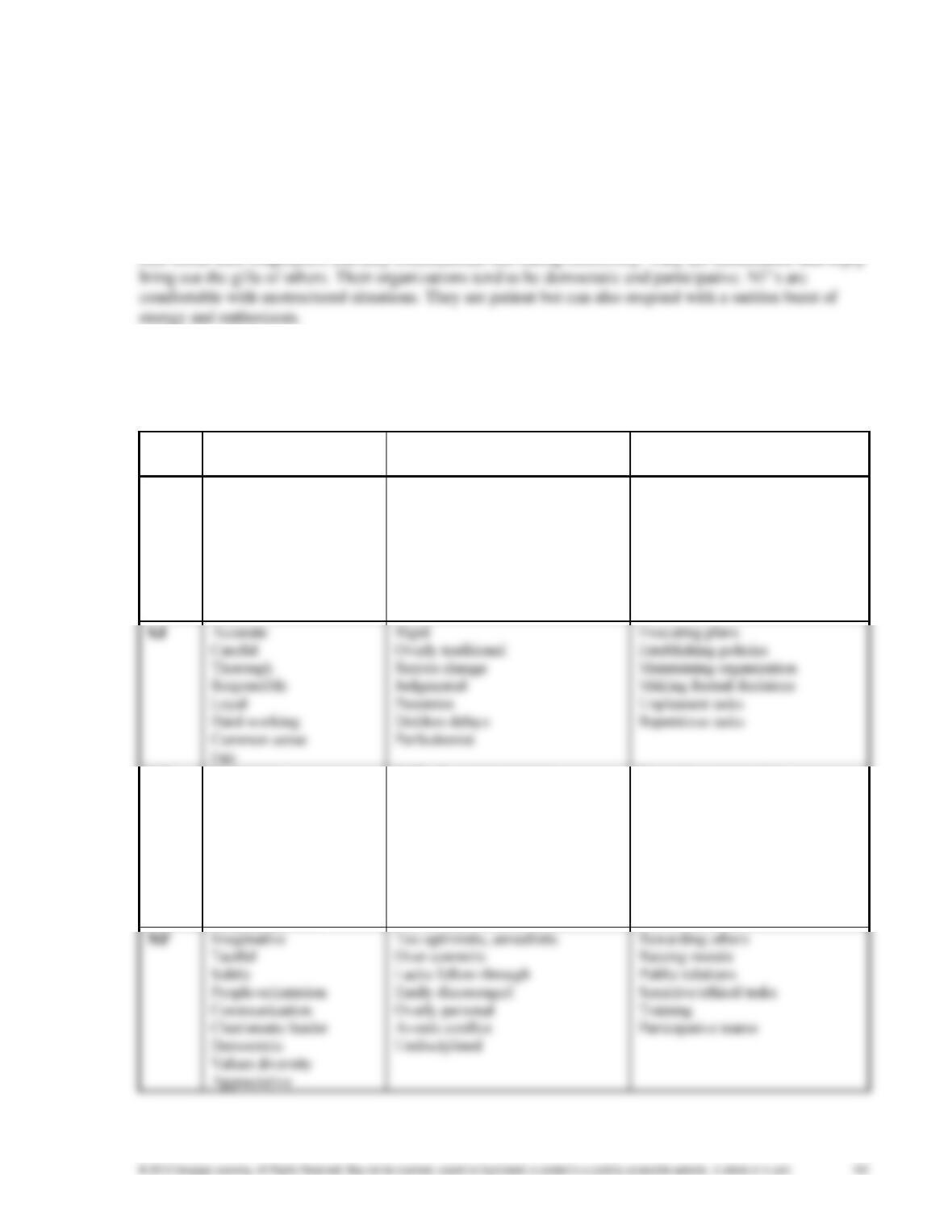
Chapter 15: Basic Elements of Individual Behavior in Organizations
NF—the “Idealist”
NF’s are likely to be drawn to professions such as teaching, ministry, creative writer, mental health
therapist, actor, and physician. They enjoy learning more about themselves and other people. Their word
is “Identity.” They are very sensitive to their own feelings and those of others. About 12% of the
population of the world are NF’s.
Strengths as a Manager: The management style of NF managers relies on charisma. They genuinely
Weaknesses as a Manager: NF managers may spend too much time seeking out and enjoying personal
interaction—to the neglect of the organization’s tasks. They can be immobilized by conflict, not wanting
to displease anyone. NF’s also commit too much and often fail to care for themselves.
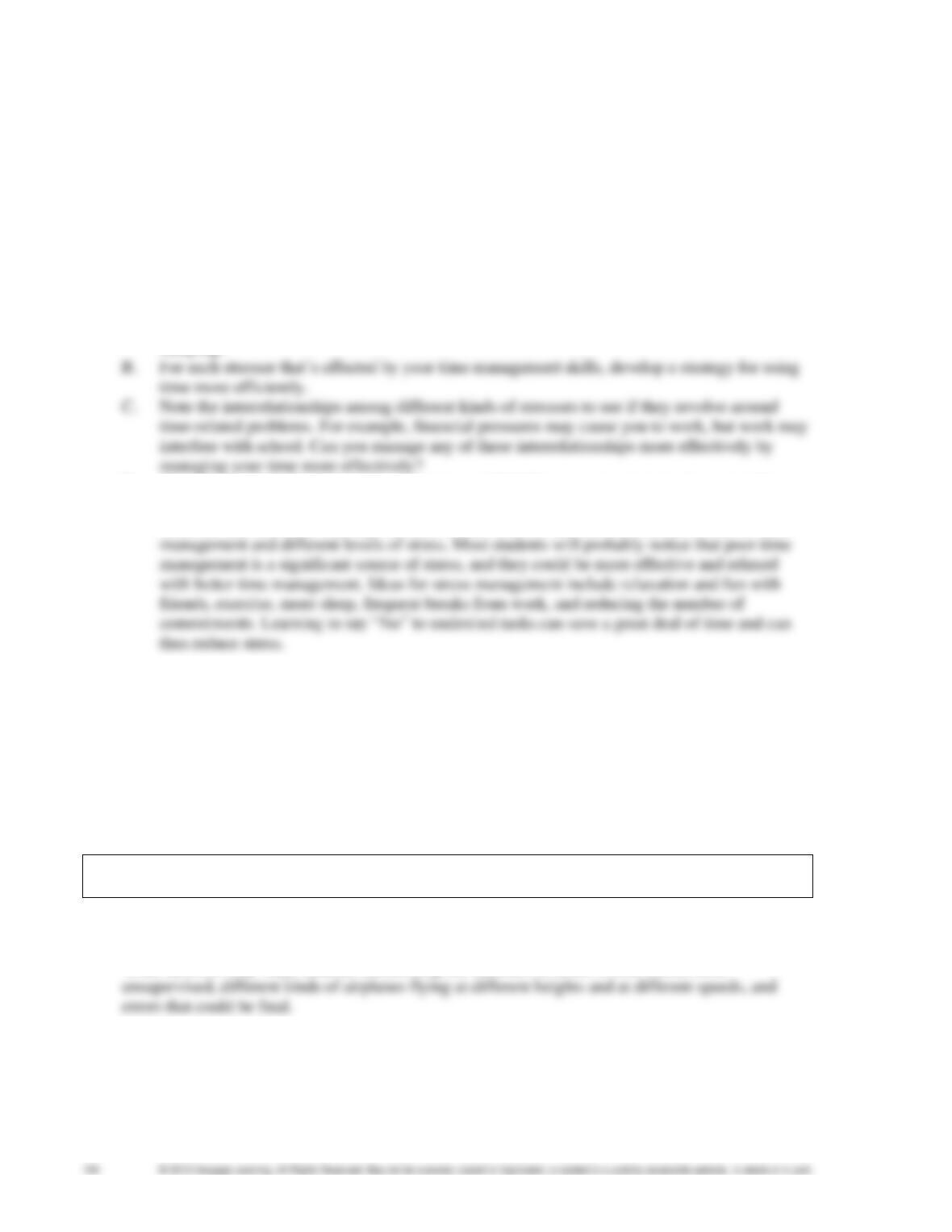
Personality Types at Work
Type
Strengths
Weaknesses
Managerial Tasks at Which
You Excel
SP
Bold
Clever
Action-orientation
Adaptable
Risk taker
Confident
Open-minded
Realist
Impatient
Dislikes planning ahead
Dislikes obeying policy
Dislikes stability
Dislikes theory
Forgetful
Unpredictable
Responding to crises
Troubleshooting
Negotiating
Changing organization
Motivating
Risky tasks
Careful
Thorough
Loyal
Hard-working
Common sense
Fair
Overly traditional
Resists change
Pessimist
Dislikes delays
Perfectionist
Establishing policies
Maintaining organization
Unpleasant tasks
Repetitious tasks
NT
Competent
Intelligent
Inventive
Handles complexity
Efficient
Technical skills
Visionary designer
Skeptical
Long-range focus
Difficulty communicating
Assumes others understand
Not appreciative
Dislikes implementation
Too impersonal
High expectations
Too much planning
Designing organization
Technical tasks
New businesses or tasks
Sharing resources
Combining ideas
Strategic planning
Tasks requiring efficiency
Appreciative
Chapter 15: Basic Elements of Individual Behavior in Organizations
Building Effective Time Management Skills
I. Purpose
This exercise is designed to aid students in seeing the relationship between poor time management
and stress. Students may also gain insight into improving their time-management skills.
II. Format
This time-management exercise is best done individually. It should take about 15–20 minutes,
although some students who take it more seriously may spend much longer completing it.
III. Follow-Up
A. Evaluate the extent to which poor time-management skills on your part play a role in the way
each stressor affects you. Do exams cause stress, for example, because you tend to put off
studying?
D. How do you typically manage the stress in your life? Can you manage stress is a more time-
effective manner?
Students’ answers will vary a great deal, as each one will notice different areas of poor time
MANAGEMENT AT WORK
IS ANYBODY IN CONTROL HERE?
The case describes the highly stressful job that air traffic controllers do. The case describes the specific
incident of January 15, 2009, when an US Airways flight was forced to land on the Hudson river after its
engines were knocked out by birds. The incident caused trauma to both the air traffic controller
monitoring the flight as well as the pilot.
Discussion Starter: How would it be to work as an air traffic controller? While there appears to be
bright prospects in this field because of manpower shortage, this is a stressful job.
1. Case Question 1: What about you? Do you think that you could handle the kind of stress that air
traffic controllers face on the job? Why or why not?
While answers may vary, students should keep the statistics in mind: 8-hour shifts, often
2. Case Question 2: In your opinion, which causes of work stress, or organizational stressors, are
likely to be among the most common experienced by air traffic controllers? Explain your
reasoning?
Chapter 15: Basic Elements of Individual Behavior in Organizations
Task demands is likely to be the major cause of stress for air traffic controllers. They have to make
3. Case Question 3: Controller Pete Rogers says that any gathering of air traffic controllers is “almost
like a mini-convention of Type A personalities.” Does this assessment surprise you or make sense
to you? In what ways is it perhaps a good thing? A not-so-good thing?
Type A personalities are extremely competitive, very devoted to work, and have a strong sense of
4. Case Question 4: “This business of people saying they ‘thrive on stress’? It’s nuts,” says one
eminent psychiatrist who goes so far to as to say that such people are in danger of slipping into a
pathological state. Nevertheless, some people say that they like getting into chaotic situations and
putting them back in order. What about you? Are there times when you seem to be motivated and
satisfied by circumstances that most people would call stressful? If your answer is yes, what kinds
of circumstances are they, and why do you think you react the way you do? If your answer is no,
what do you normally do when faced with such circumstances?