134
CHAPTER 15
Life Insurance Policies
I. SUGGESTED CLASSROOM TIME: 120 MINUTES
II. CHAPTER OVERVIEW
This chapter introduces the important subject of life insurance. The question “Why do
people purchase life insurance?” is answered. One answer is “to meet the financial needs
that would be caused by the premature death of the family wage earner.” Among the needs
described are: 1) a burial fund; 2) an income fund; and 3) an education fund. Other
substantial uses of life insurance products exist.
III. LECTURE OUTLINE
A. Introduction
1. Why do consumers buy life insurance, and what types so they buy?
2. Threats to a person’s earning power
a. Premature death—dying before one’s financial obligations are met
3. Life insurance meets premature death needs and helps fund retirement (annuities)
and can help in times of disability
B. Two Ways Life Insurance Distributed
1. Group life insurance
a. An important fringe benefit of employment with most large companies
Chapter 15/Life Insurance Policies 135
2. Individual or ordinary life
a. Purchased by individuals in any practical amount; usually sold one-to-one by a
life agent.
C. Term Life Insurance
1. Term insurance
a. Purchased for a specific period of time, e.g., one or five years, or to a specific
age, 60–70. If death does not occur during this period, no proceeds are paid.
The main benefit has been peace of mind; thus, this coverage is comparable to
property insurance.
risk of becoming uninsurable is transferred to the insurer.
D. Whole Life Insurance
1. In exchange for a premium, the insurer promises to pay a beneficiary the face
amount whenever death occurs.
2. The premium may be level and continuous, a single premium, or a level premium
for a specified period, e.g., ten-pay whole life or paid-up at age 65.
136 Chapter 15/Life Insurance Policies
E. Universal Life Insurance (ULI)
1. History leading to the development of ULI
2. IRS definition and constraints
F. Variable Life Insurance (VLI)—fixed premium contract in which the cash value is
invested in various funds at the policy owner’s discretion. The face amount increases
and decreases based upon the underlying performance of the portfolio. Sales agents
need an SEC license to sell this product as well as an insurance agent’s license.
G. Other types of life insurance
1. Flexible premium—Variable Life Insurance (FPVLI) or commonly called variable-
H. Reasons for Saving with Whole Life
1. Many people do not save unless forced to do so.
I. “Buy Term and Invest the Difference”
1. These arguments are provided to show that the universal life insurance contracts
are essentially a buy-term-and-invest-the-difference contract.
2. This advice has been heard quite a bit in recent years, especially when high interest
rates prevail, and the issue is very controversial. On one side are agents who have
Chapter 15/Life Insurance Policies 137
4. Advocates say:
a. Death benefits and savings amount are available at death.
b. Needs for life insurance do not exist after age 65.
IV. ANSWERS TO REVIEW QUESTIONS
1. Identify four different types of groups that may purchase group life
2. Describe the most common type of group that is covered by group life
3. Describe the conversion privilege found in group life insurance. When is it
useful? The conversion privilege in a group life insurance policy allows a member
138 Chapter 15/Life Insurance Policies
4. What is the function of credit life insurance? The purpose of credit life
5. List some of the differences between group and individual life insurance.
Besides the most obvious, the nature of the policy holder, group is usually annual
6. Identify the contractual rights that the owner of a life insurance policy may
exercise. The owner of a life insurance contract has a series of contractual rights.
7. Describe four different types of term insurance policies based on their
potential time span.
1) Single-year-term policies promise to pay if the insured dies within the one-year
8. Why are decreasing term policies frequently used to repay mortgage
loans? Decreasing term policies can be specifically designed to track closely the
9. Explain why the renewability feature makes term insurance more
attractive to some buyers. Renewable-term policies allow the insured to continue
the coverage up to a specified age, regardless of the status of the insured’s health (while
Chapter 15/Life Insurance Policies 139
10. How does convertible term life insurance differ from renewable term life
insurance? Convertible term allows the insured to change (convert) the term
11. Develop a set of family circumstances where term insurance is the most
12. Develop a set of family circumstances where traditional cash value, whole
life insurance is the most appropriate type of policy to meet the
13. Why have many consumers found the savings aspect of whole life
insurance policies useful? The regular savings feature of a whole life insurance
policy has found great acceptance with American consumers. There are several reasons
14. For a healthy man aged 27, rank the following policies in the order of their
premium size, from largest to smallest:
a. Continuous-premium whole life
b. Ten-payment whole life
c. Single-premium whole life
140 Chapter 15/Life Insurance Policies
d. Whole life paid up at age 65
a. Single premium (one premium is paid)
15. (16.) Describe some family circumstances where a consumer might
logically choose to purchase a universal or variable life insurance policy.
The universal or variable life insurance policies can be used to fulfill the buy-term and
16. (17.) Describe the advantages and disadvantages of buying term insurance
and investing the difference. Argument in favor of the advice: If the insured can
save regularly, invest wisely at rates greater than about 6 percent compounded
17. (18.) Why does a whole life insurance policy require a larger premium than
a term insurance policy? Whole life policies are designed to pay a death claim for
18. (19.) What are the main differences between universal life insurance and
traditional whole life insurance? There are two main differences between
Chapter 15/Life Insurance Policies 141
19. (20.) Explain the two different types of death benefit plans offered with
universal life insurance. Two different types of death benefits, generally identified
as Plan A and Plan B, are available. In Plan A, the face amount stays level until the cash
20. (21.) How can a variable life insurance policy be operated like a universal
or whole life insurance policy? Variable life can duplicate universal life and whole
V. ANSWERS TO OBJECTIVE QUESTIONS
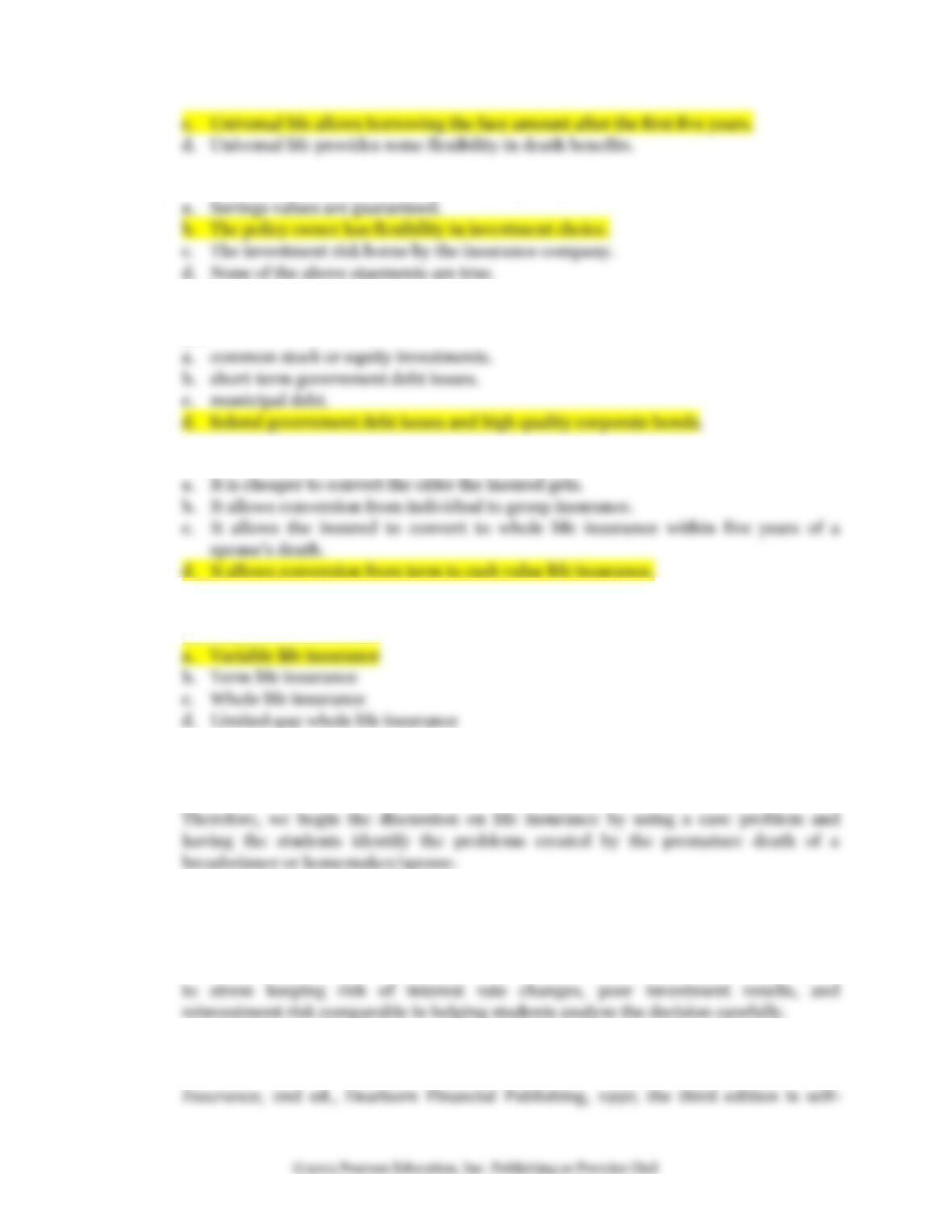
1. The simplest form of life insurance is
2. Which of the followings statements is true regarding whole life insurance?
3. Which of the following features does NOT distinguish universal life insurance from
traditional whole life insurance?
142 Chapter 15/Life Insurance Policies
4. Which of the following statements is true regarding variable life insurance?
5. The investments supporting the cash values of traditional whole life insurance policies
are
6. Which of the following statements is true regarding convertible term life insurance?
7. Selling which of the following types of life insurance policies requires registering with
the NASD?
VI. IDEAS FOR INSTRUCTORS AND TEACHING METHODS
1. Many students find it difficult to envision why people buy life insurance products.
2. In distinguishing between whole life and term products, we create various future
scenarios to look at a variety of situations based on decisions made currently. For
example, if a person buys term coverage now and becomes uninsurable, what are the
alternatives for dealing with a potential business continuation problem? It is also good
3. Students often benefit from discussing reasons why life insurance is not purchased
with the same “enthusiasm” as property insurance. Dorfman and Adelman (Life
Chapter 15/Life Insurance Policies 143
4. Have the class discuss the buy-term-and-invest-the-difference strategy. Construct a
family and advance the family through the problems of the early adult years (child