Chapter 15 – Interpersonal & Organizational Communication: Mastering the Exchange of Information
15–21
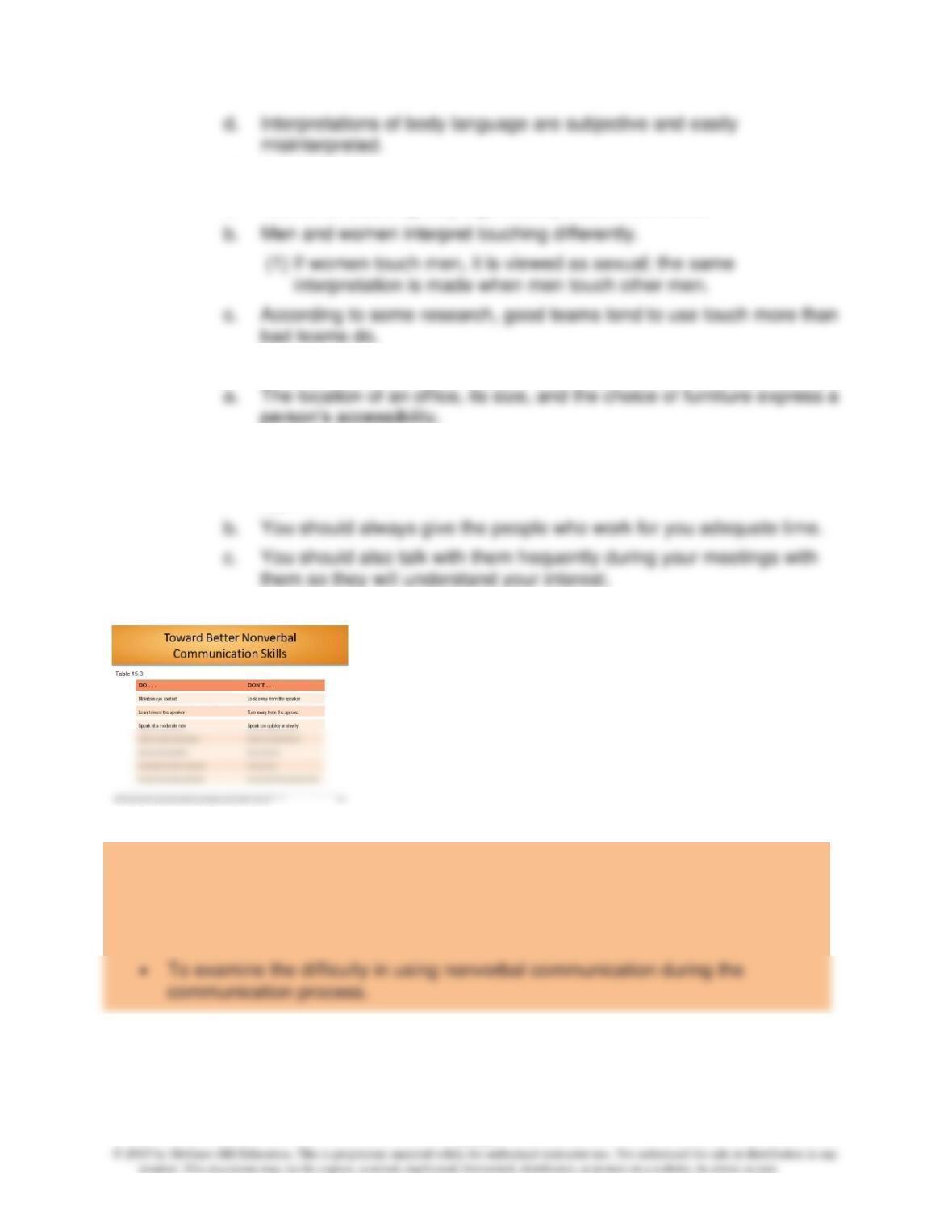
5. Touch
a. Norms for touching vary significantly around the world.
6. Setting
7. Time
a. Example: when your boss keeps you waiting 45 minutes for an
appointment with him.
Group Exercise #1: Practicing Nonverbal Communication with a Twist on Charades
There is a group exercise available at the end of this manual that provides students
with the opportunity to further examine the topic of nonverbal communication.
Exercise Objective
F. Communication Differences between Men & Women
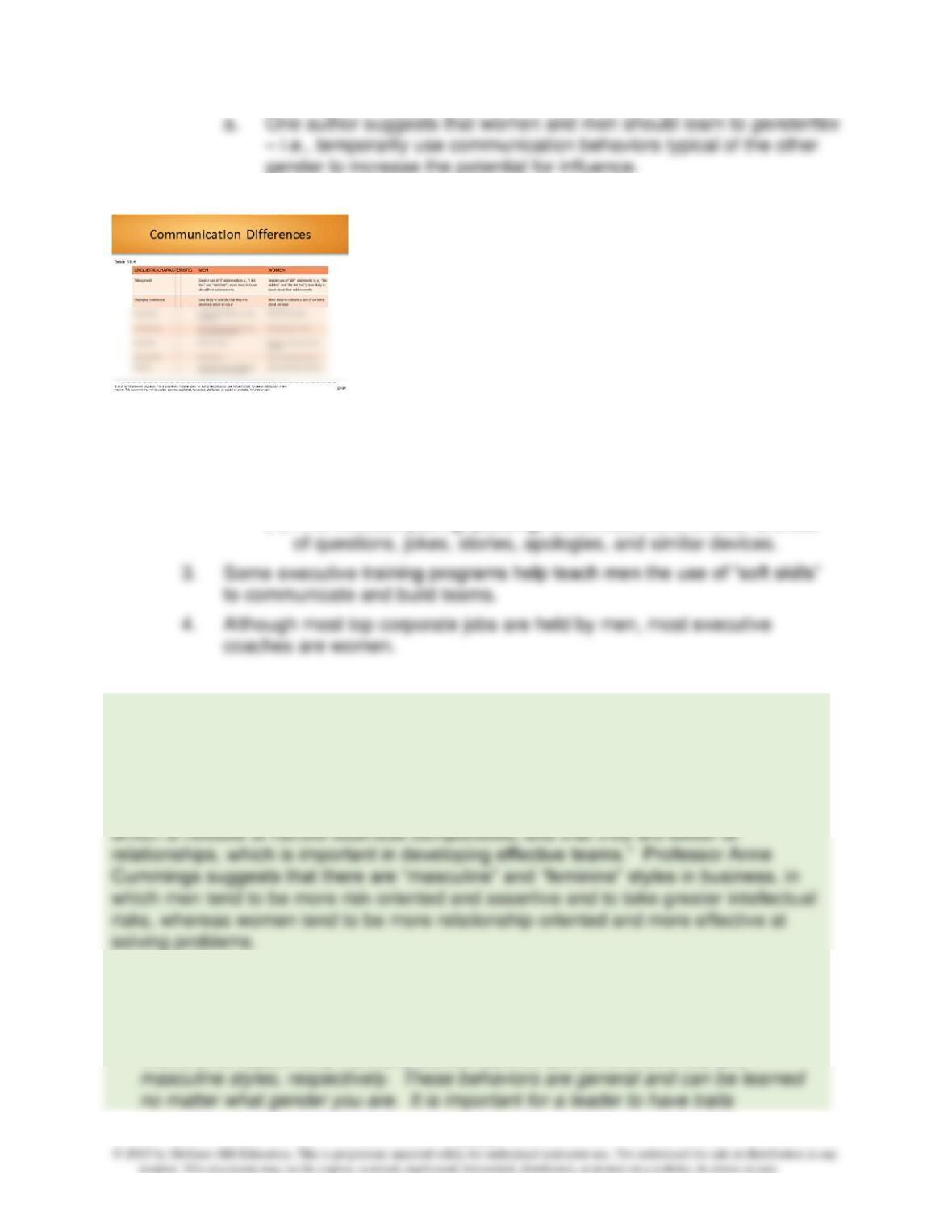
1. There are several general differences in communication between genders.
Chapter 15 – Interpersonal & Organizational Communication: Mastering the Exchange of Information
15–22
2. Another recommends that everyone become aware of how differing
linguistic styles affect our perceptions and judgments.
a. A linguistic style is a person’s characteristic speaking patterns.
(1) This includes pacing, pausing, directness, word choice, and use
Interactive Classroom Material:
EXAMPLE: Do Female Executives Have an Edge in Business? Women &
Communication (p. 493)
According to Chris Clarke, head of an executive search firm with offices in more than
40 countries, “There is increasing evidence that women are superior at multitasking,
YOUR CALL
Do you think a woman can be successful by taking on the “masculine” style?
Can a man be successful taking on the “feminine” style?
There is no reason why men and women cannot take on the feminine and

Chapter 15 – Interpersonal & Organizational Communication: Mastering the Exchange of Information
15–23
Additional Activities:
One way to build on this Example is to have the students watch the Fortune video
“HSNi CEO: This is the Key Message for Young Women.” In this 3-minute video,
Mindy Grossman discusses the mentoring advice that she provides to young women.
Consider using the following discussion questions:
Section 15.4 discusses the how millennials are “Always On” and are the Internet
generation. The three technologies that are altering the communication process
15.4 Communication in the Information Age (pp. 494-500)
How do contemporary managers use information technology to
communicate more effectively?
Chapter 15 – Interpersonal & Organizational Communication: Mastering the Exchange of Information
15–24
Possible Topics for Discussion:
• Discuss how the communication tactics and styles of members of the “Always
On” generation are likely to differ from previous generations.
Major Idea Outline:
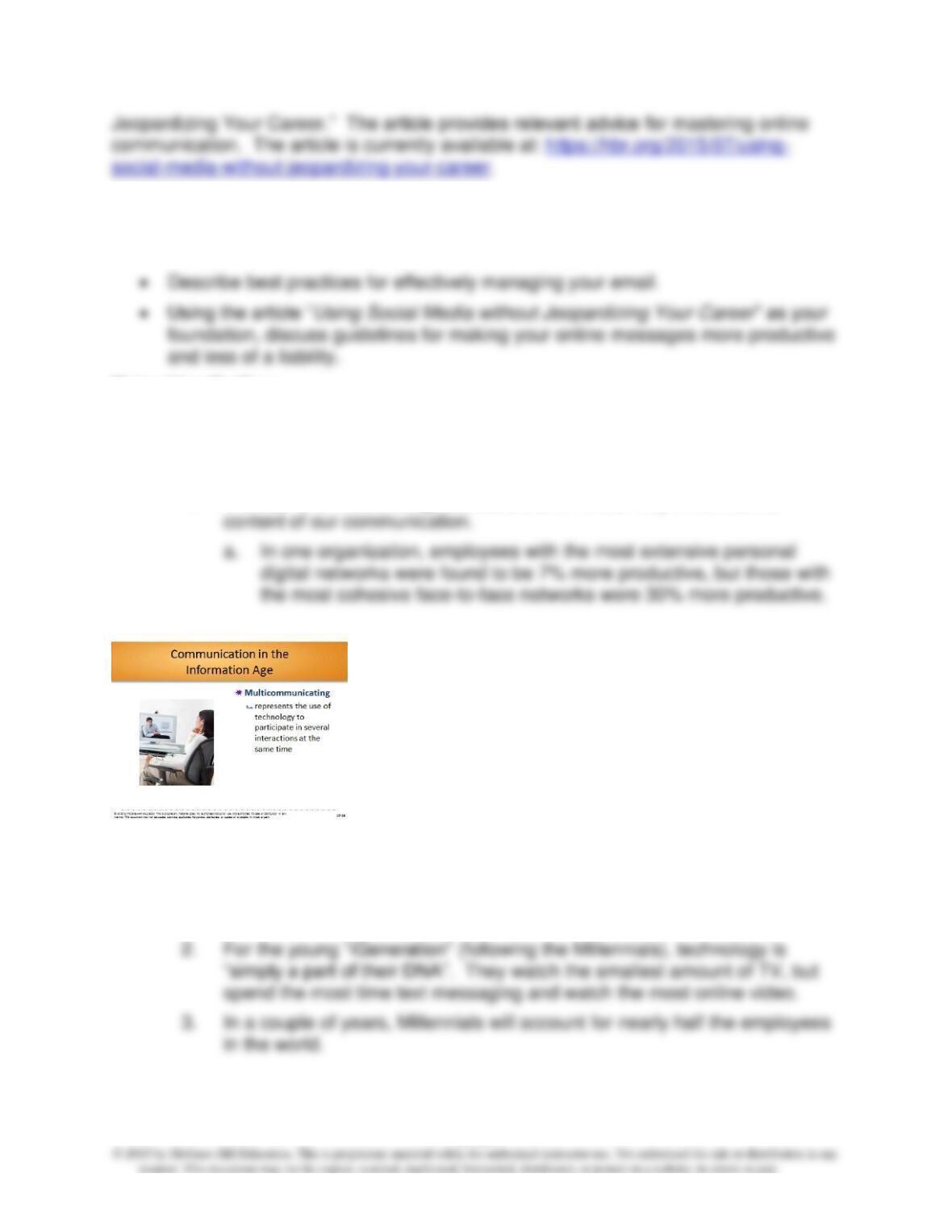
A. Multicommunicating represents the use of technology to participate in
several interactions at the same time.
B. Digital Communication Technology & Workplace Behavior
1. The use of e-mail, texting, Facebook, and Twitter may influence the
C. The “Always On” Generation
1. The Millennials (born 1977-1997) is accustomed to spending 8 hours a
day looking at various screens – on cell phones, computers and TVs.
Chapter 15 – Interpersonal & Organizational Communication: Mastering the Exchange of Information
a. Their outlook is having a profound impact on the workplace “bringing
new approaches to collaboration, knowledge sharing, and innovation
in businesses and governments.”
D. Digital Communication and the New Workplace: Videoconferencing,
Telecommuting, and Teleworking
1. Videoconferencing
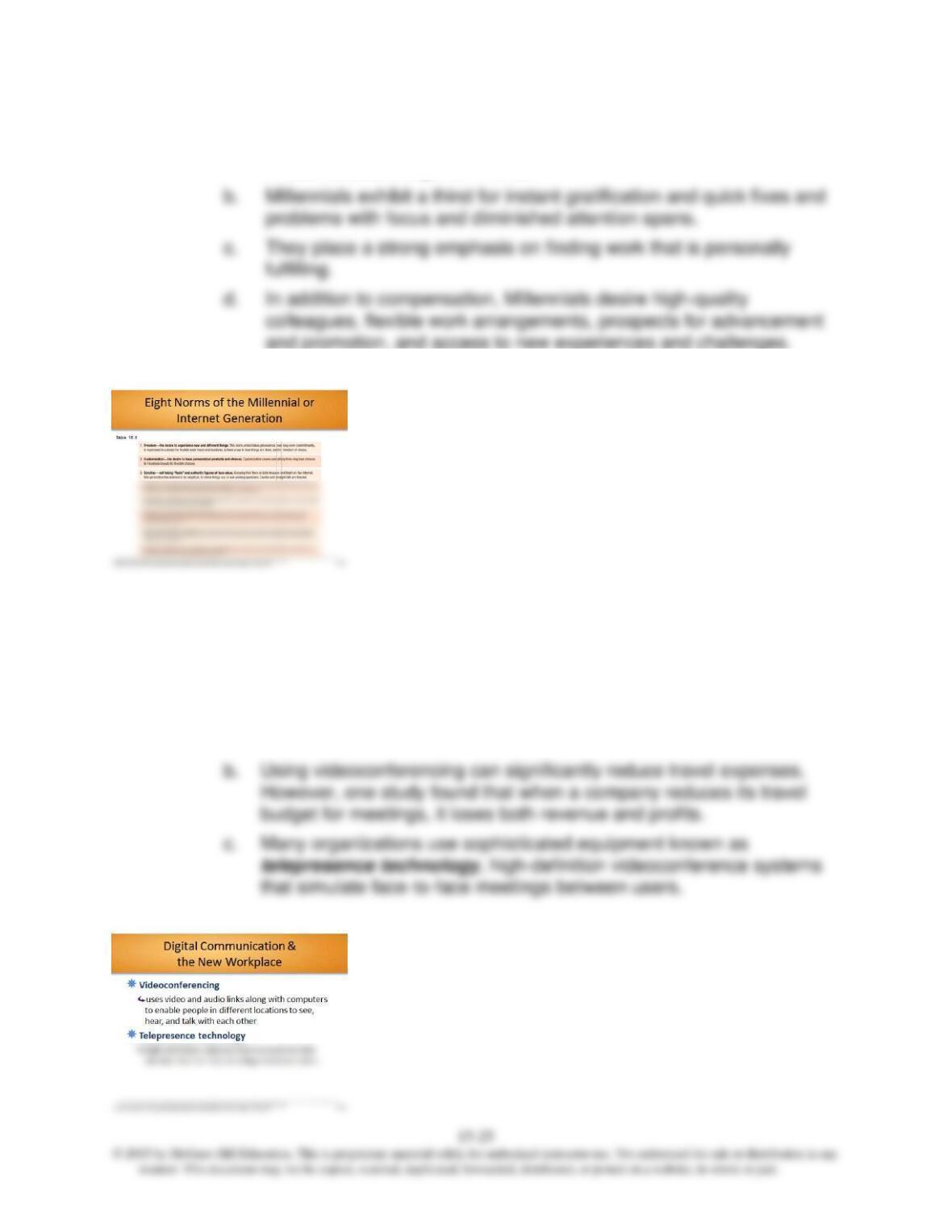
a. Videoconferencing (or teleconferencing) uses video and audio links
along with computers to enable people located at different locations to
see, hear, and talk with one another.
Chapter 15 – Interpersonal & Organizational Communication: Mastering the Exchange of Information
15–26
2. Telecommuting involves doing work that is generally performed in the
office away from the office, using a variety of information technologies.
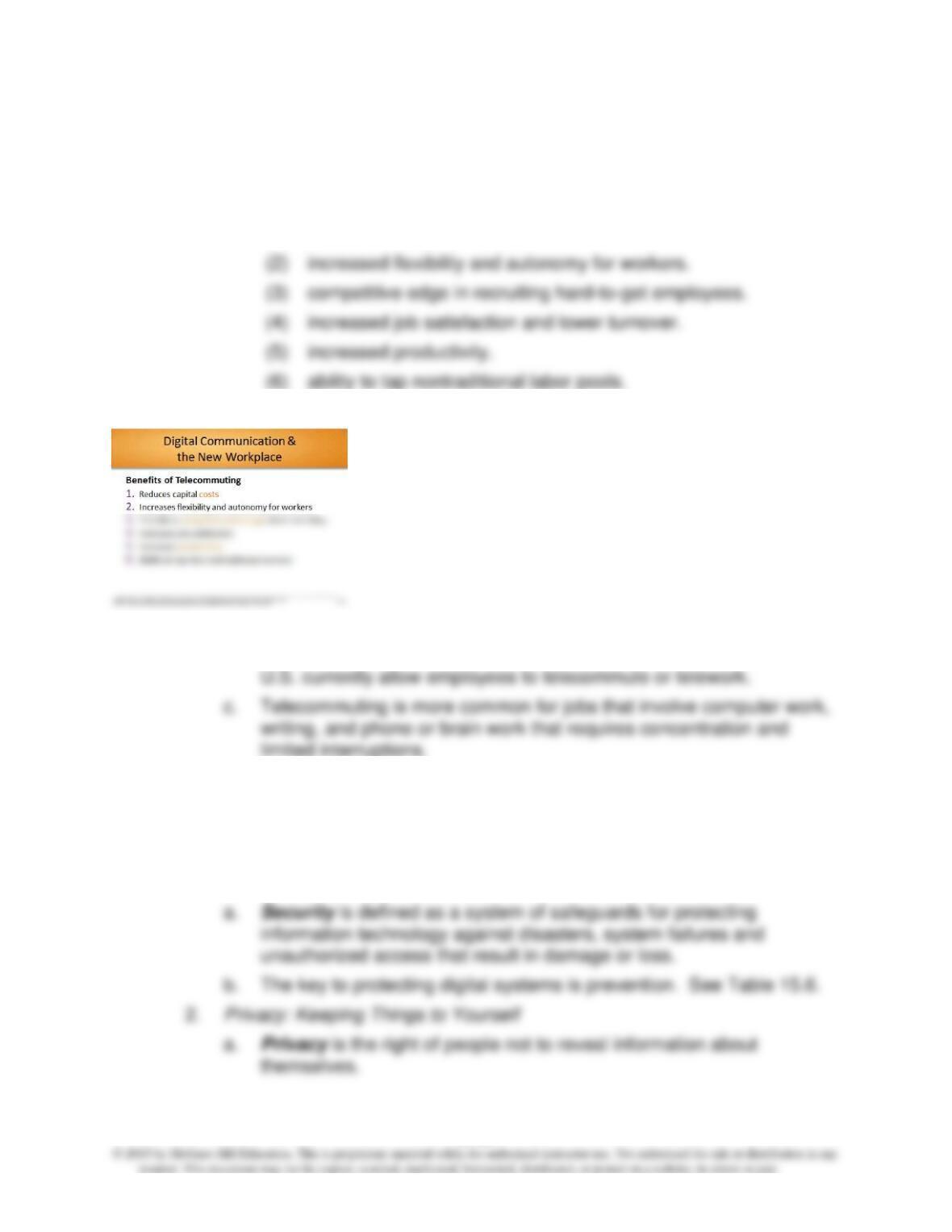
a. Among the benefits are:
(1) reduction of capital costs.
b. About 24% of rural businesses and 35% of nonrural businesses in the
3. The term telework (or virtual office) has been adopted to replace the term
“telecommuting” because it encompasses not just working from home but
working from anywhere.
E. The Downside of the Digital Age
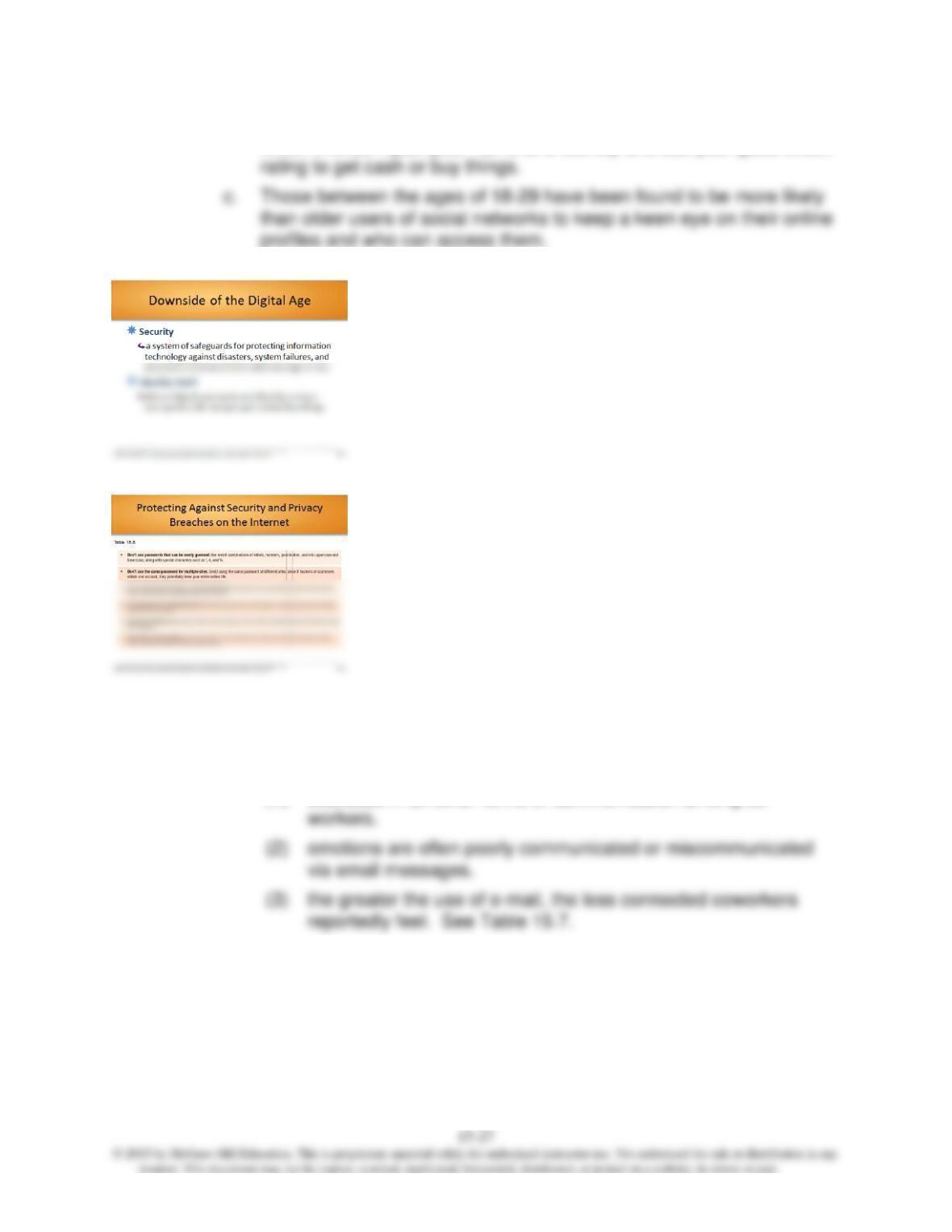
1. Security: Guarding Against Cyberthreats
Chapter 15 – Interpersonal & Organizational Communication: Mastering the Exchange of Information
b. A particularly aggravating violation of privacy is identity theft, in
which thieves hijack your name and identity and use your good credit
3. E-mail, or electronic mail, uses the Internet to send computer-generated
text and documents between people.
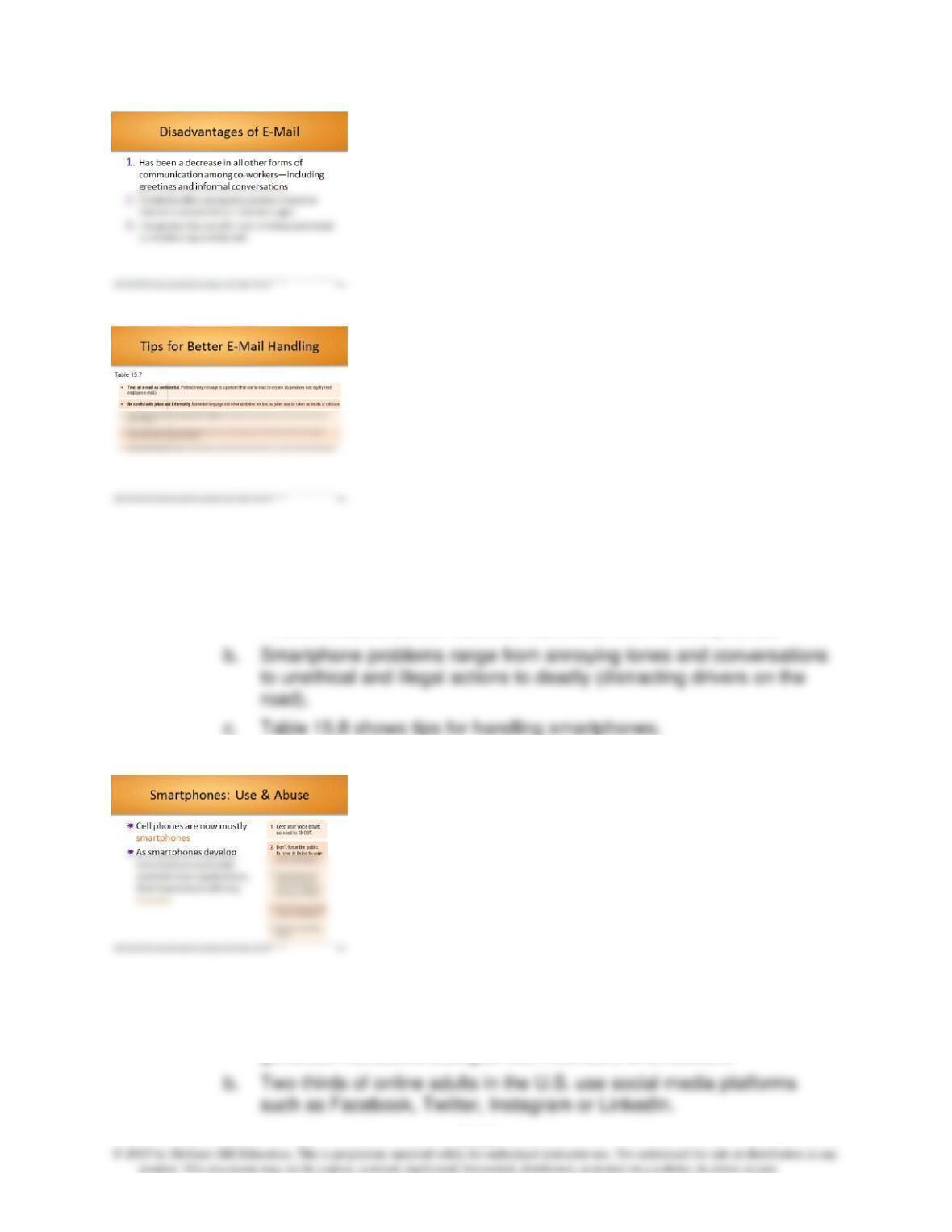
b. There are three drawbacks to e-mail:
(1) decrease in all other forms of communication among co-
Chapter 15 – Interpersonal & Organizational Communication: Mastering the Exchange of Information
15–28
4. Smartphones: Use and Abuse
a. Smartphones are so widespread that one survey reports that
respondents said they would sooner give up their land-line phones,
TV, the Internet and e-mail than surrender their mobile phones.
5. Social Media: Pros and Cons
a. Social media are Internet-based and mobile technologies used to
generate interactive dialogue with members of a network.

Chapter 15 – Interpersonal & Organizational Communication: Mastering the Exchange of Information
15–29
SELF-ASSESSMENT 15.3 (p. 499)
To What Extent Are You Effectively Using Online Social Networking
at Work?
Go to connect.mheducation.com and take Self-Assessment 15.3.
Student Questions:
1. To what extent is social media helping or hurting your performance at work?
Student responses will differ based on assessment results. The assessment
2. Based on your survey scores, what can you do to more effectively use social
Chapter 15 – Interpersonal & Organizational Communication: Mastering the Exchange of Information
15–30
media at work? Be specific.
Generally, employees should use social media to solve work-problems, not
3. What policies might companies install to ensure that social media is used in a
productive manner? Explain.
Companies can ask that employees refrain from using social media while on
Additional Activities:
You can also consult the Connect Instructors Manual for the post–assessment activity
and corresponding PowerPoint slides used for this Self-Assessment in Connect. In
e. There are also drawbacks to social media:
(1) Distraction.
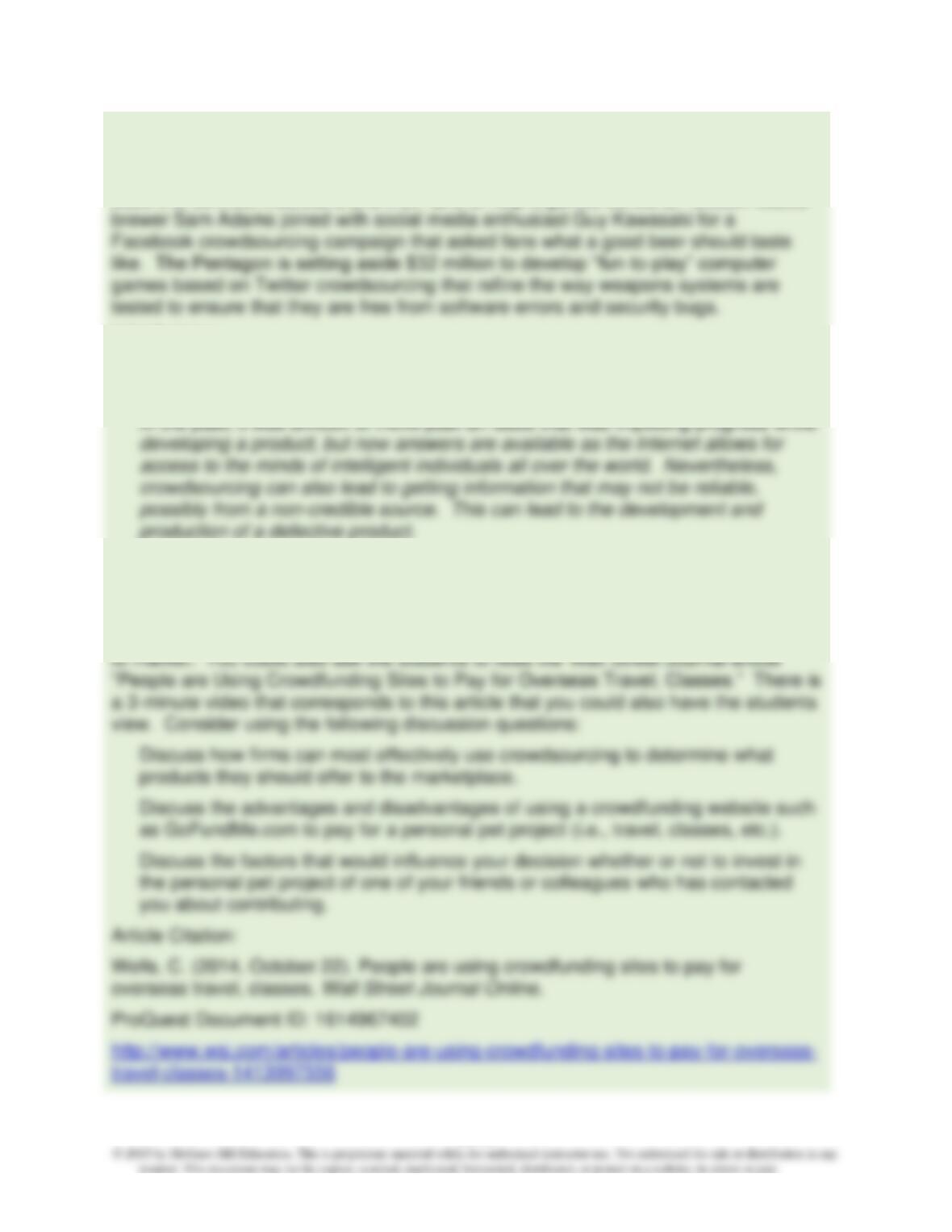
f. Some recommendations for using Facebook are shown in Table 15.9.
Interactive Classroom Material:
Chapter 15 – Interpersonal & Organizational Communication: Mastering the Exchange of Information
15–31
EXAMPLE: Crowdsourcing: Using Facebook & Twitter to Develop New Ideas (p.
500)
Crowdsourcing is being applied in many fields, and not just Wikipedia. Owngig.com
uses it to connect musicians and their fans to help organize concerts. Boston-based
YOUR CALL
What are the pros and cons of using crowdsourcing to develop a product?
Crowdsourcing is a great way to quickly get answers to many complex problems.
Additional Activities:
One way to build on this Example is to have the students watch the CNBC video
“Crowdsourcing your Bottom Line.” This 2-minute video profiles the Internet lingerie
startup Adore Me and its use of crowdsourcing to determine what designs it will bring
Chapter 15 – Interpersonal & Organizational Communication: Mastering the Exchange of Information
15–32
Section 15.5 discusses ways to improve listening, reading, writing and speaking skills.
One can be a better listener by learning to concentrate on the content of a message and
being an active listener. Becoming a better reader also incorporates this same idea. It
is also possible to become a more effective writer by following these tips: 1) don’t show
Possible Topics for Discussion:
• Discuss how you can be a more effective listener.
Major Idea Outline:
A. The principal activities that managers spend their time doing—listening,
reading, writing, and speaking—involve communication.
B. Being an Effective Listener
15.5 Improving Communication Effectiveness (pp. 501-505)
How can I be a better listener, reader, writer, and speaker?
Chapter 15 – Interpersonal & Organizational Communication: Mastering the Exchange of Information
15–33
1. People comprehend only about 35% of a typical verbal message.
2. To improve your active listening skills, you should first try to determine
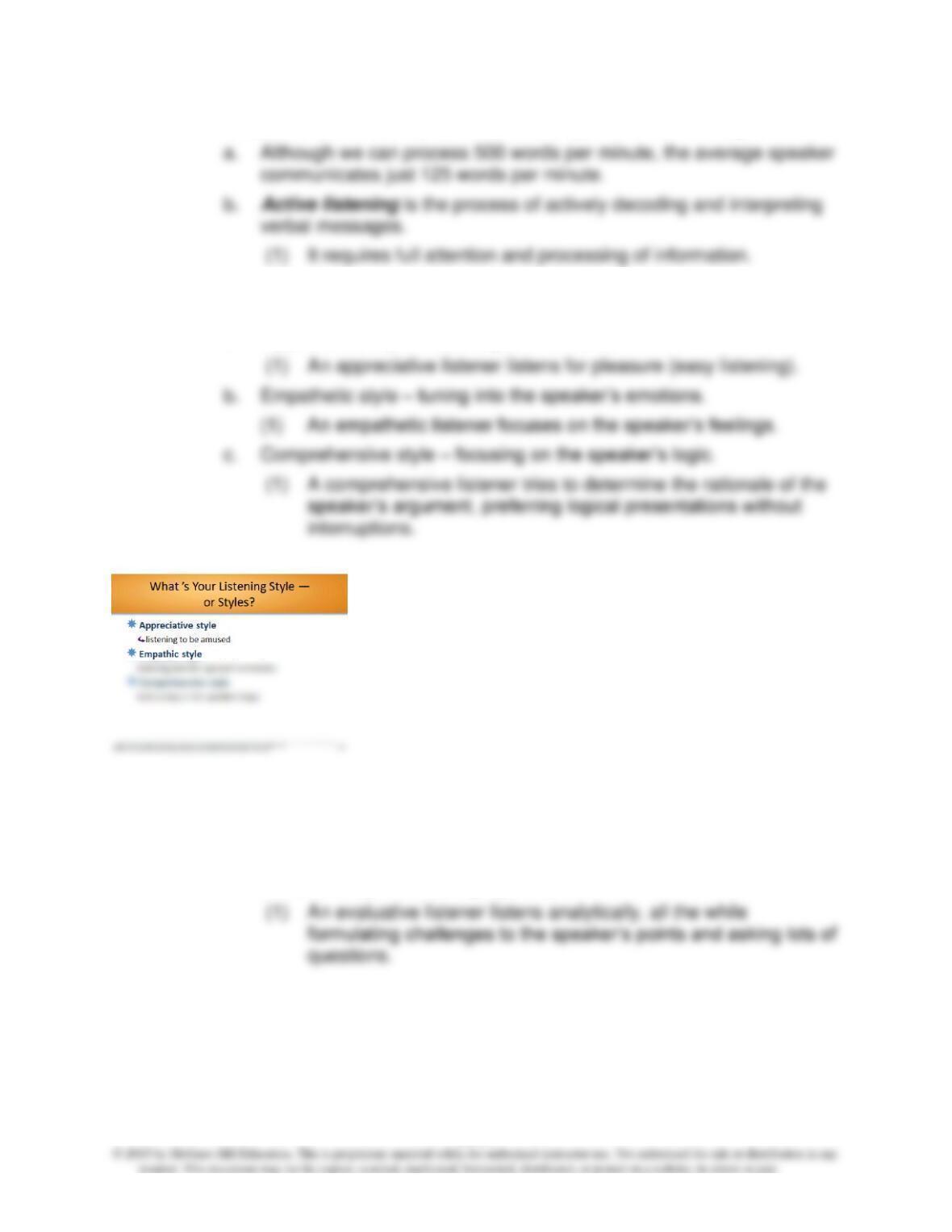
your two or three dominant listening styles:
a. Appreciative style – listening to be amused.
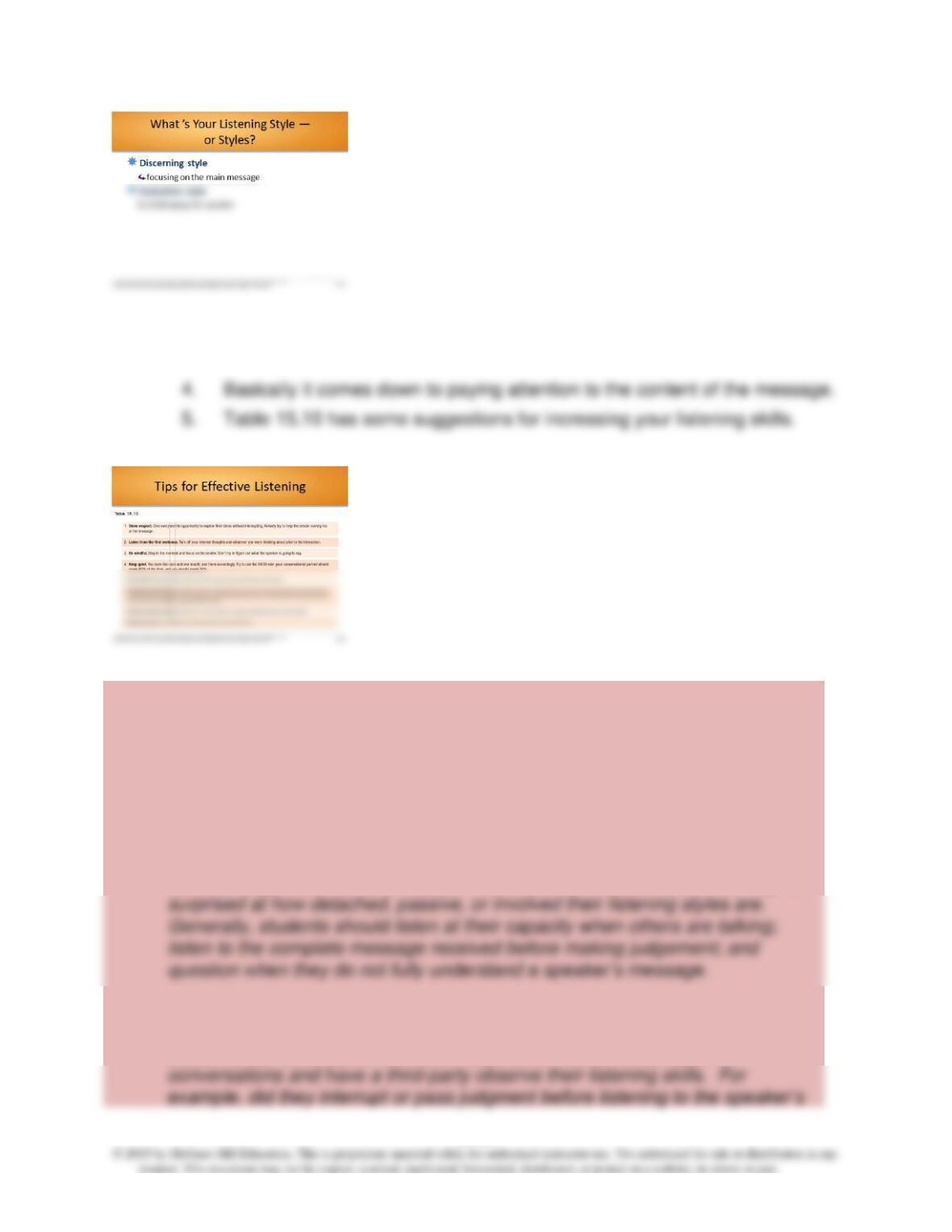
d. Discerning style – focusing on the main message.
(1) A discerning listener tries to determine the speaker’s main
message and important points, often taking notes.
e. Evaluative style – challenging the speaker.
Chapter 15 – Interpersonal & Organizational Communication: Mastering the Exchange of Information
15–34
3. Effective listening is a learned skill, and it takes energy and desire to
develop it.
SELF-ASSESSMENT 15.4 (p. 502)
Assessing Your Listening Style
Go to connect.mheducation.com and take Self-Assessment 15.4.
Student Questions:
1. Is your listening style detached, passive, or involved? Based on your survey
scores, what can you do to become more of an involved listener? Be specific.
Student responses will differ based on assessment results. Students may be
2. Think of two ways you can practice better listening in your teams at work or
school. Be specific.
Students can be creative with their ideas here. Students can start
Chapter 15 – Interpersonal & Organizational Communication: Mastering the Exchange of Information
15–35
Additional Activities:
You can also consult the Connect Instructors Manual for the post-assessment activity
and corresponding PowerPoint slides used for this Self-Assessment in Connect. In
C. Being an Effective Reader
1. Reading shares many of the same skills as listening – concentrating on
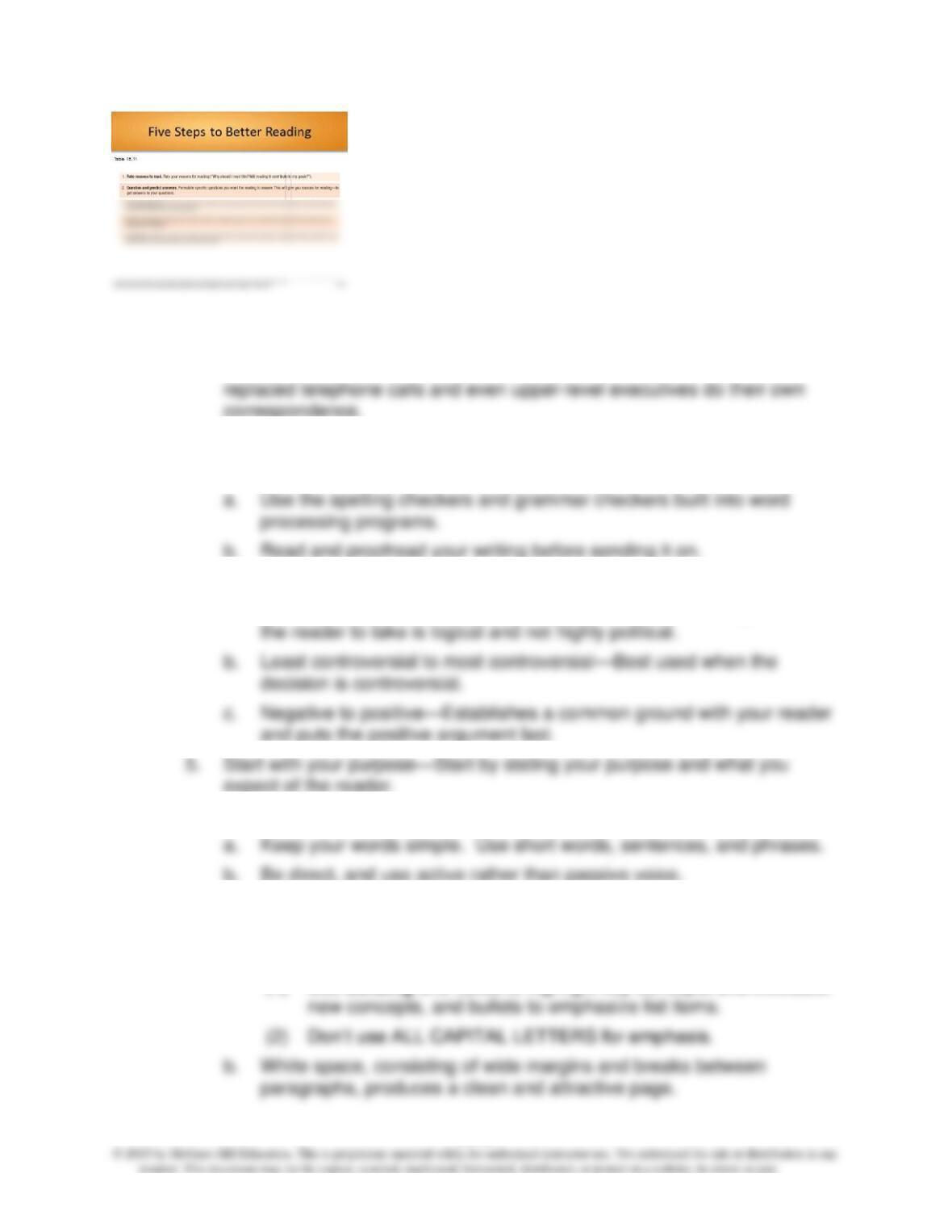
3. Do top-down reading—SQ3R—involving five steps:
a. Rate reasons to read.
Chapter 15 – Interpersonal & Organizational Communication: Mastering the Exchange of Information
15–36
D. Being an Effective Writer
1. Writing has become an essential management skill, as e-mail has
2. Tips for writing more effectively are as follows:
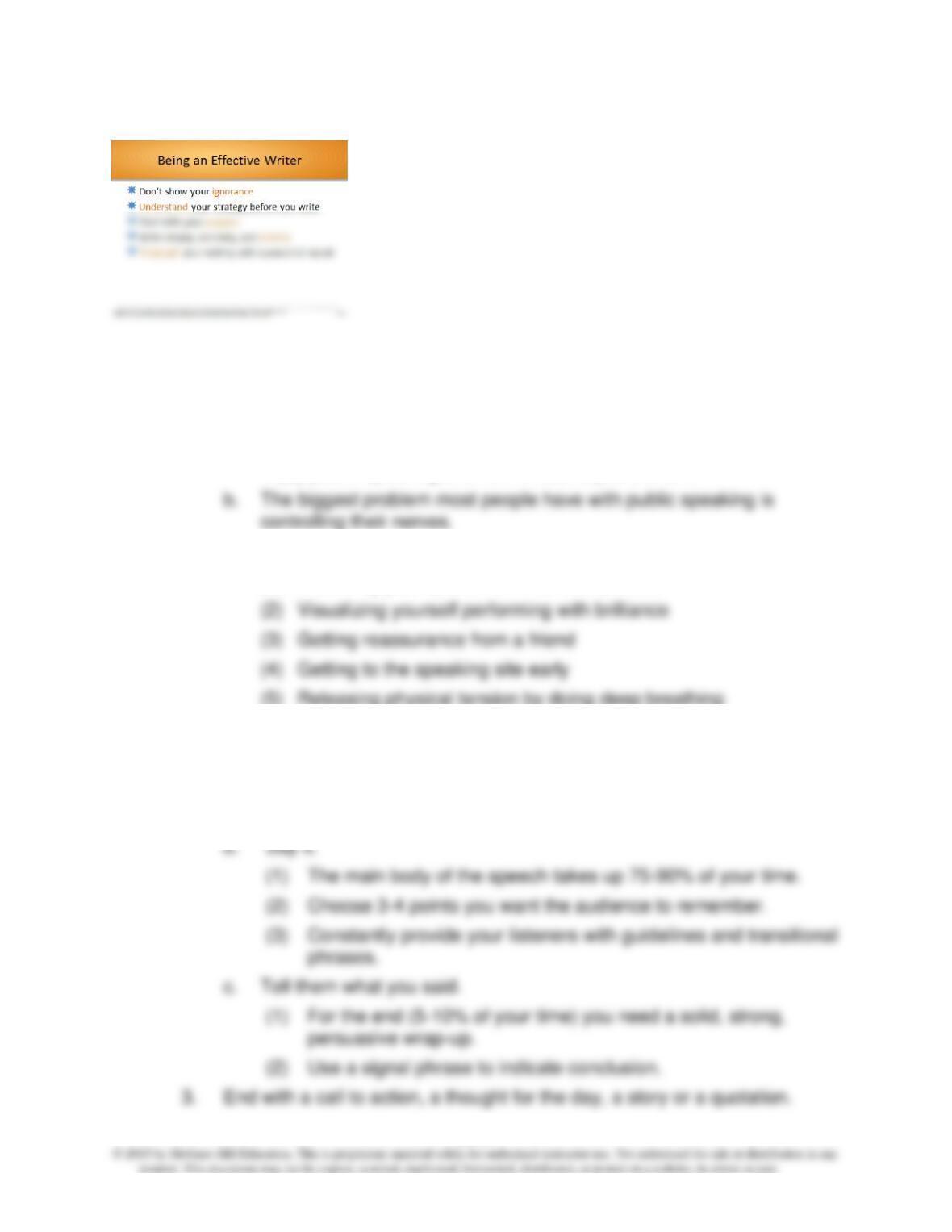
3. Don’t show your ignorance.
4. Understand your strategy before you write.
a. Most important to least important—useful when the action you want
6. Write simply, concisely, and directly.
7. Telegraph your writing with a powerful layout—Make your writing as easy
to read as possible.
a. Highlighting
(1) Use bolding and italics to highlight key concepts and introduce
Chapter 15 – Interpersonal & Organizational Communication: Mastering the Exchange of Information
15–37
E. Being an Effective Speaker
1. An important skill is the ability to make an oral presentation to a room of
people.
a. One study found that the top predictor of success is how much you
enjoy public speaking and how effective you are at it.
c. One author suggests preparing your nerves by:
(1) Practicing your speech until it’s near perfect
(5) Releasing physical tension by doing deep breathing
2. Three simple rules for a speech:
a. Tell them what you’re going to say.
(1) The introduction should take 5-15% of your speaking time.
(2) Try to go right to the point.
Chapter 15 – Interpersonal & Organizational Communication: Mastering the Exchange of Information
15–38
Group Exercise #2: Observing Group Communication
There is a group exercise available at the end of this manual that provides students
with the opportunity to observe the communication process within a group.
Exercise Objectives