Copyright © 2014 Pearson Education, Inc.
15-1
Management Information Systems, 13E, Global Edition
Laudon & Laudon
Lecture Notes by Barbara J. Ellestad
Chapter 15 Managing Global Systems
The world just keeps getting smaller and smaller. No company can afford to ignore
15.1 The Growth of International Information Systems
Globalization is possible even with very small businesses because of the technological
advances in computer networks and telecommunications. Is your organization developing
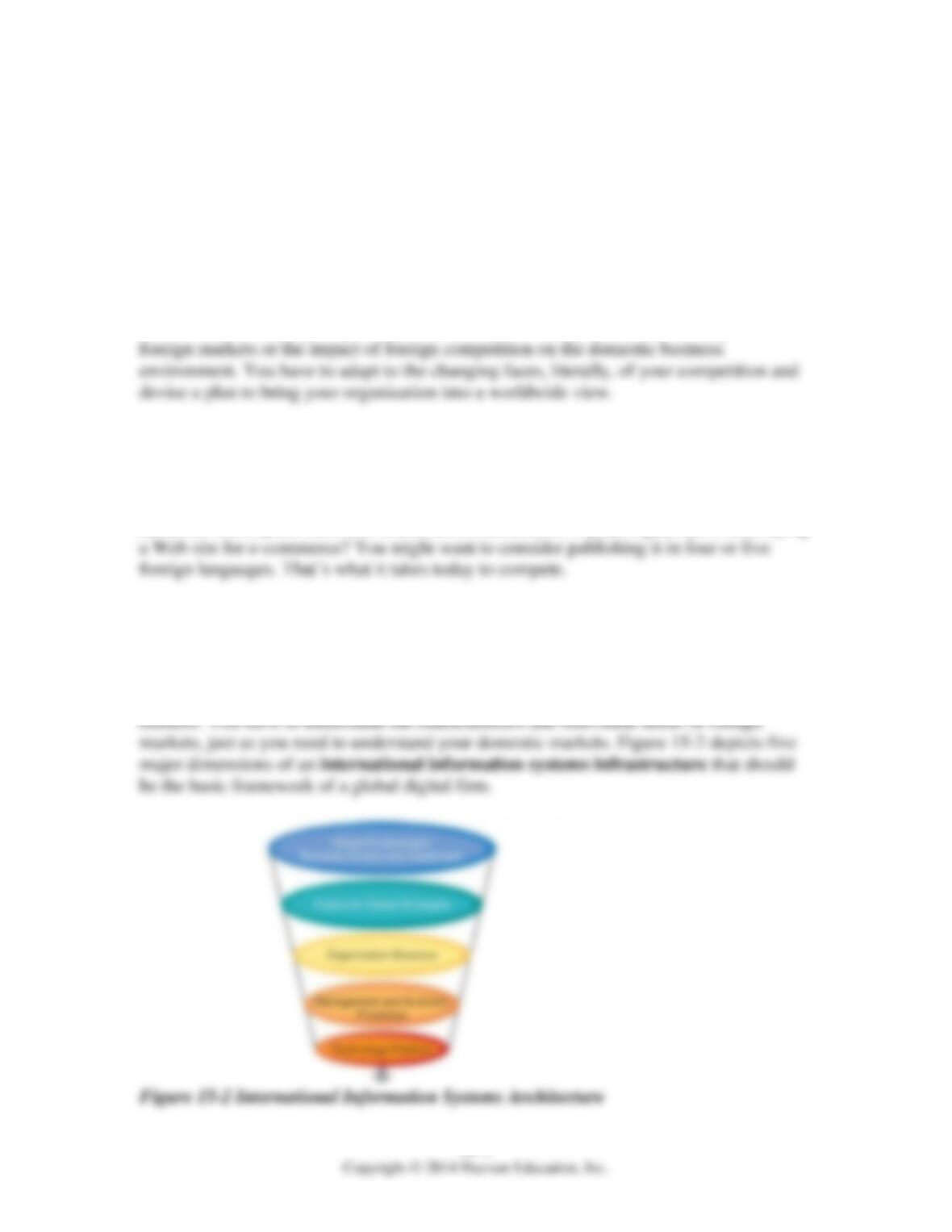
Developing an International Information Systems Architecture
You must have an information system in place that will support the communications,
coordination of people and products, and order processing for both domestic and foreign
Copyright © 2014 Pearson Education, Inc.
15-2
Walmart learned the hard way that it couldn’t just walk into a foreign country and build a
store mirroring those in the United States. Sales were very low and the products just
So don’t start creating all those juiced-up information systems as soon as you decide to
pursue the foreign marketplace. Before you tackle the technology, you must:
1. Understand the global environment, including which business driver is most
Notice that the last issue you’ll have to contend with is the technology. We said before
that every information system implementation plan must be in harmony with the basic
business plan. In fact, you must first develop the overall business strategy for entering the
global arena. Then and only then can you begin to think about how the information
system will be synchronized with the basic strategy.
The Global Environment: Business Drivers and Challenges
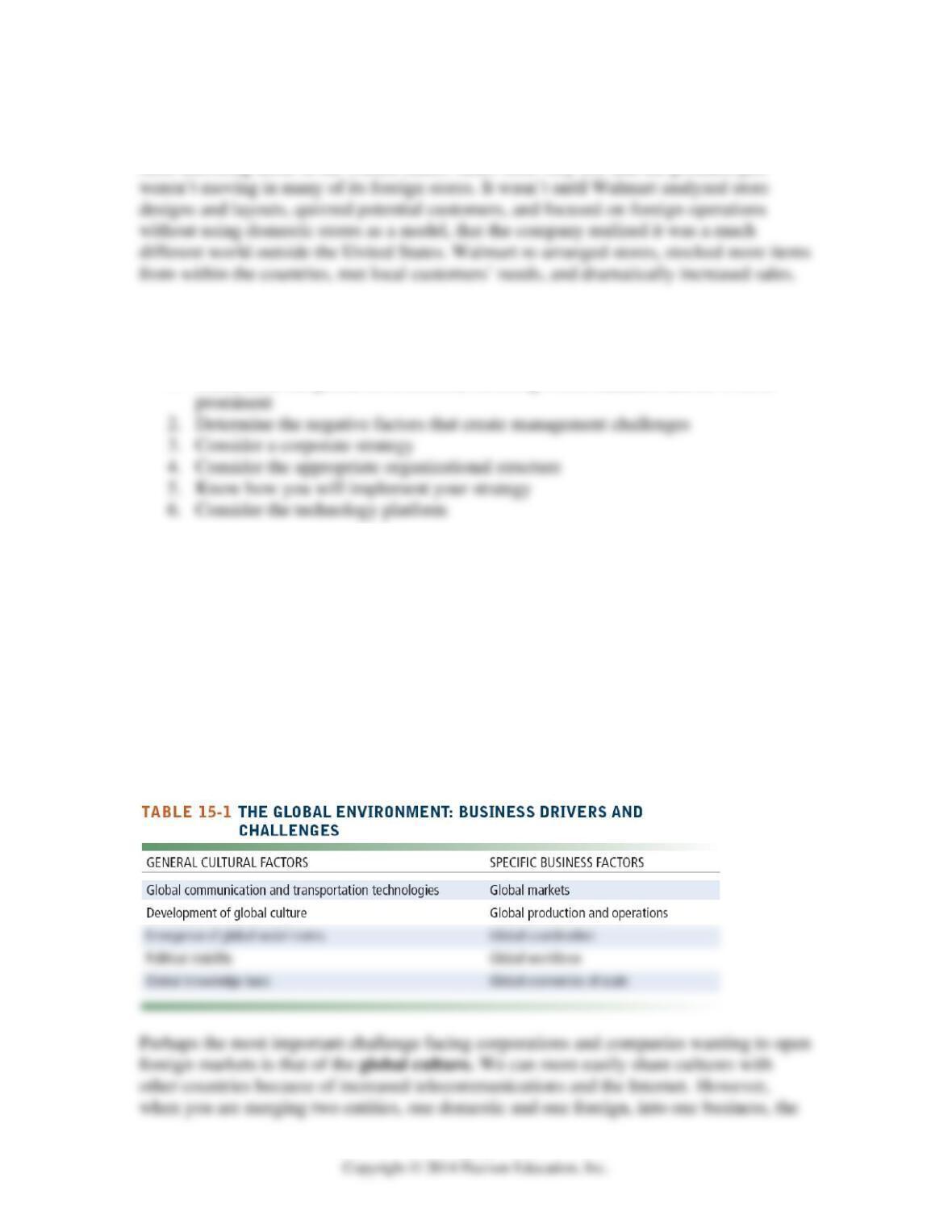
Table 15-1 gives you an idea of some of the global business drivers, factors influencing
the direction of businesses, that organizations must consider in today’s environment.
culture of that merged organization is an important influence on how well the company
does.
We’d like to destroy the myth of domestic being defined as a U.S.-based company and
the foreign company being from, well, from a foreign country. Toyota Motor Corporation
has its domestic headquarters in Toyota City, Japan with manufacturing operations in 27
foreign countries and regions, including the United States. Ask yourself this question:
Who says all corporate offices must be located in the continental Unites States?
Business Challenges
You know that doing business in foreign countries is not all that easy. There is
tremendous risk associated with global businesses. Russia is a prime example of how
difficult it can be for businesses to establish themselves in foreign markets amid political
turbulence and disorder. Just when your company thinks all is well with its foreign
establishment, a terrorist attack can put a crimp in the best laid plans.
Copyright © 2014 Pearson Education, Inc.
15-4
Corporations and companies must reconcile these differences in order to allow
transborder data flow between merged information systems.
Globalism presents challenges and opportunities in areas of accounting systems,
language, and currency usage. Some companies are deciding to adopt foreign systems
rather than continuing to use American accounting systems.
SEC Chairman Christopher Cox has called the move ‘a revolutionary
development’ that will streamline global reporting standards and create ‘a
true lingua franca’ for accounting. Business leaders such as the U.S.
Chamber of Commerce say it would help the USA compete in the world
economy, leading to more cross-border commerce.
Now, Culin says, Lenovo is weaning itself from IBM’s old ‘legacy’ U.S.
accounting system. So far, Lenovo has converted its operations in Asia
and Canada to IFRS, and it’s working now on Europe, then Latin
America. If the USA moves to global rules, Lenovo will adapt quickly.
State of the Art
If you thought building an information system for an organization doing business only in
the United States was tough, think about some of the factors we’ve just discussed and
Copyright © 2014 Pearson Education, Inc.
15-5
So why do companies even attempt to build themselves into global merchants? Because
the potential payoff is enormous!
Bottom Line: Global businesses must devote their time and attention to under-
standing the cultural factors of countries in which they want to do business. Not
only must they merge their business units, they must also merge their people into a
cohesive team. They must understand and deal with many different external factors
in both domestic and foreign environments.
15.2 Organizing International Information Systems
First you have to decide what you’re going to do—you have to choose a strategy. Then
Global Strategies and Business Organization
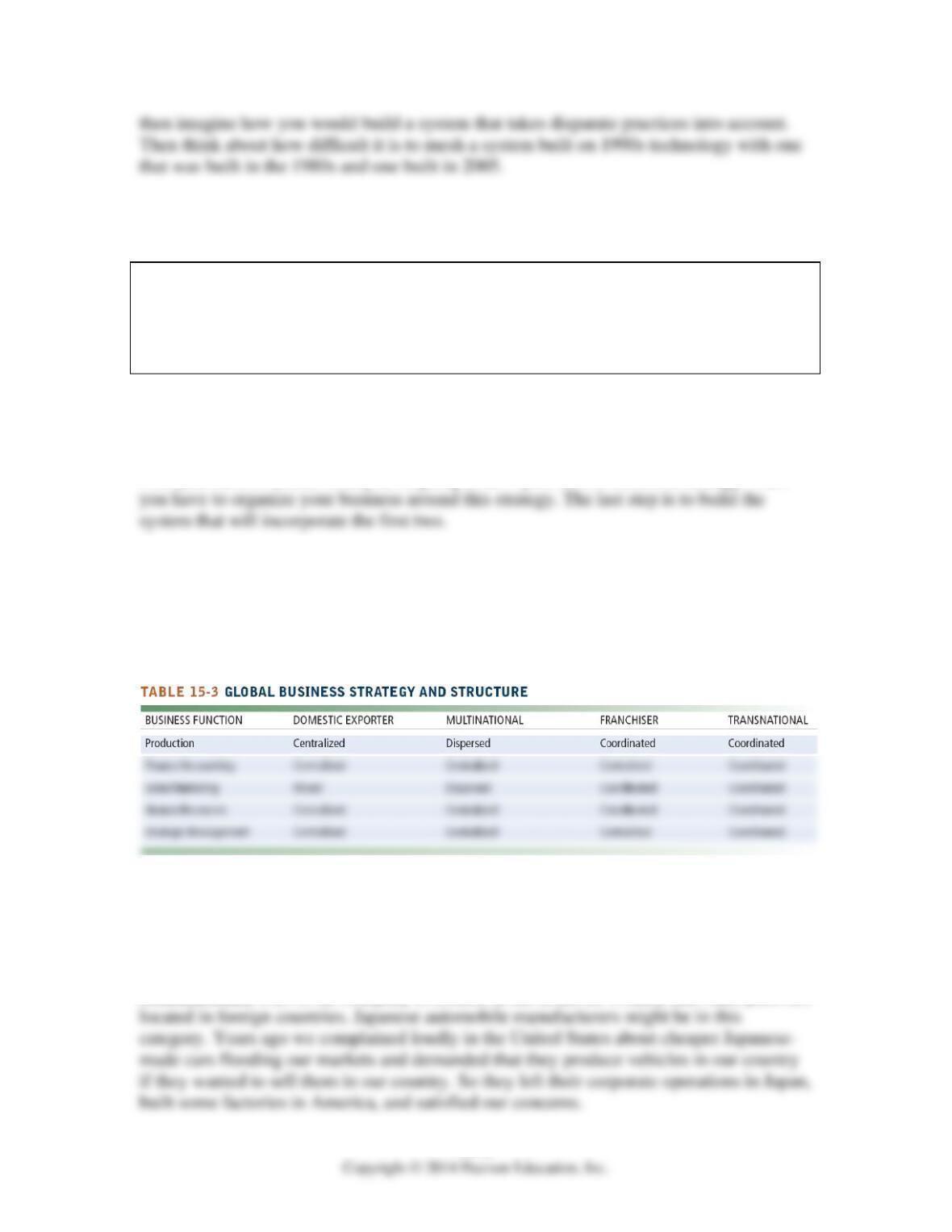
Table 15-3 shows four main global strategies that can form the basis for a global
organizational structure.
Domestic exporter: Most operations are located in the domestic country and the
company exports products to foreign companies. A company located in India that imports
rugs to the United States would fit this category. All corporate offices are in India, and
products are sent to distributors in the United States.
Multinational: Part of the company is located in the domestic country and other parts are
Franchiser: Some operations are located in the domestic homeland while extended
activities associated with the product are conducted in foreign countries. Starbucks
Transnational: One globe, one company. Going back to our earlier example of Toyota,
the company’s headquarters may be in Japan but its operations are spread throughout the
Global Systems to Fit the Strategy
Once you’ve decided which global business strategy to follow, it’s time to decide how
your information system will support it.
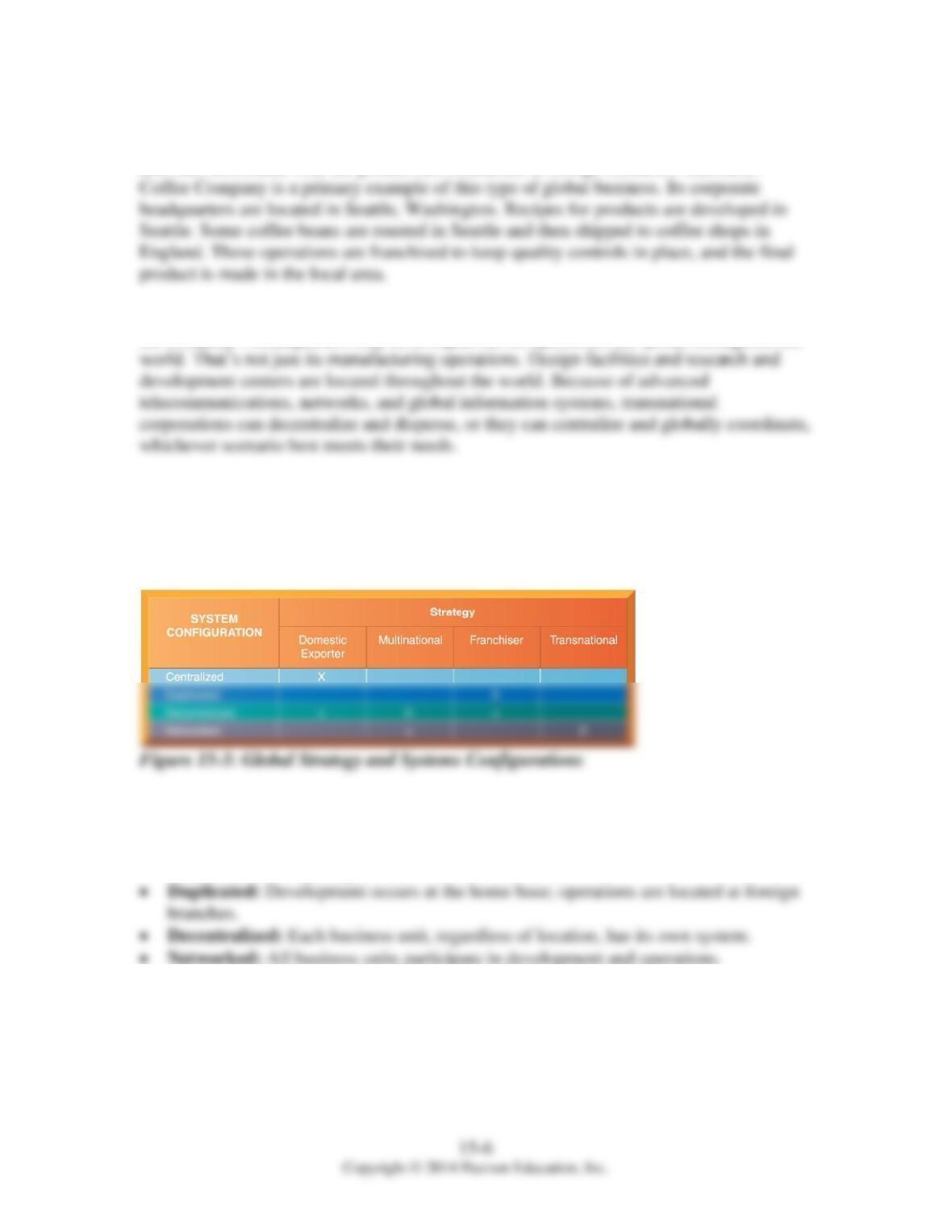
This figure gives you an idea of the type of information system that will best support the
different business strategies. To summarize the text definition of each type of system:
• Centralized: Everything is located at the domestic home base.
Reorganizing the Business
You have to decide what your overall business goals are and what makes sense for your
organization, fit the information system structure to your needs, and never lose sight of
new opportunities.
1. Organize value-adding activities along lines of comparative advantage. Starbucks has
to decide where to locate the marketing function to maximize its potential. Perhaps it
2. Develop and operate systems units at each level of corporate activity—national,
regional, and international. Walmart would probably maintain small information
3. Establish a world headquarters, a global chief information officer (CIO) position.
General Motors has one person who is responsible for an information system that
Bottom Line: There are four main global strategies that businesses can use to
organize their global efforts: domestic exporter, multinational, franchiser, and
transnational. Determining the global strategy will help a business determine its
information system structure: centralized, duplicated, decentralized, or networked.
15.3 Managing Global Systems
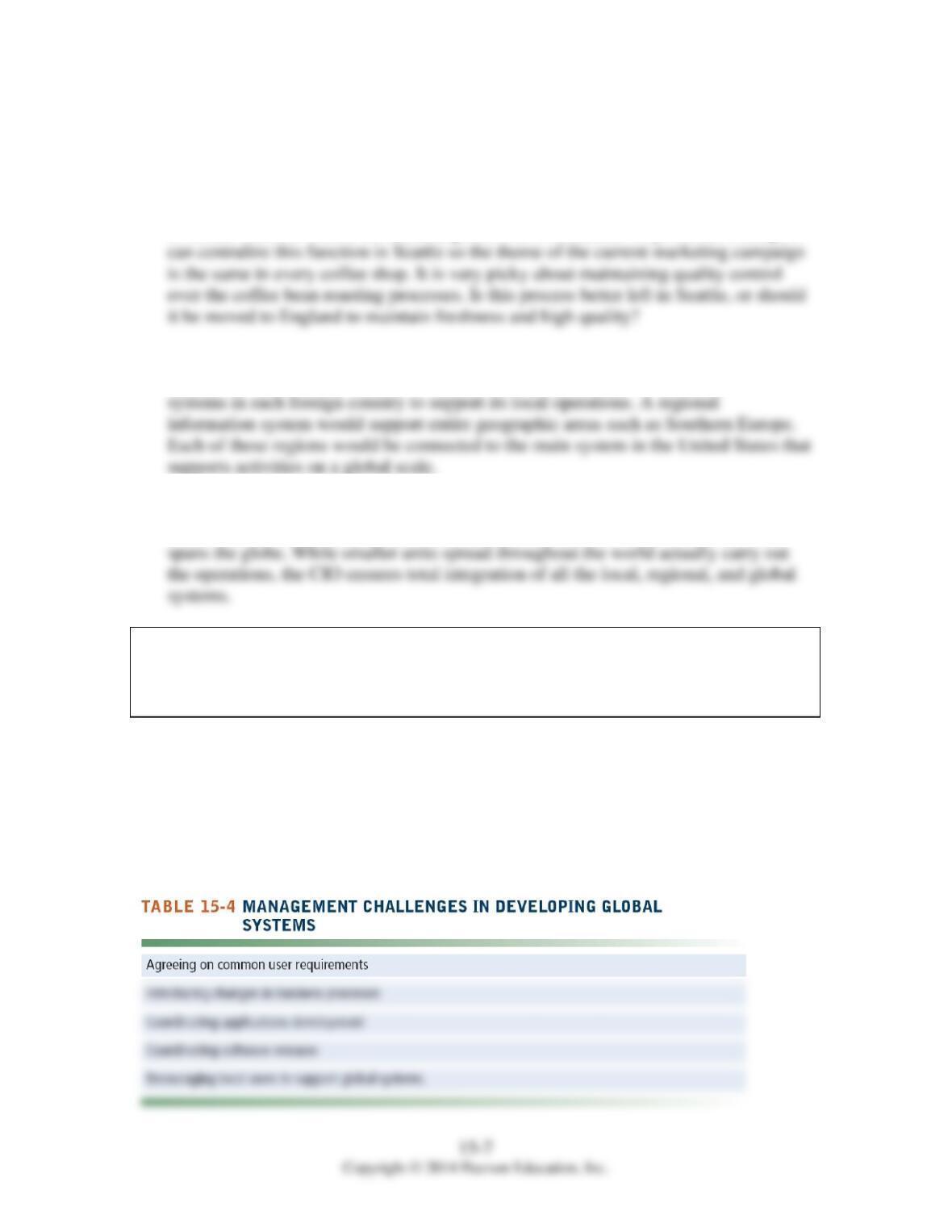
Take all the problems and challenges you can think of when developing a single
information system for a domestic operation (see the table) and then multiply it by tens or
hundreds. Now you understand the problem of developing a system to support a global
business operation.
Copyright © 2014 Pearson Education, Inc.
15-8
A Typical Scenario: Disorganization on a Global Scale
The text gives a wonderful scenario of challenges facing corporations wanting to develop
information systems to support global operations. Bring it a bit closer to home: You’re
part of a team of 12 students with an assignment due by the end of the month. You have
to develop a Web page to support three different presentations given in three different
Global Systems Strategy
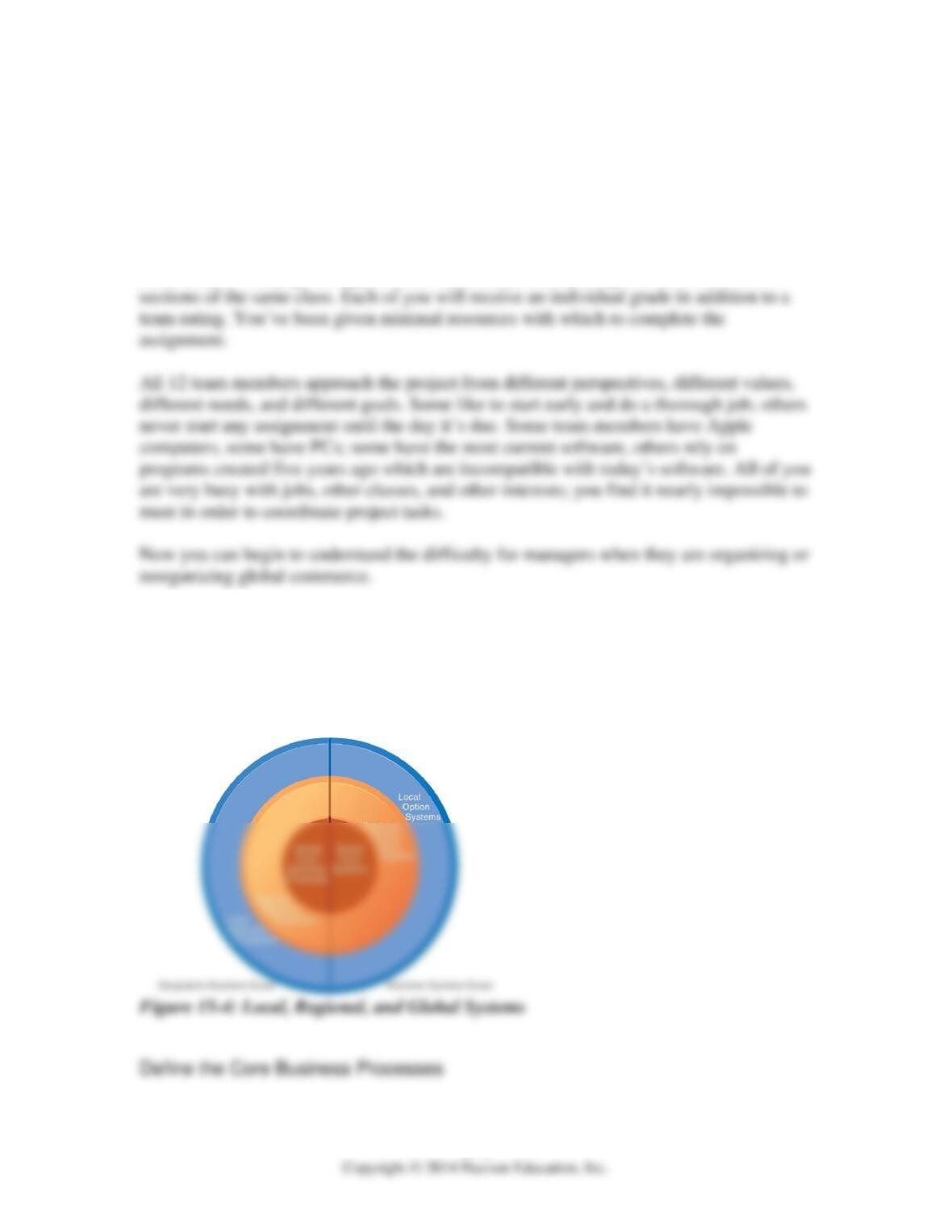
The figure below shows the connection between the core business processes and the core
systems. Only a few business processes use global core systems. Others are divided
among regional and local systems.
Identify the Core Systems to Coordinate Centrally
Once you’ve identified and analyzed each business process, you decide which systems
will be centralized and which to keep decentralized. Obviously, the systems should match
Choose an Approach: Incremental, Grand Design, Evolutionary
Don’t bite off more than you can chew. If you try to fulfill your development and
implementation plan all at once, combining every task into one huge project, you’re
setting yourself up for failure. It may indeed by cheaper to do it that way, but you have
lots of considerations other than cost. There are political, cultural, and historical biases to
Copyright © 2014 Pearson Education, Inc.
15-10
Make the Benefits Clear
You have to convince the organization’s managers that the impending changes will
benefit them in the long run. Get them behind your effort and use them to help you
develop and establish system changes. They need to understand how they can enhance
Copyright © 2014 Pearson Education, Inc.
15-11
The Management Solution: Implementation
Management’s biggest task is to manage the changes that must take place in a global
company. As we mentioned earlier, the changes are more difficult and complex because
of the added characteristics of politics, culture, and language. Here are some guidelines:
• Agree on common user requirements: Keep the list of core business processes short
and simple. It’s easier to implement the changes that way. Don’t lose sight of the
• Coordinate applications development: Communicate, communicate, communicate.
Tell people what’s going on; don’t surprise them about anything. Change is difficult
enough without people feeling like they’re getting blindsided. This is one area in
which an intranet may prove to be an invaluable tool to help you get the word out.
Interactive Session: Organizations: Hasbro Develops a Global Systems Strategy (see
page 607 of the text) discusses how one of the world’s leading toy and game makers
implemented an enterprise resource planning software throughout the company’s
global manufacturing plants and offices and created a standardized approach to
business processes.
Copyright © 2014 Pearson Education, Inc.
15-12
15.4 Technology Issues and Opportunities for Global Value
Chains
Advances in technology and the desire to seize new business opportunities presented by
the advances are what induce organizations to undertake the changes we’ve been
Computing Platforms and Systems Integration
Most global companies are a result of merging several units into one cohesive success
story. When the merger takes place, you can’t just buy all new hardware and software.
It’s too expensive for one thing, and it probably won’t make sense. You have to figure
out how you’re going to get all the different types of hardware to work together in one
Each region of the business is used to working according to its standards. For instance,
the German unit has been storing data according to its standards and definitions. The
Asian units have been using different standards and definitions to accomplish the same
task. The idea is to conform the data to one standard across all units so that they can be
shared efficiently and effectively.
Connectivity
Most Americans don’t think twice about the reliability of our telecommunications
systems. When you pick up the phone in Peoria you expect it to work and work well.
Copyright © 2014 Pearson Education, Inc.
15-13
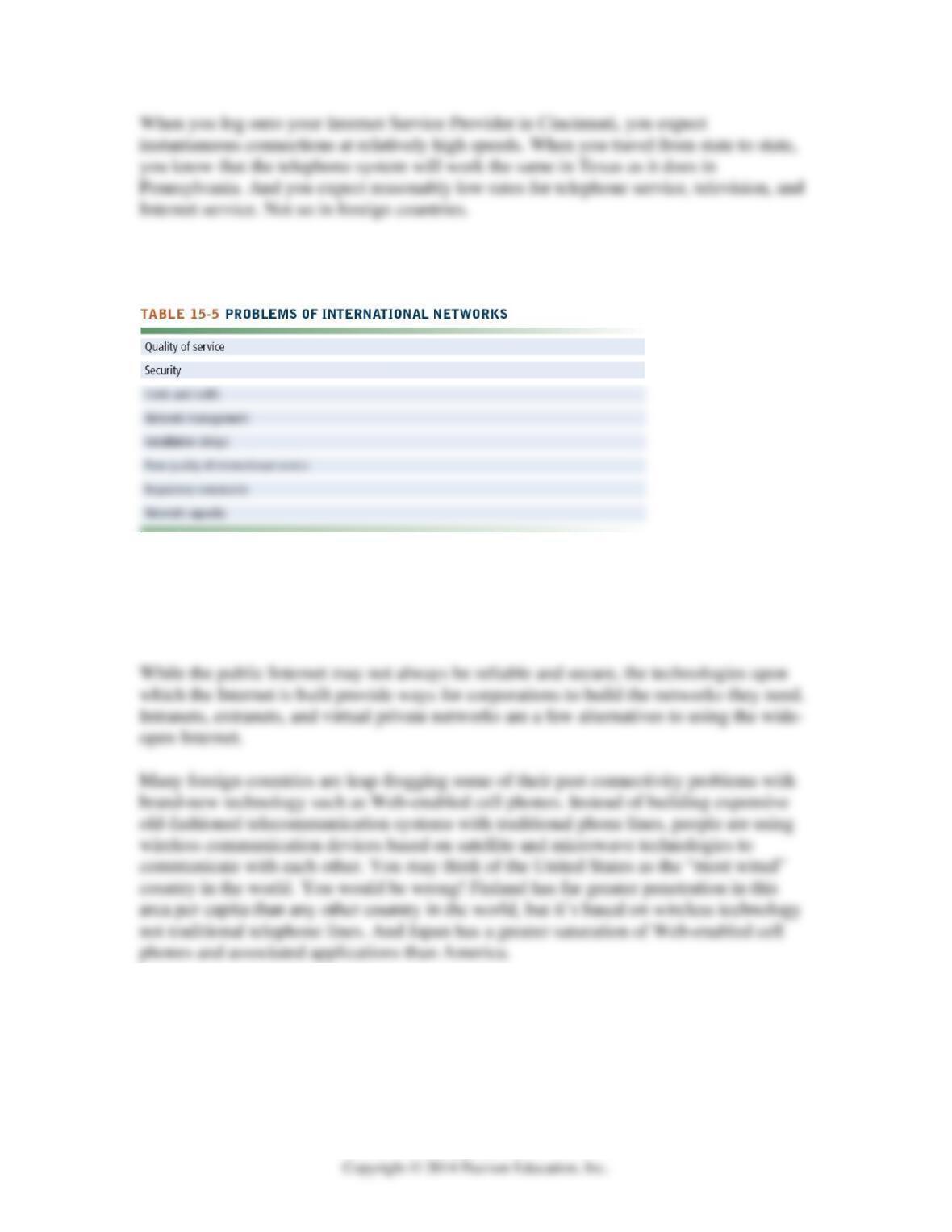
Table 15-5 shows some of the problems you’ll have to contend with when working in
other countries.
When you’re trying to establish global communication networks, you must work through
the maze of various laws, high-to-low levels of service reliability, different rate charges
and currency exchanges, and different companies and governments controlling the
telecommunication systems.
Software Localization
We mentioned before that different foreign units probably have divergent standards for
their information systems. Trying to merge different databases from several domestic
units is tough enough. Trying to merge databases from different countries can be quite
troublesome because of the added layer of politics, traditions, and languages.
Even though the English language is widely accepted in foreign business circles, and it
seems reasonable to build software programs based on that language, that decision will
Traditionally, companies have merged their transaction processing systems into one or a
few worldwide applications. Now they are looking to do the same with collaborative
workgroup software, and well they should. We mentioned at the beginning of this course
Interactive Session: Management: CombineNet ASAP Helps Primark Manage Its
Global Supply Chain (see page 613 of the text) discusses how the second largest
clothing retailer in the United Kingdom implemented a new Web-based supply
chain execution system that optimized all of its supply chain processes. Shipping
costs were greatly reduced while supplies were improved to all of its retail stores.
Bottom Line: Differences in hardware, software, and telecommunications
whole.
Discussion Questions
1. Discuss the cultural factors organizations must understand in order to do business on
a global scale.
2. Discuss the differences in the four global strategies organizations can use to organize
Copyright © 2014 Pearson Education, Inc.
15-15
Answers to Discussion Questions
1. Answers should reference religious laws and civil legal systems, collection of
2. Answers should reference the four global strategies: domestic exporters, multinational
3. Cooptation is the art of working with the opposition to convince them to be part of the
solution in designing and implementing the new system. Raw power should be
avoided as much as possible. Local units should help develop a short list of
4. Table 15-5 lists the connectivity problems global companies face: quality of service,
security, costs and tariffs, poor quality of international services, and regulatory
constraints, among others. The Internet and Internet technologies offer a standard