Chapter 15 – Interpersonal & Organizational Communication: Mastering the Exchange of Information
15-1
15
Chapter
Interpersonal & Organizational
Communication:
Mastering the Exchange of Information
Major Questions the Student Should Be Able to Answer 2
Mapping the Class: Chapter Outline 3
Overview of the Chapter 4
CHAPTER CONTENTS
Chapter 15 – Interpersonal & Organizational Communication: Mastering the Exchange of Information
15-2
15.1 The Communication Process: What It Is, How It Works
MAJOR QUESTION: What do I need to know about the communication process to be
an effective communicator?
15.4 Communication in the Information Age
MAJOR QUESTION: How do contemporary managers use information technology to
communicate more effectively?
MAJOR QUESTIONS THE STUDENT SHOULD BE ABLE TO ANSWER
Chapter 15 – Interpersonal & Organizational Communication: Mastering the Exchange of Information
15-3
15.1 The Communication Process: What It Is, How It Works
15.2 How Managers Fit into the Communication Process
15.3 Barriers to Communication
• Physical Barriers: Sound, Time, Space, & So On
15.4 Communication in the Information Age
• Digital Communication Technology & Workplace Behavior
• The “Always On” Generation
15.5 Improving Communication Effectiveness
• Being an Effective Listener
MAPPING THE CLASS: CHAPTER OUTLINE
Chapter 15 – Interpersonal & Organizational Communication: Mastering the Exchange of Information
15-4
15.1 The Communication Process: What It Is, How It Works
Communication is the transfer of information and understanding from one
15.2 How Managers Fit into the Communication Process
Formal communication channels follow the chain of command, which is either
15.3 Barriers to Communication
There are three barriers to communication: physical, semantic and personal.
15.4 Communication in the Information Age
There are three technologies that are altering the communication process:
15.5 Improving Communication Effectiveness
You can be a better listener by learning to concentrate on the content of a
message and being an active listener. Becoming a better reader also
OVERVIEW OF THE CHAPTER
Chapter 15 – Interpersonal & Organizational Communication: Mastering the Exchange of Information
15-5
The Manager’s Toolbox: Acing the Interview: Communicating Counts in Landing
a Job
Your purpose in a job interview is to prove you’re the one best candidate for the
Possible Topics for Discussion:
• How good are you at preparing for and rehearsing for an event (the job interview)
that is as important as the application you did to get into college? How good are
you at listening? How do you think you appear to other people in an important
interaction?
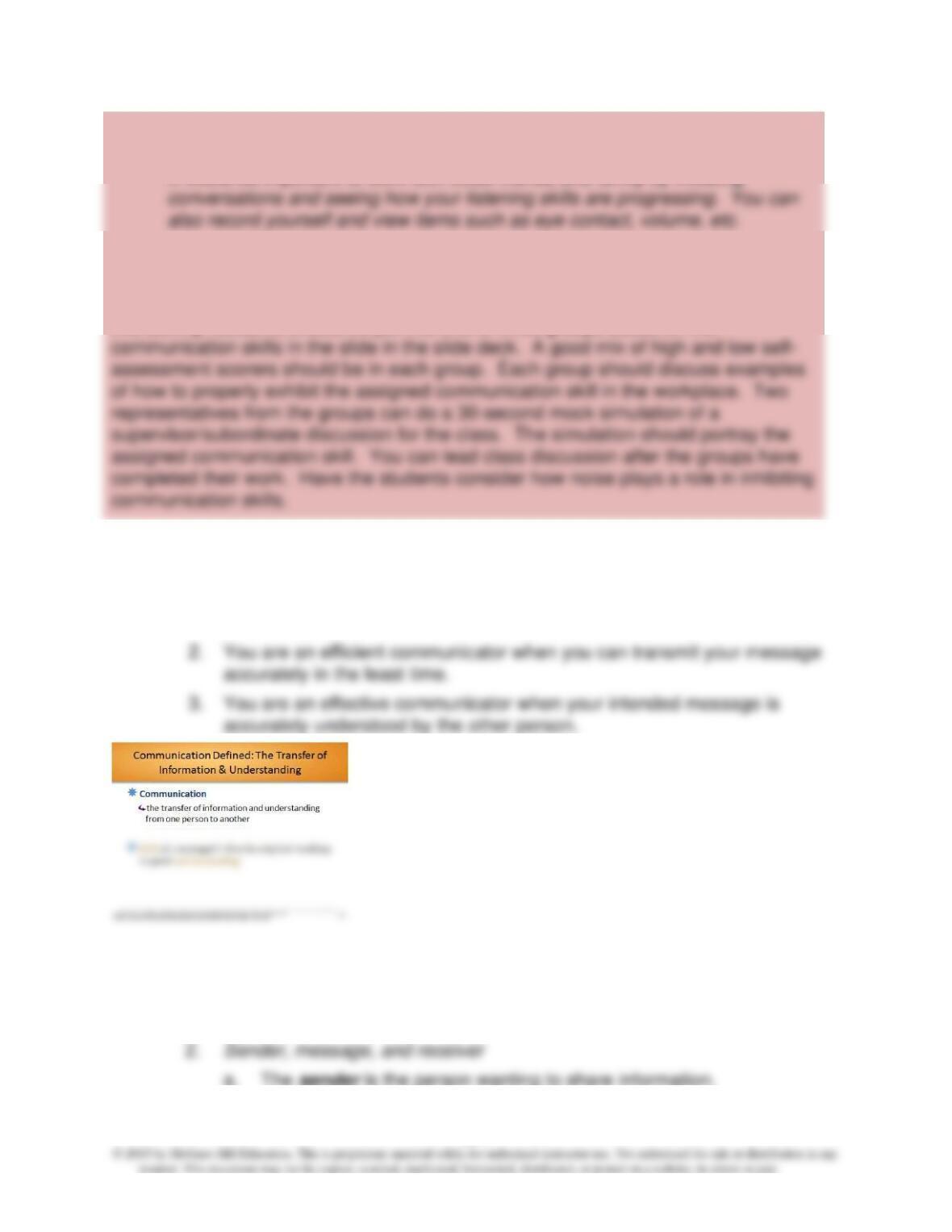
Section 15.1 discusses communication in general. Communication is the transfer of
information and understanding from one person to another. The process involves
sender, message, and receiver; encoding and decoding; the medium; feedback; and
dealing with noise, or interference.
CLASSROOM OUTLINE
15.1 The Communication Process: What It Is, How It Works
(pp. 478-481)
What do I need to know about the communication process to be an
effective communicator?
Chapter 15 – Interpersonal & Organizational Communication: Mastering the Exchange of Information
whispers a short sentence into the ear of the person next to him. The speaker is only
allowed to say the sentence once without repeating it. The receiver of the message
then needs to whisper the sentence into the ear of the person next to him. The process
continues until the message has been passed to all the people in the room. The last
listener then says out loud the message he received. With complex or not personally
Possible Topics for Discussion:
• Describe a time you experienced miscommunication, either in your personal life
or at work. What contributed to the miscommunication and how could it have
been avoided?
company (or a former one). How can managers reduce the impact of noise?
SELF-ASSESSMENT 15.1 (p. 478)
Assessing Your Communication Competence
Go to connect.mheducation.com and take Self-Assessment 15.1.
Student Questions:
1. Where do you stand in terms of communication skills? Would you like to
improve your skills? Based on reviewing the skills associated with your three
lowest scored items, what can you do to improve your communication skills?
Be specific.
Student responses will differ based on survey results. Some students may be
Chapter 15 – Interpersonal & Organizational Communication: Mastering the Exchange of Information
15-7
2. How might you get feedback on whether your communication skills improve
after implementing your ideas in Question 1 above?
It would be important to work with close friends and family by initiating
Additional Activities:
You can also consult the Connect Instructors Manual for the post-assessment activity
and corresponding PowerPoint slides used for this Self-Assessment in Connect. In
this activity, students should be put into one of three groups based on the
Major Idea Outline:
A. Communication is the transfer of information and understanding from one
person to another.
1. One study found that 81% of a manager’s time is spent communicating.
B. How the Communication Process Works
1. Communication is “a sender transmitting a message through media to a
receiver who responds.”
Chapter 15 – Interpersonal & Organizational Communication: Mastering the Exchange of Information
15-8
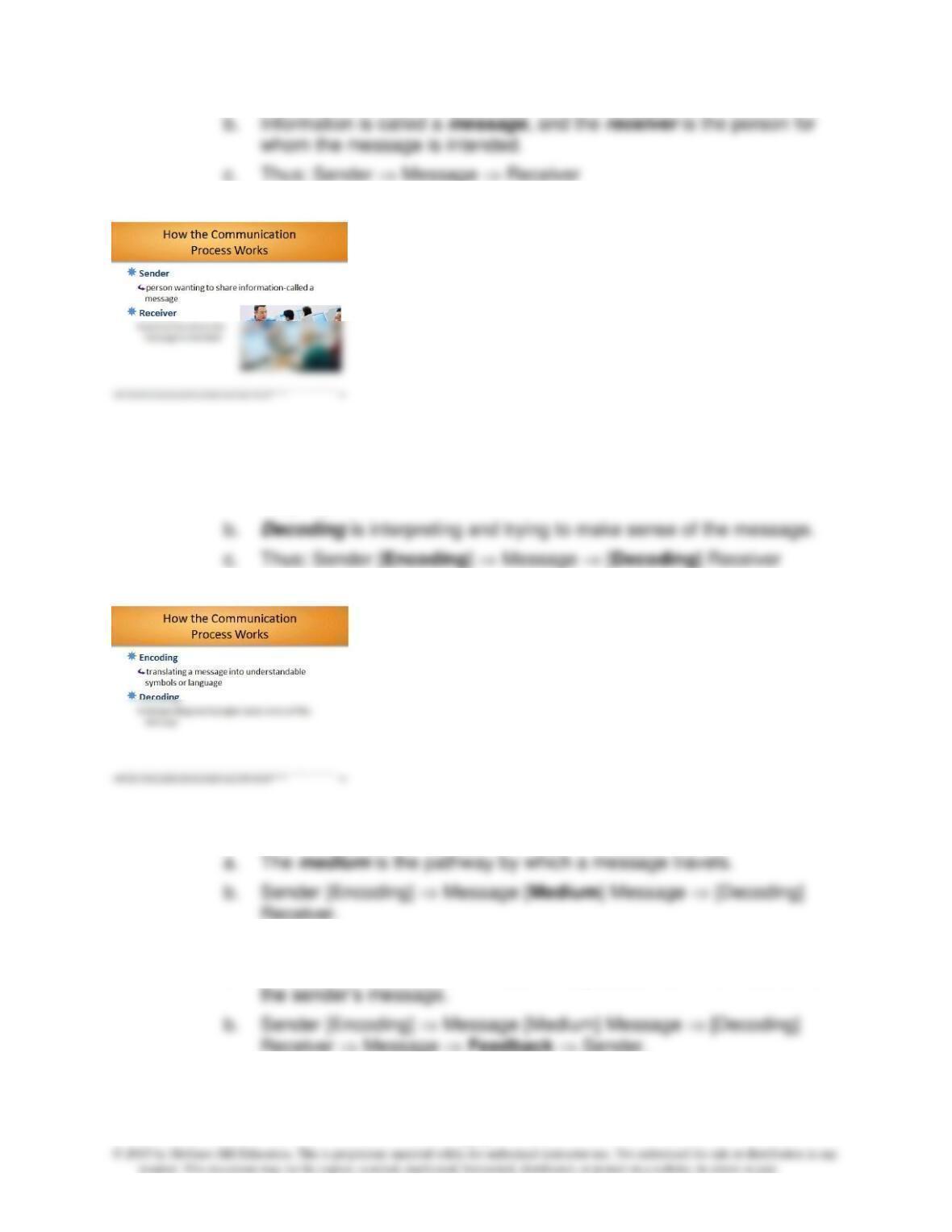
3. Encoding and decoding
a. Encoding is translating a message into understandable symbols or
language.
4. The medium
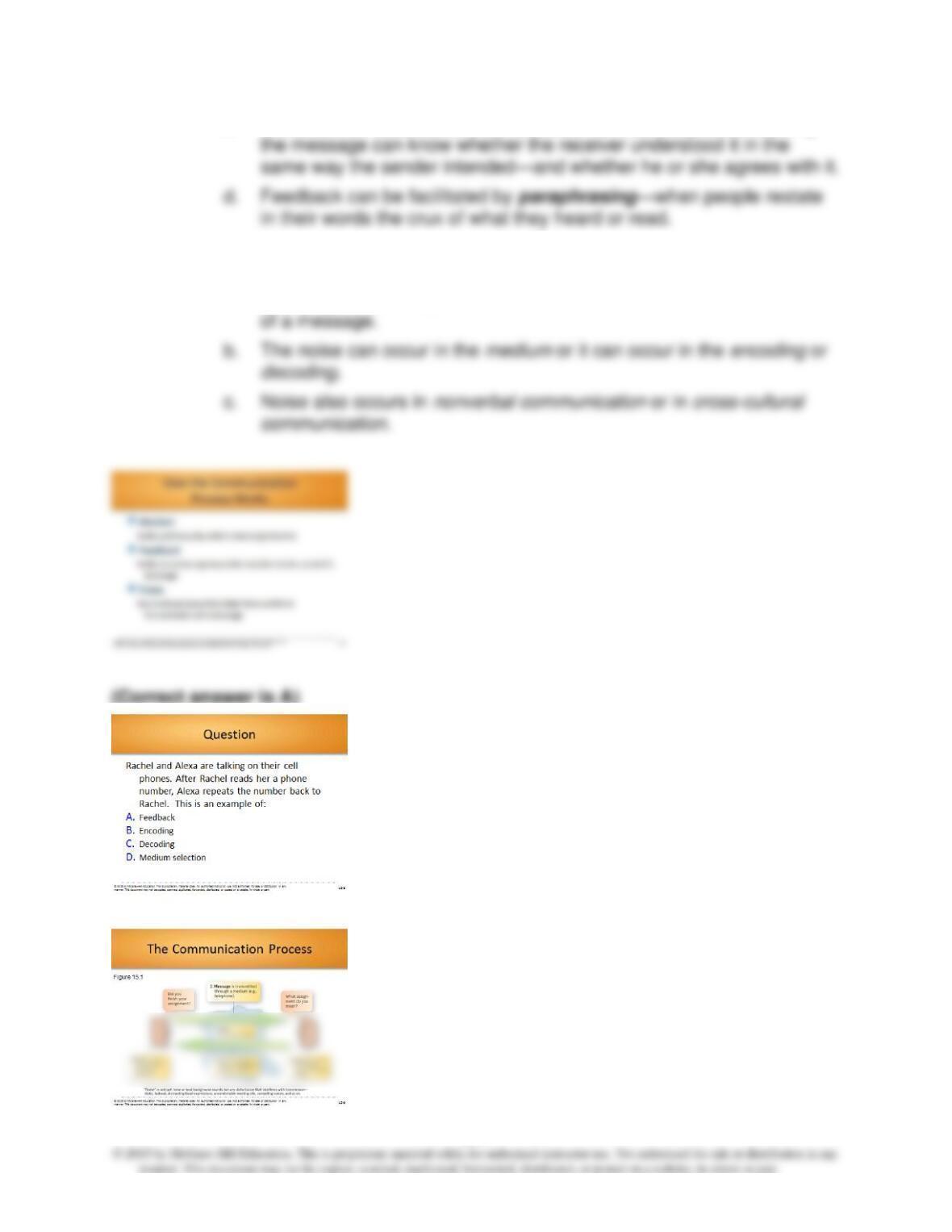
5. Feedback
a. Feedback occurs when the receiver expresses his or her reaction to
Chapter 15 – Interpersonal & Organizational Communication: Mastering the Exchange of Information
15-9
c. Feedback is essential in communication so that the person sending
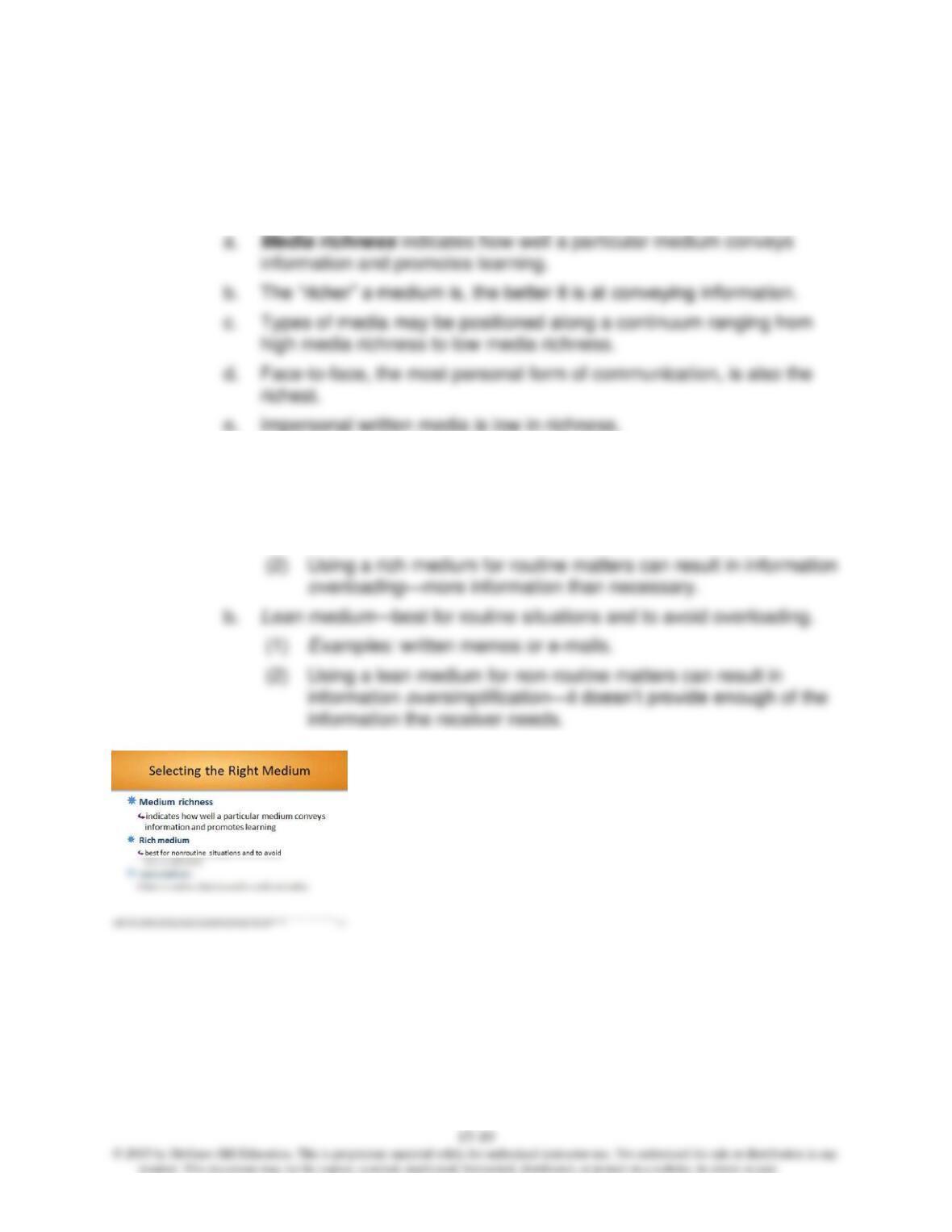
6. Noise
a. The communication process can be disrupted at several different
points by noise—any disturbance that interferes with the transmission
Chapter 15 – Interpersonal & Organizational Communication: Mastering the Exchange of Information
C. Selecting the Right Medium for Effective Communication
1. Managers need to use the right communication tool for the right condition.
2. Is a medium rich or lean in information?
3. Matching the appropriate medium to the appropriate situation
a. Rich medium—best for non-routine situations and to avoid
oversimplification.
(1) Example: a face-to-face meeting.
Chapter 15 – Interpersonal & Organizational Communication: Mastering the Exchange of Information
15–11
Section 15.2 discusses formal and informal communications channels. Formal
communication channels follow the chain of command, which is of three types: vertical,
horizontal, and external. Informal communication channels develop outside the
Possible Topics for Discussion:
• If you are engaged in upward communication with your boss, describe how you
might want to tailor your communication style depending on the gender of your
boss.
Major Idea Outline:
A. Formal Communication Channels: Up, Down, Sideways, and Outward
1. Formal communication channels follow the chain of command and are
recognized as official.
a. Formal communication is of three types: vertical (upward and
15.2 How Managers Fit into the Communication Process
(pp. 482-485)
How can I use the different channels and patterns of communication to
my advantage?
Chapter 15 – Interpersonal & Organizational Communication: Mastering the Exchange of Information
15–12
2. Vertical communication: Up and down the chain of command
a. Vertical communication is the flow of messages up and down the
hierarchy within the organization.
b. Downward communication flows from a higher level to a lower level
(or levels).
3. Horizontal communication: within and between work units
a. Horizontal communication flows within and between work units; its
main purpose is coordination.
b. Example: sharing information, coordinating tasks, solving problems,
resolving conflicts, and getting the support of your peers.
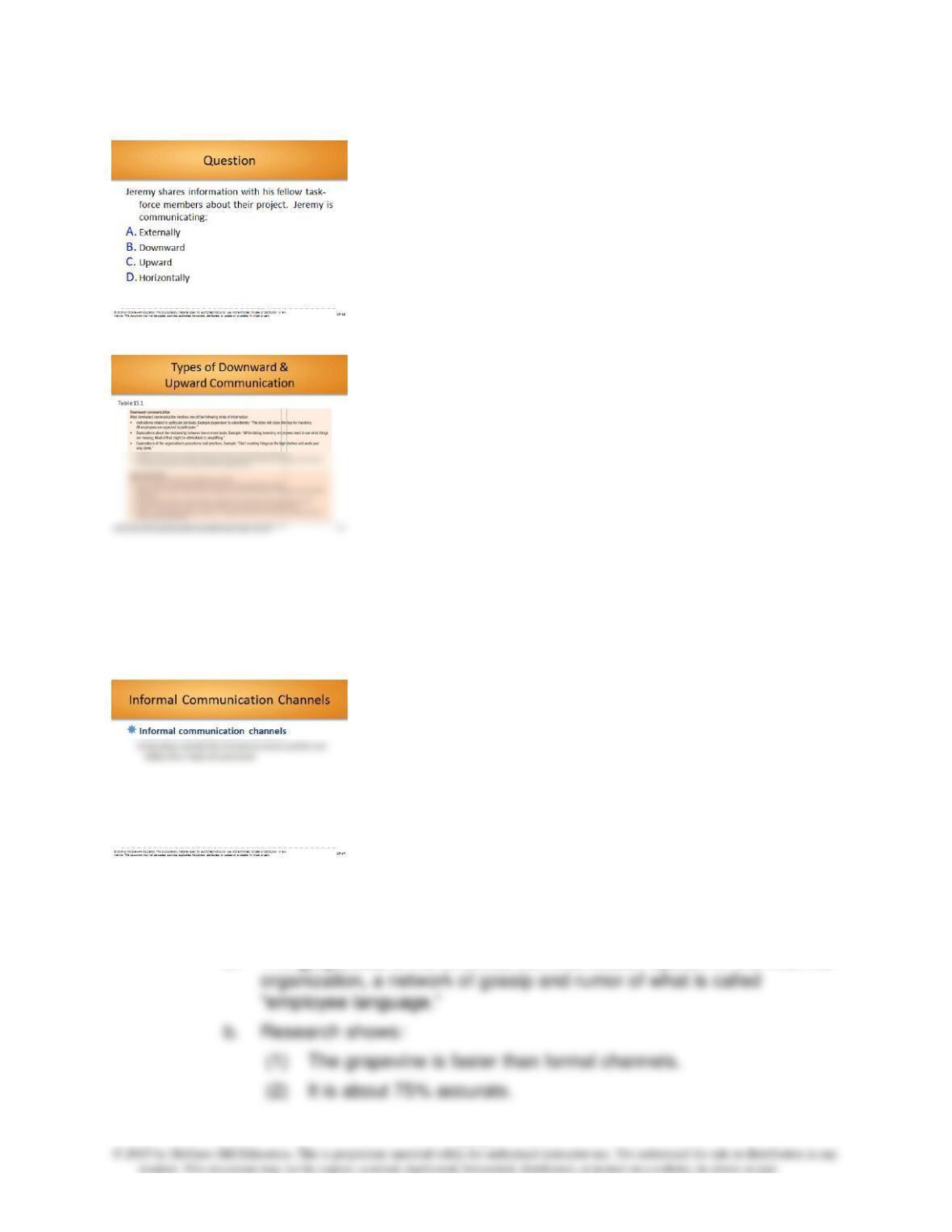
c. Barriers to horizontal communication:
Chapter 15 – Interpersonal & Organizational Communication: Mastering the Exchange of Information
15–13
(Correct answer is D)
B. Informal Communication Channels
1. Informal communication channels develop outside the formal structure
and do not follow the chain of command.
2. Two types of informal channels are the grapevine and management by
wandering around.
a. The grapevine is the unofficial communication system of the informal
Chapter 15 – Interpersonal & Organizational Communication: Mastering the Exchange of Information
15–14
(3) It is used by employees when they are insecure, threatened, or
faced with organizational change.
c. In management by wandering around (MBWA), a manager literally
wanders around his or her organization and talks with people across
all lines of authority.
Interactive Classroom Material:
PRACTICAL ACTION: How to Streamline Meetings (p. 485)
It is frustrating to be a victim of a poorly-run meeting. Problem meetings can result
from a lack of focus, nobody watching the clock, and no leader to keep the meeting
on track. Or managers may discourage conflict, which ignores crucial issues and
makes meetings boring. What can you do as a participant to make meetings run
better? Suggestions as a meeting participant include:
• Pull discussions back on point.
• Do follow-up.
YOUR CALL
What can you add to these suggestions to make meetings run better?
Students can provide innovative answers to this question. One idea is the
Chapter 15 – Interpersonal & Organizational Communication: Mastering the Exchange of Information
15–15
Additional Activities:
One way that you could build on this Practical Action is to have the students read the
Wall Street Journal article “Don’t be the Office Schedule-Wrecker.” This article and
corresponding video profile how individuals who are chronically late to meetings can
negatively impact organizations. Consider using the following discussion questions:
Discuss the problems that are created when someone is chronically late for
meetings.
Section 15.3 discusses three barriers to communication. Physical barriers include
sound, time, and space. Semantic barriers include unclear use of words and jargon.
Personal barriers include variations in communication skills, trustworthiness and
credibility, stereotypes and prejudices, and faulty listening skills. Misunderstandings
can also arise from nonverbal communication and gender-related communication
differences.
One way that you could begin your coverage of these topics is to have the students
read the Harvard Business Review article “Humor or Harassment?” This article is a
15.3 Barriers to Communication (pp. 486-493)
What are the important barriers I need to be aware of, so I can improve
my communication skills?
Chapter 15 – Interpersonal & Organizational Communication: Mastering the Exchange of Information
15–16
Possible Topics for Discussion:
• Describe examples of miscommunication that can occur with nonverbal
communication.
• Assume you are communicating with someone who as an oversized ego. What
Major Idea Outline:
A. A communication barrier is anything interfering with accurate communication
between people.
1. Some barriers are thought of as happening within the communication
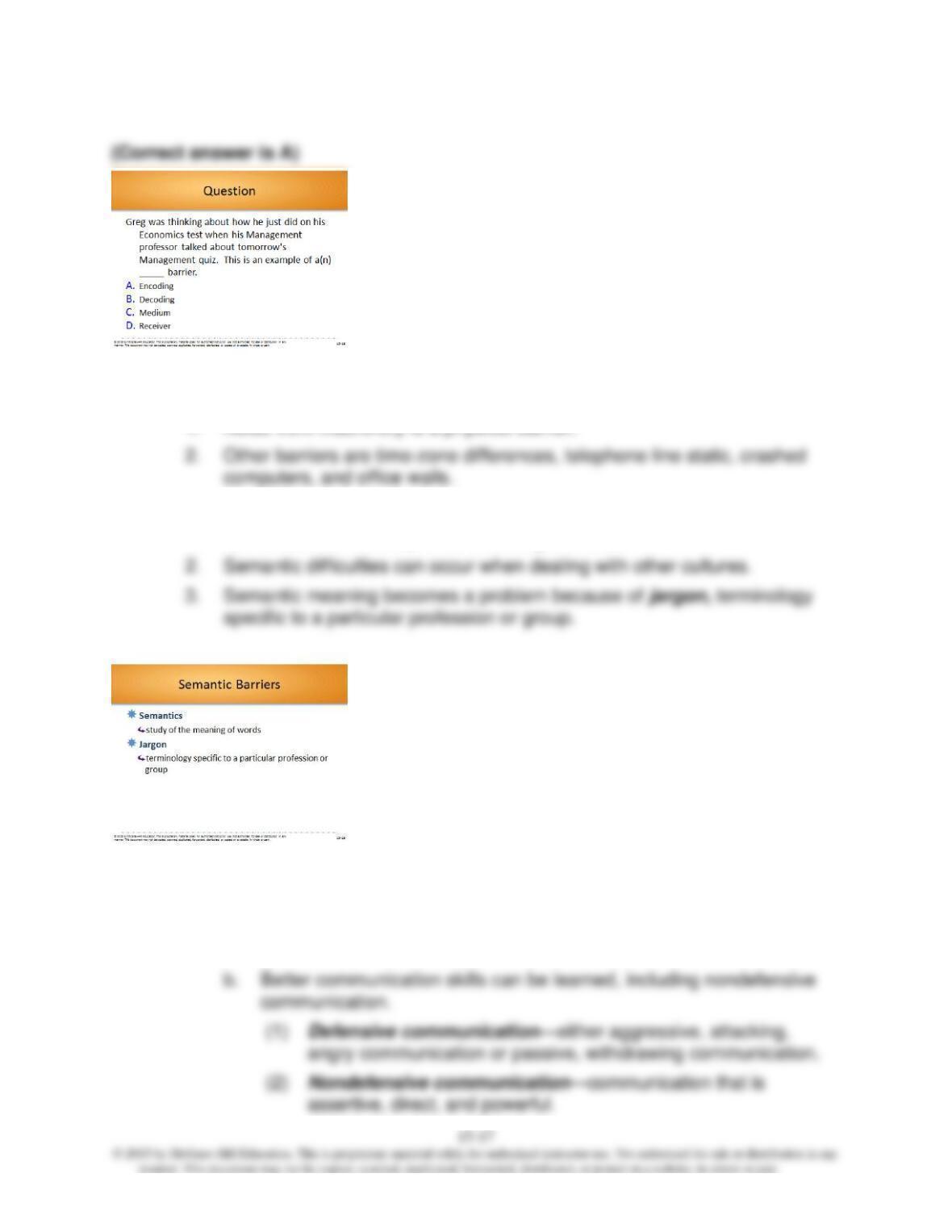
Chapter 15 – Interpersonal & Organizational Communication: Mastering the Exchange of Information
B. Physical Barriers: Sound, Time, Space, & So On
1. Noise from machinery is a physical barrier.
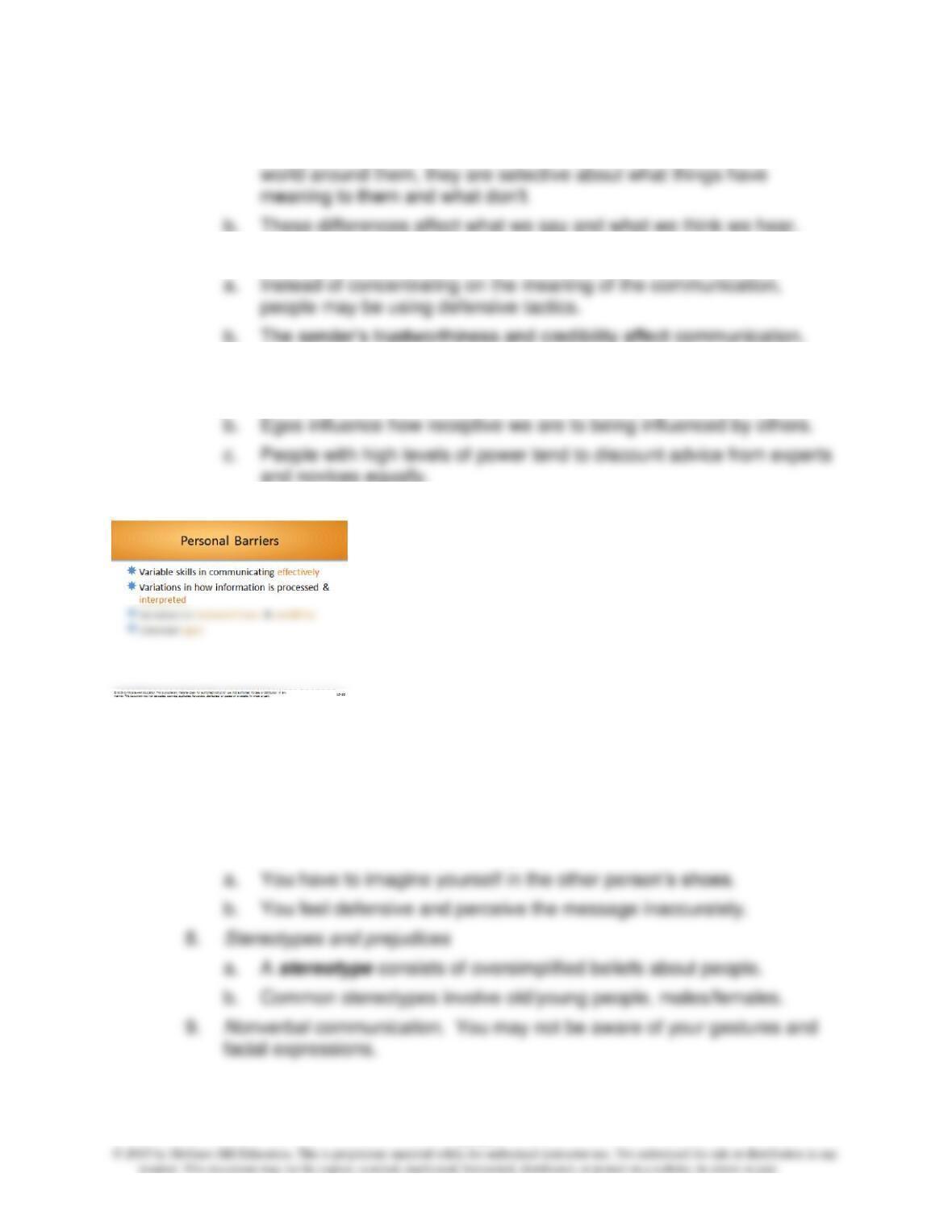
C. Semantic Barriers: When Words Matter
1. Semantics is the study of the meaning of words.
D. Personal Barriers: Individual Attributes That Hinder Communication
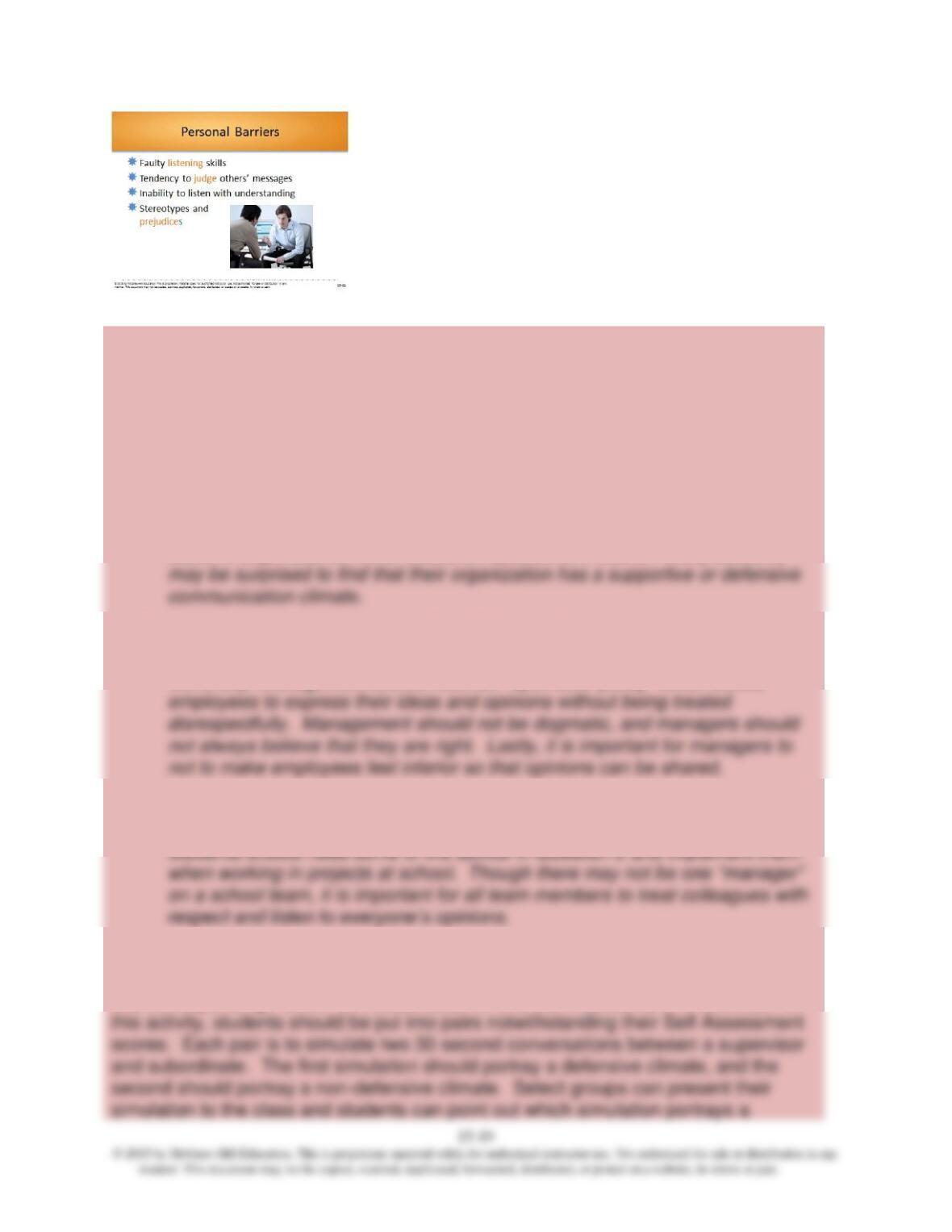
1. Variable skills in communicating effectively
a. Some people are simply better communicators than others.
Chapter 15 – Interpersonal & Organizational Communication: Mastering the Exchange of Information
15–18
2. Variations in how information is processed and interpreted
a. Because people use different frames of reference to interpret the
3. Variations in trustworthiness and credibility
4. Oversized egos
a. Egos—pride, self-esteem, even arrogance—are another barrier.
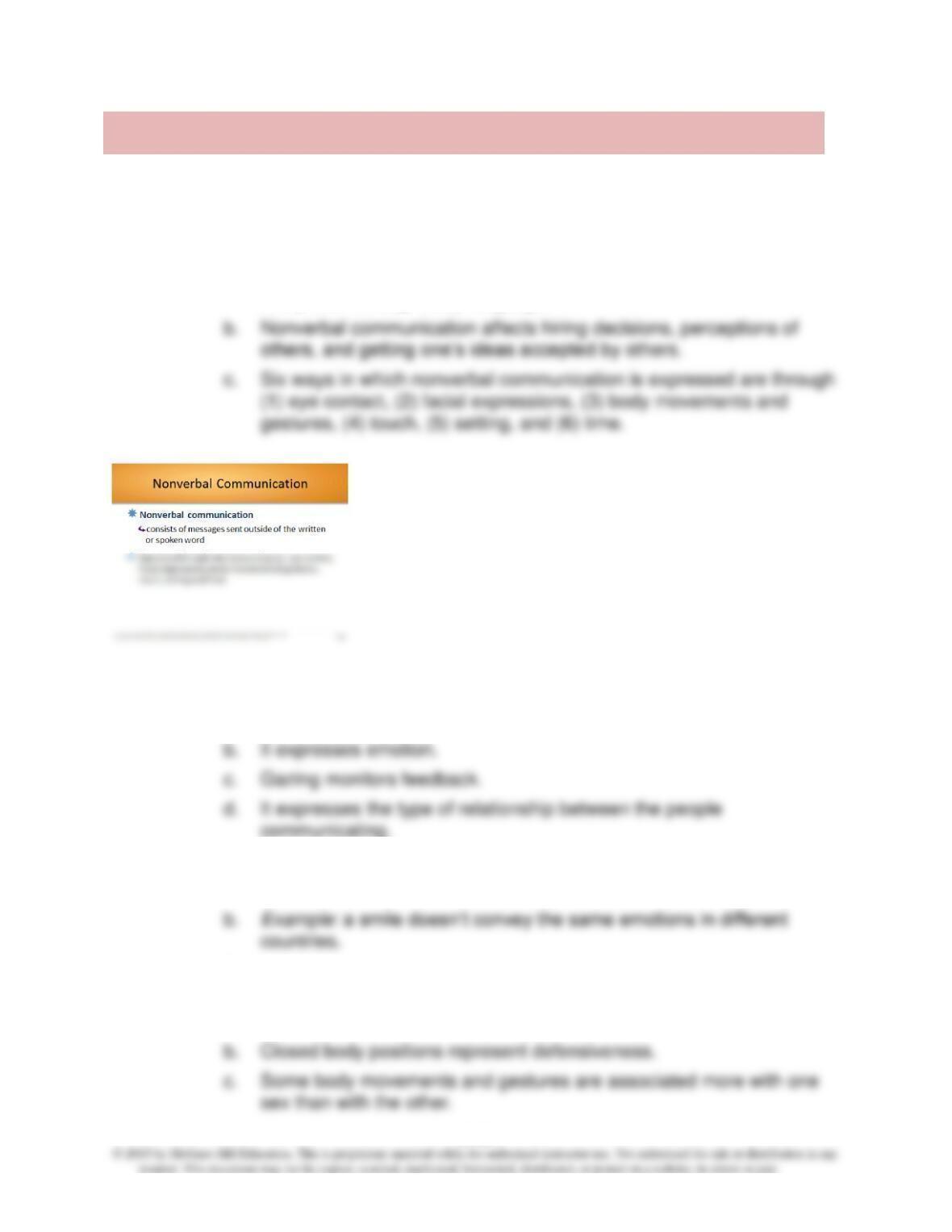
5. Faulty listening skills. Another barrier is being too ready to talk about
oneself or monopolizing the conversation.
6. Tendency to judge others’ messages. We have a natural tendency to
judge others’ statements from our own point of view.
7. Inability to listen with understanding
Chapter 15 – Interpersonal & Organizational Communication: Mastering the Exchange of Information
SELF-ASSESSMENT 15.2 (p. 488)
Does Your Organization Have a Supportive or Defensive
Communication Climate?
Go to connect.mheducation.com and take Self-Assessment 15.2.
Student Questions:
1. Where does the work environment stand in terms of having a supportive or
defensive communication climate?
Student responses will differ based on assessment results. Many students
2. Based on your survey scores, what advice would you give to management in
order to promote a more supportive communication climate? Be specific.
Generally, management should have an “open door policy” which allows
3. Considering your project teams at school, what can you do to create a more
supportive communication climate in these teams?
Additional Activities:
You can also consult the Connect Instructors Manual for the post-assessment activity
and corresponding PowerPoint slides used for this Self-Assessment in Connect. In
Chapter 15 – Interpersonal & Organizational Communication: Mastering the Exchange of Information
15–20
defensive climate and which portrays a non-defensive climate.
E. Nonverbal Communication
1. Nonverbal communication consists of messages sent outside of the
written or spoken word.
a. Researchers estimate that between 65% and 95% of conversation is
interpreted through body language.
2. Eye contact serves four functions in communication:
a. It signals the beginning and end of a conversation.
3. Facial expressions
a. Interpretations of facial expressions don’t apply across all cultures.
4. Body movements and gestures
a. Open body positions express openness, warmth, and availability for
communication.