CHAPTER FIFTEEN
ASSESSMENT AND EVALUATION
KEY CONCEPTS
Program evaluation is a systematic process of clearly articulating the services and
desired outcomes of an intervention or program using many methods of data collection,
from direct observation to interviews and surveys.
Formative
needed to improve performance.
Summative evaluation occurs after the fact and spells out accomplishments.
Accountability refers to expectations of funding bodies and the general public that early
education programs take responsibility for producing positive outcomes for children,
most often defined as success in school.
To determine what aspects of program quality are related to child outcomes, researchers
have traditionally distinguished between structural variables (elements such as class
size, available materials, and teacher qualifications) and process variables (teaching
strategies, quality of adult-child interactions).
Controlling requires the manager to communicate standards, measure performance
against them and either correct deviations or modify standards that prove unrealistic or
inappropriate.
Evaluation of program quality
self-evaluation, children, teachers and staff, families, the community and professional
organizations all contribute helpful information.
ACTIVITIES AND PROJECTS FOR STUDENTS
1.
the form fair? How would you change it? Is any item a surprise to a manager?
2. Ask students to evaluate the performance of a manager they have known using the form
3. Invite a panel of parents with children in various child care centers, ideally representing a
diverse cross-section of families in your community. Have the class interview the parents
4. If you have access to a child development program that uses database software to record
and classify observations of the children (e.g., the Child Observation RecordTM of the
5. Assign a class member to contact your state licensing agency and find out when your
rules with the NAEYC accreditation standards, are there any rules that you feel should be
changed? Find out what procedures are available for child advocates to make suggestions
6. Divide the class into three groups and have each group review and respond to one of the
following scenarios, then report their conclusions to the class:
a. Manager X stepped out of the office to watch children playing on the playground.
No teacher or adult could be seen among the children. On checking more closely,
the manager found the adults conversing indoors near the coat rack. Not
standards. What should the manager do?
b. The fire inspector refused to issue an approval rating to the Rainbow Child
Development Center until the hot water heater closet was properly lined with fire–
retardant material. What should the manager do? What standard applies?
c. For 2 days in a row, the cook served apples and grapefruit juice fo
mid-morning snack instead of items from two food groups as stated on the menu
and as required by state nutrition guidelines. What should be done? What
standard applies?
51
WEBSITES
52
Handout 15.1 Staff evaluation of program and manager
Please respond to the following questions as carefully and objectively as possible. Return the
survey in the envelope provided. Do not put your name on it. Your answers will remain
completely confidential.
Agree Disagree Not Sure
I understand the mission and goals of Rainbow Child
Development Center.
o o o
Comment
I have a clear understanding of my job duties and expectations
for my performance.
o o o
Comment
My work is evaluated fairly and I receive timely feedback about
the quality of my performance.
o o o
Comment
53
I am given clear explanations and an opportunity to correct any
deficiencies.
o o o
Comment
I am encouraged to pursue professional development and have
opportunities for advancement.
o o o
Comment
The manager respects confidentiality and models professional
behavior in dealings with employees.
o o o
Comment
The manager facilitates positive relationships between staff and
families.
o o o
Comment
54
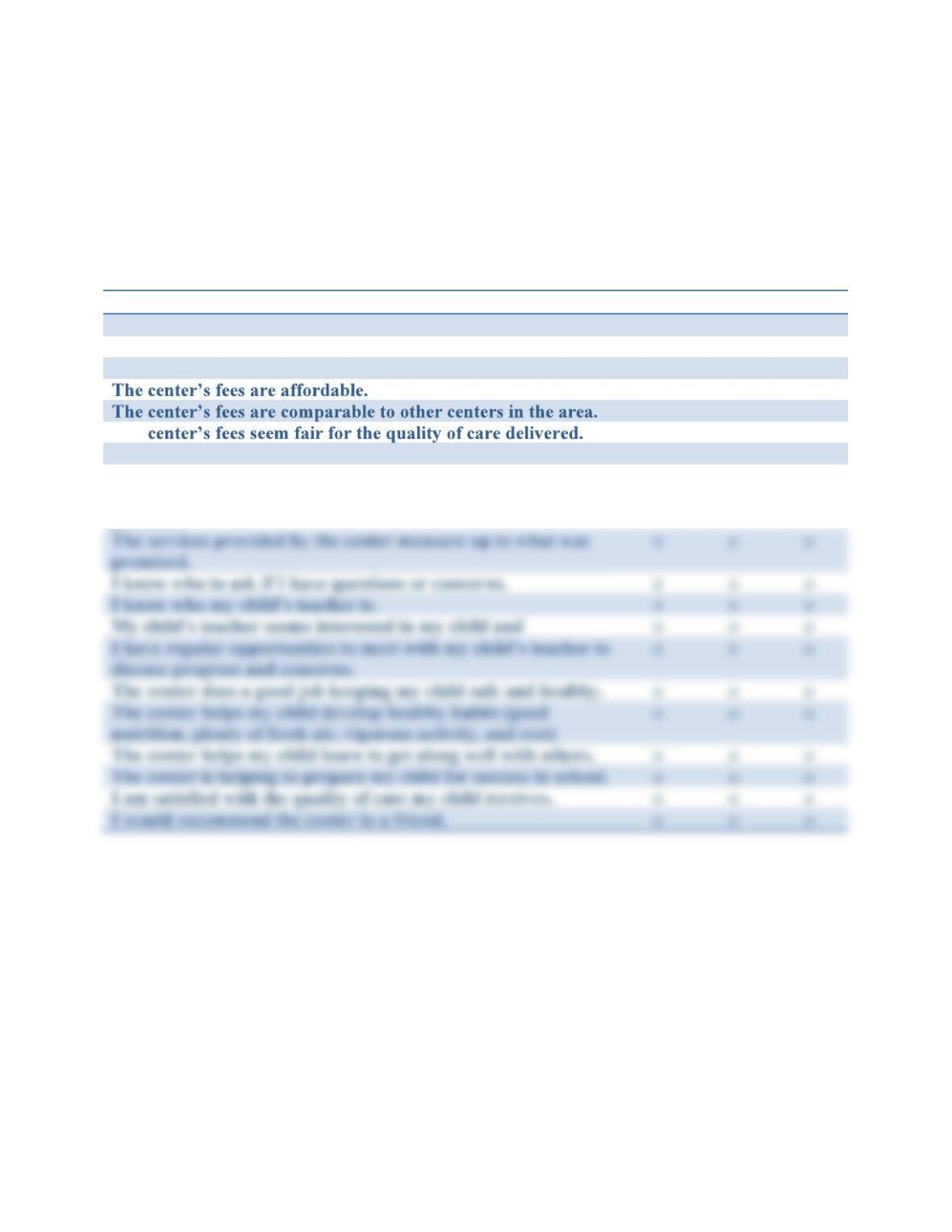
Handout 15.2 Family evaluation of program
Dear Families,
We want ____________________ Center to be the best it can be and we need your help to make
it so. Please let us know how we are doing in each of the following areas by checking the
appropriate rating. You may add comments on the back and drop the completed form in the box
inside the main entrance. Thanks for your participation!
Agree Disagree
Not Sure
My child enjoys coming to the center. o o o
The center is clean and well maintained. o o o
The outdoor play area is inviting, safe, and well-maintained. o o o
o o o
o o o
The o o o
Staff are friendly and courteous. o o o
I received enough information, in person and in writing, to
know what to expect regarding the centers policies and
practices.
o o o