Hitt 13e Case Teaching Notes
Case 15: Sturm, Ruger & Co. and the U.S. Firearms Industry
Case Synopsis
Bill Ruger, one of the co-founders of Sturm, Ruger & Company, had a lifelong passion for
firearms and an entrepreneurial spirit. His first attempt at starting his own company failed, but
with financial backing from Alexander Sturm, he was able to start a second company in 1949.
Always a savvy money manager, Ruger was both frugal and innovative. He quickly realized that
his company couldn’t compete against known brands like Smith & Wesson, Remington, and
Colt, so he pursued a low-cost strategy, which required technical design innovations that saved
money in manufacturing. In the end, Ruger created less expensive but extremely well-made
rifles, pistols, and revolvers and achieved the market position the firm still holds today. Ruger
was also a firm believer in gun safety and created ads and other content that educated gun
owners on the proper use of firearms.
The firearms manufacturing and distribution industry is closely regulated through legislation.
Most federal regulations are implemented through the Bureau of Alcohol, Tobacco, Firearms,
and Explosives (ATF), although all states have equally stringent regulations. Like all firearms
manufacturers, Sturm, Ruger must comply with these regulations when dealing with
distributors and dealers, which all require licenses to operate in this heavily monitored industry.
Related to political and legal influences, the National Rifle Association (NRA) is an extremely
Learning Objectives
• Define and describe the general environment and the industry environment. (Chapter 2)
• Name and describe the general environment’s seven segments. (Chapter 2)
• Discuss the relationship between customers and business-level strategies in terms of who,
what, and how. (Chapter 4)
• Describe business models and explain their relationship with business-level strategies.
(Chapter 4)
12)
• Describe the importance of strategic leaders in managing the firm’s resources. (Chapter 12)
• Describe what strategic leaders can do to establish and emphasize the need for everyone to
demonstrate ethical practices in their firms. (Chapter 12)
Strategic Issues and Suggested Discussion Questions & Answers
1. Use the seven segments of the external environment to identify threats and
opportunities in Sturm, Ruger & Company’s external environment. Which of these
threats might cause you the greatest concern if you were a shareholder?
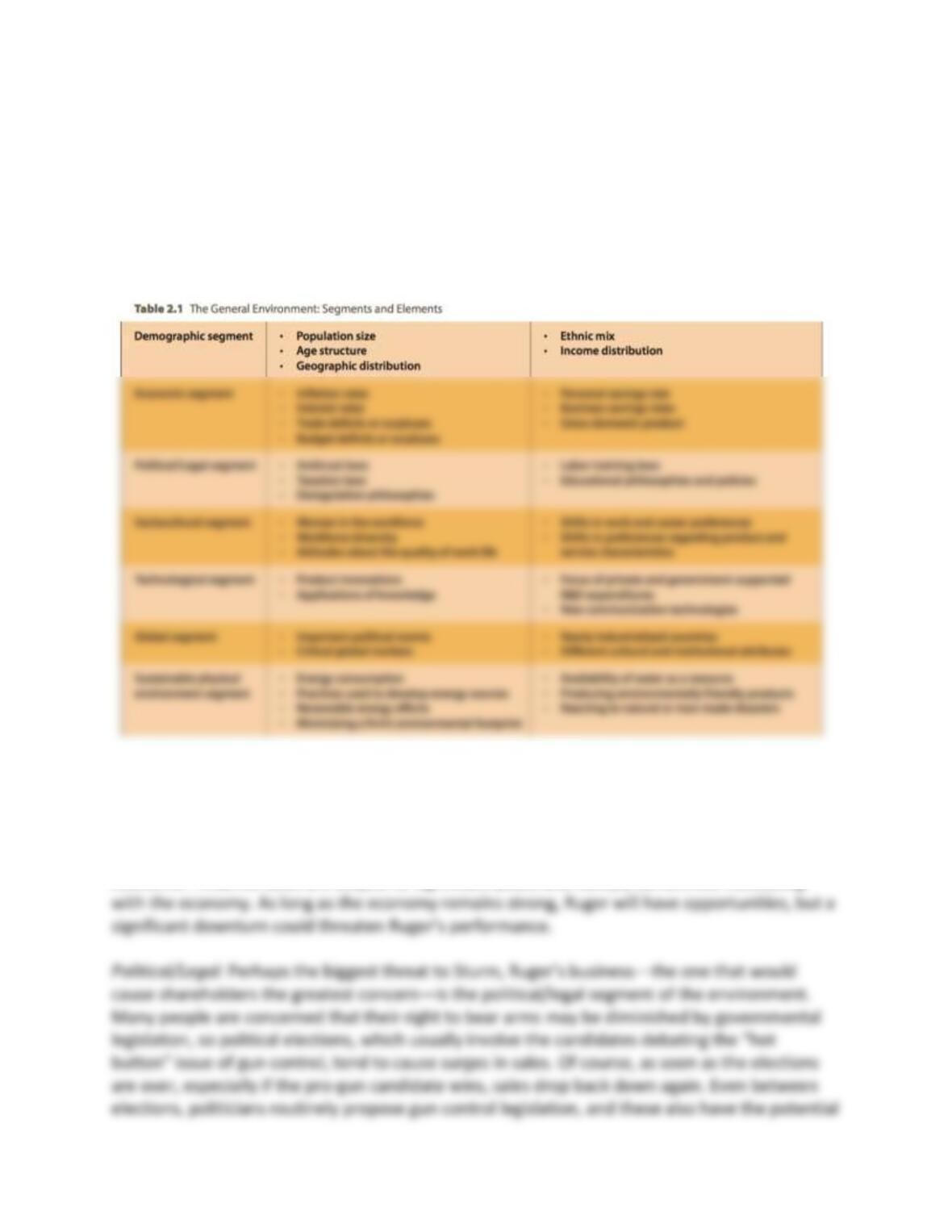
Students should work through each segment, one at a time (Table 2.1).
Demographic: Firearms—both rifles and handguns—have broad appeal for men and women in
all adult age ranges in all parts of the country. The fact that the U.S. population is growing
represents an opportunity for Sturm, Ruger.
Economic: Firearms sales are subject to significant peaks and valleys, sometimes fluctuating
to cause disruptions in sales. The NRA is a powerful force in rallying its members to fight any
proposed legislation, and so far they have succeeded in defeating new rulings. In some ways,
this is helpful to firearms manufacturers, that have yet to be challenged with new product
requirements and/or stricter sales policies. However, given the NRA’s power over the firms
Technological: Firearms enthusiasts have demonstrated a strong desire for new models, which
is why new products (models that have been in the marketplace for no more than two years)
account for about 30% of sales. Innovations from technological developments in both the
production of firearms and in the products themselves, such as advancements in “smart gun”
technology that prevents weapons from being fired by anyone other than an authorized user,
could create opportunities for Ruger.
2. When launching his company, which business-level strategy did Bill Ruger adopt, and
why? What are some of the risks the firm could face by continuing to use this strategy?
After launching his firearms manufacturing company in 1949, Bill Ruger realized he was
competing against rivals with legendary brand names—Smith & Wesson, Remington, and Colt.
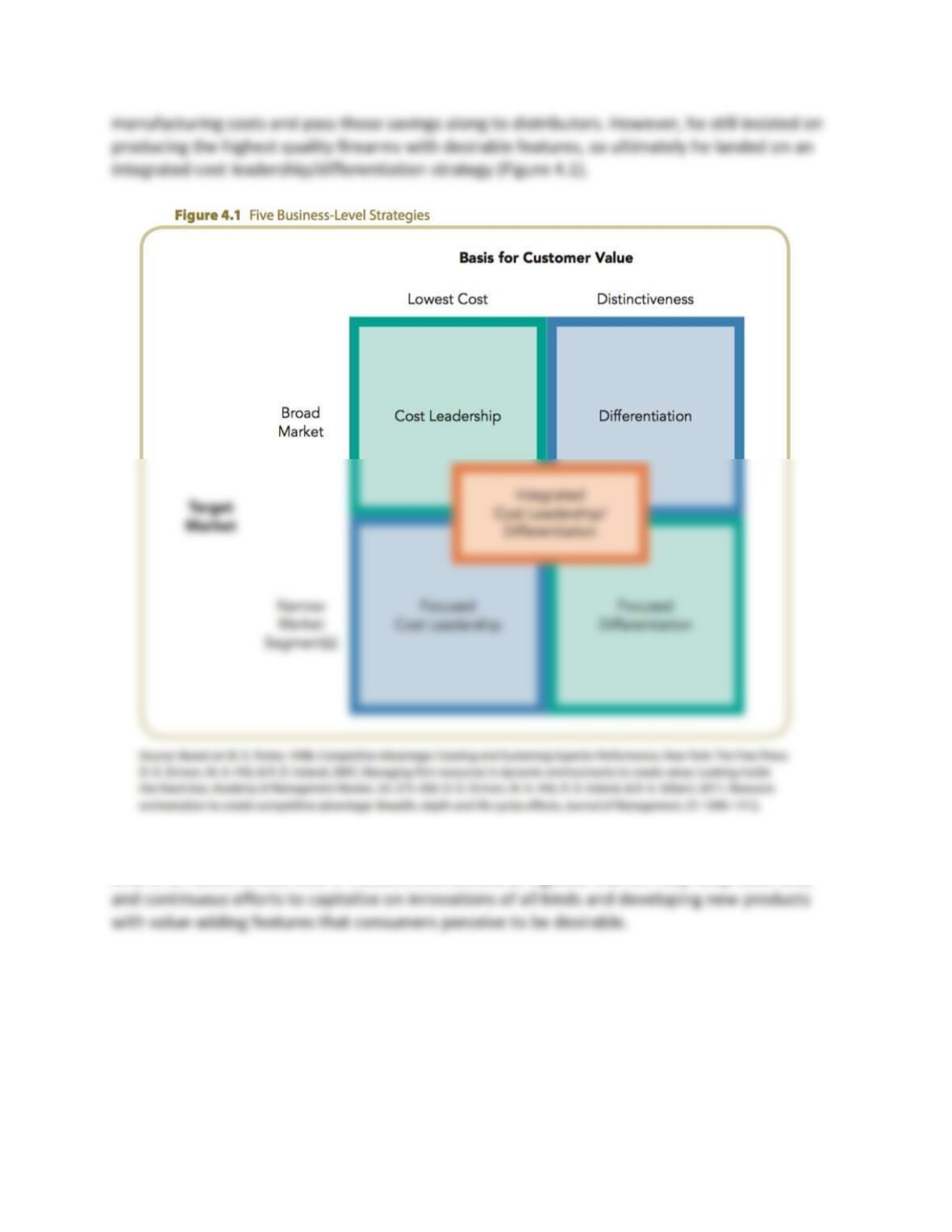
To continue to use this strategy effectively, Ruger will need to focus on two things: Ongoing
efforts to realize efficiencies in inbound and outbound logistics that will help keep costs low,
3. Compare and contrast Sturm, Ruger & Company with its two biggest rivals, American
Outdoor Brands Corporation (AOBC) and Remington Outdoor Company. After
conducting your analysis, what strategic recommendations can you make for Ruger?
Ruger and AOBC are very similar organizations, selling a similar volume of the same types of
weapons, specifically rifles, pistols, and revolvers. While 95% of AOBC’s sales come from its
firearms division, it also has a much smaller division that produces outdoor products,
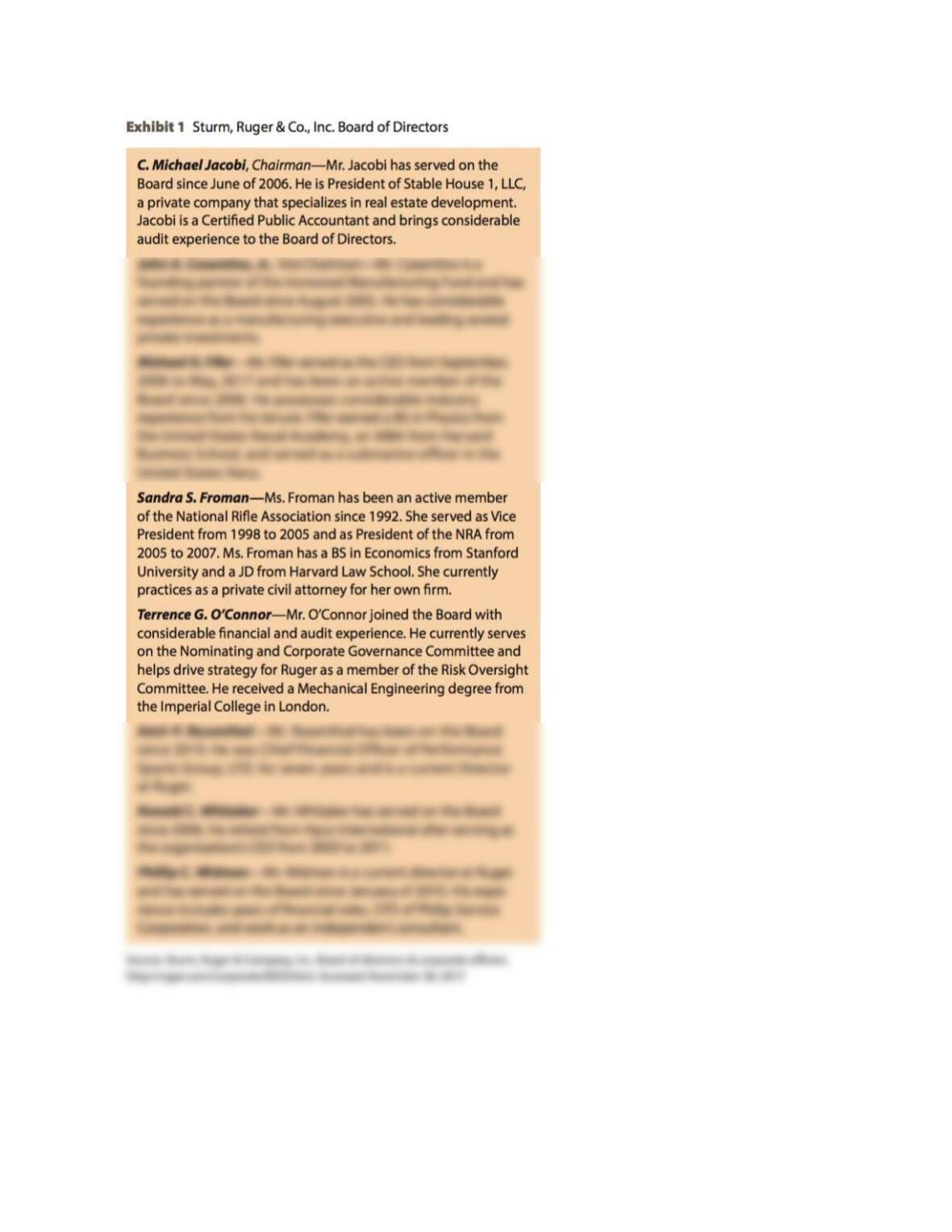
4. Review the bios of Sturm, Ruger & Company’s board of directors found in Exhibit 1 of
the case. Describe the general makeup of the board. Why do you think these people
were chosen as board members?
Ruger’s eight-person board is currently made up of primarily outsiders with only one related
outsider, former CEO Michael O. Fifer. Since none of the current members are active, top-level
managers, there are no insiders on the board.

Additional Resources
Reuters’s company profile gives in-depth background on Sturm, Ruger & Company’s current
financials, leadership, valuation, news, and more:
In May 2019, The Motley Fool explained how Sturm, Ruger’s innovative products were seeing it
through an extended slump in the marketplace:
Sturm, Ruger & Company created this self-promotional video to show how guns are made and
share the organization’s culture: