
Chapter 14 – Power, Influence, & Leadership: From Becoming a Manager to Becoming a Leader
14–21
2. Look at the items for the two lowest scored items for initiating structure and
consideration and then identify how you can increase the extent to which you
display both types of leadership.
Generally, for initiating structure, individuals are very organized and
3. When would it be most important to display initiating structure and
consideration? Explain your rationale.
Initiating structure works well for essential control systems such as accounting
Additional Activities:
You can also consult the Connect Instructors Manual for the post-assessment activity
and corresponding PowerPoint slides used for this Self-Assessment in Connect. In
5. Empowering leadership represents the extent to which a leader creates
perceptions of psychological empowerment in others.
a. Psychological empowerment is employees’ belief that they have
control over their work.
b. Employee psychological empowerment requires four kinds of
behaviors:

Chapter 14 – Power, Influence, & Leadership: From Becoming a Manager to Becoming a Leader
14–22
c. One technique used to empower employees is participative
management (PM), the process of involving employees in setting
Interactive Classroom Material:
PRACTICAL ACTION: Participative Management: Empowering Employees to
Handle Decision Making (p. 454)
Participatory management (PM) is predicted to increase motivation, innovation, and
performance because it helps employees fulfill three basic needs: autonomy,
Additional Activities:
One way that you could build on this Practical Action is to have the students watch

Chapter 14 – Power, Influence, & Leadership: From Becoming a Manager to Becoming a Leader
14–23
Business Today article “The Case for a ‘Bossless’ Organization” which further
elaborates on Semler’s leadership approach. Consider using the following discussion
questions:
Discuss the principles that guide democracy at Semco.
What recommendations would you provide to your company if it wanted to practice
an approach to leadership similar to that used at Semco? Do you think the
approach would work at your organization? Defend your position.
6. Servant leadership focuses on providing increased service to others –
meeting the goals of both followers and the organization – rather than to
oneself.
a. Servant leadership is a long-term transformational approach to life and
work.

Chapter 14 – Power, Influence, & Leadership: From Becoming a Manager to Becoming a Leader
14–24
Interactive Classroom Material:
EXAMPLE: Servant Leadership: Leaders Who Work for the Led (p. 454)
John Donahoe, CEO of eBay has a “covenant with customers”. He thinks of
customers first and employees second. Starbucks CEO Howard Schultz is also cited
as one of the foremost practitioners of servant-style leadership. Max De Pree, former
chairman of furniture maker Herman Miller Inc. promoted a “covenant” with his
employees.
YOUR CALL
Can you think of situations in which this kind of leadership role would not be
appropriate?
Sometimes leaders cannot portray servant leadership. This is especially true in
Additional Activities:
One way to build on this Example is to have the students watch the video “Between
the Lines: The Legacy of Max De Pree.” In this 13-minute video produced by the Max
De Pree Center for Leadership, employees of Herman Miller reflect on his leadership
style. Consider using the following discussion questions:

Chapter 14 – Power, Influence, & Leadership: From Becoming a Manager to Becoming a Leader
14–25
SELF-ASSESSMENT 14.3 (p. 455)
Servant Leadership: Leaders Who Work for the Led
Go to connect.mheducation.com and take Self-Assessment 14.3.
Student Questions:
1. Where does the boss stand? Are you surprised by the results?
Students’ responses will differ based on assessment results. Students may
2. Did you like this boss? Were you satisfied with your job? To what extent do
you think your boss’s level of servant leadership affected your attitudes toward
the boss and your job?
Most likely, students who chose a boss that exhibited high servant leadership
3. How can you become more of a servant leader? Explain.
Additional Activities:
You can also consult the Connect Instructors Manual for the post-assessment activity

Chapter 14 – Power, Influence, & Leadership: From Becoming a Manager to Becoming a Leader
typical manager behavior to servant-leadership behavior? Selected students can
share with the class as a whole. How can students demonstrate more servant–
leadership in their work teams?
D. Passive Leadership: The Lack of Leadership Skills
1. Passive leadership is a form of leadership behavior characterized by a
lack of leadership skills.
a. In the type of passive leadership called the management-by exception
style, managers do not intervene until problems are brought to their
E. Some Practical Implications of the Behavioral Approaches
1. A leader’s behavior is more important than his or her traits. It is important
to train managers on the various forms of task and relationship leadership.

14–27
Section 14.4 discusses contingency approaches (also known as situational
approaches). This is the belief that effective leadership behavior depends on the
situation at hand. There are two contingency approaches considered: the contingency
leadership model by Fiedler and the path–goal leadership model by House.
Possible Topics for Discussion:
Provide specific examples how differences in national culture can impact the behaviors
leaders should use.
Major Idea Outline:
A. According to the contingency approach to leadership, effective
leadership behavior depends on the situation at hand.
1. As situations change, different leadership styles become appropriate.
14.4 Situational Approaches: Does Leadership Vary with the
Situation? (pp. 457-461)
How might effective leadership vary according to the situation at hand?

Chapter 14 – Power, Influence, & Leadership: From Becoming a Manager to Becoming a Leader
14–28
2. Once leadership orientation is known, you must determine situational
control – how much control and influence a leader has in the
immediate work environment. There are three dimensions:
a. Leader-member relations – The extent to which a leader has or
doesn’t have the support, loyalty and trust of the work group.
3. For each dimension, the amount of control can be low or high.

Chapter 14 – Power, Influence, & Leadership: From Becoming a Manager to Becoming a Leader
4. By combining the dimensions with different high/low ratings, there are
8 different leadership situations shown in Figure 14.1.
5. Neither leadership style is effective all the time, although each is right
in certain situations.
a. The task-oriented style works best in either high-control or low-
C. The path-goal leadership model holds that the effective leader makes
available to followers desirable rewards in the workplace and increases their
motivation by clarifying the paths, or behavior, that will help them achieve
those goals and providing them with support.

4. Two contingency factors (or variables) cause some leadership
behaviors to be more effective than others.
a. Employee characteristics – Locus of control, task ability, need for
5. House originally proposed that there were four leader behaviors:
a. Directive (“Here’s what’s expected of you”)
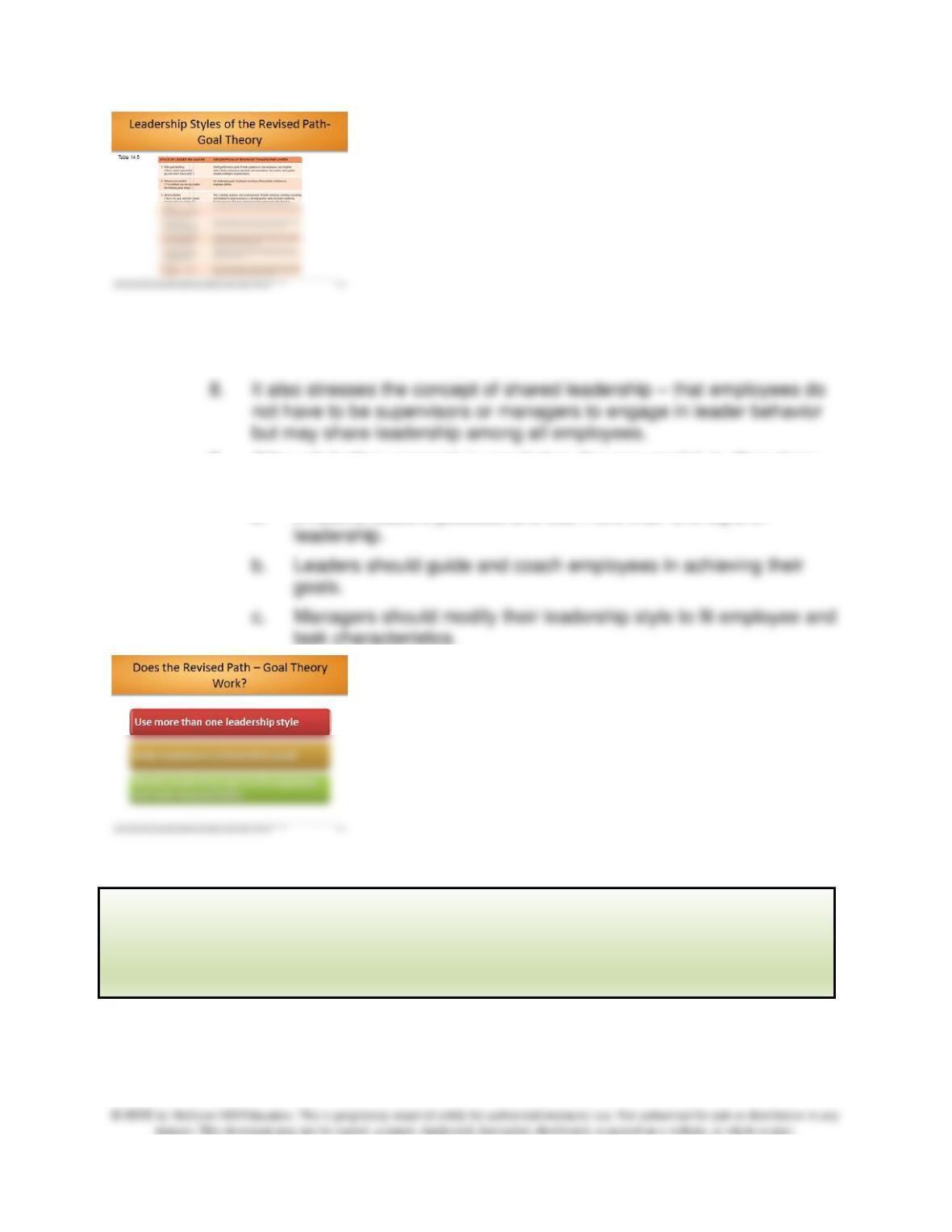
6. His revised theory expands the number of leader behaviors from four
to eight, shown in Table 14.5.
Chapter 14 – Power, Influence, & Leadership: From Becoming a Manager to Becoming a Leader
14–31
7. House’s revision puts more emphasis on the need for leaders to foster
intrinsic motivation through empowerment.
9. Although further research is needed on the new model, it offers three
important implications for managers:
a. Effective leaders possess and use more than one style of
14.5 The Uses of Transformational Leadership (pp. 462-465)
What does it take to truly inspire people to perform beyond their normal
levels?

Chapter 14 – Power, Influence, & Leadership: From Becoming a Manager to Becoming a Leader
14–32
Section 14.5 discusses transformational leadership, which transforms employees to
pursue organizational goals over self-interests. Transformational leaders inspire
motivation, inspire trust, encourage excellence, and stimulate employees intellectually.
Possible Topics for Discussion:
• Describe people who you consider to be transformational leaders—either people
you know from your own work experiences or people you have learned about
through the business press. What aspects of their leadership style would classify
them as transformational leaders?
Major Idea Outline:
A. Full-range leadership suggests that leadership behavior varies along a full
range of leadership styles, from take-no-responsibility (laissez-faire)
leadership at one extreme through transactional leadership to
transformational leadership at the other extreme.
B. Transformational leadership transforms employees to pursue
organizational goals over self-interests.
Chapter 14 – Power, Influence, & Leadership: From Becoming a Manager to Becoming a Leader
14–33
Interactive Classroom Material:
EXAMPLE: The Superior Performance of Both a Transactional and
Transformational Leader: PepsiCo’s CEO Indra Nooyi (p. 463)
PepsiCo CEO Nooyi can “rouse an audience and rally them around something as
YOUR CALL
Do you think you might have what it takes to be both a transactional and
transformational leader? What’s the evidence?
Students should provide examples of behaviors in the past that exhibit both

Chapter 14 – Power, Influence, & Leadership: From Becoming a Manager to Becoming a Leader
14–34
leader in the long run when it comes to motivating your followers.
Additional Activities:
One way to build on this Example is to have the students watch the CNBC video
“Indra Nooyi: The Secret to Pepsi’s Innovation.” In this 8-minute video, Indra Nooyi
discusses with Jim Cramer factors that have contributed to PepsiCo’s recent success.
Consider using the following discussion questions:
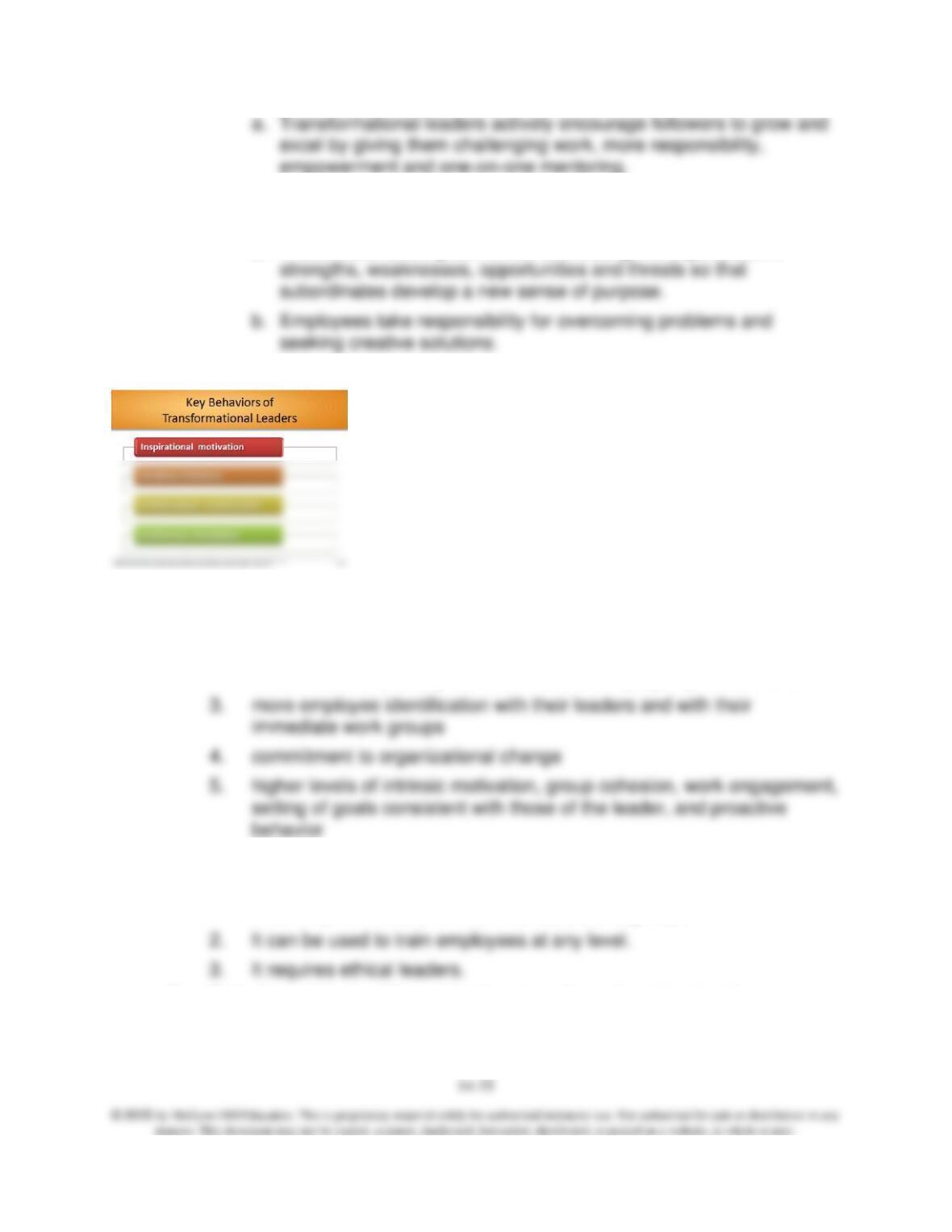
D. Transformational leaders have four key kinds of behavior that affect
followers:
1. Inspirational motivation – “Let me share a vision that transcends us all”
a. Transformational leaders have charisma, a form of interpersonal
attraction that inspires acceptance and support.
2. Idealized influence – “We are here to do the right thing”
a. Transformational leaders inspire trust by being consistent, single–
3. Individualized consideration – “You have the opportunity here to grow
and excel”
Chapter 14 – Power, Influence, & Leadership: From Becoming a Manager to Becoming a Leader
4. Intellectual stimulation – “Let me describe the great challenges we can
conquer together”
a. These leaders are gifted at communicating the organization’s
E. Transformational leadership is positively associated with:
1. measures of organizational effectiveness
2. measures of leadership effectiveness and employee job satisfaction
F. There are also three important implications of transformational leadership
for managers:
1. It can improve results for both individuals and groups.
G. To better ensure positive results from transformational leadership, top
managers should follow the practices shown in Table 14.6.

14–36
Section 14.6 discusses two other kinds of leadership: leader-member exchange model,
which emphasizes that leaders have different sorts of relationships with different
subordinates, and e-leadership, which involves leader interactions and e-leadership. It
also introduces a third perspective, which is the role of followers in the leadership
process.
14.6 Three Additional Perspectives (pp. 466-468)
If there are many ways to be a leader, which one would describe me
best?

Chapter 14 – Power, Influence, & Leadership: From Becoming a Manager to Becoming a Leader
14–37
Possible Topics for Discussion:
• Discuss traits and behaviors that are likely to be associated with e-leadership
effectiveness.
Major Idea Outline:
A. The leader-member exchange (LMX) model of leadership emphasizes
that leaders have different sorts of relationships with different subordinates.
1. It focuses on the quality of relationships between managers and
2. This unique relationship, which results from the leader’s attempt to
delegate and assign work roles, can produce two types of leader-
member exchange interactions:
3. A positive (in-group) leader-member exchange is associated with goal
commitment, trust between managers and employees, work climate,

Chapter 14 – Power, Influence, & Leadership: From Becoming a Manager to Becoming a Leader
14–38
SELF-ASSESSMENT 14.4 (p. 466)
Assessing Your Leader–Member Exchange
Go to connect.mheducation.com and take Self-Assessment 14.4.
Student Questions:
1. Where do you stand on the different dimensions underlying leader–member
exchange? Are you surprised by the results?
Students’ responses will differ based on assessment results. Many students
2. Do you think the quality of your leader–member exchange is impacting your
job satisfaction or performance? Explain.
Most students’ quality of leader-member exchange will impact their job
3. Based on your survey scores, how might you improve the quality of your
relationship with your boss? Be specific.
There are many ways to improve the quality one’s relationship with his or her
Additional Activities:
You can also consult the Connect Instructors Manual for the post-assessment activity
Chapter 14 – Power, Influence, & Leadership: From Becoming a Manager to Becoming a Leader
14–39
and corresponding PowerPoint slides used for this Self-Assessment in Connect. In
this activity, students should be put into groups based on their Self-Assessment
Group Exercise #2: Improving a Leader-Member Exchange Relationship
There is a group exercise available at the end of this manual that provides students
with the opportunity to review and analyze an example of a real-life leader-member
exchange relationship.
Exercise Objectives
B. E-leadership is leadership within the context of electronic technology.
1. It can involve one-to-one, one-to-many, within-group and between-
group and collective interactions via information technology.