
Chapter 14 – Enterprise and Global Management of Information Technology
14-1
14 Enterprise and Global Management of Information
Technology
CHAPTER OVERVIEW
Chapter 14: Enterprise and Global Management of Information Technology discusses the major challenges
that information technology presents to business managers, the components of information systems management,
and the managerial implications of the use of information technology in global business.
LEARNING OBJECTIVES
2. Explain how failures in IT management can be reduced by the involvement of business managers in IT planning
and management.
3. Identify several cultural, political, and geoeconomic challenges that confront managers in the management of
global information technologies.
4. Explain the effect on global business/IT strategy of the trend toward a transnational business strategy by
SUMMARY
• Managing Information Technology. This can be viewed as managing three major components: (1) the joint
development and implementation of e-business and IT strategies, (2) the development of e-business applications and
the research and implementation of new information technologies, and (3) IT processes, professionals, and subunits
within a company’s IT organization and IS function.
• Failures in IT Management. Information systems are not being used effectively or efficiently by many
• Managing Global IT. The international dimensions of managing global information technologies include dealing
with cultural, political, and geoeconomic challenges posed by various countries; developing appropriate business
Chapter 14 – Enterprise and Global Management of Information Technology
14-2
• Global Business and IT Strategies and Issues. Many businesses are becoming global companies and moving
toward transnational business strategies in which they integrate the global business activities of their subsidiaries
KEY TERMS AND CONCEPTS
1. Application Development Management (586):
2. Business/IT planning process (583):
3. Centralization or Decentralization of IT (586):
This represents the choice between management from a single location and group of decision makers verses
distributed management with autonomous decision making authority.
4. Chargeback Systems (587):
5. Chief Information Officer (588):
6. Chief Technology Officer (589):
The CTO is in charge of all information technology infrastructure, planning, and deployment.
7. Data Center (587):
A pool of co-located computing resources. Also known as a computer center.
8. Downsizing (586):
9. Global Business Drivers (604):
Chapter 14 – Enterprise and Global Management of Information Technology
14-3
10. Global Information Technology Management (598):
Global information technology management consists of managing information technologies in an e-business
enterprise by (1) the joint development and implementation of e-business and IT strategies by business and IT
11. IS operations management (587):
12. IT architecture (584):
The IT architecture created by the strategic business/IT planning process is a conceptual design, or blueprint,
that includes the platform, data, application architecture, and the IT organization itself.
14. Management Involvement (594):
15. Managing Information Technology (580):
16. Offshoring (591):
Offshoring involves moving an organization’s divisional activities, such as call center, software development,
or data processing to a location in a foreign country to reduce costs.
17. Outsourcing (590):
18. System Performance Monitor (587):
19. Technology Management (589):
Technology management focuses specifically on monitoring, testing, and adapting new technology
developments for use within the organization.
Chapter 14 – Enterprise and Global Management of Information Technology
14-4
20. Transborder Data Flows (TDF) (609):
TDF comprises the flow of business data over telecommunications networks across international borders.
21. Transnational Strategy (603):
Transnational strategy is a management approach in which an organization integrates its global business
22. User Services (589):
Users services provides support, consulting, and training activities for end users and workgroup computing.
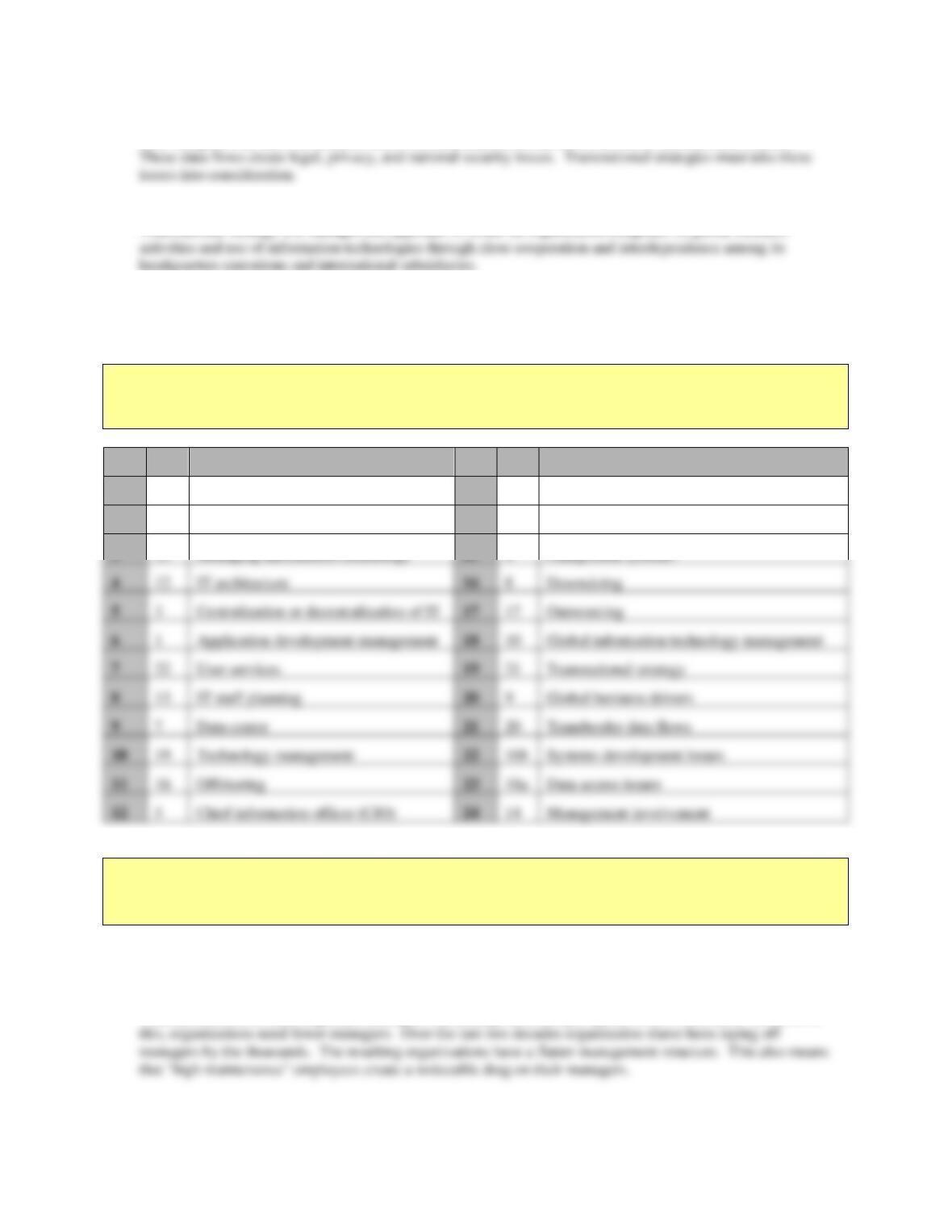
ANSWERS TO REVIEW QUIZ
Q.
A.
Key Term
Q.
A.
Key Term
1
2
Business/IT planning process
13
6
Chief technology officer (CTO)
2
11
IS operations management
14
18
System performance monitor
3
15
Managing information technology
15
4
Chargeback systems
4
12
IT architecture
16
8
Downsizing
5
3
Centralization or decentralization of IT
17
17
Outsourcing
6
1
Application development management
18
10
Global information technology management
7
22
User services
19
21
Transnational strategy
8
13
IT staff planning
20
9
Global business drivers
9
7
Data center
21
20
Transborder data flows
10
19
Technology management
22
10b
Systems development issues
11
16
Offshoring
23
10a
Data access issues
12
5
Chief information officer (CIO)
24
14
Management involvement
ANSWERS TO DISCUSSION QUESTIONS
1. What has been the impact of information technologies on the work relationships, activities, and resources
of managers?
Work relationships
With information at their fingertips, managers can manage more people spread over a wider area. Because of
Chapter 14 – Enterprise and Global Management of Information Technology
Activities
With more employees spread out over wider areas, managers must remain “connected” at all times. Managers
will spend significant amounts of time simply communicating via e-mail. Managers will also have more
information available. To use this, they will need technical skills in spreadsheets, database query tools, data
analysis tools, and presentation software.
Resources
Managers need:
2. What can business unit managers do about performance problems in the use of information technology
and the development and operation of information systems in their business units?
Fixing performance problems
• Network with the managers responsible for managing the technology
3. Refer to the Real World Case on BP‘s IT transformation in the chapter. Dana Deasy discusses the long–
term benefits of “embedded IT” while noting the need to centralize the department in the short term. How
does one organization make the transition from one approach to the other? What does it take to be successful
in this regard?
Deasy accomplished his transition by terminating most of senior IT management and a significant portion of the
IT layer beneath it. As je did so, Deasy cherry picked people to fill these positions from outside BP. Naturally
4. How are Internet technologies affecting the structure and work roles of modern organizations? For
example, will middle management wither away? Will companies consist primarily of self-directed project
teams of knowledge workers? Explain your answers.
Middle Management
• Middle management will continue to flatten with mangers managing more employees
Chapter 14 – Enterprise and Global Management of Information Technology
14-6
5. Should the IS function in a business be centralized or decentralized? Use the Internet to find recent
developments to support your answer.
Centralized
Organizations that require consistency across business units, product lines, and geographical areas will find
6. Refer to the Real World Case on the globalization challenges faced by CIOs in the chapter. All those
mentioned are CIOs from headquarters who went abroad, but there is no mention of CIOs from emerging
countries taking over the global helm. Why do you think this is the case?
Possibilities
• Author’s oversight
7. How might cultural, political, or geoeconomic challenges affect a global company’s use of the Internet?
Give several examples.
Cultural challenges
Cultural challenges include differences in languages, cultural interests, religions, customs, social attitudes, and
8. Will the increasing use of the Internet by firms with global business operations change their move toward
a transnational business strategy? Explain.

Chapter 14 – Enterprise and Global Management of Information Technology
9. How might the Internet, intranets, and extranets affect the business drivers or requirements responsible
for a company’s use of global IT, as shown in Figure 14.13 ? Give several examples to illustrate your answer.
Internet technologies will enable more efficient centralization of computing resources (cloud computing, etc.)
ANSWERS TO ANALYSIS EXERCISES
1. Top-Rated Websites for Executives
a. Evaluate the CEO Express Web site as a source of useful links to business and technology news, analysis,
and research sources for business executives and professionals.
What advantages does CEO Express provide?
Google News is open to all news sources. Users have to create their own filters for specific topics. Google’s IG
c. Select the featured article from the “Editor’s Corner.” What was the source? Summarize the article. Was
it useful to you?
2. Information & Communications for Development
a. What is the World Bank ( www.worldbank.org ) doing to address third-world computer literacy needs?
b. What is MIT ( www.mit.edu ) doing to help increase global computer literacy?
Chapter 14 – Enterprise and Global Management of Information Technology
14-8
3. Overseas Assignments
Note: Many students have no international travel experience, so they may find this exercise especially
interesting. Those who have lived or traveled overseas may have useful contributions to make to a classroom
a. What do you need to bring with you to keep your laptop computer charged?
b. What do you need to bring with you to connect your laptop’s modem to the local telephone network?
Depending on the country, visitors may require only a plug adaptor. However, not all countries use analog
c. What will you use in place of your handy cell phone?
Answers will vary by country and product. See resources below for more information. Possible answers may
d. Use a collaboration-enabled system such as Blackboard, Web CT, Dreamweaver, or Front Page to merge,
organize, and publish your results with the rest of your class to create an online resource.
This exercise will give students experience using web-based collaborative tools and allow them to form a virtual
4. Knowledge Work on the Move
a. Digitize: Convert data or information into a digital form.
b. Distribute: Process information in one direction or another based on strict rules and nondigital inputs (if
the inputs were digital, a computer could probably do the job).
c. Analyze: Process information based on human expertise.
d. Create: Create new information or products based on human expertise.
Chapter 14 – Enterprise and Global Management of Information Technology
14-9
ANSWERS TO REAL WORLD CASES
RWC 1: Reinventing IT at BP
Case Study Questions
1. The case mentions the dependence of BP’s IT organization on external contractors. Why would this be an
issue? When is it a good idea for IT departments to hire contractors, and when is it not? Discuss some
scenarios.
Outside contractors
• Expensive
2. The culture of the IT organization is mentioned as an important issue. How do you think it changed
throughout the period covered here? What did it look like when Deasy came on board? What does it look like
now?
Change
• Deasy wiped out most of IT leadership
• IT leaders became loyal to Deasy
Chapter 14 – Enterprise and Global Management of Information Technology
14–10
3. How did BP get to the situation mentioned at the beginning of the transformation process? Does it appear
to be the result of a conscious decision? Use examples from the case to illustrate your answer.
Cause
Transformation isn‘t linear. It’s easy to become complacent, but numerous factors continually erode an efficient
Conscious choice?
This process isn’t the result of conscious choice. It is the result of top management complacency, natural
competitive forces, and a culture of risk-avoidance.
Real World Activities
1. Go online and research the performance of BP since the time chronicled in the case. Did the
transformation process pay out in the end? What was the role of IT in the outcome, if any? Prepare a report
and compare BP’s performance with that of their competitors.
2. Go back and reread the last two paragraphs in the case. What do you think Deasy means when he
discusses the nonlinear and iterative nature of the process? What does he mean by “temptation”? Break into
small groups with your classmates to discuss these questions.
“Natural” processes continually erode at efficiency gains. Contracts naturally seek additional work when they
RWC 2: Cadbury, Forrester Research, A.T. Kearney, and Others
Case Study Questions
1. What are the challenges faced by the CIOs mentioned in the case? Group them into categories and use
examples from the case to define each.
Note: the categories listed here are subjective. Students will likely develop their own.
Challenge categories
Human
• Wayne Shurts had no experience with emerging markets
Chapter 14 – Enterprise and Global Management of Information Technology
14–11
Technical
• Bob Hass noted infrastructure limitations
2. The case mentions that the traditional approach toward emerging countries had been to develop
technology in the corporate offices and then hand them down to satellite operations. How has that changed,
as discussed in the case?
3. “IT is one of the most globally integrated corporate functions.” How is IT different from other business
areas when it comes to global integration? Why do you think this is the case?
IT provides instant communication and transfer of (digital) products and services over a network within and
Real World Activities
1. Go online and search for other examples of large multinational organizations facing similar challenges.
Summarize your findings and compare them to the ones chronicled in the case. Can you find any new ones
not mentioned here?
Multinationals in emerging markets
• “The World’s Top 25 Emerging Market Multinationals“
5
2. Do you think some form of international experience is key to your long-term career success? Have you
ever considered taking a position abroad? Why or why not? Break into small groups with your classmates to
discuss the advantages and disadvantages of moving abroad to gain these experiences.
Chapter 14 – Enterprise and Global Management of Information Technology
14–12
Advantages
• Good experience/exposure
Disadvantages
• Could be “forgotten” by headquarters
RWC 3: Toyota, Procter & Gamble, Hess Corporation, and Others
Case Study Questions
1. Several comments in the case note that CIOs are in a unique position for companywide leadership,
extending beyond their primary technological concerns. Why do you think this is the case? How are CIOs
different in this regard from other chief officers, for example, in finance, HR, or marketing?
2. After reading the case, what do you think are the most important competencies for the successful CIO of
tomorrow? How do you rate yourself in those? Had you considered the importance of these skills and abilities
before?
Required skills:
• business
3. How can CIOs prepare their successors for an uncertain future that will most likely require skills
different from those possessed by the successful CIOs of today? Which key competencies are enduring, and
which ones are a function of the current technological environment? How can CIOs prepare for the latter?
Preparation: CIOs should have a good grounding in business skills. It would help if they had industry
experience in accounting or operations. Prospective CIOs can benefit significantly from mentoring and new
8
American citizens must pay federal taxes regardless of where or how they earn their income.
Chapter 14 – Enterprise and Global Management of Information Technology
14–13
Real World Activities
1. Go online to research the topic of executive succession planning and the different approaches in use by
companies today. Are there any differences for those in information technology, as opposed to other
functional areas, because of the dynamics of technology change and evolution? Which competencies are being
targeted for IT executives? Prepare a report to summarize your findings.
Summary: CIOs have have placed a low priority on personnel development. The CIO as a strategic partner is a
fairly recent concept, and the CIO’s evolving role makes succession planning especially difficult. To make
2. The case mentions several strategies used by companies to mentor and develop their next generation of
IT leaders: career planning, leadership development exercises, coaching, and so on. As a Gen Y member
discussed in the chapter, how do these fit in with your expectations for the future? Break into small groups
with your classmates to discuss these issues, in particular, to what extent you believe these approaches match
well with your culture and personality.
As this answer’s author is a baby-boomer, I’m not qualified to answer the question. Guiding questions might
include:
• How many different careers do you expect during your lifetime? How many jobs?
RWC 4: Reinsurance Group of America and Fronterra
Case Study Questions
1. What is the business value of these global system developments for the companies mentioned in the case?
How did they achieve these benefits? What were the major obstacles they had to overcome?
Business value:
• reduce redundancy
2. What are the advantages and disadvantages of a full-blown versus a phased approach for system
implementations in general, and global ones in particular? How do you make the decision on which road to
take?
Advantages: by involving all stakeholders at the project’s outset, the stakeholders can negotiate and resolve
design specifications thereby reducing the need for local customization or the risk of alienating key groups.
Chapter 14 – Enterprise and Global Management of Information Technology
Disadvantages:
• Slippage. Early milestone slips may well cause milestone slips for the remainder of the project. This
Next, determine whether or not a project can be split into independent pieces. For example, project managers
often create a phase specifically for infrastructure upgrades (when required). Or, when dealing with multiple
offices, the project manager should ask if one office can reasonably serve as a “model” office. Lastly, when
3. How important is it that all units in global organization speak the same business language and use the
same functions and business processes? How do you balance the competing needs for flexibility and
consistency across operations?
The answer depends upon how important consistency is within an organization. A global accounting firm
should have consistent book keeping applications within each practice country. However, laws vary between
Real World Activities
1. Both organizations featured in the case have been quite successful with their global rollouts. Search the
Internet for examples of less-than-thriving global or international system implementations. How do they
compare to the ones in the case? What differences in the approaches taken by the successful and unsuccessful
cases do you think could account for the differences in outcome? Prepare a report and a presentation to share
your findings with the rest of the class.
EDS attempted to take over management of the U.S. Navy’s voice, video, networking, training, and desktops in
a $4 billion deal in 2003. In 2004, EDS wrote off nearly $350 million in losses on the deal.
9
A significant part

Chapter 14 – Enterprise and Global Management of Information Technology
14–15
2. Implementing major systems in global organizations, particularly when development is concentrated in
headquarters or a powerful country subsidiary, can cause a lot of resentment and frustration for the other
units in the organization. Break into small groups with your classmates to discuss which approaches
companies can take to ease these issues and incorporate all their units into the process.
Approaches:
• Use collaborative tools to bring all parties together on the project regardless of geography or time