
Chapter 14 – Operations Management: Managing Vital Operations and Processes
14–16
POWERPOINT SLIDES 14-33 TO 14-35
POWERPOINT SLIDE 14-36
Lecturer Enhancer 14.1
KEEPING THE CUSTOMER HAPPY
What should a company do for angry customers? According to experts, just about anything it can. Studies
show customers tell twice as many people about bad experiences as good ones, so complainers left
unhappy can send a company’s image crashing. Simply listening to complaints boosts brand loyalty and a
customer’s tendency to buy again.
Lecturer Enhancer 14.2
PRODUCTIVITY BOTTLENECK IN THE OFFICE: THE KEYBOARD
The modern office is likely to be equipped with personal computers linked through local area networks to
each other and to a host of specialized equipment, from laser printers to data bases storing millions of
customer records. Within this state-of-the-art operating system is a turn-of-the-century bottleneck—the
computer keyboard.
LECTURE ENHANCERS
Chapter 14 – Operations Management: Managing Vital Operations and Processes
14–17
Typewriter manufacturers went back to the drawing boards and designed a new keyboard to slow typists
down to speeds within the limits of the crude mechanism. The resulting keyboard is referred to as
“Qwerty,” named for the first six keys of the top row. Keys were placed awkwardly to force slower
typing. The “A”, for instance, one of the most frequently used keys, was placed under a typist’s left-hand
little finger, the weakest finger on the hand. “E” requires an awkward reach using the middle finger of the
left hand. Results were encouraging—typing speeds declined.
Lecturer Enhancer 14.3
THE NEW REALITY: REEVALUATING JUST-IN-TIME INVENTORY TECHNIQUES
One of the business techniques imported from Japan in the 1980s was the concept of just-in-time (JIT)
inventory. It entails having raw materials and components delivered to the user just at the time they are
needed for production. Effective use of JIT requires close coordination between the supplier and the
in time.
Wal-Mart Stores Inc. is widely cited as one of the best practitioners of inventory management. The
Bentonville, Arkansas based discount retailer is constantly trying to better its performance. Among its
current projects is an inventory-reporting system it is developing with W&H Systems Inc. in Carlstadt,
N.J., and Rank Video Systems of America in Northbrook. Since the bulk of movie videotape sales are on
Chapter 14 – Operations Management: Managing Vital Operations and Processes
14–18
“The reality today is that with just–in–time, there are still a lot of empty shelves in the stores,” says Perry
Caicco, president of Toronto-based Consumers.
Notes for Topics for Discussion and Action
DISCUSSION
1. Why is it important for managers to pay close attention to their organization’s production system if
they wish to be responsive to their customers?
2. “Total customer service is the goal toward which most organizations should strive.” To what degree is
this statement correct?
3. What is CRM, and how can it help improve responsiveness to customers?
MANAGEMENT IN ACTION
Chapter 14 – Operations Management: Managing Vital Operations and Processes
14–19
Copyright © 2017 McGraw-Hill Education. All rights reserved. No reproduction or distribution without the prior written consent of McGraw-Hill
Education.
processes information about changing customer needs, this improves marketing in many ways. Marketing
managers, for example, have access to detailed customer profiles, including data about purchases and the
reasons why individuals were or were not attracted to a company’s products.
4. What is efficiency, and what are some of the techniques that managers can use to increase it?
ACTION
5. Ask a manager how quality, efficiency, and responsiveness to customers are defined and measured in
his or her organization.
(Note: Student responses to this question will vary. The following is an example of an appropriate
response.)
I interviewed a manager at a women’s specialty store located in a very upscale shopping mall in a major
6. Go to a local store, restaurant, or supermarket, and list the ways in which you think the organization is
being responsive or unresponsive to the needs of customers. How could this business’s responsiveness to
Chapter 14 – Operations Management: Managing Vital Operations and Processes
14–20
customers be improved?
(Note: Student responses to this question will vary. The following is an example of an appropriate
response.)
AACSB: Analytic
Managing a Production System
1. What is the output of the organization?
2. Describe the production system that the organization uses to produce this output.
The value chain that is in place requires each cleaning person to perform all cleaning tasks individually.
3. What product attributes do customers of the organization desire?
BUILDING MANAGEMENT SKILLS
Chapter 14 – Operations Management: Managing Vital Operations and Processes
14–21
Copyright © 2017 McGraw-Hill Education. All rights reserved. No reproduction or distribution without the prior written consent of McGraw-Hill
Education.
to certain areas of the house or certain tasks. Finally, customers like to feel that their service is tailored to
them and their unique needs. Members of the cleaning staff go out of their way to provide customers with
service that meets their schedules and demands.
4. Does its production system allow the organization to deliver the desired product attributes?
5. Try to identify improvements that might be made to the organization’s production system to boost the
organization’s responsiveness to customers, quality, and efficiency.
AACSB: Analytic
(Note: Student responses will vary.)
1. Either by yourself or in a group, discuss how to think through the ethical implications of using an
operations management technique to improve organizational performance.
2. What criteria would you use to decide what kind of technique is ethical to adopt and/or how far to push
employees to raise the level of their performance?
MANAGING ETHICALLY
14–22
Copyright © 2017 McGraw-Hill Education. All rights reserved. No reproduction or distribution without the prior written consent of McGraw-Hill
Education.
reevaluated.
3. How big a layoff, if any, would be acceptable? If layoffs are acceptable, what could be done to reduce
their harm to employees?
Chapter 14 – Operations Management: Managing Vital Operations and Processes
14–23
How to Compete in the Sandwich Business
1. Identify the product attributes that a typical sandwich shop customer most.
Customers are central to the survival of almost any organization, so it is crucial that managers find out
what customers want and devise ways to satisfy the customers’ needs. A typical sandwich shop customer
2. In what ways do you think you will be able to improve on the operations and processes of existing
sandwich shops and achieve a competitive advantage through better (a) product quality, (b) efficiency, or
(c) responsiveness to customers?
AACSB: Reflective Thinking
How to Build Flat Panel Displays
1. What kinds of techniques discussed in the chapter can help these managers to increase efficiency?
2. In what ways can these managers go about developing a program to increase quality?
3. What critical lessons can these managers learn from operations management?
SMALL GROUP BREAKOUT EXERCISE
BE THE MANAGER
Chapter 14 – Operations Management: Managing Vital Operations and Processes
14–24
Copyright © 2017 McGraw-Hill Education. All rights reserved. No reproduction or distribution without the prior written consent of McGraw-Hill
Education.
Lesson #1: The goal of most start-ups is to break even and begin earning profits as soon as possible.
Therefore, management of efficiency is extremely important because increased efficiency lowers
production costs that, in turn, lead to profit generation.
Lesson #2: In its eagerness to please its new customers, managers of this start-up must be careful not to
promise a level of responsiveness to their customers that their company cannot yet profitability sustain.
Lesson #3: Be cautious of the temptation to continually increase the demands placed on employees to
increase productivity. Do not impose unreasonable levels of stress upon employees.
AACSB: Reflective Thinking
Case Synopsis: Big Data Brings Relief to Allergy Medicine Supply Chains
In 2010 many pharmacies around the northeastern United States sold out of allergy medications.
However, today, advanced supply-chain technology has enabled pharmaceutical companies to
keep their allergy-relief products in stock. Many vendors now are combining data from
thousands of stores of different retailers and cross-referencing it with weather, pollen, and other
data to make sure that they can meet consumer demand and not miss out on potential sales.
McLean, a product marketing company, has a team of scientists who help companies mine big
data and better anticipate future demand. The company provides web-based software that allows
clients to look at data reports and to analyze and customize the data every day.
Questions
(Note to instructor: Responses to these questions will vary, since they will require students to
apply imaginative thinking to their fundamental understanding of business operations and
management decision making.)
1. In what ways does Bayer’s operations management system help improve the company’s
efficiency?
2. What are some of the advantages of using big data when it comes to increasing customer
satisfaction? What are some disadvantages?
THE WALL STREET JOURNAL CASE IN THE NEWS
Chapter 14 – Operations Management: Managing Vital Operations and Processes
14–25
3. What strategies can companies employ to keep their supply chains lean while addressing
overall quality of their products?
AACSB: Reflective Thinking
• Working In Teams: Cross-Functional Dysfunction
SUPPLEMENTAL FEATURES
MANAGER’S HOT SEAT (MHS)
Chapter 14 – Operations Management: Managing Vital Operations and Processes
14–26
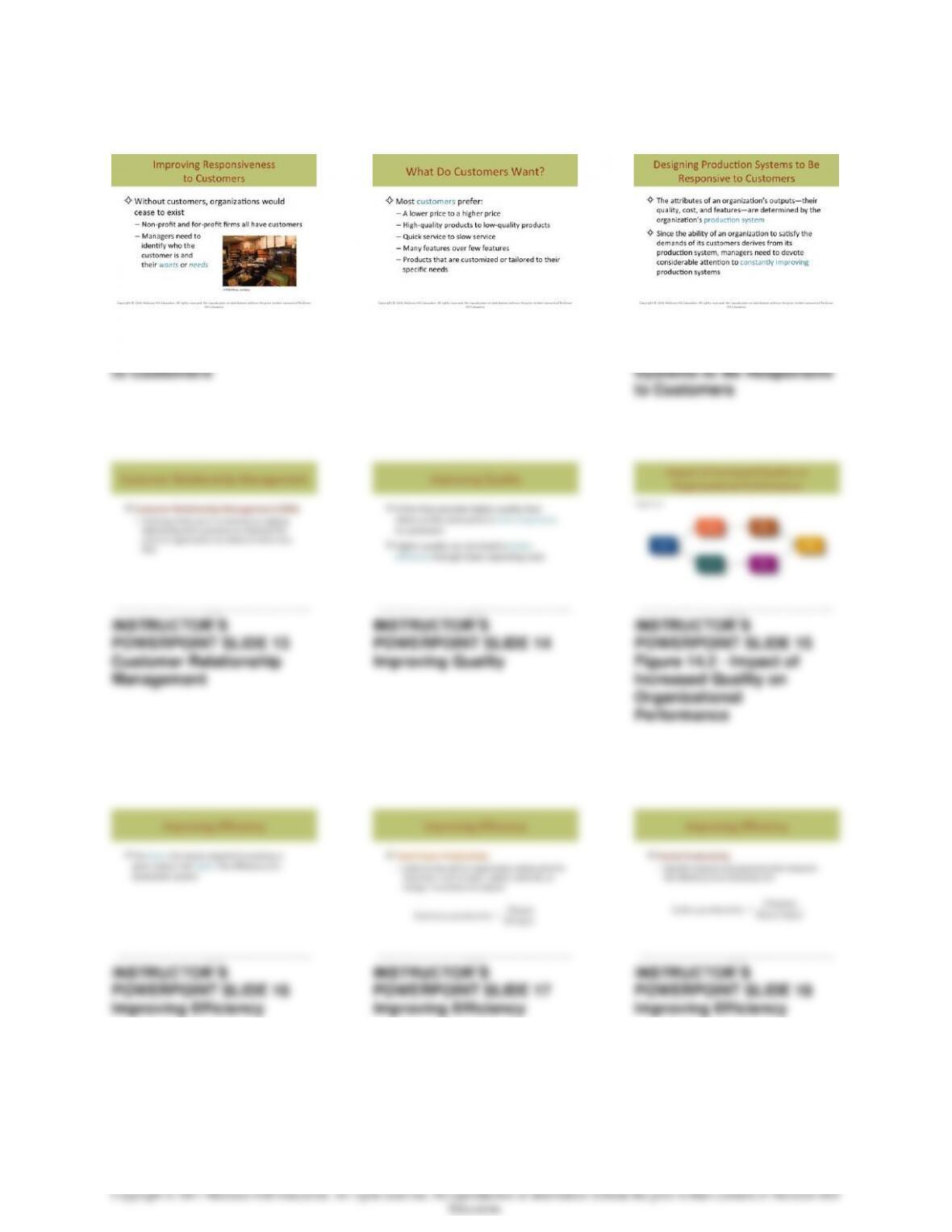
These Instructor’s PowerPoint slides can be used to supplement the lecture material.
INSTRUCTOR’S
POWERPOINT SLIDE 1
Chapter Title
INSTRUCTOR’S
POWERPOINT SLIDE 2
Learning Objectives
INSTRUCTOR’S
POWERPOINT SLIDE 3
Learning Objectives
INSTRUCTOR’S
POWERPOINT SLIDE 4
Operations Management
and Competitive Advantage
INSTRUCTOR’S
POWERPOINT SLIDE 5
Operations Management
and Competitive Advantage
INSTRUCTOR’S
POWERPOINT SLIDE 6
Operations Management
and Competitive Advantage
INSTRUCTOR’S
POWERPOINT SLIDE 7
Question?
INSTRUCTOR’S
POWERPOINT SLIDE 8
Operations Management
INSTRUCTOR’S
POWERPOINT SLIDE 9
Figure 14.1 – The Purpose
INSTRUCTOR’S POWERPOINT SLIDES
Chapter 14 – Operations Management: Managing Vital Operations and Processes
14–27
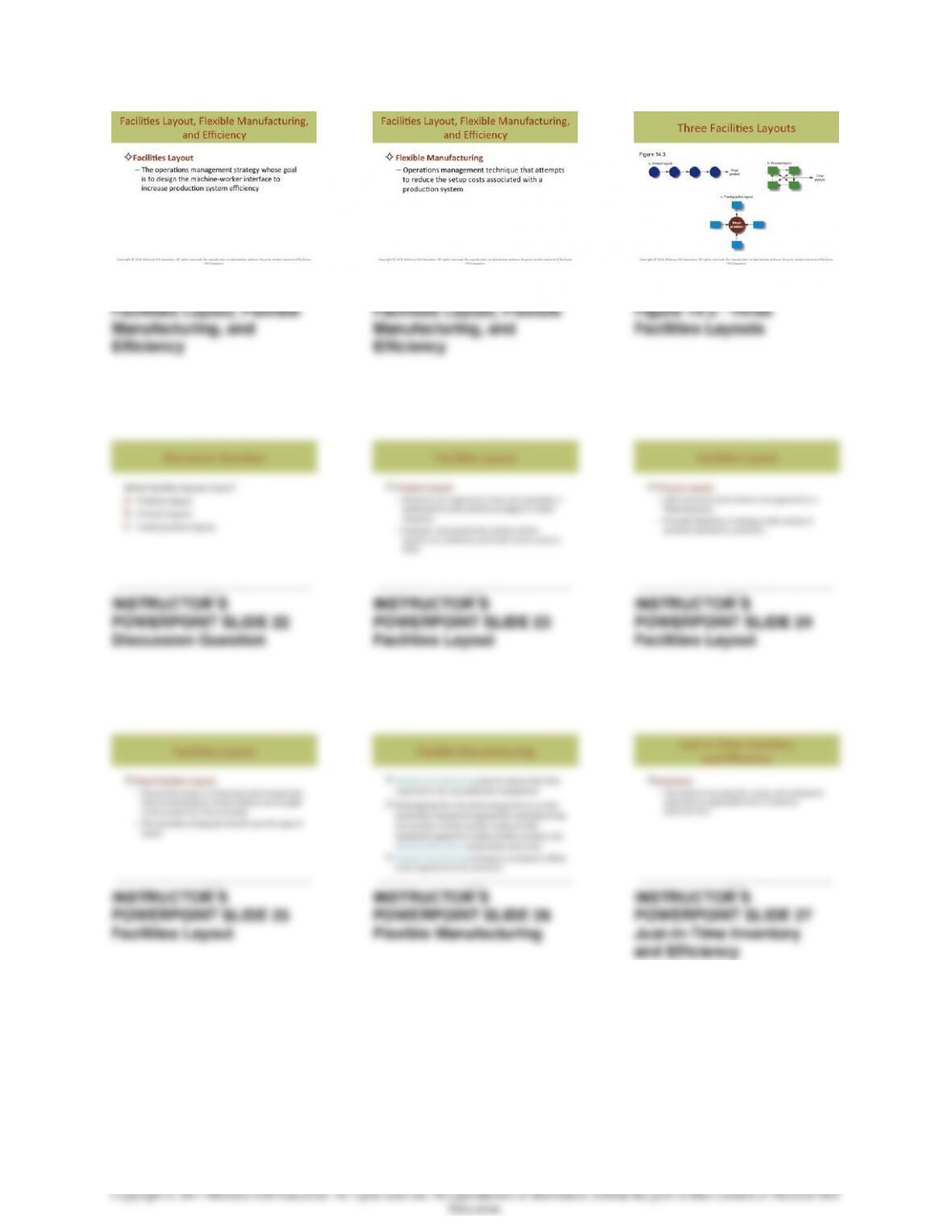
INSTRUCTOR’S
POWERPOINT SLIDE 10
Improving Responsiveness
INSTRUCTOR’S
POWERPOINT SLIDE 11
What Do Customers Want?
INSTRUCTOR’S
POWERPOINT SLIDE 12
Designing Production
Chapter 14 – Operations Management: Managing Vital Operations and Processes
14–28
INSTRUCTOR’S
POWERPOINT SLIDE 19
INSTRUCTOR’S
POWERPOINT SLIDE 20
INSTRUCTOR’S
POWERPOINT SLIDE 21
Chapter 14 – Operations Management: Managing Vital Operations and Processes
14–29
INSTRUCTOR’S
POWERPOINT SLIDE 28
INSTRUCTOR’S
POWERPOINT SLIDE 29
INSTRUCTOR’S
POWERPOINT SLIDE 30

Chapter 14 – Operations Management: Managing Vital Operations and Processes
INSTRUCTOR’S
POWERPOINT
SLIDE 37
Topics for Discussion
INSTRUCTOR’S
POWERPOINT
SLIDE 38
Topics for Discussion
INSTRUCTOR’S
POWERPOINT
SLIDE 39
Topics for Discussion