Chapter 14: Control P a g e | 14
Self-Assessment
TOO MUCH INFORMATION?
This chapter assessment helps students identify how much feedback they like to receive by indicating if
they are motivated more to learn or to demonstrate their current abilities.
In-Class Use
Give students 8 10 minutes to complete the inventory. Give students a moment to add their raw score and
then go over what the scores mean (see below under Scoring). The research supporting this inventory can
be found in M. Tuckey, N. Brewer, and P. Williamson, The Influence of Motives and Goal Orientation
on Feedback Seeking, Journal of Occupational and Organizational Psychology 75, no. 2 (2002): 195.
Scoring
This assessment, which measures feedback-seeking motives, is actually a combination of four individual
scales, so students will generate four subtotals as follows:
(A) Desire for useful information: Add together scores for items 1, 5, 9, 13, 17, 21, 25, and 29.
(B) Ego Defense: Add together scores for items 2, 6, 10, 14, 18, 22, 26, and 30.
(C) Defensive Impression Management: Add together scores for items 3, 7, 11, 15, 19, 23, 27, and 31.
(D) Assertive Impression Management: Add together scores for items 4, 8, 12, 16, 20, 24, 28, and 32.
After students calculate their raw scores, they will want to know what those scores mean. Here is
what you can tell them: How motivated you are to seek feedback when you want useful information is
reflected in your score for Scale A, a desire for useful information. If your score for A is high (over 40),
then you tend to solicit feedback when you desire useful information about your performance. A high
score in Scale A also indicates a tendency toward being a learning-oriented individual. Because learning-
Chapter 14: Control P a g e | 15
Management Workplace
Management Workplace videos can support several in-class uses. In most cases you can build an entire
50-minute class around them. Alternatively, they can provide a springboard into a group lesson plan. The
Management Workplace video for Chapter 14 would be a nice companion to your introduction to the
course on the first day teaching this chapter.
VIDEO: BARCELONA RESTAURANT GROUP
Managing Quality and Performance
Summary:
According to Andy Pforzheimer, food is only 50 percent of the experience at his restaurants. The rest
comprises intangibles like ambience and conversation with the staff. To ensure consistent quality across
Discussion Questions:
1. How do managers at Barcelona control the companys financial performance?
In the video, Barcelona uses multiple methods of controlling financial performance. First,
managers hold weekly meetings during which chefs and general managers review financials. The
exchanges get heated at times as everyone reviews P&L numbers, and owner Andy Pforzheimer
2. In what ways does Barcelona use the balanced scorecard approach to control?
Traditionally, most businesses have measured and controlled their financial performance by
analyzing sales, revenue, and profit. The balanced scorecard approach expands the bases around
which a companys progress is measured, adding components such as customer service, business
Chapter 14: Control P a g e | 16
3. Describe an instance where Barcelona followed the feedback control model to improve its
performance.
Feedback control is a mechanism for gathering information about performance deficiencies after
they occur. This information is then used to correct or prevent performance deficiencies. Study
after study has clearly shown that feedback improves both individual and organizational
Workplace Video Quiz
Students are able to take the following video quiz on CourseMate. The video is broken into segments, and
each segment has related questions to make sure students understand how the clip connects to the chapter
concepts.
Video Segment 1
Video segment title Managing Quality and Performance
Start time (in sec) 0:00
Stop time (in sec) 1:18
Quiz Question 1 Managing quality and performance at Barcelona Restaurant Group falls
under the following management category:
a. Planning
b. Organizing
c. Leading
Quiz Question 2 To assess Barcelona Restaurant Groups daily and weekly operating
success, Chief Operating Officer Scott Lawton uses video monitoring,
secret shopper reports, customer emails, and on-site observation. Such
ongoing assessment is part of:
a. Setting standards
b. Comparison to standards
Chapter 14: Control P a g e | 17
Quiz Question 3 Which of the following would not be relevant for measuring and
improving performance at an upscale restaurant like Barcelona?
a. Budgetary control
b. The control process
Video Segment 2
Video segment title Managing Quality and Performance
Start time (in sec) 1:22
Stop time (in sec) 2:46
Quiz Question 1 According to Barcelona owner Andy Pforzheimer, the difference between
successful restaurants and failed restaurants is:
a. Location
b. Staffing
c. Quality control
d. Cuisine
Correct option c: Quality control
Feedback As Pforzheimer describes, the quality of a restaurant is what leads to
success.
Quiz Question 2 Which of the following tells Barcelona owner Andy Pforzheimer if his
restaurants are operating at a profit or loss?
a. Marketing research
b. Performance appraisals
Quiz Question 3 During the weekly managers meeting, Chief Operating Officer Scott
Lawton discusses the prior weeks sagging sales, poor customer feedback
from secret shoppers, and staffing shortages. Such a review is an example
of:
a. Feedforward control
b. Concurrent control
Chapter 14: Control P a g e | 18
Video Segment 3
Video segment title Managing Quality and Performance
Start time (in sec) 2:47
Stop time (in sec) 5:00
Quiz Question 1 During Barcelona Restaurant Groups weekly war room meetings,
managers and chefs evaluate multiple performance measures, from
financial numbers and customer feedback to competition between
restaurants. This illustrates the following approach to controlling:
a. External financial audit
b. The balanced scorecard
Quiz Question 2 During the weekly meeting, managers analyze Barcelonas financial
performance by:
a. Reviewing secret shopper comment cards
b. Examining average food costs and menu prices
c. Watching video surveillance cameras
d. Reviewing marketing campaigns
Correct option b: Examining average food costs and menu prices
Feedback By analyzing how much money is spent and how much is brought in
through sales, managers get a picture of the companys financial
performance.
Quiz Question 3 At the end of the meeting, Barcelona owner Andy Pforzheimer offers
managers worksheets to help them remedy the problem of mismanaged
food costs and menu prices at the restaurant. This is an example of:
a. Adopting international standards
Chapter 14: Control P a g e | 19
Video Segment 4
Video segment title Managing Quality and Performance
time (in sec) 5:00
Stop time (in sec) 7:01
Quiz Question 1 Offering financial bonuses to restaurant managers to incentivize their
compliance with set performance goals is typical of the following control
approach:
a. Bureaucratic control
b. Decentralized control
Quiz Question 2 A type of benchmarking discussed in the video is:
a. General managers are given financial bonuses.
b. Chefs are not given financial bonuses.
c. Chefs and general managers from different Barcelona Restaurant
locations compare costs and practices and compete against each other.
Quiz Question 3 Barcelona Restaurant Groups emphasis on customers and customer
satisfaction is intended to prevent:
a. Customer defections
Additional Assignments and Activities
Review Questions
1. Describe the basic control process.
The steps to the basic control process are:
2. How can a manager determine if more control is necessary, or even possible?
Control is achieved when behavior and work procedures conform to standards and goals are
accomplished. By contrast, control loss occurs when behavior and work procedures do not conform to
standards. To determine whether control is worthwhile, managers need to carefully assess regulation
costs, that is, whether the costs and unintended consequences of control exceed its benefits. Before
3. What are a managers options if more control isnt possible?
4. Identify and describe the various methods that managers can use to maintain control.
The text outlines five basic control methods. They are bureaucratic, objective, normative, concertive,
and self-control. Bureaucratic control involves the use of hierarchical authority to influence employee
5. Explain how concertive control evolves in an organization.
Groups evolve through two phases as they develop concertive control. In phase one, group members
learn to work with each other, supervise each others work, and develop the values and beliefs that
6. Describe the elements of the balanced scorecard.
7. Explain why economic value added (EVA) includes more than just profits.
Traditionally, financial control has been achieved through cash flow analysis, balance sheets, income
8. What can companies do to control the customer perspective?
The customer perspective seeks an answer to the question, How do our customers see us?
Typically, companies try to find the answer to that question through customer-satisfaction surveys.
9. What is quality, and how does it differ from value?
The internal perspective asks the question At what must we excel? No matter what area a company
Chapter 14: Control P a g e | 22
10. Describe the strategies managers can use for waste prevention and reduction.
Waste prevention and reduction are at the top of the waste-minimization pyramid. Companies use
three strategies to prevent and reduce waste. First, they practice good housekeeping. That is,
Management Team Decision
MAKING AIRPORTS MORE SECURE
Purpose
The purpose of this case is to give students a chance to think about how to balance control with
efficiency.
Setting It Up
Asks students what they most enjoy about air travel. Some might talk about being able to go to exotic
locations, while others might talk about not having to drive long distances. Then, ask students what they
do not enjoy about air travel. At least a few students will bring up the hassle of going through airport
security waiting in long lines, having to show up to the airport several hours before a flight, not being
able to take a bottle of water onto the plane, etc. Perhaps a student might even be able to share his or her
experience of going through additional security screenings.
Scenario
Everything you do as an official at the Department of Homeland Security (DHS) is about control. Your
task is to maintain strict security standards at all U.S. airports, while also trying to keep things running
smoothly and efficiently. As the training program you created repeats emphatically, and as recent events
have demonstrated, just one slip, one small mistake, can quickly escalate into a disaster. It is your
responsibility to make sure that tragedy does not occur again.
Chapter 14: Control P a g e | 23
Sources:
Lizette Alvarez, Meet Mikey, 8: U.S. Has Him on Watch List, The New York Times, January 14, 2010,
Questions
1. In your opinion, is there a way you can maintain airport security without sacrificing efficiency? What
would such a system look like?
Students responses will vary in specific details, but their answers should include the basic elements
involved in establishing control. As described in the text, the basic control process begins with the
2. How could you incorporate feedforward control (gathering information about performance
deficiencies before they occur) into airport security measures?
Feedforward control is a mechanism for gathering information about performance deficiencies before
they occur. In contrast to feedback and concurrent control, which provide feedback on the basis of
outcomes and results, feedforward control provides information about performance deficiencies by
monitoring inputs rather than outputs. Thus, feedforward control seeks to prevent or minimize
performance deficiencies before they happen. As shown in Exhibit 14.2, there are a number of
guidelines for using feedforward control:
Thorough planning and analysis are required.
Develop Your Career Potential
LEARNING FROM FAILURE
Purpose
To give students a model to help them take a systematic approach to learning from mistakes and failures.
Setting It Up
There are several ways to handle this assignment. One way is to assign it as a journal exercise, where
students write privately about their failures and what they learned from them. Another is to treat it as a
journal exercise plus class discussion. However, because it is likely that students will be reluctant to talk
Questions
1. Identify and describe a point in your life when you failed. Dont write about simple or silly mistakes.
The difference between a failure and a mistake is how badly you felt afterwards. Years afterwards, a
real failure still makes you cringe when you think about it. What was the situation? What were your
goals? And how did it turn out?
2. Describe your initial reaction to the failure. Were you shocked, surprised, angry, or depressed?
Initially, who or what did you blame for the failure? Explain.
Since many students will describe their reactions to failure as they describe the failure itself in
question 1, focus on the issue of blame in question 2. Be sure to emphasize to students that youre
concerned with their initial reactions to failure, not their subsequent reactions (which well discuss in
question 3). On the board, write “Who did you blame?” Beneath that write these subheadings, “Others
Chapter 14: Control P a g e | 25
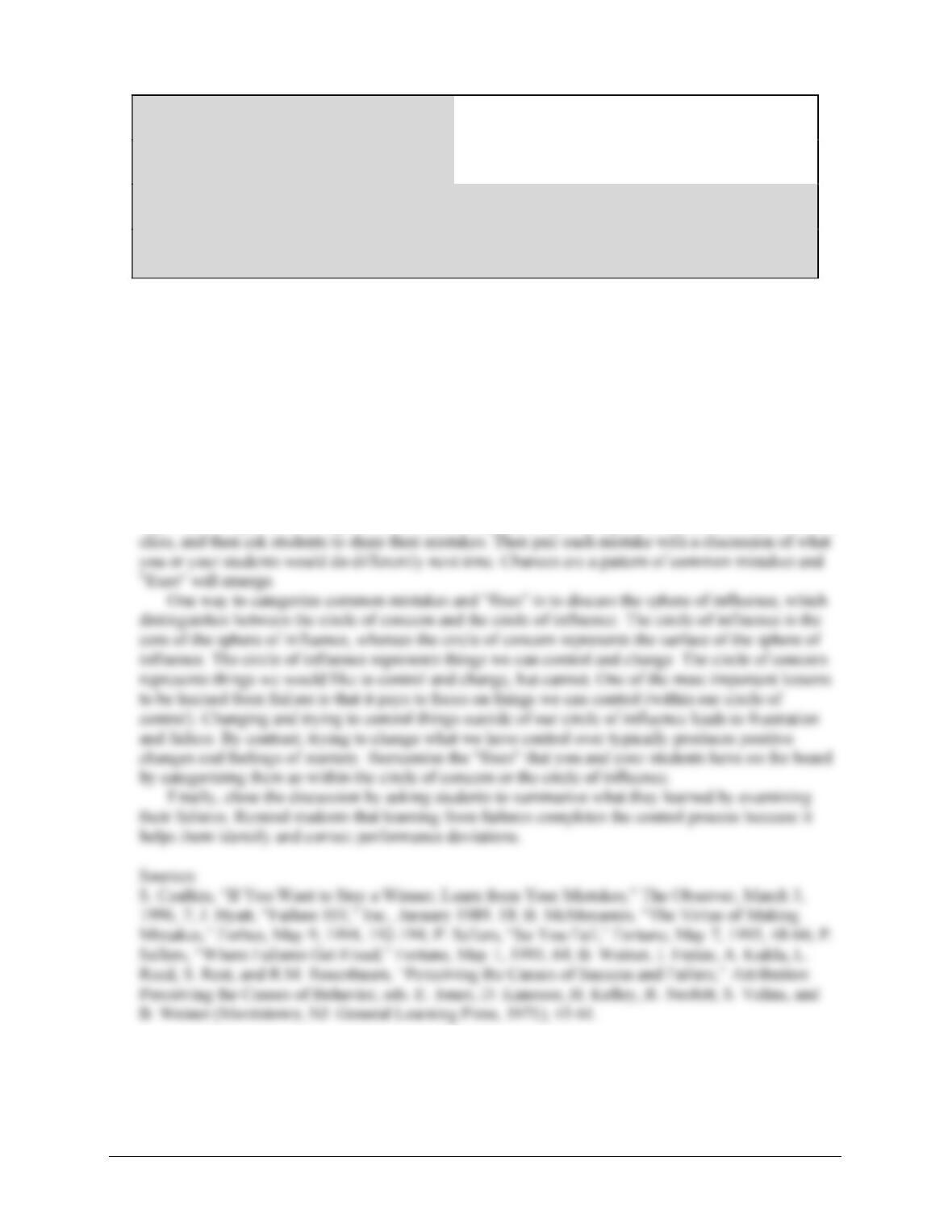
Figure 1: Attributions for Success and Failure
TASK
STABILITY
Stable
Ability
Task Difficulty
Unstable
Effort
Luck
Internal/External
LOCUS OF CAUSALITY
Sources:
B. Weiner, I. Freize, A. Kukla, L. Reed, S. Rest, and R.M. Rosenbaum, Perceiving the
Causes of Success and Failure, Attribution: Perceiving the Causes of Behavior, eds. E.
Jones, D. Kanouse, H. Kelley, R. Nesbitt, S. Valins, and B. Weiner (Morristown, NJ:
General Learning Press, 1971), p. 45-61.
3. One purpose of control is to identify and correct performance deviations. With that in mind, describe
three mistakes that you made that contributed to your failure. Now that youve had time to think
about it, what would you have done differently to prevent these mistakes? Finally, summarize what
you learned from your mistakes that will increase your chances of success the next time around.
Again, you might want to begin discussion of this question by sharing the mistakes you made with the
Additional Activities
Out-of-Class Project: “Control Case Study.” Divide the class into small groups. Each group should
thoroughly research a particular companys control practices. Those practices can include the methods of
control used, how well these methods worked, and what the results of the methods were. The research
should culminate in a paper or presentation to the class.
In-Class Activity: “Controlling Objectives.” Divide the class into small groups (3-4 students). Give