14 MULTIVARIABLE CALCULUS
EXERCISE 14-1
11
22
4. 3
30 15 10 4,500 cmVlwh
8. 23
7, 42, (49)(42) 686 2155.1 in
33
rh V rh
2
18. f(x, y, z) = 2x – 3y2 + 5z3 – 1
20. f(x, y, z) = 2x – 3y2 + 5z3 – 1
22.
!
,!!
n
Cnr rn r
,
13! 13!
13,5 1287
5! 13 5 ! 5!8!
C
24.
,2TRh RR h
,
4,12 2 4 4 12 2 4 16 128 402.1T
26.
2
1
,3
WRh Rh
,
2
11
3,10 3 10 9 10 30 94.2
W
28. A(P, r, t, n) = P1
tn
r
, A(10, 0.04, 3, 2) = 10
3(2)
0.04
12
= 10(1.02)6 ≈ 11.26
30.
1
1
11
, ; ( 1, ) ln ln ln1 1
Te
e
r
FrT x dx F e x dx x e
14-2 CHAPTER 14: MULTIVARIABLE CALCULUS
36. N(x, y) = 3xy + x2 – y2 + 1
38.
22
(,) 24
ddh
Vdh h
Npr
42. 1234 1 2 3 4
(, , , )Wx x x x x x x x 44. 222
(, ,)Txyz x y z
46. The volume of a right circular cone of radius r and height h is 2
1.
3
Vrh
The circumference C of the
C
22
1
CCh
48. F(x, y) = 5x – 4y + 12
50. F(x, y) = xy + 2x2 + y2 – 25
52. G(a, b, c) = a3 + b3 + c3 – (ab + ac + bc) – 6
The graph of y = G(2, x, 1) is shown at the right. The solutions of
G(2, x, 1) = 0 are:
x1 = –1.879, x2 = 0.347, x3 = 1.532.
5
54. f(x, y) = x2 + 2y2
2222
22 222
=
k
56. f(x, y) = 2xy2
22
222
=
k
k
58. Coordinates of point B = B(2, 0, 0). Coordinates of point H = H(0, 4, 3).
14-4 CHAPTER 14: MULTIVARIABLE CALCULUS
Copyright © 2019 Pearson Education, Inc.
2
720
z
x
and 22
2
720 3600
(,) () 5 .Mxz Mx x x x
x
x
The minimum value of M occurs at
12.16.x Thus, the dimensions of the box that requires the minimum amount of material are
12.16 12.16 4.87 (inches)
74. R(L, r) = k4
L
r, k a constant
4
76. L(w, v) = kwv2, k a constant
78. 12
12 2
(, ,) mm
Fm m r G r
F
F
(50)(100) 5,000
2
1, 600
(40)
EXERCISE 14-2
4. 22
() 3 4 , ‘() 6 4
f
xxexefxxe
f
8. 544
( ) (4 3 ) , ‘( ) 5(4 3 ) (4) 20(4 3 )
f
xxefx xe xe
dz
dx
16. 22
(1 )( ) (1)
,
x
xdz x x
zxdx
Copyright © 2019 Pearson Education, Inc.
22. z = 4x2y – 5xy2, z
y
= 4x2 – 10xy
x
26. f(x, y) = x2y2 – 5xy3, fx(x, y) = 2xy2 – 5y3, fx(4, 1) = 2(4)(1)2 – 5(1)3 = 8 – 5 = 3
y
4
x
4
(2)
30. f(x, y) = e3x–y2, fy(x, y) = e3x–y2(0 – 2y) = –2ye3x–y2,
32. f(x, y) =
22
2
1
x
y
x
,
222
(2 0)(1 ) 2 ( )
x
xxxy
33 2
2222
x
xxxy
2
22
x
xy
2
2(1 )
x
y
fx(–1, 2) =
22
(1 ( 1) )
= 2
2
4
34.
22,40 68 0.3 22 0.8 40 42.6 mpgM
36.
22,50 68 0.3 22 0.8 50 34.6 mpgM
38.
,0.8
y
Mxy ,
32,50 0.8 mpg per mph
y
M
40. f(x, y) = –2x + y + 8, fy(x, y) = –0 + 1 + 0 = 1, fyx(x, y) = 0
x
x
x
48. f(x, y) = (3x – 8y)6, fy(x, y) = 6(3x – 8y)5(0 – 8) = –48(3x – 8y)5
14-6 CHAPTER 14: MULTIVARIABLE CALCULUS
50. f(x, y) = (1 + 2xy2)8, fy(x, y) = 8(1 + 2xy2)7(4xy) = 32xy(1 + 2xy2)7
52. C(x, y) = 3x2 + 10xy – 8y2 + 4x – 15y – 120, Cy(x, y) = 10x – 16y – 15
54. Cy(x, y) = 10x – 16y – 15
58. Cy(x, y) = 10x – 16y – 15
60. Cyy(x, y) = –16
62.
,50405STr T r,
80,0 50 80 40 5 0 50 40 5 $10,000S
64.
, 50 40 5 250 2000 50 10000STr T r T r Tr
Daily sales increase at a rate of $200 per F
66.
, 50 40 5 250 2000 50 10000STr T r T r Tr
ST decreases at a rate of 50 $ / F per inch of rain
68. (A) f(x, y) = 3x + 2y,
f
x
= 3,
f
y
= 2
70. f(x, y) = x3y3 + x + y2, fx(x, y) = 3x2y3 + 1 ; fy(x, y) = 3x3y2 + 2y
72. f(x, y) =
2
x
y –
2
y
x
, fx(x, y) = 2
x
y +
2
2
y
x
; fy(x, y) = –
2
2
x
y
– 2y
x
fxx(x, y) = 2
y –
2
3
2y
x
, fxy(x, y) = – 2
2
x
y + 2
2y
x
= fyx(x, y), fyy(x, y) =
2
3
2
x
y
– 2
x
EXERCISE 14-2 14-7
74. f(x, y) = x ln(xy) = x(ln x + ln y) = x ln x + x ln y, fx(x, y) = ln x + 1 + ln y ; fy(x, y) =
x
x
x
y
76. C(x, y) = 2x2 + 2xy + 3y2 – 16x – 18y + 54, Cx(x, y) = 4x + 2y – 16 , Cy(x, y) = 2x + 6y – 18
78. G(x, y) = x2 ln y – 3x – 2y + 1, Gx(x, y) = 2x ln y – 3, Gy(x, y) =
2
x
From (2), y =
2
2
x
and substituting for y into (1),
2
x
x
Using a graphing utility, we find the x coordinate of the point of intersection of y1 = x ln
2
2
x
and y = 1.5
80. f(x, y) = 5 – 2x + 4y – 3x2 – y2
(A) f(2, y) = 5 – 4 + 4y – 12 – y2 = –11 + 4y – y2
(B) –7 is the maximum value of f(x, y) on the curve f(2, y); f(x, y) may have larger values on other curves
14-8 CHAPTER 14: MULTIVARIABLE CALCULUS
82. f(x, y) = ex + 2ey + 3xy2 + 1
(A) Let x = 1 and find the minimum value of f(1, y) = e + 2ey + 3y2 + 1
(B) fx(x, y) = ex + 3y2; fy(x, y) = 2ey + 6xy
84. f(x, y) = 2xy2
(A) 0
lim
h
(,)(,)
f
xhy fxy
h
= 0
lim
h
22
2( ) 2
x
hy xy
h
= 0
lim
h
222
222
x
yhyxy
h
2
2hy
(B) 0
lim
(, ) (, )
f
xy k f xy
= 0
lim
22
2( ) 2
x
yk xy
= 0
lim
222
2( 2 ) 2
x
ykyk xy
x
222
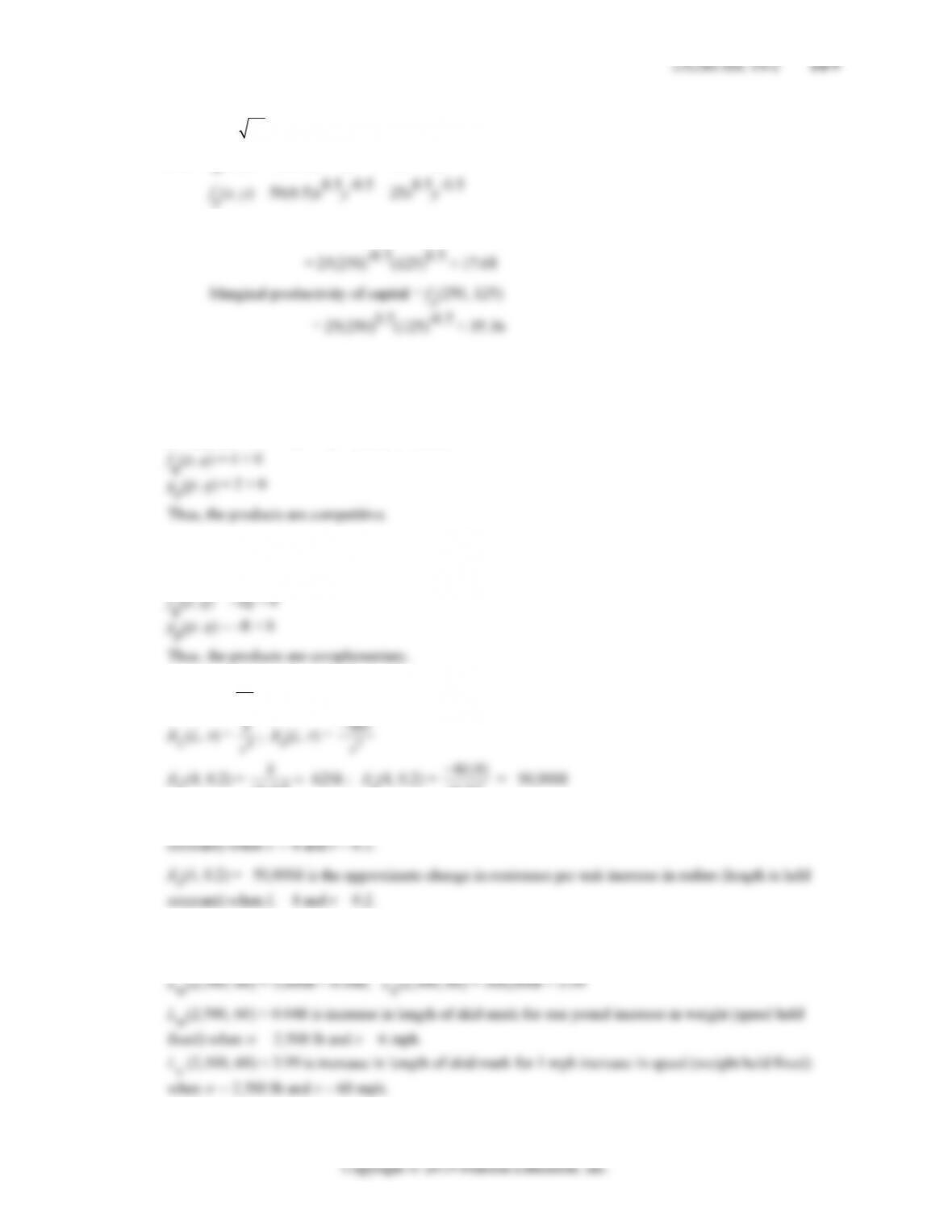
86. S(x, y) = 10x0.4y0.8, Sx(x, y) = 10(0.4)x-0.6y0.8 = 4x-0.6y0.8
Sx(3,000, 2,000) = 4(3,000)-0.6(2,000)0.8 = 14.34
Sales will increase approximately $14.34 per $1 increase in online advertising at the (3,000, 2,000)
expenditure level.
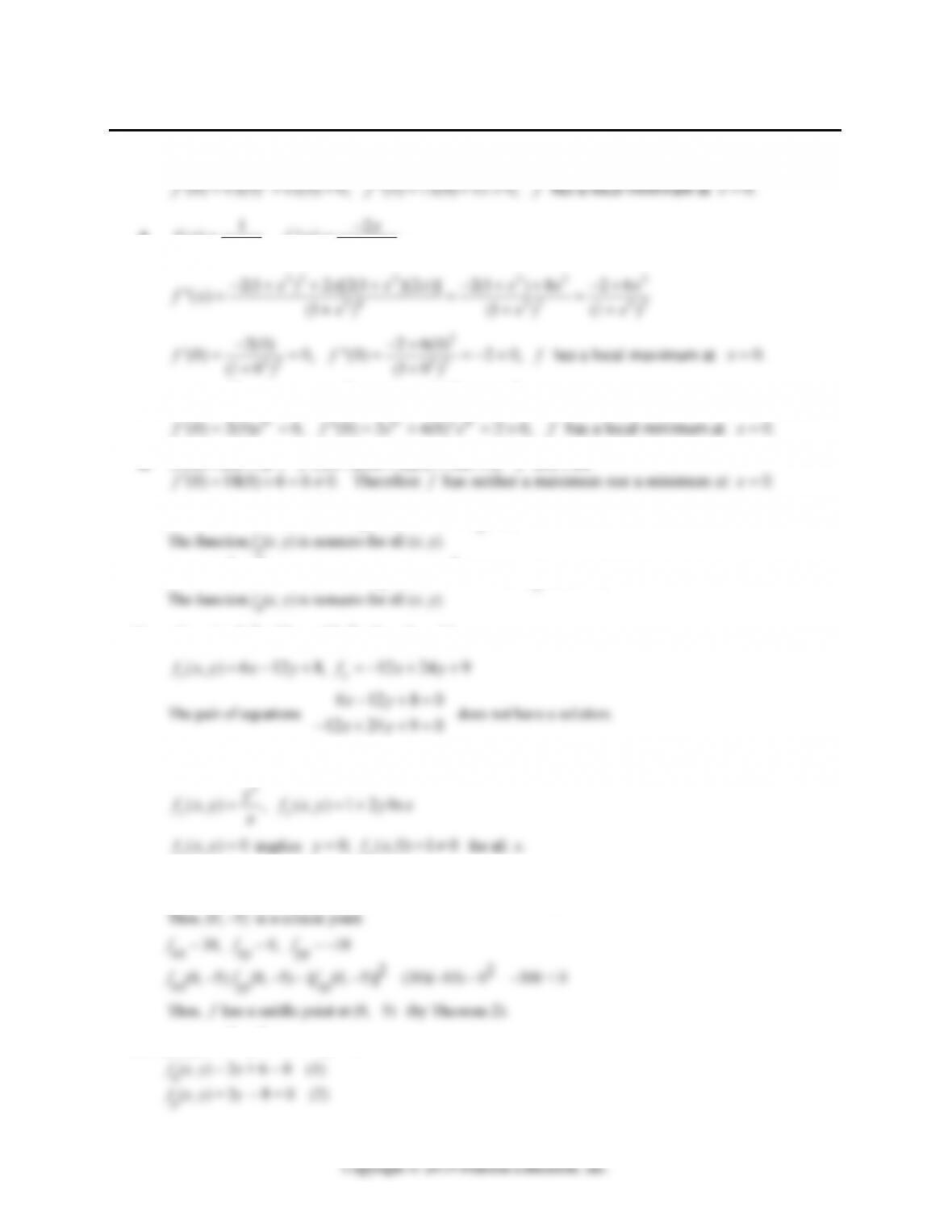
88. R(x, y) = xp + yq = x(230 – 9x + y) + y(130 + x – 4y) = 230x + 130y – 9x2 + 2xy – 4y2
Rx(x, y) = 230 – 18x + 2y
14-10 CHAPTER 14: MULTIVARIABLE CALCULUS
EXERCISE 14-3
2. 32 2
( ) 4 6 100, ‘( ) 12 12 , ”( ) 24 12fx x x f x x x f x x
4. 222
() , ‘() ,
1(1)
fx f x
xx
x
22 2 2 2 2
2(1 ) 2 [2(1 )(2 )] 2(1 ) 8 2 6
x
xxx xx x
6. 2222
2
() , ‘() 2 , ‘‘() 2 4 .
x
xxx
f
xe fx xe fx e xe
0020
8. 2
() (3 1), ‘() 2(3 1)(3) 18 6, ‘‘() 18fx x f x x x f x
10. f(x, y) = 10 – 2x – 3y + x2, fx(x, y) = –2 + 2x, fy(x, y) = –3 ≠ 0
12. f(x, y) = x3 – y2 + 7x + 3y + 1, fx(x, y) = 3x2 + 7 ≠ 0, fy(x, y) = –2y + 3
14. 22
( , ) 3 12 12 8 9 15fxy x xy y x y
12 24 9 0
xy
16. 2
(, ) ln
f
xy y y x
f
2
y
x
y
18. 22
(, ) 15 10
f
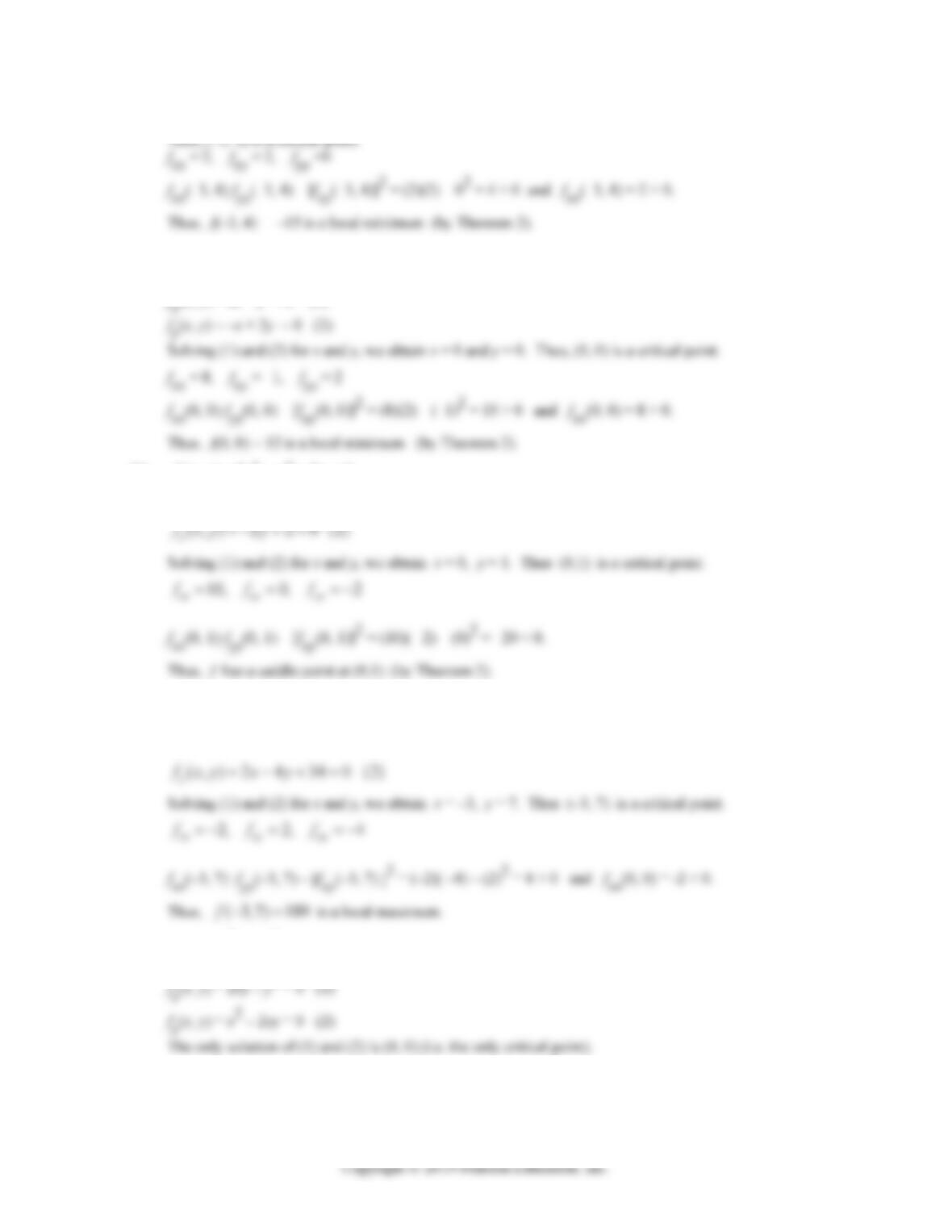
xy x y y, fx(x, y) = 30x = 0, x = 0, fy(x, y) = –2y – 10 = 0, y = –5
20.. f(x, y) = x2 + y2 + 6x – 8y + 10
EXERCISE 14-3 14-11
Solving (1) and (2) for x and y, we obtain x = –3 and y = 4.
22. f(x, y) = 4x2 – xy + y2 +12,
fx(x, y) = 8x – y = 0 (1)
24. 22
(, ) 5 2 6fxy x y y
(, ) 10 0(1)
x
fxy x
26. 22
(, ) 2 2 20 34 40fxy x xy y x y
(, ) 2 2 20 0 (1)
x
fxy x y
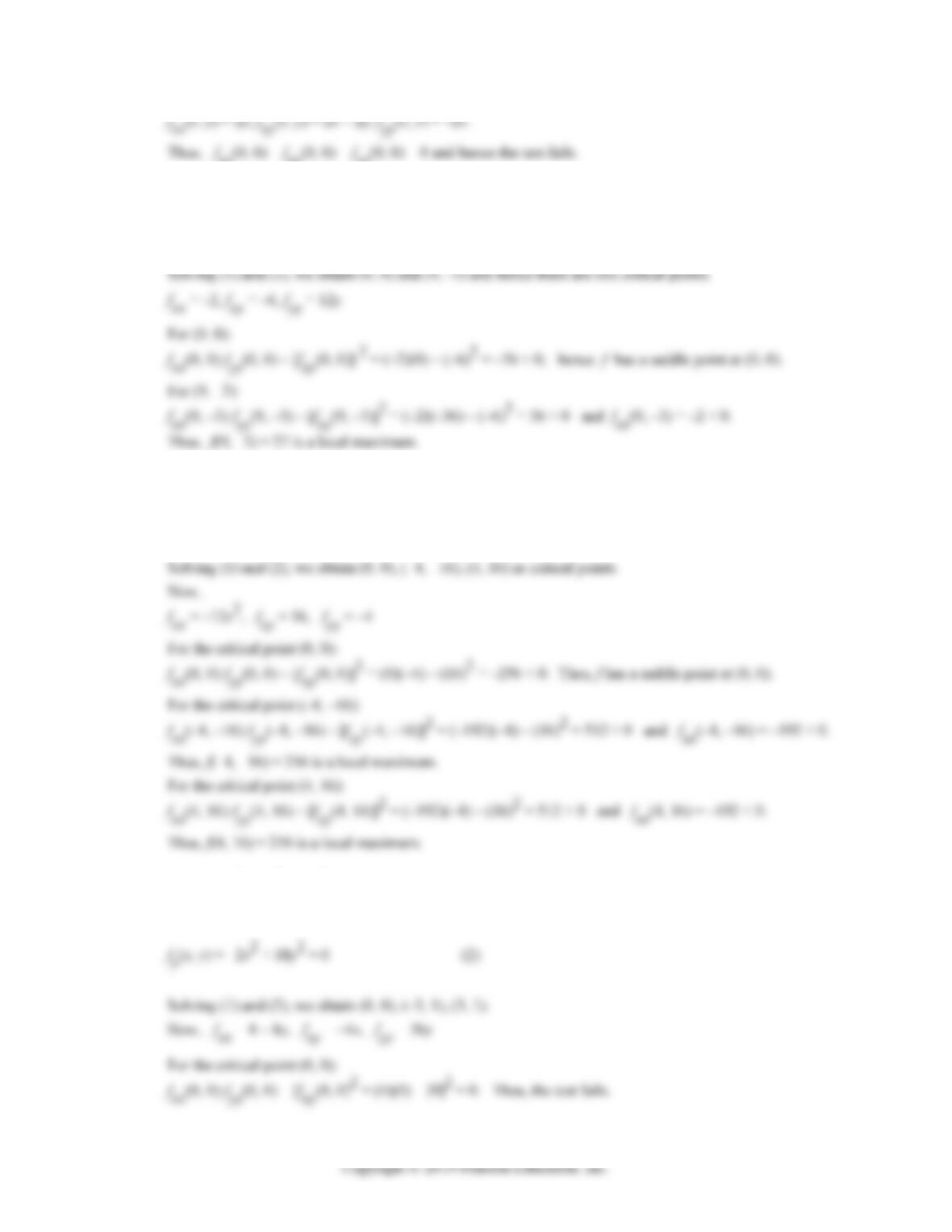
28. f(x, y) = x2y – xy2
14-12 CHAPTER 14: MULTIVARIABLE CALCULUS
Copyright © 2019 Pearson Education, Inc.
fxx(x, y) = 2y, fxy(x, y) = 2x – 2y, fyy(x, y) = –2x.
Thus, fxx(0, 0) = fxy(0, 0) = fyy(0, 0) = 0 and hence the test fails.
30. f(x, y) = 2y3 – 6xy – x2
fx(x, y) = –6y – 2x = 0 (1)
fy(x, y) = 6y2 – 6x = 0 (2)
32. f(x, y) = 16xy – x4 – 2y2
fx(x, y) = 16y – 4x3 = 0 (1)
fy(x, y) = 16x – 4y = 0 (2)
34. f(x, y) = 2x2 – 2x2y + 6y3
fx(x, y) = 4x – 4x y = 0 (1)
EXERCISE 14-3 14-13
For the critical point (–3, 1):
36. (, ) ln 3 0fxyyxxy
(, ) 3 0 (1)
x
y
fxy y
x
38. (A) f(x, y) = x + y, fx(x, y) = 1 ≠ 0, fy(x, y) = 1 ≠ 0. Thus, f has no local extrema.
g(x, y) = x2 + y2
gx(x, y) = 2x = 0 (1)
gy(x, y) = 2y = 0 (2)
(B) k(x, y) = xn + yn
kx(x, y) = nxn–1 = 0 (5)
14-14 CHAPTER 14: MULTIVARIABLE CALCULUS
40. (A) g( x, y) = exy2 + x2y3 + 2
gx(x, y) = y2exy2 + 2xy3 = 0 (1)
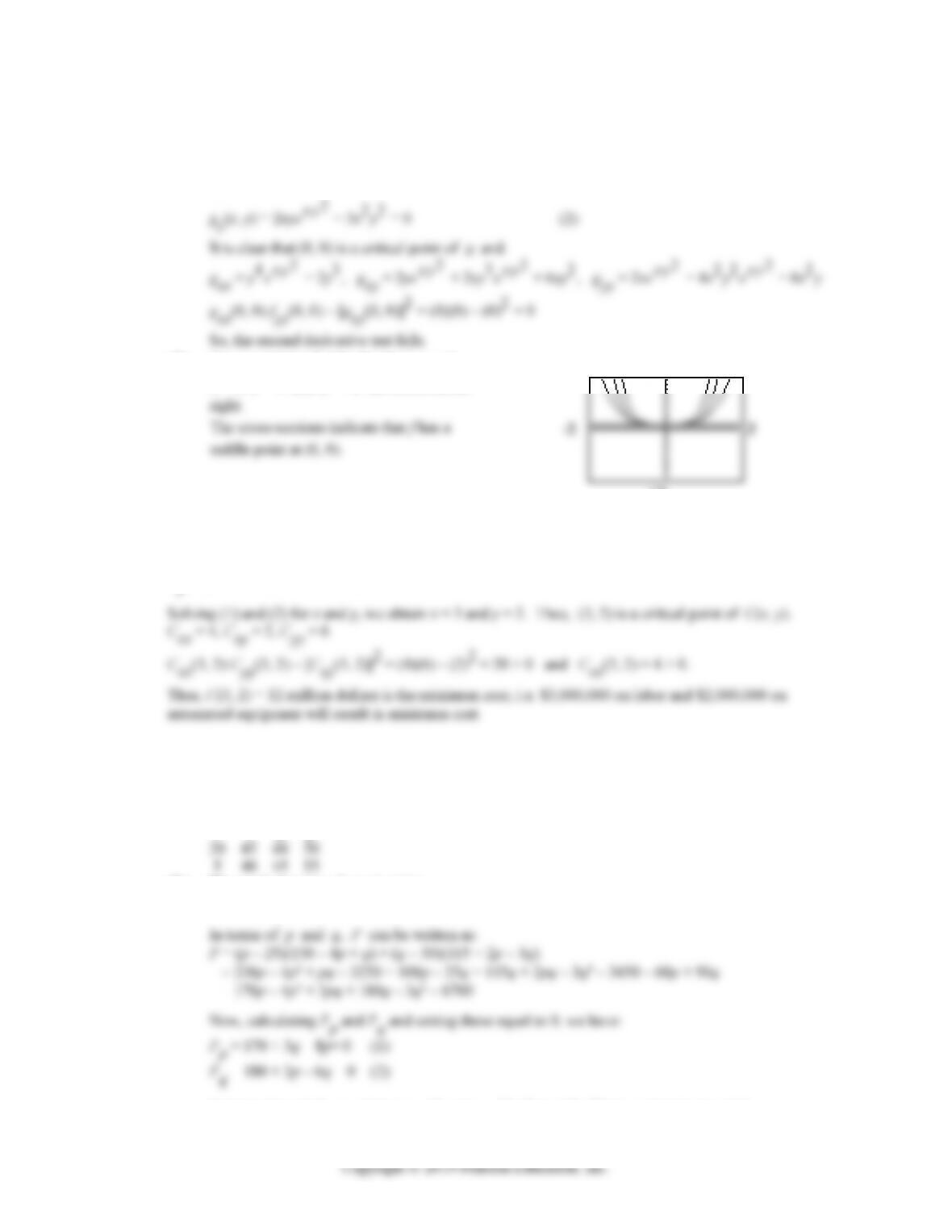
(B) Cross-sections of f by the planes y = 0,
x = 0, y = x and y = –x are shown at the
10
-10
42. C(x, y) = 2x2 + 2xy + 3y2 – 16x – 18y + 54
Cx(x, y) = 4x + 2y – 16 = 0 (1)
Cy(x, y) = 2x + 6y – 18 = 0 (2)
44. x = 130 – 4p + q (Brand A)
y = 115 + 2p – 3q (Brand B)
(A)
x y p q
(B) The profit function P is given by:
P(x, y) = R(x, y) – C(x, y) = px + qy – (25x + 30y) = (p – 25)x + (q – 30)y
Solving (1) and (2), we obtain p = 40 and q = 50. Thus, (40, 50) is a critical point of P.
EXERCISE 14-3 14-15
Copyright © 2019 Pearson Education, Inc.
Ppp = –8, Ppq = 3, Pqq = –6
Ppp(40, 50)·Pqq(40, 50) – [Ppq(40, 50)]2 = (–8)(–6) – (3)2 = 39 > 0 and Ppp(40, 50) = –8 < 0.
Thus, P has a maximum at (40, 50); the daily maximum profit is P(40, 50) = 1200. Therefore, for p
= $40, q = $50, the maximum daily profit is $1200.
46. The square of the distance from P to A is: x2 + y2. The square of the distance from P to B is:
(x – 6)2 + (y – 9)2 = x2 – 12x + y2 – 18y + 117
The square of the distance from P to C is: (x – 9)2 + (y – 0)2 = x2 – 18x + y2 + 81
48. Let x = length, y = width, and z = height. Then V = xyz = 72 or z = 72
x
y.
The surface area of the box is:
S = xy + 3xz + 3yz or S(x, y) = xy + 216
y + 216
x
, x > 0, y > 0
x
x
216
216
Substituting (2) into (1) we have: y = 2
216 2
216
y
=
4
216
y
Since y > 0, y = 0 does not yield a critical point, so only y = 6 is acceptable. Setting y = 6 in (2) we find
x = 6. Therefore, the critical point is (6, 6). Now we have:
Sxx = 3
432
x
and Sxx(6, 6) = 2
50. Let x = length of the box, y = width, and z = height.
14-16 CHAPTER 14: MULTIVARIABLE CALCULUS
Thus, we have:
V(x, y, z) = xy(36 – x – y) = 36xy – x2y – xy2, x > 0, y > 0
Therefore,
36 – 2x – y = 0 (2)
36 – x – 2y = 0 (3)
Solving (2) and (3) for x and y, we obtain x = 12 and y = 12. Thus, (12, 12) is the critical point.
EXERCISE 14-4
2. Maximize 22
(, ) 64 3 , subject to: 6.fxy x xy y x
4. Maximize (, ) 3 , subject to: 1or 1 .
f
xy xy x y y x
2
(,1)3(1)33, ‘(,1)36, ‘‘(,1) 6fxxxxxxfxx xfxx
14-18 CHAPTER 14: MULTIVARIABLE CALCULUS
12. Step 1. Maximize f(x, y) = 6x + 5y + 24 subject to 3x + 2y – 4 = 0.
Step 2. F(x, y,
) = 6x + 5y + 24 +
(3x + 2y – 4)
Step 3. Fx = 6 + 3
= 0 (1)
F
14. Step 1. Maximize and minimize f(x, y) = x2 – y2
Step 2. F(x, y,
) = f(x, y) +
g(x, y)
Step 3. Fx = 2x + 2
x = 0 (1)
Fy = –2y + 2
y = 0 (2)
F
From (1), (2), and (3), we obtain the critical points
(5, 0, –1), (–5, 0, 1), (0, 5, 1) and (0, –5, –1).
Step 4. f(5, 0) = 25
16. Let x and y be the required numbers.
Step 1. Minimize f(x, y) = xy
Subject to: x – y = 10 or g(x, y) = x – y – 10 = 0
Step 2. F(x, y,
) = xy +
(x – y – 10)
Step 3. Fx = y +
= 0 (1)
Fy = x –
= 0 (2)
Step 4. Since (5, –5, 5) is the only critical point for F, we conclude that min f(x, y) = f(5, –5) = –
18. Step 1. Maximize 222
(, ,) 300 2
f
xyz x y z
Step 2. F(x, y, z,
) = 222
300 2
x
yz +
(4x + y + z – 70)
EXERCISE 14-4 14-19
Step 3. Fx = –2x + 4
= 0 (1)
Fy = –4y +
= 0 (2)
F
20. Step 1. Minimize 222
(, ,) 4 2
f
xyz x y z
Step 2. F(x, y, z,
) = 222
42
x
yz+
(x + 2y + z – 10)
Step 3. Fx = 2x +
= 0 (1)
Fy = 8y + 2
= 0 (2)
22. Step 1. Maximize and minimize f(x, y, z) = 3x + y + 2z
Step 2. F(x, y, z,
) = 3x + y + 2z +
(2x2 +3y2 + 4z2 – 210)
Step 3. Fx = 3 + 4
x = 0 (1)
Fy = 1 + 6
y = 0 (2)
4
6
84
14-20 CHAPTER 14: MULTIVARIABLE CALCULUS
Substituting these into (4), we have:
222
18 3 4 210 0
Step 4. f(–9, –2, –3) = –27 – 2 – 6 = –35
24. Step 1. Maximize and minimize f(x, y, z) = x – y – 3z
Subject to: g(x, y, z) = x2 + y2 +z2 – 99 = 0
Step 2. F(x, y, z,
) = x – y – 3z +
(x2 + y2 + z2 – 99)
Step 3. Fx = 1 + 2
x = 0 (1)
Fy = –1 + 2
y = 0 (2)
Step 4. f(3, –3, –9) = 33 and f(–3, 3, 9) = –33.
26. Step 1. Minimize f(x, y) = x3 + 2y3
Step 2. F(x, y,
) = x3 + 2y3 +
(6x – 2y – 1)
Step 3. Fx = 3x2 + 6
= 0 (1)