
Chapter 14
Multinational Capital Budgeting
Lecture Outline
Subsidiary versus Parent Perspective
Tax Differentials
Restrictions on Remitted Earnings
Exchange Rate Movements
Input for Multinational Capital Budgeting
Multinational Capital Budgeting Example
Background
Analysis
Other Factors to Consider
Exchange Rate Fluctuations
Inflation
Adjusting Project Assessment for Risk
Risk-Adjusted Discount Rate
Sensitivity Analysis
Simulation

Multinational Capital Budgeting ❖ 2
Chapter Theme
This chapter identifies additional considerations in multinational capital budgeting versus domestic
capital budgeting. These considerations can either be explained briefly or illustrated with the use of an
example.
Topics to Stimulate Class Discussion
1. Create an idea for a firm to expand its operations overseas. Provide the industry of the firm. Given
this information, students should be requested to list all information that needs to be gathered in order
to conduct a capital budgeting analysis.
2. How should a firm adjust the capital budgeting analysis for investment in a country where the
currency is extremely volatile?
3. How should a firm adjust the capital budgeting for investment in a country where the chance of a
government takeover is relatively high?
POINT/COUNTER-POINT
Should MNCs Use Forward Rates to Estimate Dollar Cash Flows of Foreign
Projects?
POINT: Yes. An MNC’s parent should use the forward rate for each year in which it will receive net cash
flows in a foreign currency. The forward rate is market-determined and serves as a useful forecast for
future years.
COUNTER-POINT: No. An MNC should use its own forecasts for each year in which it will receive net
cash flows in a foreign currency. If the forward rates for future time periods are higher than the MNC’s
expected spot rates, the MNC may accept a project that it should not accept.
WHO IS CORRECT? Use the Internet to learn more about this issue. Which argument do you support?
Offer your own opinion on this issue.
ANSWER: An MNC should only use the forward rate in place of its expectations if it plans to hedge its
Answers to End of Chapter Questions
1. MNC Parent’s Perspective. Why should capital budgeting for subsidiary projects be assessed from
the parent’s perspective? What additional factors that normally are not relevant for a purely domestic
project deserve consideration in multinational capital budgeting?
ANSWER: When a parent allocates funds for a project, it should view the project’s feasibility from
its own perspective. It is possible that a project could be feasible from a subsidiary’s perspective but
Multinational Capital Budgeting ❖ 3
2. Accounting for Risk. What is the limitation of using point estimates of exchange rates in the capital
budgeting analysis?
List the various techniques for adjusting risk in multinational capital budgeting. Describe any
advantages or disadvantages of each technique.
Explain how simulation can be used in multinational capital budgeting. What can it do that other risk
adjustment techniques cannot?
ANSWER: Point estimates of exchange rates lead to a point estimate of a project’s NPV. It is more
3. Uncertainty of Cash Flows. Using the capital budgeting framework discussed in this chapter,
explain the sources of uncertainty surrounding a proposed project in Hungary by a U.S. firm. In what
ways is the estimated net present value of this project more uncertain than that of a similar project in a
more developed European country?
4. Accounting for Risk. Your employees have estimated the net present value of project X to be $1.2
million. Their report says that they have not accounted for risk, but that with such a large NPV, the
project should be accepted since even a risk-adjusted NPV would likely be positive. You have the
final decision as to whether to accept or reject the project. What is your decision?
5. Impact of Exchange Rates on NPV.
a. Describe in general terms how future appreciation of the euro will likely affect the value (from
the parent’s perspective) of a project established in Germany today by a U.S.-based MNC. Will the
sensitivity of the project value be affected by the percentage of earnings remitted to the parent each
year?
b. Repeat this question, but assume the future depreciation of the euro.
6. Impact of Financing on NPV. Explain how the financing decision can influence the sensitivity of
the net present value to exchange rate forecasts.
7. September 11 Effects on NPV. In August 2001, Woodsen Inc. of Pittsburgh, PA considered the
development of a large subsidiary in Greece. In response to the September 11, 2001 terrorist attack on
the U.S., its expected cash flows and earnings from this acquisition were reduced only slightly. Yet,
the firm decided to retract its offer because of an increase in its required rate of return on the project,
which caused the NPV to be negative. Explain why the required rate of return on its project may have
increased after the attack.
8. Assessing a Foreign Project. Huskie Industries, a U.S.-based MNC, considers purchasing a small
manufacturing company in France that sells products only within France. Huskie has no other
existing business in France and no cash flows in euros. Would the proposed acquisition likely be
more feasible if the euro is expected to appreciate or depreciate over the long run? Explain.
9. Relevant Cash Flows in Disney’s French Theme Park. When Walt Disney World considered
establishing a theme park in France, were the forecasted revenues and costs associated with the
French park sufficient to assess the feasibility of this project? Were there any other “relevant cash
flows” that deserved to be considered?
10. Capital Budgeting Logic. Athens, Inc. established a subsidiary in the United Kingdom that was
independent of its operations in the United States. The subsidiary’s performance was well above
what was expected. Consequently, when a British firm approached Athens about the possibility of
acquiring the subsidiary, Athens’ chief financial officer replied that the subsidiary was performing so
well that it was not for sale. Comment on this strategy.
11. Capital Budgeting Logic. Lehigh Co. established a subsidiary in Switzerland that was performing
below the cash flow projections developed before the subsidiary was established. Lehigh anticipated
that future cash flows would also be lower than the original cash flow projections. Consequently,
Lehigh decided to inform several potential acquiring firms of its plan to sell the subsidiary. Lehigh
then received a few bids. Even the highest bid was very low, but Lehigh accepted the offer. It
justified its decision by stating that any existing project whose cash flows are not sufficient to recover
the initial investment should be divested. Comment on this statement.
12. Impact of Reinvested Foreign Earnings on NPV. Flagstaff Corp. is a U.S.-based firm with a
subsidiary in Mexico. It plans to reinvest its earnings in Mexican government securities for the next
10 years since the interest rate earned on these securities is so high. Then, after 10 years, it will remit
all accumulated earnings to the United States. What is a drawback of using this approach? (Assume
the securities have no default or interest rate risk.)
13. Capital Budgeting Example. Brower, Inc. just constructed a manufacturing plant in Ghana. The
construction cost 9 billion Ghanian cedi. Brower intends to leave the plant open for three years.
During the three years of operation, cedi cash flows are expected to be 3 billion cedi, 3 billion cedi,
and 2 billion cedi, respectively. Operating cash flows will begin one year from today and are remitted
back to the parent at the end of each year. At the end of the third year, Brower expects to sell the plant
for 5 billion cedi. Brower has a required rate of return of 17 percent. It currently takes 8,700 cedi to
buy one U.S. dollar, and the cedi is expected to depreciate by 5 percent per year.
Multinational Capital Budgeting ❖ 6
a. Determine the NPV for this project. Should Brower build the plant?
ANSWER:
Cash Flows:
Year 0 1 2 3
Investment –9
b. How would your answer change if the value of the cedi was expected to remain unchanged from
its current value of 8,700 cedis per U.S. dollar over the course of the three years? Should Brower
construct the plant then?
ANSWER:
If the cedi was expected to remain unchanged from its current value of 8700 cedis per U.S. dollar
over the course of the three years:
Year 0 1 2 3
14. Impact of Financing on NPV. Ventura Corp., a U.S.-based MNC, plans to establish a subsidiary in
Japan. It is confident that the Japanese yen will appreciate against the dollar over time. The
subsidiary will retain only enough revenue to cover expenses and will remit the rest to the parent each
year. Will Ventura benefit more from exchange rate effects if its parent provides equity financing for
the subsidiary or if the subsidiary is financed by local banks in Japan? Explain.
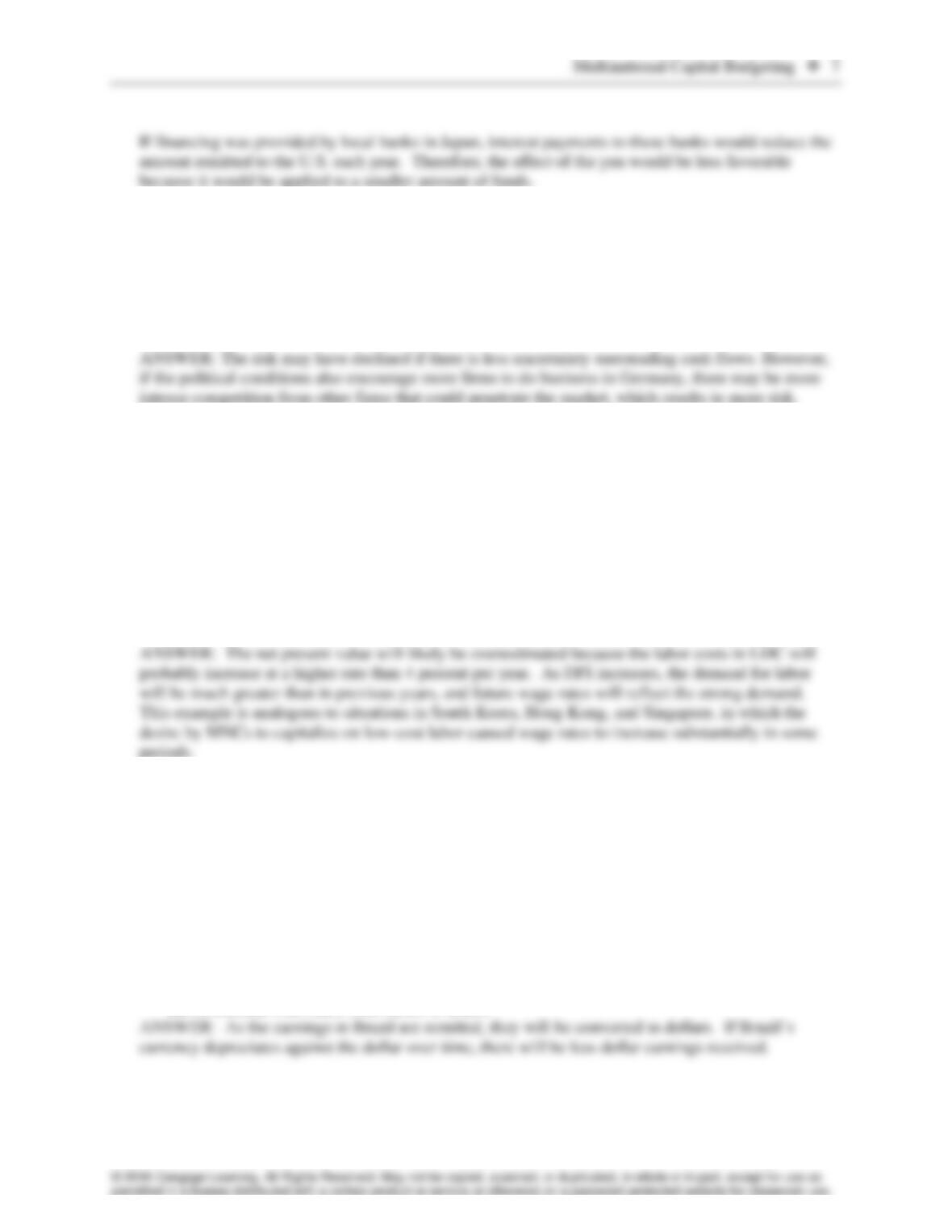
15. Accounting for Changes in Risk. Santa Monica Co., a U.S.-based MNC, was considering
establishing a consumer products division in Germany, which would be financed by German banks.
Santa Monica completed its capital budgeting analysis in August. Then, in November, the
government leadership stabilized and political conditions improved in Germany. In response, Santa
Monica increased its expected cash flows by 20 percent but did not adjust the discount rate applied to
the project. Should the discount rate be affected by the change in political conditions?
16. Estimating the NPV. Assume that a less developed country called LDC encourages direct foreign
investment (DFI) in order to reduce its unemployment rate, currently at 15 percent. Also assume that
several MNCs are likely to consider DFI in this country. The inflation rate in recent years has
averaged 4 percent. The hourly wage in LDC for manufacturing work is the equivalent of about $5
per hour. When Piedmont Co. develops cash flow forecasts to perform a capital budgeting analysis
for a project in LDC, it assumes a wage rate of $5 in Year 1 and applies a 4 percent increase for each
of the next 10 years. The components produced are to be exported to Piedmont’s headquarters in the
United States, where they will be used in the production of computers. Do you think Piedmont will
overestimate or underestimate the net present value of this project? Why? (Assume that LDC’s
currency is tied to the dollar and will remain that way.)
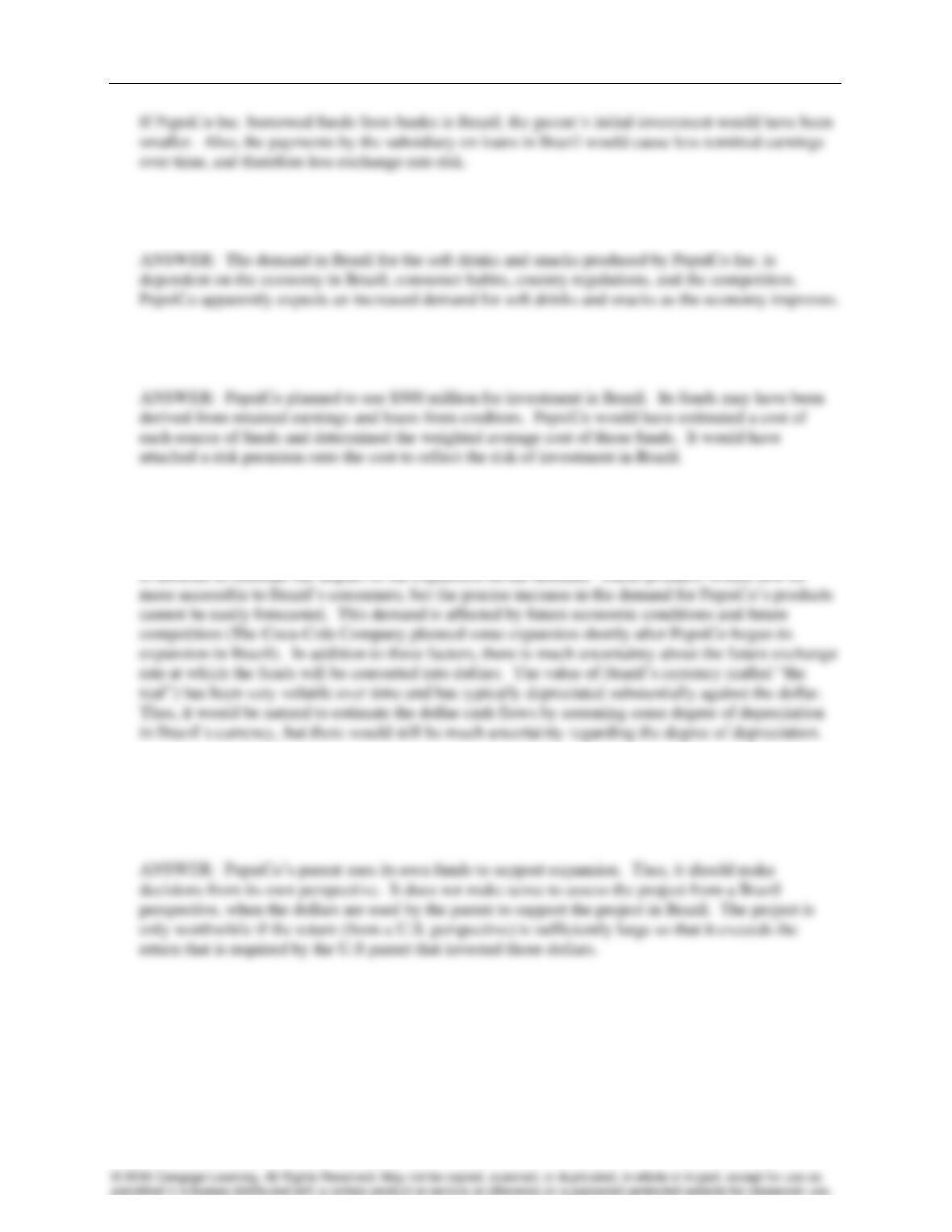
17. PepsiCo’s Project in Brazil. PepsiCo recently decided to invest more than $300 million for
expansion in Brazil. Brazil offers considerable potential because it has 150 million people and their
demand for soft drinks is increasing. However, the soft drink consumption is still only about one-fifth
of the soft drink consumption in the U.S. PepsiCo’s initial outlay was used to purchase three
production plants and a distribution network of almost 1,000 trucks to distribute its products to retail
stores in Brazil. The expansion in Brazil was expected to make PepsiCo’s products more accessible to
Brazilian consumers.
a. Given that PepsiCo’s investment in Brazil was entirely in dollars, describe its exposure to
exchange rate risk resulting from the project. Explain how the size of the parent’s initial
investment and the exchange rate risk would have been affected if PepsiCo had financed much of
the investment with loans from banks in Brazil.
Multinational Capital Budgeting ❖ 8
b. Describe the factors that PepsiCo likely considered when estimating the future cash flows of the
project in Brazil.
c. What factors did PepsiCo likely consider in deriving its required rate of return on the project in
Brazil?
d. Describe the uncertainty that surrounds the estimate of future cash flows from the perspective of
the U.S. parent.
ANSWER: There is some uncertainty about the demand for PepsiCo’s products in Brazil, because it
e. PepsiCo’s parent was responsible for assessing the expansion in Brazil. Yet, PepsiCo already had
some existing operations in Brazil. When capital budgeting analysis was used to determine the
feasibility of this project, should the project have been assessed from a Brazil perspective or a
U.S. perspective? Explain.
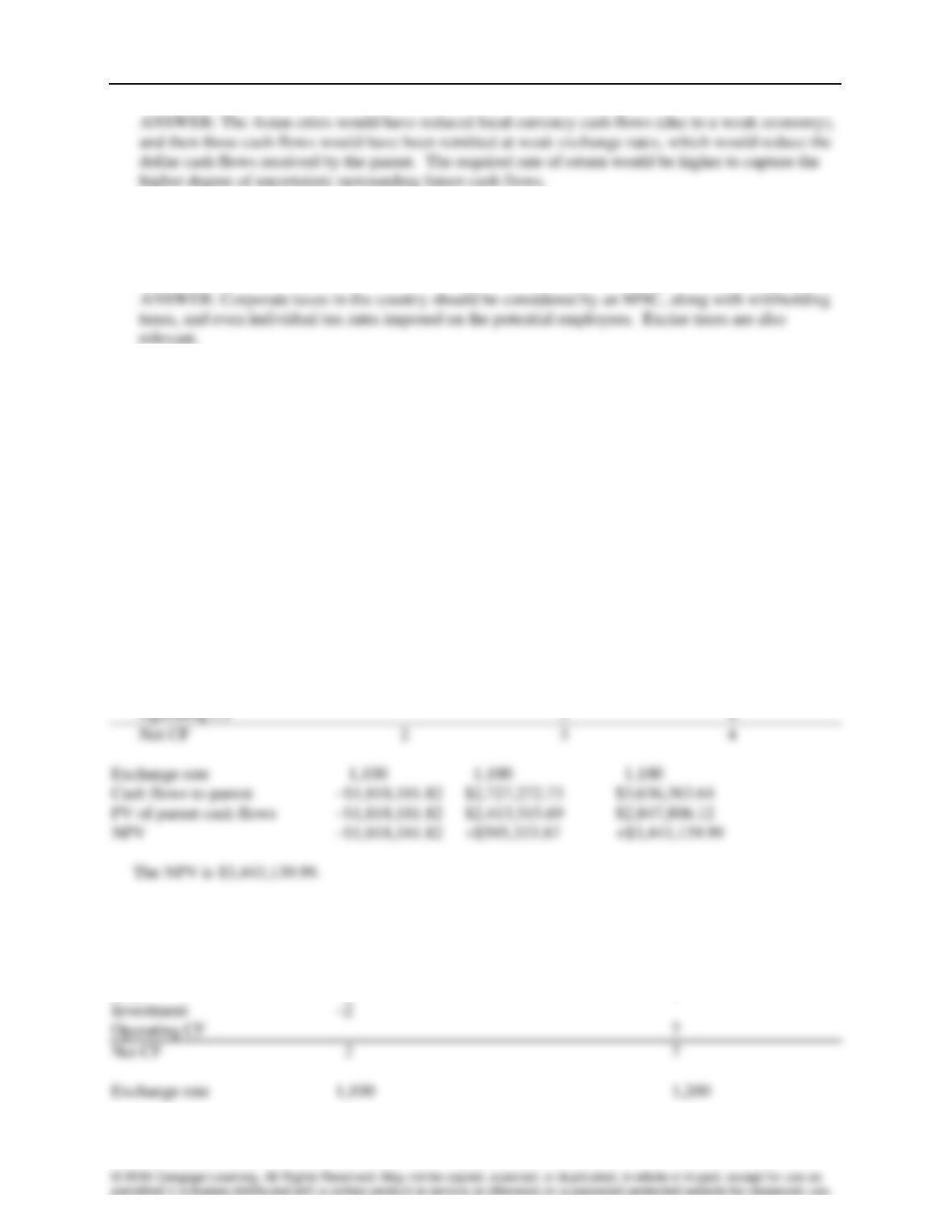
18. Impact of Asian Crisis. Assume that Fordham Co. was evaluating a project in Thailand (to be
financed with U.S. dollars). All cash flows generated from the project were to be reinvested in
Thailand for several years. Explain how the Asian crisis would have affected the expected cash flows
of this project and the required rate of return on this project. If the cash flows were to be remitted to
the U.S. parent, explain how the Asian crisis would have affected the expected cash flows of this
project.
Multinational Capital Budgeting ❖ 9
19. Tax Effects on NPV. When considering the implementation of a project in one of various possible
countries, what types of tax characteristics should be assessed among the countries? (See the chapter
appendix)
20. Capital Budgeting Analysis. A project in South Korea requires an initial investment of 2 billion
South Korean won. The project is expected to generate net cash flows to the subsidiary of 3 billion
and 4 billion won in the two years of operation, respectively. The project has no salvage value. The
current value of the won is 1,100 won per U.S. dollar, and the value of the won is expected to remain
constant over the next two years.
a. What is the NPV of this project if the required rate of return is 13 percent?
b. Repeat the question, except assume that the value of the won is expected to be 1,200 won per
U.S. dollar after two years. Further assume that the funds are blocked and that the parent
company will only be able to remit them back to the U.S. in two years. How does this affect the
NPV of the project?
ANSWER:
Year 0 1 2
Investment –2
ANSWER:
Year 0 2
Multinational Capital Budgeting ❖ 10
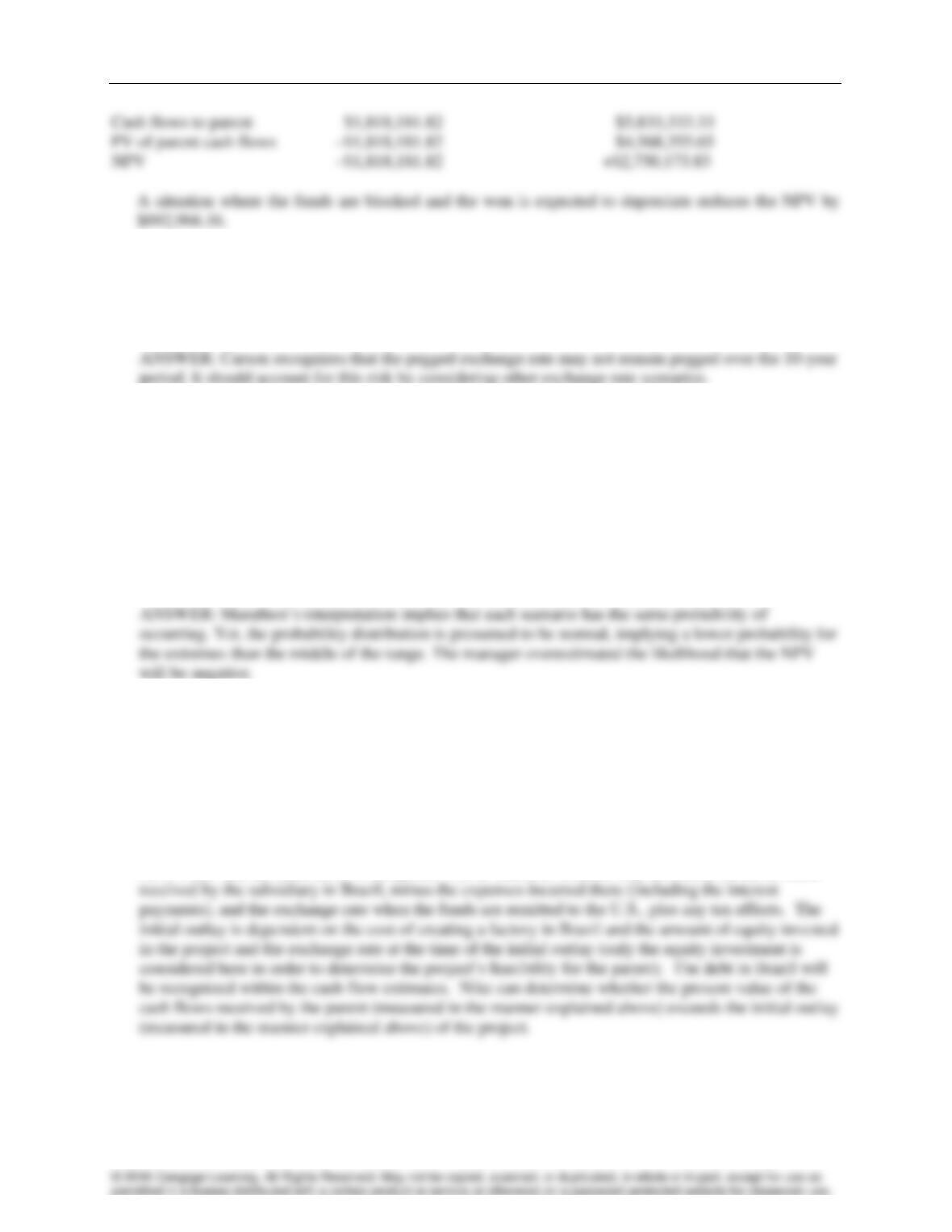
21. Accounting for Exchange Rate Risk. Carson Co. is considering a 10-year project in Hong Kong,
where the Hong Kong dollar is tied to the U.S. dollar. Carson Co. uses sensitivity analysis that allows
for alternative exchange rate scenarios. Why would Carson use this approach rather than using the
pegged exchange rate as its exchange rate forecast in every year?
22. Decisions Based on Capital Budgeting. Marathon Inc. considers a one-year project with the Belgian
government. Its euro revenue would be guaranteed. Its consultant states that the percentage change in
the euro is represented by a normal distribution, and that based on a 95 percent confidence interval,
the percentage change in the euro is expected to be between 0 percent and 6 percent. Marathon uses
this information to create three scenarios: 0%, 3%, and 6% for the euro. It derives an estimated NPV
based on each scenario, and then determines the mean NPV. The NPV was positive for the 3% and
6% scenarios, but was slightly negative for the 0 percent scenario. This led Marathon to reject the
project. Its manager stated that it did not want to pursue a project that had a one-in-three chance of
having a negative NPV. Do you agree with the manager’s interpretation of the analysis? Explain.
23. Estimating Cash Flows of a Foreign Project. Assume that Nike decides to build a shoe factory in
Brazil, half the initial outlay will be funded by the parent’s equity and half by borrowing funds in
Brazil. Assume that Nike wants to assess the project from its own perspective to determine whether
the project’s future cash flows will provide a sufficient return to the parent to warrant the initial
investment. Why will the estimated cash flows be different from the estimated cash flows of Nike’s
shoe factory in New Hampshire? Why will the initial outlay be different? Explain how Nike can
conduct multinational capital budgeting in a manner that will achieve its objective.
ANSWER: The net cash flows to the parent will be different because they are based on the revenue
Multinational Capital Budgeting ❖ 11
Advanced Questions
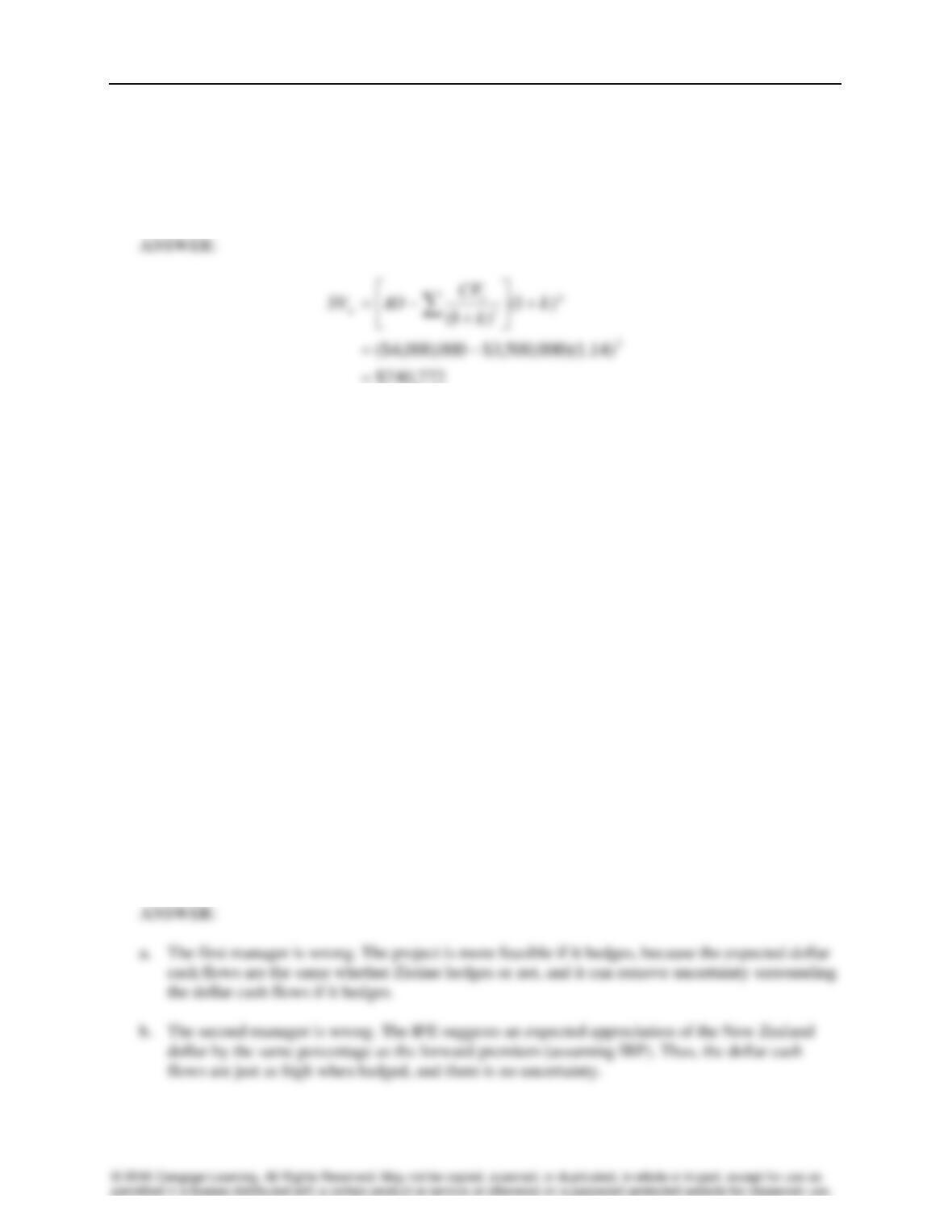
24. Break-even Salvage Value. A project in Malaysia costs $4,000,000. Over the next three years, the
project will generate total operating cash flows of $3,500,000, measured in today’s dollars using a
required rate of return of 14 percent. What is the break-even salvage value of this project?
25. Capital Budgeting Analysis. Zistine Co. considers a one-year project in New Zealand so that it can
capitalize on its technology. It is risk-averse, but is attracted to the project because of a government
guarantee. The project will generate a guaranteed NZ$8 million in revenue, paid by the New Zealand
government at the end of the year. The payment by the New Zealand government is also guaranteed
by a credible U.S. bank. The cash flows earned on the project will be converted to U.S. dollars and
remitted to the parent in one year. The prevailing nominal one-year interest rate in New Zealand is
5% while the nominal one-year interest rate in the U.S. is 9%. Zistine’s chief executive officer
believes that the movement in the New Zealand dollar is highly uncertain over the next year, but his
best guess is that the change in its value will be in accordance with the international Fisher effect. He
also believes that interest rate parity holds. He provides this information to three recent finance
graduates that he just hired as managers and asks them for their input.
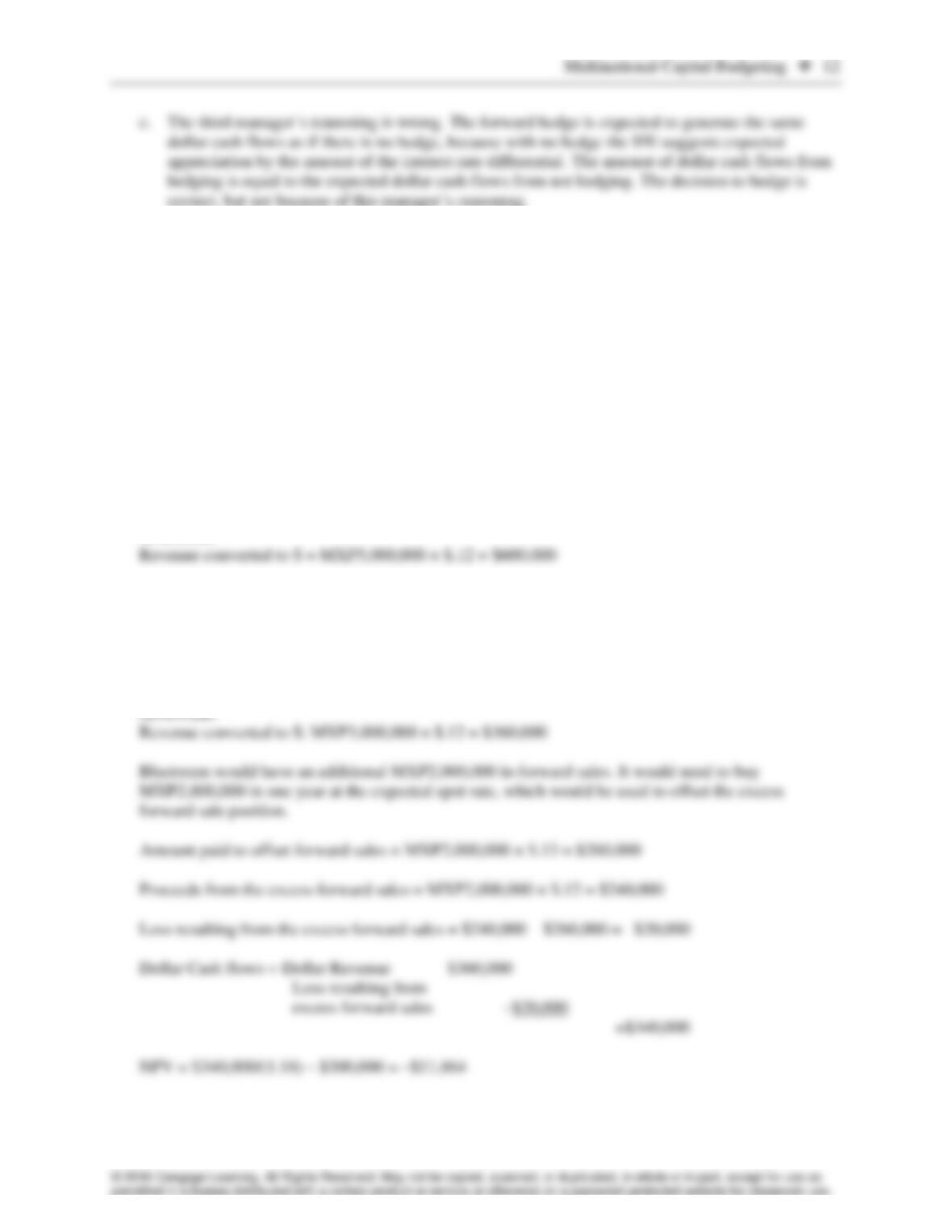
a. The first manager states that due to the parity conditions, the feasibility of the project will be the
same whether the cash flows are hedged with a forward contract or are not hedged. Is this
manager correct? Explain.
b. The second manager states that the project should not be hedged. Based on the interest rates, the
IFE suggests that Zistine Co. will benefit from the future exchange rate movements, so the project
will generate a higher NPV if Zistine does not hedge. Is this manager correct? Explain.
c. The third manager states that the project should be hedged because the forward rate contains a
premium, and therefore the forward rate will generate more U.S. dollar cash flows than the
expected amount of dollar cash flows if the firm remains unhedged. Is this manager correct?
Explain.
26. Accounting for Uncertain Cash Flows. Blustream Inc. considers a project in which it will sell the
use of its technology to firms in Mexico. It already has received orders from Mexican firms that will
generate 3 million Mexican pesos (MXP) in revenue at the end of the next year. However, it might
also receive a contract to provide this technology to the Mexican government. In this case, it will
generate a total of MXP5,000,000 at the end of the next year. It will not know whether it will receive
the government order until the end of the year.
Today’s spot rate of the peso is $.14. The one-year forward rate is $.12. Blustream expects that the
spot rate of the peso will be $.13 one year from now. The only initial outlay will be $300,000 to cover
development expenses (regardless of whether the Mexican government purchases the technology). It
will pursue the project only if it can satisfy its required rate of return of 18 percent. Ignore possible
tax effects. It decides to hedge the maximum amount of revenue that it will receive from the project.
a. Determine the NPV if Blustream receives the government contract.
ANSWER:
NPV = $600,000/(1.18) – $300,000 = $208,475
b. If Blustream does not receive the contract, it will have hedged more than it needed to and will
offset the excess forward sales by purchasing pesos in the spot market at the time the forward sale
is executed. Determine the NPV of the project assuming that Blustream does not receive the
government contract.

Multinational Capital Budgeting ❖ 13
c. Now consider an alternative strategy in which Blustream only hedges the minimum peso revenue
that it will receive. In this case, any revenue due to the government contract would not be
hedged. Determine the NPV based on this alternative strategy and assume that Blustream receives
the government contract.
d. If Blustream uses the alternative strategy of only hedging the minimum peso revenue that it will
receive, determine the NPV assuming that it does not receive the government contract.
e. If there is a 50 percent chance that Blustream will receive the government contract, would you
advise Blustream to hedge the maximum amount or the minimum amount of revenue that it may
receive? Explain.
f. Blustream recognizes that it is exposed to exchange rate risk whether it hedges the minimum
amount or the maximum amount of revenue it will receive. It considers a new strategy of hedging
the minimum amount it will receive with a forward contract and hedging the additional revenue it
might receive with a put option on Mexican pesos. The one-year put option has an exercise price
of $.125 and a premium of $.01. Determine the NPV if Blustream uses this strategy and receives
the government contract. Also, determine the NPV if Blustream uses this strategy and does not
receive the government contract. Given that there is a 50 percent probability that Blustream will
receive the government contract, would you use this new strategy or the strategy that you selected
in question (e)?
ANSWER:
SCENARIO IF BLUSTREAM RECEIVES GOVERNMENT CONTRACT
SCENARIO IF BLUSTREAM DOES NOT RECEIVE GOVERNMENT CONTRACT

Multinational Capital Budgeting ❖ 14
27. Capital Budgeting Analysis. Wolverine Corp. currently has no existing business in New Zealand but
is considering establishing a subsidiary there. The following information has been gathered to assess
this project:
• The initial investment required is $50 million in New Zealand dollars (NZ$). Given the existing
spot rate of $.50 per New Zealand dollar, the initial investment in U.S. dollars is $25 million. In
addition to the NZ$50 million initial investment for plant and equipment, NZ$20 million is
needed for working capital and will be borrowed by the subsidiary from a New Zealand bank.
The New Zealand subsidiary will pay interest only on the loan each year, at an interest rate of 14
percent. The loan principal is to be paid in 10 years.
• The project will be terminated at the end of Year 3, when the subsidiary will be sold.
• The price, demand, and variable cost of the product in New Zealand are as follows:
Year Price Demand Variable Cost
1 NZ$500 40,000 units NZ$30
2 NZ$511 50,000 units NZ$35
3 NZ$530 60,000 units NZ$40
• The fixed costs, such as overhead expenses, are estimated to be NZ$6 million per year.
• The exchange rate of the New Zealand dollar is expected to be $.52 at the end of Year 1, $.54 at
the end of Year 2, and $.56 at the end of Year 3.
• The New Zealand government will impose an income tax of 30 percent on income. In addition, it
will impose a withholding tax of 10 percent on earnings remitted by the subsidiary. The U.S.
government will allow a tax credit on the remitted earnings and will not impose any additional
taxes.
• All cash flows received by the subsidiary are to be sent to the parent at the end of each year. The
subsidiary will use its working capital to support ongoing operations.
• The plant and equipment are depreciated over 10 years using the straight-line depreciation
method. Since the plant and equipment are initially valued at NZ$50 million, the annual
depreciation expense is NZ$5 million.
• In three years, the subsidiary is to be sold. Wolverine plans to let the acquiring firm assume the
existing New Zealand loan. The working capital will not be liquidated but will be used by the

Multinational Capital Budgeting ❖ 15
acquiring firm when it sells the subsidiary. Wolverine expects to receive NZ$52 million after
subtracting capital gains taxes. Assume that this amount is not subject to a withholding tax.
• Wolverine requires a 20 percent rate of return on this project.
a. Determine the net present value of this project. Should Wolverine accept this project?
Capital Budgeting Analysis: Wolverine Corporation
Year 0 Year 1 Year 2 Year 3
1. Demand 40,000 50,000 60,000
2. Price per unit NZ$500 NZ$511 NZ$530
3. Total revenue = (1) × (2) NZ$20,000,000 NZ$25,550,000 NZ$31,800,000
4. Variable cost per unit NZ$30 NZ$35 NZ$40
5. Total variable cost = (1) × (4) NZ$1,200,000 NZ$1,750,000 NZ$2,400,000
6. Fixed cost NZ$6,000,000 NZ$6,000,000 NZ$6,000,000
7. Interest expense of New
Zealand loan NZ$2,800,000 NZ$2,800,000 NZ$2,800,000
8. Noncash expense (depreciation) NZ$5,000,000 NZ$5,000,000 NZ$5,000,000
9. Total expenses = (5)+(6)+(7)+(8) NZ$15,000,000 NZ$15,550,000 NZ$16,200,000
10. Before-tax earnings of subsidiary
= (3)–(9) NZ$5,000,000 NZ$10,000,000 NZ$15,600,000
11. Host government tax (30%) NZ$1,500,000 NZ$3,000,000 NZ$4,680,000
12. After-tax earnings of subsidiary NZ$3,500,000 NZ$7,000,000 NZ$10,920,000
13. Net cash flow to subsidiary
= (12)+(8) NZ$8,500,000 NZ$12,000,000 NZ$15,920,000
14. NZ$ remitted by sub.
(100% of CF) NZ$8,500,000 NZ$12,000,000 NZ$15,920,000
15. Withholding tax imposed on
remitted funds (10%) NZ$850,000 NZ$1,200,000 NZ$1,592,000
16. NZ$ remitted after withholding
taxes NZ$7,650,000 NZ$10,800,000 NZ$14,328,000
17. Salvage value NZ$52,000,000
18. Exchange rate of NZ$ $.52 $.54 $.56
19. Cash flows to parent $3,978,000 $5,832,000 $37,143,680
20. PV of parent cash flows
(20% of discount rate) $3,315,000 $4,050,000 $21,495,185
21. Initial investment by parent –$25,000,000
22. Cumulative NPV of cash flows –$21,685,000 –$17,635,000 $3,860,185
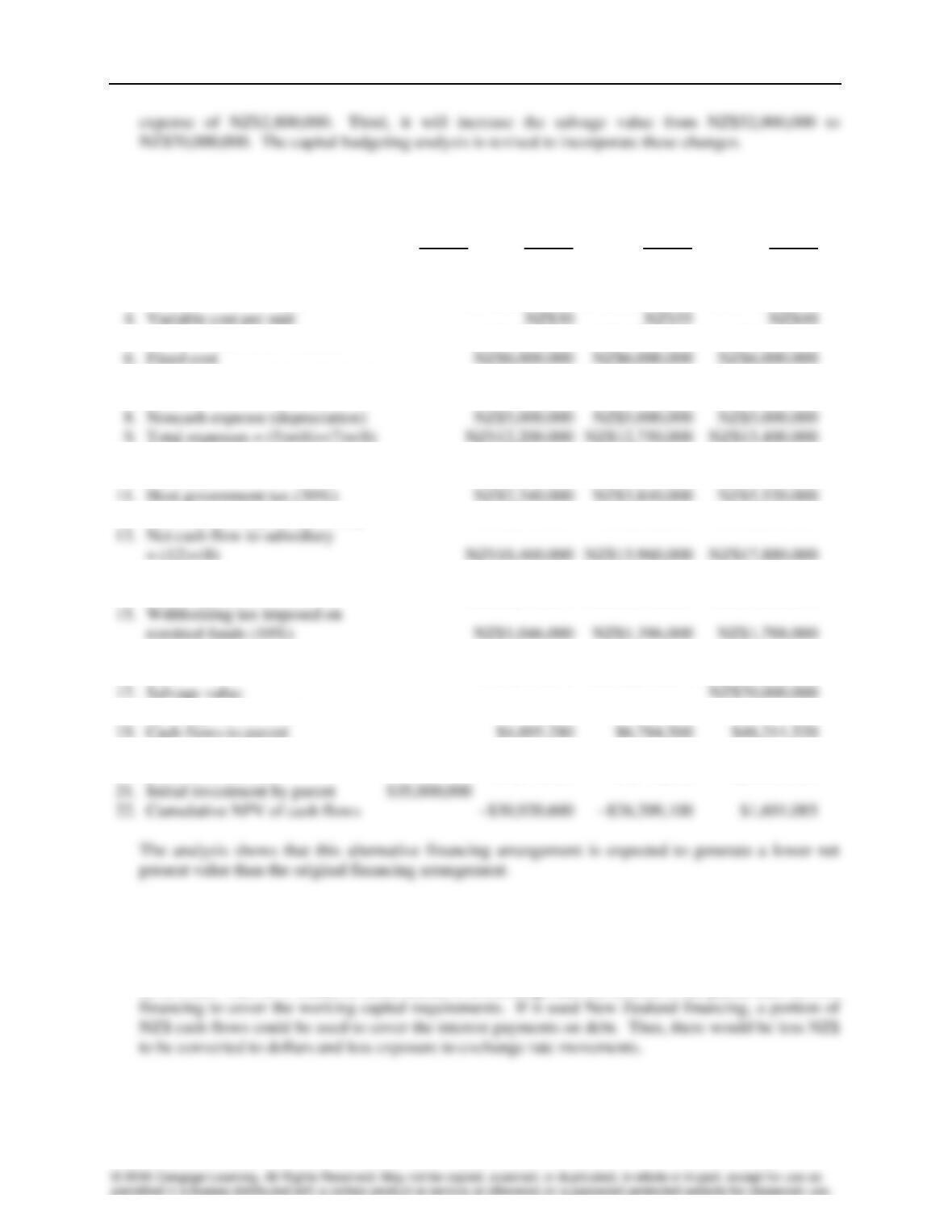
b. Assume that Wolverine is also considering an alternative financing arrangement, in which the parent
would invest an additional $10 million to cover the working capital requirements so that the
subsidiary would not need the New Zealand loan. If this arrangement is used, the selling price of the
subsidiary (after subtracting any capital gains taxes) is expected to be NZ$18 million higher. Is this
alternative financing arrangement more feasible for the parent than the original proposal? Explain.
Multinational Capital Budgeting ❖ 16
Capital Budgeting Analysis with an Alternative
Financing Arrangement: Wolverine Corporation
Year 0 Year 1 Year 2 Year 3
1. Demand 40,000 50,000 60,000
2. Price per unit NZ$500 NZ$511 NZ$530
3. Total revenue = (1)×(2) NZ$20,000,000 NZ$25,550,000 NZ$31,800,000
5. Total variable cost = (1)×(4) NZ$1,200,000 NZ$1,750,000 NZ$2,400,000
7. Interest expense of New Zealand
loan NZ$0 NZ$0 NZ$0
10. Before-tax earnings of subsidiary
= (3)–(9) NZ$7,800,000 NZ$12,800,000 NZ$18,400,000
12. After-tax earnings of subsidiary NZ$5,460,000 NZ$8,960,000 NZ$12,880,000
14. NZ$ remitted by sub.
(100% of CF) NZ$10,460,000 NZ$13,960,000 NZ$17,880,000
16. NZ$ remitted after withholding
taxes NZ$9,414,000 NZ$12,564,000 NZ$16,092,000
18. Exchange rate of NZ$ $.52 $.54 $.56
20. PV of parent cash flows
(20% discount rate) $4,079,400 $4,711,500 $27,900,185
c. From the parent’s perspective, would the NPV of this project be more sensitive to exchange rate
movements if the subsidiary uses New Zealand financing to cover the working capital or if the parent
invests more of its own funds to cover the working capital? Explain.
ANSWER: The NPV would be more sensitive to exchange rate movements if the parent uses its own

Multinational Capital Budgeting ❖ 17
d. Assume Wolverine used the original financing proposal and that funds are blocked until the
subsidiary is sold. The funds to be remitted are reinvested at a rate of 6 percent (after taxes) until the
end of Year 3. How is the project’s NPV affected?
ANSWER: The effects of the blocked funds are shown below:
Year 1 Year 2 Year 3
13. Net cash flow to subsidiary
=(12)+(8) NZ$8,500,000 NZ$12,000,000 NZ$ 15,920,000
16. NZ$ remitted after withholding
taxes NZ$ 34,371,540
18. Exchange rate of NZ$ $.56
e. What is the break-even salvage value of this project if Wolverine uses the original financing proposal
and funds are not blocked?
First, determine the present value of cash flows when excluding salvage value:
End of Present Value of Cash Flows
Year (excluding salvage value)
1 $ 3,315,000
2 4,050,000
3 4,643,333*
$ 12,008,333
*This number is determined by converting the third year NZ$ cash flows excluding salvage value
(NZ$14,328,000) into dollars at the forecasted exchange rate of $.56 per New Zealand dollar:
NZ$14,328,000 × $.56 = $8,023,680
The present value of the $8,023,680 received 3 years from now is $4,643,333.
Then determine the break-even salvage value:
Break-even
Salvage = [IO – (present value of cash flows)](1+k)n
Value
= [$25,000,000 – $12,008,333](1+.20)3
= $22,449,601

Multinational Capital Budgeting ❖ 18
ANSWER: Since the NZ$ is expected to be $.56 in Year 3, this implies that the break-even salvage
value in terms of New Zealand dollars is:
f. Assume that Wolverine decides to implement the project, using the original financing proposal.
Also assume that after one year, a New Zealand firm offers Wolverine a price of $27 million after
taxes for the subsidiary and that Wolverine’s original forecasts for Years 2 and 3 have not
changed. Compare the present value of the expected cash flows it Wolverine keeps the subsidiary
to the selling price. Should Wolverine divest the subsidiary? Explain.
ANSWER:
Divestiture Analysis One Year After
the Project Began
End of Year 2 End of Year 3
28. Capital Budgeting With Hedging. Baxter Co. considers a project with Thailand’s government. If it
accepts the project, it will definitely receive one lump sum cash flow of 10 million Thai baht in five
years. The spot rate of the Thai baht is presently $0.03. The annualized interest rate for a 5-year
period is 4% in the U.S. and 17% in Thailand. Interest rate parity exists. Baxter plans to hedge its
cash flows with a forward contract. What is the dollar amount of cash flows that Baxter will receive
in five years if it accepts this project?
ANSWER: The forward rate premium is:
29. Capital Budgeting and Financing. Cantoon Co. is considering the acquisition of a unit from the
French government. Its initial outlay would be $4 million. It will reinvest all the earnings in the unit.
It expects that at the end of 8 years, it will sell the unit for 12 million euros after capital gains taxes
are paid. The spot rate of the euro is $1.20 and is used as the forecast of the euro in the future years.
Cantoon has no plans to hedge its exposure to exchange rate risk. The annualized U.S. risk-free
interest rate is 5% regardless of the maturity of the debt, and the annualized risk-free interest rate on