Page 1 of 18
Chapter 14: Managing Quality Improvement
Teams and Projects
Chapter Outline
• Leading Teams for Quality Improvement
• Types of Teams
Overview
This chapter covers three topics:
1. Today’s business environment has changed business’s focus from command and
3. Managing projects has increased in importance. Most development or
modification efforts are done via a project. These projects have a defined life;
Page 2 of 18
Discussion Questions
1. Why has increased complexity in the workplace resulted in an increased emphasis
on employee participation and teamwork?
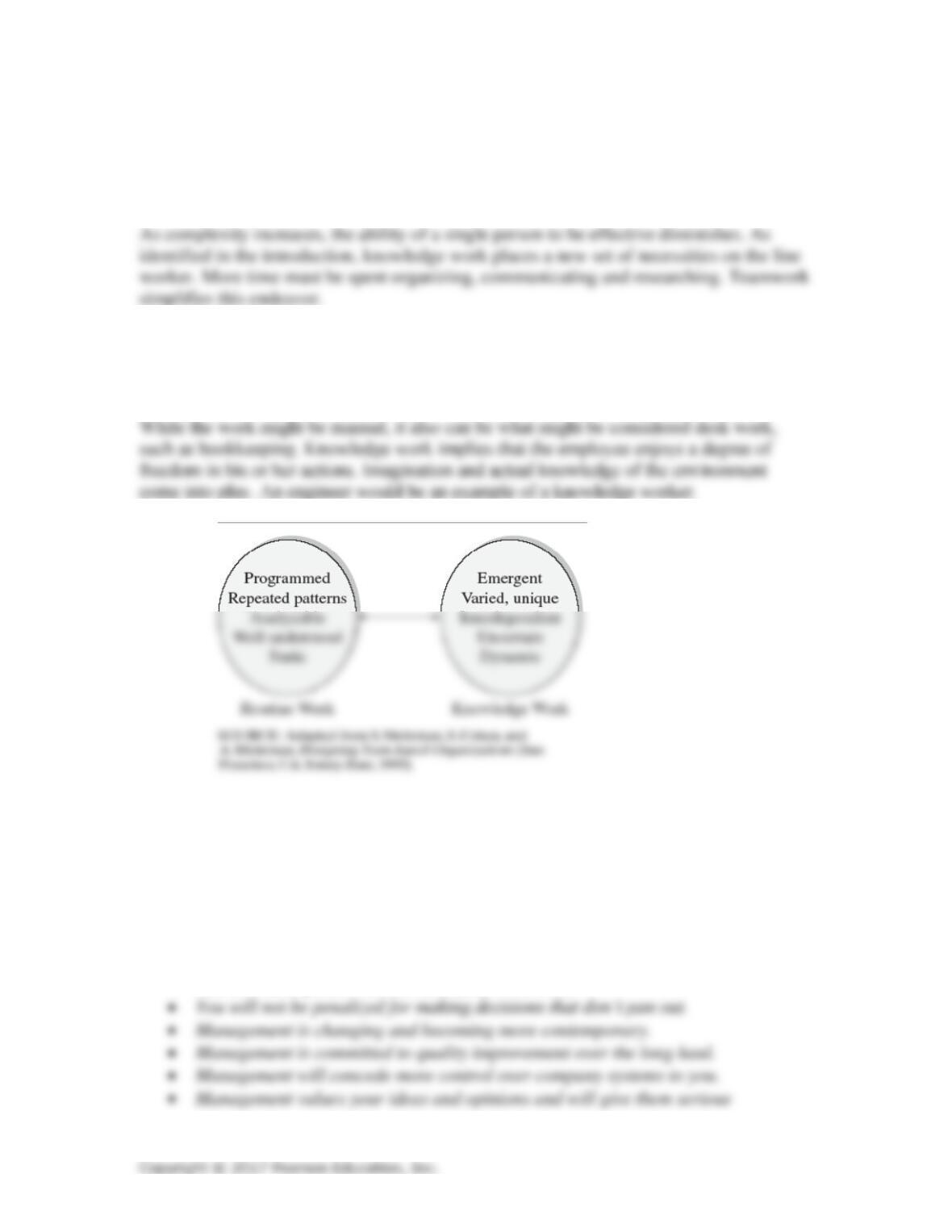
2. What is the difference between routine work and knowledge work? Provide
examples of each type of work.
The figure below explains the concept. Routine work is work that has been structured.
3. What is meant by employee empowerment? What is the relationship between
employee empowerment and teamwork?
One of the prevailing concepts in management today is the idea of making decisions at
the lowest level possible. Empowerment is done when a worker has the freedom to make
decisions. On page 373, the text provides a list of the promises to employees that identify
employee empowerment.
• You will have greater control over your own work.

Page 3 of 18
4. In what ways can employee empowerment facilitate and contribute to
organizational learning?
5. What are the major disadvantages of multiple layers of management in a business
organization? Is teamwork typically implemented in organizations that have
multiple layers of management or organizations that have fairly flat hierarchies?
Explain your answer.
Reducing levels of management or flattening hierarchies immediately improves
communication. The text discusses the efforts led by consultants such as Tom Peters and
others. The discussion on page 375 presents the advantages. Reducing levels of
6. Describe the principal attributes of Hersey and Blanchard’s situational leadership
model. Is this model of leadership appropriate for a quality-minded company?
Hersey and Blanchard looked at two key qualities of management – guidance and
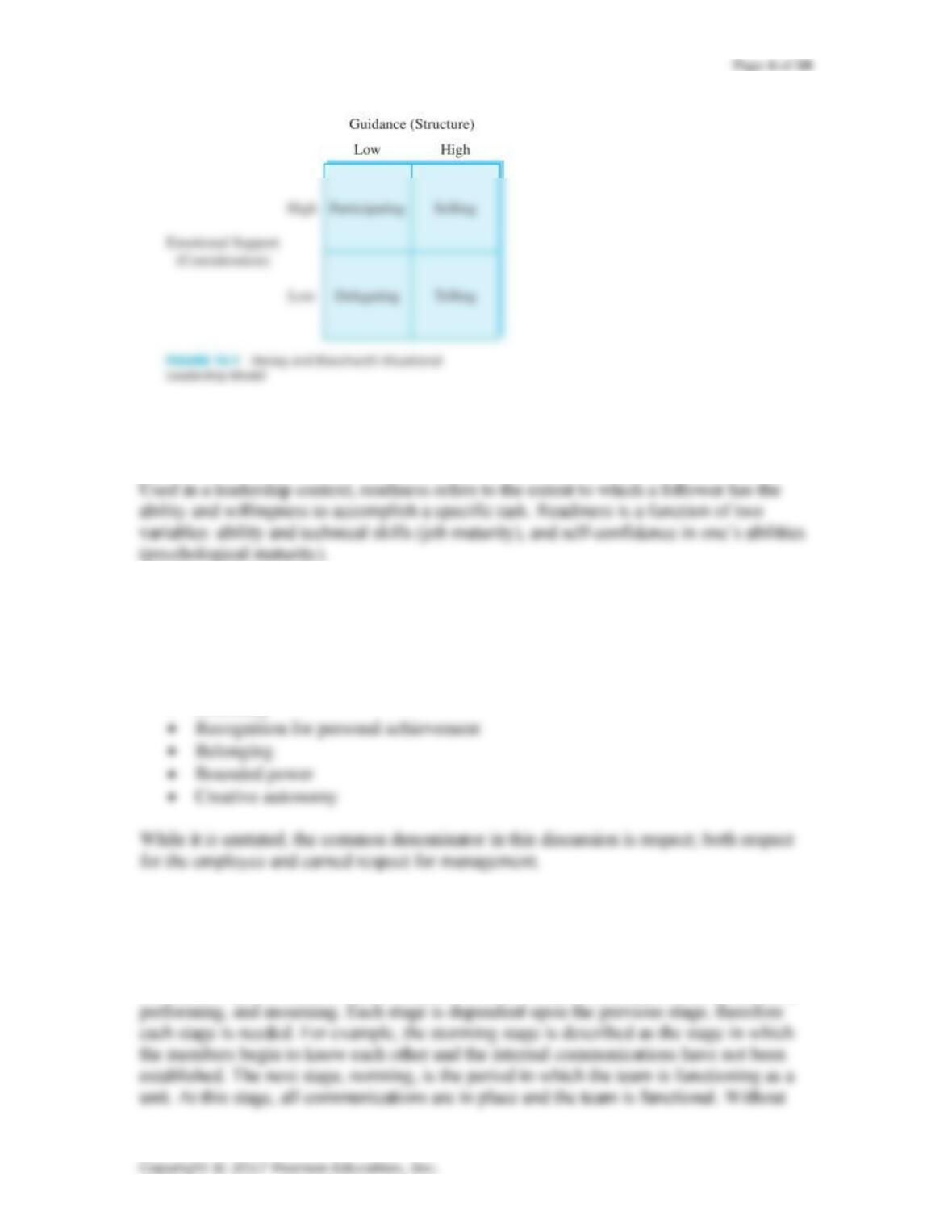
7. What does readiness refer to in a leadership context? What are the two variables
that an employee’s level of readiness is a function of?
8. In general, do employees enjoy working in teams? Why or why not?
Page 373 of the text states that employees enjoy working on teams in environments in
which expectations are known and the employee is empowered, The text goes on to list
five motivators that empowered employees enjoy:
• Mutuality
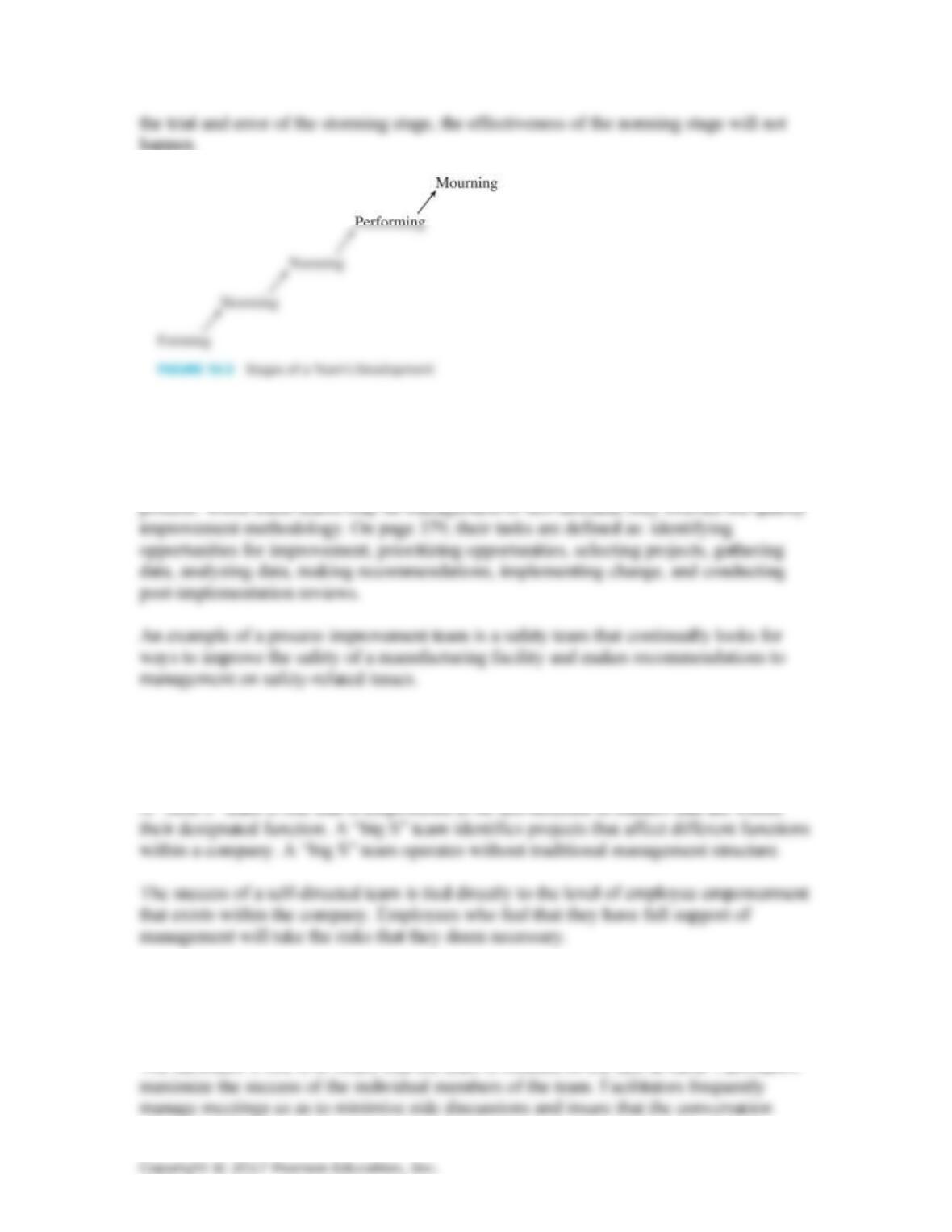
9. Briefly describe the five stages of the life cycle of a team. Is it important for a
team to pass through each of these stages? Why or why not?
On page 377, the text discusses the five stages that a team goes through during its
existence. Figure 14-2, shown below, presents these stages: forming, storming, norming,
Page 5 of 18
happen.
10. What is the purpose of a process improvement team? Provide an example of a
process improvement team for a business organization.
Process improvement teams exist to shepherd the continuous quality improvement
11. What is meant by a self-directed work team? In your judgment, are self-directed
work teams a good idea? Explain your answer.
The phrase self-directed is self-explanatory. The text discusses “little s” or “big S” teams.
12. Describe the role of the facilitator of a team. Is the role of the facilitator
important, or is it primarily ceremonial in nature?
A facilitator is essentially a “traffic cop.” A facilitator is not a project leader or manager.
The facilitator’s role is to insure that the team is focused on the task at hand. Facilitators
13. What is meant by team building? Is team building a concept from which all
teams can benefit?
14. In a meeting management context, to what does parking lot refer?
15. What are the primary sources of conflict in work teams? What are some of the
methods for resolving team conflict?
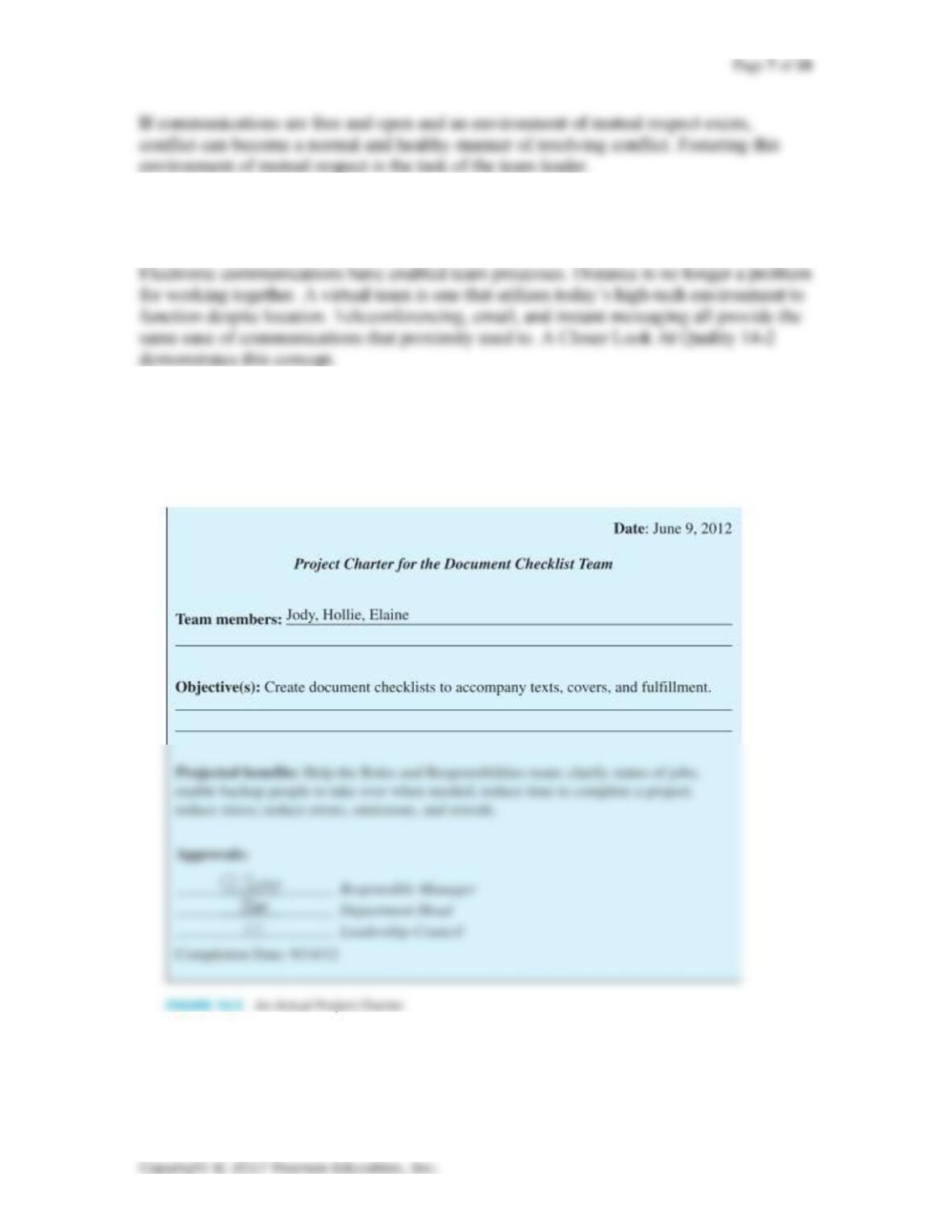
People come from various backgrounds and have different attitudes. Conflict is
unavoidable. When handled correctly, conflict can be quite healthy. When handled
poorly, conflict can destroy a project. On page 383, the text defines four stages of
conflict:
• Frustration. People are at odds, and competition or aggression ensues.
16. Describe what is meant by virtual teams. Provide an example of a virtual team in
a business organization.
17. How does a project charter help a team identify issues relevant to team success?
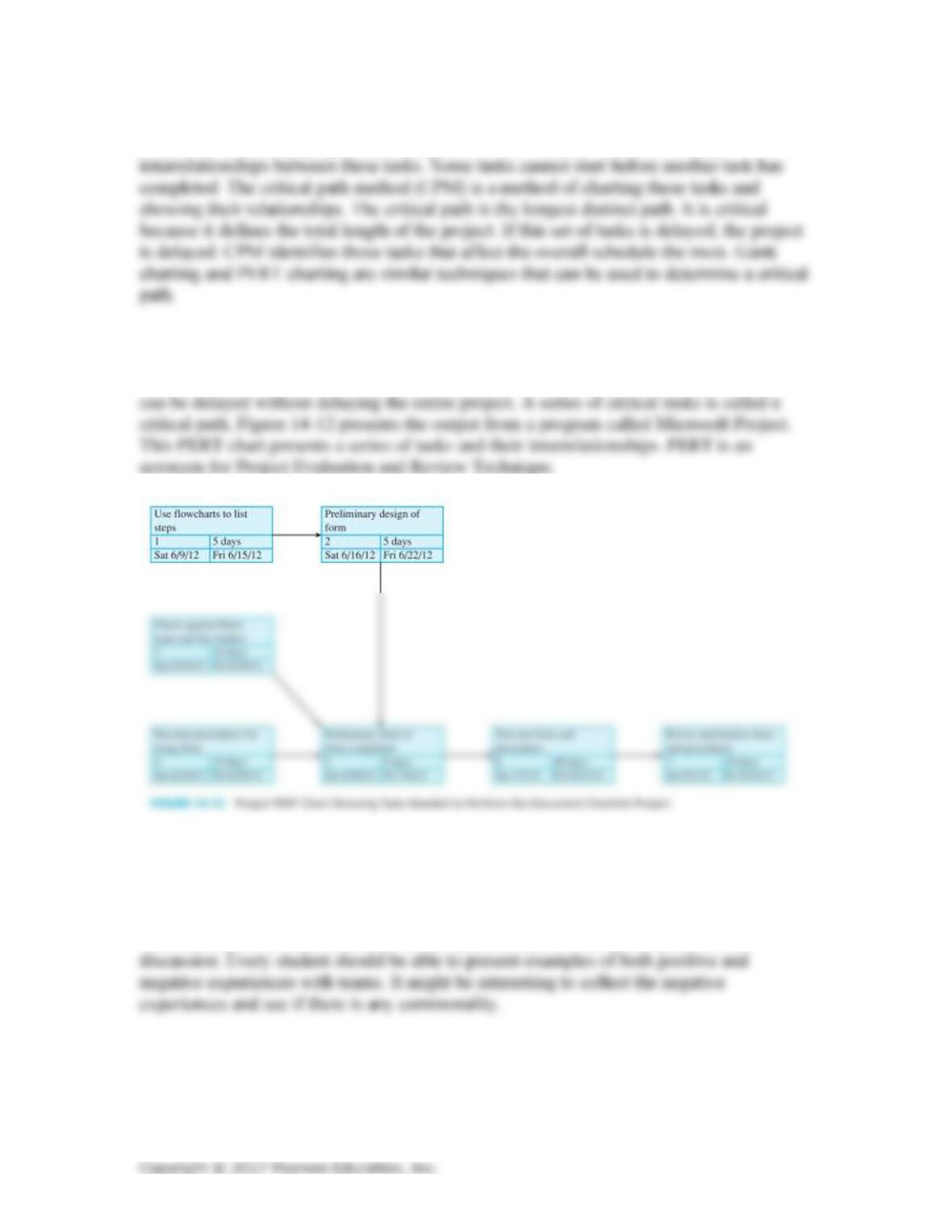
The project charter is a document that defines objectives, participants, and expected
benefits from the charter. Figure 14-5, on page 388, contains an example of a project
charter. Essentially, the charter is the “permission slip” for the project to start.
18. Describe the critical path method for organizing work projects. When is the use
of this method appropriate?
Page 8 of 18
Almost all non-trivial projects are composed of sets of tasks. There are usually
19. Describe the difference between critical tasks and a critical path.
A critical task is a task with no slack. Slack is the amount of time an activity in a project
20. Describe an experience you have had working in a team (in a work setting or in a
college class). Describe how your experience either confirms or refutes one of the
principles of teamwork described in this chapter
There are as many correct answers to this question as there are participants in the
Case 14-1: Whole Foods Market: Using Teamwork as a Recipe for
Success

Page 9 of 18
Discussion Questions
1. Do you believe that Whole Foods’ emphasis on teamwork is appropriate for the
grocery store industry? Why or why not?
Because the supermarket industry is aging and is not known for innovative management
techniques, most students will probably argue that teamwork (which represents a fresh
2. What is your opinion of Whole Foods’ practice of sharing team performance data
with all company employees? Do you believe that this practice risks creating “too
competitive” a spirit among the firm’s teams and employees? Explain your answer.
There are pluses and minuses to sharing team performance data among employees. On
the plus side, the sharing of performance data with all employees facilitates an “open
3. Would you enjoy working on a team at Whole Foods? Why or why not?
Page 10 of 18
Suggested Answers to End of Chapter Problems
1.
2.
3.
Perform a cost benefit analysis with payback period for a project where
indirect costs are $50,000, direct costs are $25,000, and annualized benefits are
$60,000.
Perform a cost benefit analysis using the following data:
Direct Costs:
10 laptops – $2,000 ea.
A server – $2,000
Network Installation – $15,000
Software – $20,000
Indirect Costs:
Training – $15,000
Annualized Benefits
Increased Capacity – $100,000
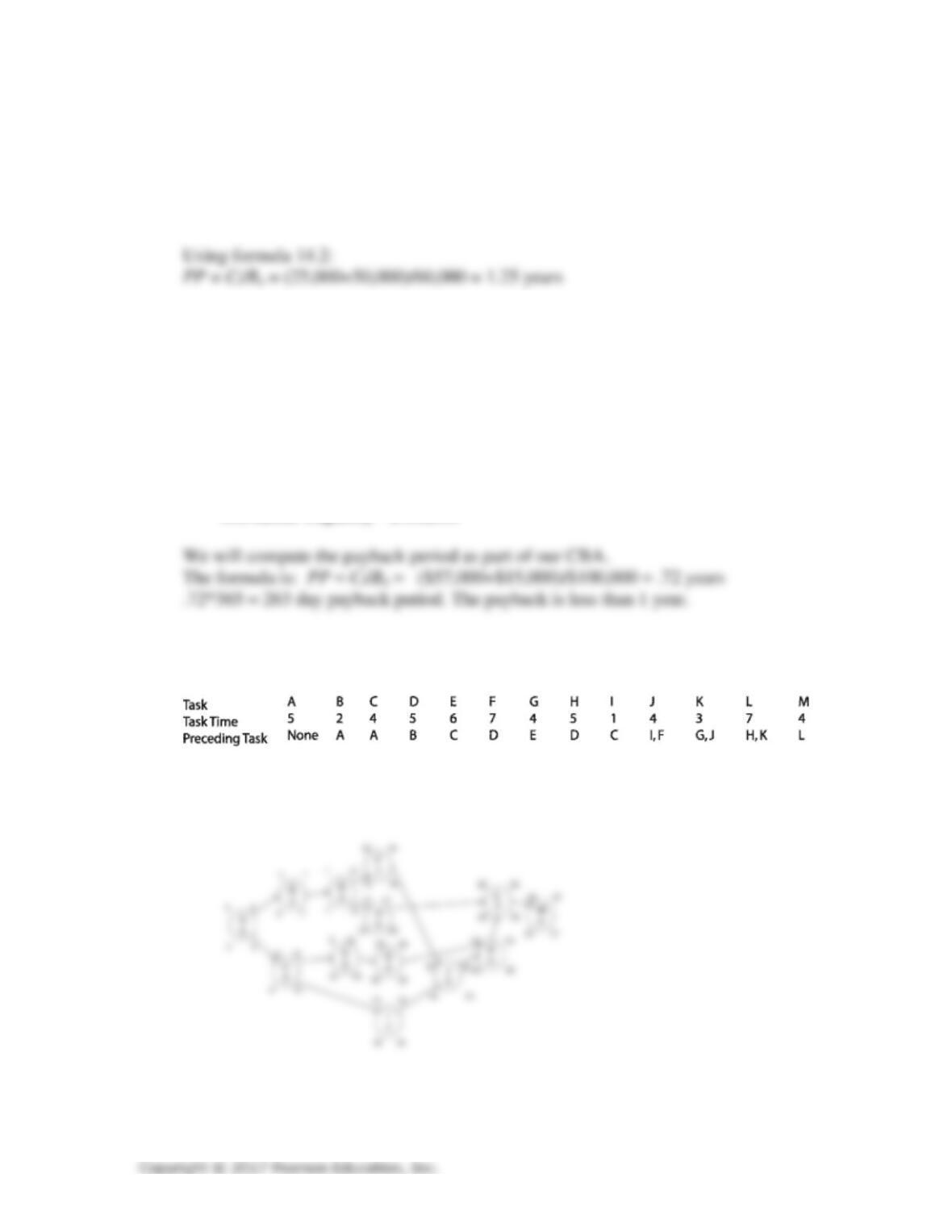
Following are activities, precedence relationships, and task times (days) for a
number of tasks.
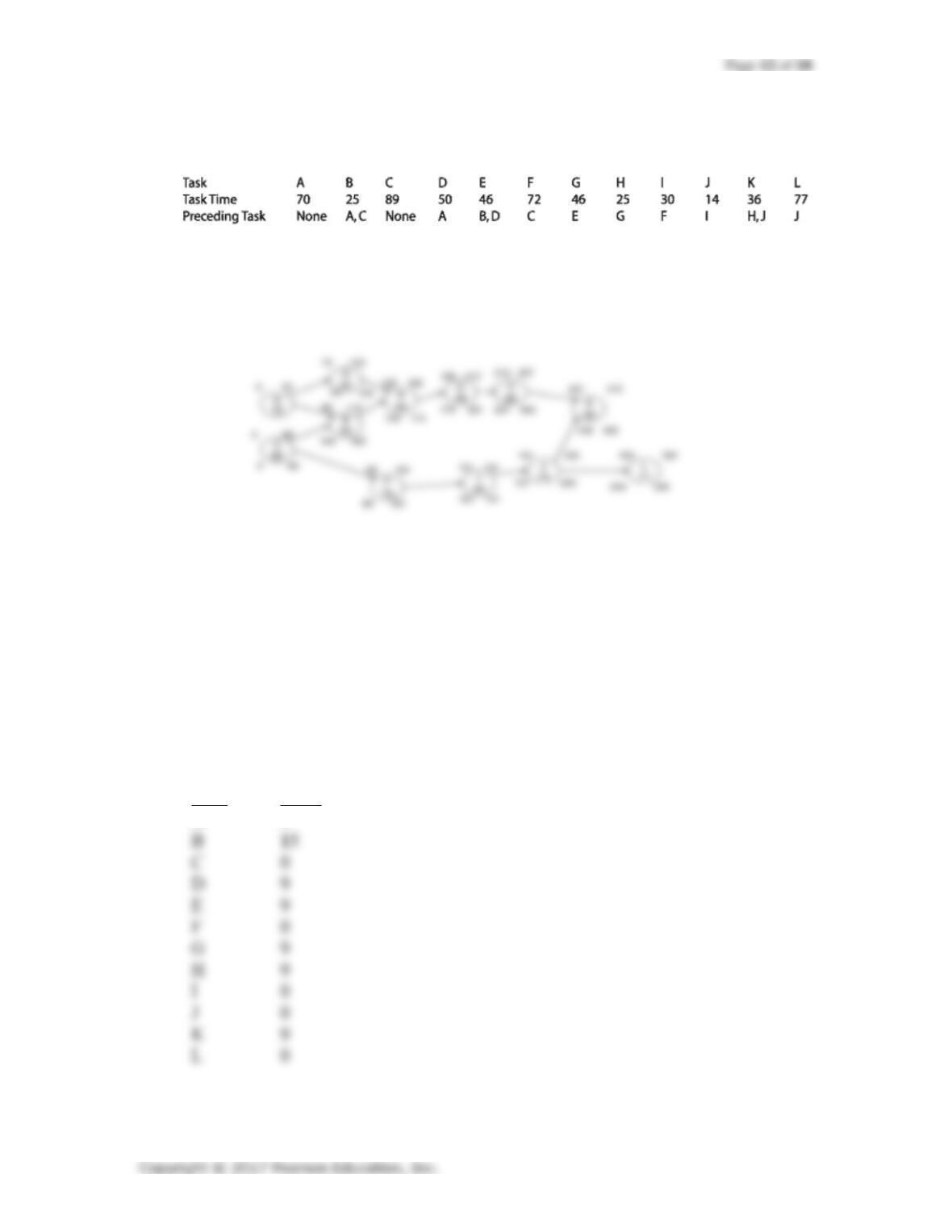
a. Construct a precedence diagram.

Page 11 of 18
b. Compute early and late times.
See the above diagram.
c. Compute the slack for each task.
Use formula 14.7, late start – early start:
A = 0 – 0 = 0
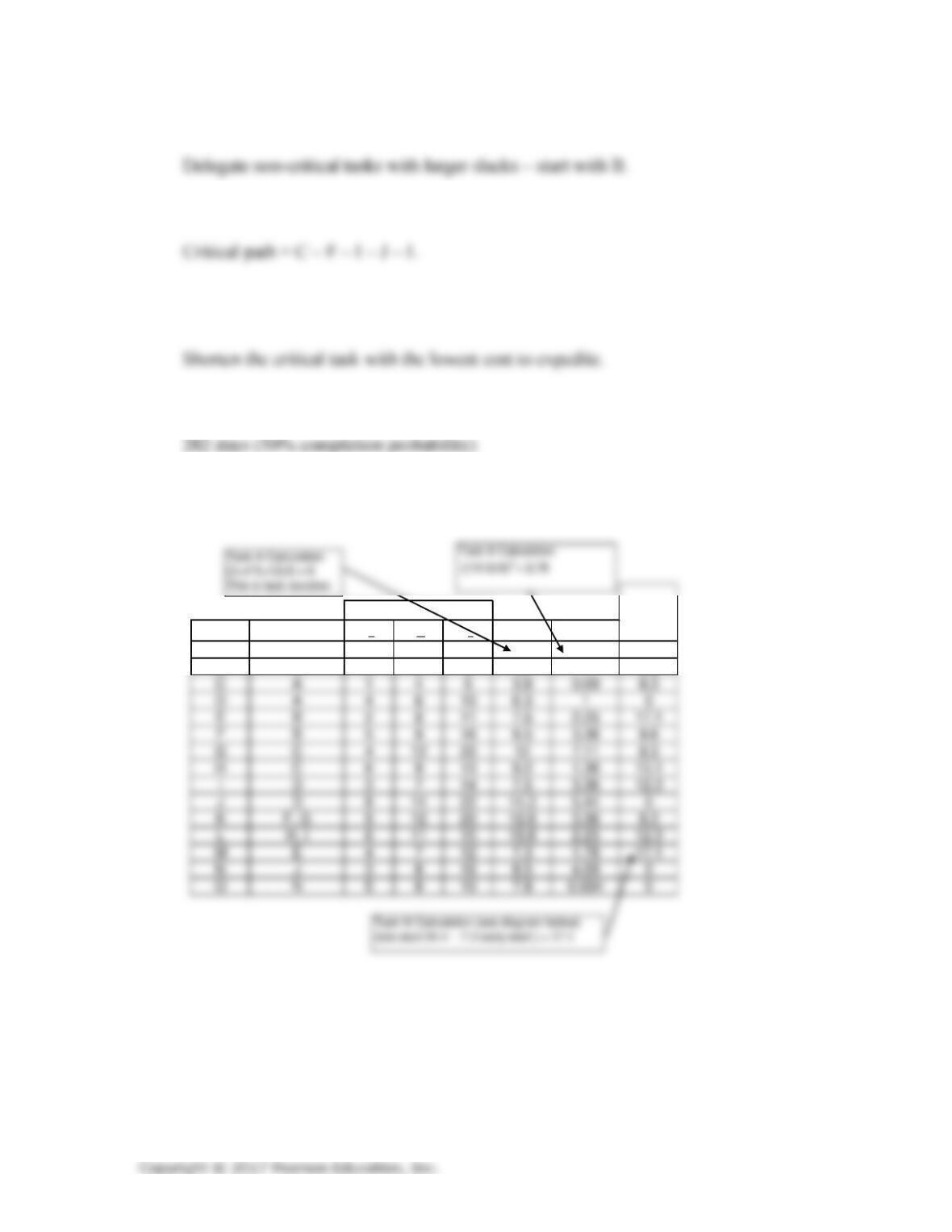
d. Which tasks could the project manager delegate?
e. Find the critical path.
f. Which tasks would you shorten first to shorten the project completion
time?
g. What is the expected project completion time?
h. What is the probability of completing the project in the time identified in
G?
B
15
C
0
D
9
E
9
F
0
G
9
H
9
I
0
J
0
K
9
L
0
4.
Following are activities, precedence relationships, and task times (days) for a
number of tasks.
a. Construct a precedence diagram.
b. Compute early and late times.
See the above diagram.
c. Compute the slack for each task.
Task
Slack
A
9
Page 13 of 18
d. Which tasks could the project manager delegate?
e. Find the critical path.
f. Which tasks would you shorten first to shorten the project completion
time?
g. What is the expected project completion time?
5. For the data presented in the text (see also below):
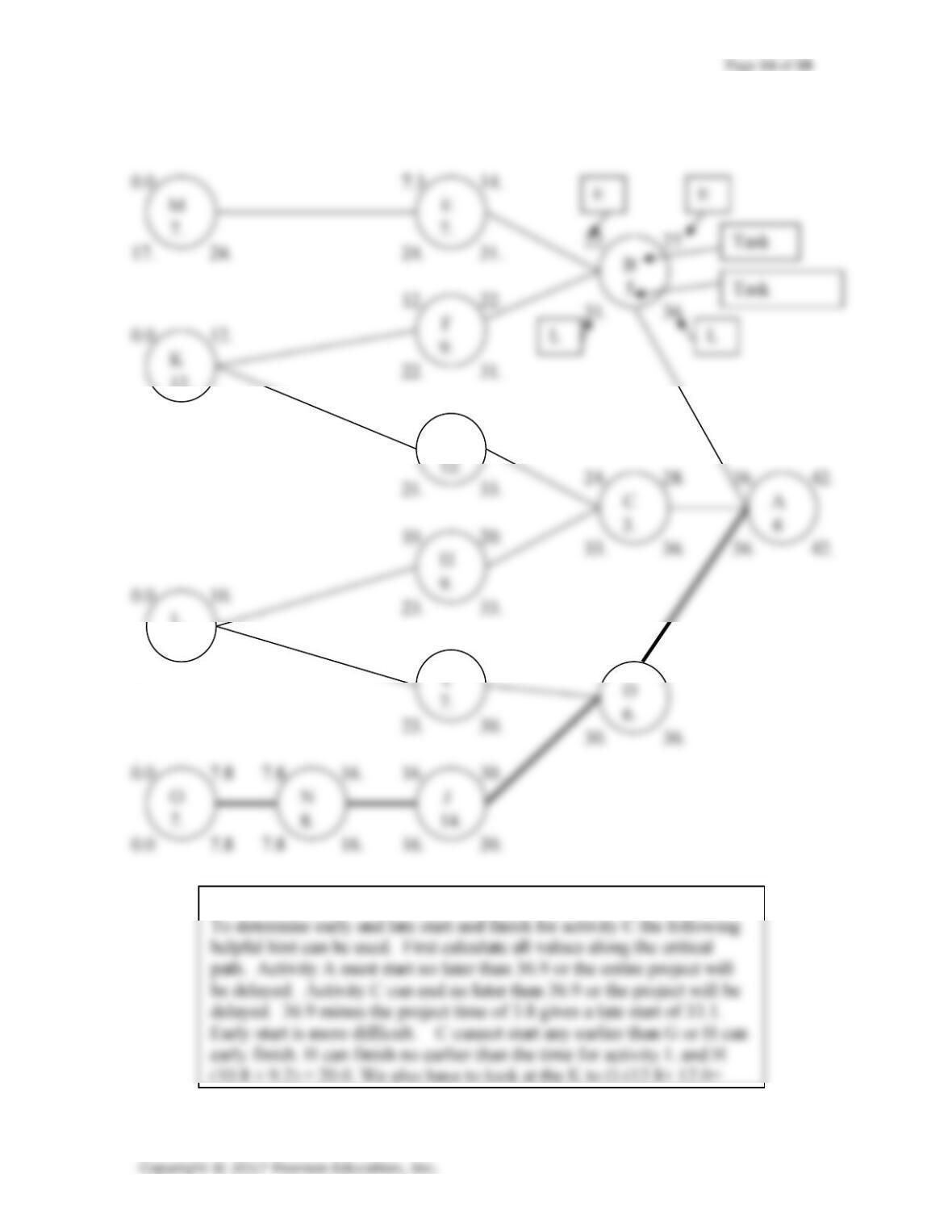
a. Draw an AON diagram.
Task Predecessor
totmtpteVariance
A 3 5 13 6 2.78 0
B A 2 5 8 5 1 9.6
Time Estimates (Days)
Start
Slack
33.
1
21.
1
H
9.
10.
20.
33.
23.
C
24.
8
28.
6
36.
33.
36.
42.
42.
36.
9
10.
7.
30.
23.
16.
30.
16.
36.
30.
16.
12.
8
21.
1
8.3
9
4
G
12.
8
24.
8
1
9
10.
18.
30.
36.
L
10.8
8
23.
12.
Critical Path = 42.9 A-D-J-N-O
24.8). Thus C cannot start any later than 24.8.
Page 15 of 18
b. Compute expected completion for each task.
See table above.
c. Compute slacks for all tasks.
See table above.
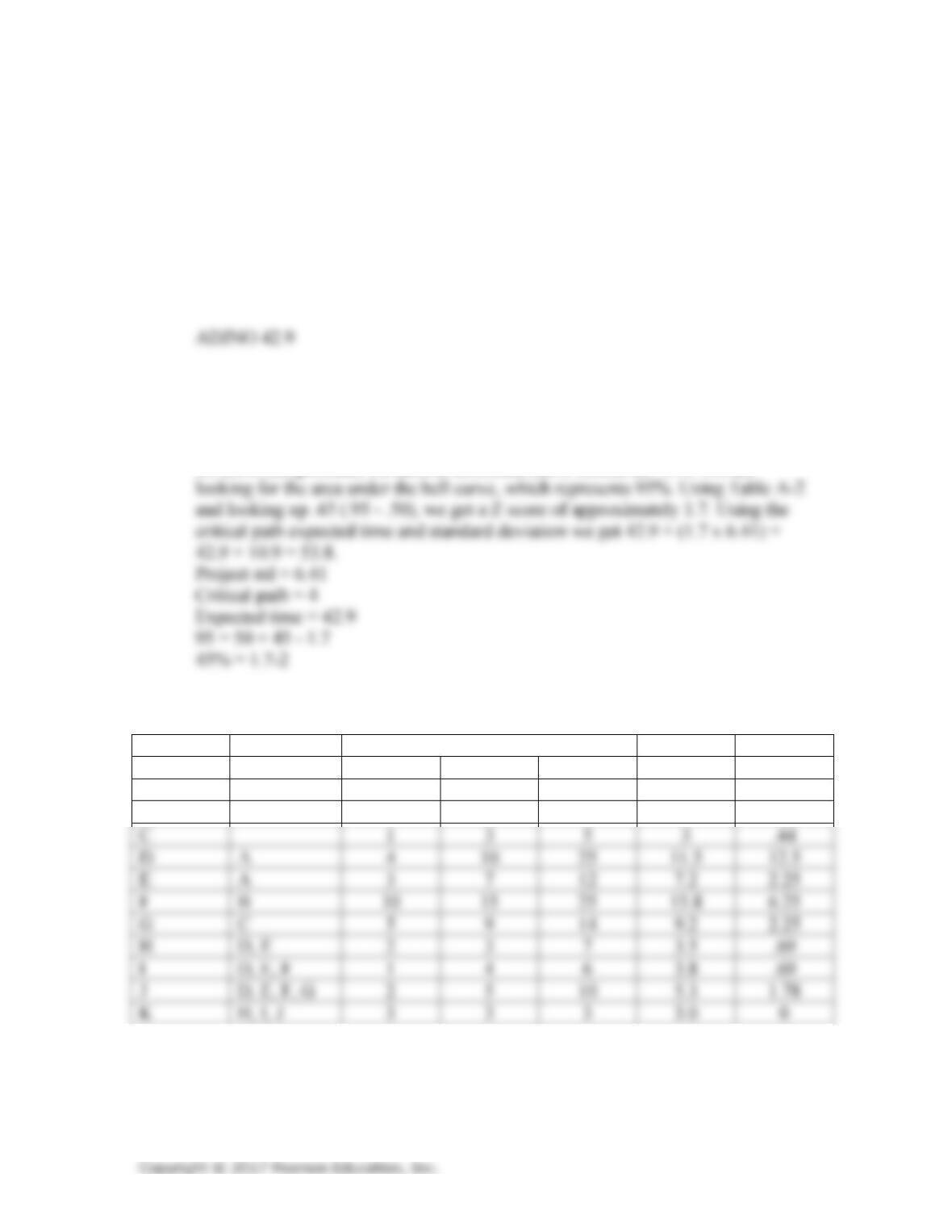
d. Identify the critical path and the expected completion time.
e. Your project manager wishes for you to compute a completion time (in days)
that gives you a 95% chance of success. He will use this time estimate in
negotiating a completion date for the project.
To solve this problem, we need to determine the Z Scores for 95%. We are
6. For the following data:
Time Estimates (Days)
Task
Predecessor
To
Tm
Tp
Te
Variance
A
1
2
9
3
1.78
B
2
5
8
5
1.00
C
1
3
5
3
D
A
4
11.5
12.5
E
A
3
7
2.25
G
C
5
9
2.25
H
D, E
2
3
7
I
D, E, F
1
4
6
J
D, E, F, G
2
5
1.78
K
H, I, J
3
3
3
0
Page 16 of 18
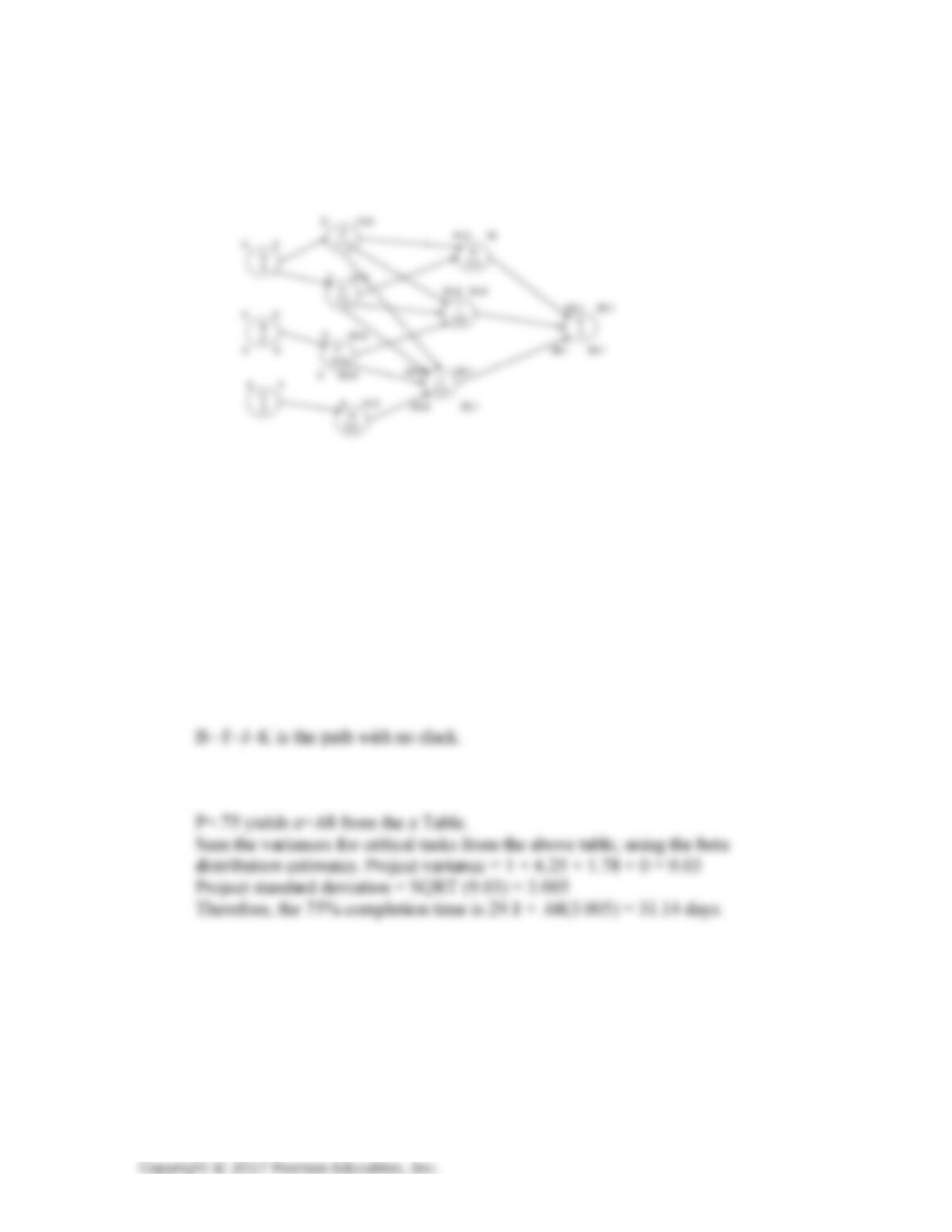
a. Draw a PERT diagram.
b. Compute expected completion times for all tasks.
See the above diagram.
c. Find the critical path.
d. What is the completion time that gives you a 75% chance of success.
7. (Team Project) Develop a project plan for buying a house. Use the following
steps:
a. Use a work breakdown structure (tree diagram – Chapter 10) to identify
tasks for completing the project. Be complete (at least 50 tasks) and use
sticky notes.
b. Laying out your sticky notes, identify the precedence relationships for each
task.
Page 17 of 18
c. Brainstorm optimistic time, most likely time, and pessimistic time for each
task.
d. Compute expected completion time for each task.
e. Draw your network diagram, compute early and late times, and find the
critical path.
f. Compute the 90% completion time for your project.
Answers will vary for this. This is a good project to help students go through the steps
8. (Team Project) Complete the steps in problem 7 for the following project:
Completing a university degree program (choose any major).
Answers will vary for this. This is a good project to help students go through the steps
9. (Team Project) Develop a Gantt chart for welcoming a new baby into the world
(conception has already occurred). Remember you only have 9 months to
complete the project.
10. Complete a cost benefit analysis for a college degree at your university. Be sure
to include all direct and indirect costs. Tale into account the time value of money
11. Complete a cost benefit analysis for a marriage. Be sure to include both the
benefits and costs in your model. Model the marriage given two scenarios – a
strong marriage and a poor marriage. (Hint: You should find that the benefits
for a strong marriage approach infinity and the benefits of a poor marriage
approach zero.)
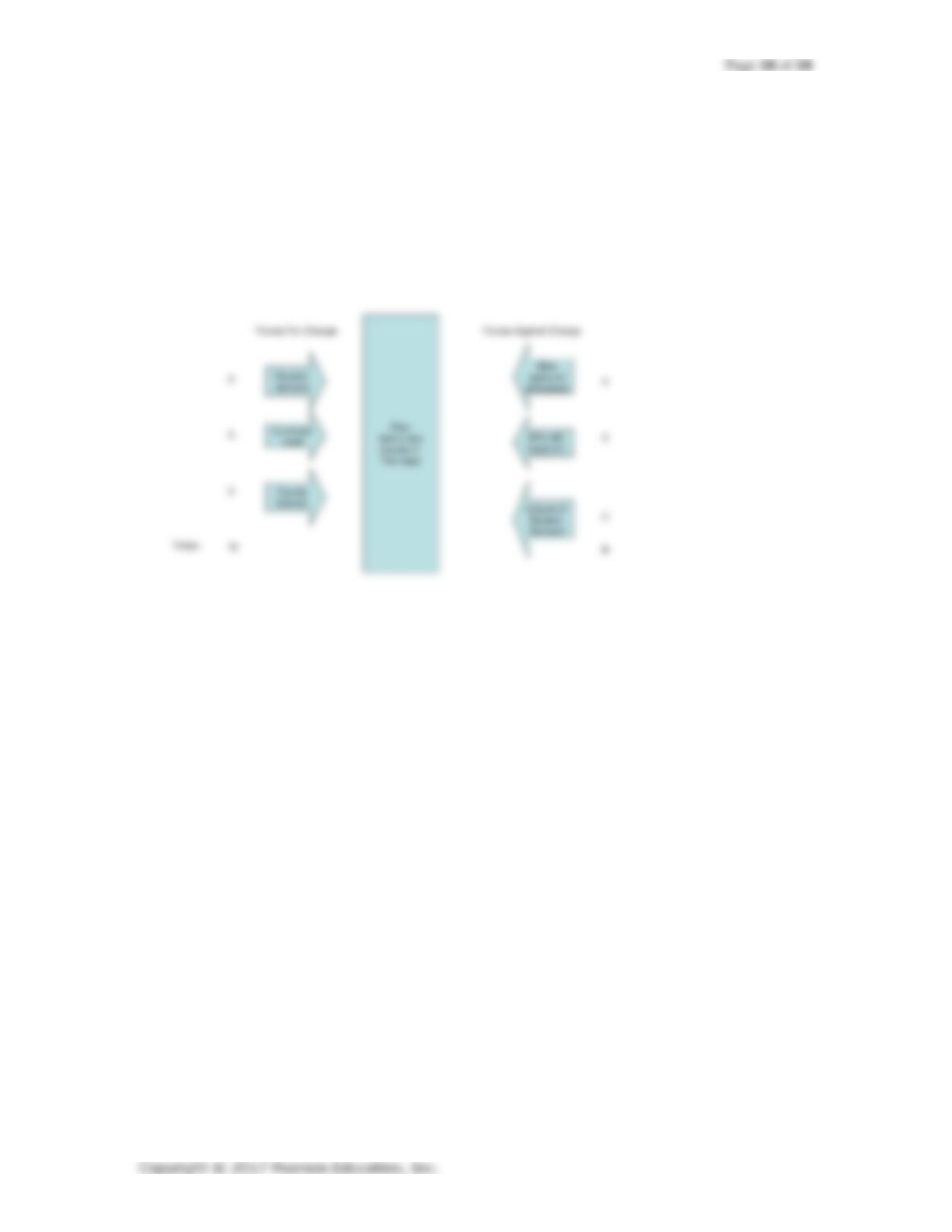
12. Meet with a favorite professor to perform a force-field analysis relating to
adding a new course to your major in the university. Would you recommend this
project?
Below is an example answer. Students often don’t understand the difficult process of
making curricular changes.