Solutions for Chapter 14: Questions and Problems
– 110 –
CHAPTER 14
DERIVATIVES: ANALYSIS AND VALUATION
Answers to Questions
1. There are many different reasons some futures contracts succeed and some fail, but the
most important is demand. If people need a particular contract to expose themselves to or
hedge a price risk, then the contract will succeed. Most people use Treasury bond futures
to gain exposure to or hedge general long-term interest rate risk. The only additional
2. Before entering into a futures or forward contract, hedgers have exposure to price
changes in the underlying asset. To hedge this risk, hedgers enter into contracts that most
closely offset this price risk. The problem is that for most hedgers there is not a contract
highly correlated with the price of the asset to be hedged.
3(a). To hedge price risk, you could enter into a long position in 100,000 gallons worth of
gasoline futures.
3(b). Since you will have to post margin on the futures contract, the price swings in the futures
contract will effect how much you earn on the capital posted as margin. If gas prices go
Solutions for Chapter 14: Questions and Problems
movements in gas one way or the other. Next, if you synthetically create a three month
4. There are two types of basis risk that this hedge is exposed to. The first is from changes
in the shape of the yield curve. Since the company wishes to hedge a seven year issue’s
cost with a ten year contract, the hedge is exposed to changes in the relative level of
5. It is most likely that a single position in an index futures market would be the best hedge.
There are several reasons for this. The most important is cost. Since there are no
exchange traded futures for individual stocks, entering 50 different positions would have
to be done through an over-the-counter derivative dealer. This typically would mean
6. When the index futures price is below its theoretical level, the arbitrage involves buying
the futures contract and selling the underlying index of stocks short. When the index
futures price is above its theoretical level, the arbitrage involves selling the futures
contract and buying the underlying index of stocks. The practicalities of selling the index
Solutions for Chapter 14: Questions and Problems
– 112 –
7. Put-call parity indicates that a long position in a stock combined with being short a call
and long a put (with the same strike price) is a risk-free investment. In other words, no
matter what the stock price at expiration, the payoff will be the same. Consequently, any
8. In the Black-Scholes model, the expected future value of a stock is a function of the risk–
free interest rate and the dividend yield. As long as the risk-free rate is greater than the
dividend yield, the future expected value will be greater than today’s price. The longer
the time period, the higher the expected price. So, as time to expiration increases, there
are two opposing forces on the value of a European put. First, the increased time to
9. On October 19, 1987, implied volatilities sky-rocketed. The jump in implied volatility
10. To have zero value at origination, the present vale of the expected cash flows from the
swap must be zero. This implies that if there is an upward sloping yield curve, the
11. A total return swap provides for the periodic exchange of cash flows based on (1) a
variable-debt rate (e.g., LIBOR) and (2) the total return (i.e., periodic interest and any
capital gain or loss) to a reference entity specified by the agreement; the reference
entity can be either a specific bond obligation or a portfolio (index) of bonds. A total
Solutions for Chapter 14: Questions and Problems
return swap can be used to hedge credit risk; the manager transfers credit risk by
“selling” the total exposure to the dealer via the swap agreement in exchange for
“buying” a floating-rate note paying LIBOR.
A credit default swap is making the payment of any compensation for loss contingent
on the actual occurrence of a credit-related event. This contingent payment makes the
12. The difference between warrants and regular options comes from the difference in issuer.
Unlike a regular call option, when a warrant is exercised the shares purchased are new
shares created by the company. Since the shares have identical rights as existing shares
13. Convertible bonds and preferred stock are both very similar to an ordinary bond (or
perpetuity) and a call option on the firm’s common stock. This is because these
instruments give the holder the option but not the obligation to trade in the existing asset
for common stock, much the way a call option gives its holder the right but not the
obligation to purchase shares at a prospected price. Since call options have upside
Solutions for Chapter 14: Questions and Problems
– 114 –
CHAPTER 14
Answers to Problems
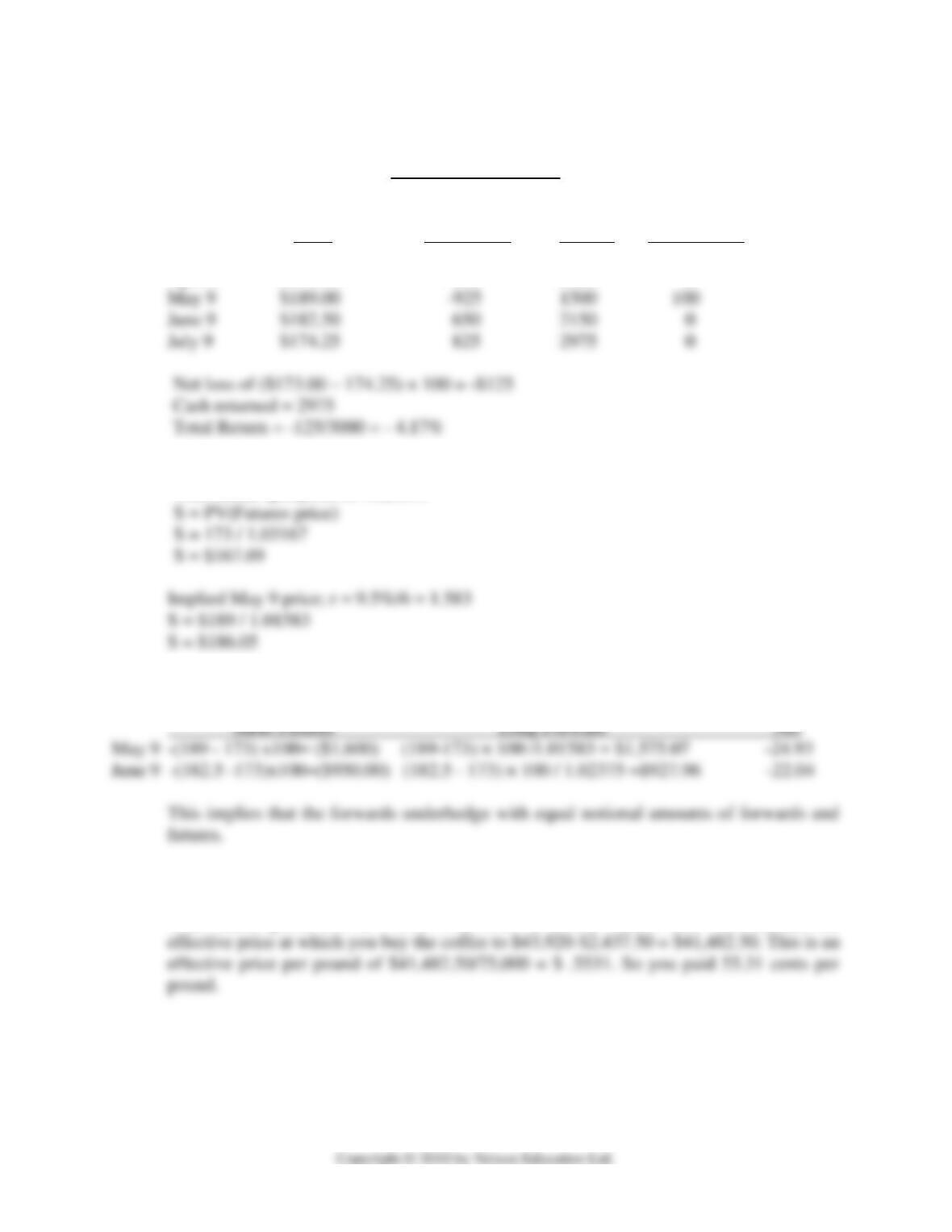
1(a).
Price Adjustment Margin Maintenance
March 9 $173.00 0 3000 0
April 9 $179.75 -675 2325 0
1(b). Cost of Carry = 1.5% + 8%=9.5%; for four month, r = 9.5%/3 = 3.167%
Theoretical spot price on March 9
1(c). Futures (Forwards) unwind without (with) discounting net differential, so
Short Futures Long Forward Net
2(a). You buy the coffee at 58.56 cents per pound. This will cost 75,000 × ($.5856) = $43,920.
Your futures profit will be 75,000 × ($ .592 – $ .5595) = $2,437.50. This reduces the
Solutions for Chapter 14: Questions and Problems
– 115 –
2(b). There are a couple of types of basis risk. First the anticipated amount is not exactly
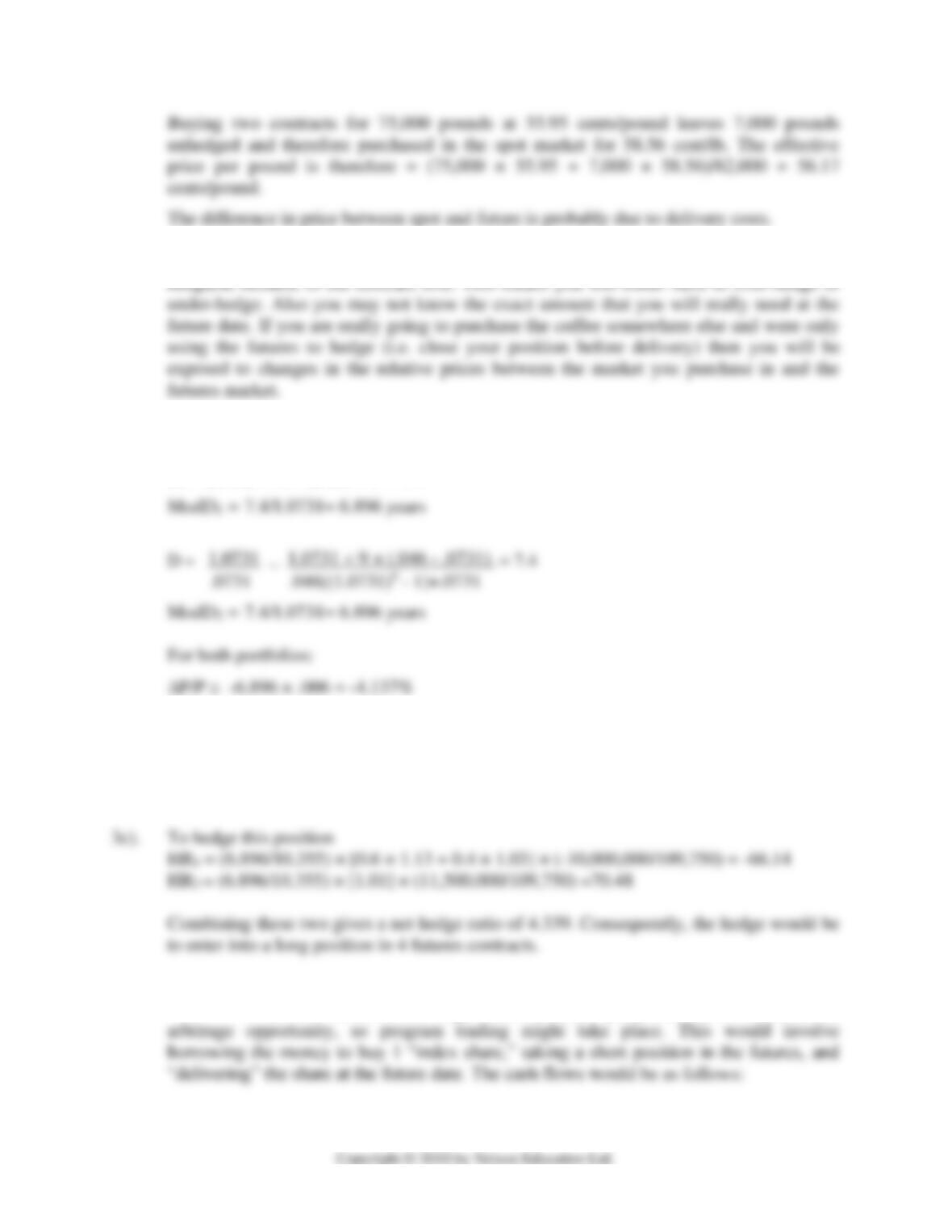
3a). Both bonds in portfolio 1 are zero coupon bonds, so:
D1 = (4/10) × 14+ (6/10) × 3 = 7.4
3b). Though the two portfolios have identical durations, the actual price changes will be
different because the portfolios have different convexities. In general, a “barbell”
portfolio (i.e. portfolio l) will have greater convexity, meaning that its value will fall less
relative to portfolio 2.
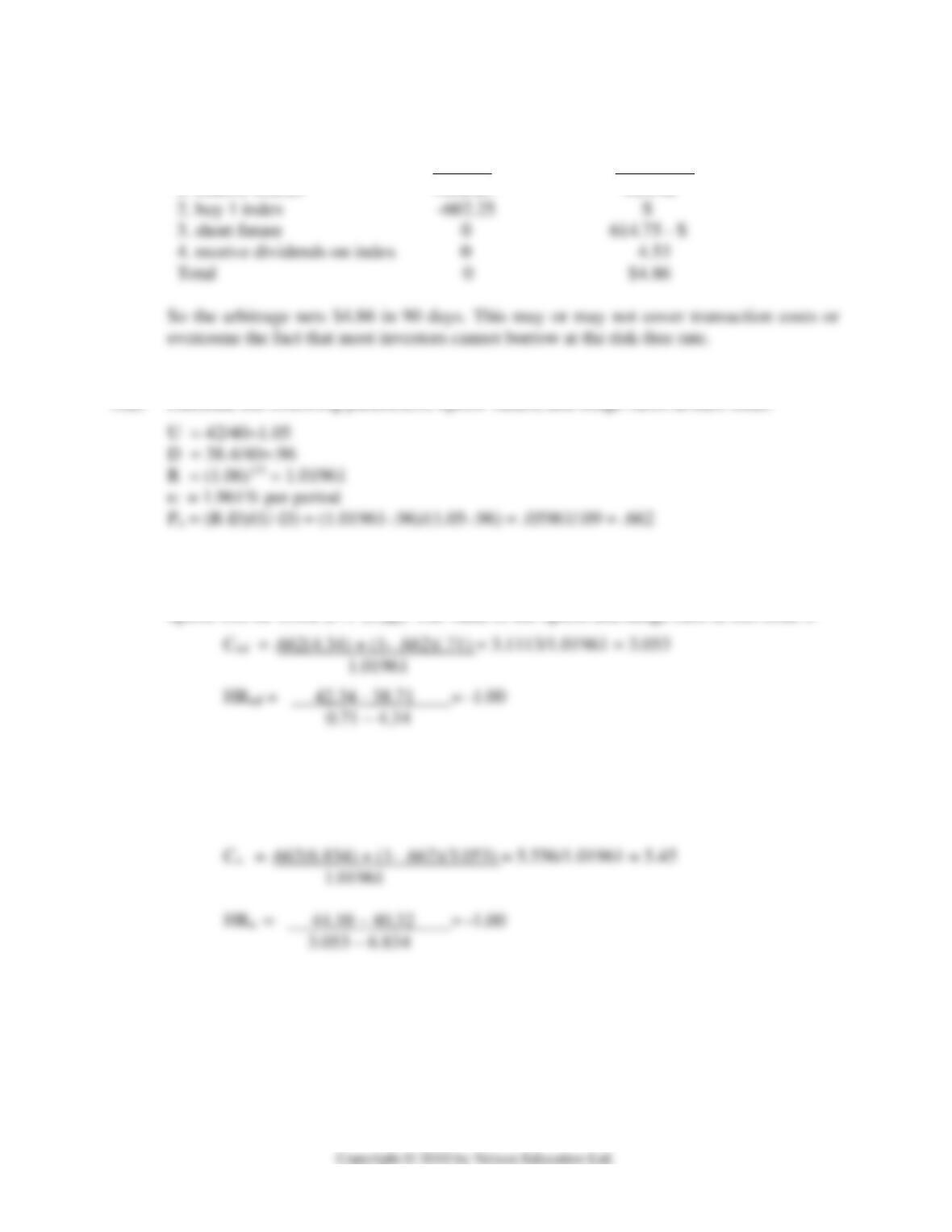
4. We can calculate the theoretical spot price for the index as S = F x e[-(r-d)t] = 614.75 x e [-
(.08-.03) x .25] = 607.11. Since this is larger than the actual spot price, there is a theoretical
Solutions for Chapter 14: Questions and Problems
– 116 –
T= now T=90 days
1. borrow 602.25 +602.25 -614.42
5(a). Calculate the following parameters, option values, and hedge ratios at each node:
5(a)(i). S = 40.32
If the stock moves up the option will be worth $4.34 (Cudu); if the stock moves down the
option will be worth $.71 (Cudd). The value of the option and hedge ratio at this node is
5(a)(ii). S = 42
If the stock moves up the option will be worth $6.834 (Cuu); if the stock moves down the
option will be worth $3.053 (Cud). The value of the option and hedge ratio at this node is
Solutions for Chapter 14: Questions and Problems
– 117 –
5(a)(iii). S = 40
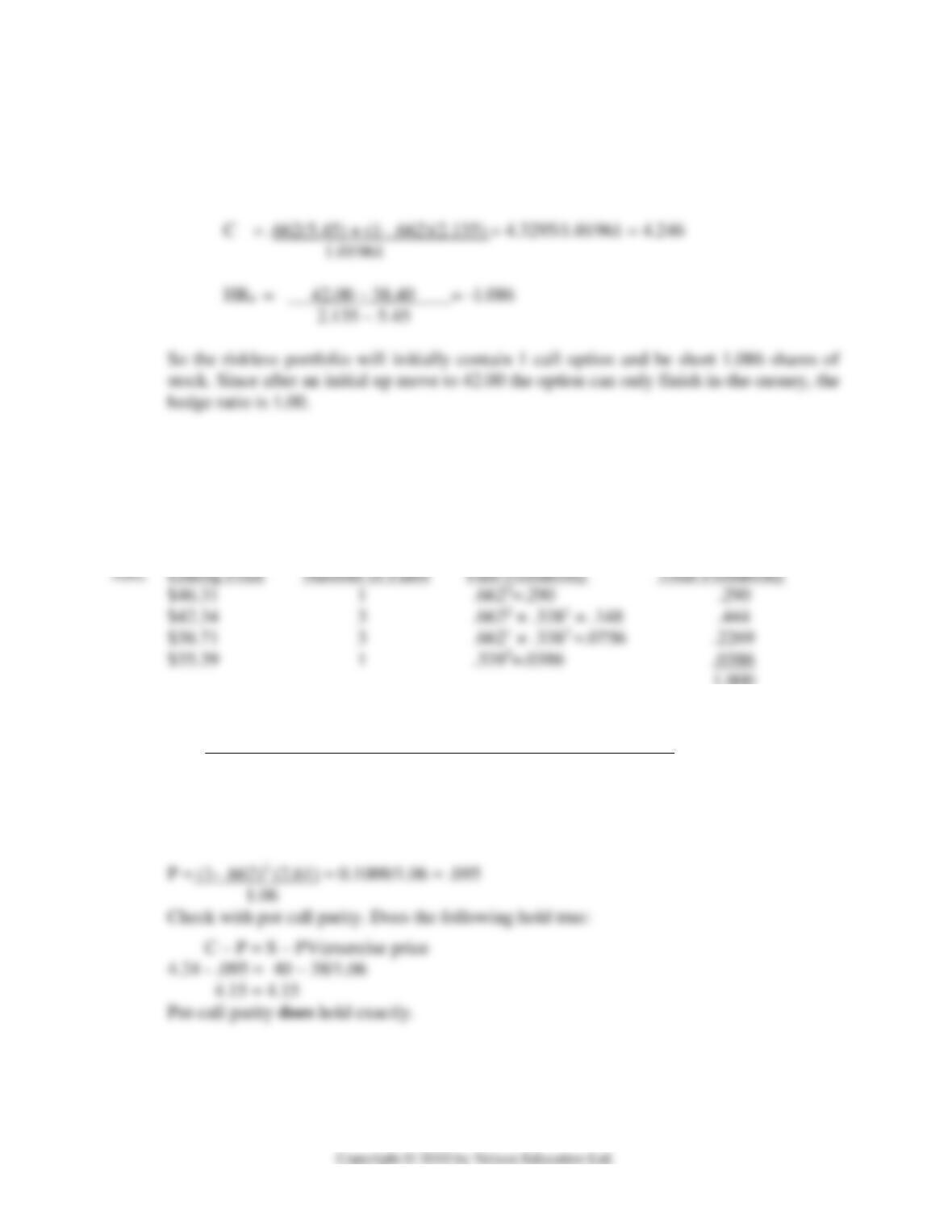
If the stock moves up the option will be worth $5.45 (Cu); if the stock moves down the
option will be worth $2.135. The value of the option and hedge ratio at this node is
Note the value of the S0 , S1, and S2 options are as follows:
C0 = 4.24 Cu = 5.45 Cuu = 6.834
Cd = 2.135 Cud = Cdu = 3.053
Cdd = 0.461
1.000
5(c). C = .6623 (8.31) + (3)(.6622)(1-.662)(4.34) +(3)(.662)(1-.662)2 (.71) = 4.50/1.06 = 4.24
1.06
5(d). The only path where the put option has a positive intrinsic value is ddd. Its intrinsic value
is $38.00 – $35.39 = $2.61.
Solutions for Chapter 14: Questions and Problems
– 118 –
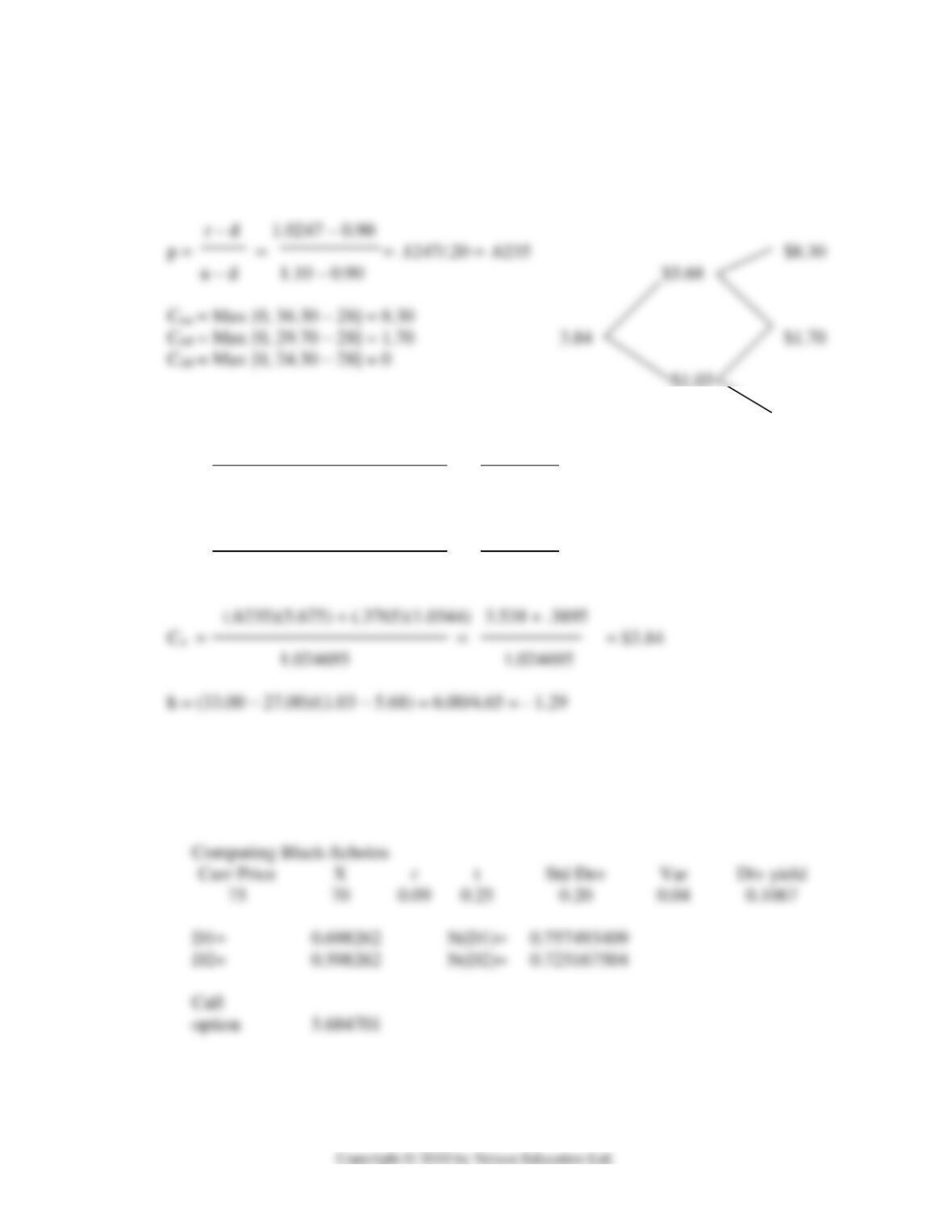
6. u = 33.00/30.00 = 36.00/33.00 = 1.10 d = 27.00/30.00 = 24.30/27.00 = 0.90
r = (1 + .05)1/2 = 1.0247
$0.00
(.6235)(8.30) + (.3765)(1.70) 5.17 + 0.64
CU = = = 5.815/1.025 = $5.68
1.024695 1.024695
(.6235)(1.70) + (.3765)(0.00) 1.05995
Cd = = = $1.03
1.024695 1.024695
7(a). One way is to calculate approximate dividend yield: approximate annual dividend yield =
8/75 = .1067
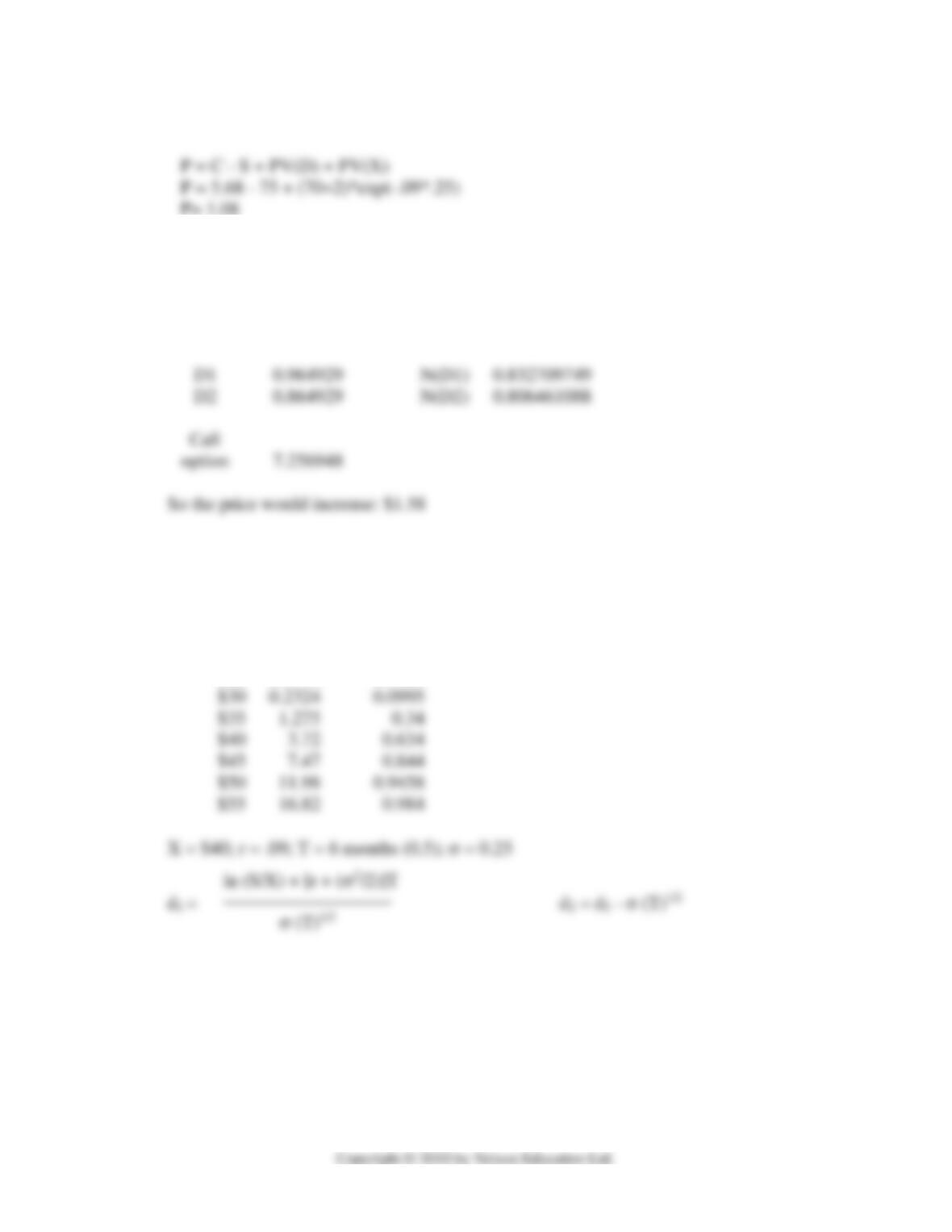
0.964929
0.864929
option
7.256948
Solutions for Chapter 14: Questions and Problems
– 119 –
7(b). Using put call parity
P= 1.08
7(c).
7(d). An increase in the volatility to 30% would increase the call’s value. A decrease in the
risk-free rate to 8% would decrease the call’s value.
8(a).
Price
Call
Hedge
Ratio
$25
0.0146
0.0103
$30
0.2324
0.0995
$35
$40
$45
$50
0.9458
$55
Computing Black-Scholes
Curr Price
X
r
t
Std Dev
Var
Div yield
75
70
0.09
0.25
0.20
0.04
0.0000
Solutions for Chapter 14: Questions and Problems
– 120 –
For example, if S = 25
8(b). The call value for each level of stock price is lower than those shown in Exhibit 14.15
because:
(1) A decrease in time to expiration (one year to six months) causes a decrease in the call
value.
(2) A decrease in security volatility () causes a decrease in the call value.
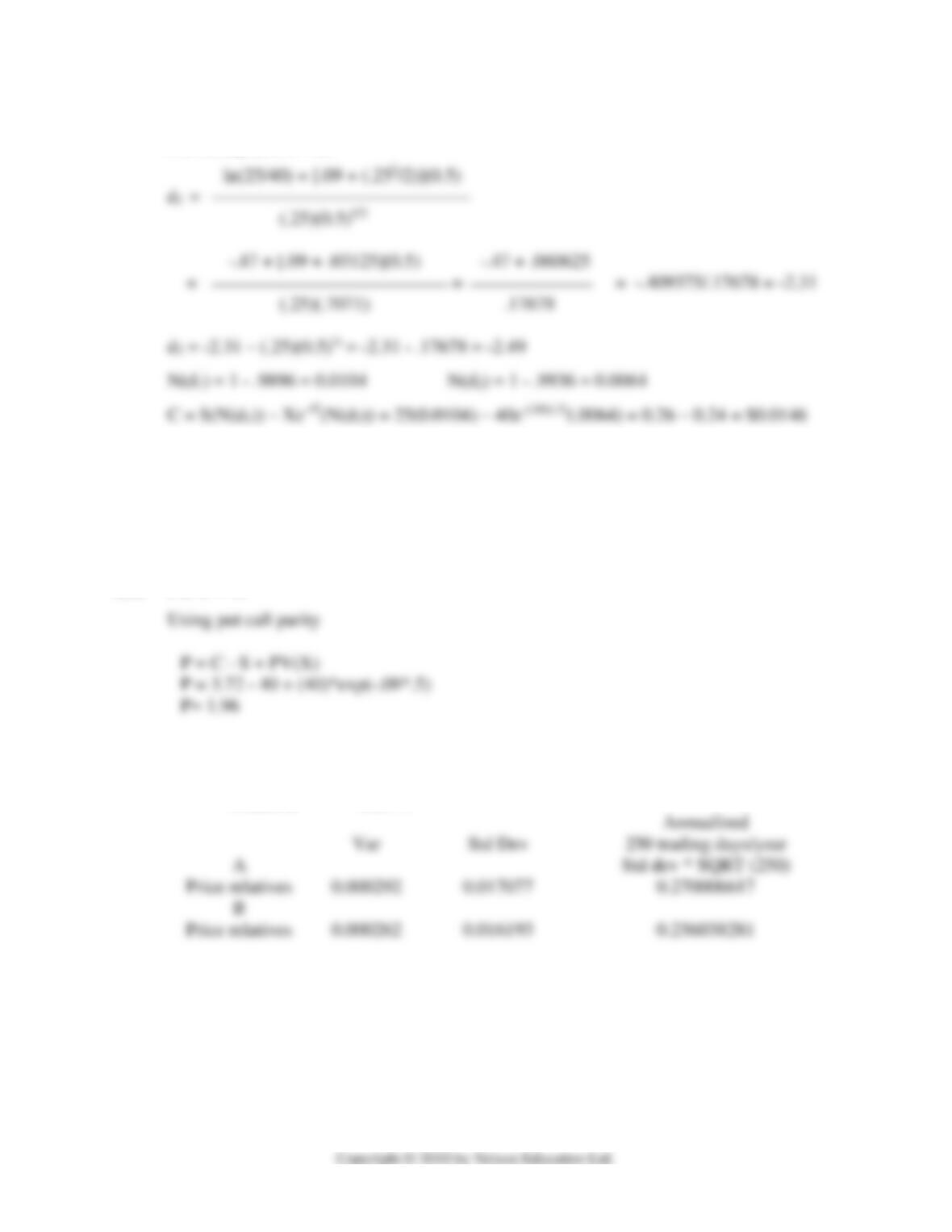
8(c). For S = 40
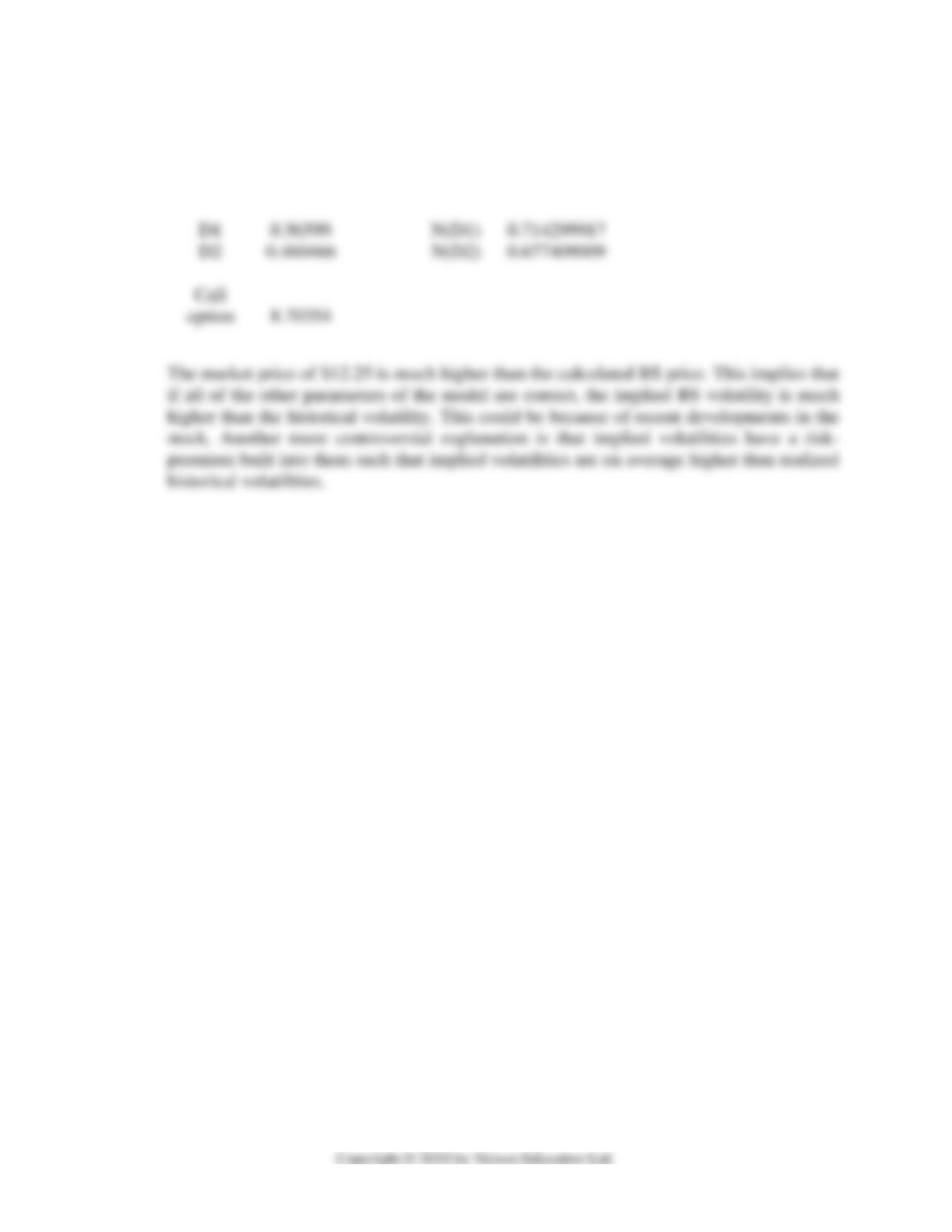
9(a). The volatility estimates are calculated as:
Period A 0.2708
Period B 0.2570
Solutions for Chapter 14: Questions and Problems
– 121 –
9(b).
Computing Black-Scholes
Curr Price
X
r
t
Std Dev
Var
Div yield
120.625
115
0.0742
0.169863
0.2560
0.065556
0.0365
0.714299917
0.460466
0.677409009
Call