
Chapter 14 – Power, Influence, & Leadership: From Becoming a Manager to Becoming a Leader
14-1
1
14
Chapter
Power, Influence, & Leadership:
From Becoming a Manager to Becoming a Leader
Major Questions the Student Should Be Able to Answer 2
Mapping the Class: Chapter Outline 3
Overview of the Chapter 4
Classroom Outline 6
CHAPTER CONTENTS
Chapter 14 – Power, Influence, & Leadership: From Becoming a Manager to Becoming a Leader
14-2
14.1 The Nature of Leadership: Wielding Influence
MAJOR QUESTION: I don’t want to be just a manager; I want to be a leader. What’s the
difference between the two?
MAJOR QUESTION: Do effective leaders behave in similar ways?
14.4 Situational Approaches: Should Leadership Vary with the
Situation?
MAJOR QUESTION: How might effective leadership vary according to the situation at
hand?
MAJOR QUESTIONS THE STUDENT SHOULD BE ABLE TO ANSWER
Chapter 14 – Power, Influence, & Leadership: From Becoming a Manager to Becoming a Leader
14-3
14.1 The Nature of Leadership: Wielding Influence
• Managers & Leaders: Not Always the Same
• Managerial Leadership: Can You Be Both a Manager & a Leader?
14.2 Trait Approaches: Do Leaders Have Distinctive Personality
Characteristics?
14.3 Behavioral Approaches: Do Leaders Show Distinctive Patterns
of Behavior?
• Task-Oriented Leader Behaviors: Initiating-Structure Leadership & Transactional
Leadership
14.4 Situational Approaches: Should Leadership Vary with the
Situation?
14.5 The Uses of Transformational Leadership
• Transformational Leaders
14.6 Three Additional Perspectives
• Leader–Member Exchange (LMX) Leadership: Having Different Relationships
with Different Subordinates
MAPPING THE CLASS: CHAPTER OUTLINE

Chapter 14 – Power, Influence, & Leadership: From Becoming a Manager to Becoming a Leader
14-4
14.1 The Nature of Leadership: Wielding Influence
Being a manager and being a leader are not the same. Leadership skills are
14.2 Trait Approaches: Do Leaders Have Distinctive Personality
Characteristics?
14.3 Behavioral Approaches: Do Leaders Show Distinctive Patterns
of Behavior?
Behavioral leadership approaches try to determine unique behaviors displayed
by effective leaders. These approaches can be divided into four categories, the
14.4 Situational Approaches: Should Leadership Vary with the
Situation?
Contingency approaches are based on the theory that effective leadership
14.5 The Uses of Transformational Leadership
14.6 Three Additional Perspectives
Two other kinds of leadership are the leader–member exchange model, which
OVERVIEW OF THE CHAPTER

Chapter 14 – Power, Influence, & Leadership: From Becoming a Manager to Becoming a Leader
14-5

Chapter 14 – Power, Influence, & Leadership: From Becoming a Manager to Becoming a Leader
14-6
The Manager’s Toolbox: Advancing Your Career: Staying Ahead in the Workplace
of Tomorrow
In this Toolbox, career coach Richard Knowdell offers strategies for staying ahead in the
workplace of tomorrow. His first recommendation is that you should develop a career
plan and base your choices on that plan. You need to make informed choices when
Possible Topics for Discussion:
• Which of these five rules do you think is most important—and why?
• Identify three new capacities that you believe that you should develop and
present an action plan on how you could develop them.
• Ask a trusted friend or colleague to serve as your career coach for the day and
Section 14.1 discusses the differences between managing and leading. Leadership
skills are needed to create and communicate a company’s vision, strategies, and goals,
while management skills are needed to execute on these plans and goals. This section
CLASSROOM OUTLINE
14.1 The Nature of Leadership: Wielding Influence (pp. 442-
447)
I don’t want to be just a manager; I want to be a leader. What’s the
difference between the two?

Chapter 14 – Power, Influence, & Leadership: From Becoming a Manager to Becoming a Leader
14-7
Possible Topics for Discussion:
• Think of someone who you consider to be an effective leader. Now, explain why
Major Idea Outline:
A. Leadership is the ability to influence employees to voluntarily pursue
organizational goals.
B. Leaders manage and managers lead, but the two activities are not
synonymous.
1. Managers do planning, organizing, directing and control.

Chapter 14 – Power, Influence, & Leadership: From Becoming a Manager to Becoming a Leader
14-8
C. In the workplace, many people are capable of exhibiting managerial
leadership, defined as “the process of influencing others to understand and
D. In considering management vs. leadership, retired Harvard professor John
Kotter suggests that they are complementary systems of action:
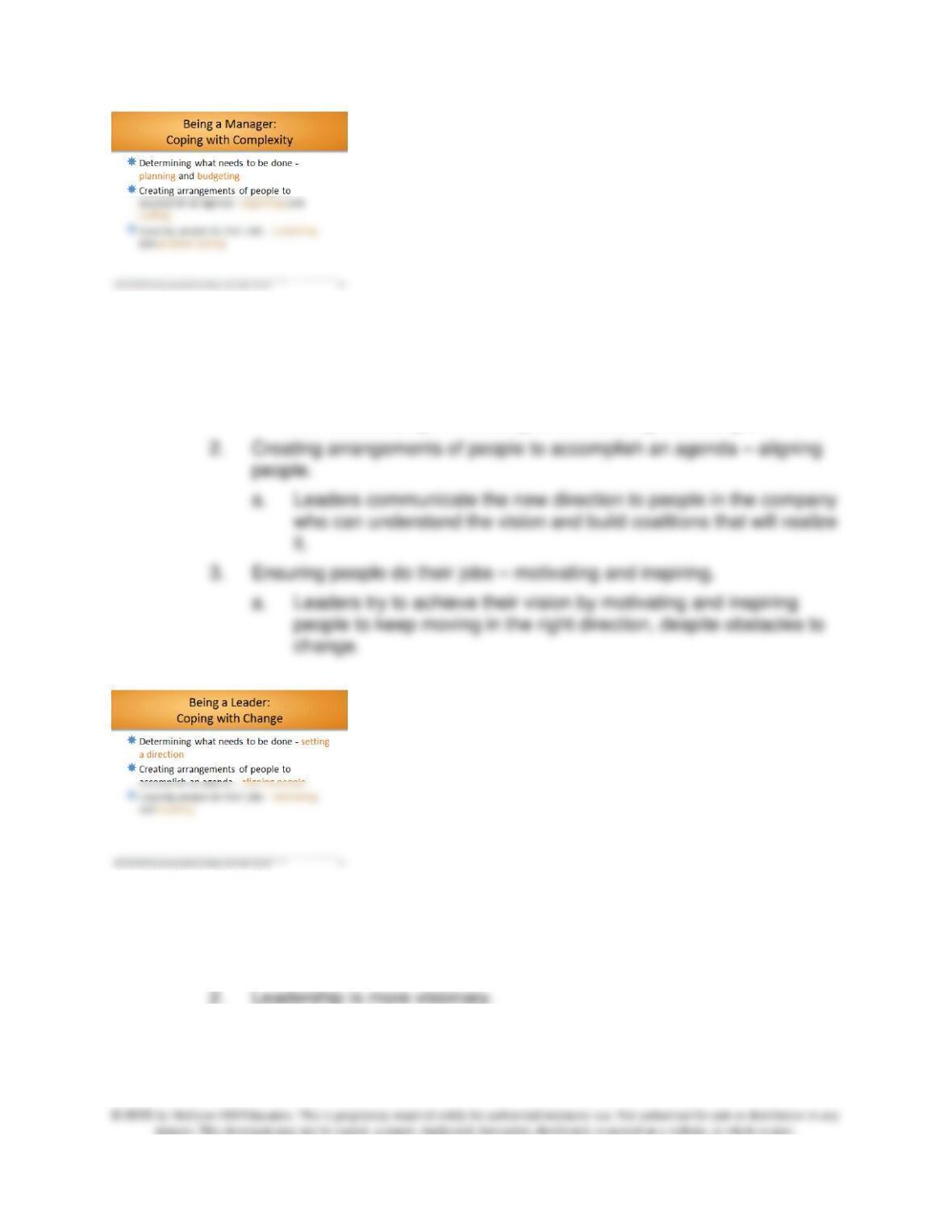
1. Management is about coping with complexity.
E. Management is necessary because complex organizations tend to become
chaotic unless there is good management. Companies manage complexity
in three ways:
1. Determining what needs to be done – planning and budgeting.
3. Ensuring people do their jobs – controlling and problem-solving.
a. Managers monitor results versus plan and then plan and organize
to solve problems as they arise.
Chapter 14 – Power, Influence, & Leadership: From Becoming a Manager to Becoming a Leader
14-9
F. Leadership copes with change in three ways:
1. Determining what needs to be done – setting a direction.
a. Leaders strive for constructive change by developing a vision for
the future, along with strategies for realizing the changes.
G. Managers plan, organize and control, but they don’t necessarily have the
characteristics to be leaders.
1. Management is a process that lots of people are able to learn.

Chapter 14 – Power, Influence, & Leadership: From Becoming a Manager to Becoming a Leader
14–10
SELF-ASSESSMENT 14.1 (p. 444)
Assessing Your Readiness to Assume the Leadership Role
Go to connect.mheducation.com and take Self-Assessment 14.1.
Student Questions:
1. What is your level of readiness? Are you surprised by the results?
2. Looking at the three highest– and lowest-rated items in the survey, what can
you do to increase your readiness to lead? Think of specific actions you take
right now.
Generally, in order to increase readiness to lead, students should understand
3. Do you think your readiness to lead will change over time? Explain your
rationale.
Readiness to lead changes with the experiences individuals have throughout
Additional Activities:
You can also consult the Connect Instructors Manual for the post-assessment activity
H. Authority is the right to perform or command. Power is the extent to which a
person is able to influence others so they respond to others.
1. Personalized power is power directed at helping oneself.

Chapter 14 – Power, Influence, & Leadership: From Becoming a Manager to Becoming a Leader
14–11
I. Within an organization, there are typically five powers that leaders may draw
on: legitimate, reward, coercive, expert and referent.
1. Legitimate power, which all managers have, is power that results
2. Reward power, which all managers have, is power that results from
3. Coercive power, which all managers have, results from managers’
authority to punish their subordinates.
a. Punishment can range from verbal or written reprimands to

Chapter 14 – Power, Influence, & Leadership: From Becoming a Manager to Becoming a Leader
4. Expert power is power resulting from one’s specialized information or
expertise.
5. Referent power is power deriving from one’s personal attraction.
a. This power characterizes strong, visionary leaders who are able
J. Leaders have the ability to influence others – to get others to follow their
wishes. There are nine tactics for trying to influence others, ranked by
employees from most-used to least-used:
1. Rational persuasion – trying to convince somebody by using reason,
logic or facts.
5. Personal appeals – referring to friendship and loyalty when making a
request.
6. Exchange tactics – reminding someone of past favors or offering to
trade favors.

Chapter 14 – Power, Influence, & Leadership: From Becoming a Manager to Becoming a Leader
14–13
9. Legitimating tactics – basing a request on one’s authority or right,
organizational rules or policies, or express or implied support from
superiors.
K. These influence tactics are considered generic because they are applied in
all directions – up, down and sideways within the organization.
1. The first five influence tactics are considered “soft” tactics because
they are considered friendlier than the last four “hard” or pressure

Chapter 14 – Power, Influence, & Leadership: From Becoming a Manager to Becoming a Leader
14–14
Section 14.2 discusses trait approaches. Trait approaches attempt to identify distinctive
characteristics that account for the effectiveness of leaders. This section describes (1)
positive task-oriented traits and positive/negative interpersonal attributes (narcissism,
Machiavellianism, psychopathy) and (2) some results of gender studies.
Possible Topics for Discussion:
• Reflect on the traits and leadership style of a male leader and those of a female
leader with whom you have worked. Describe the key differences between their
approaches to leadership.
Major Idea Outline:
A. Trait approaches to leadership attempt to identify distinctive characteristics
that account for the effectiveness of leaders.
14.2 Trait Approaches: Do Leaders Have Distinctive
Personality Characteristics? (pp. 448-450)
What does it take to be a successful leader?

Chapter 14 – Power, Influence, & Leadership: From Becoming a Manager to Becoming a Leader
14–15
C. Three “Dark Side” Traits:
2. Machiavellianism displays a cynical view of human nature and condones
3. Psychopathy is characterized by lack of concern for others, impulsive
D. Organizations can apply trait theory in three ways:
1. They can incorporate personality and trait assessments into their selection
and promotion processes.
3. They can send targeted employees to management development programs
that include management classes, coaching sessions, trait assessments,
and the like.
E. Gender Studies – Do Women Have Traits That Make Them Better Leaders?
Chapter 14 – Power, Influence, & Leadership: From Becoming a Manager to Becoming a Leader
14–16
1. Management studies have shown that “women executives, when rated
2. Women were found to be better at:
a. Teamwork and partnering
b. Being more collaborative
3. Women were also found to be better at producing quality work,
recognizing trends, and generating new ideas and acting on them.
4. Women used a more democratic or participative style than men, who
were apt to use a more autocratic and directive style.
6. Women executives, when rated by their peers, managers, and direct
7. Possible explanations for the lack of women in positions of top
leadership include:
a. Unwillingness to compete as hard as men or make the required
personal sacrifices.
levels than men in their first jobs, putting them at a disadvantage.
8. With more than half of college students being women and women

Chapter 14 – Power, Influence, & Leadership: From Becoming a Manager to Becoming a Leader
14–17
Group Exercise #1: Identifying Preferences for Traits Possessed by Leaders
There is a group exercise available at the end of this manual that provides students
with the opportunity to explore individual preferences for preferred leadership traits.
Exercise Objectives
Section 14.3 discusses behavioral leadership approaches. These approaches try to
determine unique behaviors displayed by effective leaders and can be divided into four
categories, of which three are covered in this section: (1) task-oriented behavior, (2)
relationship-oriented behavior and (3) passive behavior.
14.3 Behavioral Approaches: Do Leaders Show Distinctive
Patterns of Behavior? (pp. 451-456)
Do effective leaders behave in similar ways?

Chapter 14 – Power, Influence, & Leadership: From Becoming a Manager to Becoming a Leader
14–18
Possible Topics for Discussion:
• Thinking of your most recent job, describe the task-oriented and relationship-
oriented behavior that your manager or supervisor has displayed. Describe the
type of leader behaviors that you find most inspiring.
Major Idea Outline:
A. Behavioral leadership approaches attempt to determine the distinctive styles
used by effective leaders.
B. Task-Oriented Leadership Behaviors
1. The primary purpose of task-oriented leadership behaviors is to ensure

Chapter 14 – Power, Influence, & Leadership: From Becoming a Manager to Becoming a Leader
14–19
2. Initiating-structure leadership
3. Transactional leadership
a. Transactional leadership focuses on clarifying employees’ roles and
C. Relationship-Oriented Leadership
1. Relationship-oriented leadership is primarily concerned with the
leader’s interactions with his or her people.
Chapter 14 – Power, Influence, & Leadership: From Becoming a Manager to Becoming a Leader
14–20
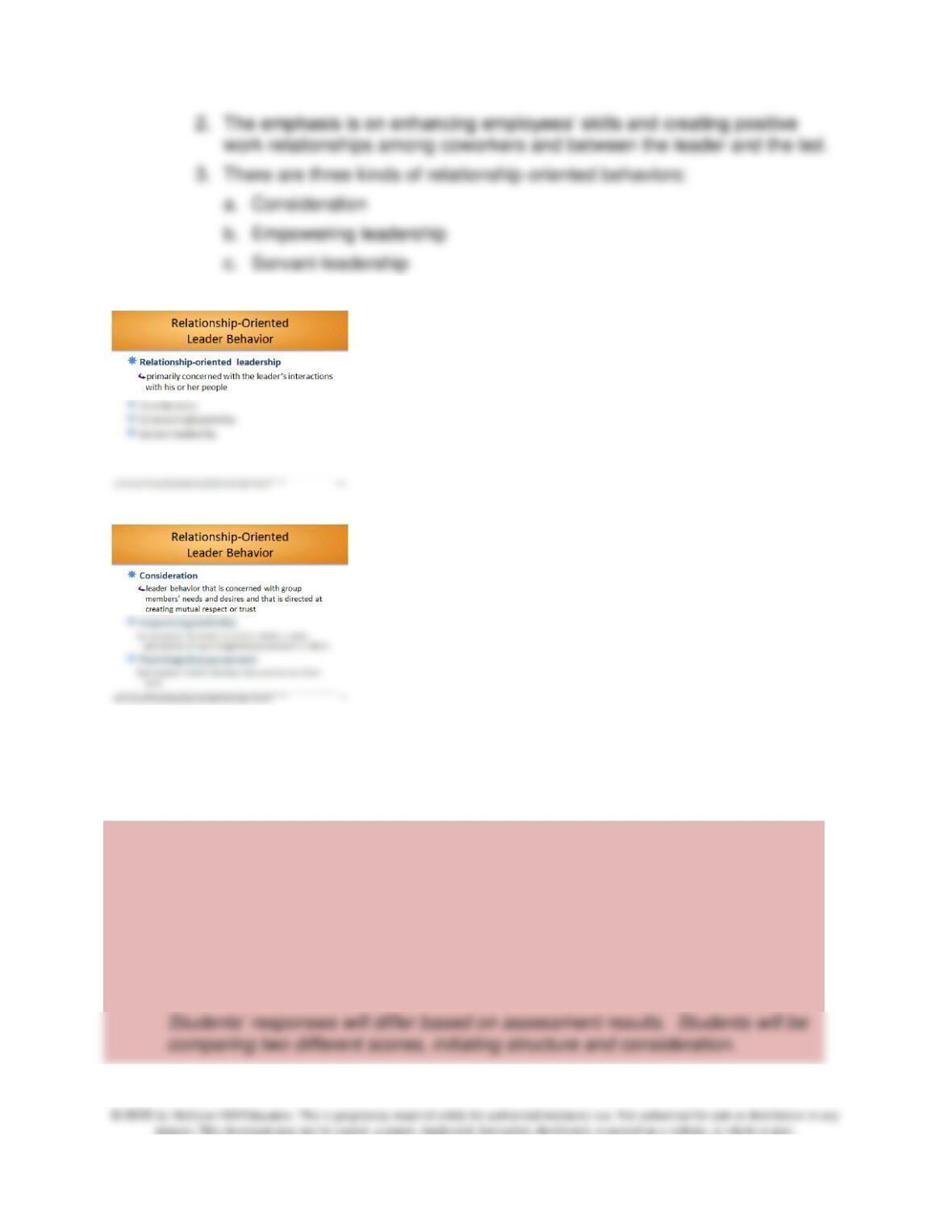
4. Consideration is leader behavior that is concerned with group members’
needs and desires and that is directed at creating mutual respect or trust.
SELF-ASSESSMENT 14.2 (p. 453)
Assessing Your Task & Relationship-Oriented Leader Behavior
Go to connect.mheducation.com and take Self-Assessment 14.2.
Student Questions:
1. Do you prefer to use task or relationship leadership? Why do you think this is
the case?