
Chapter 13 – Groups & Teams: Increasing Cooperation, Reducing Conflict
13-1
13
Chapter
Groups & Teams:
Increasing Cooperation, Reducing Conflict
Major Questions the Student Should Be Able to Answer 2
Mapping the Class: Chapter Outline 3
Overview of the Chapter 4
Classroom Outline 5
CHAPTER CONTENTS
Chapter 13 – Groups & Teams: Increasing Cooperation, Reducing Conflict
13-2
13.1 Groups versus Teams
MAJOR QUESTION: How is one collection of workers different from any other?
13.2 Stages of Group and Team Development
MAJOR QUESTION: How does a group evolve into a team?
MAJOR QUESTIONS THE STUDENT SHOULD BE ABLE TO ANSWER

Chapter 13 – Groups & Teams: Increasing Cooperation, Reducing Conflict
13-3
13.1 Groups versus Teams
• Groups & Teams: How Do They Differ?
13.2 Stages of Group and Team Development
• Stage 1: Forming—“Why Are We Here?”
13.3 Building Effective Teams
• Cooperation: “We Need to Systematically Integrate Our Efforts”
• Trust: “We Need to Have Reciprocal Faith in Each Other”
• Cohesiveness: “Togetherness Is Vital”
13.4 Managing Conflict
• The Nature of Conflict: Disagreement Is Normal
• Can Too Little or Too Much Conflict Affect Performance?
MAPPING THE CLASS: CHAPTER OUTLINE
Chapter 13 – Groups & Teams: Increasing Cooperation, Reducing Conflict
13-4
13.1 Groups versus Teams
A team is different from a group. A group typically is management-directed, a
13.2 Stages of Group and Team Development
13.3 Building Effective Teams
To build a group into a high-performance team, managers must consider matters
13.4 Managing Conflict
Conflict, an enduring feature of the workplace, is a process in which one party
OVERVIEW OF THE CHAPTER
Chapter 13 – Groups & Teams: Increasing Cooperation, Reducing Conflict
13-5
The Manager’s Toolbox: Reaching across Time & Space: The Challenge of
Managing Virtual Teams
Advances in technology are making it easier than ever for people to collaborate, even
when they are dispersed geographically. Virtual teams, or geographically dispersed
teams, are groups of people who use information technology—computers and
Possible Topics for Discussion:
• What do you feel might be the greatest difficulties of always working online with
numerous people that you never see? How would you try to avoid or solve these
difficulties?
Section 13.1 discusses how a team is different from a group. A group typically is
management-directed while a team is self-directed. Groups may be formal, created to
CLASSROOM OUTLINE
13.1 Groups versus Teams (pp. 412-416)
How is one collection of workers different from any other?
Chapter 13 – Groups & Teams: Increasing Cooperation, Reducing Conflict
13-6
Possible Topics for Discussion:
• Discuss the reasons why companies rely on teams and the main advantages to
their use.
Major Idea Outline:
A. Organizations are not only flatter and information-based but also organized
around teamwork.
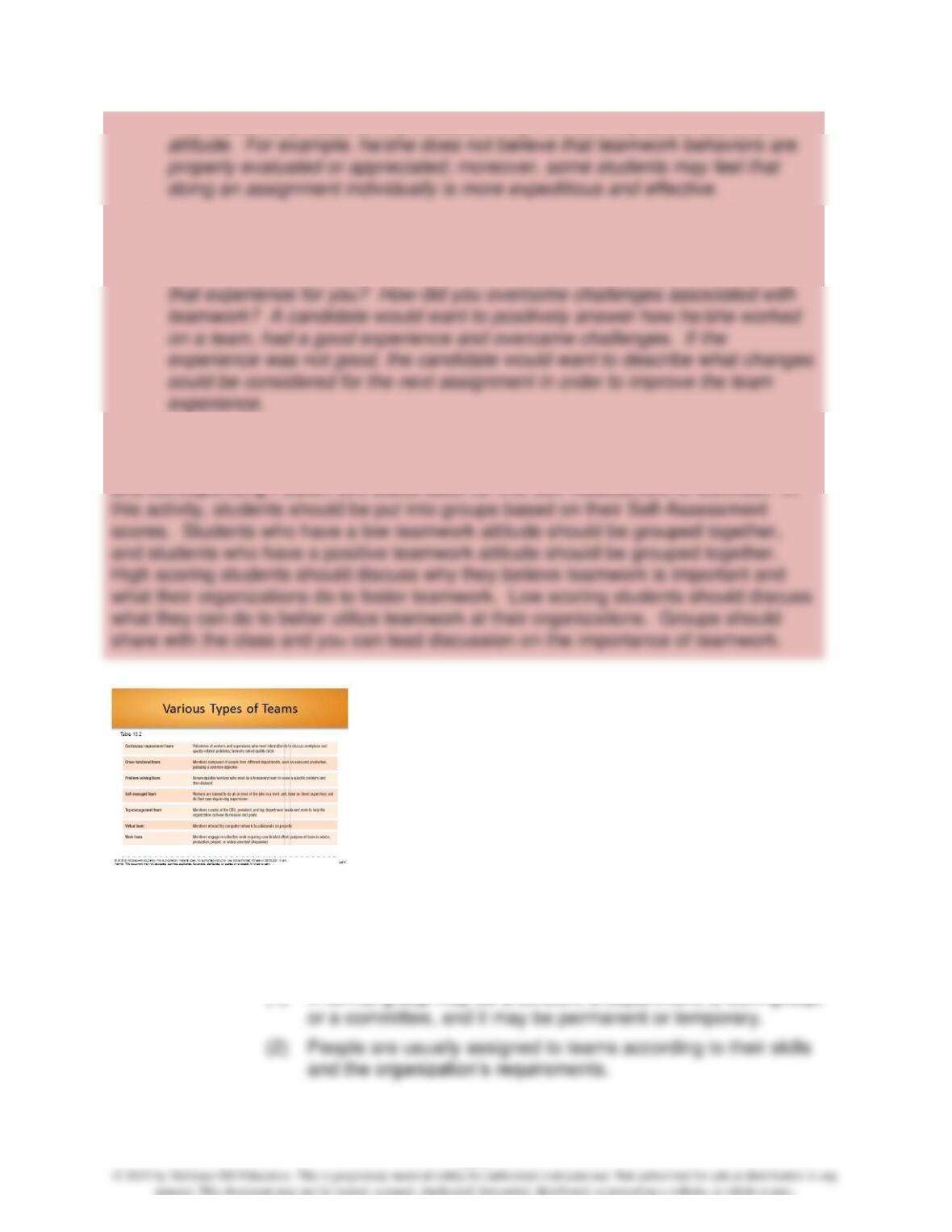
C. Groups and Teams: How Do They Differ?
1. A group of people and a team of people are not the same thing.

Chapter 13 – Groups & Teams: Increasing Cooperation, Reducing Conflict
13-7
a. A group is defined as two or more freely interacting individuals who
share collective norms and goals, and have a common identity.
SELF-ASSESSMENT 13.1 (p. 413)
Attitudes toward Teamwork
Go to connect.mheducation.com and take Self-Assessment 13.1.
Student Questions:
1. What is your attitude toward teamwork?
Student responses will differ based on assessment results. Some students
2. If you do not have a positive teamwork attitude, consider the reason why and
identify what you might do to foster a more positive attitude.
Chapter 13 – Groups & Teams: Increasing Cooperation, Reducing Conflict
13-8
There are many reasons why a student may not have a positive teamwork
3. Develop three potential questions that a recruiter might ask to determine if you
are positively disposed to teamwork. Now answer the questions.
Some questions include: Have you ever worked on a work team? How was
Additional Activities:
You can also consult the Connect Instructors Manual for the post-assessment activity
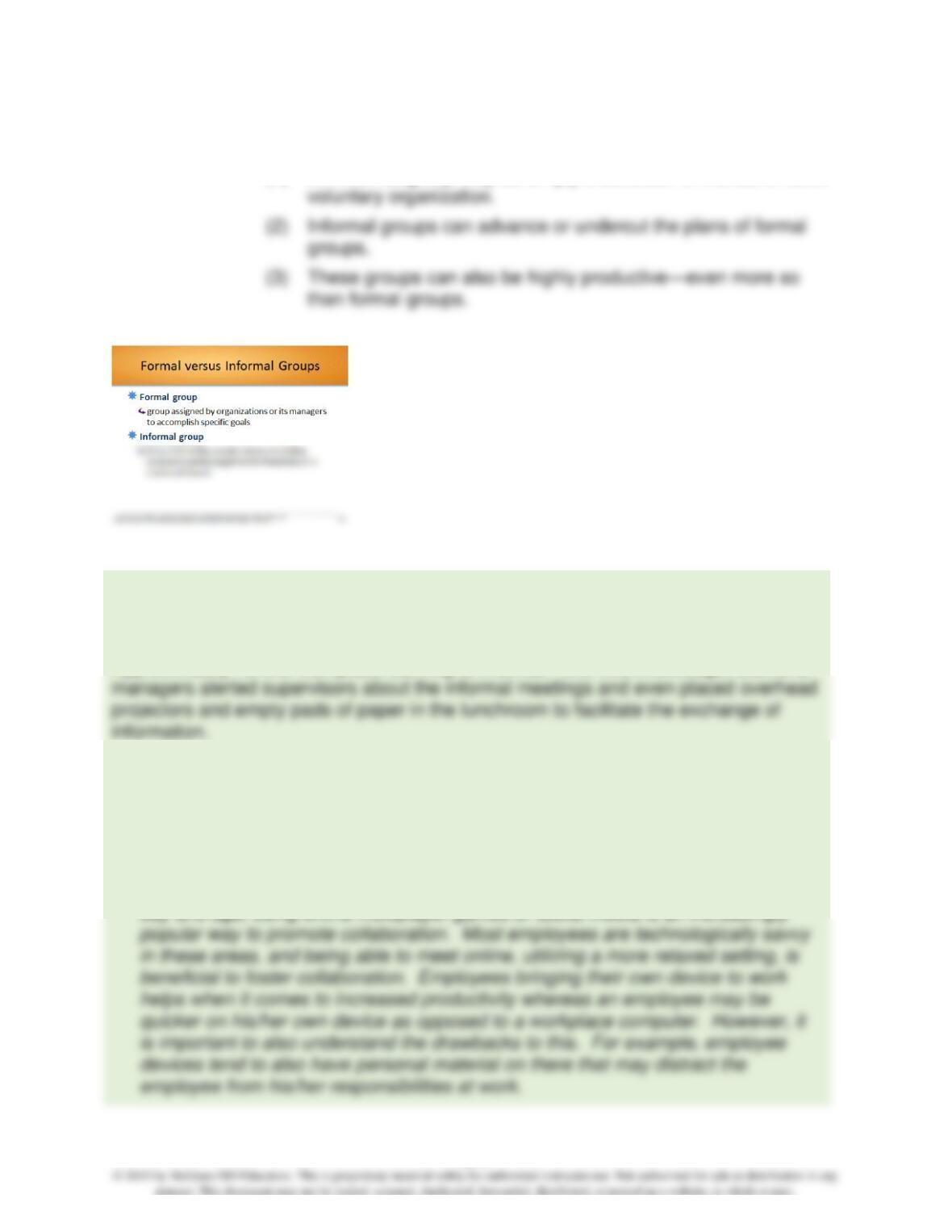
2. Groups may be formal or informal.
a. A formal group is a group established to do something productive for
the organization and is headed by a leader.
(1) A formal group may be a division, a department, a work group,
Chapter 13 – Groups & Teams: Increasing Cooperation, Reducing Conflict
13-9
b. An informal group is a group formed by people whose overriding
purpose is getting together for friendship or a common interest.
(1) An informal group may be simply a collection of friends or other
Interactive Classroom Material:
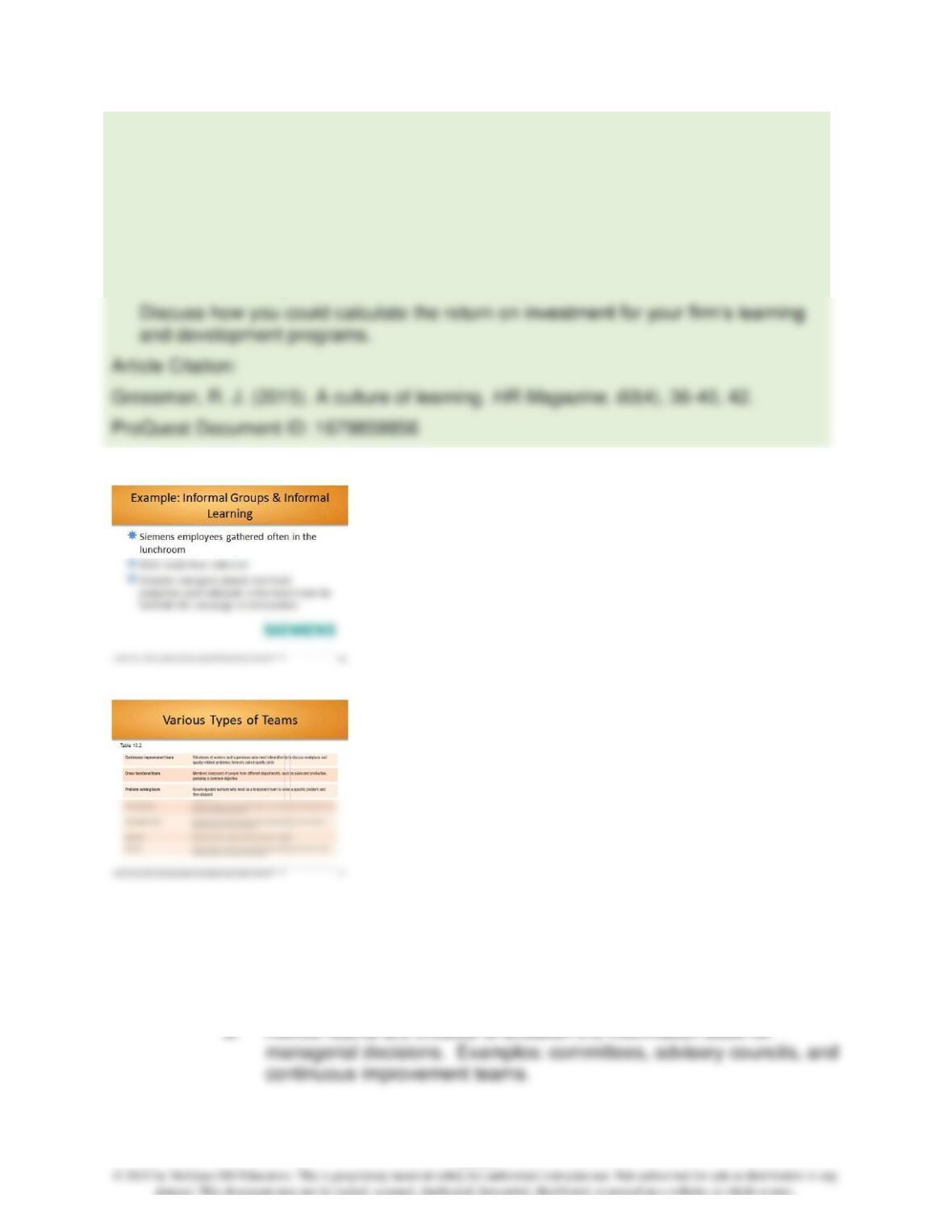
EXAMPLE: Informal Groups & Informal Learning: Sharing Knowledge in the
Lunchroom and on Social Media (p. 414)
Approximately 70% of workplace learning is informal. With this knowledge, Siemens
YOUR CALL
Can games (such as the online multiplayer game Second Life) or other social
media (Facebook, Twitter) be used to foster informal workplace collaboration?
How about allowing employees to BYOD – bring your own device – to work,
such as their smartphone or tablet computer?
There are a lot of ways to foster informal workplace collaboration and in today’s
day and age, using online multiplayer games or social media is an increasingly
Chapter 13 – Groups & Teams: Increasing Cooperation, Reducing Conflict
13–10
Additional Activities:
One way to build on this Example is to have the students read the HR Magazine
article “A Culture of Learning.” This article discusses the importance of creating a
learning mindset in your organization. Consider using the following discussion
questions:
Discuss how the corporate learning environment is changing.
What is a learning mindset and how can companies foster one?
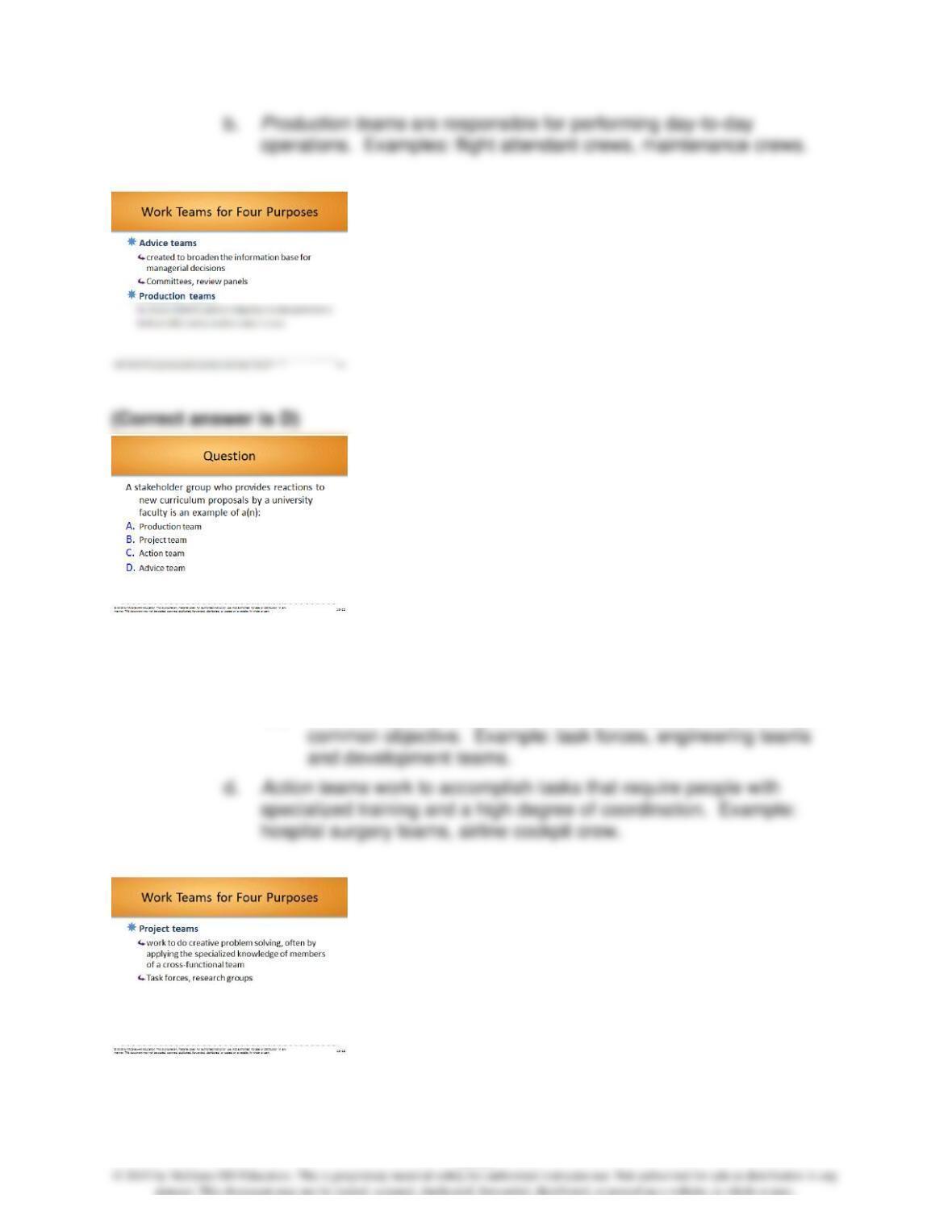
D. Work Teams for Four Purposes: Advice, Production, Project, and Action
1. Work teams engage in collective work requiring coordinated effort. They
are of four types, identified according to their basic purpose: advice,
production, project or action.
Chapter 13 – Groups & Teams: Increasing Cooperation, Reducing Conflict
13–11
c. Project teams work to do creative problem solving, often by applying
the specialized knowledge of members of a cross-functional team.
(1) A cross-functional team is staffed with specialists pursuing a

Chapter 13 – Groups & Teams: Increasing Cooperation, Reducing Conflict
E. Self-Managed Teams: Workers with Own Administrative Oversight
1. Self-managed teams emerged from what were called quality circles.
a. These are now known as continuous improvement teams, which
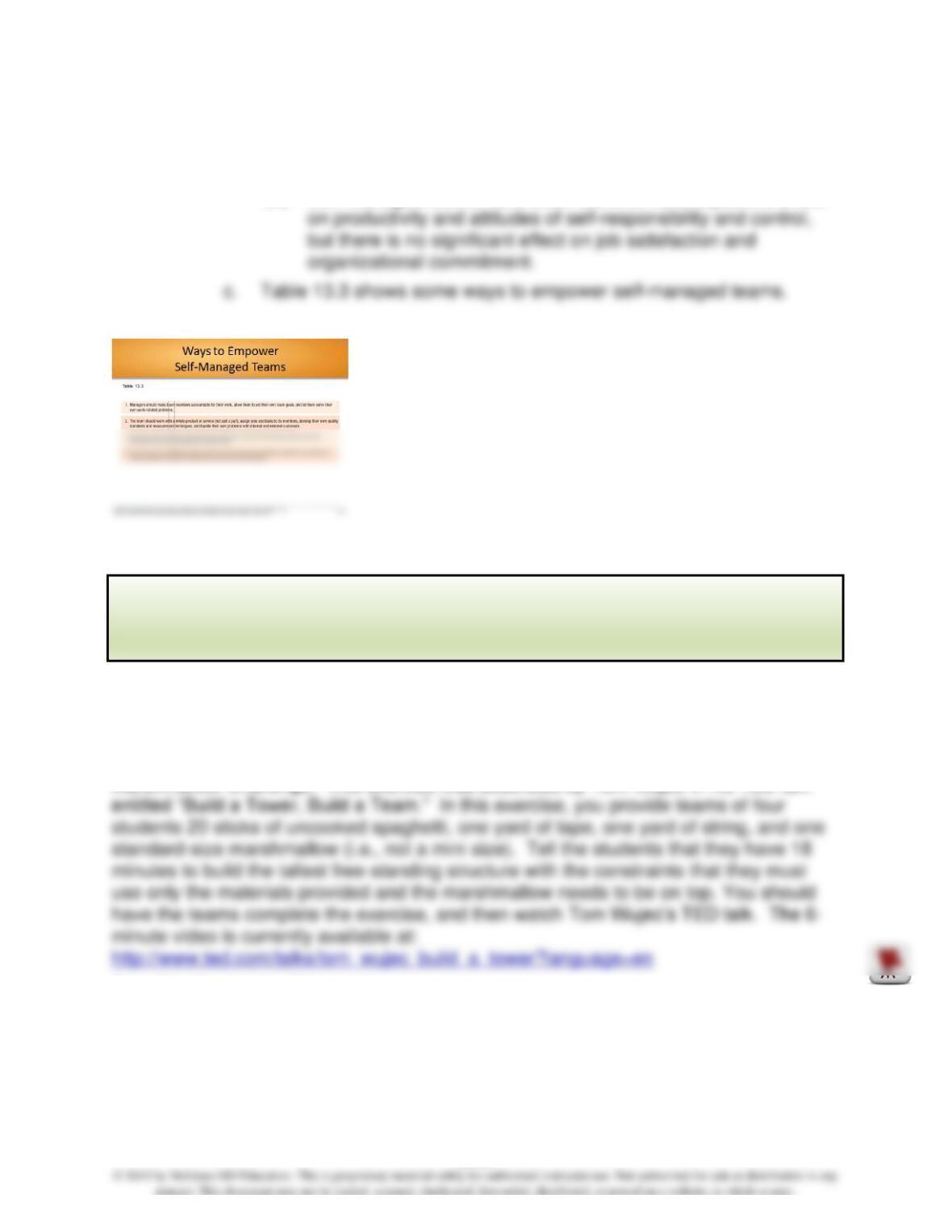
b. Self-managed teams are defined as groups of workers who are given
administrative oversight for their task domains.
planning, scheduling, monitoring and staffing.
(2) The traditional distinction between manager and managed is
Chapter 13 – Groups & Teams: Increasing Cooperation, Reducing Conflict
13–13
(3) The most common chores of today’s self-managed teams are
work scheduling and customer interaction. Least common are
hiring and firing.
(4) Self-managed teams have been found to have a positive effect
Section 13.2 discusses the five-stages groups go through in order to evolve into a team.
These are forming, storming, norming, performing, and adjourning.
One way that you could begin your coverage of these topics is to conduct the
Marshmallow Challenge. This exercise was described by Tom Wujec in his TED talk
Possible Topics for Discussion:
• Discuss how the stages of group development might be different for virtual teams
compared to traditional face-to-face teams.
13.2 Stages of Group & Team Development (pp. 417-418)
How does a group evolve into a team?
Chapter 13 – Groups & Teams: Increasing Cooperation, Reducing Conflict
Major Idea Outline:
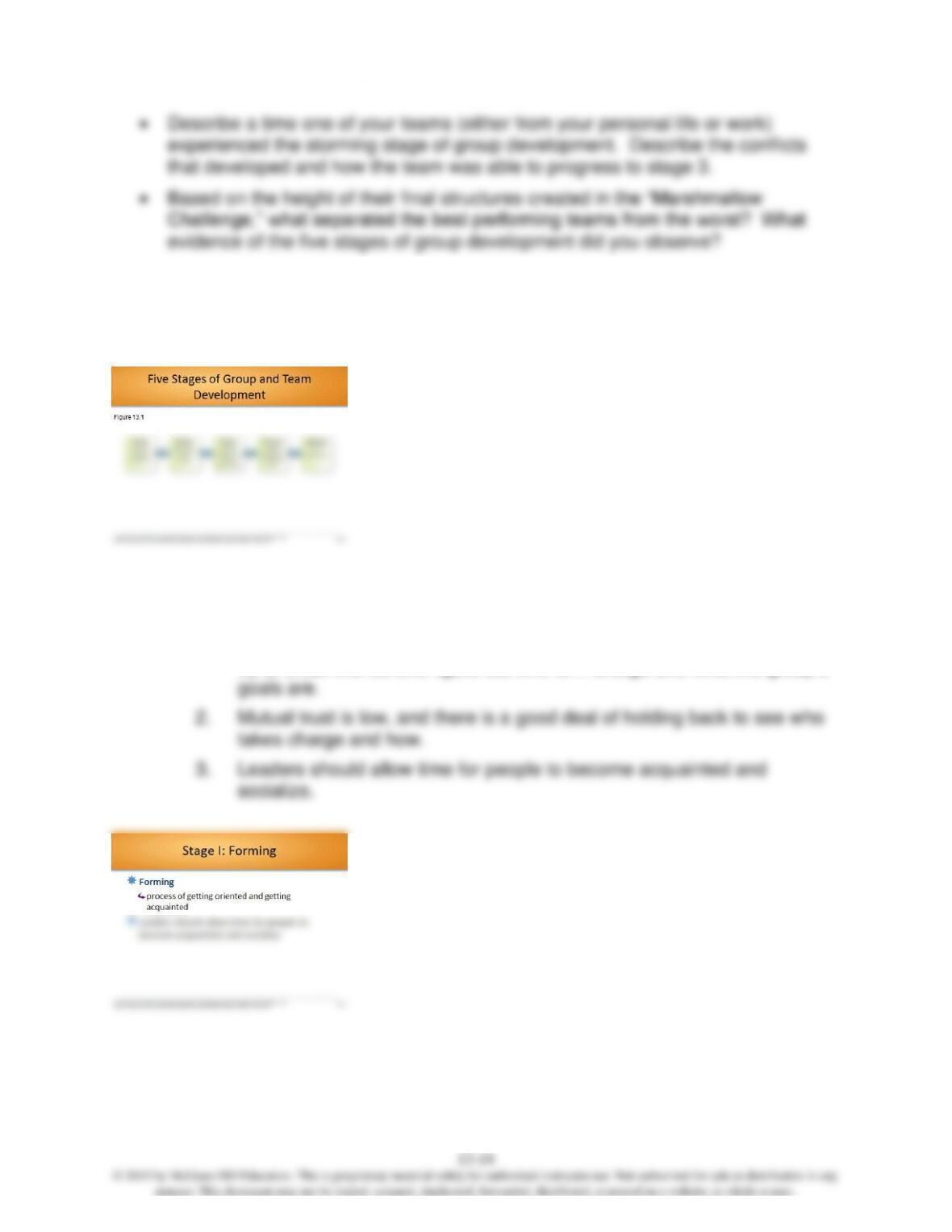
A. Groups and teams go through five stages of development: forming, storming,
norming, performing and adjourning. (See Figure 13.1)
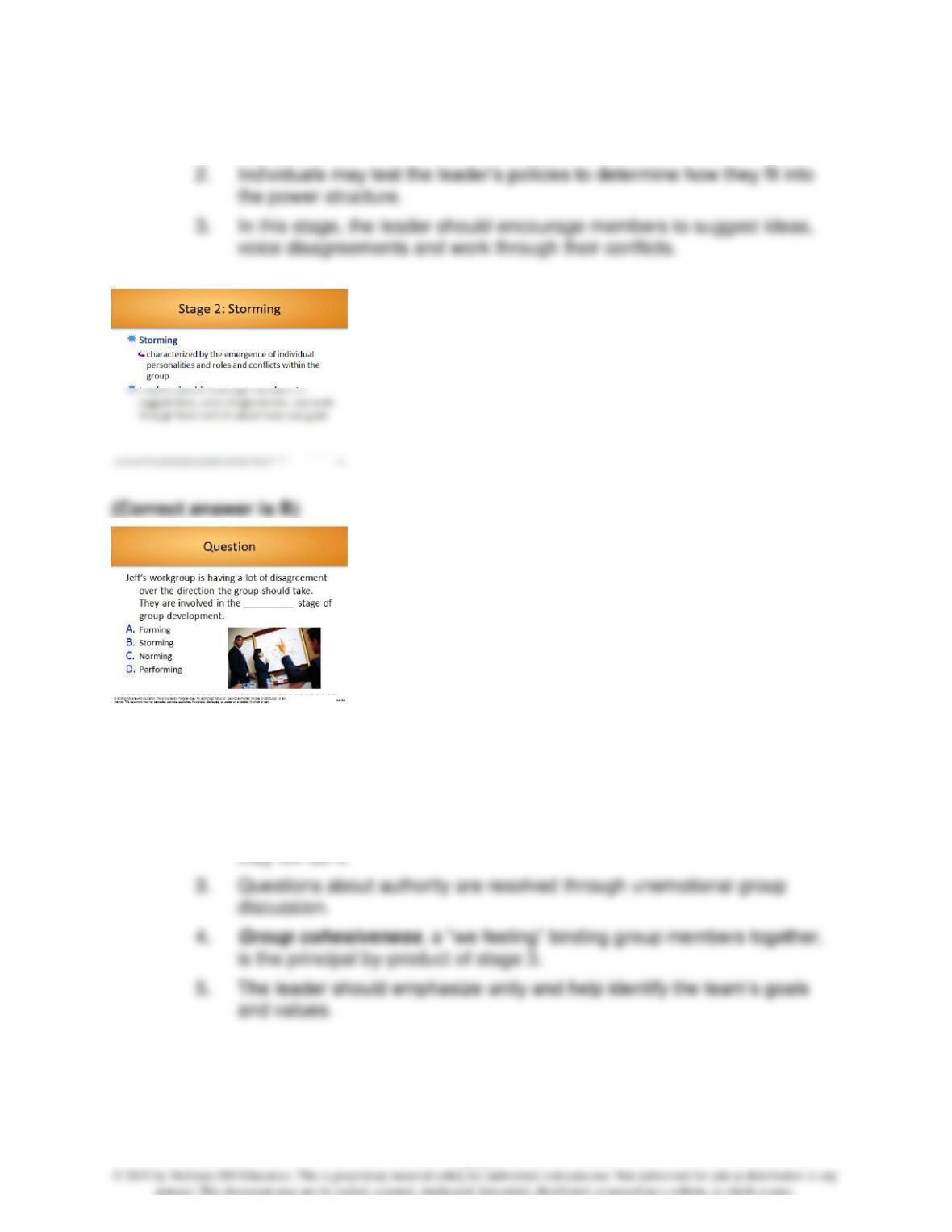
B. The first stage, forming, is the process of getting oriented and getting
acquainted.
1. This stage is characterized by a high degree of uncertainty as members
try to break the ice and figure out who is in charge and what the group’s
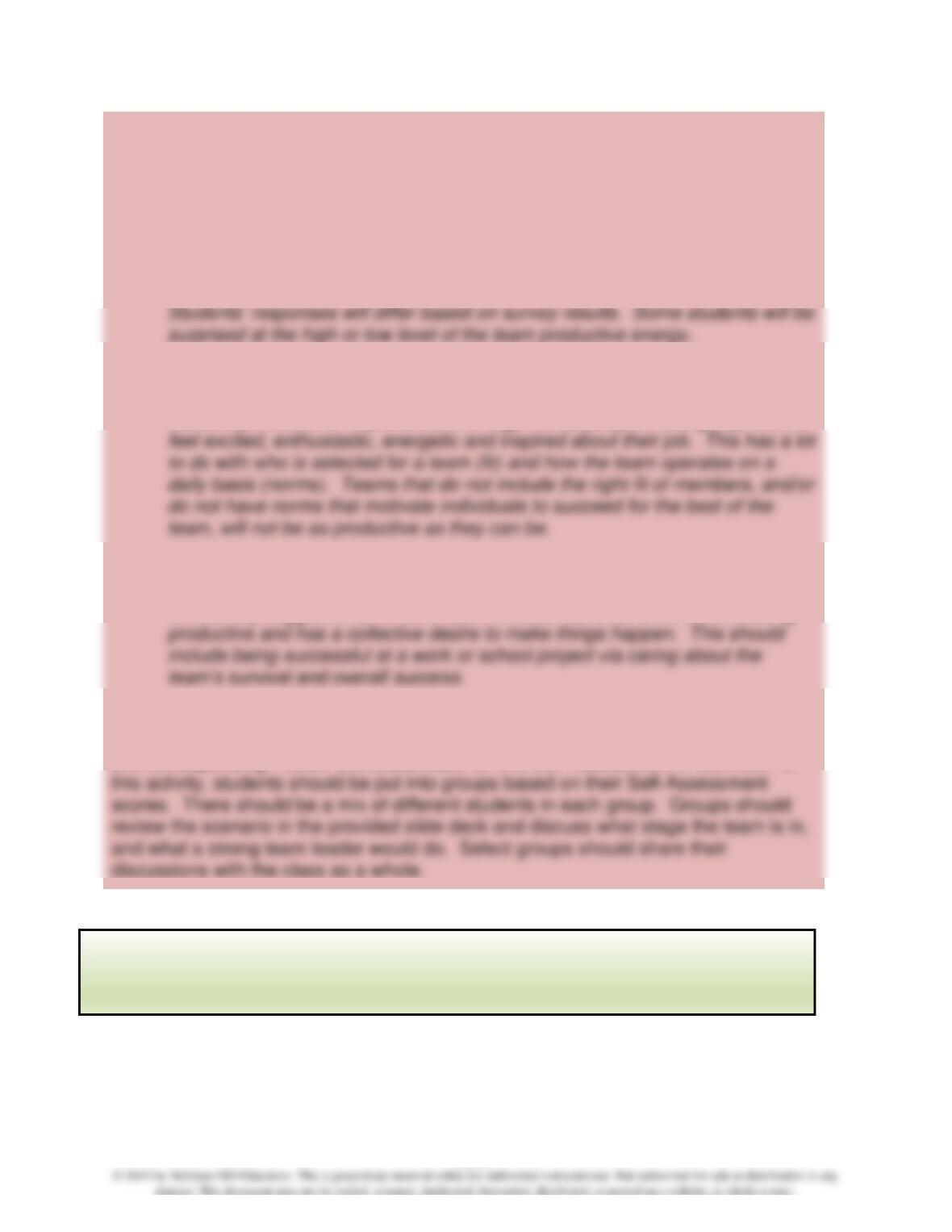
C. The second stage, storming, is characterized by the emergence of individual
personalities and roles and conflicts within the group.
Chapter 13 – Groups & Teams: Increasing Cooperation, Reducing Conflict
13–15
1. The length of this stage depends on the clarity of goals and the
commitment and maturity of the members.
D. In the third stage, norming, conflicts are resolved, close relationships
develop, and unity and harmony emerge.
1. The group may now evolve into a team.
2. The team sets guidelines for what its members will do together and how

Chapter 13 – Groups & Teams: Increasing Cooperation, Reducing Conflict
13–16
E. In the fourth stage, performing, members concentrate on solving problems
and completing the assigned task.
F. In the final stage, adjourning, members prepare for disbandment.
2. The team leader can highlight valuable lessons learned to prepare
everyone for future group and team efforts.
Chapter 13 – Groups & Teams: Increasing Cooperation, Reducing Conflict
13–17
SELF-ASSESSMENT 13.2 (p. 418)
Assessing Your Team’s Productive Energy
Go to connect.mheducation.com and take Self-Assessment 13.2.
Student Questions:
1. To what extent does the team display productive energy? Are you surprised
by the results?
2. Based on your survey scores, what can be done to improve the level of
energy being displayed by the team? Be specific.
Generally, in order to improve team energy levels, people in the group need to
3. What would the survey suggest that you should do next time you are the
leader of a work or school project team?
The survey suggests that a team leader should make sure the team is being
Additional Activities:
You can also consult the Connect Instructors Manual for the post-assessment activity
and corresponding PowerPoint slides used for this Self-Assessment in Connect. In
Section 13.3 discusses transforming a group into a high performance team. In order to
accomplish such a task, managers must consider matters of cooperation, trust, and
13.3 Building Effective Teams (pp. 419-427)
How can I as a manager build an effective team?
Chapter 13 – Groups & Teams: Increasing Cooperation, Reducing Conflict
13–18
cohesiveness, followed by performance goals and feedback, motivation through mutual
accountability, team size, roles, norms, and awareness of groupthink.
Possible Topics for Discussion:
• Discuss the dangers of groupthink and describe best practices for avoiding it.
• How do you come to trust your classmates or your co-workers? What can
Major Idea Outline:
A. The most essential considerations in building an effective team are:
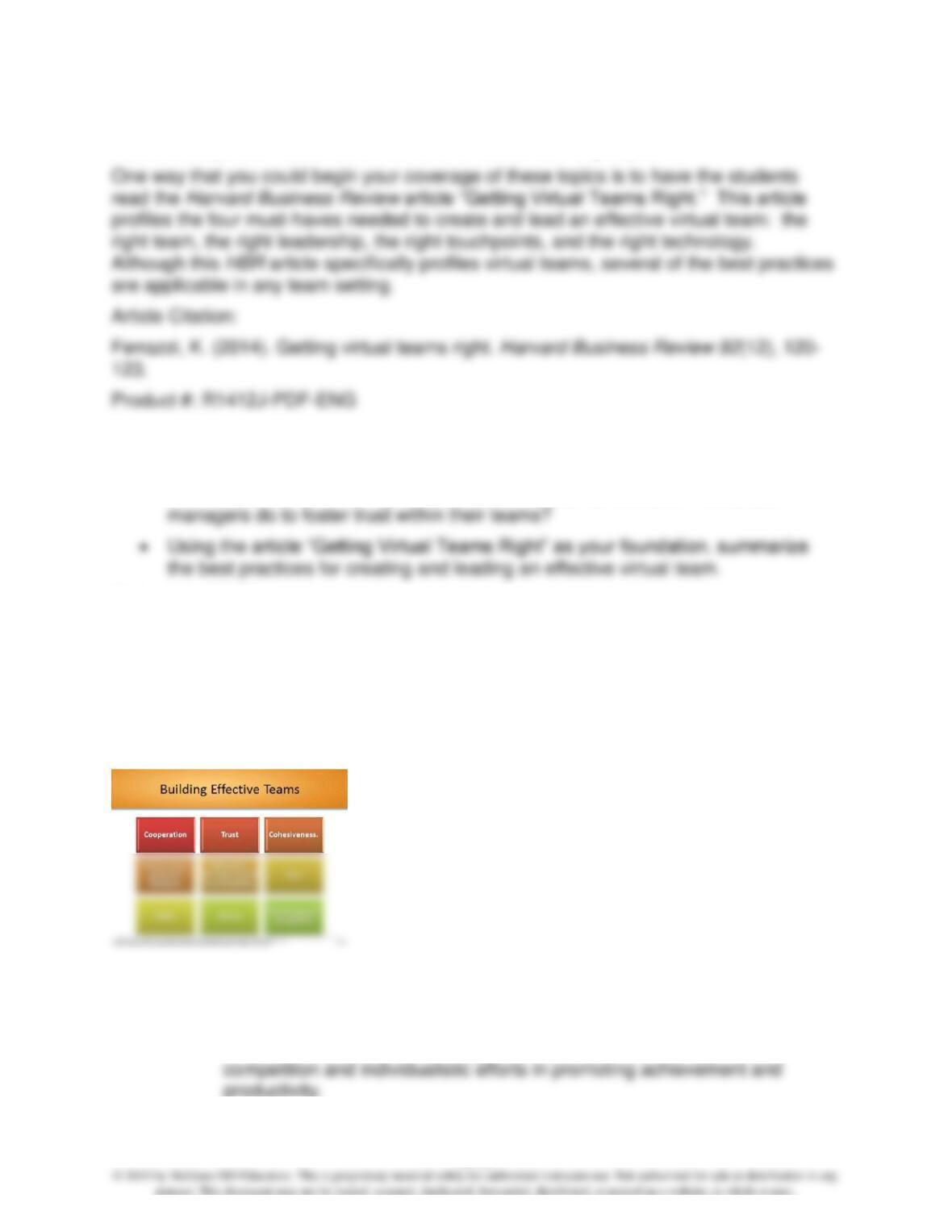
cooperation, trust and cohesiveness.
1. These are followed by performance goals and feedback, motivation
through mutual accountability, size, roles, norms, and awareness of
groupthink.
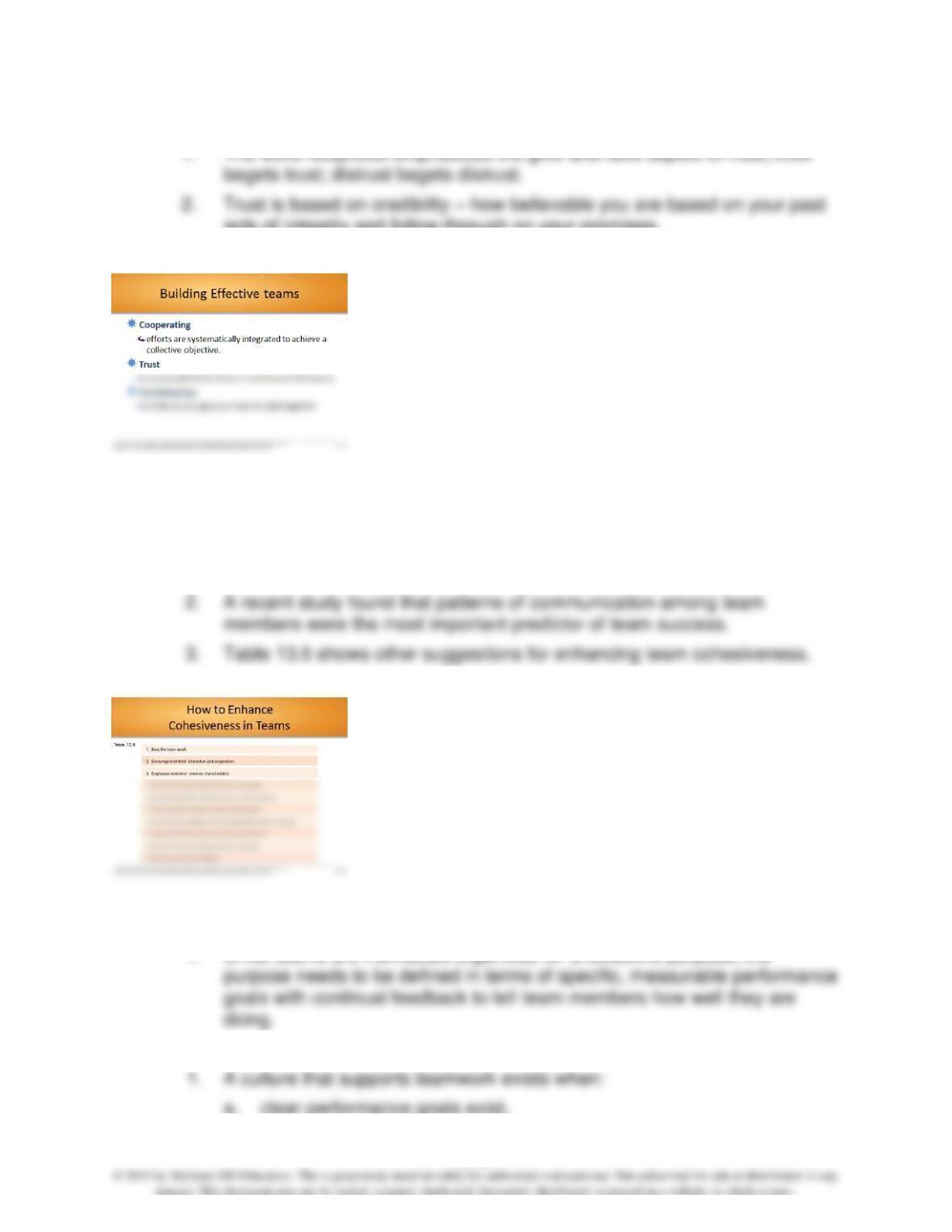
B. Cooperation – Individuals are said to be cooperating when their efforts are
systematically integrated to achieve a collective objective.
1. A meta-analysis of studies suggests that cooperation is superior to
Chapter 13 – Groups & Teams: Increasing Cooperation, Reducing Conflict
13–19
C. Trust – Trust is defined as reciprocal faith in others’ intentions and behaviors.
acts of integrity and follow-through on your promises.
D. Cohesiveness – Cohesiveness is the tendency of a group or team to stick
together.
1. Managers can stimulate cohesiveness by encouraging people to have
face-to-face exchanges at work.
E. Performance Goals & Feedback
F. Motivation through Mutual Accountability
Chapter 13 – Groups & Teams: Increasing Cooperation, Reducing Conflict
13–20
b. the work is considered meaningful,
c. members believe their efforts matter, and
d. they don’t feel they are being exploited by others.
2. Members feel mutual trust and commitment because they are mutually
accountable.
G. Size – Small and large teams have different characteristics, although the
number of members is somewhat arbitrary.
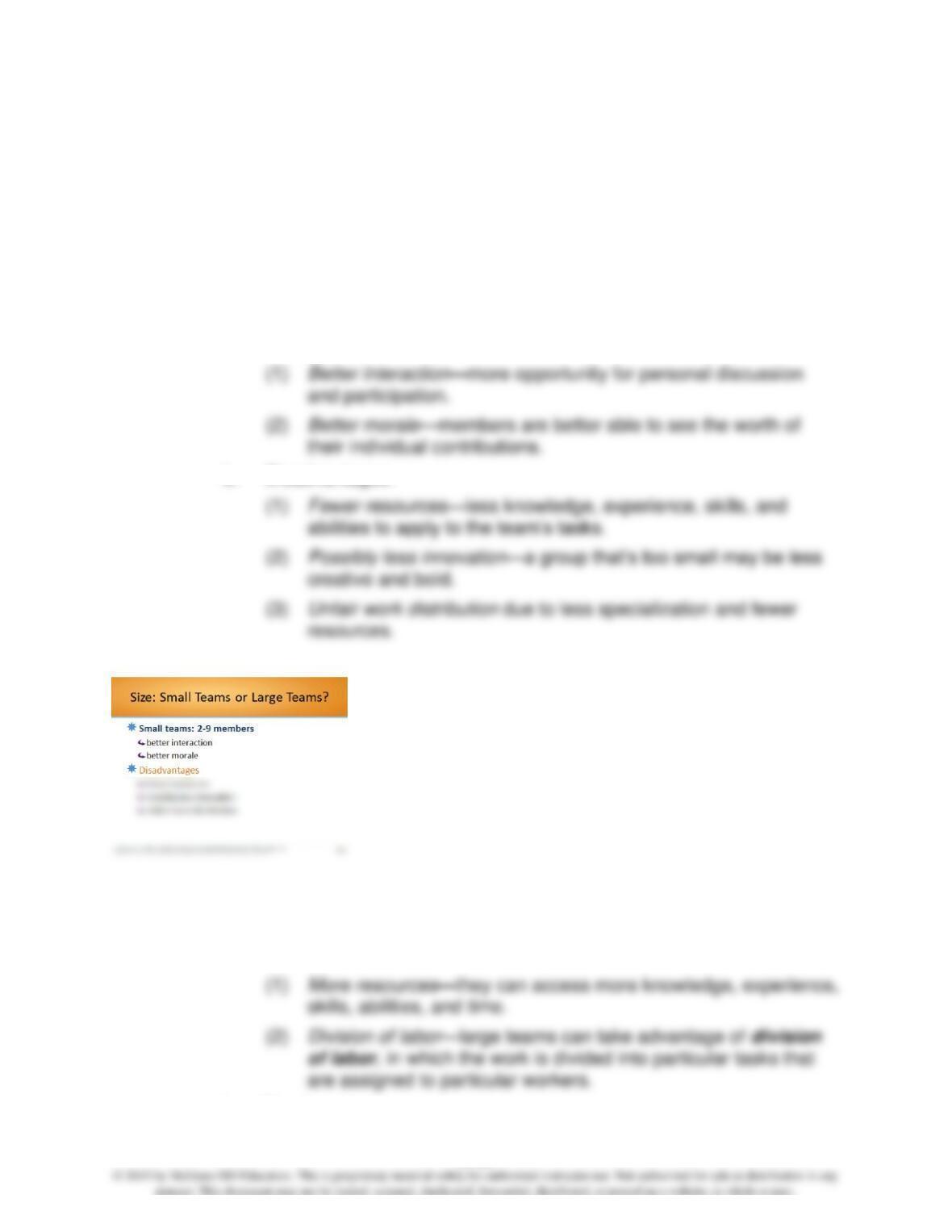
1. Teams with 9 or fewer members have advantages and disadvantages:
a. Advantages:
b. Disadvantages:
2. Large teams of 10-16 members have different advantages and
disadvantages:
a. Advantages:
b. Disadvantages: