Instructor’s Manual
13-1
CHAPTER THIRTEEN
The Statement of Cash Flows
This chapter examines the statement of cash flows. In particular, it
Key Concepts
• The statement of cash flows is viewed by many as the most important
financial statement because it provides evidence of the company’s
ability to meet its short-term financial obligations.
• The statement of cash flows reports all the major sources and uses of
cash that result from different activities of the company.
• In using the indirect method, increases (decreases) in related
noncash assets (related liabilities) accounts during the year must be
deducted from net income. When related noncash assets (related
liabilities) accounts decrease (increase) during the year, the amount
Learning Objectives
LO1— Recognize the purpose of a statement of cash flows and the activities
making up a cash-flow statement.
Instructor’s Manual
LO2— Discuss the difference between the direct and the indirect methods of
Lecture Outline
A. Introduction
The statement of cash flows reports the impact of a firm’s operating,
investing, and financing activities on cash flows during the accounting
B. The Statement of Cash Flows (LO1)
The statement of cash flows summarizes and explains all major cash
receipts (inflows) and cash payments (outflows) during a period and
1. Operating Activities
o Operating activities include acquiring and selling products
in the normal course of business. Cash inflows from
operating activities include cash from sales to customers,
Instructor’s Manual
13-3
2. Investing Activities
o Cash inflows from investing activities include cash inflows
from the sale of property, plant, and equipment; the sale of
3. Financing Activities
o Cash inflows from financing activities include cash inflows
from selling stock or from issuing bonds. Cash inflows from
financing activities also include contributions from owners
Cash Flows from Operating Activities = Cash received from the sale of
goods or services and cash received from interest and dividends – Cash
paid for operating expenses, cash paid for interest on debt, and cash paid
for taxes
Instructor’s Manual
13-4
4. The Definition of Cash: Cash and Cash Equivalents
o A cash equivalent is an item that can be readily converted
5. Noncash Transactions
o It is not uncommon for organizations to have exchange
transactions that do not directly involve cash inflows or
outflows but still warrant disclosure on a statement of cash
Instructor’s Manual
C. Direct Method vs. Indirect Method (LO2)
Organizations use two methods (direct and indirect) to report cash flows
from operating activities.
1. Direct Method
The direct method reports major classes of gross cash receipts and
payments. With the direct method, each item on the income
Key Concept
The statement of cash flows reports all the major sources and uses of cash
Making It Real:
How Much Cash Is Enough?
Making It Real:
Exactly What Is Cash?
Key Concept
An understanding of the effects of different types of transactions on a
Instructor’s Manual
13-6
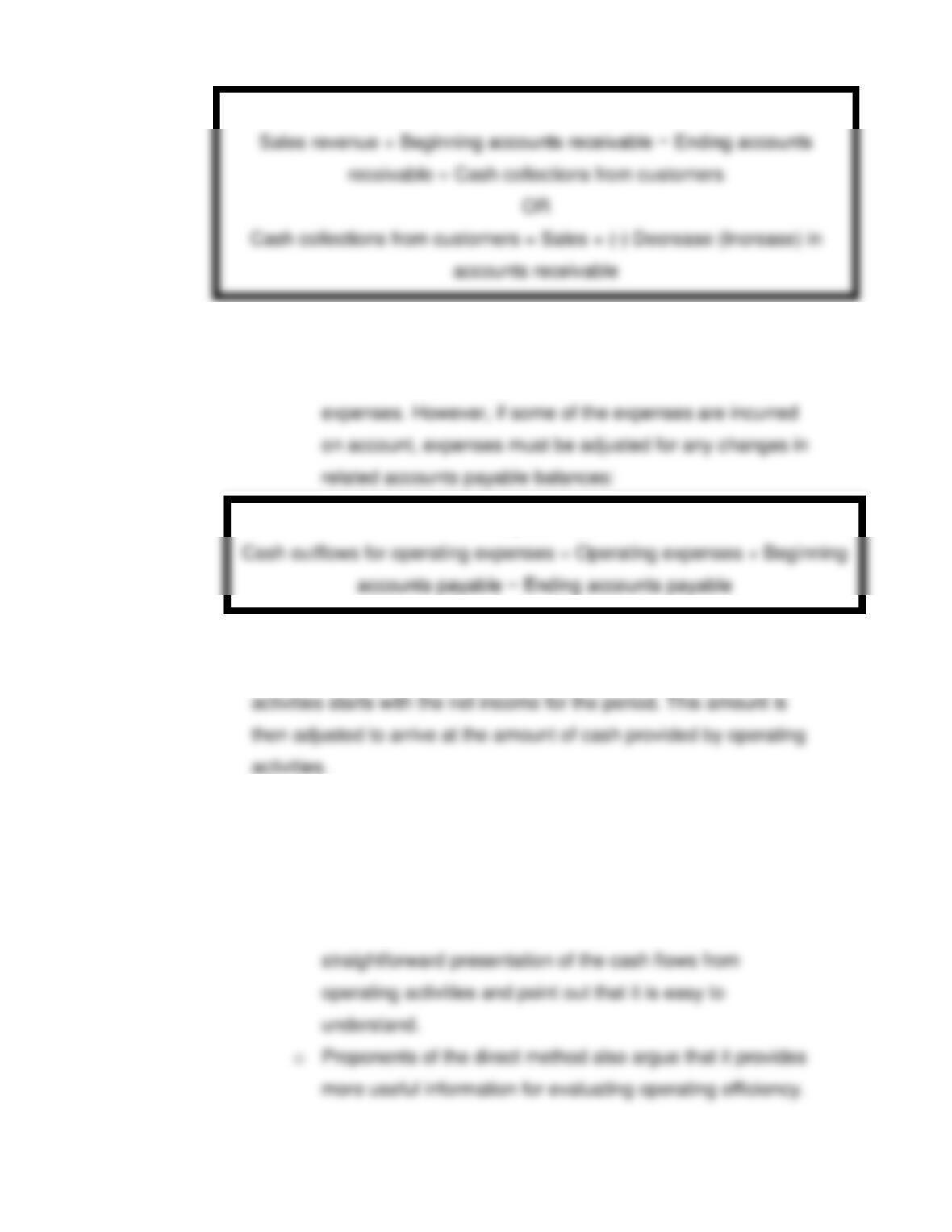
o Similarly, if all operating expenses are paid in cash, cash
outflows for operating expenses will equal to operating
2. Indirect Method
The indirect method of preparing the cash flows from operating
3. The only difference between the direct and indirect methods is in
the presentation of the cash flows from operating activities. Cash
flows from investing activities and cash flows from financing
activities are calculated in exactly the same way.
o Proponents of the direct method point to the
Key Formula
Key Formula
Instructor’s Manual
o Supporters of the indirect method argue that it focuses
attention on differences between the cash and accrual
4. The Statement of Cash Flows and the Accounting Equation
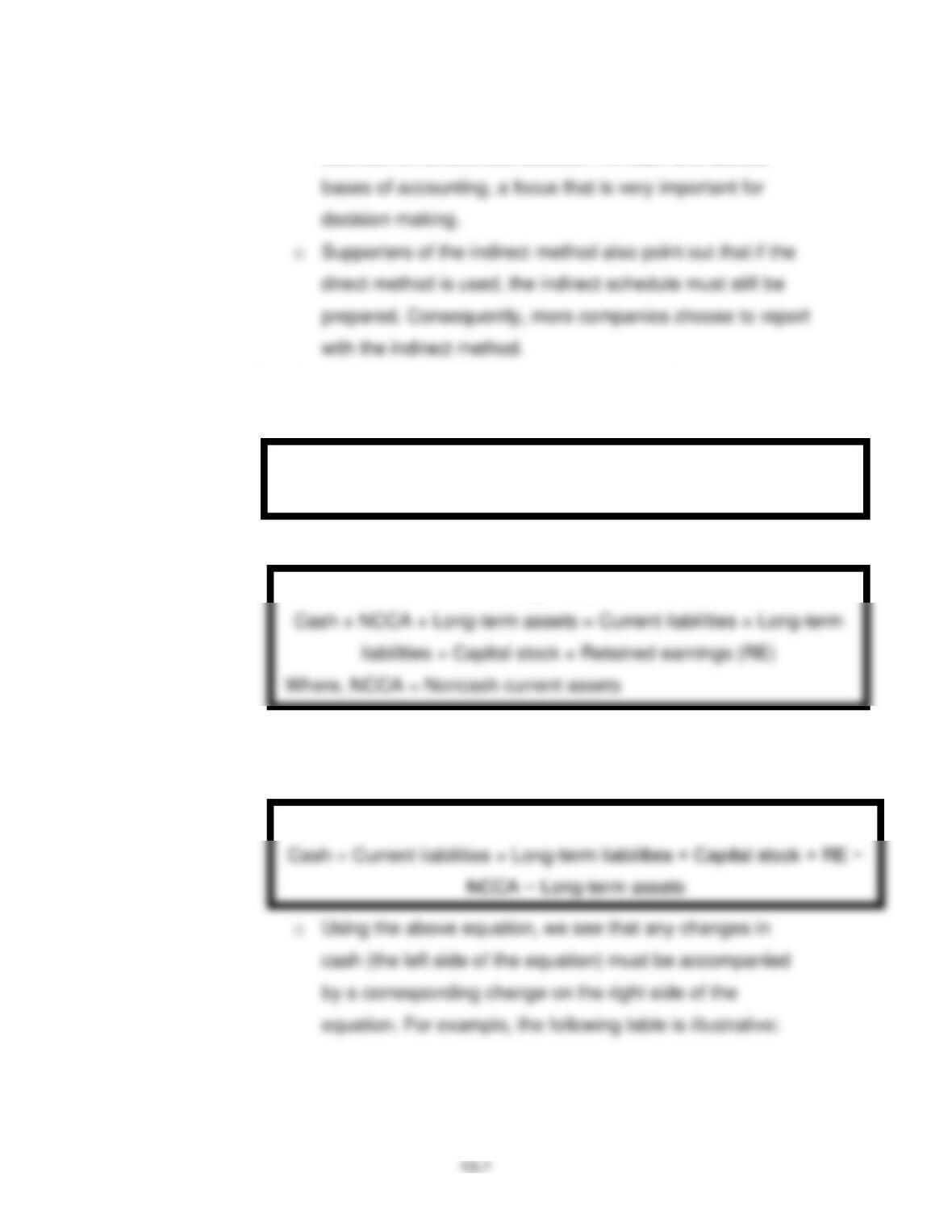
o The basic accounting equation is:
o In more detail, the accounting equation is:
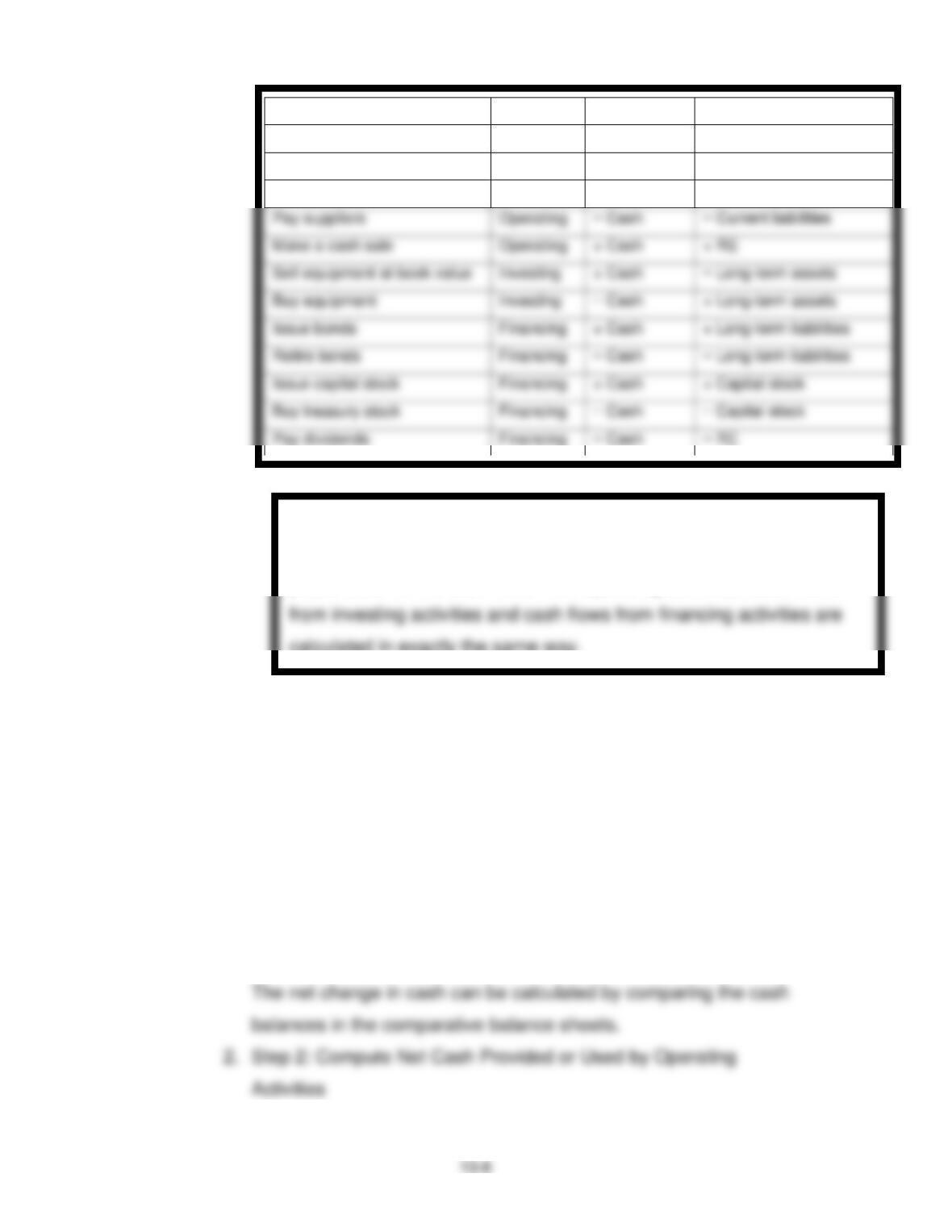
o We can rearrange the equation so that cash is on the left
side and all the other terms are on the right side:
Key Formula
Assets = Liabilities + Owners’ equity
Key Formula
Key Formula
Pay suppliers
Operating
− Cash
− Current liabilities
Make a cash sale
Operating
+ Cash
+ RE
Sell equipment at book value
Investing
+ Cash
Buy equipment
+ Long-term assets
Issue bonds
Financing
+ Cash
+ Long-term liabilities
Retire bonds
Financing
Buy treasury stock
Financing
Instructor’s Manual
D. Preparing the Statement of Cash Flows (LO3)
To prepare the statement of cash flows, we must gather appropriate
information, which includes comparative balance sheets (last year’s and this
year’s), the current income statement, and additional information needed to
analyze noncash transactions. After gathering the preceding information, we
must complete the following six steps in preparing the statement of cash
flows:
1. Step 1: Compute the Net Change in Cash
Key Concept
The only difference between the direct and indirect methods is in the
presentation of the cash flows from operating activities. Cash flows
calculated in exactly the same way.
Transaction
Activity
Left Side
Right Side
Collect accounts receivable
Operating
+ Cash
− NCCA
Prepay insurance
Operating
− Cash
+ NCCA
Collect customer’s deposit
Operating
+ Cash
+ Current liabilities
Instructor’s Manual
13-9
Direct Method:
o Operating activities generating cash inflows include cash
from sale of goods, interest received, and dividend
received.
o Operating activities that result in cash outflows include
o If the inflows are more (less) than the outflows, it indicates
net cash provided (used) by operating activities.
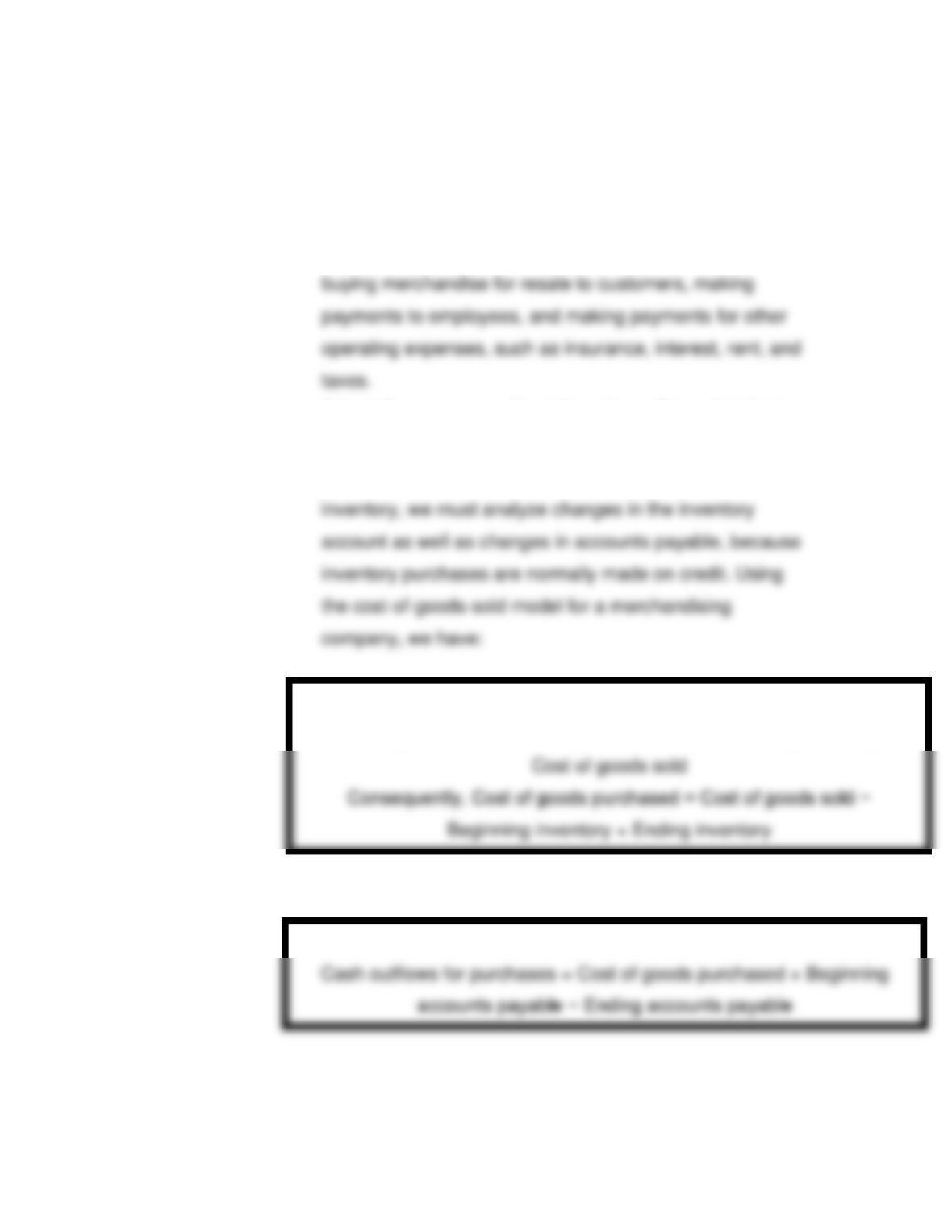
o To determine the amount of cash paid to purchase
o The cash paid for purchases can be computed as:
Key Formula
Beginning inventory + Cost of goods purchased – Ending inventory =
Key Formula
Instructor’s Manual
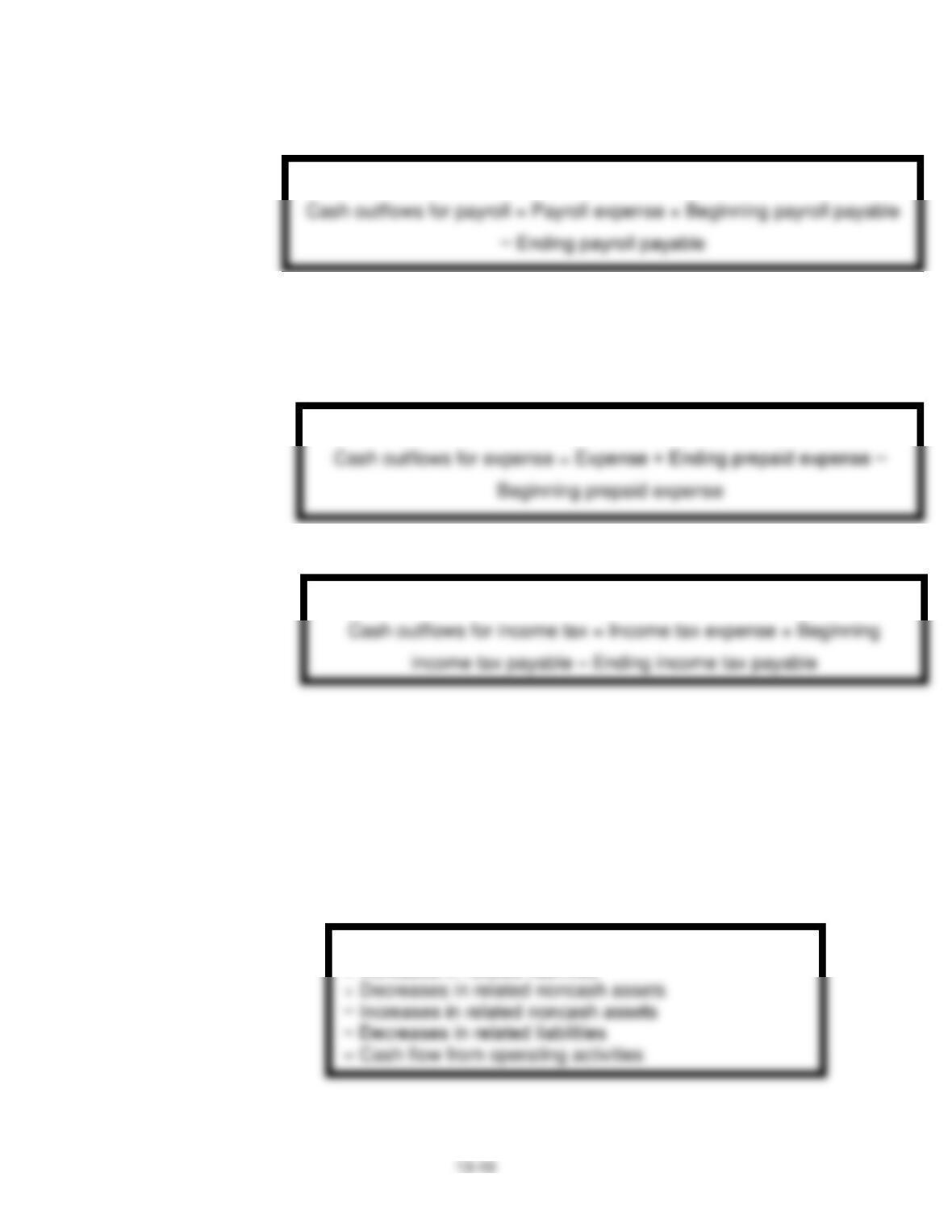
o Cash paid for the payroll can be calculated as:
o Cash paid for any operating expense (when prepaid
expense balance appears in the balance sheet) can be
calculated as:
o Cash paid for income taxes can be calculated as:
Indirect Method:
o The indirect method reconciles net income with net cash
flow from operating activities by taking the income
statement amounts of revenues and expenses and
adjusting for changes in related noncash assets and
liabilities:
Key Formula
Key Formula
Key Formula
Net income
+ Increases in related liabilities
Decrease in inventory
Increase in inventory
Decrease in prepaid assets
Increase in prepaid assets
Increase in accounts payable
Decrease in accounts payable
Instructor’s Manual
13–11
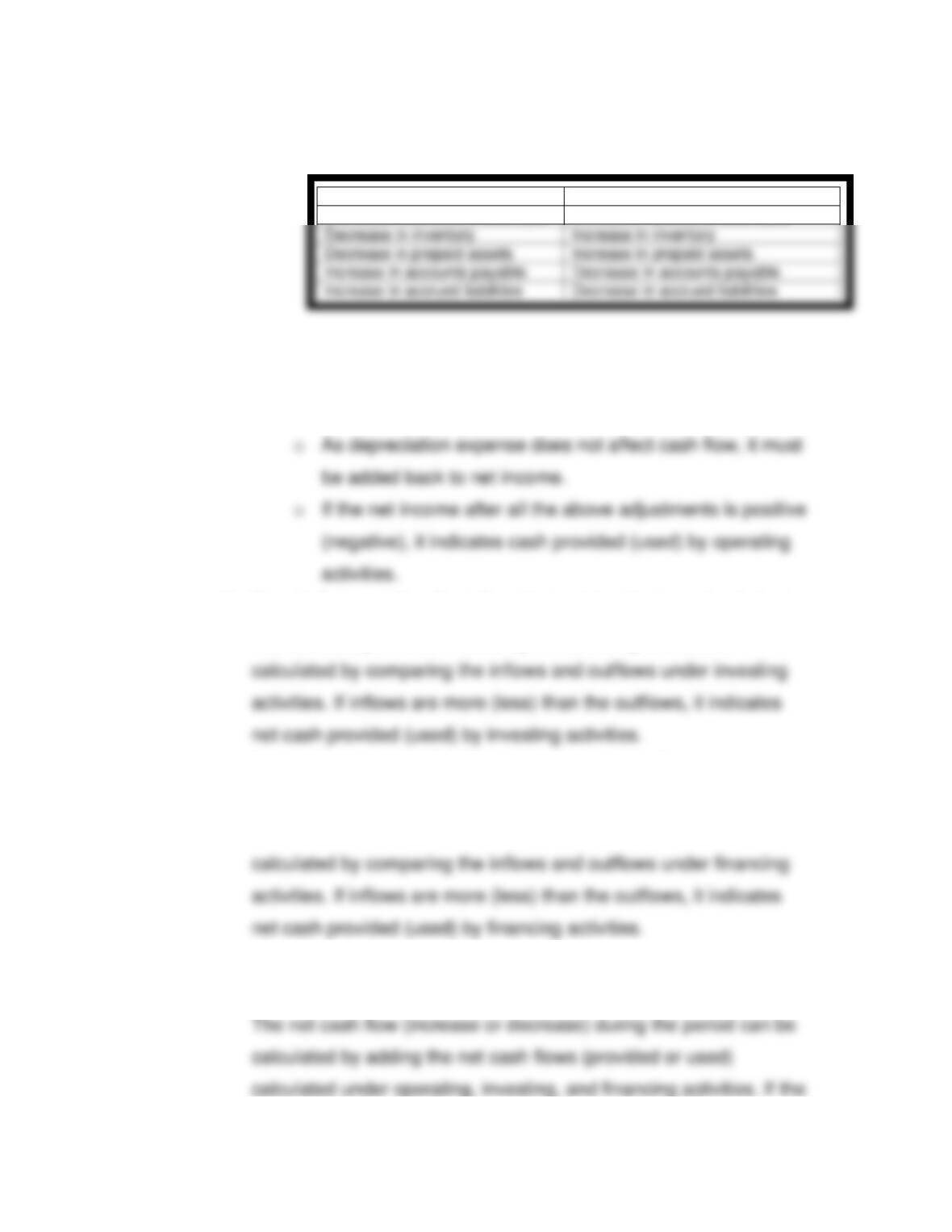
o The following table summarizes the additions to and
deductions from net income
o In addition, gains (losses) on sales of long-term assets and
investments must be deducted from (added to) net income
because these amounts are not operating in nature.
3. Step 3: Compute Net Cash Provided or Used by Investing Activities
The net cash provided or used by the investing activities is
4. Step 4: Compute Net Cash Provided or Used by Financing
Activities
The net cash provided or used by the financing activities is
5. Step 5: Compute Net Cash Flow by Combining the Results from
Operating, Investing, and Financing Activities
Additions to Net Income
Deductions from Net Income
Decrease in accounts receivable
Increase in accounts receivable
Instructor’s Manual
13–12
6. Step 6: Report Any Significant Noncash Investing or Financing
Activities in a Separate Schedule or a Footnote
Significant noncash investing or financing activities, if any, are
reported in a separate schedule or in the footnote.
End-of-Chapter Material
Brief exercises, exercises, and problems based on different learning objectives
have been provided at the end of the chapter. These-end-of chapter materials
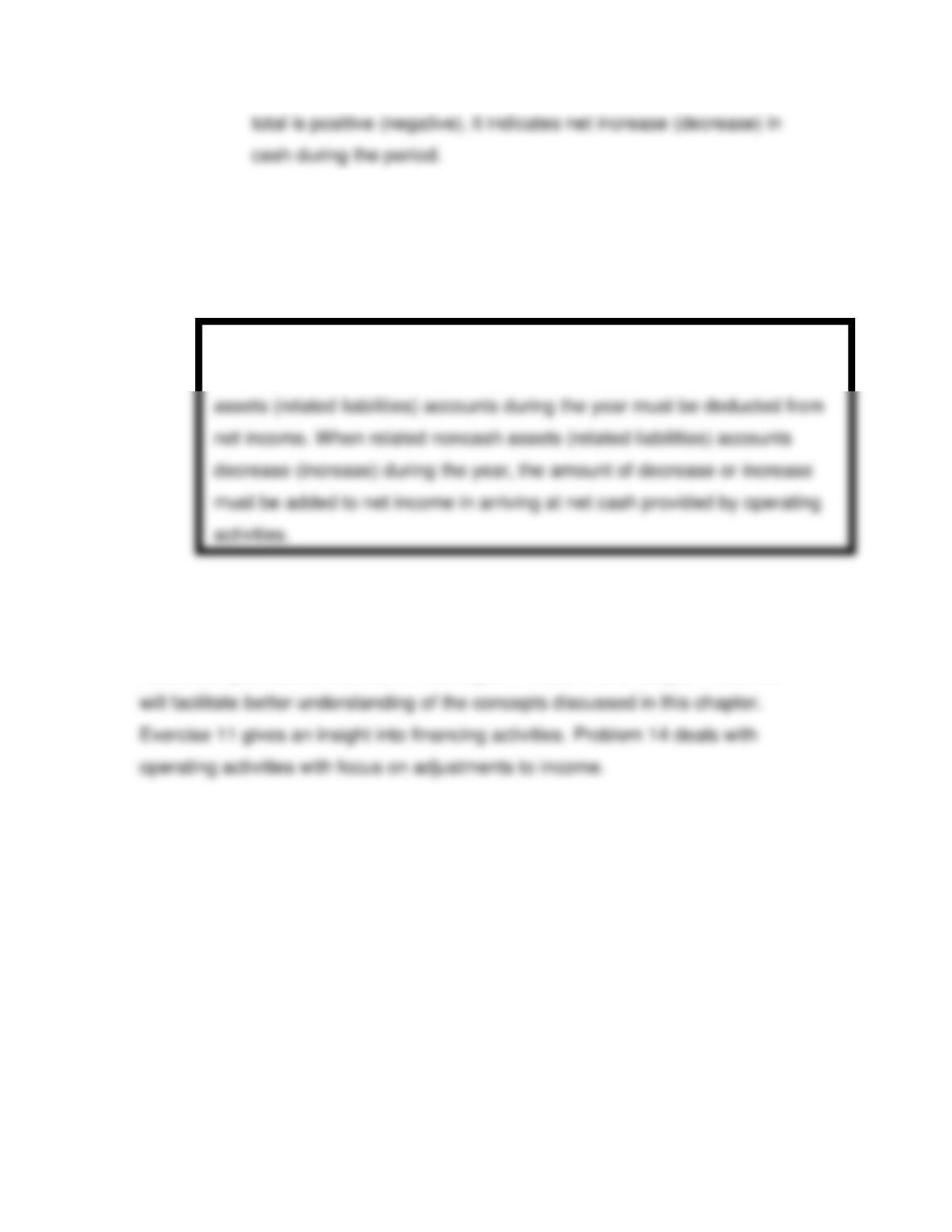
Key Concept
In using the indirect method, increases (decreases) in related noncash