Hitt 13e Case Teaching Notes
Case 13: Publix Supermarkets, Inc.
Case Synopsis
Working under the tagline, “Where Shopping is a Pleasure,” Publix has been in business since
its founding in 1930 by George Jenkins. The grocery store chain operates in seven states in the
United States: Florida (where the firm began), Georgia, Alabama, South Carolina, Tennessee,
North Carolina, and Virginia. Publix is known for its exceptional customer service and has been
ranked as one of the best grocery chains in the United States as well as one of the best places
to work. Perhaps most interesting of all, Publix is the largest employee-owned business in the
country.
Employee ownership brings a unique spin to the organizational culture at Publix. Operating
under the understanding that high performance in the workplace will directly result in financial
dividends, Publix’s employees are known for their positivity, helpfulness, and enthusiasm.
Employees are strongly encouraged to seek improvements and innovations in whatever part of
the business in which they operate, and collectively they enjoy giving back to charitable causes
and engaging in eco-friendly business practices. It’s not surprising that Publix’s annual
employee turnover rate averages 5% when the industry standard can be as high as 65%.
Learning Objectives
• Describe vision and mission and discuss their value. (Chapter 1)
• Define stakeholders and describe their ability to influence organizations. (Chapter 1)
• Describe business models and explain their relationship with business-level strategies.
(Chapter 4)
• Explain the differences among five types of business-level strategies. (Chapter 4)
• Define competitors, competitive rivalry, competitive behavior, and competitive
dynamics. (Chapter 5)
5)
• Describe how strategic actions and tactical actions drive competitive rivalry between
firms. (Chapter 5)
• Discuss factors affecting the likelihood a firm will take actions to attack its competitors.
Strategic Issues and Suggested Discussion Questions & Answers
1. Compare and contrast Publix against its new competitors in Richmond, Virginia, to get
a sense of the industry environment. Based on your analysis, what is Publix doing right
that gives the firm a competitive advantage? What could Publix learn from
competitors?
When Publix decided to expand by opening 10 new stores in Richmond, it faced competition
from a number of rivals, including national powerhouses, regional favorites, and smaller up-
and-comers.
Whole Foods, another national brand, is perhaps the “premium” or upscale grocery store chain
found in this market. The organization built its reputation on natural, organic, and gourmet
offerings, along with special amenities like wine bars and prepared meals, and set higher prices
accordingly. However, competitors, including Publix, responded by offering similar natural and
organic products and prepared foods. Whole Foods’ weakening position prompted Amazon to
acquire the firm as a quick way to enter the grocery business, one of its strategic goals. Amazon
Wegman’s, although a smaller chain focused on the Northeast, is expanding south into Publix’s
new territory, which poses a problem since it is probably the most similar to Publix. It is also
known for its outstanding customer service and reputation as an employer of choice. While its
stores are much smaller, they outsell the competition.
However, students should be able to generate several ideas to help Publix better compete
against rivals. They should question why Wegman’s is able to sell so much product from such
2. Publix is using an integrated cost leadership/differentiation strategy. Describe at least
two tactics it uses to differentiate itself. Then describe at least two tactics it uses to be
a low-cost leader. What are some of the risks of this strategy?
Customer service is probably the most important point of differentiation. Customers are
greeted immediately upon arrival, offered assistance in finding items, do not have to wait in
line, and still have their groceries carried out to their cars for them. Recently, Publix shoppers
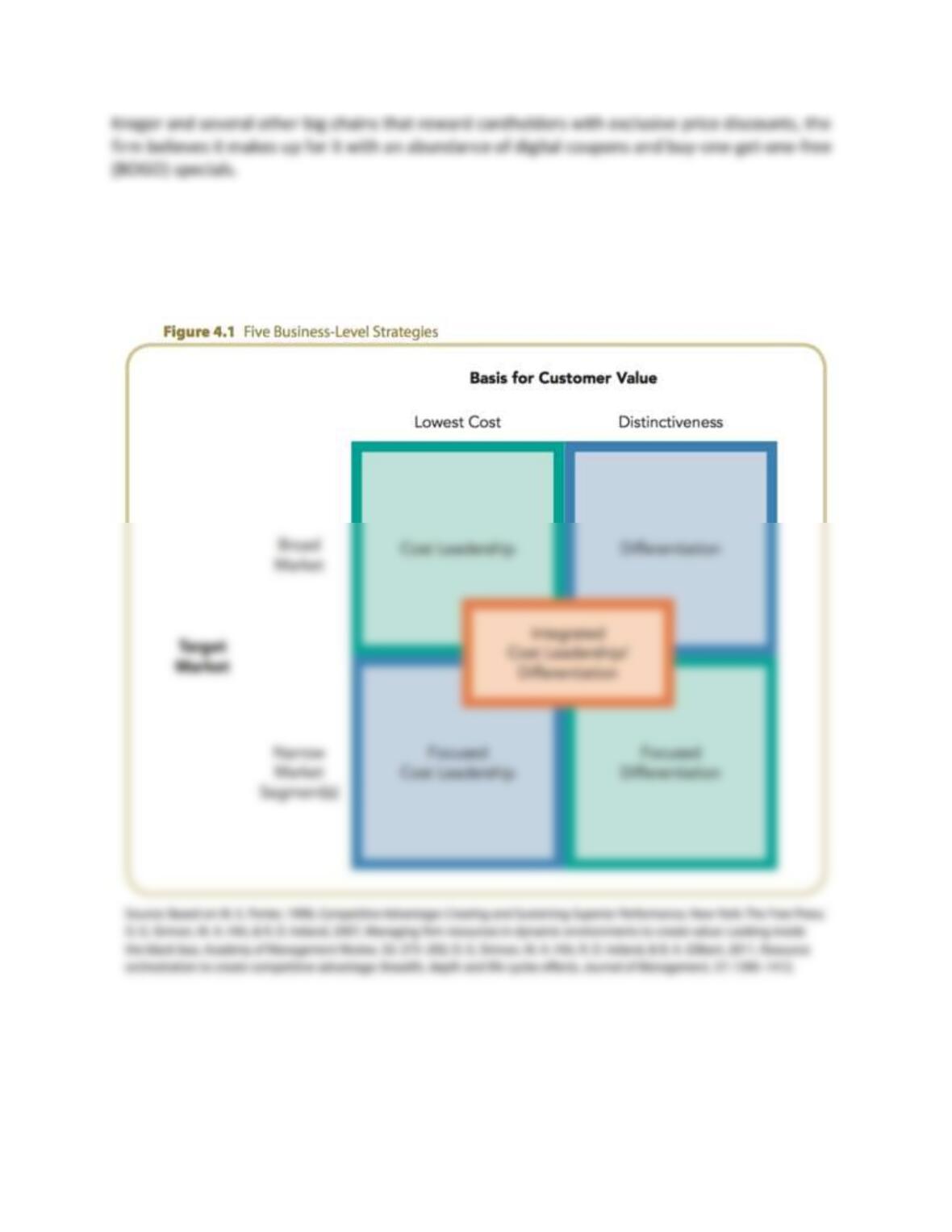
The biggest risk of this strategy is the potential to become “stuck in the middle,” in which Publix
would neither be offering low-cost incentives nor providing points of differentiation (Figure
4.1). As it grows, it will be essential for the firm to stay focused on optimizing its value chain
activities.
3. In 2003, Publix was a first mover in offering a grocery delivery service, called Publix
Direct, but the new service failed. Now that competitors have recently succeeded with
this service, Publix is trying again. Do you think Publix will succeed or fail? Explain your
answer.
The case does not explain why Publix failed in its aggressive, first-mover attack on rivals with a
new home delivery service back in 2003, but students should be able to speculate on likely
4. Publix is the largest employee-owned business in the United States. What does this
mean in terms of corporate governance mechanisms and how they function at Publix?
In this situation, in which all employees are shareholders and top-level managers are also
shareholders, it is more important than ever to monitor executive decision making, ensuring
5. Publix employees routinely demonstrate an entrepreneurial mind-set. Describe at least
two examples of trends in the external environment that Publix has turned into
entrepreneurial opportunities and answered with innovations.
Given the organizational culture at Publix, which encourages empowerment and
entrepreneurial thinking, it seems likely that employees themselves, as opposed to executive
management, are responsible for many of the innovations that add value to Publix’s customers.
number of locations, home delivery.
Additional Resources
Supermarket News published this May 2019 report on Publix’s earnings and financial standing:
In March 2018, The Motley Fool speculated on Publix going public:
Fortune also published this look at Publix employees:

In April 2015, ABC News provided this coverage of a survey of grocery stores conducted by
Consumer Reports in which Publix ranked second best: