CHAPTER 13
Homeowners Insurance
I. SUGGESTED CLASSROOM TIME: 180 MINUTES
II. CHAPTER OVERVIEW
The Homeowners Policy (HO) is an interesting and important policy for students to
understand. Because it provides both property and liability coverage, it illustrates many
principles of insurance contract construction. We stress the reason(s) for the inclusion of a
particular policy provision, such as the 80 percent of replacement cost (insurance-to–
value) requirement, as well as the impact of the provision. Thus, a student learning about
the “no benefit to bailee” provision in the HO will be able to recognize this provision in
III. LECTURE OUTLINE
A. Introduction—development of the homeowners’ policy
1. Most people use a version of the HO contract to provide coverage for their dwelling
B. The Homeowners Policy (HO)
1. A package policy developed in the 1950s to provide “complete” property and
liability coverage to the “average” homeowner.
2. The group of Insurance Services Office (ISO) HO policies has evolved over the
106 Chapter 13/Homeowners Insurance
4. The policy layout, declarations page and setting policy limits for the various
insuring agreements. Section 1 (property section) versus Section 2 (legal liability
section) are explained as well as the various insuring agreements (A–F).
a. declarations page—spells out the particulars to the contract; personalizes this
contract to the insured’s situation
C. Definitions—Persons Insured
1. Named insured versus “insured”
D. Section I—Property Covered and Insured Perils
1. Property insurance policies may be written on a named perils basis, “we will pay
for loss caused by any of the following perils,” or on an open perils basis, “we will
3. The text provides examples and definitions of the perils specified in HO-2.
4. Special limits—Some property is highly mobile, very valuable (coins, furs, jewelry,
silverware), and quite prone to loss; hence, HO limits of coverage are small on
5. Loss of use (in older forms called additional living expense) (Coverage D)
a. Pays additional amounts needed to maintain a household after a specified peril
6. Additional coverage
a. Debris removal
b. Expenses to protect property from further damage
Chapter 13/Homeowners Insurance 107
c. Trees and shrubs
d. Fire department service charges
7. Collapse—not in the perils section due to the problem of concurrent causation. Also
notice that glass breakage is a result, not a peril. Glass can be damaged by many
causes.
E. Section I—Perils Insured (HO-2)
1. Some perils are not defined; others have long definitions.
F. Section I— Exclusions
1. Catastrophic losses: earthquakes, floods, wars and nuclear disasters can’t be
handled by private insurers.
7. Earth movement
G. Section I—Conditions
1. Loss Settlement: Insurance-to-value—Property insurance policies contain these
clauses to achieve fairness in rates. That is, rates are expressed as X dollars per
$100 of value, regardless of whether the first or last $100 in value is being insured.
Obviously, the chance of loss is greater for the first than the last $100 of value. (See
108 Chapter 13/Homeowners Insurance
2. Mortgage Clause. If the loss is payable to a mortgagee, the claim is paid to both the
H. Liability Coverage
1. Coverage E is designed to pay for legal liability claims arising out of most general
3. Important Exclusions to Coverage E
a. Injuries that are expected or intended by the insured.
b. Arising out of business pursuits.
I. Section I and II Conditions
a. This section contains the conditions applicable to both sections I and II of the HO
contract.
J. Endorsements
a. There are many different ways to change or endorse the HO contract in
preapproved ways.
K. Reduction of Insurance Due to Previous Losses
Chapter 13/Homeowners Insurance 109
IV. ANSWERS TO REVIEW QUESTIONS
1. Describe some individuals who are protected by the HO contract who are
parties to the contract. Distinguish between the “named insured” and
other insureds. Describe some covered people who are not parties to the
contract. The HO protects the following classes of people as parties to the contract: 1)
2. List the four coverages found in Section 1 of the HO. Give an example of
a loss covered by each section. The four coverages of Section 1 are: 1) Dwelling
3. List the two coverages found in Section 2 of the HO. Give an example of
a loss covered by each section. The two coverages found in Section 2 are: 1)
Personal Liability and 2) Medical Payments to Others. An example could be that a
4. What is the relationship between the ordinance-or-law exclusion and
building codes? The ordinance-or-law exclusion eliminates coverage for
expenses caused by the operation of building codes. For example if building codes
110 Chapter 13/Homeowners Insurance
5. Why is the mortgage clause of the HO desirable from a lender’s viewpoint?
It is established that a lender with a mortgage on property (creating a secured interest
in the property) has an insurable interest. If the lender and insured purchased separate
6. What is the difference between a “named perils” policy and an “open
perils” policy? A “named perils” policy creates liability for the insurer only if the
7. Referring to the previous question, is one format always preferable over
the other? Both formats are found in property insurance and neither is always better
than the other from the insured’s standpoint. A “named perils” policy, such as the HO-
8. Why do property insurance policies contain exclusions? Illustrate your
answer with examples from the HO. Exclusions are frequently found in property
Chapter 13/Homeowners Insurance 111
birds, animals, and fish.
9. Will an exclusion result in partial recovery? No. An exclusion means there will
10. Why are limits placed on coin, stamp, and gun collections in the HO? Can
this kind of property be insured? Certain property has relatively low sublimits
because to include this property on an unlimited basis would result in an increase of
11. (Questions 11–15 are related.) Assume John Marshall owns a $150,000
home, which covers the replacement cost of the structure. (Ignore the
deductible clause and consider just the coinsurance requirement.) If John
purchased $120,000 of insurance, how much would he collect for a partial
loss of $40,000? For a total loss of $150,000? For a $150,000 replacement cost
structure, John would be required to purchase $120,000 (80 percent) of coverage to
12. If John purchased $100,000 of insurance, how much would he collect for a
$40,000 loss? How much would he collect for a total loss? (Again, ignore
the deductible clause.) If he purchased $100,000, he will only collect 100/120 of
each dollar up to $100,000. He will collect 0.833 × $40,000 = $33,333 for the
13. Next, assume that John Marshall purchased $50,000 of insurance on his
$150,000 home. How much would he collect for a partial loss of $40,000?
How much would he collect for a total loss? (Again, ignore the deductible
clause.) John needs $150,000 × 0.8 = $120,000 to collect 100 percent of each dollar
112 Chapter 13/Homeowners Insurance
14. Now assume all the conditions of the loss settlement clause of the HO
apply to the case. Assume that John has $100,000 coverage on his
$150,000 house, which has been used for only one-eighth of its estimated
useful life. How much would John collect for a $40,000 partial loss? How
much would be collected for a total loss? The ACV calculation = 40,000 × 7/8 =
15. Finally, given the same amount of coverage in the preceding question, if
John’s home had been used for seven-eighths of its estimated useful life,
how much would John collect for a $40,000 partial loss? If the home is used
16. Under the HO, will a theft loss in April mean less coverage available for
a fire in July? Under the HO contract, policy limits are not reduced by prior
losses, so a theft loss will not reduce coverage on personal property or other parts
V. ANSWERS TO OBJECTIVE QUESTIONS
OBJECTIVE QUESTIONS
Assume Bill Clanton owns the ISO HO-2 policy described in this chapter and
reproduced in Appendix A. The limits are as follows:
A = $ 120,000
B = $ 12,000
C = $ 60,000
D = $ 24,000
E = $ 100,000
F = $ 5,000
A $250 deductible applies to Section I, Coverages A through D. The
replacement cost of Bill’s home is $130,000, the contents are valued at
$70,000, and the home is 30 percent depreciated.
Chapter 13/Homeowners Insurance 113
Your assignment is to compute the amount Bill will collect in each of the
following circumstances. (Assume each event occurs separately.)
1. Bill’s house and all its contents are destroyed by a tornado. It takes six
months to rebuild the home, and Bill’s additional living expenses amount
to $12,000. The first step we recommend is to check the recovery ratio. Bill is
required to have Coverage A equal to or greater than 80 percent of $130,000
2. A neighbor’s eight-year old child accidentally releases the brakes on his
family’s pick-up truck, sending it crashing into Bill’s home. Damage to the
home amounts to $15,000. The truck is destroyed. Its actual cash value
before the loss was $22,000. The child and Bill both suffer a broken arm.
Medical expenses amount to $5,000 for each person. Damage to the home is
covered under the peril “vehicles.” After the HO contract pays the claim, subrogation
3. Bill’s unattached tool shed burns, destroying the shed (damage = $7,000)
and the lawn-care equipment inside (damage = $3,000). Assuming that the
4. Bill negligently starts a fire while cooking. His home and all the contents
are a total loss. It costs Bill an additional $14,000 to live in a rental home
while his house is being rebuilt. Even though Bill is negligent, he can still collect
114 Chapter 13/Homeowners Insurance
5. While burning leaves, Bill causes his neighbor’s house to burn (damage =
6. While playing golf, Bill’s ball hits another golfer in the head. Bill yelled a
warning before the victim, Bob, was hit. Bob claims not to have heard the
warning, and sues Bill for $60,000 in medical expenses, $6,000 in lost
wages (because he couldn’t perform his work for three months), and
$100,000 for pain and suffering. Assume Bob wins the case, and it costs an
additional $20,000 to provide Bill with a legal defense. Bill has $100,000 of
legal liability coverage and $5,000 in medical payments coverage. Under normal
7. While his daughter is away at college, her stereo is stolen from her dorm
8. While carrying his television to the basement, Bill drops it. It is a total loss
(damage = $850). There is no coverage for dropping a TV set because no insured
9. Bill is a certified public accountant working from his office at home. He is
sued for negligence in preparing Al’s income tax. The suit is successful and
VI. IDEAS FOR INSTRUCTORS AND TEACHING METHODS
1. Go through the homeowner’s contract explaining its parts, coverages, exclusions, and
2. The following is a handout that we use in explaining and teaching how the loss
3. The second handout is given to students to test their knowledge of both the
homeowners and automobile contracts (previous chapter). Some of the questions are
controversial and may lead to extended discussions.
Chapter 13/Homeowners Insurance 115
COMPUTING RECOVERY FOR LOSS UNDER HO CONTRACTS
1
SECTION A (BUILDING) OR B (OTHER STRUCTURES)
RULES:
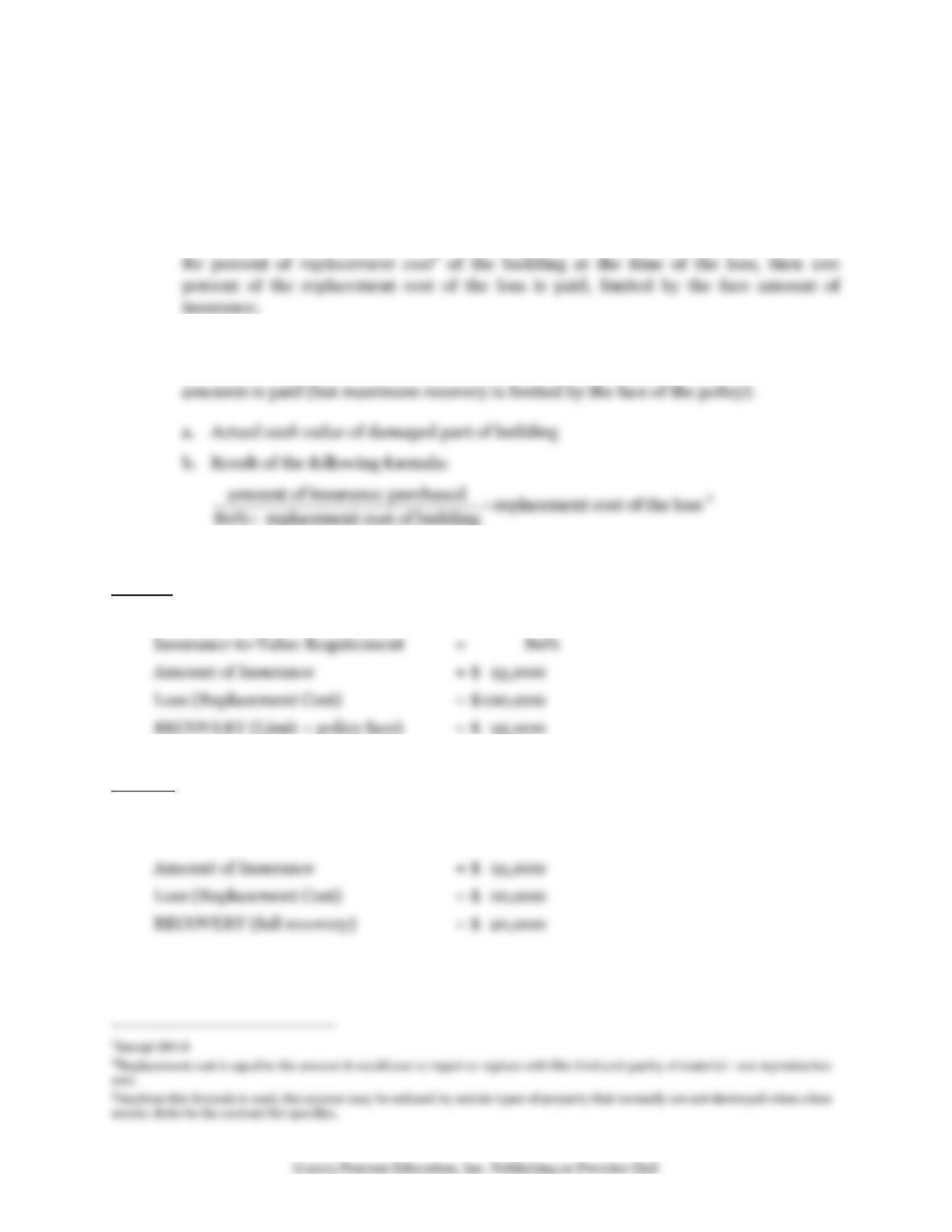
1. In general, if there is a covered loss and insurance coverage is equal to or greater than
2. In general, if the amount of insurance equals less than 80 percent of the replacement
cost of the building at the time of the loss, then the larger of the following two
CASE 1: TOTAL LOSS, REQUIREMENT MET
Replacement Cost of Building = $ 100,000
CASE 2: PARTIAL LOSS, REQUIREMENT MET
Replacement Cost = $ 100,000
Insurance-to-Value Requirement = 80%
116 Chapter 13/Homeowners Insurance
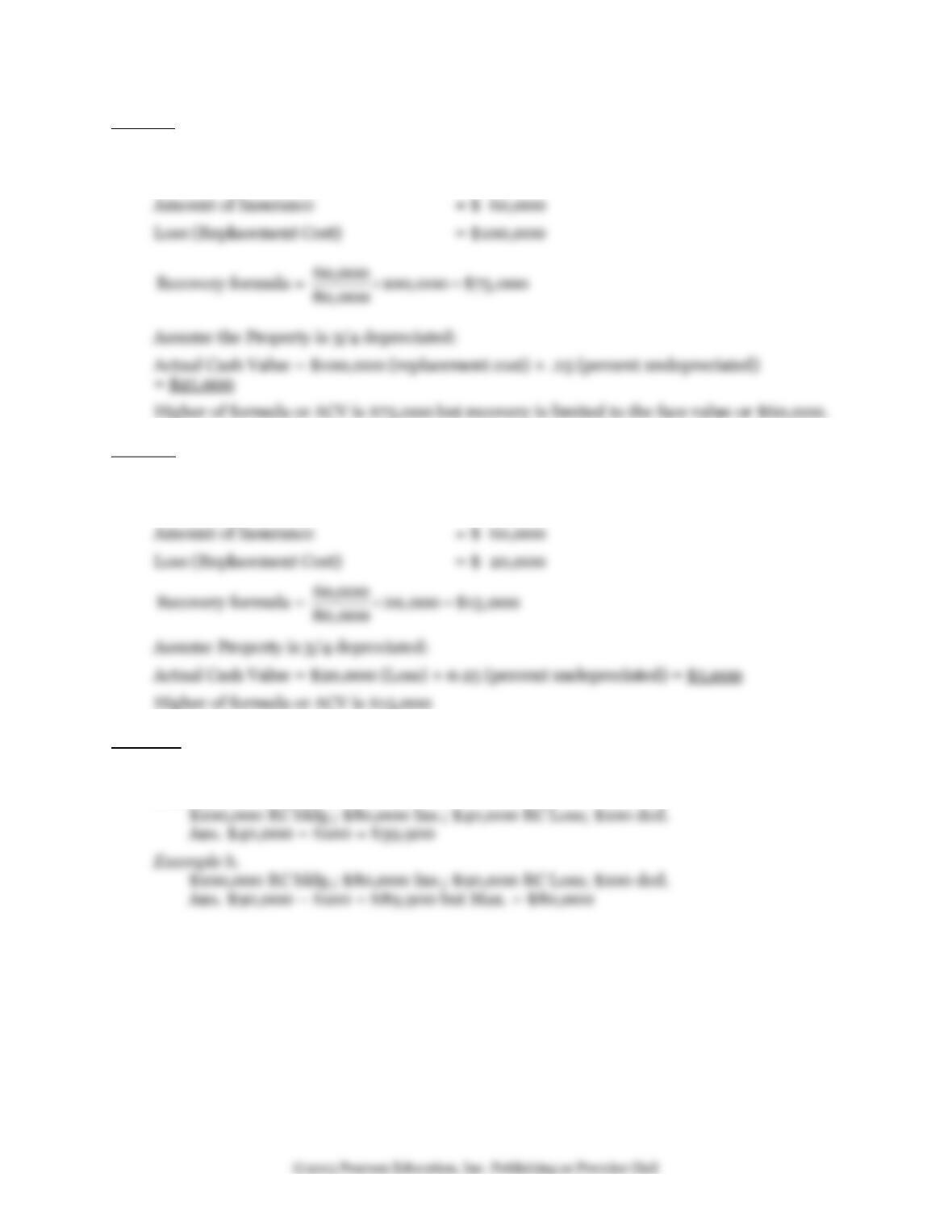
CASE 3: TOTAL LOSS, REQUIREMENT NOT MET
Replacement Cost = $ 100,000
Insurance-to-Value Requirement = 80%
CASE 4: PARTIAL LOSS, COINSURANCE REQUIREMENT NOT MET
Replacement cost of bldg. = $ 100,000
Insurance-to-Value Requirement = 80%
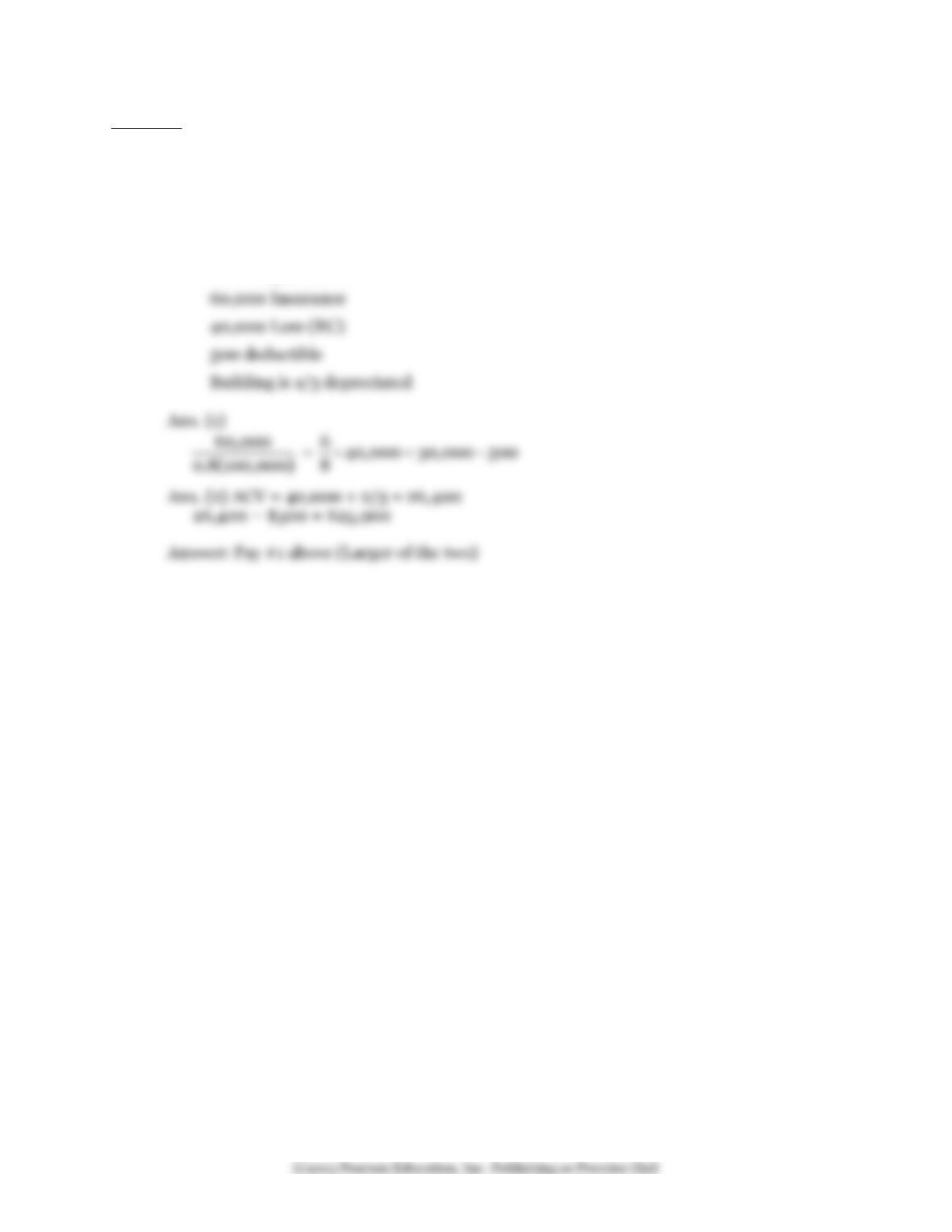
CASE 5: DEDUCTIBLES, REQUIREMENT MET
Subtract the deductible from the amount of insured’s loss (RC)
Example a.
Chapter 13/Homeowners Insurance 117
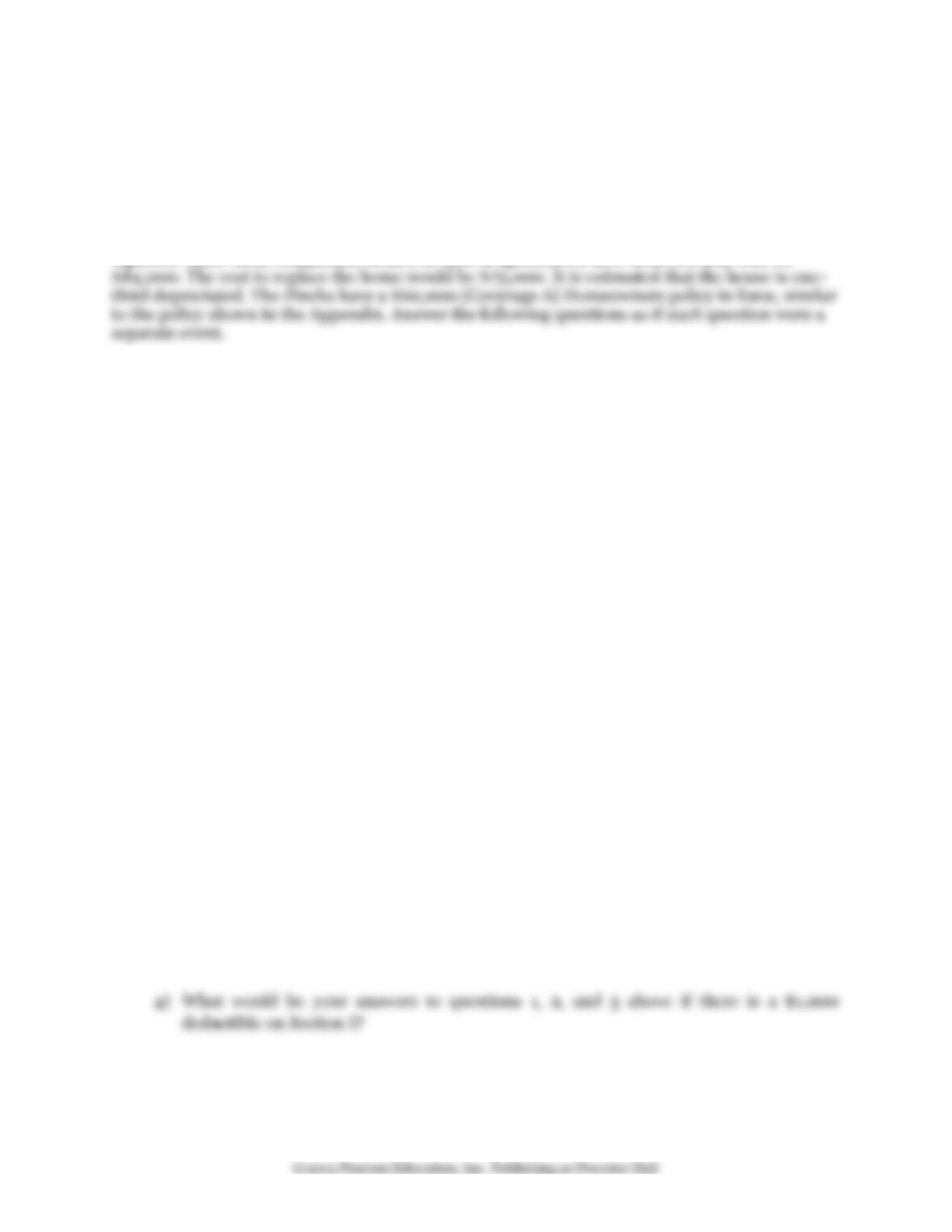
CASE 6: DEDUCTIBLES, REQUIREMENT NOT MET
– Subtract deductible from amount of insured’s loss, after applying penalty
– Compare with (ACV – deductible)
– Pick the larger of the two
EX: 100,000 RC bldg.
80% Requirement
118 Chapter 13/Homeowners Insurance
PROBLEM
THE FINCH FAMILY HOMEOWNERS CONTRACT
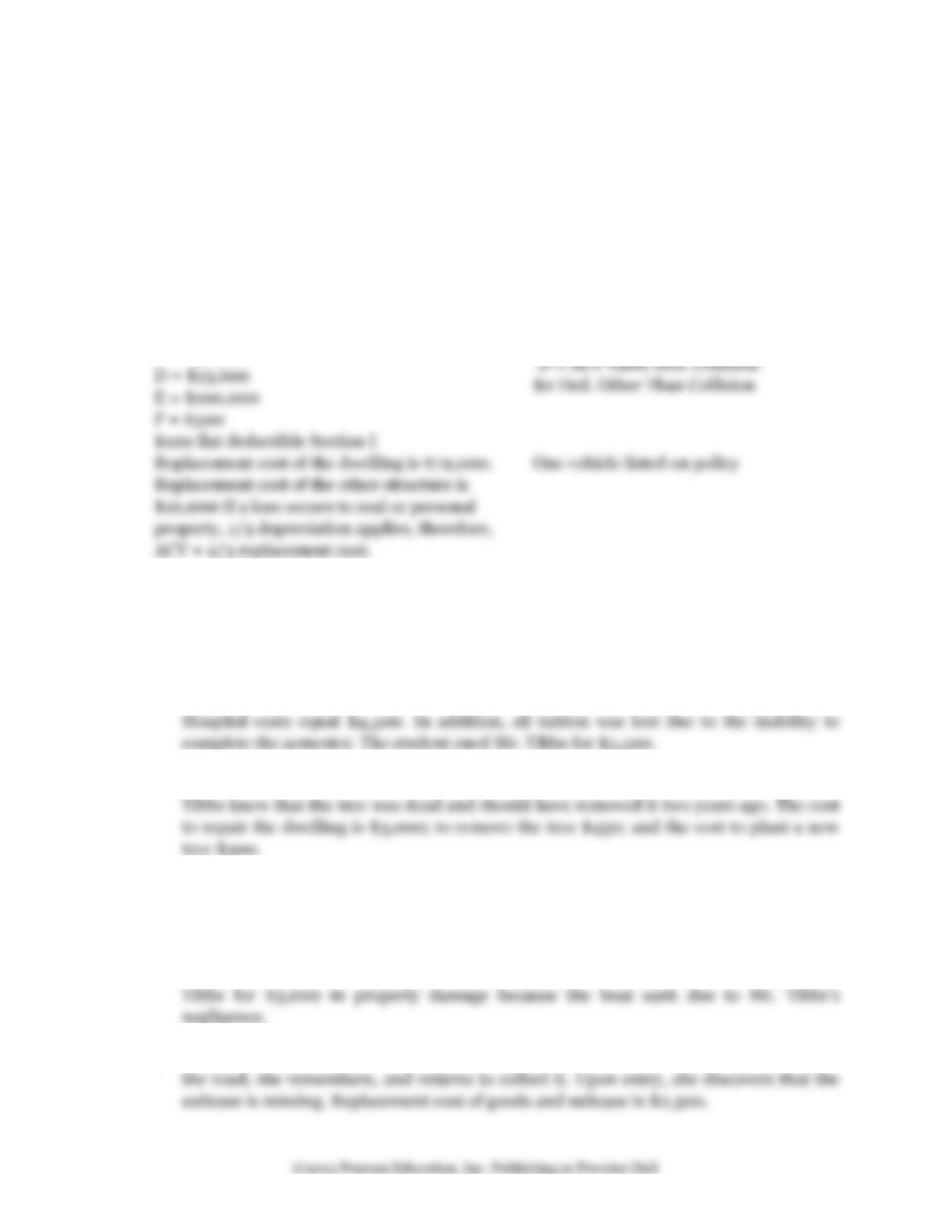
Assume the Finch family of Charlotte, North Carolina, purchased their home in 1966 for
$42,000. Since then, comparable homes in their neighborhood have most recently sold for
1) How much will the Finchs collect for a total covered fire loss under coverage A?
2) How much will be collected for a $20,000 partial loss under coverage A?
3) What would be your answers to questions 1 and 2 above if the Finchs had only $42,000
of insurance of Coverage A?
Chapter 13/Homeowners Insurance 119
POLICY QUESTIONS
HO-2 AND PAP
Mr. Tibbs owns the Homeowners (HO-2) and the Personal Auto Policy found in your text’s
appendices. The following limits apply.
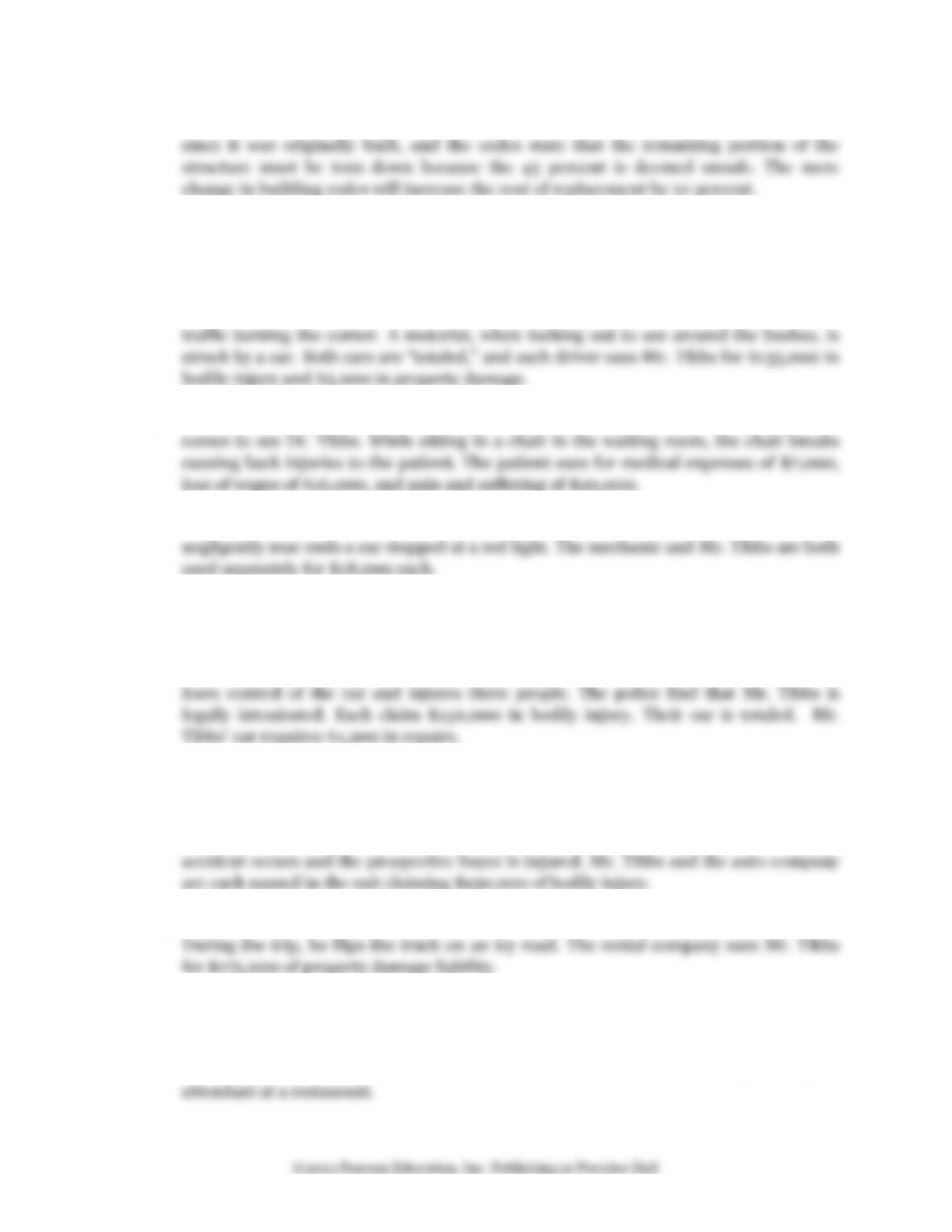
HOMEOWNERS LIMITS:
PERSONAL AUTO POLICY LIMITS:
$100 flat deductible Section I
ACV = 2/3 replacement cost.
A = $65,000
B = $6,500
C = $32,500
A = $100,000/$300,000/$50,000
B = $1,000
C = $100,000/$300,000
Your assignment is to determine if the following situations are covered by the above
policies. If there is coverage how much should be paid? The two policies above are the only
ones in existence. No other contracts are to be considered. Each event is a separate
occurrence.
1. Mr. Tibbs rents out a room to two students. One of the students falls down the stairs.
2. Mr. Tibbs wakes up one morning and discovers a large tree leaning on the house. Mr.
3. The insured is found to be legally obligated to pay $170,000 because of bodily injury to
a neighbor (a fishing partner) caused by an accident involving Mr. Tibbs’s 35
horsepower outboard motor boat.
4. In question 3, the boat was rented to Mr. Tibbs, and the owner of the boat sues Mr.
5. Mrs. Tibbs leaves a suitcase filled with clothing in a motel room. Twenty miles down
120 Chapter 13/Homeowners Insurance
6. Mr. Tibbs’s house is 55 percent destroyed by fire. Local building codes have changed
7. In question 6 above, when Mr. Tibbs inventories his damaged property, he discovers
that a $6,000 (ACV) gun collection is missing. The adjusters conclude that in the
confusion during the fire, someone stole the property.
8. Mr. Tibbs fails to trim his bushes near the street. The bushes obstruct the view of
9. Dr. Tibbs is a medical doctor who operates out of an office in his house. A patient
10. Mr. Tibbs takes his car to a repair shop. While the mechanic is test driving the car, he
11. A tornado causes an unattached garage to collapse on the owned car. The shed and the
automobile are total losses. How much is covered under the two contracts?
12. Mr. Tibbs has an argument with his wife and goes bar hopping. On the way home, he
13. In question 12, Mrs. Tibbs is also in the car. She is injured and sues Mr. Tibbs for
$350,000.
14. Mr. Tibbs decides to sell cars. One day, while he is demonstrating a new car, an
15. Mr. Tibbs decides to move to Nevada, so he rents a large (18-wheel) moving truck.
16. In question 15, instead of moving his own property, Mr. Tibbs decides to move
property of others for a business. The damage to the truck equals $175,000.
17. Mrs. Tibbs’s fur coat (worth $700 ACV) is stolen out of the car after it is parked by an
Chapter 13/Homeowners Insurance 121
18. Mr. Tibbs’s car is at a repair shop. For transportation, he uses his son-in–law’s
20. While driving his car under a bridge being spray painted by the Department of
Transportation, the car is coated with paint. Because of the chemicals being used in the
122 Chapter 13/Homeowners Insurance
ANSWERS
THE FINCH FAMILY
HOMEOWNERS CONTRACT
1) No coinsurance penalty. Collects RC $60,000 if replaced.
2) No coinsurance penalty. Collects RC, $20,000 if replaced.
Applies to all answers: Can’t collect replacement cost unless actually repairs or replaces.
POLICY QUESTIONS
1. BI Liability paid $5,500 – hospital costs and tuition; no exclusion applies.
7. $6,000 by fire— ded already taken; fire cause of loss, not theft—doctrine of proximate
cause
Chapter 13/Homeowners Insurance 123
10. Mechanic $0 (in the automobile business); Tibbs up to 100/300/50 therefore $18,000
16. $0 same as question 15 and excludes moving people or property for a fee (public or
livery conveyance).
17. $700 ACV – $100 deductible paid. Property covered for theft anywhere in the world.