Demand rate: 750 units per hour
Lead Time: 40 hours
Demand rate: 200 units per hour
Lead Time: 12 hours
a.)
Kanban cards required: 20
b.)
c.)
Demand rate: 200 units per hour
Lead Time: 12 hours
Container capacity: 72 units
Demand rate: 300 units per hour
Lead Time: 4 hours
a.)
Kanban cards required: 33
b.)
c.)
Demand rate: 300 units per hour
Lead Time: 3 hours
Container capacity: 40 units
Demand rate: 1000 units per hour
Lead Time: 2 hours
a.)
Kanban cards required: 10
b.)
c.)
Demand rate: 1000 units per hour
Lead Time: 2 hours
Container capacity: 250 units
Demand rate: 60 units per hour
Lead Time: 40 hours
a.)
Kanban cards required: 132
b.)
c.)
Demand rate: 120 units per hour
Lead Time: 20 hours
Container capacity: 20 units
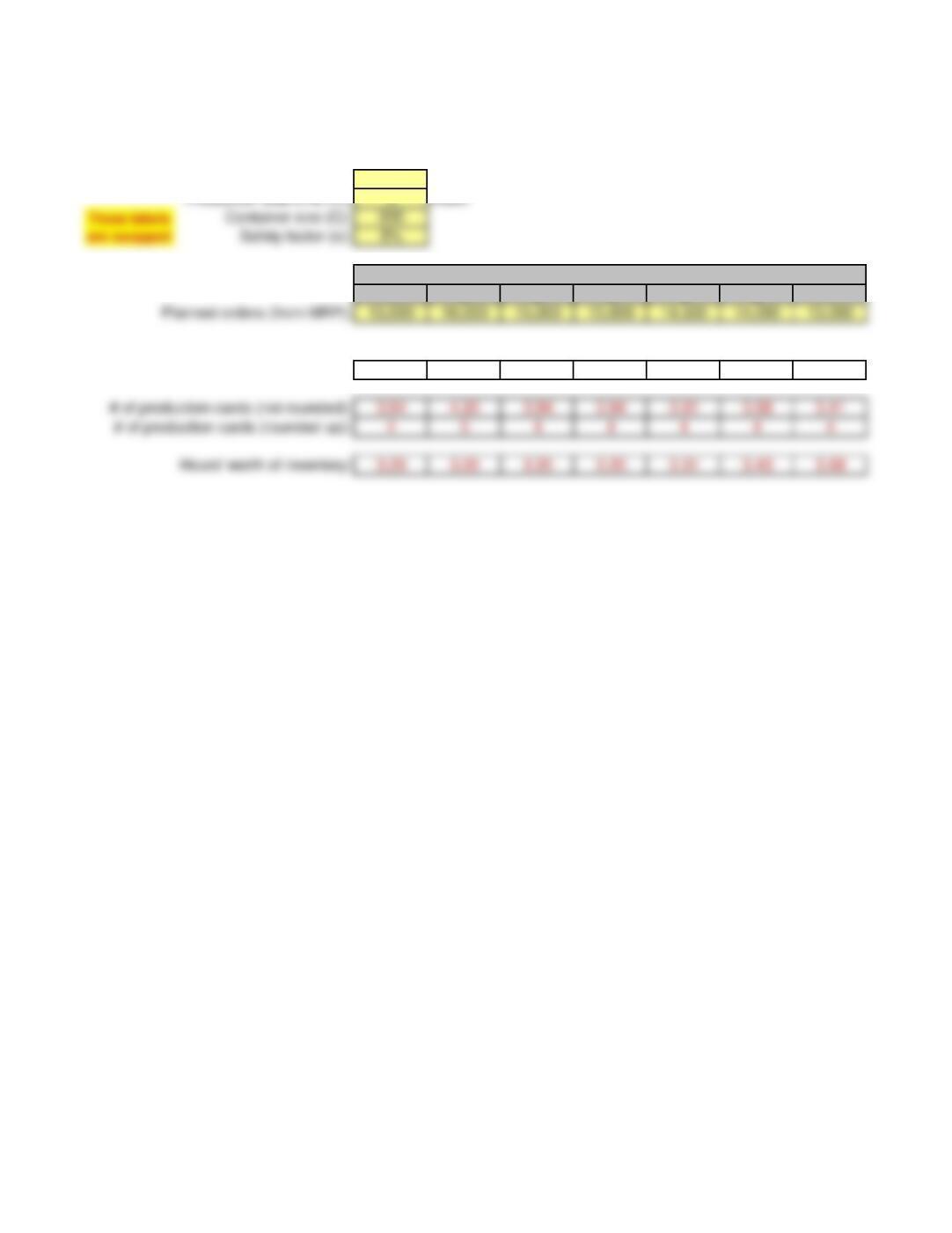
Using MRP Planned Orders to Determine the Number of Kanban Production Cards Needed
Hours per week: 40
WEEK
1 2 3 4 5 6 7
Hourly demand (D): 375 400 375 375 362.5 350 325

1. Some of the key advantages of the Japanese automotive supply chain were a) its leanness in terms of
inventory, which helped keep costs low, b) the emphasis on a few, key suppliers, which help firms focus their
quality improvement efforts, and c) an emphasis on waste reduction. Running supply chains with very little
2. The push toward standardization of parts and more autonomous supply sources for each region are
consistent with lean. But what about higher inventory levels? One could argue that higher inventory is
3. In addition to the above strategies, Toyota and other manufacturers might also try working with
competitors to establish inventory or capacity “pools” that can be tapped into in case of severe interruptions.
4. If Toyota asks its upstream suppliers to keep more safety stock inventory, then Toyota has to be willing to
pay for the added protection. Toyota will also need to work closely with suppliers to identify what the “right”