
Page 1 of 23
Chapter 13: Six Sigma Management and Lean Tools
Chapter Outline
• What is Six Sigma?
• Organizing Lean-Six Sigma
• DMAIC Overview
o Define Phase
o Measure Phase
o Analyze Phase
o Improve Phase
o Control Phase
• Taguchi Design of Experiments
• Background of the Taguchi Method
• The Taguchi Process
• Design for Six Sigma
• Lean-Six Sigma from a Contingency Perspective
Overview
In 1995, General Electric began implementation of Six Sigma with a goal of being
a Six Sigma company by 2000. Six Sigma is a methodology that puts the entire quality
atmosphere within a firm into focus. Six Sigma involves all of the topics that have been
presented so far under a single organization.
On page 337, the text provides a definition of Six Sigma: First, Six Sigma represents a
well-thought out packaging of quality tools and philosophies in an honest effort to
provide rigor and repeatability to quality improvement efforts. Second, Six Sigma is
much more cost-reduction-oriented than traditional continuous improvement.
This pragmatic, overall approach is what makes Six Sigma successful. Many
companies have reported outstanding results with lean-Six Sigma. There are also many
failures. Keys to lean-Six Sigma success are skilled management, leadership, and long-
term commitment.
Page 2 of 23
Discussion Questions
1. Where do you think that Lean-Six Sigma can be used effectively?
Actually, the concept works well within any type of organization. The primary challenge
is to better define objectives with appropriate measurable criteria. The following is a list
of U.S. companies that use Six Sigma:1
3M, A.B. Dick Company, Abbott Labs, Adolph Coors, Advanced Micro Devices, Aerospace Corp,
Airborne, Alcoa, Allen Bradley, Allied Signal, Ampex, Apple Computers, Applied Magnetics, ASQC,
Atmel, Baxter Pharmaseal, Beatrice Foods, Bell Helicopter, Boeing, Bombardier, Borden, Bristol Meyers –
Squibb, Bryn Mawr Hospital, Campbell Soup, Cellular 1, Chevron, Citicorp, City of Austin, TX, City of
Dallas, TX, Clorox, Cooper Ind, Dannon, Defense Mapping Agency, Delnosa ( Delco Electronics in
Mexico), Digital Equipment Corp, DTM Corp, Eastman Kodak, Electronic Systems Center, Empak,
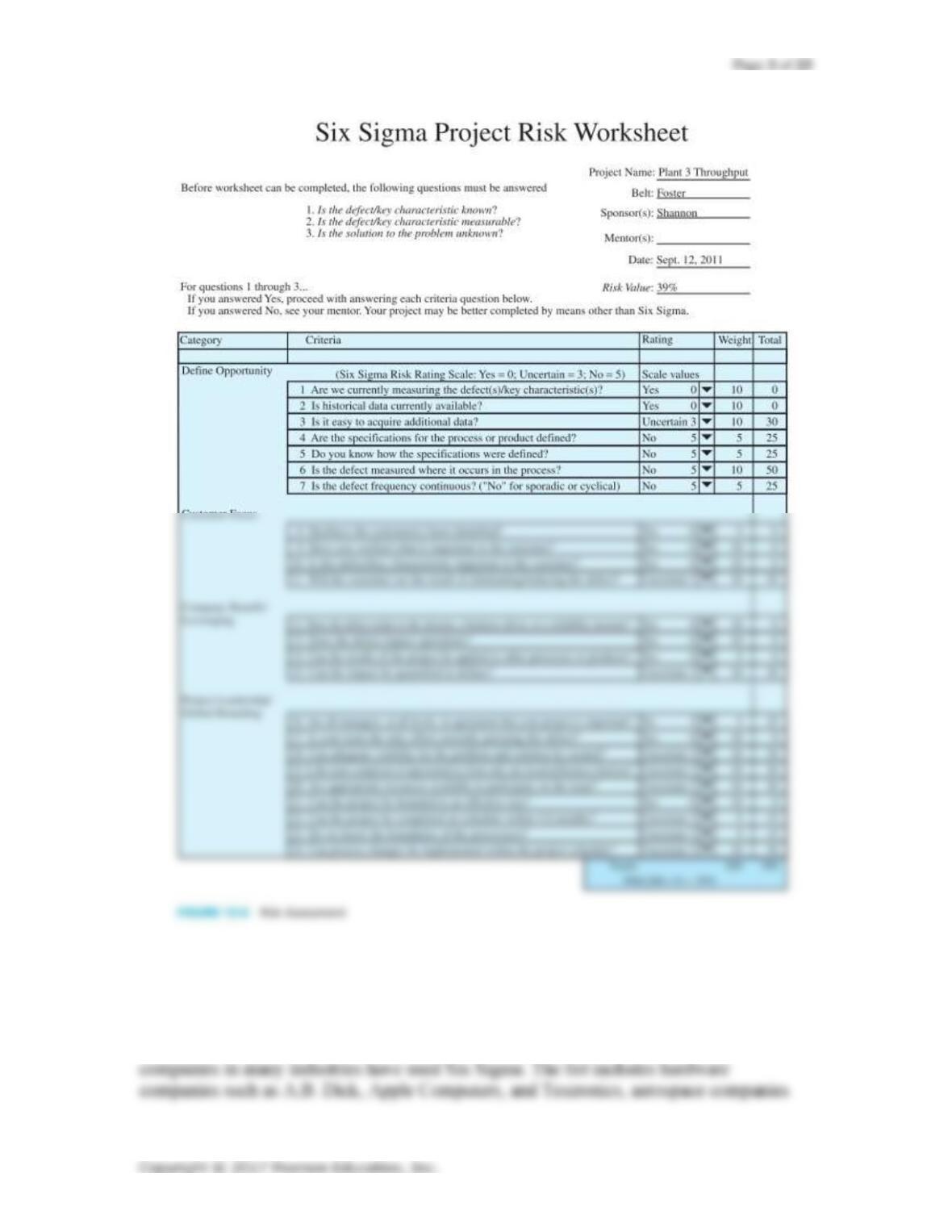
2. How will risk assessments vary from industry to industry?
3. What industries would be the best candidates for the Lean-Six Sigma approach?
Why?
The list of companies that use Six Sigma listed in question 2 makes it obvious that many
Page 4 of 23
4. What is different between Lean-Six Sigma and traditional quality improvement?
Lean-Six Sigma is a documented methodology for insuring that the continuing quality
5. Can you think of an example where the Taguchi quality loss function (QLF)
would work in real life? Discuss how it might work.
QLF defines a situation where a problem has a “potential loss to society” (page 359).
This function defines all of the losses due to poor quality. Taguchi says that, in addition,
these losses are usually associated with lack of quality. There is also a potential for
environmental damage.
6. How does the Taguchi concept of ideal quality compare to other definitions of
quality discussed in Chapter 1?
Traditionally, manufacturing focuses on the concept of tolerance ranges. In other words,
a manufactured product can have a dimension that fits within a specified range to be
successful. Taguchi’s concept of robust design focuses on target values.
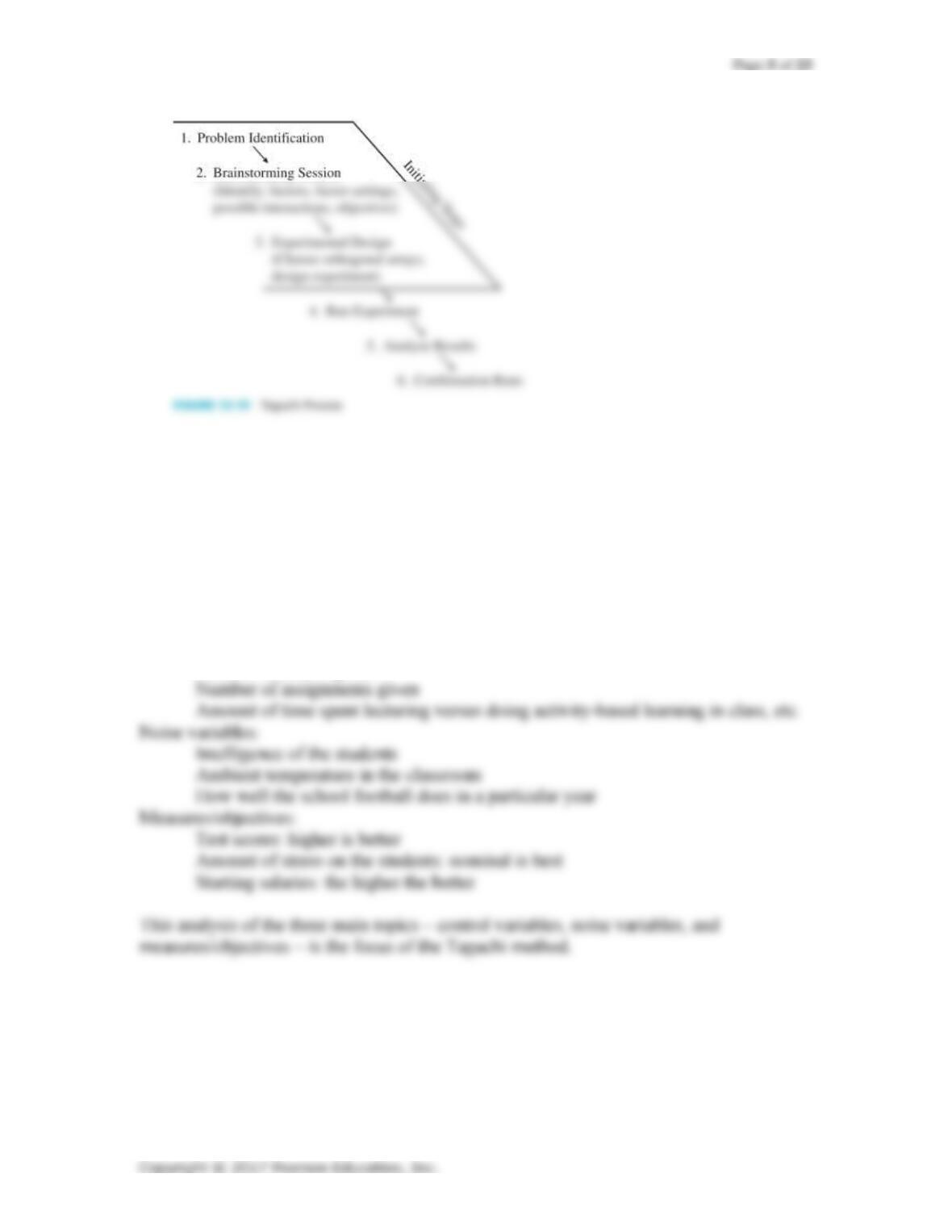
7. How could the Taguchi method be used to design a course in quality
management? Identify all the variables, measures, and objectives.
If the discussion involves using the course content as the topic for the Taguchi method,
the topics for analysis and discussion might include:
Control variables:
Mix of topics taught
Time spent on each topic
Number of exams given
8. Why are behavioral processes such as brainstorming important for the Taguchi
method?
A properly conducted brainstorming session or Delphi study obtains the expertise and
9. How would you cost-benefit a Taguchi experiment? What might be some of the
quantifiable parameters you would use in evaluating the worth of a Taguchi
experiment?
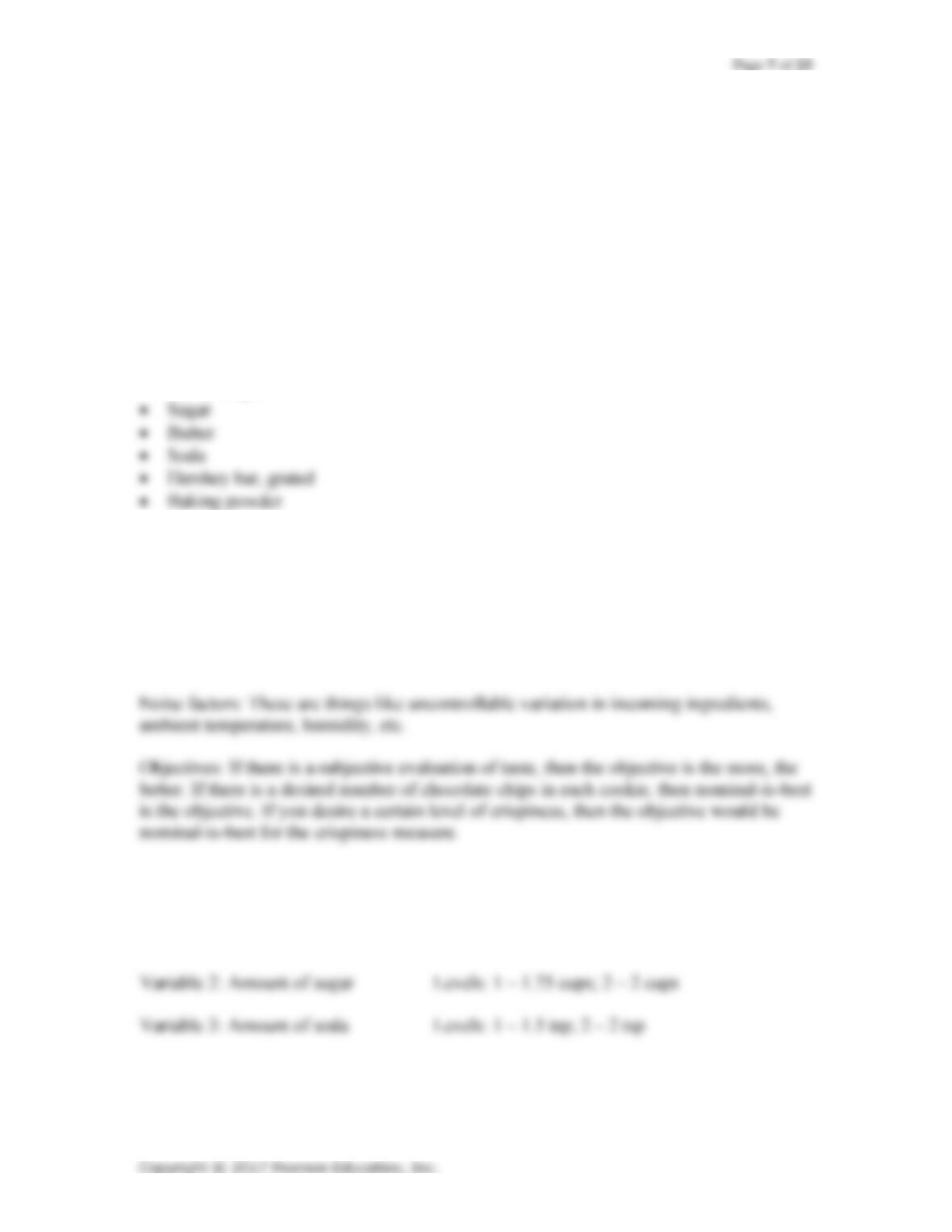
The QLF is specifically identified as the cost of deviation from a target value. Examining
historic data can identify this cost. The Taguchi method is based upon specific metrics or
10. The chapter cites different services implementations of the Taguchi method. Do
you think the Taguchi method is useful for services? Why or why not? Why do you
think the technique has not been widely adopted in services?
On page 357, the point is made: The Taguchi method is a standardized approach for
determining the best combination of inputs to produce a product or service. This is
accomplished through design of experiments (DOE) for determining parameters.
Case 13-1: The Neiman-Marcus Cookie
Using this recipe and these production procedures, develop a Taguchi experiment to
find the optimal process for making chocolate chip cookies. Be careful in identifying
control factors, noise factors, objectives, and designing the experiment the whole
experiment.
We will establish a simple Taguchi experiment. Each response will be different, so
this example is instructive of a simple answer.
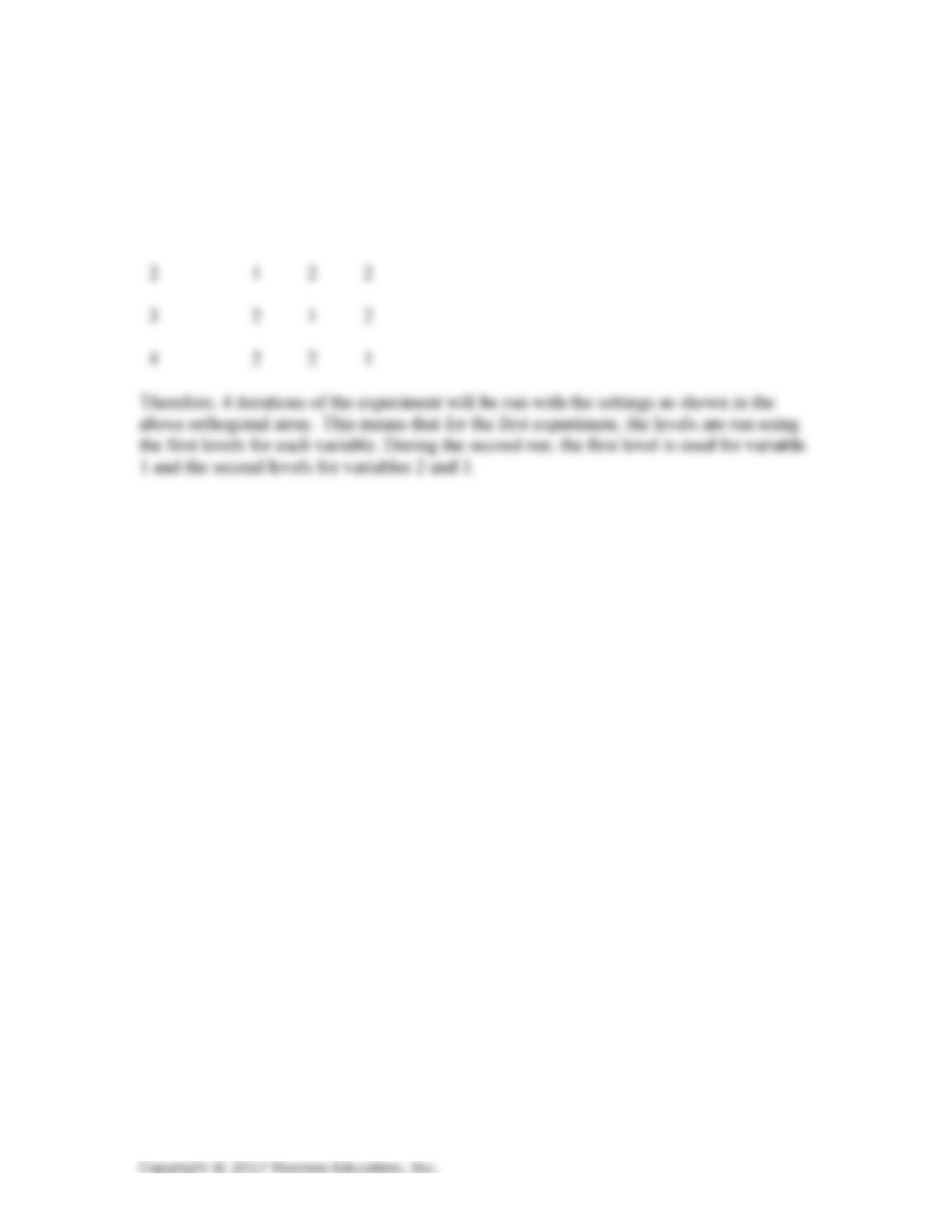
Control factors: Variation in the quantities of each of the following ingredients:
• Blended oatmeal
• Brown sugar
• Vanilla
• Flour
• Chocolate chips
• Salt
• Eggs
• Chopped nuts
• Variation in baking time, temperature, types of flour or other ingredients, etc.
Let’s set up a simple experiment. Suppose we choose three variables with two levels each
as follows:
Variable 1: Amount of oatmeal chips Levels: 1 – 4.5 cups; 2 – 5 cups
Page 8 of 23
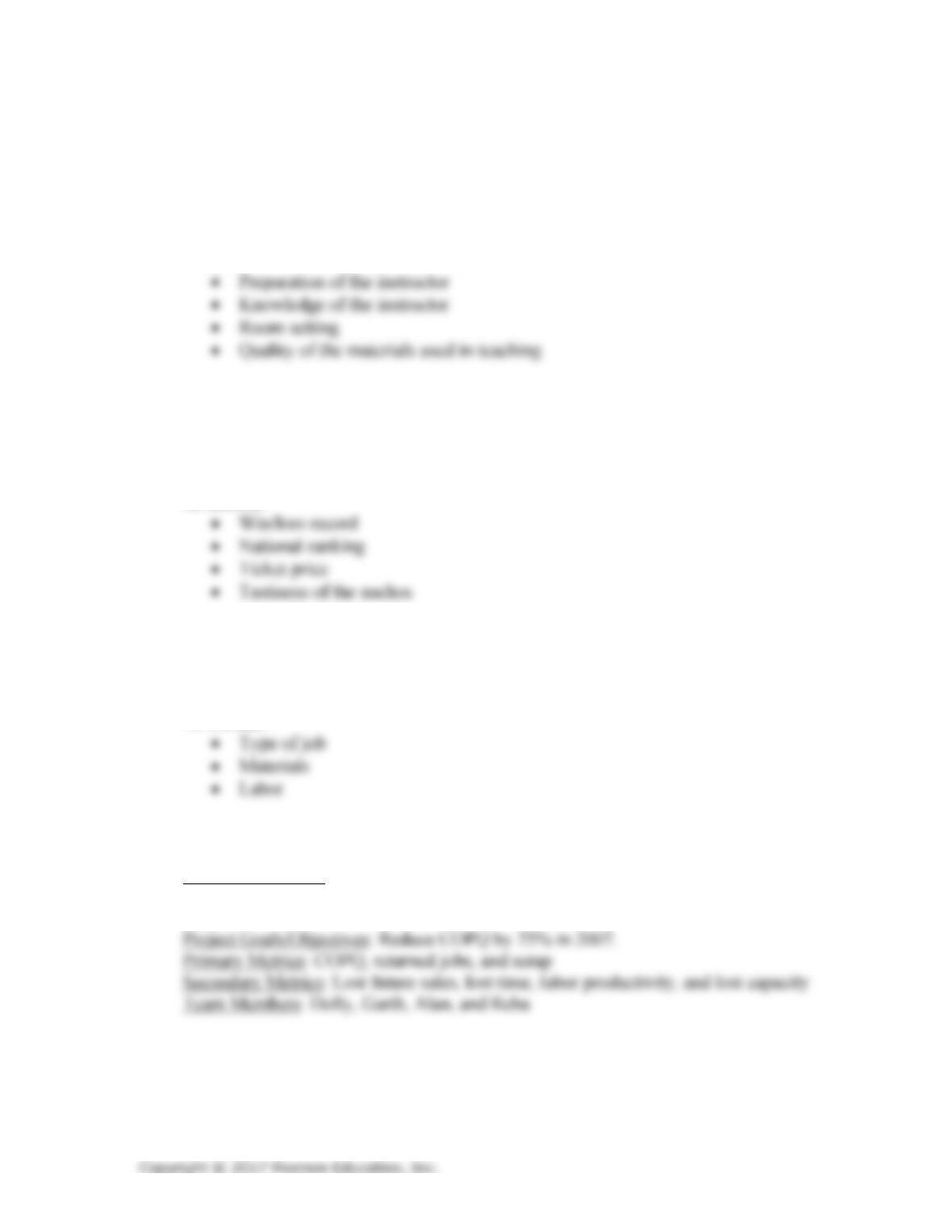
Since three variables with 2 levels were chosen, an L4 array is chosen. Here is the array:
Expt. Columns
Number 1 2 3
1 1 1 1
Page 9 of 23
Suggested Answers to End of Chapter Problems
1.
2.
3.
4.
Part of a Six-Sigma project is to identify Xs and Ys. What are the Xs you can
identify for student satisfaction with a quality management course? Use the Y
(dependent variable) of student satisfaction with a quality management class.
Independent variables (Xs) include items such as:
Part of a Six-Sigma project is to identify Xs and Ys. Identify Xs and Ys for an
athletic director of a major university (insert the name of your university here)
who is interesting in increasing attendance at football games.
Y = game attendance
Xs include:
Part of a Six-Sigma project is to identify Xs and Ys. Identify these variables
for the owner of a copy shop who is interested in reducing mistakes in orders.
Y = copy shop defects
Xs include:
Develop a Problem Definition (see Figure 13-10) for the project in Problem 3.
Problem Statement: In 2009, the copy center lost $X from scrap and rework
resulting from mistakes in orders. This has resulted in a loss of profitability for the
firm.
5.
6.
7.
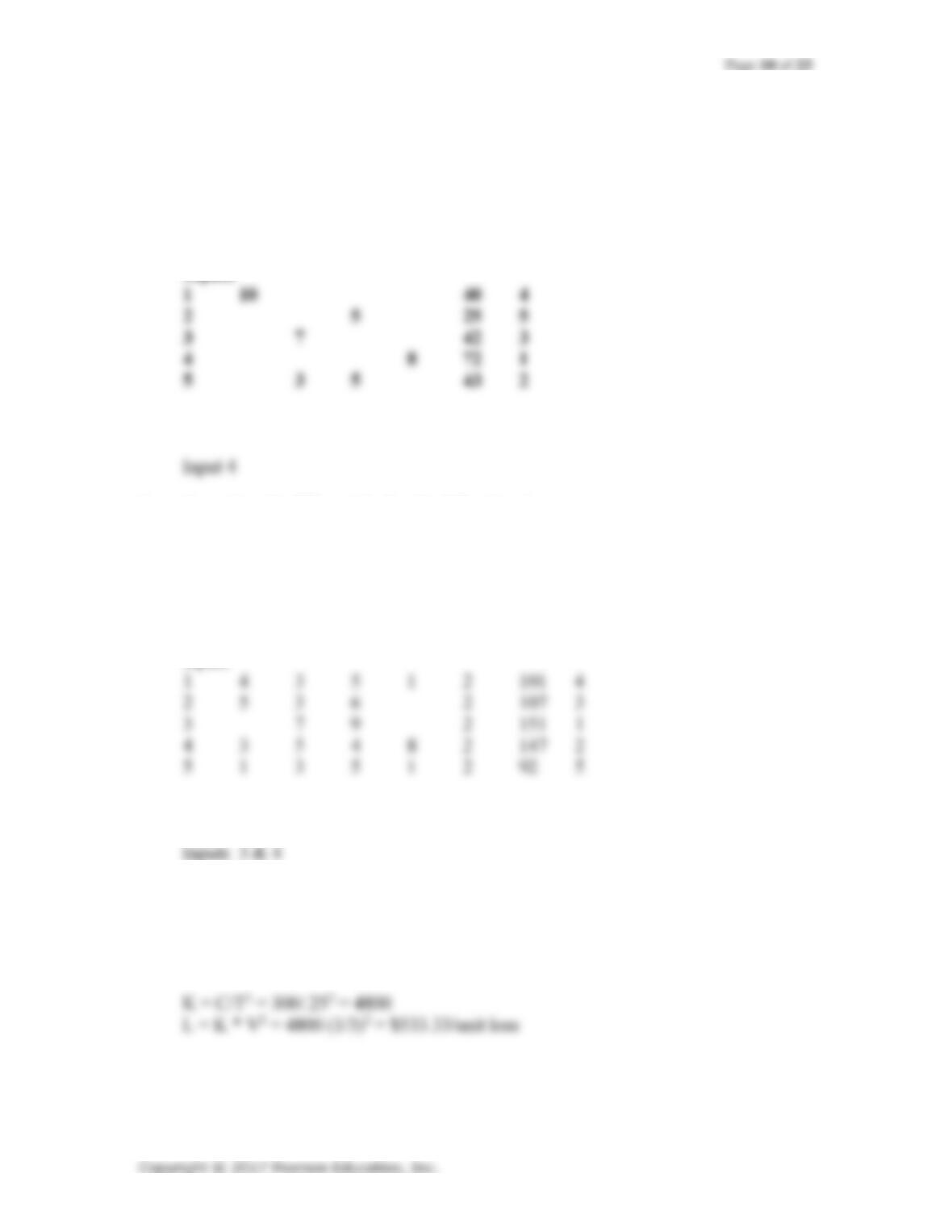
Complete the XY matrix for the following data:
Here is the solution in spreadsheet form:
Outputs
A B C D Total Rank
Ranks: 4 6 5 9
Inputs
Which inputs are the most important?
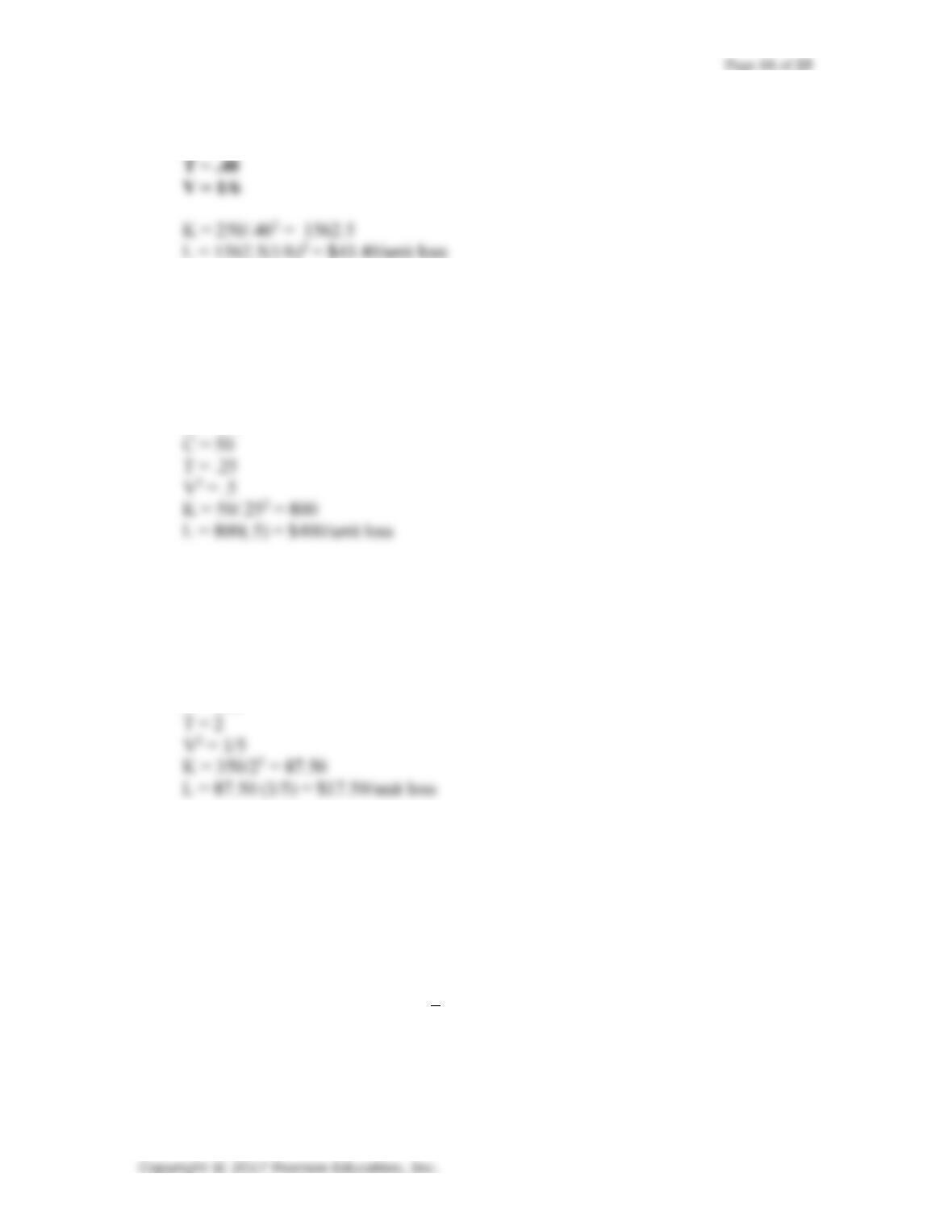
Complete the XY matrix for the following data:
Here is the solution.
Outputs
A B C D E Total Rank
Ranks: 3 8 9 6 7
Inputs
Which inputs are the most important?
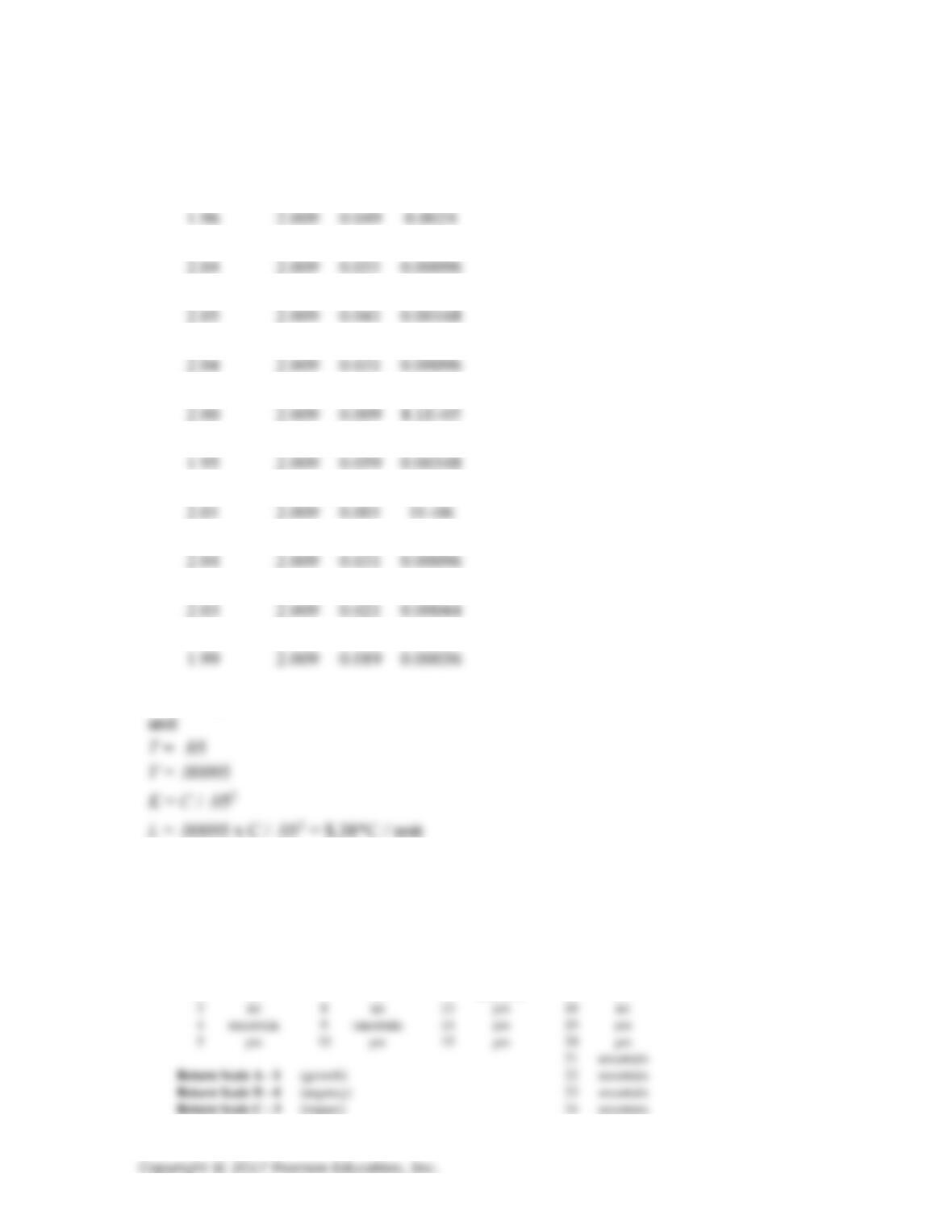
Find the QLF for the following information:
C=300
T=.25
V=1/3
8.
9.
Compute the QLF for the following information:
C = 250
It costs $50 to repair a component in a VCR. Compute the QLF for losses
incurred as a result of a deviation from a target setting with a nominal
tolerance of 10 plus or minus .25 mm required. The mean squared deviation is
½.
Answer:
K = C/T2
10.
It costs $350 to repair a refrigerator compressor. Compute the QLF for losses
incurred as a result of a deviation from a target setting with a nominal
tolerance of 60 amps where a 2-amp variation is acceptable. The mean squared
deviation is 1/5.
Answer:
C = 350
11.
For a component, the following measurements were taken:
2.04
1.96
2.03
2.02
1.99
2.05
1.97
2.04
2.03
2.00
2.03
1.95
2.02
2.01
1.98
2.04
1.96
2.03
2.02
1.99
If the nominal target value is 2 + .05, compute the QLF for this
component, where the repair cost is $200.
Page 12 of 23
Answer:
Measurement
Mean
Error
Error
Sq
2.04
2.009
0.031
0.00096
1.96
2.009
0.049
0.0024
2.03
2.009
0.021
0.00044
2.04
2.009
0.031
0.00096
1.99
2.009
0.019
0.00036
2.05
2.009
0.041
0.00168
1.97
2.009
0.039
0.00152
2.04
2.009
0.031
0.00096
2.03
2.009
0.021
0.00044
2.00
2.009
0.009
8.1E-05
2.03
2.009
0.021
0.00044
1.95
2.009
0.059
0.00348
2.02
2.009
0.011
0.00012
2.01
2.009
0.001
1.98
2.009
0.029
0.00084
2.04
2.009
0.031
0.00096
1.96
2.009
0.049
0.0024
2.03
2.009
0.021
0.00044
2.02
2.009
0.011
0.00012
1.99
2.009
0.019
0.00036
unit
C = cost per
12. Below are answers to the worksheets in Figures 13-6 and 13-7. Using these
responses, develop a risk assessment for this project. Produce a risk and return
matrix to determine if this project is worth pursuing. Use the weights in Figure
13-6.
1 yes 6 no 11 no 16 no
2no 7no 12 uncertain 17 no