Instructor’s Manual – OMSC2 – Collier/Evans – C13 Supply Chain Management and Logistics
Chapter 13 focuses on basic concepts and methods of supply chain management, sourcing and
purchasing, logistics, transportation, sustainable supply chains, reverse logistics, supply chain
Questions and problems are provided in four categories:
1. Review questions
The chapter has three cases:
1. LCC Medical Manufacturing is the first case study. It focuses on computing the total supply
chain costs for three different order quantities for three global suppliers. The second part of the
2. J&L Packaging, Inc. Cash-to-Cash Conversion Cycle, allows students to understand how
3. The integrative case study, Hudson Jewelers, with case assignment questions in all chapters,
requires the student to evaluate the risks for the global diamond supply chain’s tactical and
KEY TERMS
A backhaul is when a truck delivers its load and also carries freight on the return journey.
Order amplification is a phenomenon that occurs when each member of a supply chain “orders
up” to buffer its own inventory.
Pipeline inventory is inventory that has been ordered but is in transit.
Purchasing (procurement) is the function responsible for acquiring raw materials, component
parts, tools, services, and other items required from external suppliers.
Supply chain integration is the process of coordinating the physical flow of materials to ensure
that the right parts are available at various stages of the supply chain, such as manufacturing
and assembly plants.
Supply Chain Management (SCM) is the management of all activities that facilitate the
fulfillment of a customer order for a manufactured good to achieve customer satisfaction at
reasonable cost.
REVIEW QUESTIONS
1. What is supply chain management? How does it differ from logistics?
The basic purpose of a supply chain is to coordinate the flow of materials, services, and
information among the elements of the supply chain to maximize customer value. The key
functions of supply chain management generally include sales and order processing,
transportation and distribution, operations, inventory and materials management, finance,
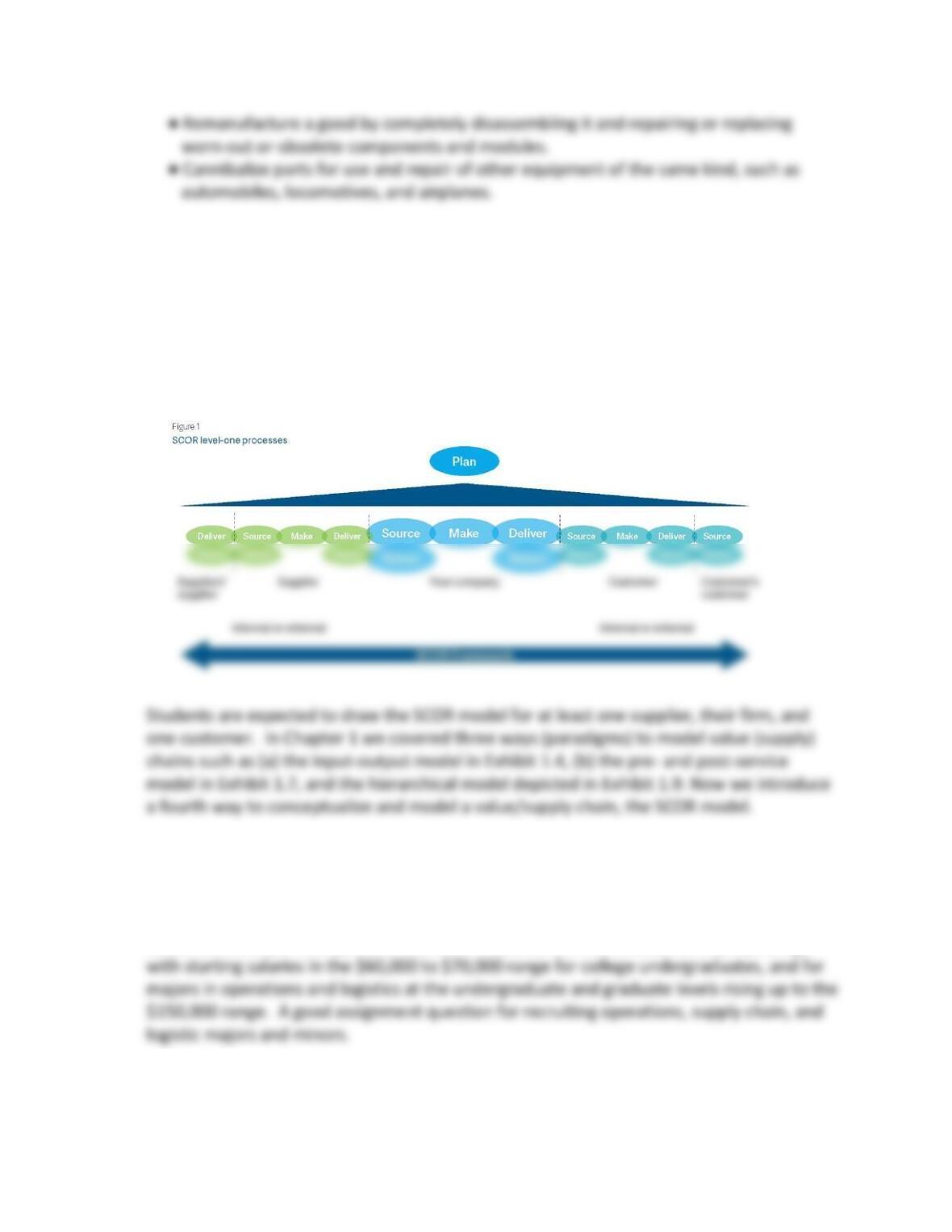
2. Explain the SCOR model. Why is it useful in managing supply chains?
The Supply Chain Operations Reference (SCOR) model is a framework for understanding
the scope of supply chain management (SCM) that is based on five basic functions involved
in managing a supply chain: plan, source, make, deliver, and return. (see the box on the
SCOR model), which are the key processes that create value to customers.4 These
3. Explain the role of the purchasing function.
Purchasing (procurement) is the function responsible for acquiring raw materials,
component parts, tools, services, and other items required from external suppliers.
4. What are the three key principles that should be used in working with suppliers?
Three principles for working with suppliers are:
1. Recognizing their strategic importance in accomplishing business objectives such as
minimizing the total cost of ownership.
5. Explain supply chain and value chain integration.
Supply chain integration is the process of coordinating the physical flow of materials to
ensure that the right parts are available at various stages of the supply chain, such as
manufacturing and assembly plants. value chain integration is the process of managing
6. List the activities associated with logistics.
Logistics managers have the two primary responsibilities:
1. Purchasing transportation services.
• Selecting appropriate modes of shipment and mix of specific carriers.
2. Managing inventories and movement of materials and goods through the supply chain.
• Managing the flow of goods through warehouses, and sometimes, shipping directly
7. Cite and explain one advantage and one disadvantage of each of the following
transportation modes: air, rail, truck, ships and barges, and pipelines.
Air: Advantages include fast, for mostly high-value items, etc. Disadvantages include
weight and/or volume limits, no door-to-door service, highest transportation cost, and so
on.
8. What is vendor managed inventory?
Vendor-managed inventory (VMI) is becoming a popular concept where the vendor (a
consumer goods manufacturer, for example) monitors and manages inventory for the
9. Explain the bullwhip effect in supply chains.
The bullwhip effect results from order amplification in the supply chain (see Exhibit 13.2 on
HP Inkjet Printers). Order amplification is a phenomenon that occurs when each member
of a supply chain “orders up” to buffer his or her own inventory. In the case of a
distributor, this might mean ordering extra finished goods; for a manufacturer, this might
mean ordering extra raw materials or parts. Order amplification increases as one moves
back up the supply chain away from the retail customer. For example, small increases in
10. Describe the types of risks supply chains face and ways to mitigate them.
Risks in domestic supply chains are often minimal; however, risks in global supply chains
are much greater. These include production problems with suppliers that result in material
11. Describe how e-commerce has changed the role of supply chains.
The e-commerce view of the supply chain is shown in Exhibit 13.5. An intermediary is any
entity—real or virtual—that coordinates and shares information between buyers and
12. List and describe the important metrics used in supply chain performance and be able to
evaluate total supply chain costs.
Supply chain managers use numerous metrics to evaluate performance and identify
improvements to the design and operation of their supply chains. These include delivery
13. Describe the components of cash-to–cash conversion cycle analyses. What are the
implications of positive and negative cash flows?
The cash-to–conversion cycle is computed as inventory days’ supply (IDS) plus accounts
receivable days’ supply (ARDS) minus accounts payable days’ supply (APDS). See Equations
13.6 to 13.11. The following formulas are used:
14. What is a certified supplier? Why is supplier certification important?
Many companies also use some type of supplier certification process. These processes
are designed to rate and certify suppliers who provide quality materials in a cost-effective
15. Describe how organizations are incorporating sustainability issues in managing their supply
chains and explain how manufactured goods recovery and reverse logistics work.
Companies move goods using trucks, airplanes, and trains. They are challenged not only to
avoid high energy costs but also to reduce their carbon footprint. Many work to analyze
DISCUSSION QUESTIONS AND EXPERIENTIAL ACTIVITIES
16. Draw a supply chain flowchart similar to Exhibit 13.1 using the SCOR Model for a business
you have worked in or have experience with. Describe how the supply chain works. If you
have little or no work experience, then do the assignment for a restaurant or business you
frequent (maximum of two typed pages).
17. Research the job of a global sourcing manager and describe the job duties, travel
requirements, and skill set (maximum of two typed pages).
One recent Google search reveals almost 4 million hits on “global sourcing specialist.”
Below are excerpts from just one web site. Students will find thousands of job postings
Global sourcing specialists – would they be useful to me?
Why should a firm use global sourcing specialists for their international procurement?
What can global sourcing specialists do for me?
Most global third-party procurement agents or strategic sourcing companies can achieve a
Choose the right organization for your needs.
Proven sourcing skills are the base requirement for choosing global sourcing specialists.
Price negotiations
Negotiation on base price and packaging and transportation costs is one of the key roles of
global sourcing specialists. They provide clients with the lowest possible pricing based on
Sourcing a manufacturer
Selecting the most suitable manufacturer for your new product requires the use of global
Quality control
The top class firms in this field monitor and ensure that all the suppliers and factories that
Value added services
Providing prototypes and final samples for approval is another service that is available
from global sourcing specialists. They can provide packaging design and manufacture,
18. Select three types of supply chain risks and explain in-depth how supply chain managers can
help mitigate these risks. That is, develop an action plan to mitigate these risks (maximum
of two typed pages).
Students have plenty of source material in Exhibits 13.3 and 13.4 to answer this question.
19. Research and find a “return facilitator.” Describe what they do and how they make money
(maximum of two typed pages).
The e-commerce view of the supply chain is shown in Exhibit 13.5. An intermediary is any
Return facilitators specialize in handling all aspects of customers returning a manufactured
good or delivered service and requesting their money back, repairing the manufactured
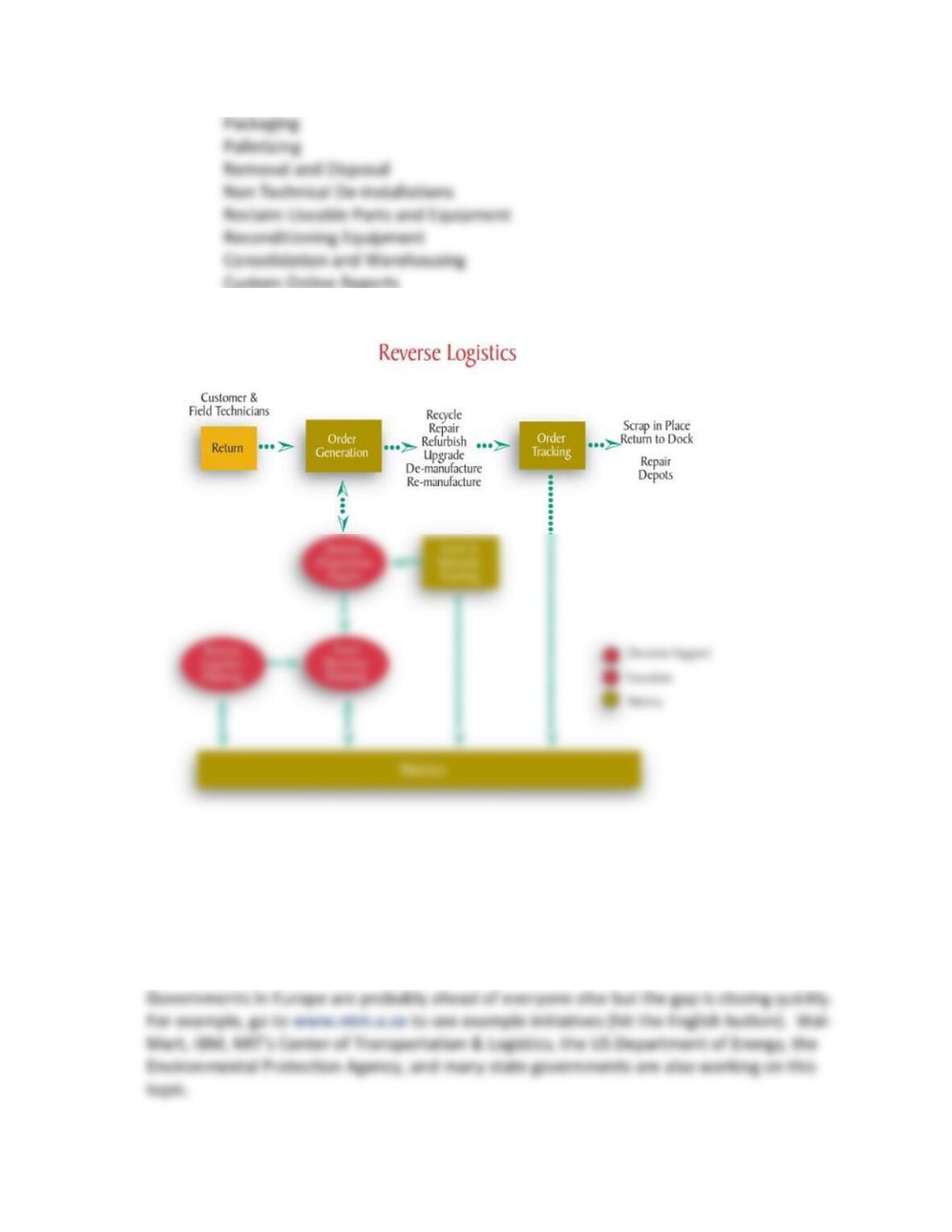
Reverse Logistics [Source: (moveit.com)]
Reverse Logistics is the process related to the reuse of products and materials. The
MoveIt® companies are skilled at helping companies with planning, implementing and
controlling the cost-effective return of goods. Our projects have included returns of surplus
and lease-return goods, as well as end-of-life assets.
20. Research and find a good or service supply chain with a quantifiable carbon footprint.
Write a short paper (maximum of two typed pages) on the topic, and if possible, how the
carbon footprint was computed. Cite your sources.
This is a challenging assignment since many organizations and governments are only
recently trying to quantify carbons emissions and footprints for a good or service.
21. Research and find a physical good that is biodegradable or carbon neutral. Be prepared to
present your findings to the class in a two- to five-minute discussion.
22. Research what type(s) of reverse logistics program(s) your city, county, or state
government supports and write a short paper describing how it works (and a simple
flowchart if possible). What percentage of total waste ends up in a landfill? (maximum of
two typed pages)
Possible items students may use include: vehicle parts, cell phones, used college textbooks,
cell phones, iPads, pizza box, old personal computers, tires, paper, ink cartridges,
COMPUTATIONAL PROBLEMS AND EXERCISES
These exercises require you to apply the formulas and methods described in the chapter. The
problems should be solved manually.
23. Keto Grocery Store sells 400 gallons of milk each month. The average on-hand inventory is
50 gallons. What is the inventory turnover? What does it mean?
24. Over the past year, Keto Grocery Store had a cost of goods sold of $24,500,000 and an
average value of inventory of $1,100,500. What is its inventory turnover? What does it
mean?
Inventory turnover (IT) = Cost of goods sold /Average inventory value (13.2)
25. A big box electronics store sells 250 65-inch televisions during the year. The store
maintains an average inventory of five units. What is its inventory turnover? What
implications does this have for inventory management?
Using equation [13.1], Inventory turnover = Sales/Average inventory, we have
26. A manufacturer of large industrial electric motors has a cost of goods sold of $111,690,000
and an average inventory value of $14,609,300. What is its inventory turnover? What does
it mean?
Inventory turnover (IT) = Cost of goods sold /Average inventory value (13.2)
= $111,690,000/$14,609,000 = 7.65
for this industry, but it could indicate decreasing sales, extra or obsolete inventory, and
poor inventory management. This may also be a signal that the firm struggles to make
sales and a positive cash flow.
27. Bragg Johnson, materials manager at Johnson & Sons, has determined that a certain
product experienced 3.8 turns last year, with an annual sales volume (at cost) of $975,000.
What was the average inventory value for this product last year? What would be the
average inventory level if inventory turns could be increased to 6.0?
28. Andrew Manufacturing held an average inventory of $1.1 million (raw materials, work-in-
process, finished goods) last year. Its sales were $8.0 million, and its cost of goods sold
was $5.8 million. The firm operates 260 days a year. What is the inventory days’ supply?
What target inventory level is necessary to reach a 20- and 10-day inventory days’ supply
during the next two years?
Inventory turnover (IT) = Cost of goods sold /Average inventory value (13.2)
= $5,800,000/$1,100,000 = 5.3 inventory turnover rate.
29. Based on the following information, how many days of supply of inventory is the firm
holding (assume 250 days of operation per year)? Interpret your answer if the industry
average inventory days’ supply is 30 days.
Sales $8,300,000
30. Claiken Incorporated is a supplier of axles for light trucks. They held an average axle
inventory of $1.6 million last year, with a cost of goods sold of $21.0 million. What is the
inventory turnover for axles? A customer wants them to increase its inventory turnover
rate to 20 by implementing better inventory and operating practices. What average axle
inventory level is needed to meet this 20-turn target?
Inventory turnover (IT) = Cost of goods sold /Average inventory value (13.2)
31. What are total purchase and oversight costs if annual demand is 1,000,000 units, the
purchase price is $2.42, and the management oversight costs to monitor and expedite the
trans-Pacific shipment are $0.16 per unit?
Procurement costs = PD = $2.42*1,000,000 units= $2,420,000
32. What is the pipeline inventory value if average daily demand is 82 units, the lead time is 20
days, and annual inventory carrying costs is $12?
33. What are order cycle costs if annual demand is 8,000 units, the order quantity is 1,000 units,
and annual order cost is $97? What if the order size changes to 500 units or 8,000 units?
Order cycle cost = Co (D/Q) = $97*(8,000/1,000) = $776
34. What is the annual transportation cost if annual demand is 240,000 units and the cost to
transship a unit is $0.80 per unit?
Transportation cost = CtD = $0.80*240,000 units = $192,000
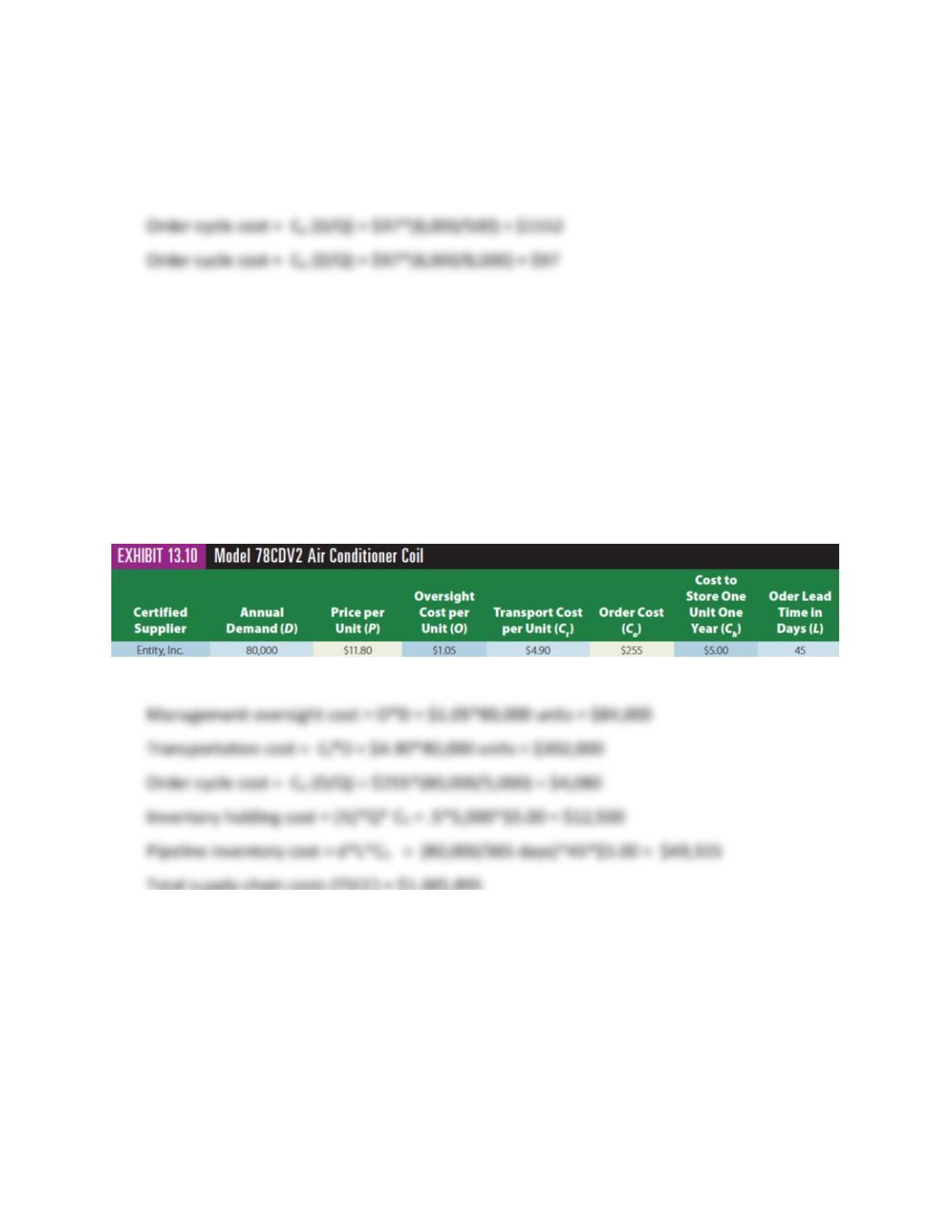
35. Given the information in Exhibit 13.10, compute the procurement, oversight,
transportation, order cycle inventory, and pipeline inventory costs, and total supply chain
costs for an air conditioner coil purchased from the supplier Entity, Inc. The order size is Q
= 5,000 units and the supply chain operates 365 days a year.
Procurement costs = P*D = $11.48*80,000 units= $944,000
Total supply chain costs (TSCC) = $1,485,895
36. Given the information in Exhibit 13.11, what are the procurement, oversight,
transportation, order cycle inventory, and pipeline inventory costs, and total supply chain
costs for using the supplier Ebert, Inc. Ebert manufacturers small speakers for automobiles
in its factory in the Philippines. The order size is Q = 10,000 units and the supply chain
operates 300 days a year.