
Management Information Systems, 13TH ED.
MANAGING THE DIGITAL FIRM
Kenneth C. Laudon ● Jane P. Laudon
continued
Learning Track 3: Primer on Business Process Management
Many businesses do not have a clear conception of what business processes exist in their firms,
how they work, or how much they cost. In a recent survey by Forrester and IBM, 38% of business
executives said they had no real-time visibility into their firm’s business processes. Surely this is an
understatement. In contrast, nearly all businesses have fairly good measures of revenue, custom-
1.0 What Is Business Process Management?
Business Process Management is a methodology, a set of tools and systems, and a management
philosophy or approach to business. Let’s start with the basic definition of a business process. A busi–
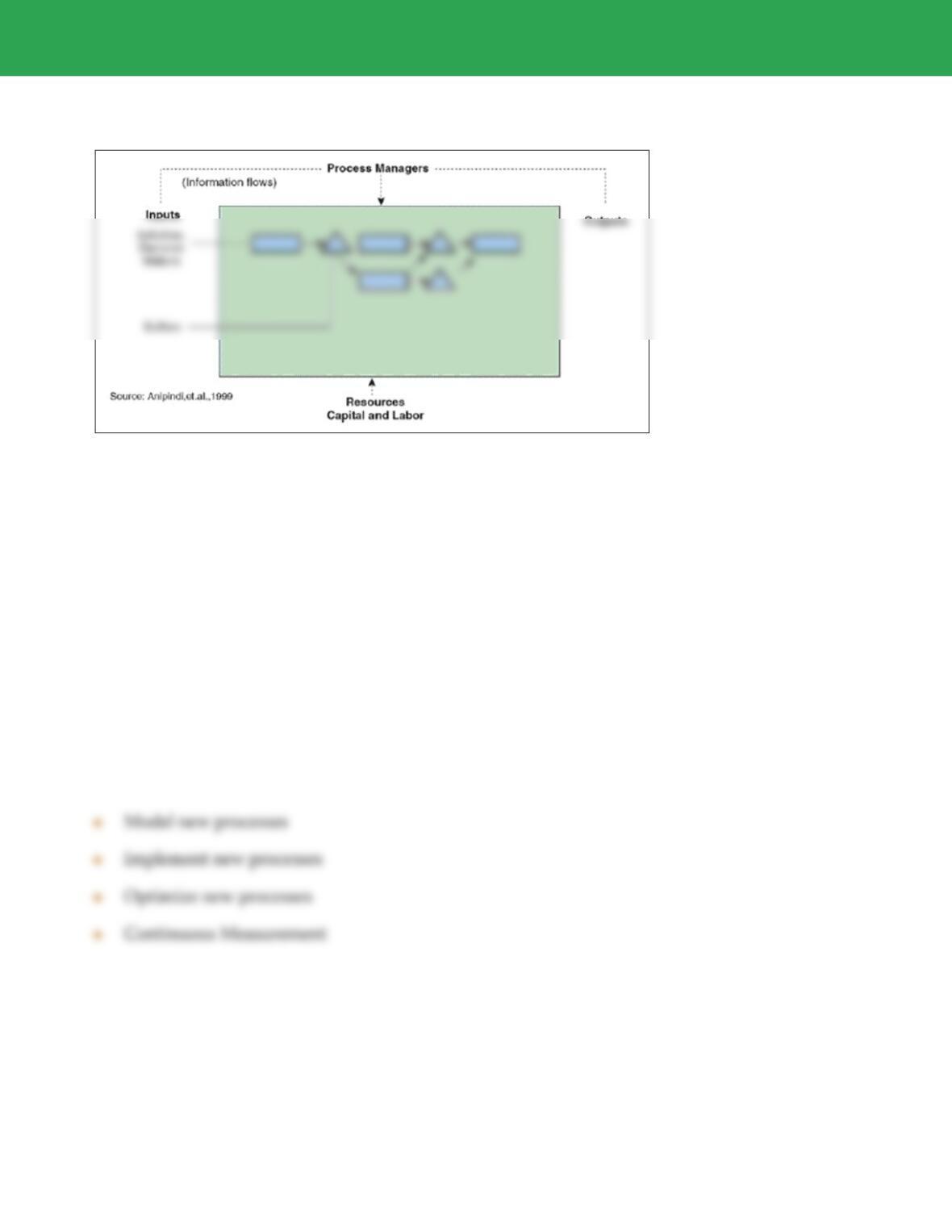
ness process is a set of activities that transform inputs into outputs, utilize capital and labor, and
require time to complete. Buffers represent time delays in the process where products or information
Chapter 13: Building Information Systems
Chapter 13 Learning Track 3 2
continued
FIGURE 1 A Generic Business Process
BPM uses a variety of tools and methodologies to understand existing processes, design new
processes, and optimize those processes. BPM is never concluded because continuous improve–
ment requires continual change.
2.0 The Business Process Management Development
Model
ere are a number of stages in the business process management management model:
◆ Identify processes for change
◆ Analyze existing process
◆ Design new processes
Let’s examine each of these stages in the BPM model.
Identify processes for change. is may seem obvious but deciding what to improve in a busi–
ness can be a daunting task, and choosing a process to improve is inuenced by many factors. First,
any sizable business has thousands of processes. Rationally, one would like to identify all processes
Chapter 13 Learning Track 3 3
continued
in the firm, and rank order them on various criteria such as cost-benefit: how much does each
process contribute to profits and how much does it cost. ose processes which have a poor cost–
benefit ratio would be candidates for BPM. is rational approach is not very useful if only because
the cost of identifying all the business processes is prohibitive, and linking each to a portion of
profits virtually impossible.
One method is to rely on a business scorecard approach in which senior executives decide the
A different less formal method is also used. I call this the pain reduction method which is a vari-
ation of the “squeaky wheel” approach. Sometimes particular business processes are trouble-
some and produce negative results that obviously hurt the business. A poor Web site may turnoff
customers; a loading dock may be the source of many accidents; some process might be far more
costly than the same process developed by competitors; the number of employees in a transaction
processing unit or call center may be expanding faster than sales, suggesting a problem worthy of
further investigation. Briey, some processes are well-known in the firm as not being very good or
effective. ese become candidates for further analysis.
Analyze existing processes. Once a candidate process is identified for improvement, the next
step is to analyze the process and determine how much resources in terms of time and costs
are expended by the process. Once this is understood, the results can be compared to historical
Design new processes. Once the existing process is mapped and measured in terms of time and
cost, the next step is to try to improve the process by designing a new one. Generally, alternative
Chapter 13 Learning Track 3 4
Model new processes. Once the new process is chosen, it’s still a theoretical process that needs
more refinement. e new process can be physically modeled and then “run” and compared to
Optimize new processes. Once the new process has been implemented, and employees trained
and accustomed to working with the new process, BPM managers ideally continue to experiment
Implement new processes. Once the new process is thoroughly modeled and understood at the
theoretical and experimental level, it’s time to roll it out into the field. Most firms adopt a phased
roll-out of new processes, starting with business units most likely to adopt the new process, or
Continuous Measurement. Once designed and implemented, and optimized, business process-
es need to be continually measured. Why? Processes can deteriorate over time as field employees
can fall back on old methods. Processes should improve over time as employees go up the learning
curve and become more familiar and polished in the new system. Continuous measurement may
also be demanded by senior management.
BPM is not without its diculties. Executives report that the largest single barrier to BPM is orga–
nizational culture. Employees are set in their ways, do not like to change, and do not like unfamil-
3.0 BPM Software: the Technology Connection
Implementing a BPM approach in any but the smallest of firms will require investments in new
Chapter 13 Learning Track 3 5
continued
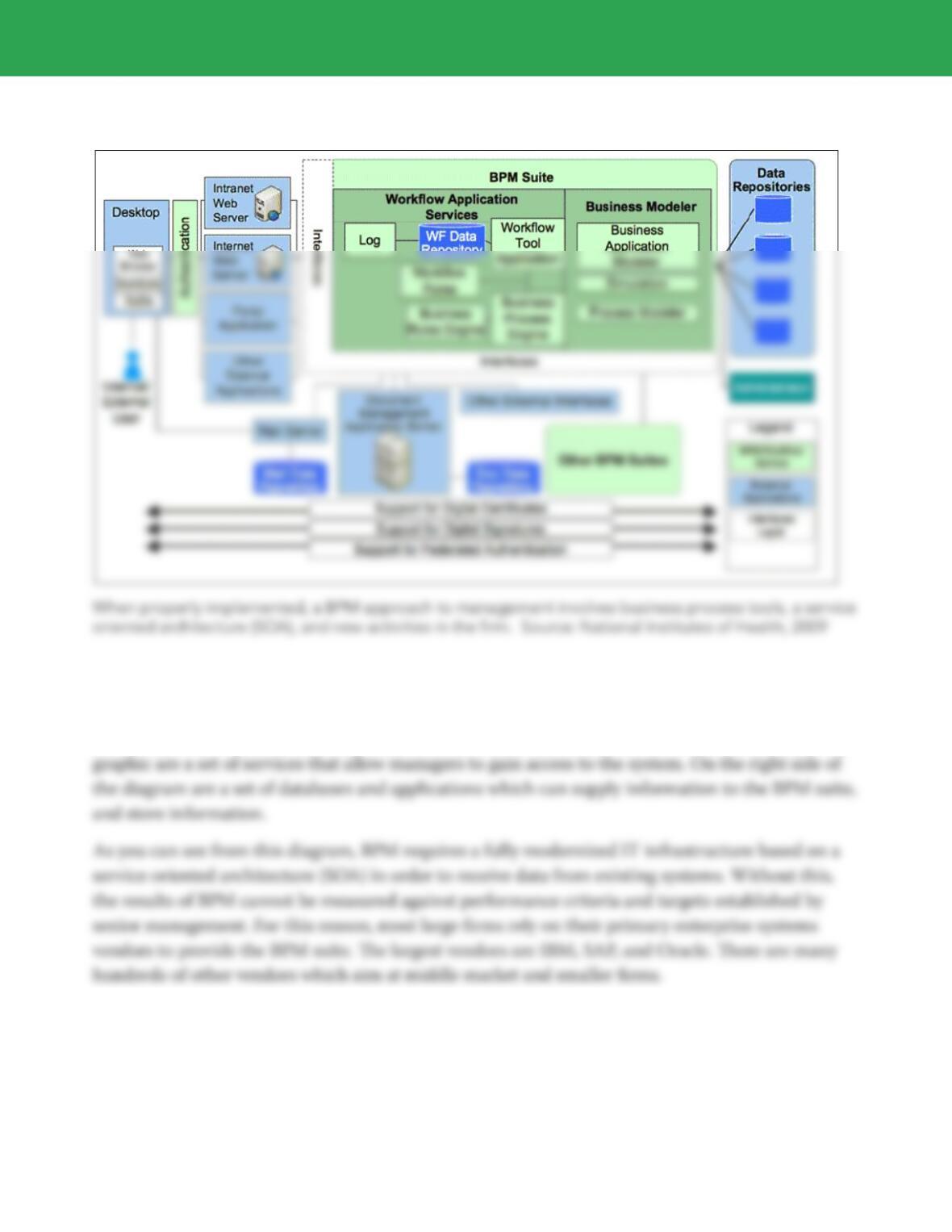
FIGURE 2 BPM System Requirements
Let’s take a closer look at the BPM graphic. At its heart is a BPM suite of software tools that can
capture business rules (for existing and new systems), design workows and processes, model busi–
ness processes, simulate processes, and provide continuous measurement. On the left side of the

Chapter 13 Learning Track 3 6
REFERENCES
Armistead, Colin; Jean-Philip Pritchard; and Simon Machin. “Strategic Business Process Management for
Organisational Effectiveness.” ScienceDirect, June 1999.
Forrester Consulting, “Enabling Dynamic Business Processes With BPM and SOA.” Survey conducted for IBM, 2008.
Leymann, F.; D. Roller, and M.-T. Schmidt. “Web services and business process management.” IBM White Paper,
2001.
National Institutes of Health, “Workow/Business Process Management (BPM) Service Pattern,” http://enter–