13-1
Chapter 13
The Statement of Cash Flows
Concept Questions
1. (LO1—The purpose of the statement of cash flows)
The purpose of the statement of cash flows is to provide internal and external
2. (LO1—Statement of cash flows versus income statement)
The statement of cash flows reports inflows and outflows of cash for a given
period, whereas the income statement reports revenues earned and expenses
incurred for a given period. Although cash flows are often associated with some
3. (LO1—Cash equivalents and the statement of cash flows)
A cash equivalent is a balance sheet item that can be readily converted to a
4. (LO2—Depreciation expense and the statement of cash flows)
Depreciation expense reduces net income on the income statement but does not
5. (LO2—Indirect method)
A decrease in a current asset other than cash must be added back to net income
for several reasons. If the current asset is related to revenues (e.g., accounts
receivable), then a decrease in its balance from the beginning to the end of the
Solutions Manual
13-2
year implies that more cash than the current year’s sales revenue was received
6. (LO1, 2—The purpose of the statement of cash flows, types of activities, and the
preparation of the statement)
Students should not agree with this statement. To prepare the statement of cash
7. (LO1, 3—The need for the statement of cash flows and its preparation)
Students should not agree with this statement. Although it is true that you know
how much cash changed during the period, you do not know why the change
balance changed.
Brief Exercises
1. (LO1—Adjustments to net income via the indirect method: Operating activities)
a. A
Chapter 13: The Statement of Cash Flows
13-3
2. (LO1, 3—Investing versus financing activities and cash equivalents)
a. OI
Exercises
3. (LO1—Operating, investing, and financing activities)
a. F
b. S
4. (LO1, 2—Accrual to cash conversions)
Case 1: Sales revenue (cash and credit sales) $435,000
Add: Beginning accounts receivable 250,000
Case 2: Cost of goods sold $275,000
Add: Beginning accounts payable 125,000
Solutions Manual
13-4
Case 3: Insurance expense $ 25,000
Case 4: Interest expense $300,000
Case 5: Income tax expense $100,000
5. (LO2—Accrual to cash: Direct method)
The cash paid for insurance would be $62,500.
6. (LO2—Accrual to cash: Direct method)
Cash collections from operating activities would be $1,975,000.
Chapter 13: The Statement of Cash Flows
13-5
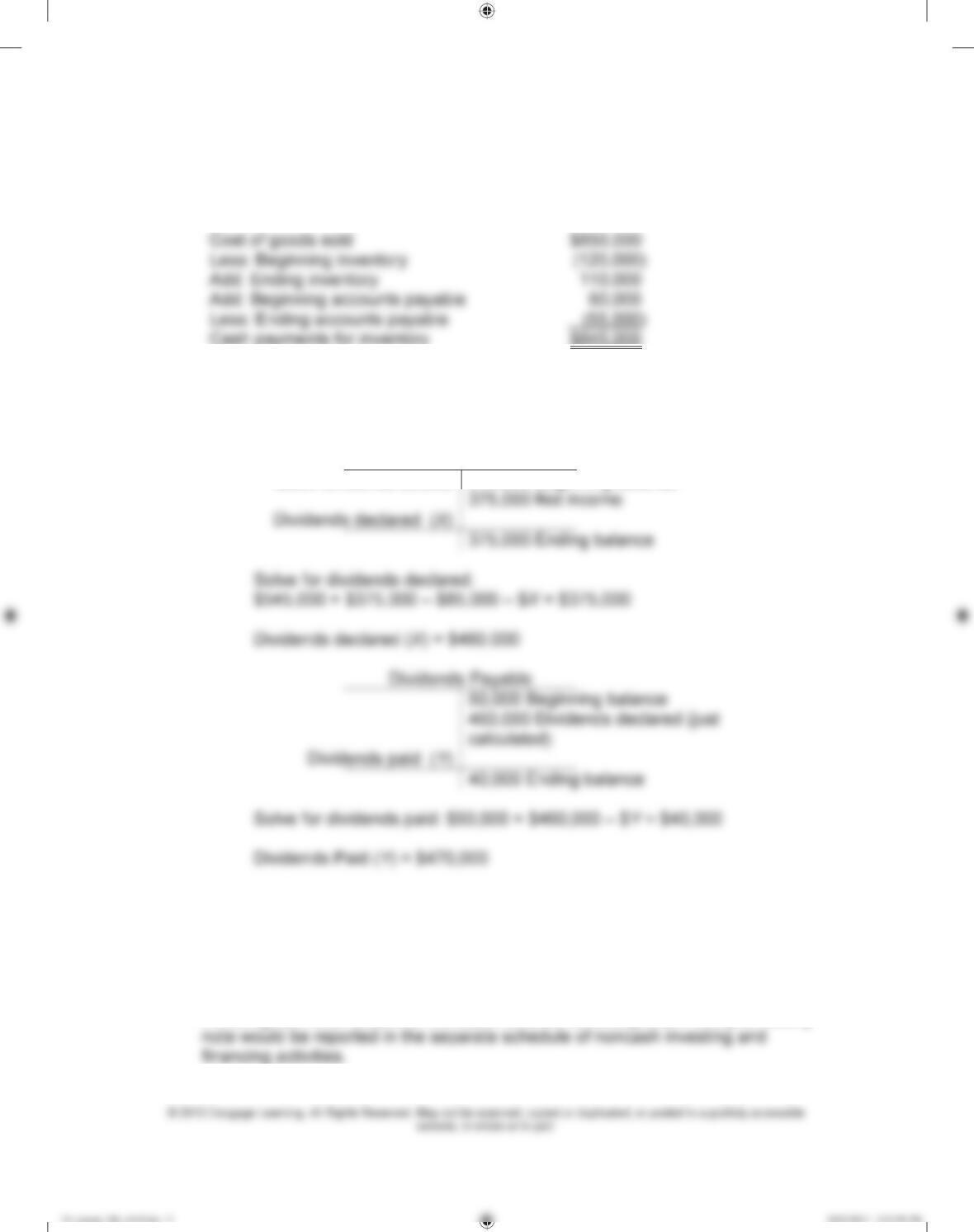
7. (LO2—Accrual to cash: Direct method)
Cash payments for inventory would be $845,000.
8. (LO1, 3—Impact of cash and stock dividends)
A. Dividends paid were $470,000, shown by means of the T-account
approach as follows:
Retained Earnings
Stock dividends 85,000 545,000 Beginning balance
B. The stock dividend should be shown on a separate schedule as a
noncash financing activity or in a footnote to the financial statements.
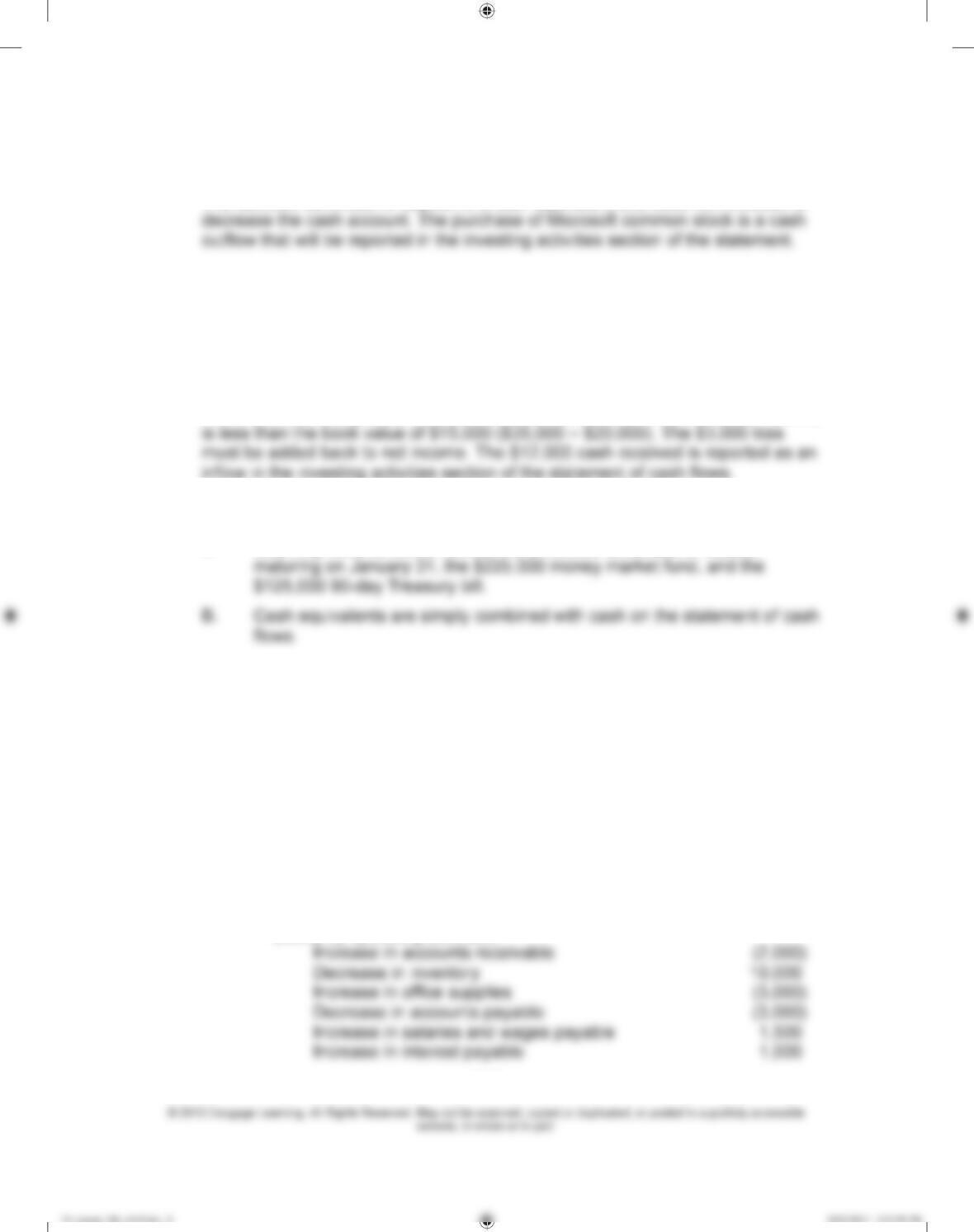
9. (LO1, 3—Investing activities and noncash activities)
The down payment of $30,000 would be reported as a cash outflow in the
investing activities’ section of the statement; the land acquisition and promissory
Solutions Manual
13-6
10. (LO1, 3—Cash equivalents and investing activities)
The $25,000 certificate of deposit is a cash equivalent and does not increase or
11. (LO1, 3—Financing activities)
A purchase of treasury stock is a cash outflow that will be reported in the
financing activities section of the statement of cash flows.
12. (LO1, 3—Investing activities: Indirect method)
There is a loss recognized on the transaction because the $12,000 cash received
13. (LO1, 3—Cash equivalents)
A. Cash equivalents would include the $100,000 certificate of deposit
Problems
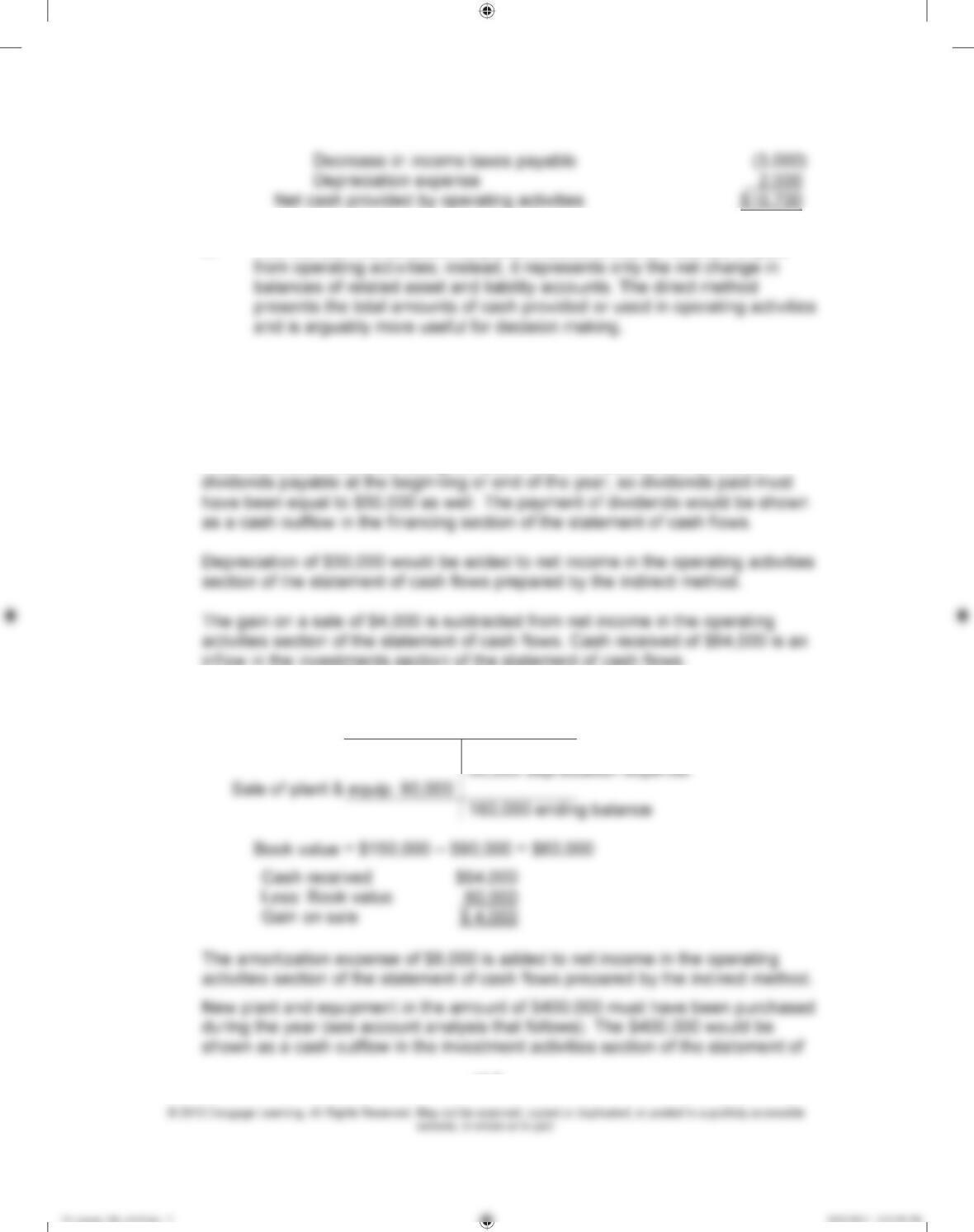
14. (LO1, 2, and 3—Adjustments to income by means of the indirect method:
Operating activities)
A.
Wynn Bicycle Company
Net Cash Flows from Operating Activities
for the Year Ending December 31, 2012
(Indirect Method)
Net income $ 7,200
Adjustments to reconcile net income with cash provided
(used) by operating activities:
Chapter 13: The Statement of Cash Flows
13-7
B. The indirect method does not present actual amounts received or paid
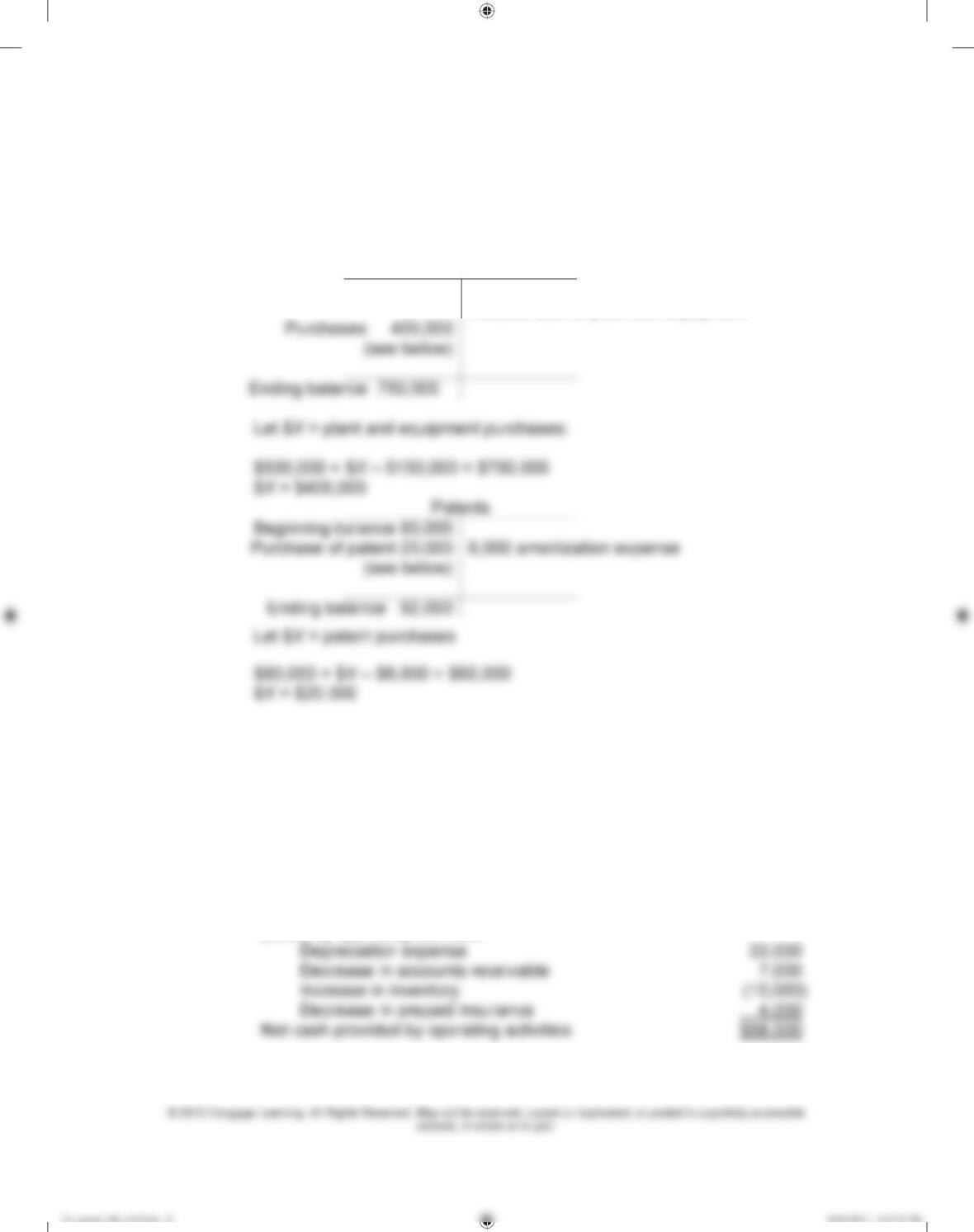
15. (LO1, 2, and 3—Impact of operating and investing activities: Indirect method)
The net income of $200,000 is the starting point in the operating activities section
of the statement of cash flows prepared by the indirect method. In addition,
because retained earnings increased by only $150,000, $50,000 of dividends
must have been declared during the year. Also, no liabilities are shown for
inflow in the investments section of the statement of cash flows.
Account analysis
Accumulated Depreciation
200,000 beginning balance
Solutions Manual
13-8
cash flows. In addition, $20,000 of patents must have been purchased. This
outflow would also be shown in the investing activities section of the statement of
cash flows.
Account analysis
Plant and Equipment
Beginning balance 500,000
150,000 sale of plant and equipment
16. (LO1, 2, and 3—Operating activities: Direct versus indirect method)
A.
Allen Company
Net Cash Flows from Operating Activities
for the Year Ending December 31, 2012
(Indirect Method)
Net Income $35,000
Adjustments to reconcile net income with cash provided
(used) by operating activities:
Chapter 13: The Statement of Cash Flows
13-9
The statement of cash flows reports inflows and outflows of cash for a
given period, whereas the income statement reports revenues earned and
B. In order to prepare the operating activities section of the cash flow
statement by the direct method, you would need to know sales, cost of
goods sold, insurance expense, and any other expenses paid during the
year.

13_sawyer_SM_ch13.doc 1013_sawyer_SM_ch13.doc 10 10/21/2011 3:37:37 PM10/21/2011 3:37:37 PM