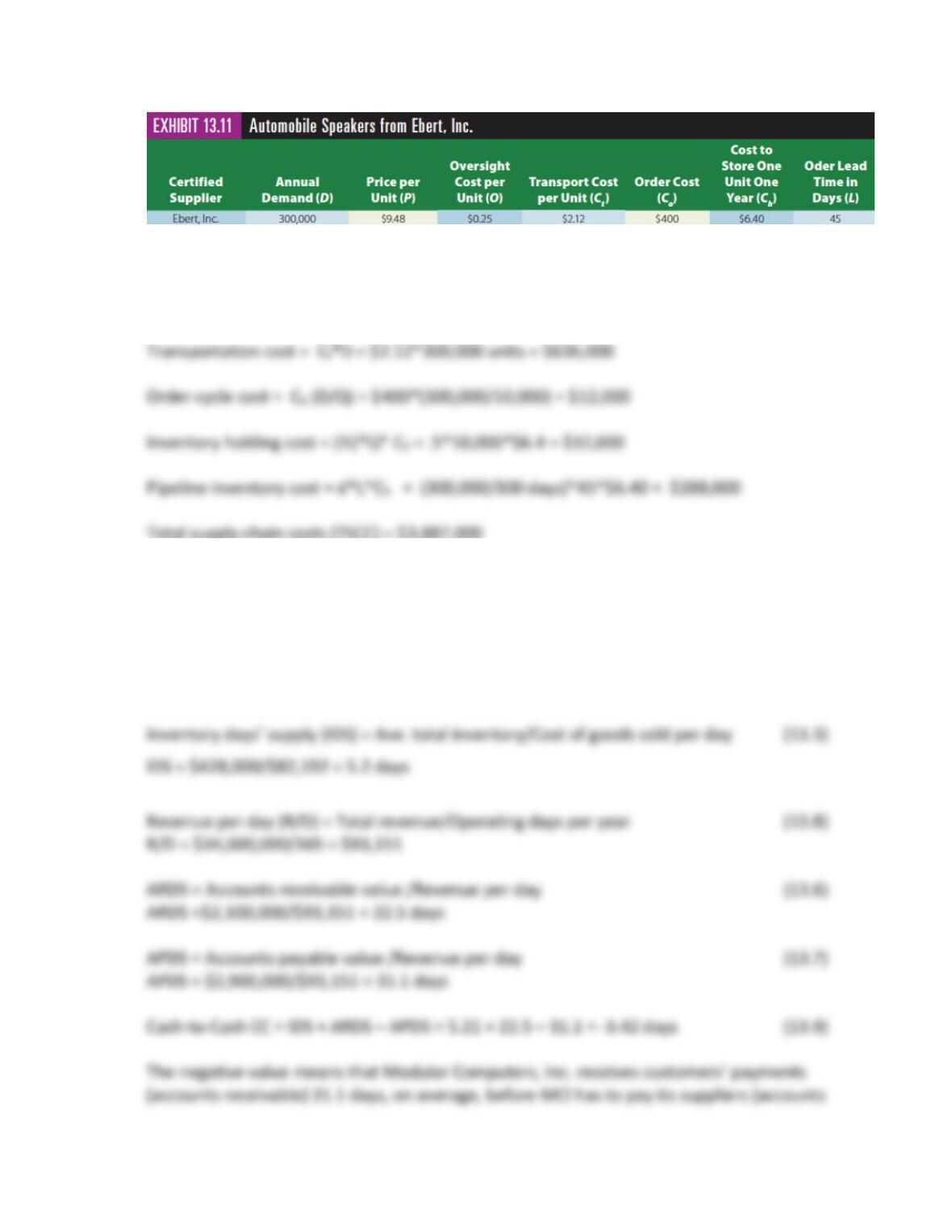
Procurement costs = P*D = $9.48*300,000 units= $2,844,000
Management oversight cost = O*D = $0.25*300,000 units = $75,000
37. Consider the following performance data in for Modular Computers, Inc (MCI). Sales = $34
million, cost of goods sold = $30 million, total average inventory = $428,000, accounts
receivable = $2,100,000, accounts payable = $2,900,000, and operating 365 days per year.
Compute the cash-to-cash conversion cycle. What does it mean?
Cost of goods sold/day (CGS/D) = Cost of goods sold value/Operating days per year (13.4)
CGS/D = $30,000,000/365 = $82,192
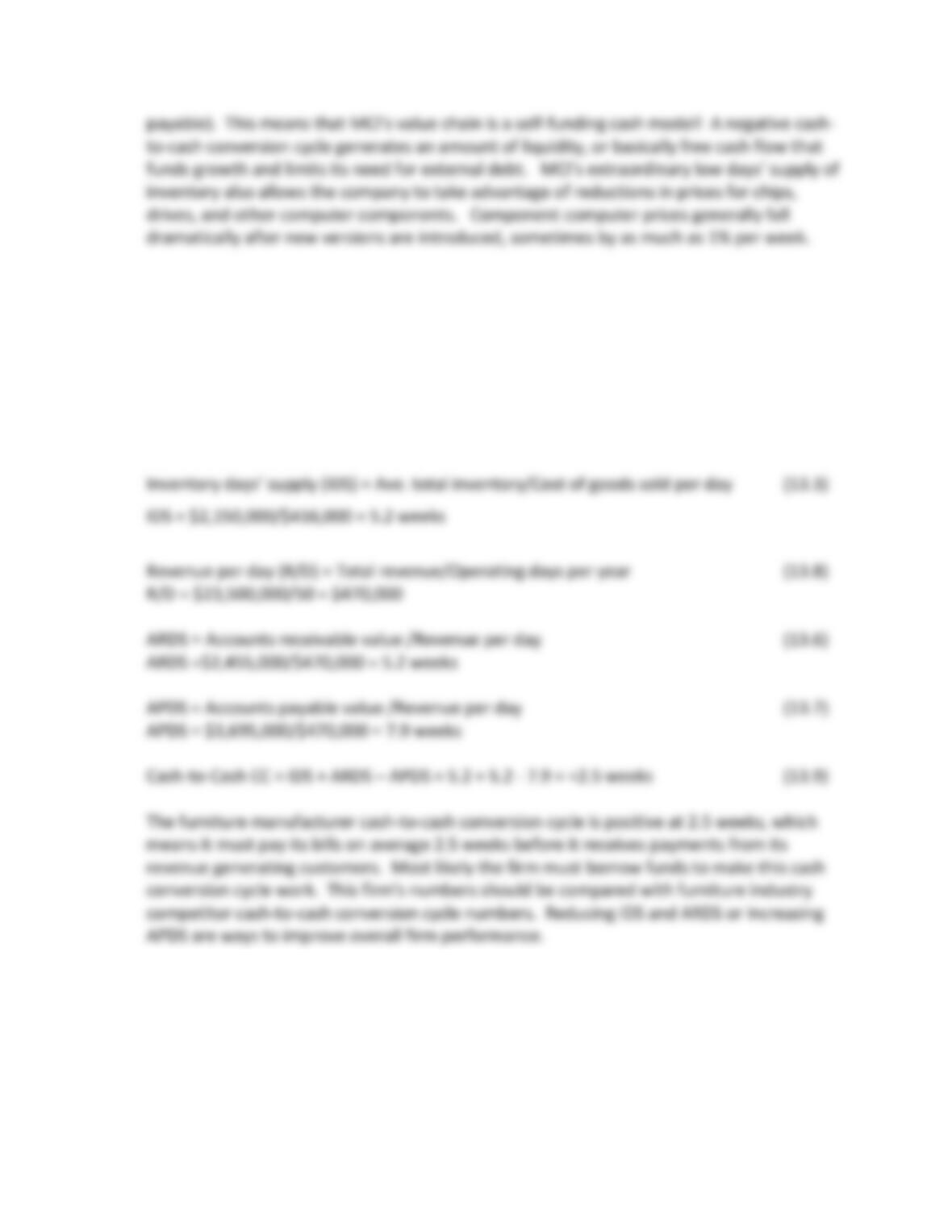
38. As an operations management consultant, you have been asked to evaluate a furniture
manufacturer’s cash-to-cash conversion cycle under the following assumptions: sales of
$23.5 million, cost of goods sold of $20.8 million, 50 operating weeks a year, total average
on-hand inventory of $2,150,000, accounts receivable equal to $2,455,000, and accounts
payable of $3,695,000. What do you conclude? What recommendations can you make to
improve performance?
Cost of goods sold/day (CGS/D) = Cost of goods sold value/Operating days per year (13.4)
CGS/D = $20,800,000/50 = $416,000
39. Using the data in Problem 38, assume the operating manager reduces total average
inventory on-hand by 21 percent by using better operations and supply chain methods.
What is the revised cash-to-cash conversion cycle in weeks? What does this change in the
C2C cycle mean?
Cost of goods sold/day (CGS/D) = Cost of goods sold value/Operating days per year (13.4)
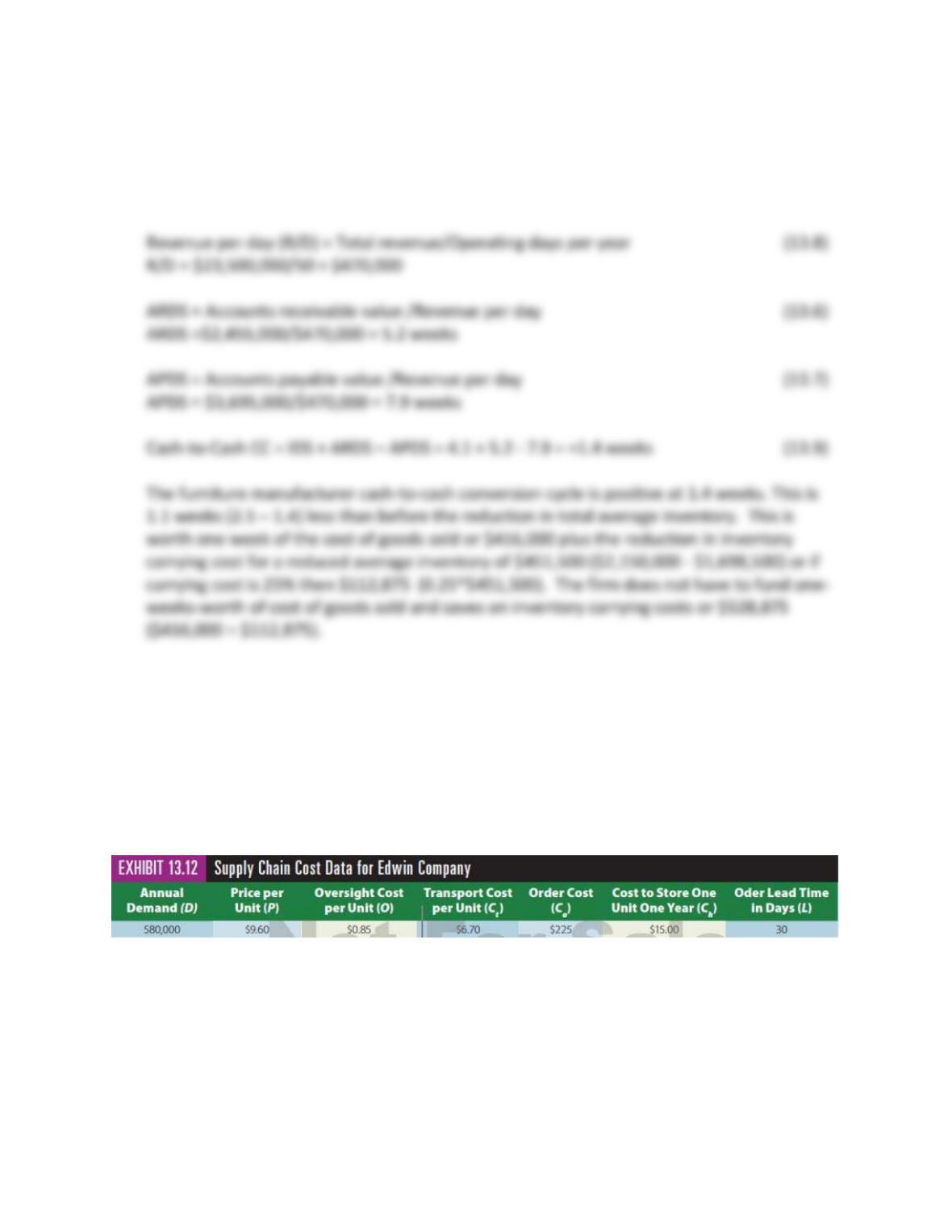
CGS/D = $20,800,000/50 = $416,000
Inventory days’ supply (IDS) = Ave. total inventory/Cost of goods sold per day (13.3)
IDS = ($2,150,000*0.79)/$416,000 = $1,698,500/$416,000 = 4.1 weeks
EXCEL-BASED PROBLEMS
For these problems, you may use Excel or the spreadsheet templates in MindTap to assist in
your analysis.
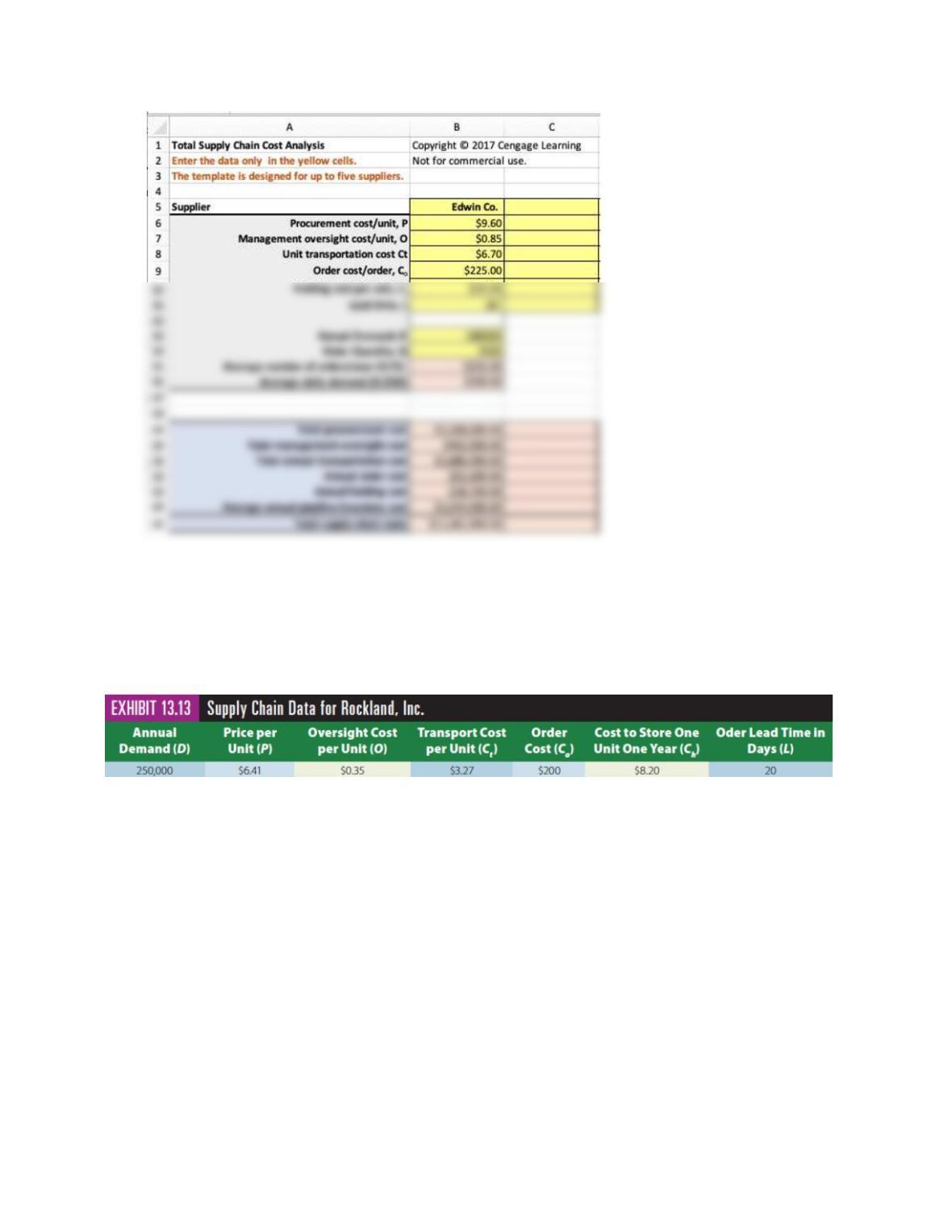
40. Given the information in Exhibit 13.12 for the Edwin Company, use the Total Supply Chain
Cost Excel template to find the costs associated with the supply chain. The order size is Q =
2,500 units and the supply chain operates 250 days a year.
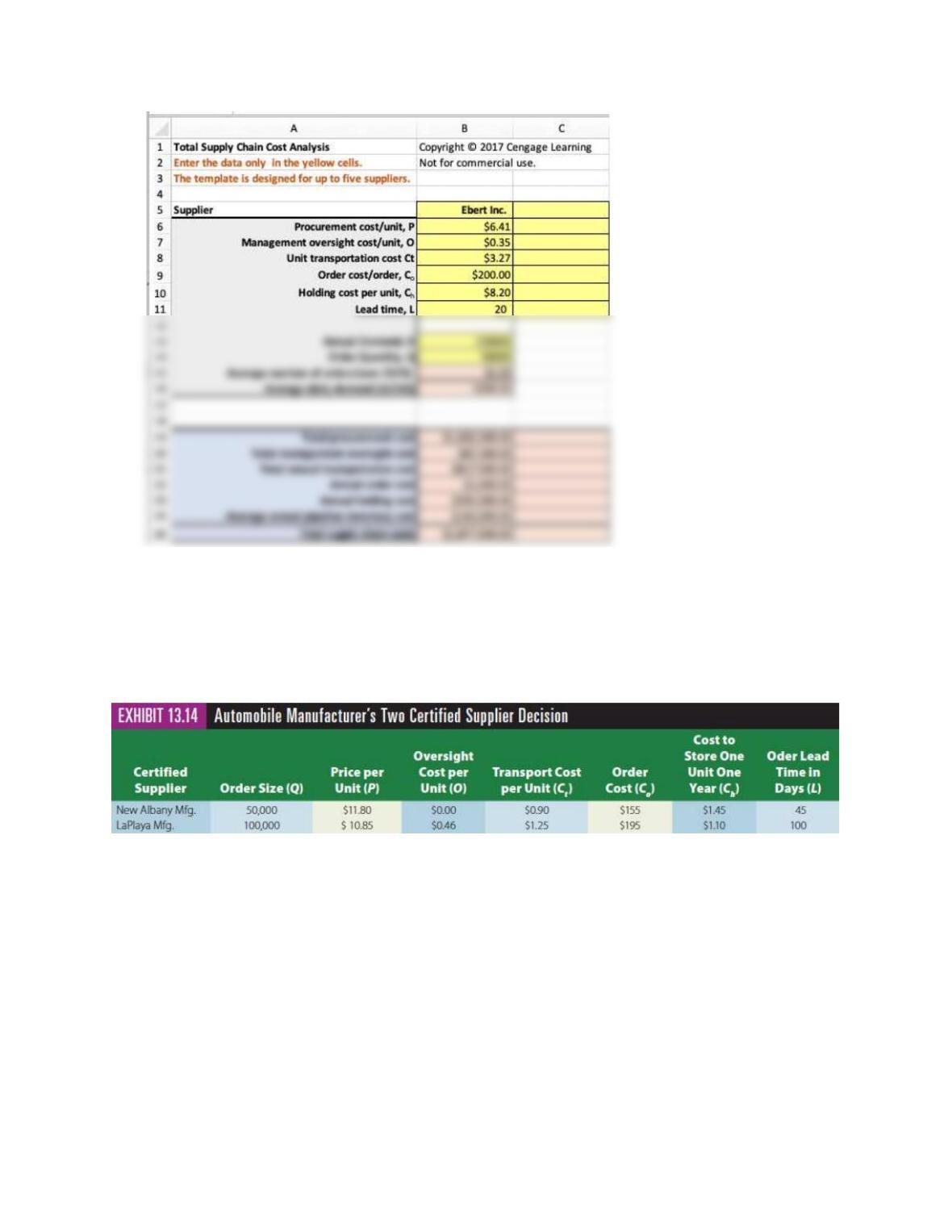
41. Given the information in Exhibit 13.13 for Ebert, Inc, use the Total Supply Chain Cost Excel
template to compute the costs associated with the supply chain. The order quantity is
20,000 units, and the supply chain operates 250 days a year. What if the supplier asks you
to increase your order quantity to Q = 50,000 for a price discount of 2 percent, would you
accept the new deal? Explain.
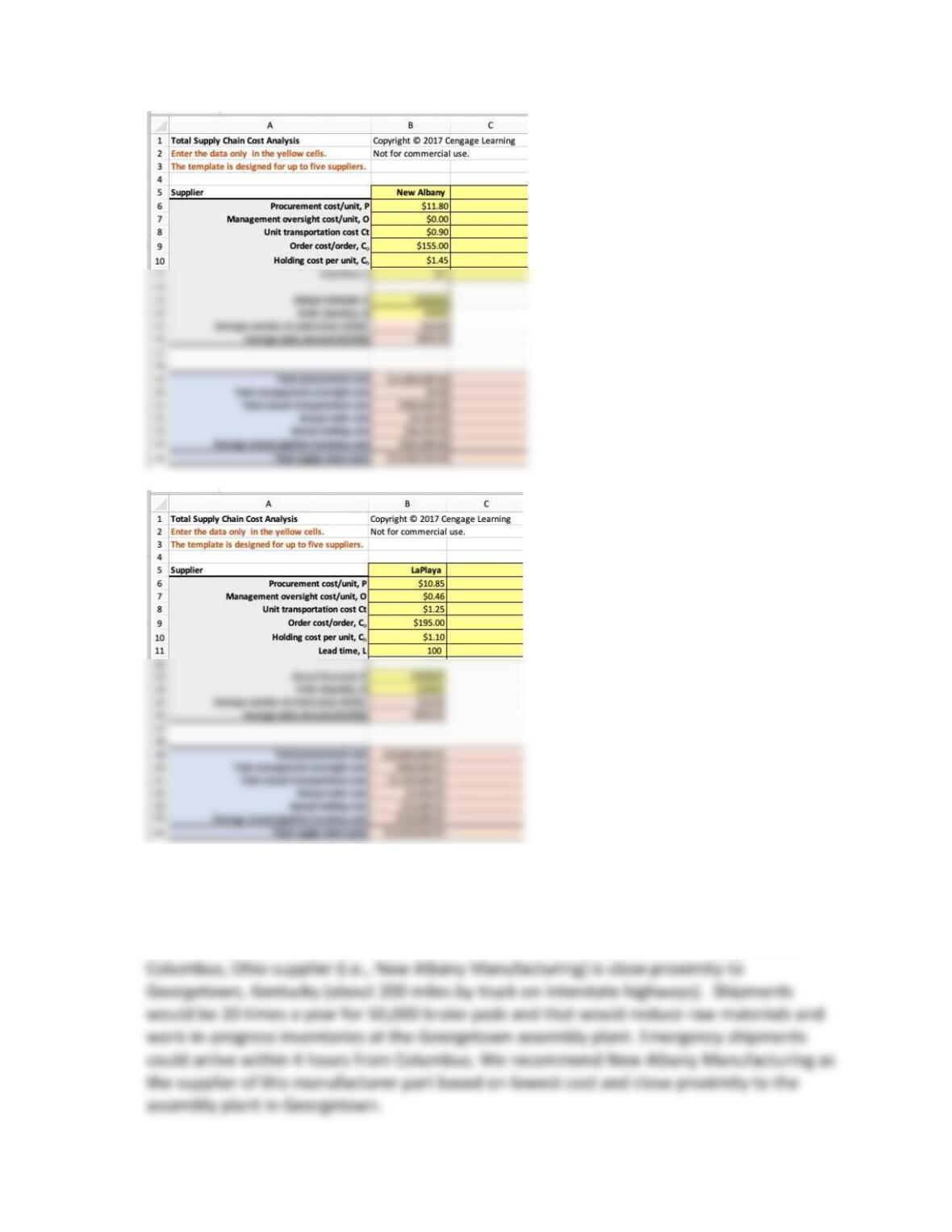
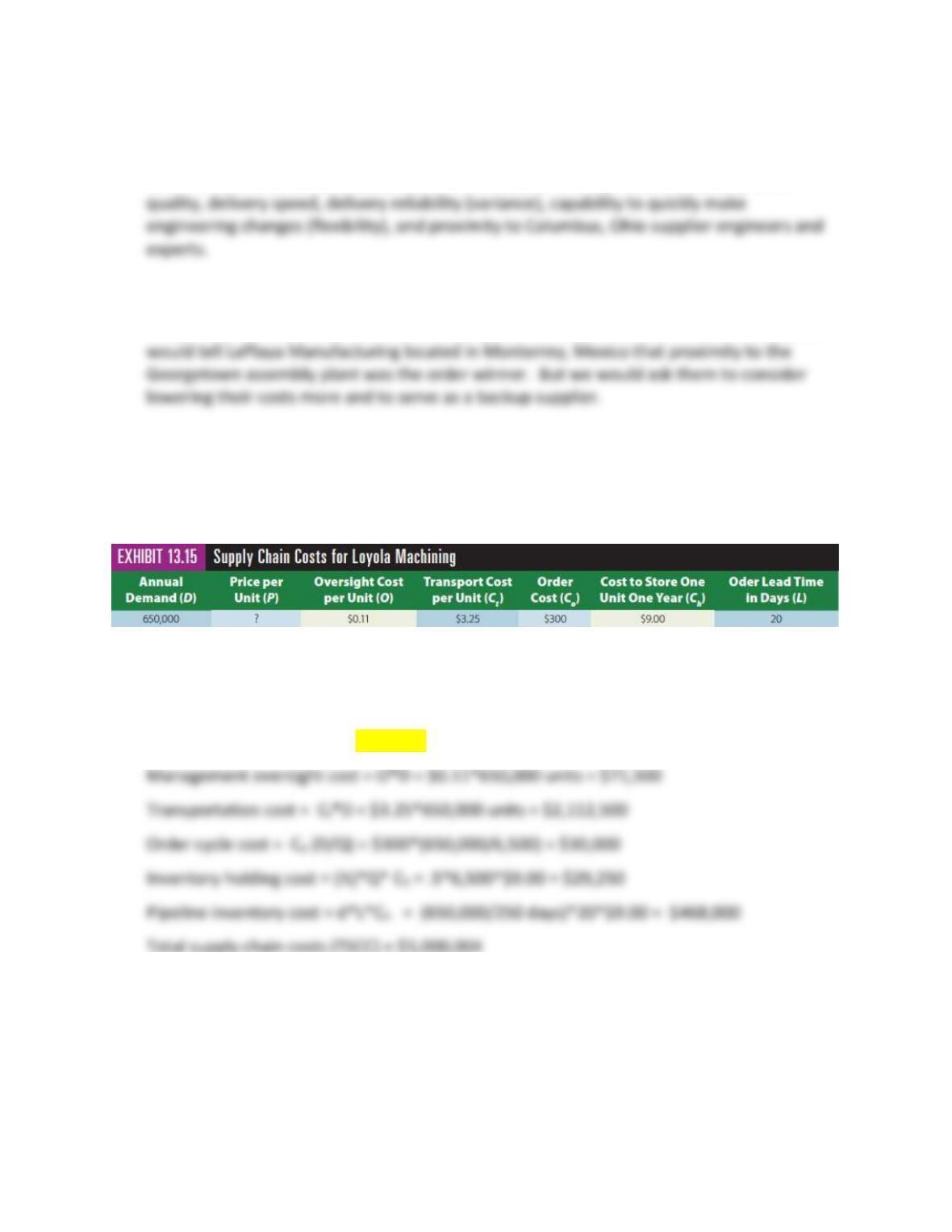
42. A major automobile manufacturer located in Georgetown, Kentucky, has two certified
vendors that produce brake pads with the information shown in Exhibit 13.14. New Albany
Manufacturing is located in Columbus, Ohio, and LaPlaya Manufacturing is located in
Monterrey, Mexico. The automobile assembly factory is assumed to operate 250 days per
year.
a. Use the Total Supply Chain Cost Excel template to compute the supply chain costs
associated with each supplier if the annual demand is 1,000,000 brake pads?
Note: the template must be used individually for each supplier to account for differences in
order sizes.
b. What supplier and order quantity do you recommend based on total costs?
The difference in total logistical costs is small, so the economics are about equal.
Technically, New Albany Manufacturing is the lowest total cost. One advantage of the
c. List other criteria you might use to make the final supplier decision.
Other criteria that can be measured but not available in this problem include: product
d. What will you tell the supplier that is not awarded the brake pad order?
When total costs are this close and all other performance criteria are about the same, we
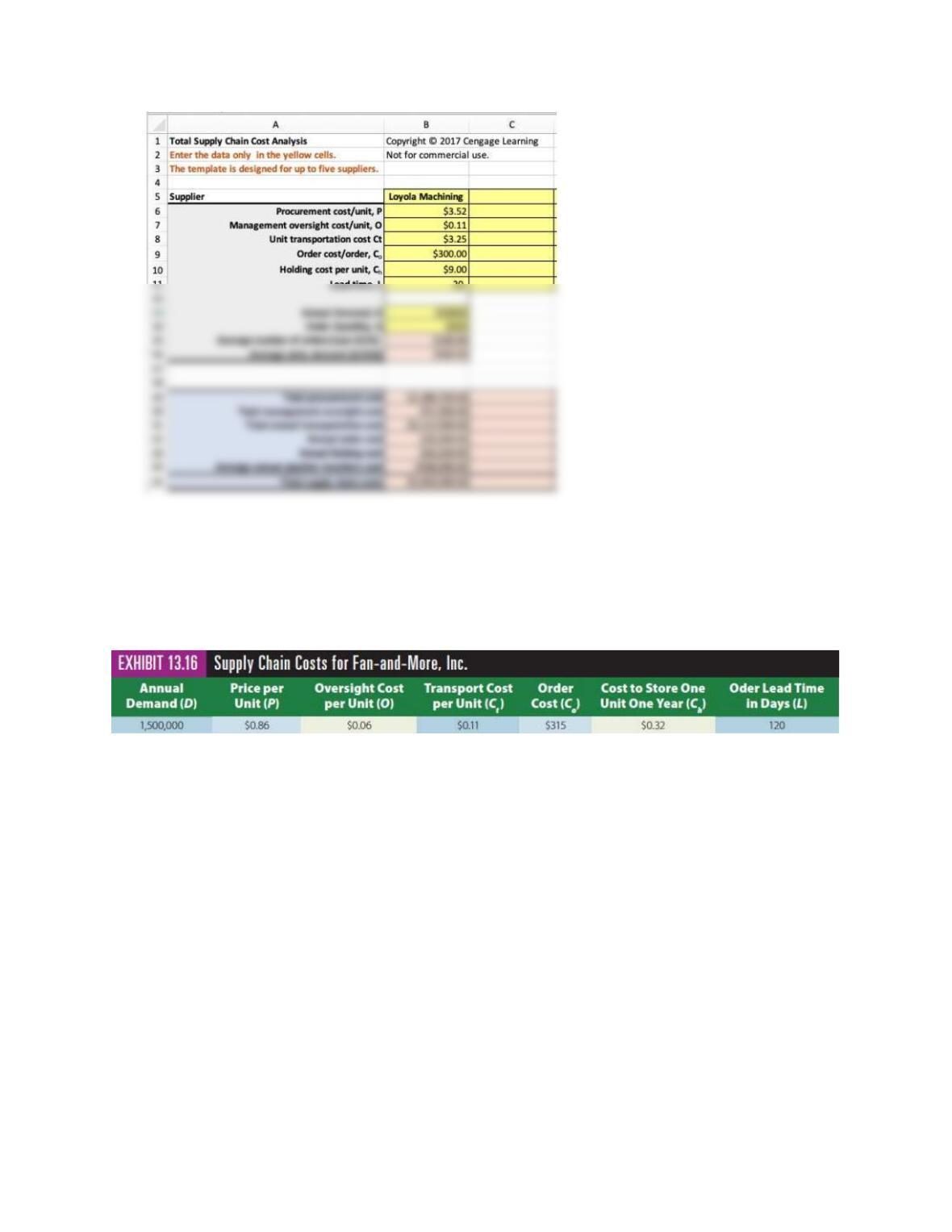
43. Given the information in Exhibit 13.15 and a budget of $5,000,000, what is the most that
Loyola Machining can pay for each manufactured unit? Assume one year is 250 working
days and the order size is 6,500 units. Use the Excel Total Supply Chain Cost Excel
template for your analysis.
Students can use the Excel template and trial-and-error to determine a maximum price of
$3.52 (i.e., $3.52116). Alternatively, instructors might wish to show how to use Excel Goal
Seek to find the solution (similar to break-even analysis).
Procurement costs = P*D = $3.52116*650,000 units= $2,288,754
44. Fans-and-More, Inc. assemble controllers for ceiling fans. Exhibit 13.16 provides information
on a plastic case for fan infrared controllers produced by one of their suppliers, Byannan, Inc.
The plastic case is made using injection molding machines. Byannan requires a minimum
order quantity of 100,000 units. The supply chain is assumed to operate 250 days a year.
a. Use the Total Supply Chain Cost Excel template to find the total supply chain cost.
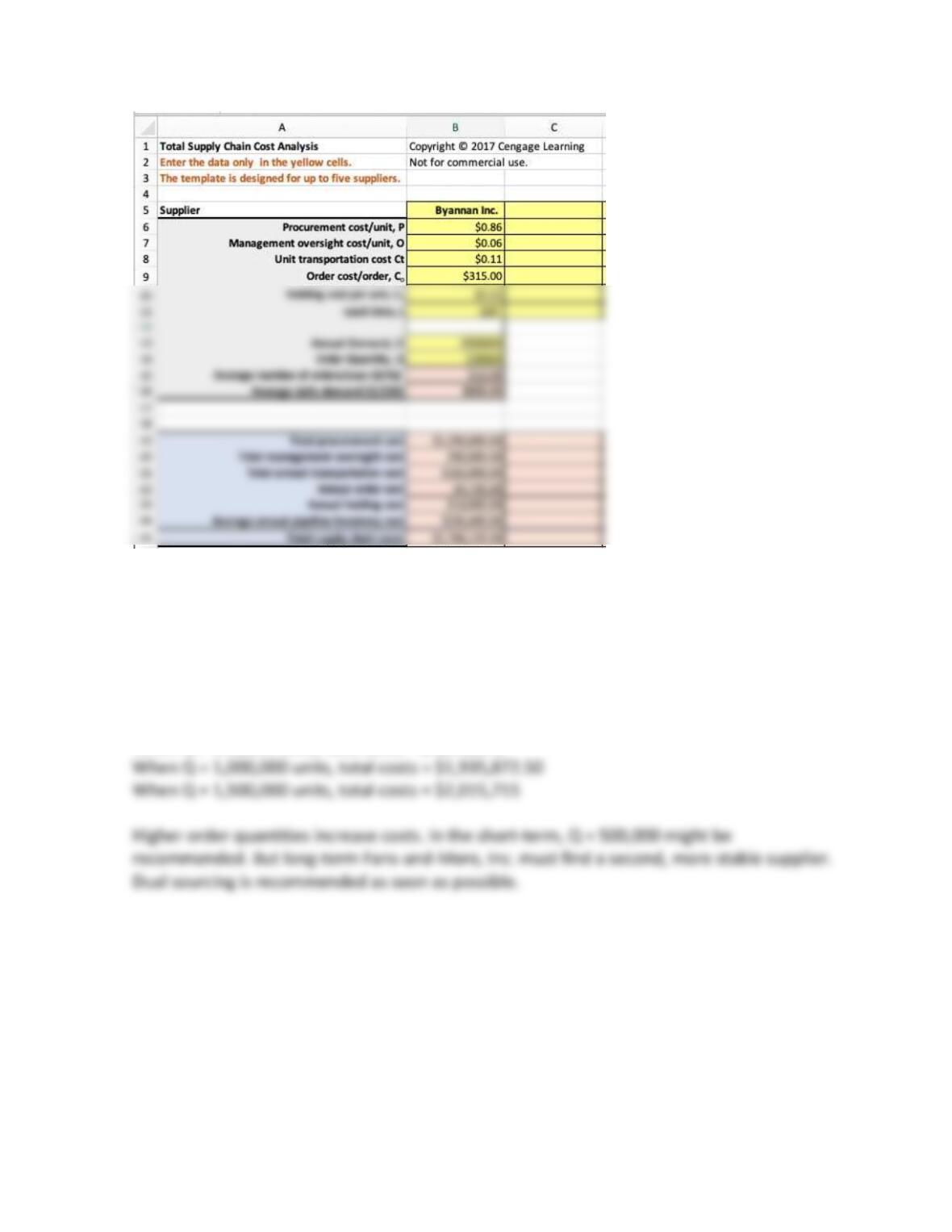
b. Due to political and loading dock unrest in Byannan’s home country, you must decide
whether to increase order sizes and carry more inventory to support fan sales. A fan with no
controller is not a sellable stock-keeping-unit. What order size is best? What do you
recommend Fans-and-More do?
Students can use the template to study the impact of increasing order quantities.
When Q = 500,000 units, total costs = $1,856,345
Teaching Note: LCC Medical Manufacturing, Inc.
Overview
LCC Medical Manufacturing is the first case study. It focuses on computing the total supply
chain costs for three different order quantities for three global suppliers. The second part of the
case provides a set of ordinal rankings on other qualitative criteria like product quality, delivery
reliability, sole sourcing risks, product obsolescence and customs risks, and sustainability
Case Questions for Discussion:
1. What is the total supply chain and logistics cost for each supplier when Q = 5,000, Q =
10,000, and Q = 20,000?
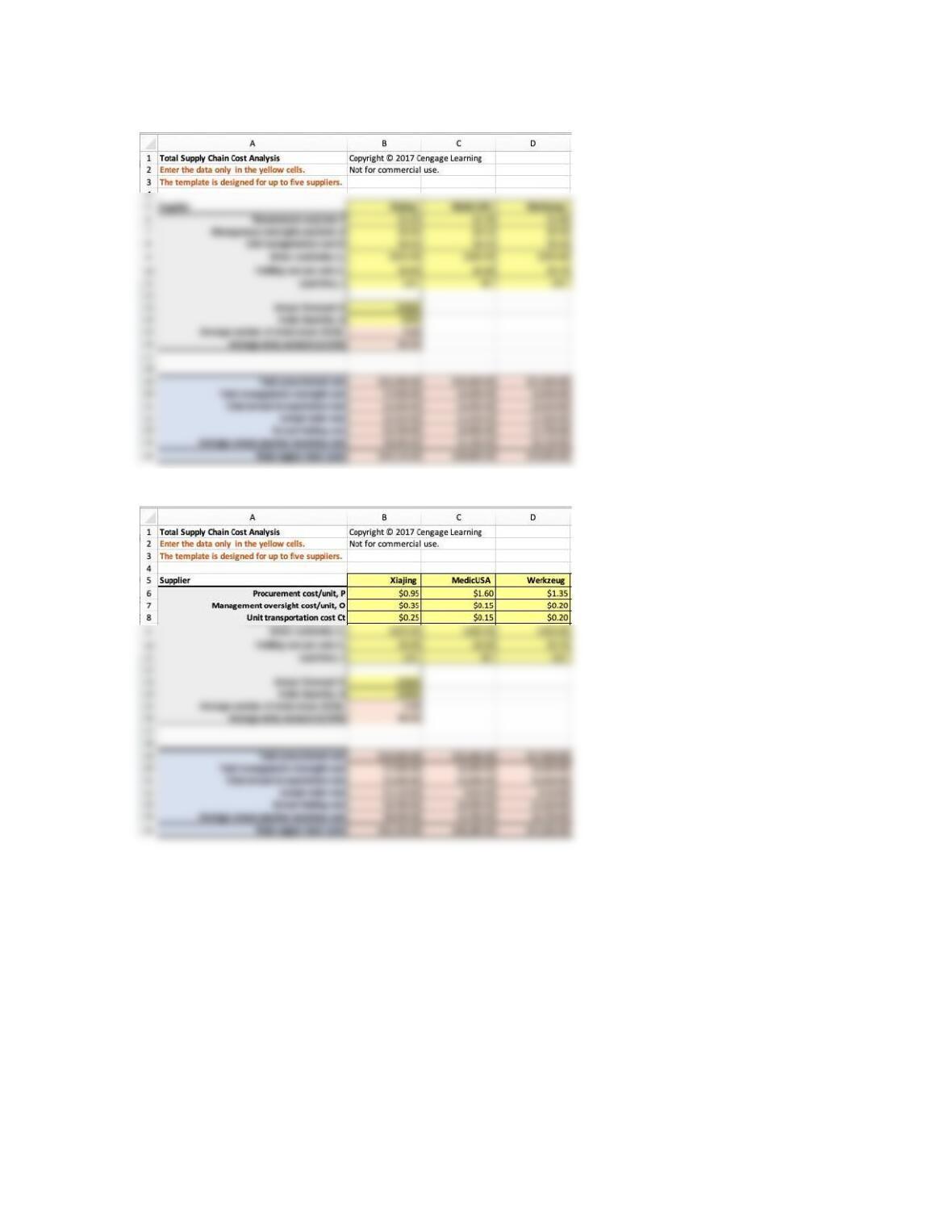
When Q = 5,000 units
When Q = 10,000 units
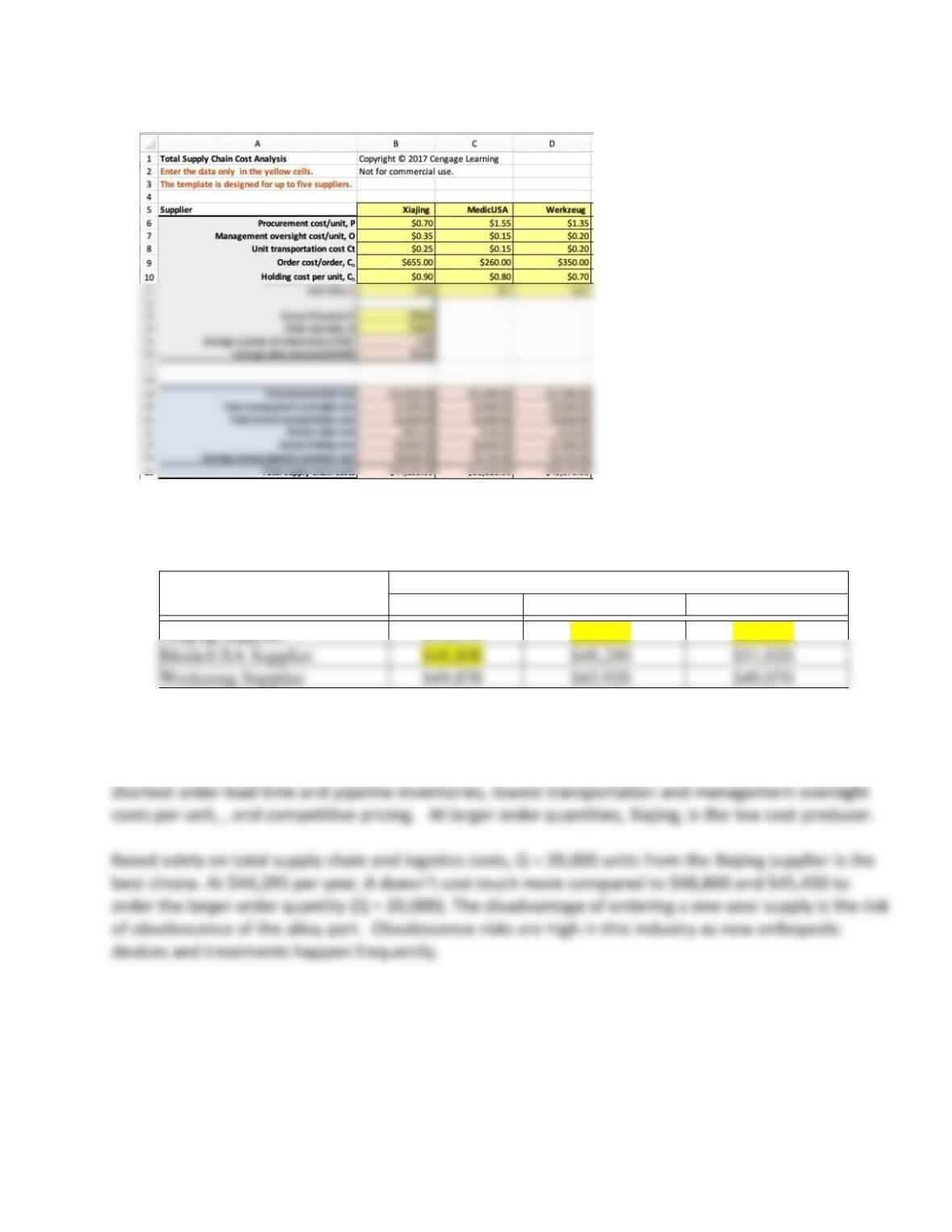
When Q = 20,000 units
2. What supplier and order quantity do you recommend based on total supply chain costs?
Summary Total Cost for LCC Medical Manufacturers
Global Supplier
Order Quantity (Q)
5,000 units
10,000 units
20,000 units
Xiajing Supplier
MedicUSA Supplier
Werkzeug Supplier
With the three order quantities students will see the impact on order and inventory holding costs as
well as price breaks. Only for an order size of Q = 5,000 units does the supplier, MedicUSA, become the
lowest cost manufacturer of the aluminum part. This is because of MedicUSA’s low order cost,
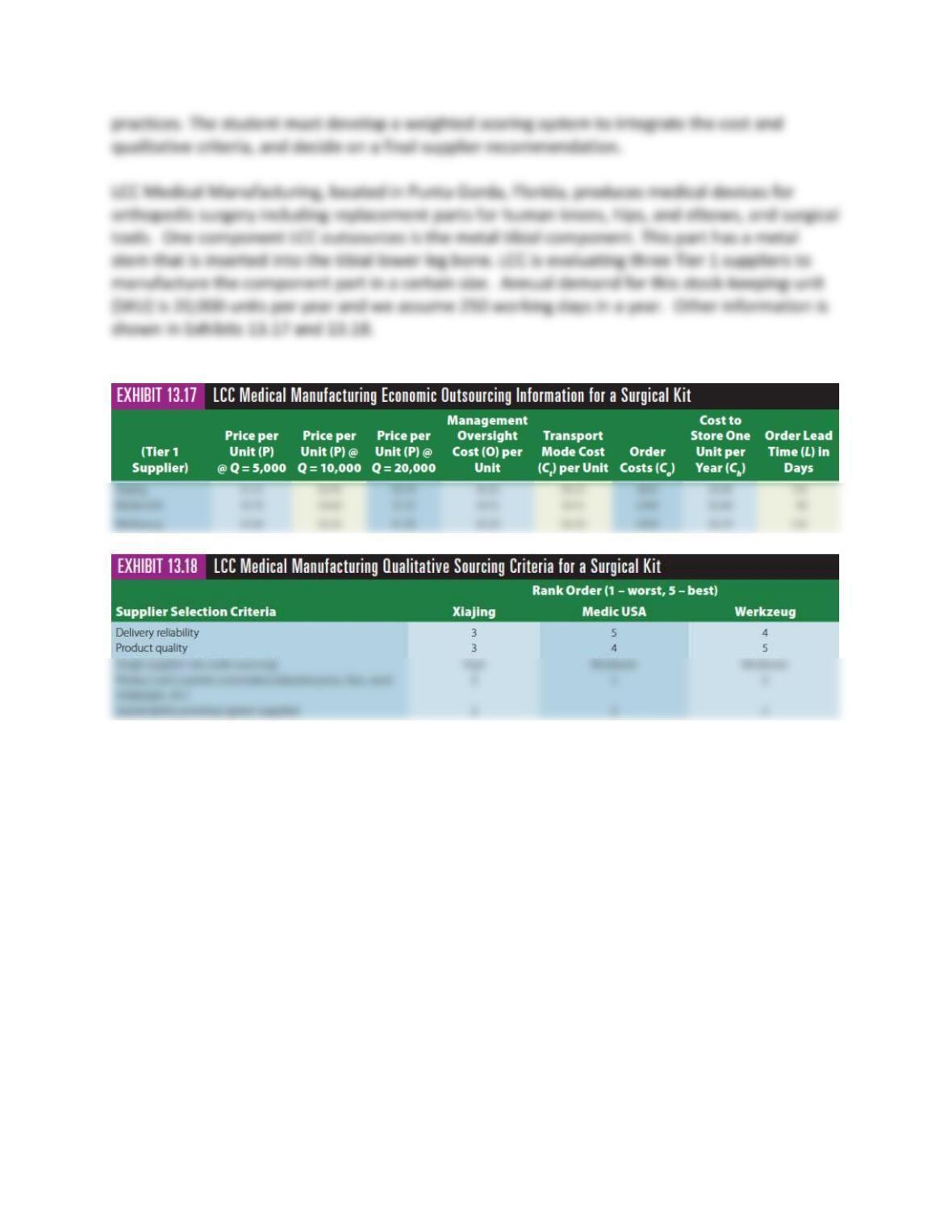
3. Given your total supply chain cost analysis and the qualitative criteria in Exhibit 13.18,
using a weighted scoring model of your own design, what are your summary scores for
each supplier? (You may decide how to scale each criterion, the weight of each
criterion, and whether to include costs or not.)
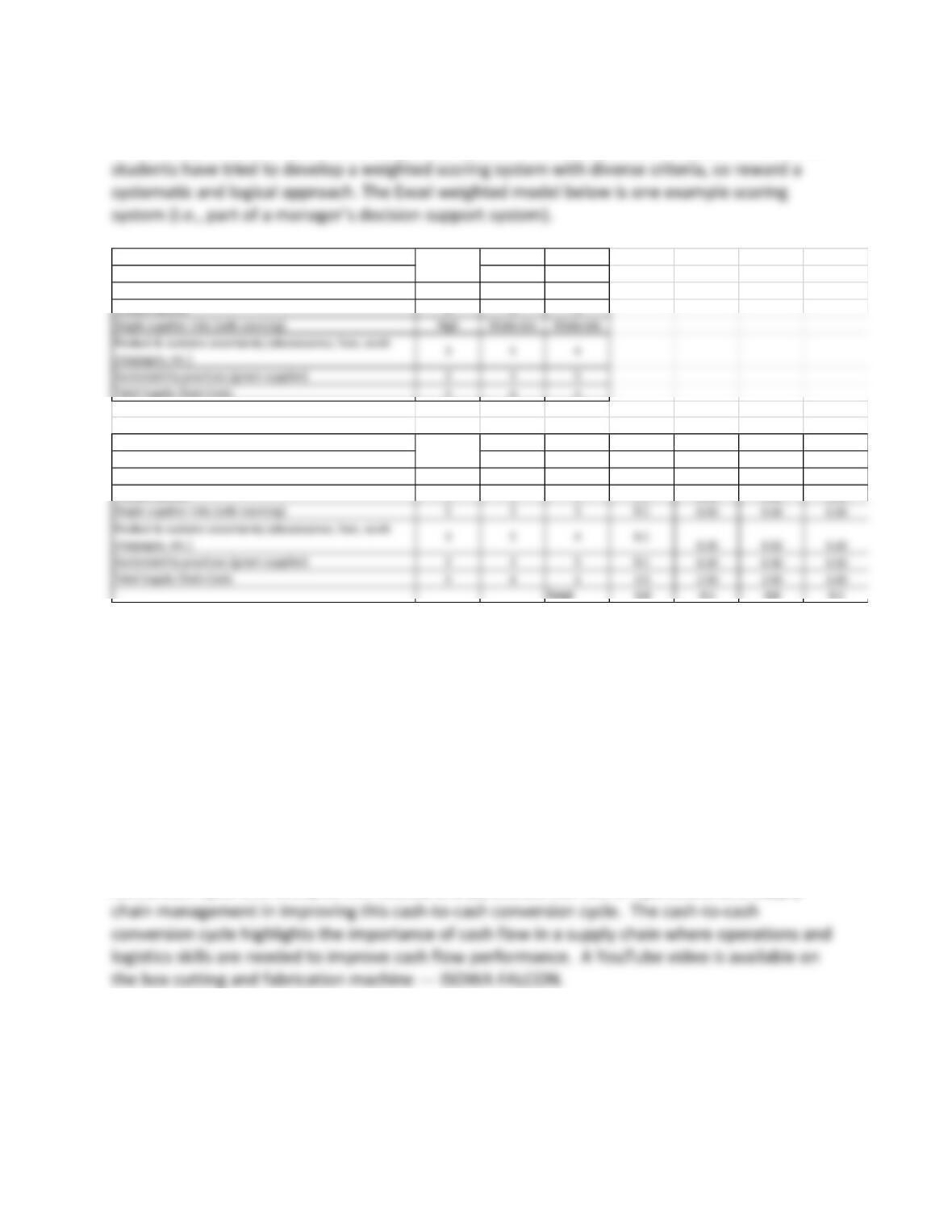
Students will develop a wide variety of weighted scoring models. As long as the logic is sound
and assumptions stated, this case assignment question is successful. This may be the first time
C13 LCC Medical Manufacturer Case Study – Original Data
MedicUSA Werkzeug
Supplier Supplier
Delivery reliability 3 5 4
Weighted Total Score
C13 LCC Medical Manufacturer Case Study
MedicUSA Werkzeug Criteria Xiajing MedicUSA Werkzeug
Supplier Supplier Weight Supplier Supplier Supplier
Delivery reliability 3 5 4 0.1 0.30 0.50 0.40
Total Supply Chain Costs 5 4 2 0.5 2.50 2.00 1.00
Total 1.0 4.1 4.0 3.1
Xiajing
Supplier
Xiajing
Supplier
4. What are your final recommendations?
Based only on total supply chain costs, Xiajing with Q = 20,000 units is best. Based on all cost
and qualitative criteria, and the criteria weighting scheme in Question 3, Xiajing and MedicUSA
are best, with weighted total scores of 4.1 and 4.0 respectively. Of course, changes in the
weights can modify these conclusions.
Teaching Note: J&L Packaging, Inc.—Cash-to-Cash Conversion Cycle
Overview
The objectives of the case are (1) to learn how to do the computations for the cash–to-cash
Case Questions for Discussion:
1. Should we consider services in the cash-to-cash conversion cycle computations?
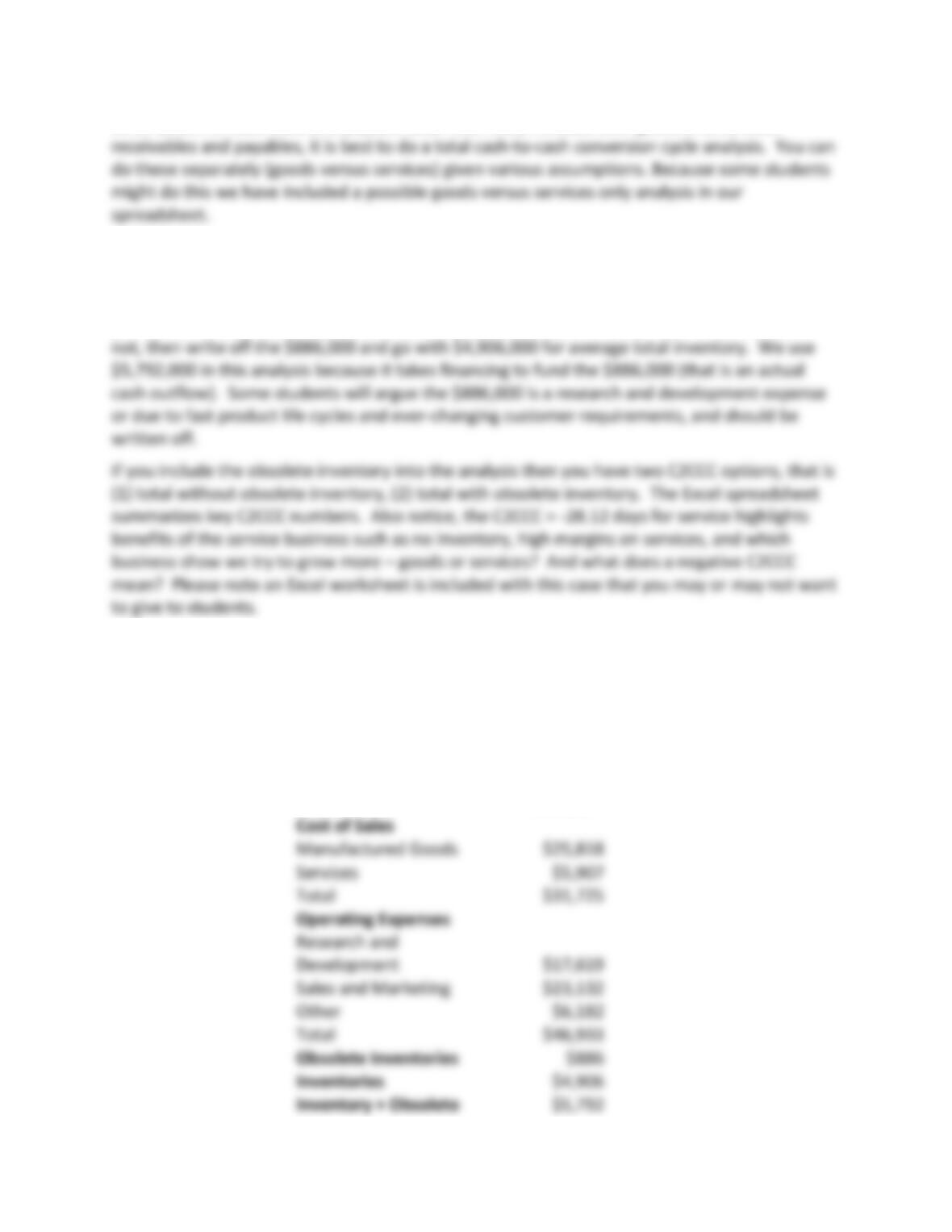
Since accounts receivable and payable data most likely includes both goods and services
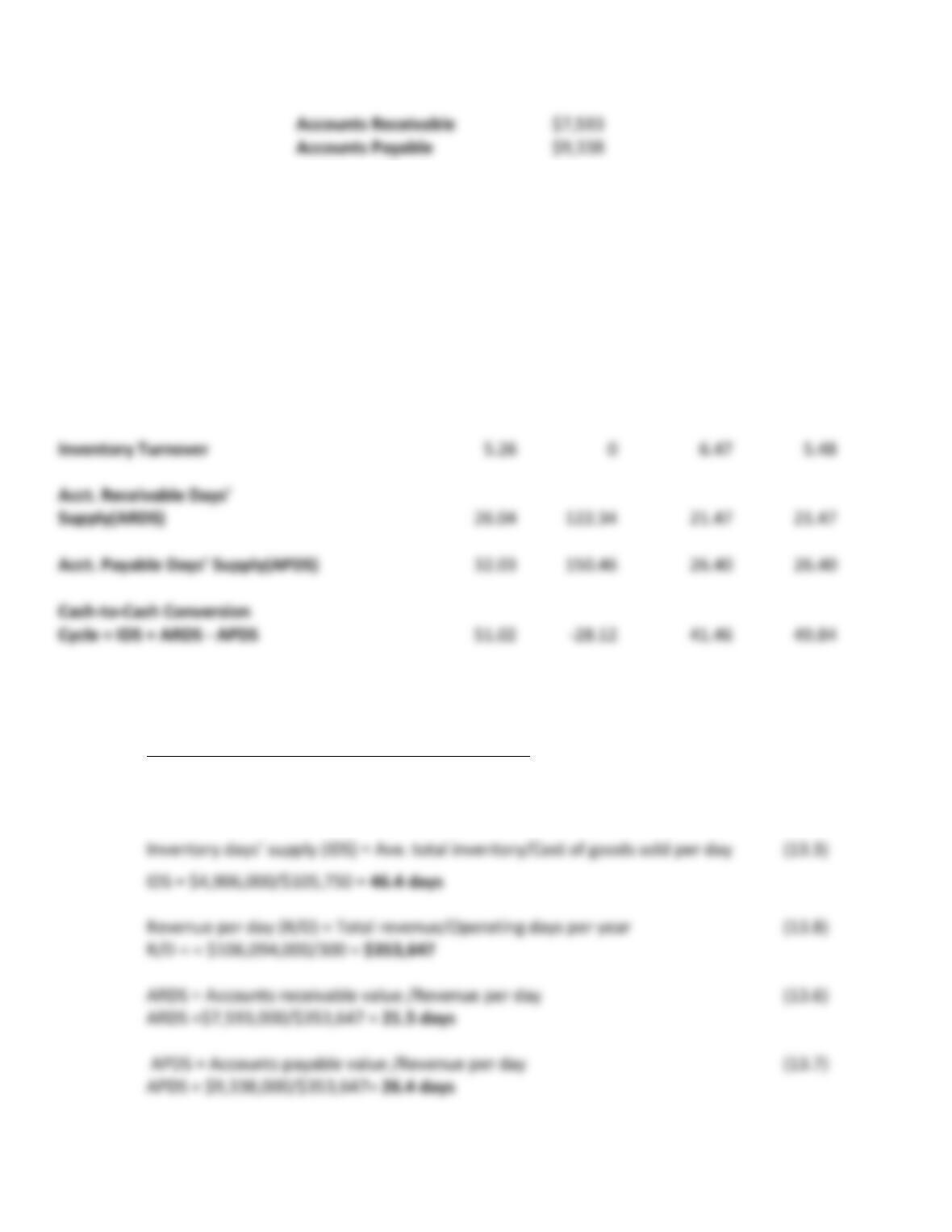
2. How will you handle the $886,000 in obsolete inventory?
The box and packaging business is more technical and dynamic than your students might have
thought so obsolete inventory is a recurring problem. If you want to penalize the firm for such
practices then add $886,000 to $4,906,000 or $5,792,000 (see Excel spreadsheet). If you do
3. What is the “total” cash–to-cash conversion cycle for J&L Packaging, Inc. for last year?
Dollars
(in 1,000)
Sales
Manufactured Goods
$87,475
Services
$18,619
Total
$106,094
Cost of Sales
Manufactured Goods
$25,818
Services
Total
$31,725
Operating Expenses
$17,619
Sales and Marketing
$23,132
Other
Total
$46,933
Obsolete Inventories
Accounts Receivable
Accounts Payable
Manufactured
Total
Total
Goods w/o Obs
Services
w/o Obs Inv
with Obs
Inv
Cost of Goods Sold per Day
$86,060
$19,690
$105,750
$105,750
Revenue per Day
$291,583
$62,063
$353,647
$353,647
Inventory Day’s Supply
57.0
0
46.4
54.8
Inventory Turnover
5.26
0
6.47
5.48
Acct. Payable Days’ Supply(APDS)
Cycle = IDS + ARDS – APDS
Below is one set of example computations; all others are in the spreadsheet.
Total C2CCC without Obsolete Inventory Included
Cost of goods sold/day (CGS/D) = Cost of goods sold value/Operating days per year (13.4)
CGS/D = $31,725,000/300 = $105,750
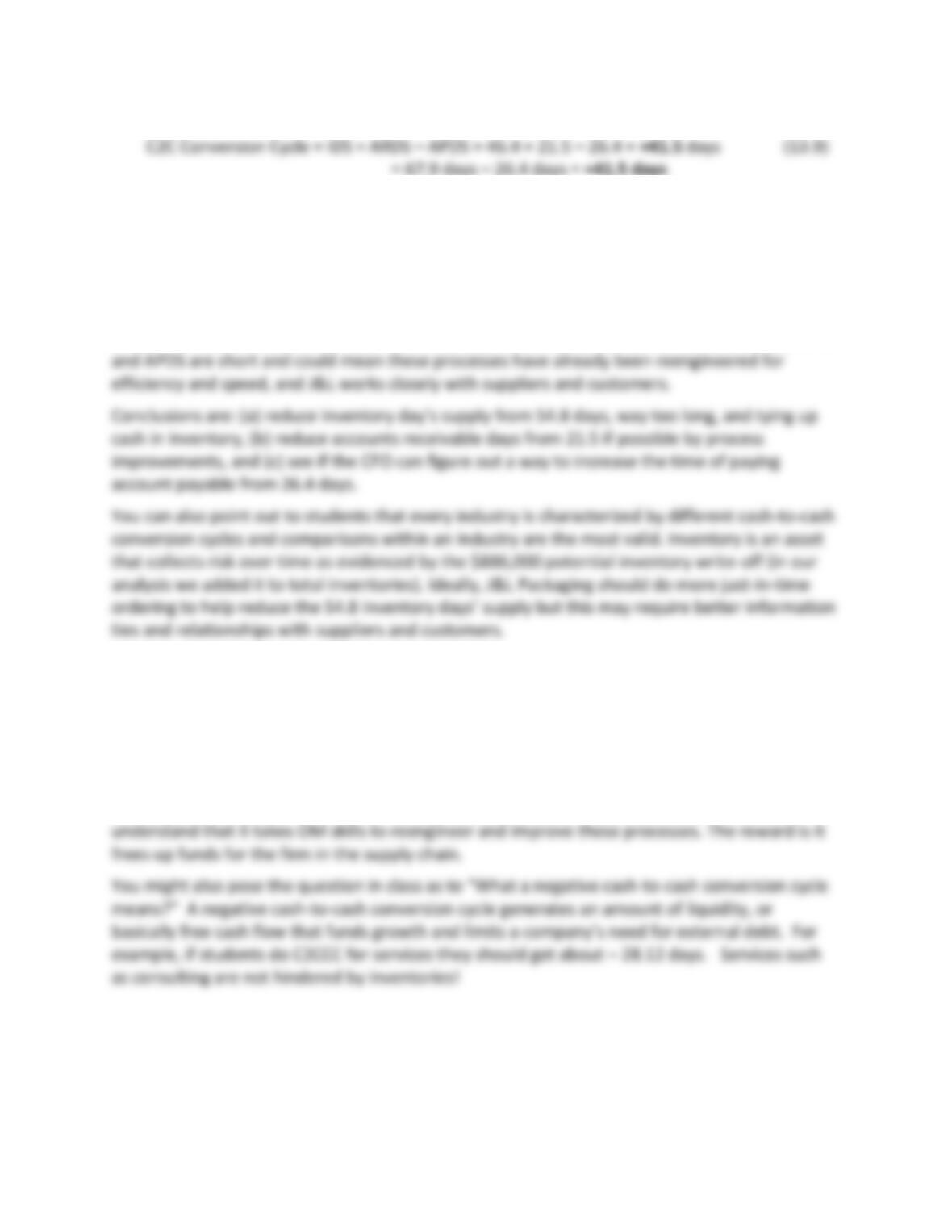
4. What are your conclusions and final recommendations?
J&L Packaging, Inc. total cash-to-cash conversion cycle with obsolete inventory included is
positive at 49.84 days that means it must pay its bills on average 49.84 days before it receives
payments from its revenue generating customers. Most likely J&L Packaging, Inc. must borrow
funds to make this cash conversion cycle work. This firm’s numbers should be compared with
industry competitor’s cash-to-cash conversion cycle numbers. Relative to inventory days, ARDS
You can teach this case in 15 to 40 minutes (depends on how many teams or students present
the case or if you teach it in class or if you want to show the YouTube video of the ISOWA
FALCON box machine) by exploring the role of operations in (1) reducing IDS from 54.8 days,
and (2) reducing ARDS from 21.5 days (an information intensive process that can be
reengineered).
For example, ask the students if you reduce ARDS by one-half (22 to 11 days) how many dollars
do you get earlier? Answer: 11 days*$353,647 = $3,890,117! Also, make sure students
Teaching Plan
(1) Should we consider services in the cash-to-cash conversion cycle computations?
(2) How will you handle the $886,000 in obsolete inventory?
Integrative Case: Hudson Jewelers
Chapter 13 Case Questions for Discussion:
1. Research short- and long-term risks in the global diamond supply chains and write a short
paper (maximum of 3 pages) defining what these risks are and how they are mitigated by
major diamond producing corporations.
A great place to begin to answer this question is using Exhibits 13.3 and 13.4. The challenge for
2. Obtain the annual report of a major diamond producer such as DeBeers, ALROSA, Rio
Tinto, BHP Billiton, and perform a cash-to-cash conversion cycle analysis of their business.
What conclusions do you reach? Explain the implications of the analysis for the firm.
Students need only the following information from an annual report to figure out the cash-to-cash
conversion cycle. Results will differ depending on the company and detail of the financial data.
• Sales (Revenue)