Chapter 13 – Groups & Teams: Increasing Cooperation, Reducing Conflict
13–21
(1) Less interaction—less sharing of information and coordinating of
activities.
working in groups than when working alone.
Interactive Classroom Material:
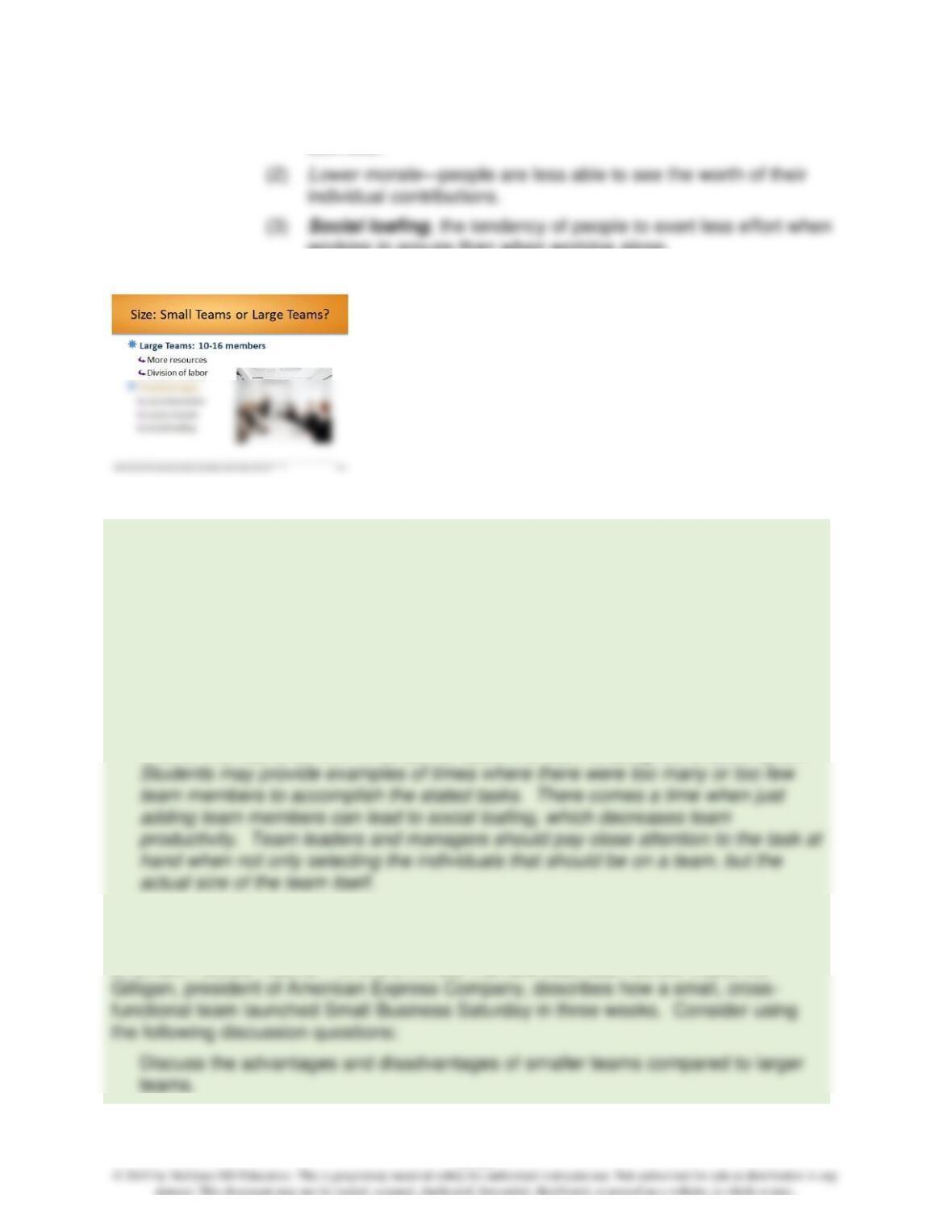
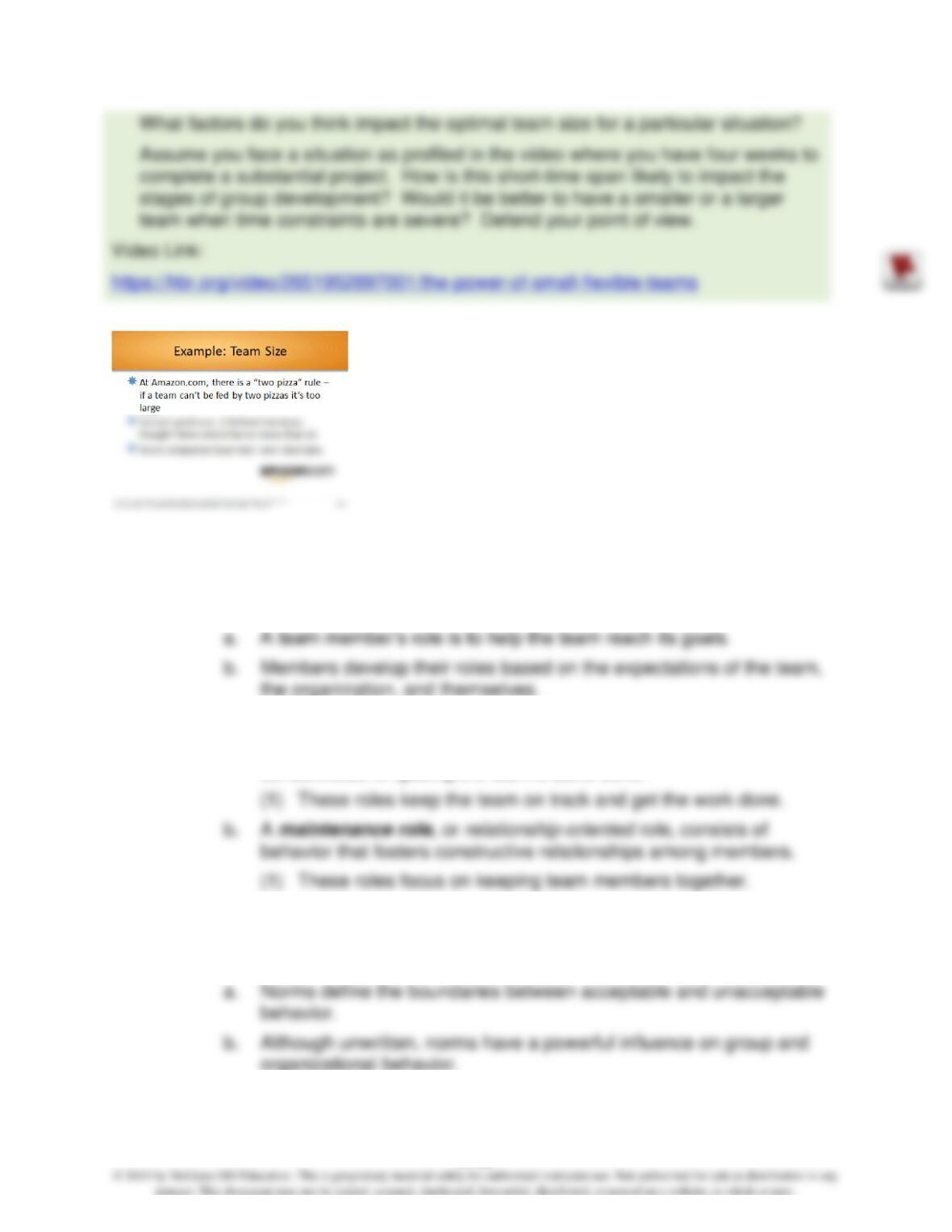
EXAMPLE: Team Size: And the Magic Number is… (p. 422)
Managers are advised to keep teams small but large enough to accomplish the work
needed.
YOUR CALL
What’s been your experience with team size? At what point does adding
members begin to hurt a team’s performance as people become less motivated
and group coordination becomes more difficult?
A lot of this has to do with what task or tasks the team is assigned to accomplish.
Additional Activities:
One way to build on this Example is to have the students watch the video “The Power
of Small, Flexible Teams.” In this 6-minute Harvard Business Review video, Ed
Chapter 13 – Groups & Teams: Increasing Cooperation, Reducing Conflict
13–22
H. Roles: How Team Members Are Expected to Behave
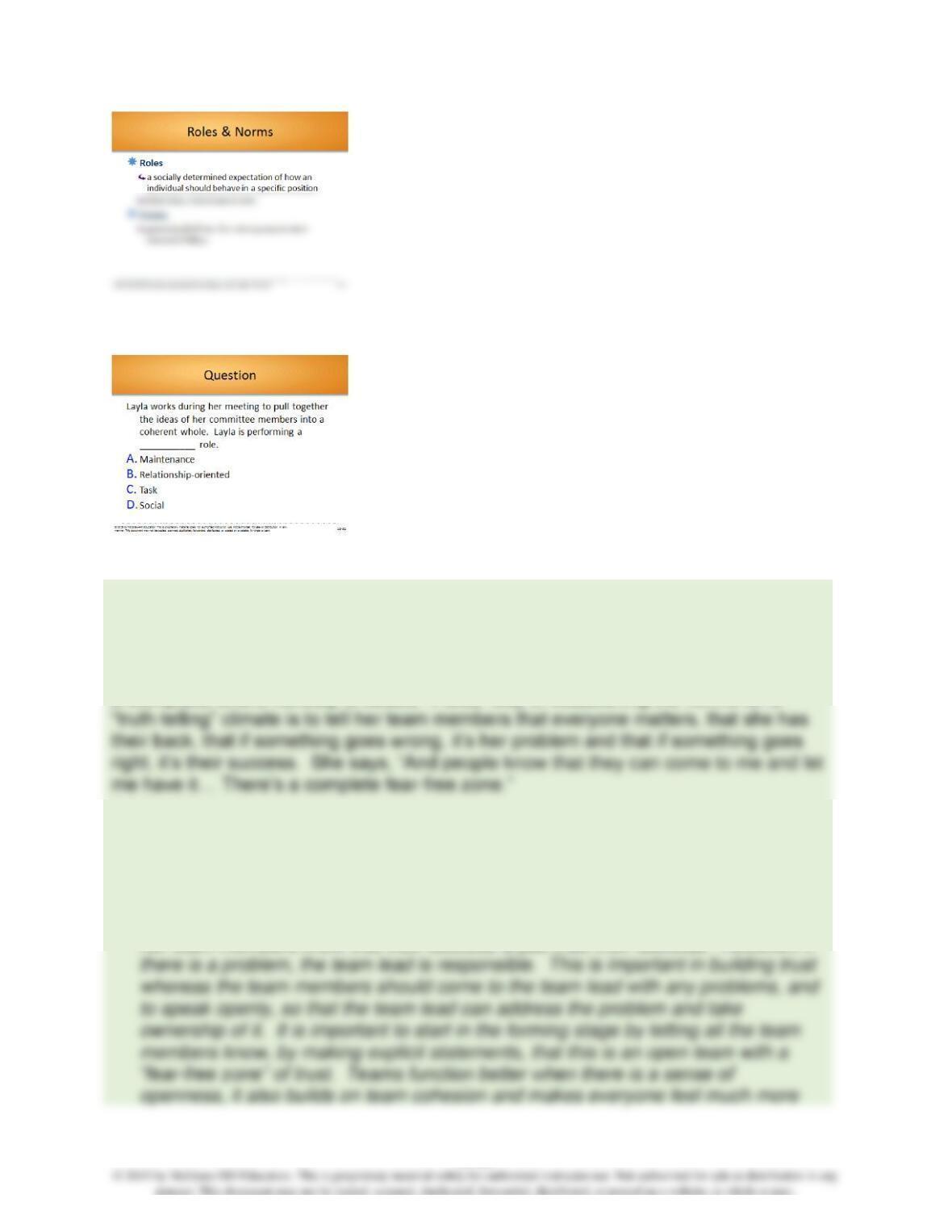
1. A role is a socially determined expectation of how an individual should
behave in a specific position.
2. There are two types of team roles: task and maintenance.
a. A task role, or task-oriented role, consists of behavior that
concentrates on getting the team’s tasks done.
I. Norms: Unwritten Rules for Team Members
1. Norms are general guidelines or rules of behavior that most group or
team members follow.
Chapter 13 – Groups & Teams: Increasing Cooperation, Reducing Conflict
13–23
(Correct answer is C)
Interactive Classroom Material:
EXAMPLE: How to Develop Team Norms: Creating a “Fear–Free Zone” of Trust
(p. 423)
Trust is everything. Pamela Fields, CEO of Stetson, learned the necessity for creating
a workplace where honesty is valued. Fields’ way of establishing the norms for a
YOUR CALL
As a manager of a team, do you think you could adopt a climate of trust in
which your team members understand that if something goes wrong it’s your
problem, not theirs?
This is a very important norm to adopt in a team. A team leader should let his or
her team members know that their success is just that, their success. However, if
Chapter 13 – Groups & Teams: Increasing Cooperation, Reducing Conflict
Additional Activities:
One way to build on this Example is to have the students watch Margaret Heffernan’s
TED Talk “Why It’s Time to Forget the Pecking Order at Work.” In this 16-minute
video, Margaret Heffernan discusses the importance of social cohesion in driving
high-achieving teams. Consider using the following discussion questions:
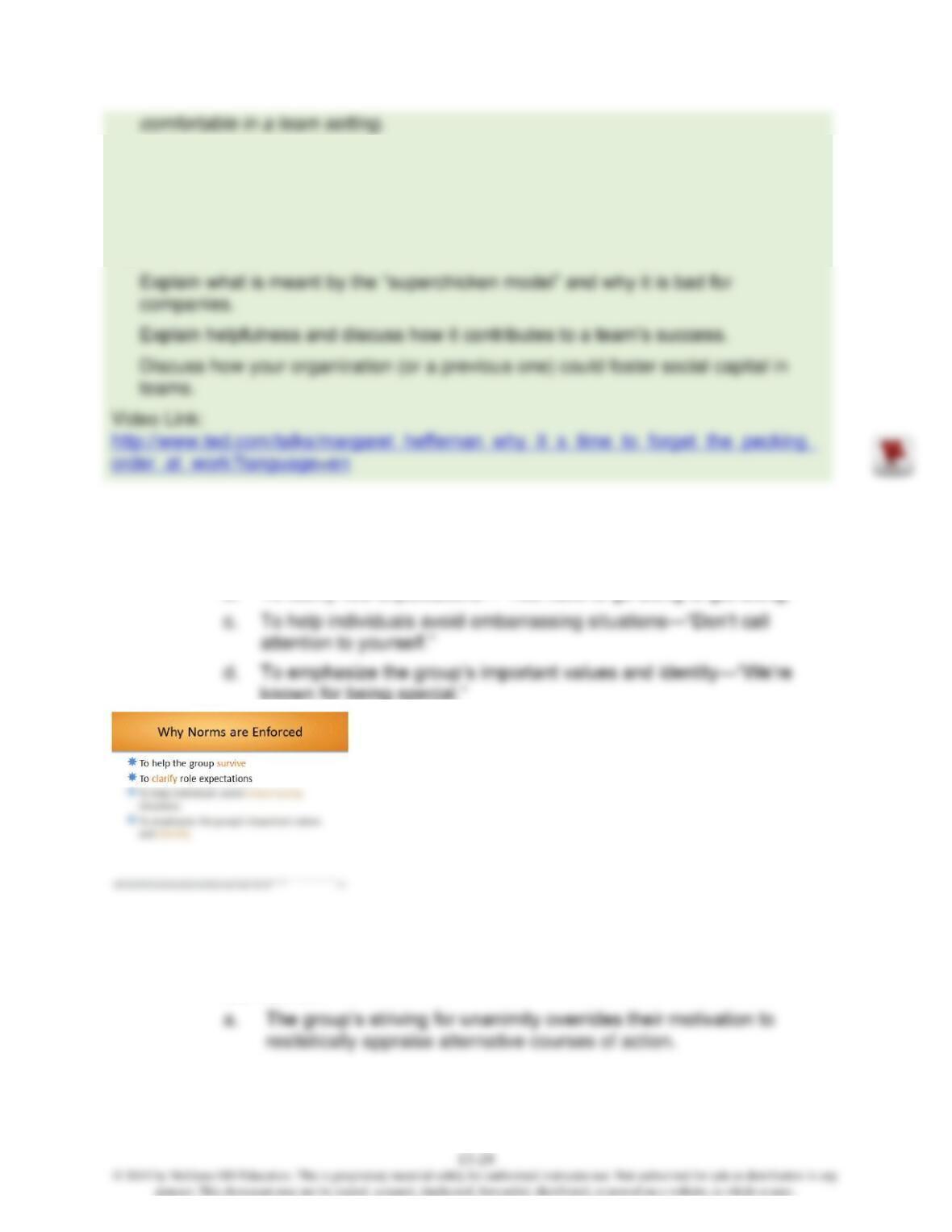
2. Norms are enforced for four primary reasons:
a. To help the group survive—“Don’t do anything that will hurt us.”
b. To clarify role expectations—“You have to go along to get along.”
known for being special.”
J. Groupthink: When Peer Pressure Discourages “Thinking Outside the Box”
1. Groupthink is a cohesive group’s blind unwillingness to consider
alternatives.
Chapter 13 – Groups & Teams: Increasing Cooperation, Reducing Conflict
13–25
2. Symptoms of groupthink include:
a. Invulnerability, inherent morality, and stereotyping of opposition
(1) Group members have the illusion that nothing can go wrong,
b. Rationalization and self-censorship
(1) Rationalizing protects the pet assumptions underlying the
group’s decisions from critical questions.
(2) Self-censorship also stifles critical debate.
c. Illusion of unanimity, peer pressure, and mindguards
Chapter 13 – Groups & Teams: Increasing Cooperation, Reducing Conflict
13–26
SELF-ASSESSMENT 13.3 (p. 425)
Assessing Groupthink
Go to connect.mheducation.com and take Self-Assessment 13.3.
Student Questions:
1. Where does the team stand on the three aspects of groupthink?
2. Based on your survey scores, what would you do differently to reduce
groupthink in the group you evaluated? Be specific.
Generally, groups should investigate alternatives to their proposed solutions,
problem.
Additional Activities:
You can also consult the Connect Instructors Manual for the post-assessment activity
and corresponding PowerPoint slides used for this Self-Assessment in Connect. In
this activity, students should be put into groups based on their Self-Assessment
3. The results of groupthink: decision-making defects
a. Groups with a moderate amount of cohesion tend to produce better
decisions than groups with low or high cohesiveness.
b. Among decision-making defects that can arise from groupthink are:
(1) Reduction in alternative ideas
(2) Limiting of other information
Chapter 13 – Groups & Teams: Increasing Cooperation, Reducing Conflict
13–27
Interactive Classroom Material:
EXAMPLE: Groupthink: An Enthusiasm for Brainstorming, a Technique That
Often Doesn’t Work (p. 426)
Promoted as an idea-generation machine, brainstorming has become “practically a
YOUR CALL
Do you agree that brainstorming has endured too long because of admirers’
groupthink? But an important exception to its dismal record, says Cain, is
Internet “electronic brainstorming, where large groups outperform individuals.”
Why do you suppose that is?
There are many reasons behind groupthink, and students should share examples
Additional Activities:
One way to build on this Example is to have the students read the Harvard Business
Review article “Where to Look for Insight.” This article outlines seven “insight
channels” that decision makers can use to produce innovation decisions. In a group
situation, using these approaches may help to reduce groupthink. Consider using the
following discussion questions:
How can teams more effectively look for “anomalies” during the decision-making
process?
Chapter 13 – Groups & Teams: Increasing Cooperation, Reducing Conflict
13–28
4. Preventing groupthink: making criticism and other perspectives
a. Allow criticism.
(1) Each member should be encouraged to be a critical evaluator.
SELF-ASSESSMENT 13.4 (p. 427)
Assessing Team Effectiveness
Go to connect.mheducation.com and take Self-Assessment 13.4.
Student Questions:
1. How effective is the team?
Student responses will differ based on assessment results. Some students
2. What aspects of the team’s internal processes are most in need of positive
Chapter 13 – Groups & Teams: Increasing Cooperation, Reducing Conflict
13–29
development?
These responses will also differ, but in general, team members need to
3. Based on your survey scores, what are three recommendations for improving
the team’s internal processes? Be specific.
Additional Activities:
You can also consult the Connect Instructors Manual for the post-assessment activity
and corresponding PowerPoint slides used for this Self-Assessment in Connect. In
Group Exercise #1: Identifying Task and Maintenance Roles within Groups
There is a group exercise available at the end of this manual that provides students
with the opportunity to enhance their understanding of task and maintenance roles.
Exercise Objectives
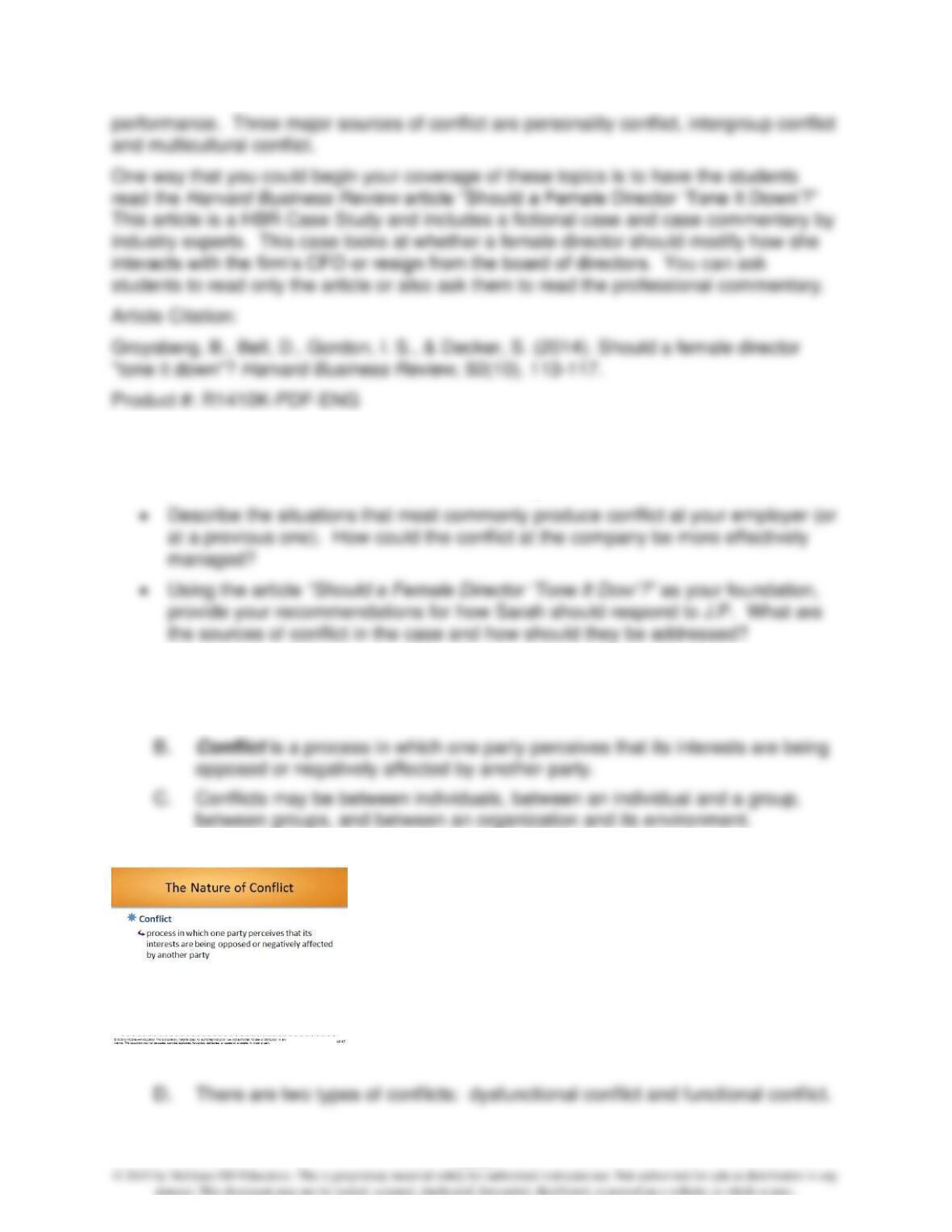
Section 13.4 discusses conflict, which is a process in which one party perceives that its
interests are being opposed or negatively affected by another party. Conflict can be
negative (bad) or functional (good). Either too much or too little conflict can affect
13.4 Managing Conflict (pp. 428-434)
Since conflict is a part of life, what should a manager know about it in
order to deal successfully with it?
Chapter 13 – Groups & Teams: Increasing Cooperation, Reducing Conflict
13–30
Possible Topics for Discussion:
• Think of examples of conflict that you have observed at your workplace (or at a
previous one). Describe the positive and negative outcomes of this conflict.
Major Idea Outline:
A. Among the sources of workplace conflict are pressure-cooker deadlines,
increased workloads and demands for higher productivity.
Chapter 13 – Groups & Teams: Increasing Cooperation, Reducing Conflict
13–31
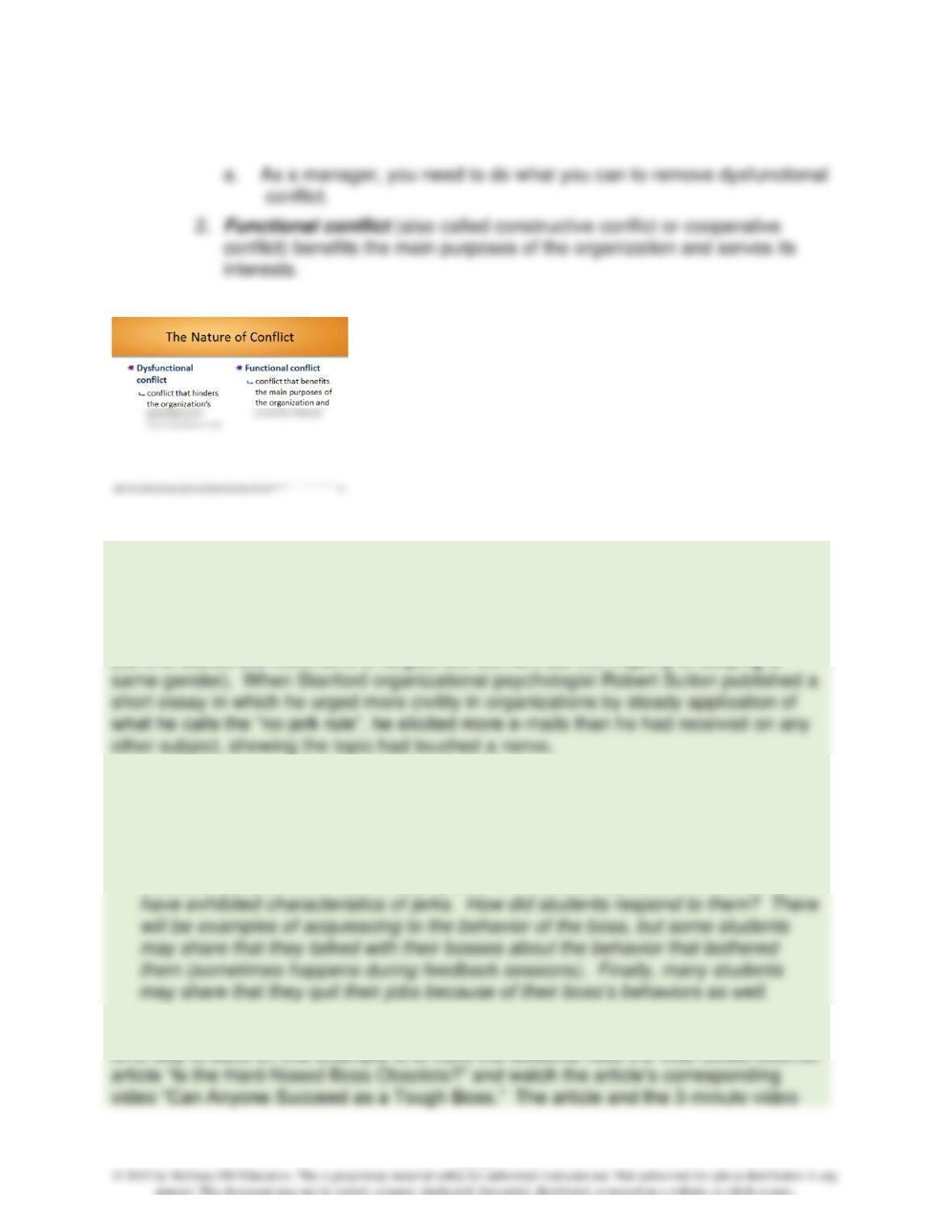
1. Dysfunctional conflict (sometimes called negative conflict) is conflict that
hinders the organization’s performance or threatens its interests.
Interactive Classroom Material:
EXAMPLE: Dysfunctional and Functional Conflict: Do Nasty Bosses Get Better
Performance? (pp. 428-429)
In a recent survey, 35% of American workers reported they had been bullied at work
(62% of bullies are men, 58% of targets are women, but the majority of bullying is
YOUR CALL
Have you ever worked for jerks (otherwise known, as Sutton puts it, as “tyrants,
bullies, boors, destructive narcissists, and psychologically abusive people”)?
How did you respond to them?
Students can provide different examples of individuals they have worked for who
Additional Activities:
Chapter 13 – Groups & Teams: Increasing Cooperation, Reducing Conflict
13–32
explore how much a modern leader must soften his or her style to be effective in
today’s world of cooperation and consensus in the workplace. Consider using the
following discussion questions:
Discuss why today’s managers may need to soften their style compared to
managers a couple of decades ago.
If you had to choose between a high-achieving but demanding boss and a nice but
ineffective manager, which one would you choose? Explain your position.
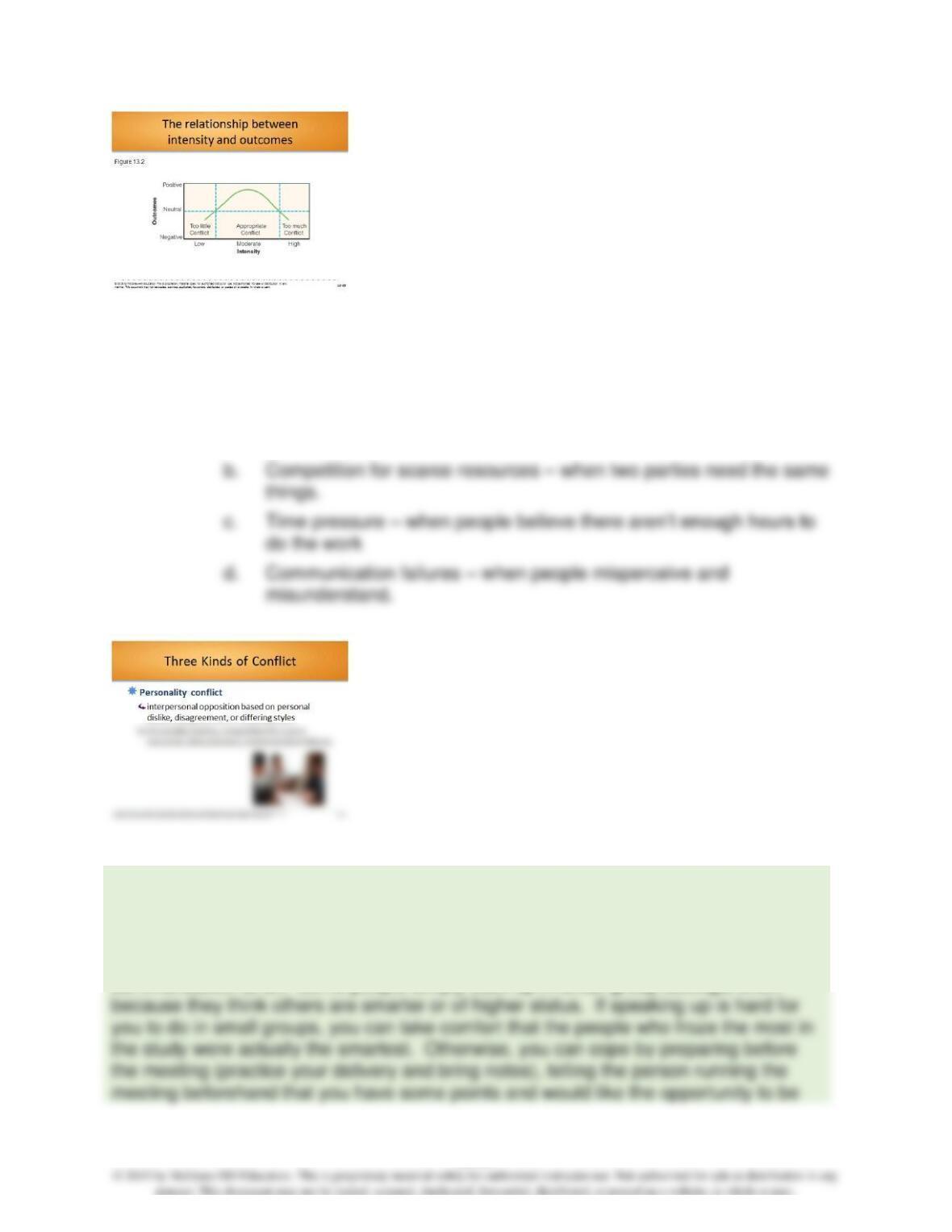
E. Can Too Little or Too Much Conflict Affect Performance?
1. Social scientists now believe that organizations can suffer from too little
conflict.
2. Too little conflict—indolence:
3. Too much conflict—warfare:
4. A moderate level of conflict can raise performance by encouraging
creativity.
Chapter 13 – Groups & Teams: Increasing Cooperation, Reducing Conflict
13–33
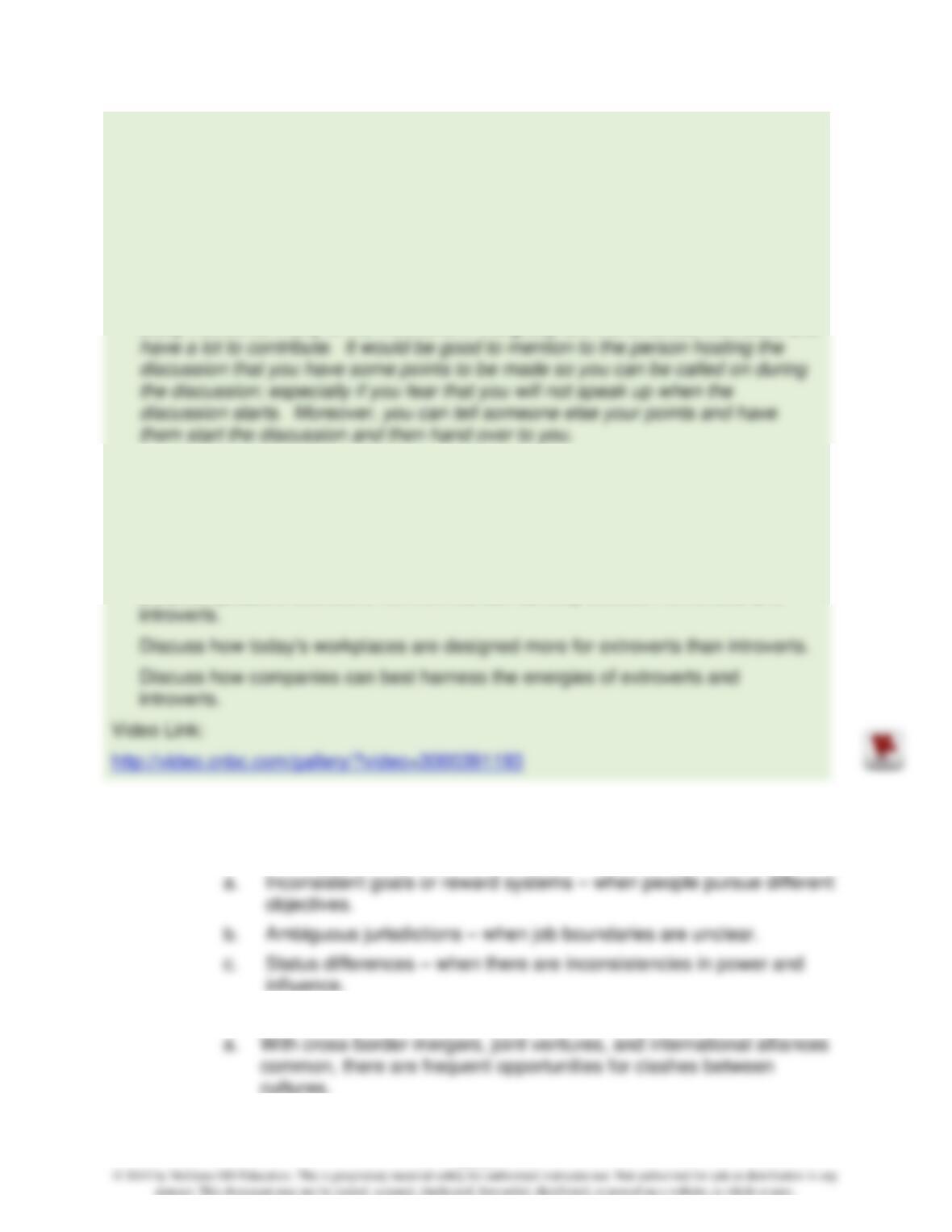
F. Three Kinds of Conflict: Personality, Intergroup, & Cross-Cultural. There are a
variety of sources of conflict—so-called conflict triggers.
1. Personality conflict is defined as interpersonal opposition based on
personal dislike, disagreement, or differing styles.
a. Personality clashes – when individual differences can’t be resolved.
Interactive Classroom Material:
EXAMPLE: “What We’ve Got Have Here Is a Failure to Communicate”: The
Plight of the Tongue-Tied (p. 431)
Miscommunication happens for all kinds of reasons – sometimes because there is no
communication at all. Some people simply clam up in small-group settings, often
Chapter 13 – Groups & Teams: Increasing Cooperation, Reducing Conflict
13–34
called upon, or joining with a more outgoing or higher-status member in the group
who can bring up your points and then toss you an opening.
YOUR CALL
Do you tend to go silent during some small-group settings or social situations?
Perhaps it’s not that you’re shy but rather an introvert and want to collect your
thoughts before speaking—hard to do in the company of extroverts who “think
out loud.” Could any of the advice above work for you?
It is important to try and overcome introversion during group discussions. As the
study mentions, many of the introverts in the group are the smartest members and
Additional Activities:
One way to build on this Example is to have the students watch the CNBC video
“Harnessing the Power of Introverts.” In this 3-minute video, Susan Cain discusses
how corporations can tap into the power of introverts. Consider using the following
discussion questions:
Describe possible sources of conflict that can develop between extroverts and
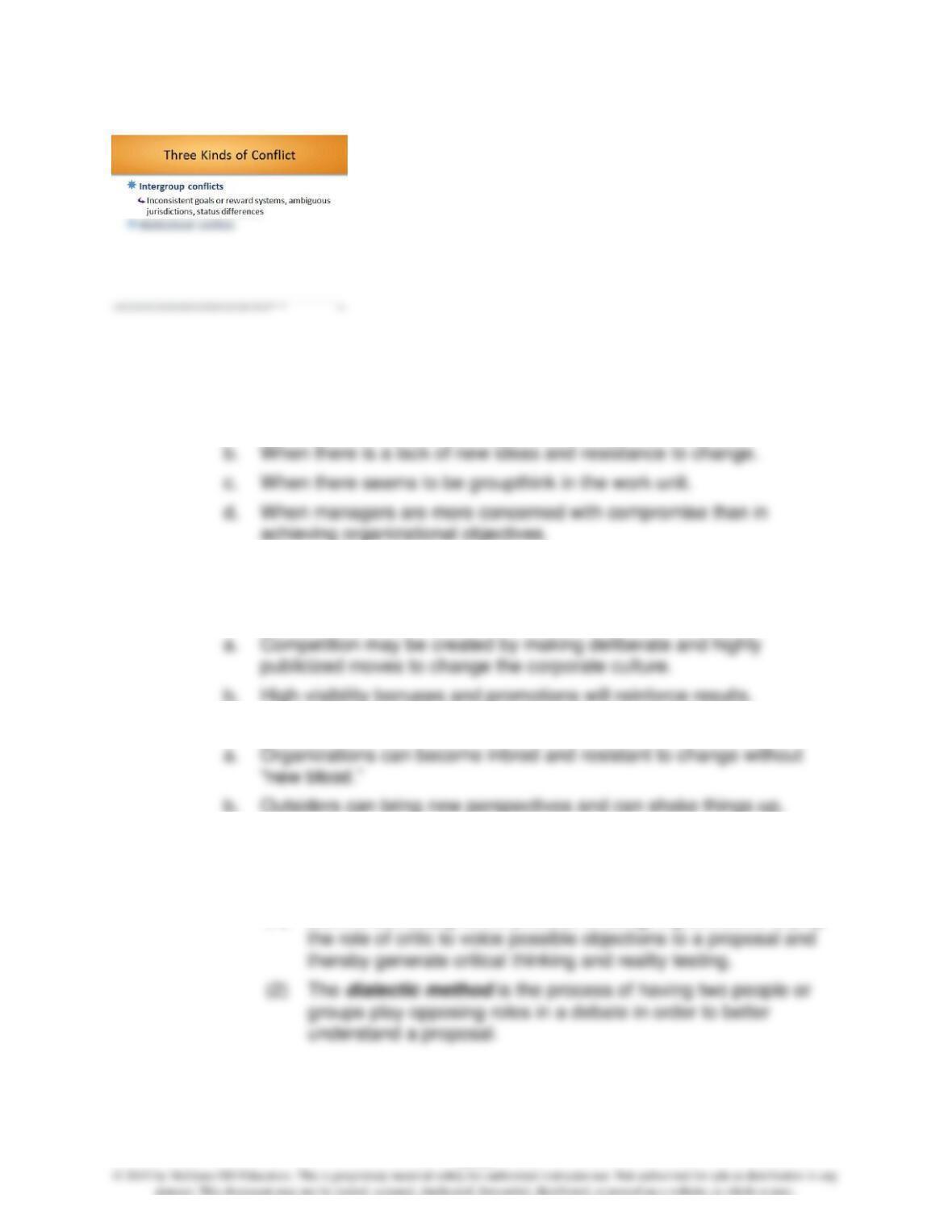
2. Intergroup conflicts: Clashes Between Work Groups, Teams, and
Departments. Some causes of intergroup conflicts are:
3. Multicultural Conflicts: Clashes between Cultures
Chapter 13 – Groups & Teams: Increasing Cooperation, Reducing Conflict
13–35
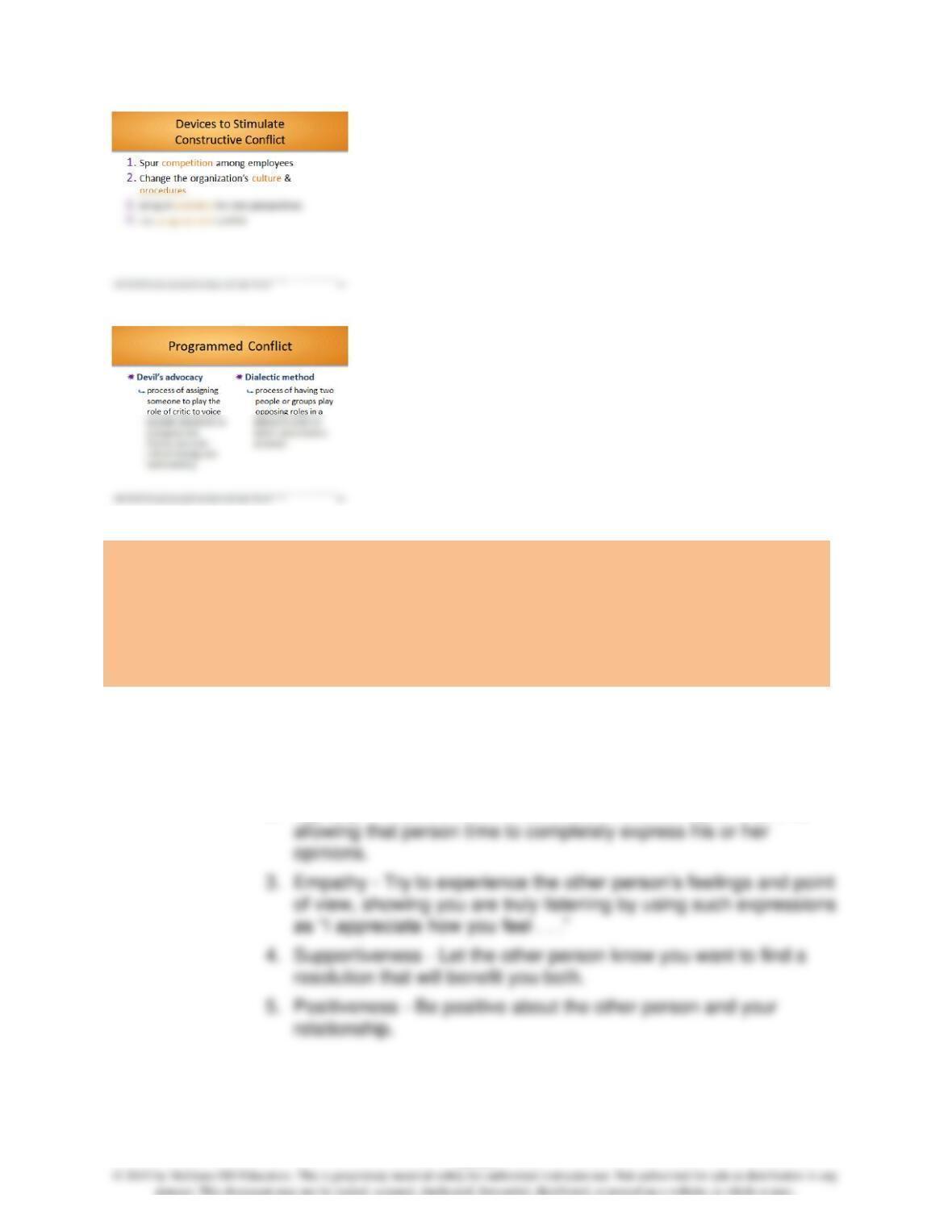
G. How to Stimulate Constructive Conflict
1. Constructive conflict can be productive under a number of circumstances:
a. When your work group seems afflicted with inertia and apathy.
2. Spur competition among employees. Competition can spur people to
produce higher results.
3. Change the organization’s culture and procedures.
4. Bring in outsiders for new perspectives.
5. Use programmed conflict: devil’s advocacy and the dialectic method.
a. Programmed conflict is designed to elicit different opinions without
inciting people’s personal feelings. There are two proven methods:
(1) Devil’s advocacy is the process of assigning someone to play
Chapter 13 – Groups & Teams: Increasing Cooperation, Reducing Conflict
13–36
Group Exercise #2: Empathy: The Misunderstood Skill
There is a group exercise available at the end of this manual that provides students
with the opportunity to practice a three-step approach for being empathetic.
Exercise Objective
• To present and practice a three-step approach for being empathetic.
H. Five Basic Behaviors to Help You Better Handle Conflict
1. Openness – State your views openly and honesty, not trying to
disguise the real object of your disagreement.
2. Equality – Treat the other’s status and ideas as equal to yours,
Chapter 13 – Groups & Teams: Increasing Cooperation, Reducing Conflict
13–37
Interactive Classroom Material:
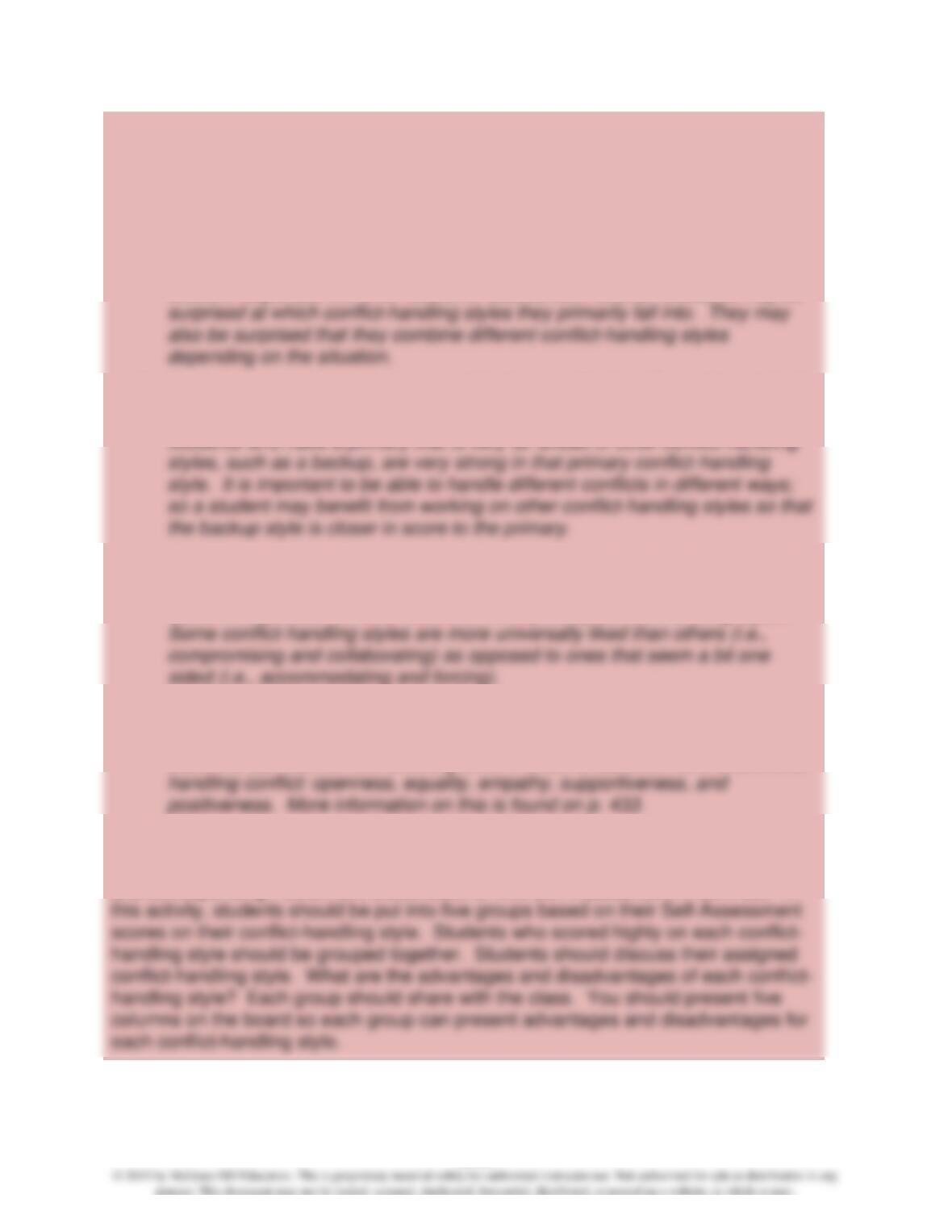
PRACTICAL ACTION: Dealing with Disagreements: Five Conflict-Handling
Styles (p. 434)
Even if you’re at the top of your game as a manager, working with groups and teams
of people will now and then put you in the middle of disagreements, sometimes even
destructive conflicts. How can you deal with it?
Additional Activities:
One way that you could build on this Practical Action is to have the students read the
Wall Street Journal article “To Fight, or Not to Fight.” This article profiles why people
sometimes avoid conflicts at work and the advantages and disadvantages of this
avoidance. For WSJ subscribers, there is a corresponding video for this article that
you can have the students watch. Consider using the following discussion questions:
Think of the worst workplace conflict in which you were personally involved.
Article Citation:
Shellenbarger, S. (2014, December 16). To fight, or not to fight? Wall Street Journal
Online.
Chapter 13 – Groups & Teams: Increasing Cooperation, Reducing Conflict
13–38
SELF-ASSESSMENT 13.5 (p. 434)
What Is Your Conflict-Management Style?
Go to connect.mheducation.com and take Self-Assessment 13.5.
Student Questions:
1. Were you surprised by the results? Why or why not? Explain.
Student responses will differ based on assessment results. Students may be
2. Were the scores for your primary and backup conflict-handling styles relatively
similar, or was there a large gap? What does this imply? Discuss.
3. Is your conflict-handling style one that can be used in many different conflict
scenarios? Explain.
Student responses will differ based on their primary conflict-handling styles.
4. What are some skills you can work on to become more effective at handling
conflict?
Students can work on the following skills in order to become more effective at
Additional Activities:
You can also consult the Connect Instructors Manual for the post-assessment activity
and corresponding PowerPoint slides used for this Self-Assessment in Connect. In
Chapter 13 – Groups & Teams: Increasing Cooperation, Reducing Conflict
13–39
Group Exercise #3: What is Your Preferred Conflict-Handling Style?
There is a group exercise available at the end of this manual that provides students
Exercise Objective
• To give students a chance to apply and evaluate the effectiveness of five
different conflict-handling styles.
Chapter 13 – Groups & Teams: Increasing Cooperation, Reducing Conflict
13.1 How is one collection of workers different from any other?
Groups and teams are different. A group is defined as two or more freely
13.2 How does a group evolve into a team?
A group may evolve into a team through five stages. (1) Forming is the process of
13.3 How can I as a manager build an effective team?
There are nine considerations managers must take into account in building a group
into an effective team. First, they must ensure individuals are cooperating, or
13.4 Since conflict is a part of life, what should a manager know about it in order
to deal successfully with it?
Conflict is a process in which one party perceives that its interests are being
opposed or negatively affected by another party. Three types of conflict are
CHALLENGE: MAJOR QUESTIONS