Chapter 13 – Communication and Information Technology Management
their decisions.
E. Artificial Intelligence and Expert Systems
1. Artificial intelligence is behavior performed by a
machine that, if performed by a human being, would
be called “intelligent.”
2. Expert systems are the most advanced management
information systems available and incorporate artificial
intelligence in their design.
3. An expert system is a system that employs human
knowledge captured in a computer to solve problems
that ordinarily require human expertise.
4. Expert systems can at a minimum (1) recognize,
formulate, and solve a problem; (2) explain the
solution; and (3) learn from experience.
F. Enterprise Resource Planning Systems
1. Enterprise resource planning (ERP) systems are
multimodule application software packages that allow
a company to link and coordinate the entire set of
functional activities and operations necessary to move
products from the initial design stage to the final
customer stage.
2. ERP systems provide two major advantages:
b. They improve integration among all functions
so that together they form a competitive advantage
for the company.
G. E-Commerce Systems
1. E-commerce is trade that takes place between
customers using technology and the Internet.
takes place between companies using technology and
different companies.

13–20
3. B2B marketplaces are Internet-based online trading
platforms set up in many industries to connect buyers
and sellers.
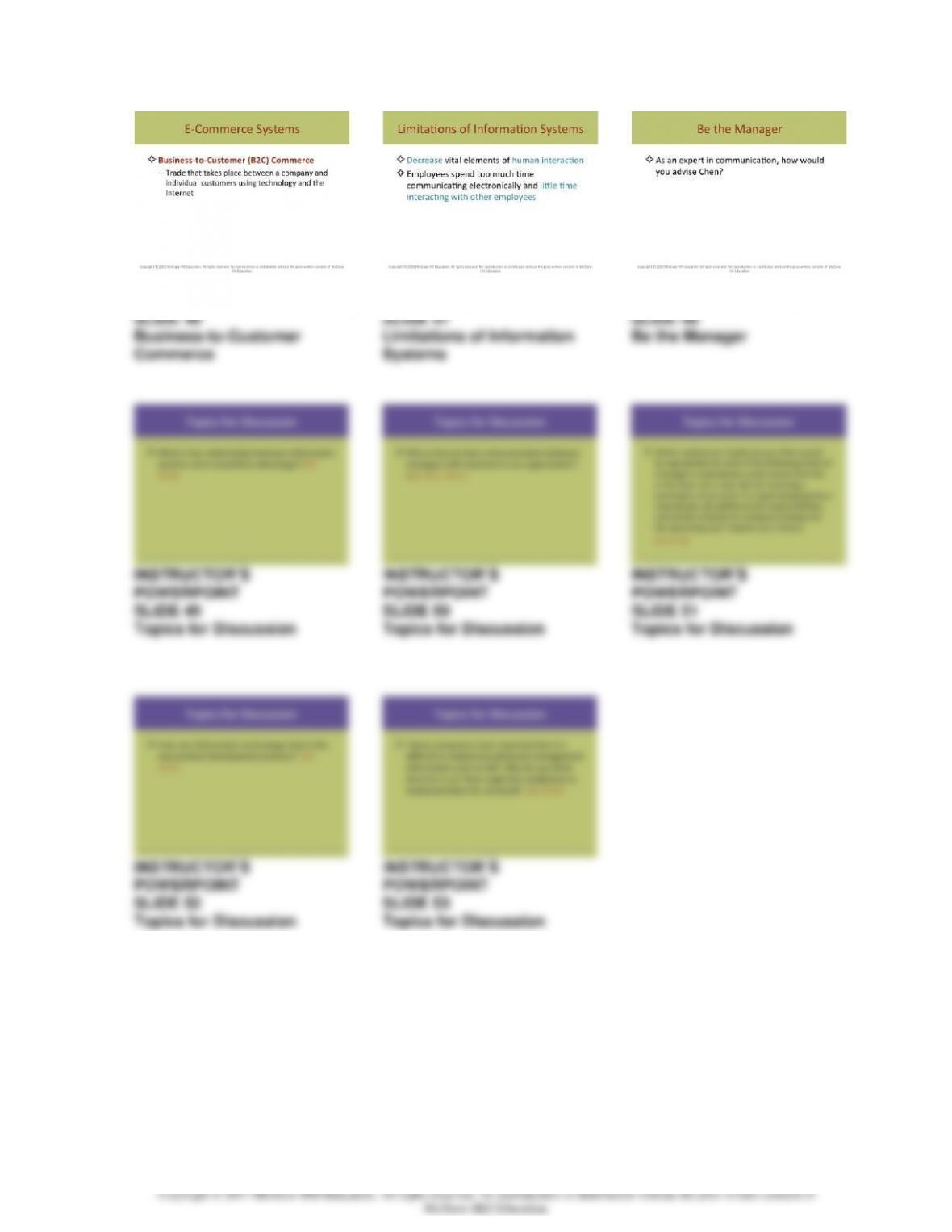
4. Business-to-customer (B2C) commerce is trade
that takes place between a company and individual
customers using technology and the Internet.
5. The challenge facing managers now is to select e-
commerce software that allows a seamless exchange of
information between companies anywhere in the
world.
VI. Limitations of Information Systems
1. A serious potential problem is that in all the
enthusiasm for MIS and electronic communication, a
vital human element of communication might be lost.
2. There is a strong argument in favor of using
electronic communication to support face-to-face
communications, not to replace it.
3. Another drawback of using technology such as
email and teleconferencing is that employees spend too
much time communicating electronically and little
time interacting with other employees.
POWERPOINT SLIDES 13-
47
Lecturer Enhancer 13.1
BODY LANGUAGE
Your inner feelings and personality are often revealed by the way you move your body, experts
are determining. Confidence or insecurity is telegraphed very well by nonverbal behavior. Take
more confident and more comfortable than people who slouch or shift their body weight from
LECTURE ENHANCERS

Chapter 13 – Communication and Information Technology Management
13–21
Even the position of a person’s eyebrows when he or she speaks or looks at another can reveal
something about that person’s mood or feelings. If you say a perfectly innocuous sentence to
someone but you say it without any sign of a smile on your face and with your brows lowered,
you will convey a hostile impression. Stares accompanied by lowered brows show anger,
aggression, or assertiveness, while raised brows show fear, surprise, questioning, or retreat.
Body language is also important in the business world. When a respected executive talks to a
subordinate, the lower-ranking person will listen intently with his eyes riveted on the executive’s
face. To look around would be a sign of disrespect. On the other hand, when the subordinate is
speaking, it is considered perfectly appropriate if the boss looks about or glances at his or her
watch.
And, of course, the high-status person directs the topics of conversation and how long the talk
will last. It’s the same with office visits. The higher-ranking person can exert his or her status by
simply dropping into a subordinate’s office without notice. The subordinate, of course, calls for
an appointment.
Lecture Enhancer 13.2
E-MAIL ETIQUETTE
Many of us are awash in e-mail. There’s no question that e-mail helps us to be more efficient but
misuse can hurt. Some compare e-mail to the Interstate highway system: it works well because
motorists observe common rules and courtesies, such as staying out of the left lane when not
passing, that allow for faster, more efficient travel. Those common rules and courtesies for e-
mail are evolving slowly.
Good e-mail starts with a useful subject line and a short message. The subject line should make
sense to both the sender and the recipient. For instance, a subject line “Meeting” may make
perfect sense to the sender, but the recipient may go to half a dozen meetings a day—which
meeting does it refer to?
Chapter 13 – Communication and Information Technology Management
13–22
Keep the typesetting clean. The Internet dutifully reduced most e-mail to a single font, but in-
house electronic mail systems allow senders to use multiple fonts, colors, and clip art. How can
you claim to have a lean organization when the annual notice-of-carpet-shampooing memo
includes purple headlines and a clip art of a guy in a blue, zip-up service jacket?
Lecture Enhancer 13.3
LEARNING CORPORATE LANGUAGE
Despite the best efforts of English professors, business communication consultants, and other
horrified bystanders, obfuscation in business lingo appears to be a growing and troublesome
phenomenon. This may mean big trouble for inexperienced or naive employees who take
business talk at face value. Those relatively new to management sometimes fail to comprehend
the overstatement, understatement, and evasion that characterize much business talk.
An assistant office manager at an auto-parts manufacturer discovered the perils of
understatement. She was told by her boss of “an impromptu meeting at 4 o’clock—but it’s
nothing to worry about.” She passed up the meeting to learn afterward that it dealt with the
reorganization of her department and the cutting back of her staff and responsibilities.
One consultant says a good rule to follow is that when the boss says, “Don’t worry,” then do
worry. “Management deals with change with studied casualness,” she says. “The bigger things
are, the more people try to speak of them casually.”
Recruits are often misled from the beginning by such observations as, “We don’t punch the clock
around here.” That’s probably true. Who needs a time clock when employees always come in
early and work late? When employees are told of “challenges” or “opportunities,” should they
expect high adventure and the heights of achievement? No, the counselors say. They should
Chapter 13 – Communication and Information Technology Management
13–23
Notes for Topics for Discussion and Action
DISCUSSION
1. What is the relationship between information systems and competitive advantage?
2. Why is face-to-face communication between managers still important in an organization?
3. Which medium (or media) do you think would be appropriate for each of the following kinds
of messages a subordinate could receive from his or her boss: (a) a raise, (b) not receiving a
promotion, (c) an error in a report prepared by a subordinate, (d) additional job responsibilities,
and (e) the schedule for company holidays for the upcoming year? Explain your choices.
MANAGEMENT IN ACTION
13–24
Copyright © 2017 McGraw-Hill Education. All rights reserved. No reproduction or distribution without the prior written consent of McGraw-Hill
Education.
(e) The holiday schedule should be sent to employees by e-mail or memo, enabling them to keep
the document for further reference.
4. How can information technology help in the new product development process?
5. Many companies have reported that it is difficult to implement advanced management
information, such as ERP. Why do you think that this is so? How might the roadblocks to
implementation be removed?
Action
6. Ask a manager to describe the main kinds of information systems that he or she uses on a
routine basis at work.
Chapter 13 – Communication and Information Technology Management
13–25
Diagnosing Ineffective Communication
Think about the last time you experienced very ineffective communication with another person—
someone you work with, a classmate, a friend, a member of your family. Describe the incident.
Then answer these questions:
(Note to Instructors: Student answers will vary based on their experience. Following is some
information to aid your understanding of the terminology referenced in the questions.)
1. Why was your communication ineffective in this incident?
2. What stages of the communication process were particularly problematic and why?
3. Describe any filtering or information distortion that occurred.
Filtering is a barrier to effective communication that occurs when senders withhold part of a
4. How could you have handled this situation differently so that communication would have been
effective?
BUILDING MANAGEMENT SKILLS
Chapter 13 – Communication and Information Technology Management
13–26
(Note: Student answers will vary.)
1. Either by yourself or in a group, explore the ethics of using an IT for personal uses at work.
Should employees have some rights to use these resources? When does their behavior become
unethical?
2. Some companies keep track of the way their employees use IT and the Internet. Is it ethical for
managers to read employees private e-mail or to record websites that employees visit World
Wide Web?
AACSB: Ethics
Using New Management Information Systems
1. What advantages can you tell accountants they will obtain when they use the new information
technology?
MANAGING ETHICALLY
SMALL GROUP BREAKOUT EXERCISE
Chapter 13 – Communication and Information Technology Management
2. What problems do you think you may encounter in convincing accountants to use the new
information technology?
3. Discuss how you might make it easy for accountants to learn to use the new technology.
AACSB: Reflective Thinking
AACSB: Reflective Thinking
Case Synopsis: How Google Humanizes Technology in the Workplace, and You Can, Too
Many people have become overwhelmed using the Internet. Believing it’s easier to communicate
with people electronically, for example, we’ve stopped calling each other. Many of us now check
our cell phones 150 times a day. Trends like these not only suggest that we’re allowing
BE THE MANAGER
FAST COMPANY CASE IN THE NEWS
13–28
1. Thoughtfully mix it up. Be very thoughtful in determining the best way to communicate in
every situation. Talking in person is sometimes better than using technology.
3. Leverage technology to give employees a greater voice. Google sees its workers as the true
4. Go high-tech and low-tech. For example, despite all the technology available, Google top
5. Encourage people to disconnect. Google stresses to employees to check emails only a few
times a day and disconnect from work and technology when at home.
Questions
1. How does using the same form of communication with employees hinder a manager’s
ability to maintain a strong working relationship with direct reports?
2. What are some advantages and disadvantages of Google managers making themselves
available live and in person to employees on a weekly basis?
3. Describe the characteristics of a Segmentor and an Integrator. Which type of employee
are you?
AACSB: Analytic Thinking
SUPPLEMENTAL FEATURES

Chapter 13 – Communication and Information Technology Management
13–29
• Listening Skills: Yeah, Whatever
MANAGER’S HOT SEAT (MHS)
Chapter 13 – Communication and Information Technology Management
13–30
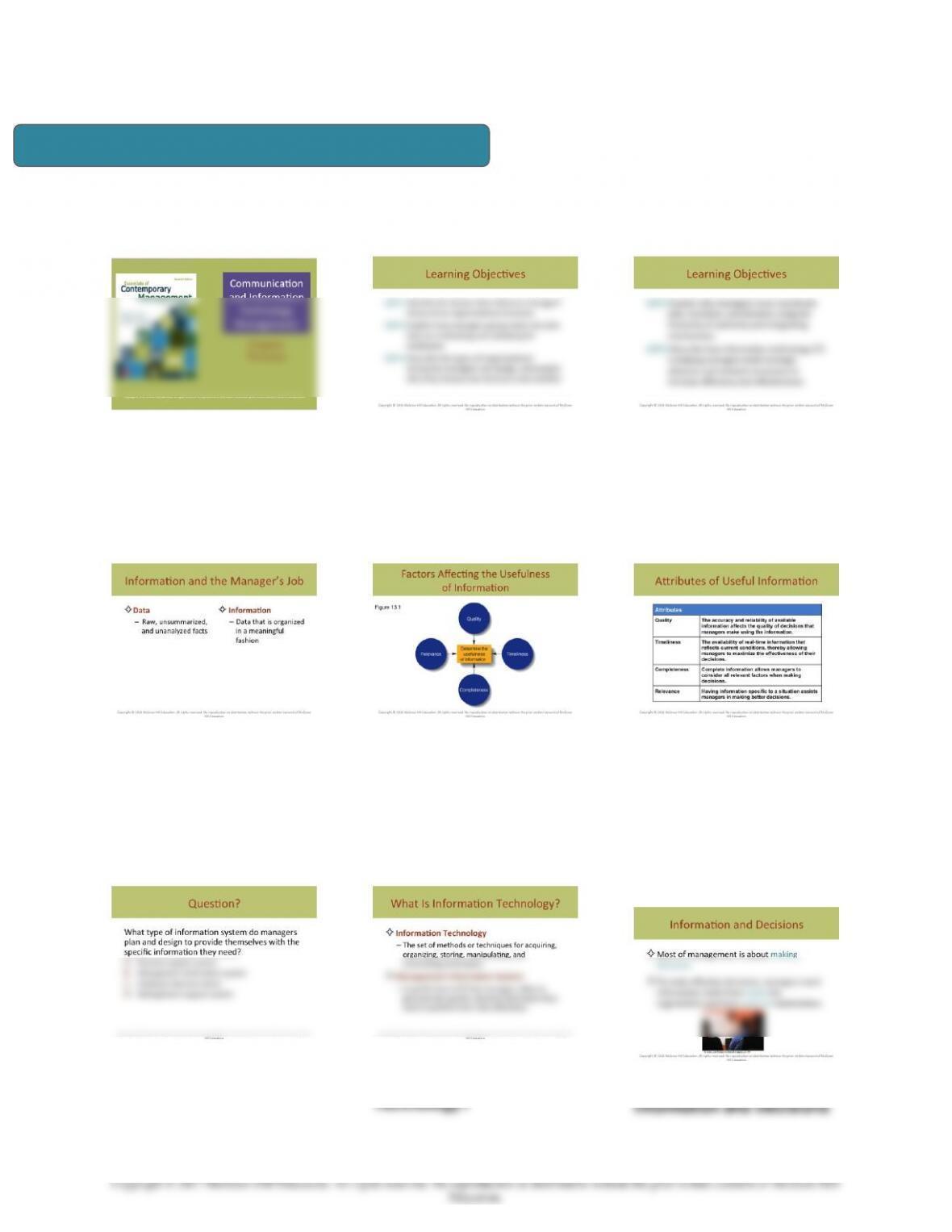
These Instructor’s PowerPoint slides can be used to supplement the lecture material.
INSTRUCTOR’S
POWERPOINT SLIDE 1
Chapter Title
INSTRUCTOR’S
POWERPOINT SLIDE 2
Learning Objectives
INSTRUCTOR’S
POWERPOINT SLIDE 3
Learning Objectives
INSTRUCTOR’S
POWERPOINT SLIDE 4
Information and the
Manager’s Job
INSTRUCTOR’S
POWERPOINT SLIDE 5
Figure 13.1 – Factors
Affecting the Usefulness of
Information
INSTRUCTOR’S
POWERPOINT SLIDE 6
Attributes of Useful
Information
INSTRUCTOR’S
POWERPOINT SLIDE 7
Question?
INSTRUCTOR’S
POWERPOINT SLIDE 8
What Is Information
INSTRUCTOR’S
POWERPOINT SLIDE 9
INSTRUCTOR’S POWERPOINT SLIDES
Chapter 13 – Communication and Information Technology Management
13–31
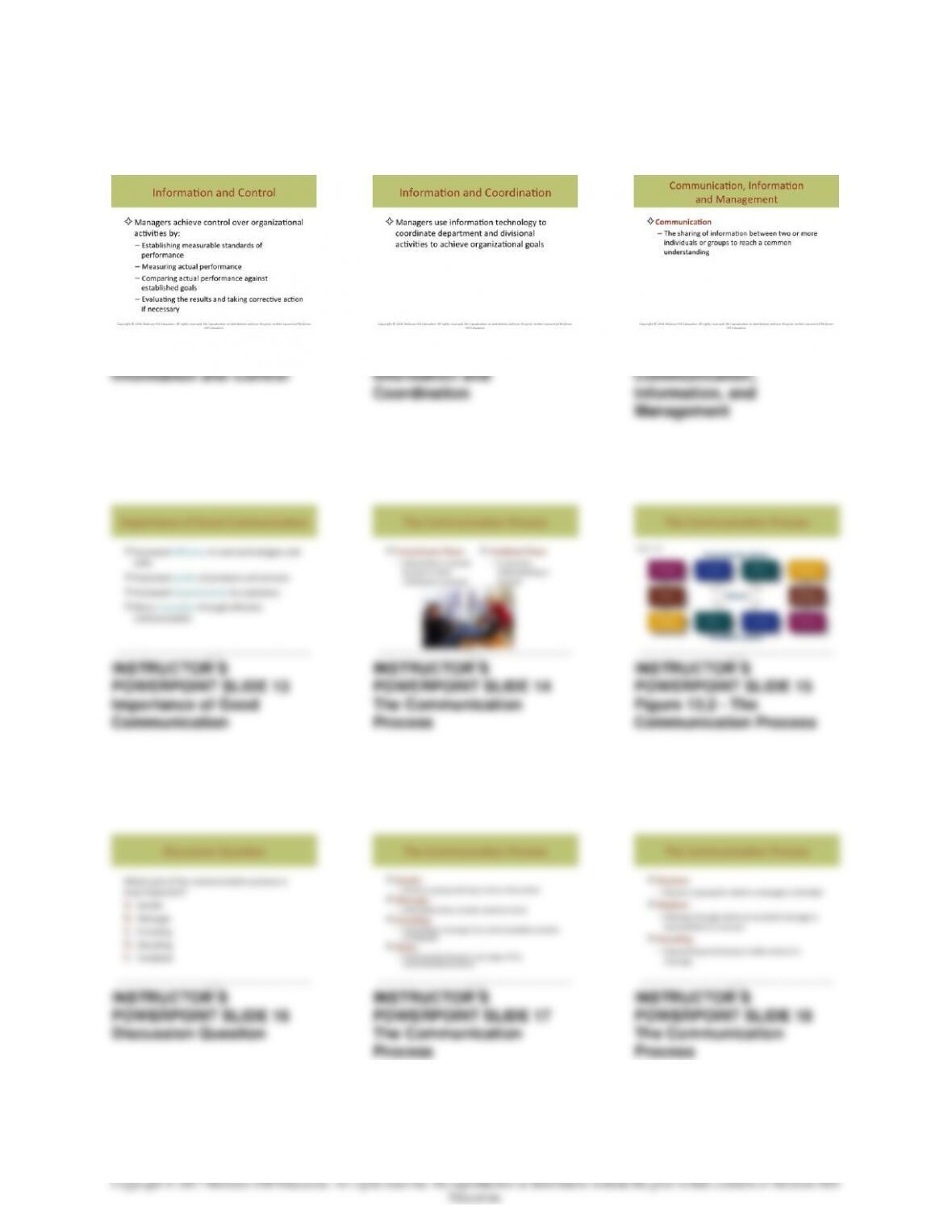
INSTRUCTOR’S
POWERPOINT SLIDE 10
INSTRUCTOR’S
POWERPOINT SLIDE 11
INSTRUCTOR’S
POWERPOINT SLIDE 12
Chapter 13 – Communication and Information Technology Management
13–32
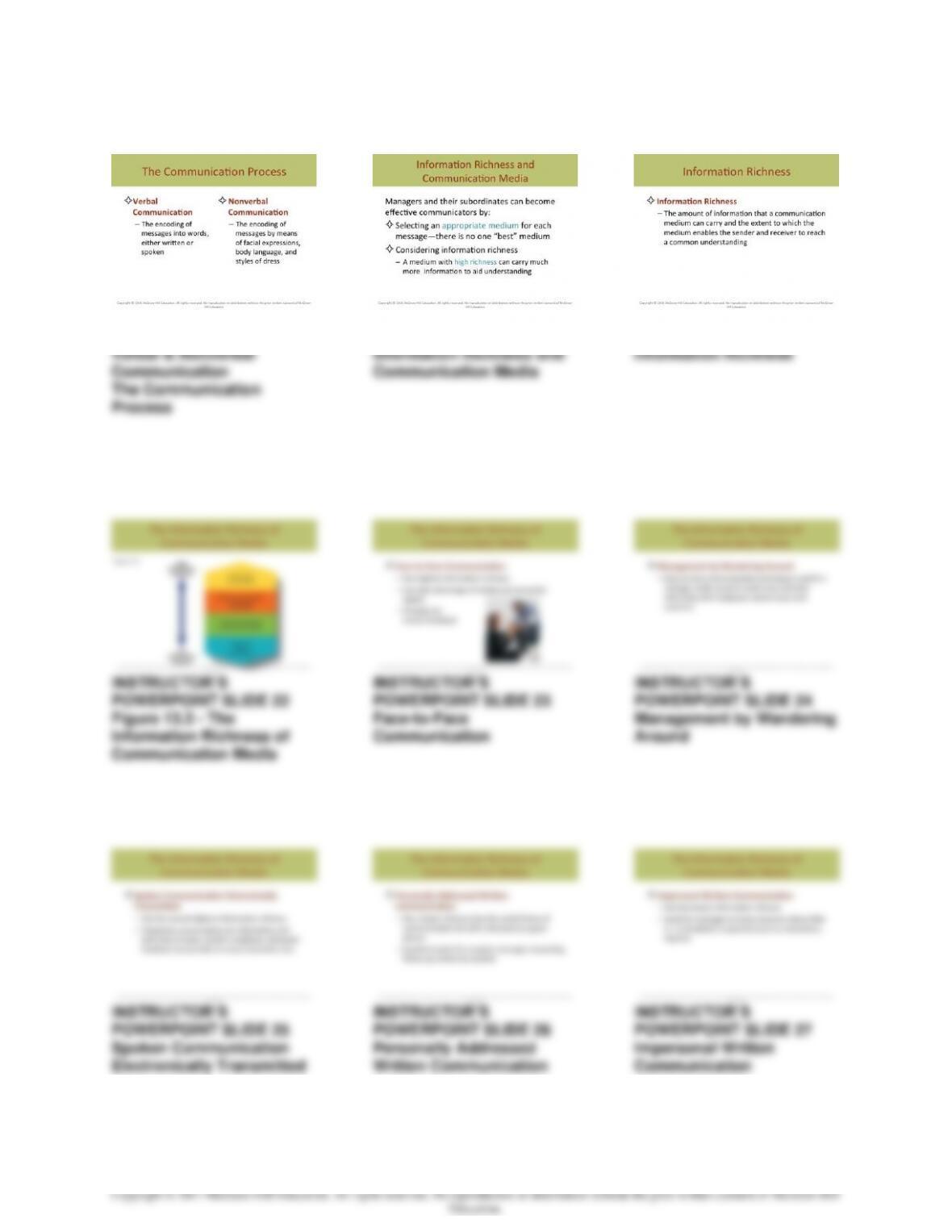
INSTRUCTOR’S
POWERPOINT SLIDE 19
INSTRUCTOR’S
POWERPOINT SLIDE 20
INSTRUCTOR’S
POWERPOINT SLIDE 21
Chapter 13 – Communication and Information Technology Management
13–33
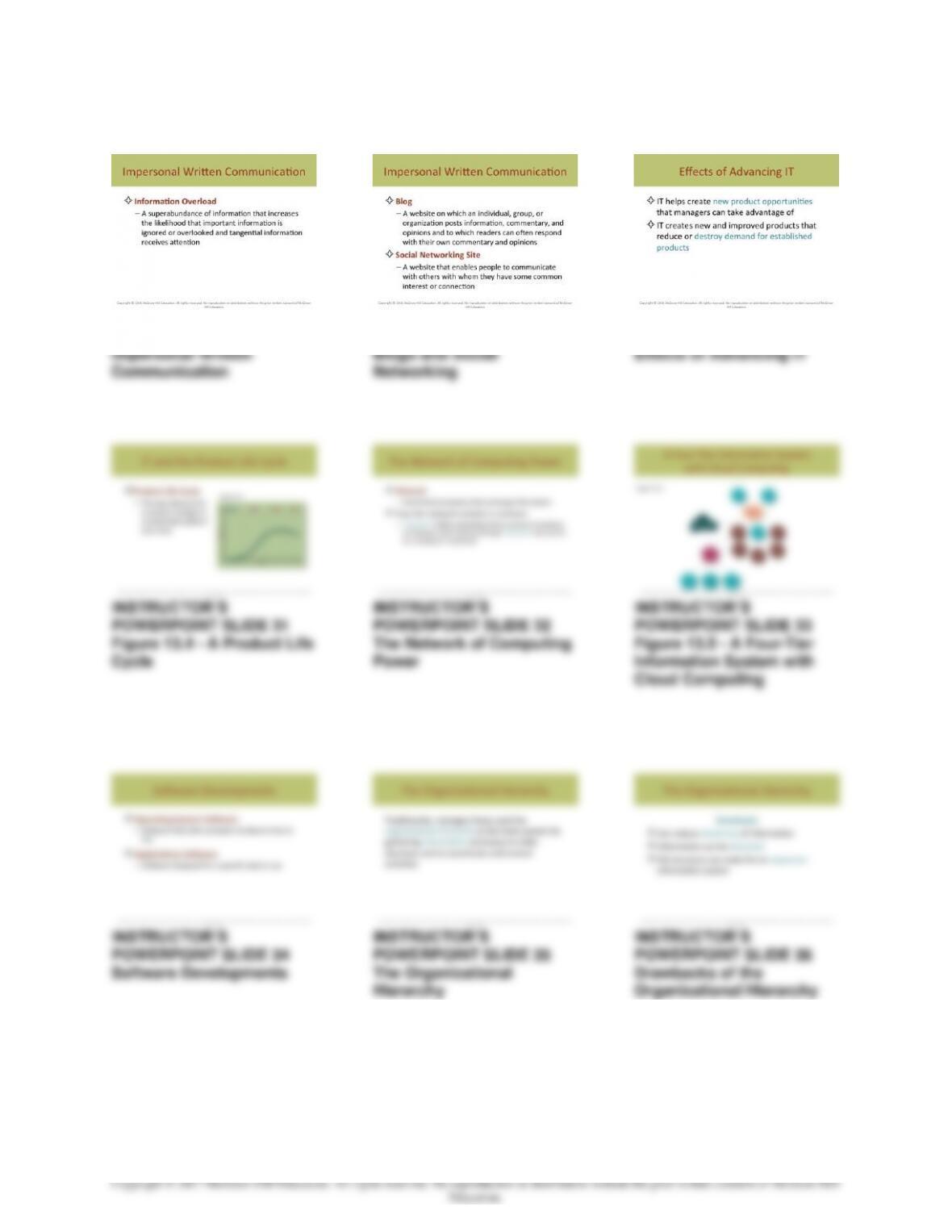
INSTRUCTOR’S
POWERPOINT SLIDE 28
INSTRUCTOR’S
POWERPOINT SLIDE 29
INSTRUCTOR’S
POWERPOINT SLIDE 30

Chapter 13 – Communication and Information Technology Management
INSTRUCTOR’S
POWERPOINT SLIDE 37
INSTRUCTOR’S
POWERPOINT SLIDE 38
INSTRUCTOR’S
POWERPOINT SLIDE 39
Chapter 13 – Communication and Information Technology Management
INSTRUCTOR’S
POWERPOINT
SLIDE 46
Business-to-Customer
Commerce
INSTRUCTOR’S
POWERPOINT
SLIDE 47
Limitations of Information
Systems
INSTRUCTOR’S
POWERPOINT
SLIDE 48
Be the Manager
INSTRUCTOR’S
POWERPOINT
SLIDE 49
Topics for Discussion
INSTRUCTOR’S
POWERPOINT
SLIDE 50
Topics for Discussion
INSTRUCTOR’S
POWERPOINT
SLIDE 51
Topics for Discussion
INSTRUCTOR’S
POWERPOINT
SLIDE 52
Topics for Discussion
INSTRUCTOR’S
POWERPOINT
SLIDE 53
Topics for Discussion