Instructor Resource
Rowe, Cases in Leadership 5e
SAGE Publications, Inc., 2019
Case Notes
Case 13.2: Women Board Directors: Championing the Tough Issues
Nancy McInerny-Lacombe wrote this teaching note under the supervision of Professor Alison M.
Konrad as an aid to instructors in the classroom use of the case Women Board Director:
Championing the Tough Issues, No. 9B13C014. This teaching note should not be used in any
way that would prejudice the future use of the case.
This publication may not be transmitted, photocopied, digitized or otherwise reproduced in any
form or by any means without the permission of the copyright holder. Reproduction of this
Teaching Note
Introduction
In an environment of heightened shareholder activism in Canada, this case investigates the
hypothesis that, compared with their male colleagues, women are the more likely champion of
tough issues at the board. Interviews with five female directors provide insight into each of their
board battles. Through the detailed enactment of their respective stories, the case presents the
Instructor Resource
Rowe, Cases in Leadership 5e
SAGE Publications, Inc., 2019
Teaching Objectives
The primary objective is to expose students to five senior female role models so they can
appreciate that women in a male-dominated environment, such as the board of directors, are able
to have a significant impact. A secondary objective is for students to understand that
Assignment Questions
1. Evaluate each mini case:
(a) First, identify the preconditions leading the woman board director to raise an
issue to the attention of the board.
(b) Next, propose the process that the woman board director should use to raise
her issue thoughtfully and in a way that will engage the other board members.
Mini Case Finales
CEO Compensation
Sandra specifically commented:
Well, the outcome was a good one because we ended up, you know, taking a defensible
approach to compensation. Despite the somewhat rocky road and the days where I
wanted to tear my hair out [laughs], I think in the end there was respect . . . for the fact
that I did . . . you know, I, I did keep them on track. Certainly when you look on the
evaluations of the HR [human resources] committee, I was wondering how that would
Stonewalled at the Board
Sally gained an unexpected ally as a result of the concurrent appointment of a new chief financial
officer (CFO) at the company. They were of like mind regarding formalized processes. Sally
CEO Management Style
Joanne was relieved that the CEO responded well at the meeting and agreed there were some
style issues that he needed to improve. The consultant became his coach, and the CEO ended up
implementing a 360 performance review across the management team, which he had originally
Board Chair Bullying
Anne explained that at the meeting with the chair where she and her colleague presented their
case regarding his management style and the direction he was taking the company, “He backed
CEO Performance
Jane ruminated:
It was a real wake-up for the group. We became a better and more diligent board. We
became aware of healthy disagreement between management and the board. We were
prepared to look at things more deeply and we are not concerned that management would
Discussion Framework
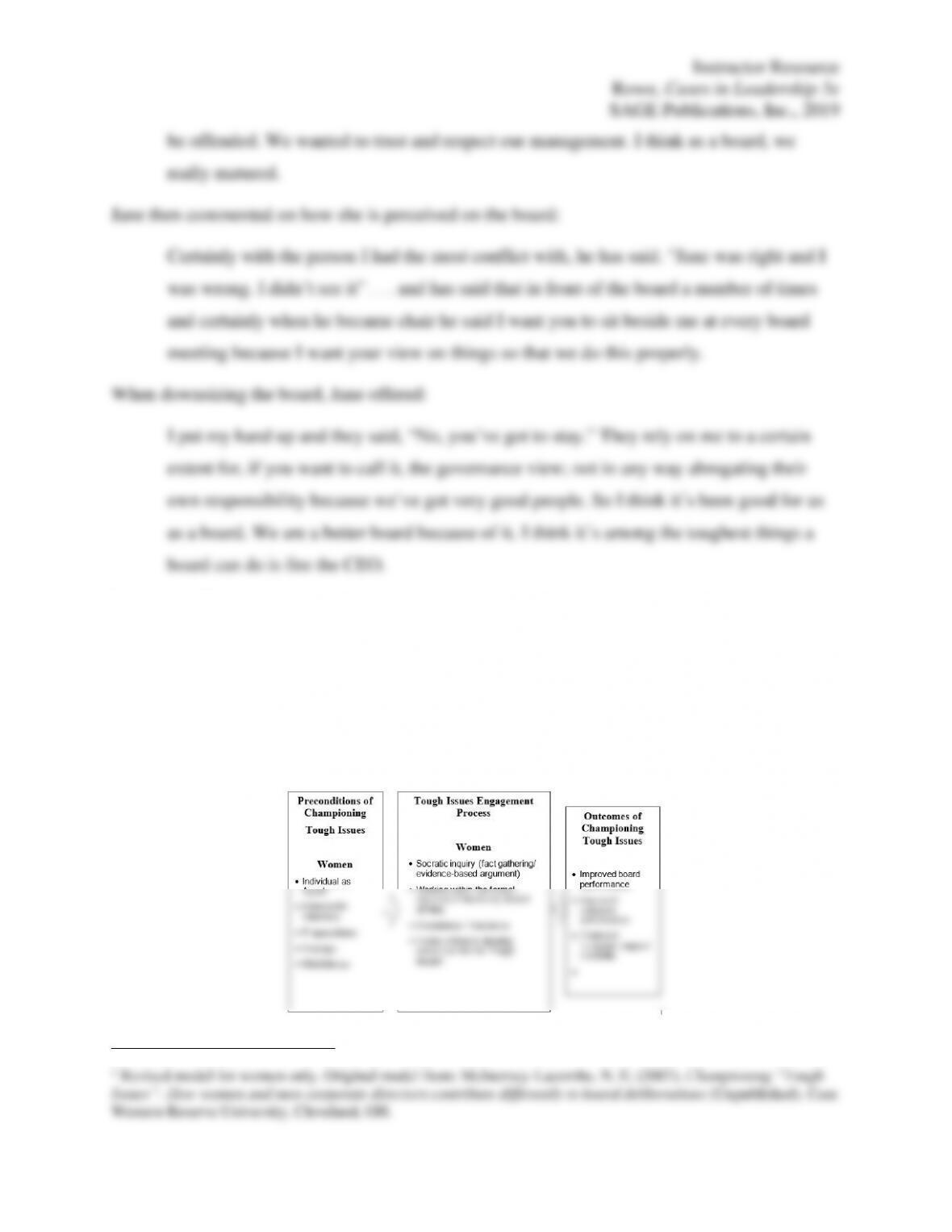
It may be helpful to the analysis for the instructor to address the commonalities and differences
of the champions within a simple framework. A championing model below is offered to guide
discussion:
“Tough Issues” Championing Process Model
1
Instructor Resource
Rowe, Cases in Leadership 5e
SAGE Publications, Inc., 2019
Preconditions of Championing Tough Issues
Individual as agent
• All champions “acted” on their tough issue. Had they not, they would have been a serious
breach of their directorship responsibilities.
Honorable intentions
Preparedness
• Sandra evidenced significant preparedness. With the help of the human resources
consultant, she researched what other companies were doing with respect to CEO
compensation. Her objections to her CEO’s compensation request were grounded in
Instructor Resource
Rowe, Cases in Leadership 5e
SAGE Publications, Inc., 2019
• Jane was exceptionally well prepared, having gathered evidence for a period of two
years.
Courage
• Although not one champion articulated the word courage, it takes enormous courage to
break from the group to champion a tough issue that the group either would rather not
address and/or would support an opposing position:
1. Sandra faced significant opposition to her fact-based stance on compensation.
Mindfulness
• Each champion evidenced mindfulness:
1. Sandra was very mindful that discussions could be taking place “outside the
3. Joanne recognized that her male directors were uncomfortable dealing with
the “soft stuff.”
5. Jane alone noticed the signals regarding poor CEO performance.
Teaching Plan: 80 minutes
0:00—Case introduction
Instructor Resource
Rowe, Cases in Leadership 5e
SAGE Publications, Inc., 2019
Globally, women hold about 15 per cent of seats on the boards of directors of the largest
corporations in Canada,
2
the United States and the European Union. Interviews with women
directors on these boards suggest that they play the very important role of asking the hard
questions and raising the difficult issues that the male directors might tend to ignore.
3
This case
provides five examples of raising challenging issues as a woman director on a corporate board.
The purpose of discussing these cases is three-fold:
1. To identify the preconditions leading people to raise challenging issues in decision-
making teams,
0:05—Preconditions of issue-raising
Let’s begin by discussing what caused each woman board director to raise a difficult issue with
her board.
• First, why did Sandra raise the issue of compensation? Did she have good reasons to
challenge the board on this topic? If so, why didn’t the other board members raise the
issue themselves?
Instructor Resource
Rowe, Cases in Leadership 5e
SAGE Publications, Inc., 2019
• Why did Joanne challenge the CEO’s management style? Why did the other board
members resist doing this? Did she have a solid rationale for her actions?
• Why did Anne raise the issue of the chair’s leadership style? What was her objective in
0:20—Commonalities regarding factors leading to issue-raising
• What commonalities do you see across these five cases regarding the factors that caused
the women to challenge their boards?
• Do personal factors affect the likelihood of raising a difficult issue?
• What factors in a situation affect the likelihood of raising a difficult issue in a decision-
0:30—Processes—how to champion tough issues effectively
Let’s turn to the question of how to do it—how can women ask difficult questions or raise tough
issues in a male-dominated environment in a way that raises the probability that they will be
heard and the board will engage with their issues?
• In raising the issue of CEO compensation on her board, what did Sandra do that was
effective? What did she do that was ineffective?
Instructor Resource
Rowe, Cases in Leadership 5e
SAGE Publications, Inc., 2019
0:45—Commonalities regarding effective processes for raising challenging issues
• What commonalities do you see across these five cases, regarding the influence processes
the women used to challenge their boards?
• What conclusions can you draw regarding how to raise a difficult issue effectively in a
0:55—Share outcome of each case in turn
• For each case: Did you expect this outcome? Why or why not?
0:65—Outcomes for individuals and organizations
Let’s draw some conclusions regarding the impacts of raising difficult issues in organizations.
• Is it good or bad for companies if people in decision-making teams ask difficult questions
and raise challenging issues?
Instructor Resource
Rowe, Cases in Leadership 5e
SAGE Publications, Inc., 2019
0:75—Lessons learned
• Show slide with “Championing Process Model”