Chapter 12 – Developing Business/IT Solutions
12-1
12 Developing Business/IT Solutions
CHAPTER OVERVIEW
Chapter 12: Developing Business/IT Solutions introduces the traditional, prototyping, and end-user approaches to
LEARNING OBJECTIVES
1. Use the systems development process outlined in this chapter and the model of IS components from Chapter 1
as problem-solving frameworks to help you propose information systems solutions to simple business problems.
SUMMARY
• The Systems Development Life Cycle. Business end users and IS specialists may use a systems approach to help
them develop information system solutions to meet business opportunities. This frequently involves a systems
• Prototyping. Prototyping is a major alternative methodology to the traditional information systems development
• End-User Development. The application development capabilities built into many end–user software packages
have made it easier for end users to develop their own business applications. End users should focus their
development efforts on the system components of business processes that can benefit from the use of information
technology, as summarized in Figure 12.14 .
• Implementing IS. The implementation process for information system projects is summarized in Figure 12.27 .
Chapter 12 – Developing Business/IT Solutions
• Evaluating Hardware, Software, and Services. Business professionals should know how to evaluate the
acquisition of information system resources. IT vendors’ proposals should be based on specifications developed
KEY TERMS AND CONCEPTS
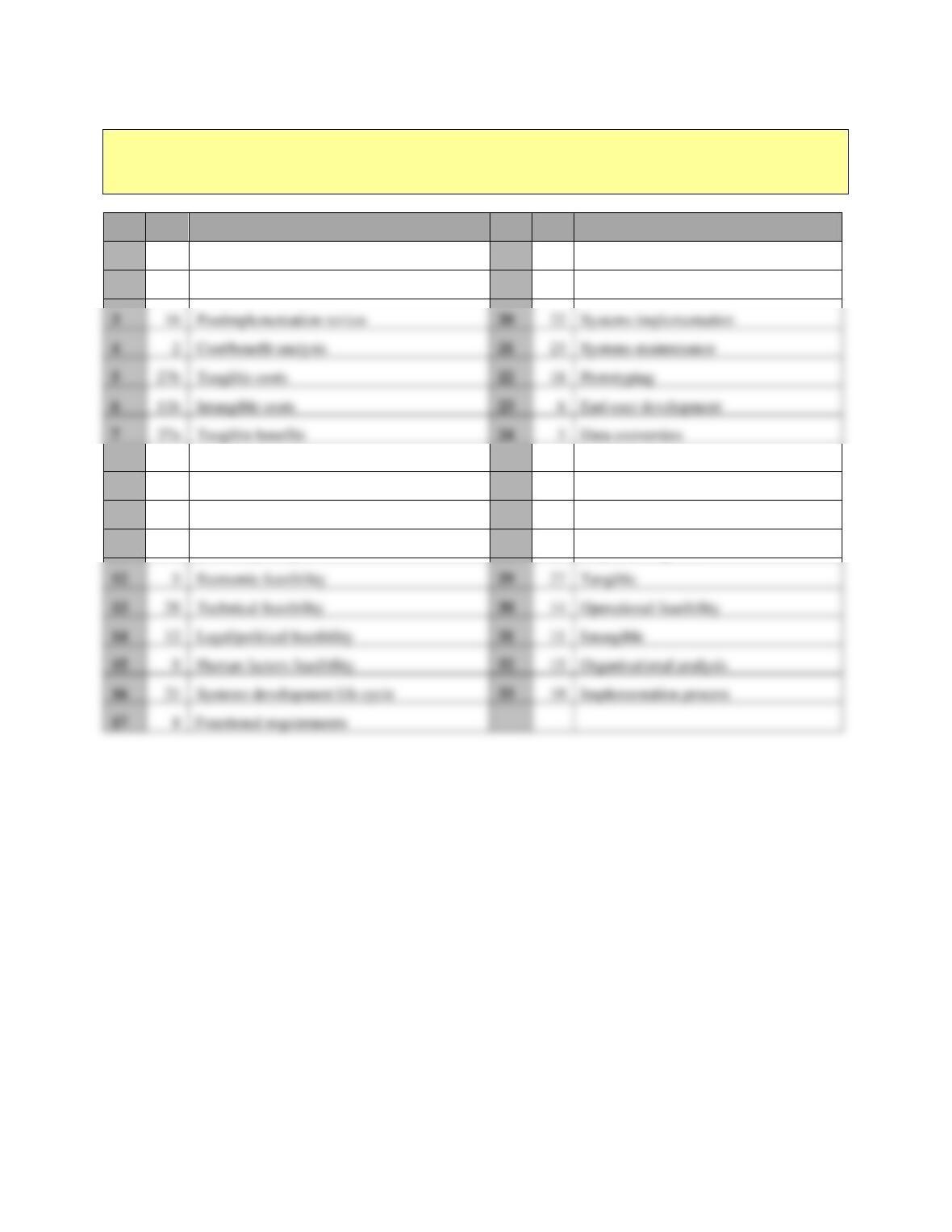
1. Conversion (514):
Conversion is the process in which the hardware, software, data resources, and users of an old information
2. Cost/benefit Analysis (488):
Identifying the advantages or benefits and the disadvantages or costs of a proposed solution.
3. Data Conversion (512):
4. Documentation (513):
Documentation serves as a method of communication among the people responsible for developing,
5. Economic Feasibility (487):
6. End User Development (497):
End user developed applications are applications written by managers and business specialists rather than
professional programmers.
7. Feasibility Study (486):
8. Functional Requirements (492):
9. Human factors feasibility (489)
Chapter 12 – Developing Business/IT Solutions
10. Implementation Process (503):
The implementation process typically requires a project management effort on the part of IT and business unit
11. Intangible (488):
Not quantifiable yet still meaningful.
a. Benefits (488):
Meaningful but difficult to measure benefits of a proposed solution. Employee moral or customer goodwill
12. Legal/Political Feasibility (489):
13. Logical Model (491):
A blueprint of a system that displays only what the system does (or should do) without regard for how it does it.
14. Operational feasibility (487):
16. Postimplementation Review (516):
Measuring and evaluating the results of a completed project to ensure it has met its stated goals and objectives.
17. Project Management (507):
18. Prototyping (493):
The rapid development and testing of working models of new information system applications in an interactive,
iterative process involving systems analysts, programmers, and end users.
19 Systems Analysis and design (485):
Evaluating an organization’s information needs in order to specify the requirements for an application intended
20. Systems Approach (482):
Chapter 12 – Developing Business/IT Solutions
12-4
21. Systems Development Life Cycle (485):
(1) Conceiving, designing, and implementing a system, (2) Developing information systems by a process of
22. Systems Implementation (503):
23. Systems Maintenance (516):
The monitoring, evaluating, and modifying of a system to make desirable or necessary improvements.
24. System Specifications (497):
25. Systems Thinking (482):
Trying to recognize systems and the new interrelationships and components of systems in any situation.
26 System Testing (512):
27. Tangible (488):
Quantifiable, measurable.
28. Technical Feasibility (488):
29. User Interface Design (495):
Chapter 12 – Developing Business/IT Solutions
12-5
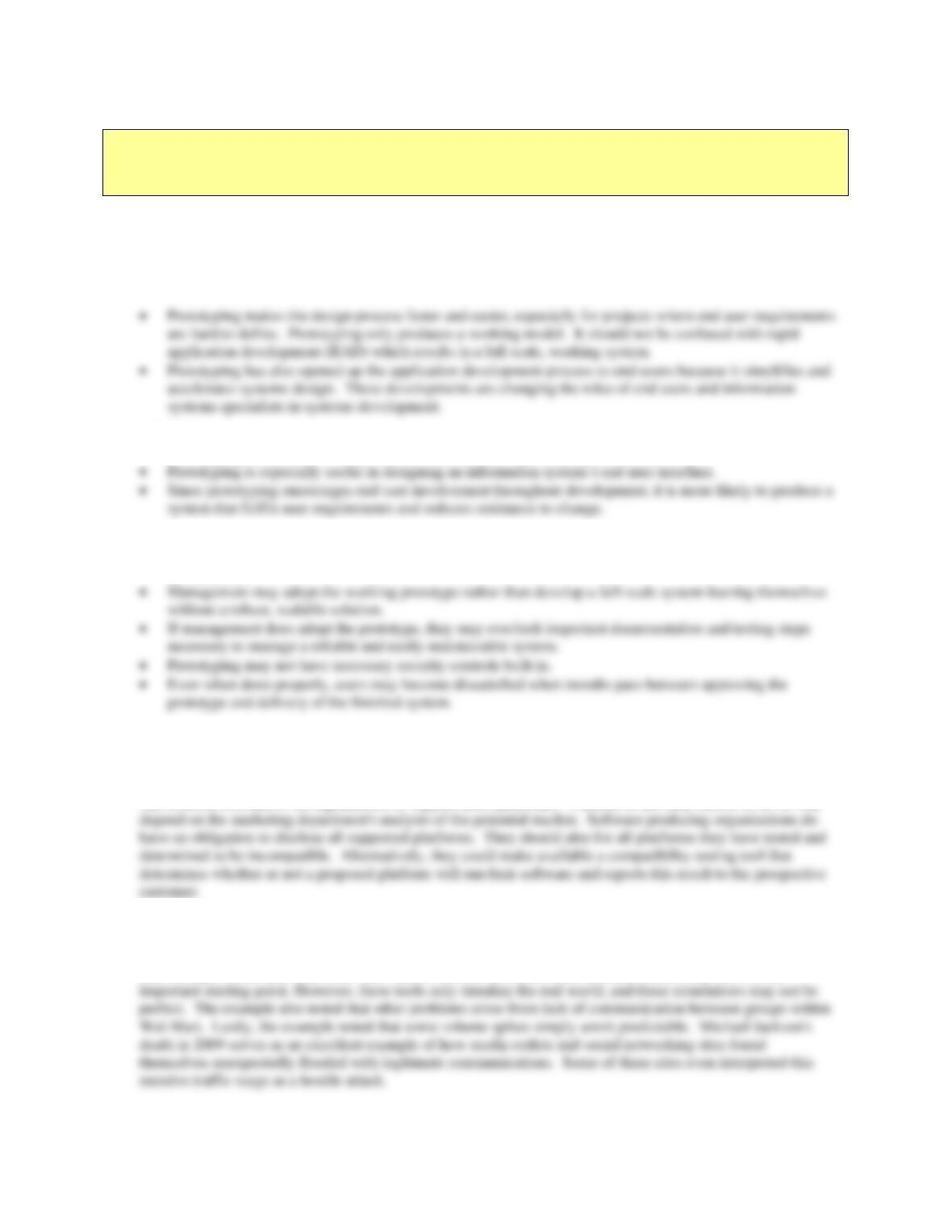
ANSWERS TO REVIEW QUIZ
Q.
A.
Key Term
Q.
A.
Key Term
1
19
Systems analysis and design
18
29
User interface design
2
25
Systems thinking
19
24
Systems specifications
8
11a
Intangible benefits
25
1
Conversion
9
20
Systems approach
26
26
System testing
10
13
Logical model
27
4
Documentation
11
7
Feasibility study
28
17
Project management
12
5
Economic feasibility
29
27
Tangible
13
28
Technical feasibility
30
14
Operational feasibility
15
9
Human factors feasibility
32
15
Organizational analysis
16
21
Systems development life cycle
33
10
Implementation process
17
8
Functional requirements
3
16
Postimplementation review
20
22
Systems implementation
4
2
Cost/benefit analysis
21
23
Systems maintenance
5
Tangible costs
22
18
Prototyping
6
Intangible costs
23
6
End-user development
7
Tangible benefits
24
3
Data conversion
Chapter 12 – Developing Business/IT Solutions
12-6
ANSWERS TO DISCUSSION QUESTIONS
1. Why has prototyping become a popular way to develop business applications? What are prototyping’s
advantages and disadvantages?
Popularity: Prototyping is the rapid development and testing of working models of new applications in an
interactive, iterative process involving both IS specialists and business professionals.
Advantages:
• Prototyping is most useful when there is some uncertainty about requirements.
Disadvantage:
• The prototype may not accommodate large quantities of data or a large number of users in a production
environment.
2. Refer to the Real World Case on Microsoft, SiCortex, and Others in the chapter. Does the ability of
virtualization technology to provide developers with multiple combinations of operating systems and
applications mean that companies should be required, or expected, to support all possible ones? Discuss.
The reduced cost allows an organization to support more platforms. Whether or not they choose to do so will
3. Review the real-world example about Wal-Mart and Others in the chapter. How could these companies
prepare for the unexpected changes in demand that brought down their Web sites? Explain your reasoning.
The example stated that Wal-Mart uses various tools to stress-test their website. These tools serve as an

Chapter 12 – Developing Business/IT Solutions
12-7
Preparations:
• Improve testing
4. What are the three most important factors you would use in evaluating computer hardware? Computer
software? Explain why.
Hardware:
• Software availability
• Reliability
Computer software:
• Hardware platforms
• Reliability
5. Assume that in your first week on a new job you are asked to use a type of business software that you
have never used before. What kind of user training should your company provide to you before you start?
Formal training:
Formal training includes formal classes which include hands on exercises in a training environment. These
Chapter 12 – Developing Business/IT Solutions
6. Refer to the Real World Case on WestJet, JetBlue, and Others in the chapter. In general, is it a good idea
for companies to make major software upgrades public beforehand? What are the advantages and
disadvantages of doing so? Do they have an ethical responsibility to tell their customers? Discuss.
Forewarning – in general, no. Upgrades are frequent and frequently transparent to the customer. If all
organizations warn all customers prior to all significant upgrades, customers will simply learn to ignore these
7. What is the difference between the parallel, direct, phased, and pilot forms of IS conversion? Which
conversion strategy is best? Explain why.
Parallel conversion operates both the old and the new system for a limited time.
8. Review the Google real-world example in the chapter. How might you change the user interface of
Google’s search pages and those of some of its other products on the Web? Defend your proposals.
UI change approach
Google should make a list of features common between applications. Those features which appear in the largest
9. Review the real-world example discussing the factors involved in project failure in the chapter. If these
are well-known, why would companies choose to ignore them over and over again? What could be the reasons
behind such behavior?
Since the causes are known and software development is not a new endeavor, the best explanation would be
12-9
10. Pick a business task you would like to computerize. How could you use the steps of the information
systems development life cycle as illustrated in Figure 12.3 to help you? Use examples to illustrate your
answer.
The SDLC provides a logical guideline for the students to follow in their computerization efforts. Note that
ANSWERS TO ANALYSIS EXERCISES
1. SDLC in Practice
Note: Just as developers follow the SDLC in stages, instructors may consider breaking down this project into
its constituent parts for assignment. This also makes a great team project. Students completing this task
through implementation might want to put it on their resume.
Project examples:
• Cigarette litter
a. Select a problem and quantify its effects.
It helps if instructors require students to receive topic approval prior to starting work. Try to keep the projects
small and manageable yet not trivial.
b. Identify the cause or causes of the problem.
c. Describe various solutions to this problem. Include estimated costs and benefits for each solution.
d. Select a solution and prepare a plan for its implementation.
Consider requiring an implementation and maintenance plan without requiring actual implementation.
e. Identify the parties responsible for monitoring and maintaining the solution. What metrics should they
use to monitor the results?
Chapter 12 – Developing Business/IT Solutions
12–10
2. Planning for Success
Note:
Students will complete many projects during their academic careers, but how often do they stop and think about
a. Read the article “How to Create a Clear Project Plan,” Darwin Magazine , August 2004 (
Note: the link referenced above has subsequently moved.
1
Students can find the article by searching for its
title.
b. Read through the “SDLC in Practice” exercise above, and select a problem as directed by your professor.
A sample problem might include cigarette litter outside the business school building entrances. Consider the
guidelines suggested for problem selection in the SDLC application exercise.
c. Prepare a project plan for the problem you selected above.
Here’s a project plan outline you may consider adopting. Consider using Microsoft Project to manage the tasks,
dependencies, and schedule.
• Project description
d. Present your project plan to your class. Solicit your peers’ suggestions for improvement.
3. Americans with Disabilities Act
Note:
Very few students have experience either directly or through a friend or family member with these issues.
However, students who anticipate moving into management positions should familiarize themselves with these
issues.
Research information systems access solutions. Be sure to include a detailed description of the hardware or
software solution, solution provider, and costs for accommodating each limitation listed below.
a. Partial visual impairment
1
http://www.northalabamapmi.org/documents/papers/2006_How_to_create_a_clear_project_plan.pdf
Chapter 12 – Developing Business/IT Solutions
12–11
b. Total visual impairment
c. Manual dexterity impairment
The following websites provide useful information about types of products and manufacturers:
4. Central London Congestion Charging Scheme
Note: students should be able to apply their studies to real-world problems. This particular problem allows
students to relate conversion strategies to a real-world situation with which they may have some familiarity:
traffic congestion. This example may also give students a preview of the future of traffic management.
a. Briefly describe the advantages and disadvantages of each conversion strategy (parallel, pilot, phased,
and plunge) as they apply to the Central London Congestion Charging Scheme project.
Parallel:
By bringing the system online – but refraining from collecting tolls – project managers can assess the entire
system’s performance without upsetting drivers with any toll collecting errors. In fact, drivers wouldn’t even
Pilot:
While London might test their toll charging scheme on a smaller city, it isn’t likely to find one that would
volunteer. By testing on a few roads heading into London, developers could ensure that critical technologies
Phased:
A phased approach would give the developers obtain real-world data and the opportunity to work out
Direct:
No set of testing methods can substitute for real-world volumes and malfunctions one can expect from such a
massive system implementation. Given the public’s presumed sensitivity about a toll-charging system, the city
government can ill afford embarrassing bugs. Flipping the switch on this system is asking for a public relations
disaster.
b. Which conversion strategy would you recommend for this project?
Phased.
Chapter 12 – Developing Business/IT Solutions
12–12
c. Defend your recommendation in detail.
The phased approach allows developers to catch problems with system components, make changes, and
ANSWERS TO REAL WORLD CASES
RWC 1: Microsoft, SiCortex, and Others
Case Study Questions
1. How does virtualization work? In your own words, describe what you understand about the virtualization
process as depicted in the case.
Virtualization simulates a computing platform onto which an administrator can install an operating system and
2. In software development and testing, where does virtualization help, and where does it not help? Why?
Helpful
• Saves time preparing test environments
3. What are the business benefits of implementing virtualization technologies in software development?
Classify them into those that enhance the effectiveness and the efficiency of the development and testing
process.
Effectiveness
Easier to test on more environments
Chapter 12 – Developing Business/IT Solutions
Real World Activities
1. Go online and research other users of virtualization technology (backup and disaster recovery being one
of those). How do those differ from the ones described in the case? How are they similar? Prepare a report to
summarize your findings.
Considerable efforts are being made to virtualize datacenters. This approach enables greater load-balancing
2. If virtualization technology were to eventually allow end users to run any environment of their choice in
the same device, does that mean the choice of computing platform (desktop, notebook, smartphone;
Windows, Linux, Mac OS) becomes irrelevant? Break into small groups to discuss this issue.
Hardware platforms
Hardware platforms are constrained by size, weight, heat produced, energy consumed, operating systems
RWC 2: JetBlue Airways, WestJet Airlines, and Others
Case Study Questions
1. In the case, both airlines upgraded to the same application but approached the upgrade process differently.
What were those differences, and how much impact did they have on the outcome of the project?
Differences
• WestJet went first, JetBlue observed
2. What precautions did the organizations in the case take to prevent software upgrade problems? To what
extent do you believe those helped?
Precautions
• JetBlue observed WestJet’s implementation and learned from it
Chapter 12 – Developing Business/IT Solutions
12–14
3. SAP customers have the choice between upgrading to the most recent version of the application suite or
integrating third-party products into their existing infrastructure. What are the advantages and
disadvantages of each alternative?
Upgrade advantages
• Many new features immediately available
• Faster future implementations
Real World Activities
1. Why are ERP upgrades so complex and expensive? What role does ERP customization, if any, play in
this process? Go online and research other examples discussing ERP upgrades. Can you discern a pattern in
what seems to be the major cost drivers of the upgrade process?
2. Place yourself in the position of a WestJet or JetBlue customer while the upgrading was being
implemented. What, if anything, would you have done differently had the companies told you that a major
software upgrade would be happening soon? Should they have told you? Break into small groups with your
classmates and discuss these questions.
I would try to fly with a different airline until the crisis had past.
Chapter 12 – Developing Business/IT Solutions
12–15
RWC 3: PayPal
Case Study Questions
1. One of the challenges that PayPal faces now that they have managed to overcome the polylingual obstacle
is finding the best way to put this functionality in the hands of the business, so that they do not have to go
through IT each time. How do you balance this need for responsiveness and flexibility versus IT’s need to
keep some degree of control to make sure everything keeps working with everything else? Provide some
recommendations to managers who find themselves in this situation.
Balance: IT needs to control the architecture while business needs to control the content. Putting content into
2. PayPal opted to deviate from industry standards and build their own custom technology that would
better suit their needs. When is it a good idea for companies to take this alternative? What issues factor into
that decision? Provide a discussion and some examples.
Strategy: if a business uses customization to do something significant no one else is doing, whether cost
3. Although the new system has been quite successful, Pay– Pal has chosen not to license this technology to
others, forgoing a potentially important revenue stream given the lack of good solutions to this problem. Why
do you think PayPal chose not to sell this technology? Do you really think this can be made into a strategic
advantage over their competitors? How easy would it be for their competitors to imitate this
accomplishment?
Possible reasons not to sell:
• the technology may not be mature enough to sell

Chapter 12 – Developing Business/IT Solutions
12–16
Real World Activities
1. Choose two or three companies with global operations that interest you and visit their Web sites for
countries other than the United States. Even if you are not familiar with the language, do the Web sites have
the same look and feel of the U.S. site? In which ways are they similar, and in which ways are they different?
If you did not know, would you have guessed it was the same company? Prepare a presentation with
screenshots to share your findings with the rest of the class.
Examples
Apple: Apple’s websites’ look and feel remained largely the same between regions. However, English still
appeared on the main navigation toolbar and within some of the graphics on several language versions. The
Russian, Spanish, and Mexican versions had no such problem with the toolbar. Indeed, it was interesting to
2. Although PayPal opted for a centralized approach to keep consistency across Web site appearance and
content, other companies let both of these vary for each of the countries in which they operate. When would
you use one or the other approach? Would it depend on the company, products offered, markets, countries,
or on another factor? Break into small groups with your classmates to discuss these issues.
Localization criteria: if an organization is decentralized, then allowing local control over its website is
probably unavoidable. If an organization wishes to communicate that it provides consistent service regardless
Chapter 12 – Developing Business/IT Solutions
12–17
RWC 4: Queen’s Medical Center, National Public Radio, Worldspan, and Others
Case Study Questions
1. The case notes that a changing environment or business priorities can render an ongoing project obsolete
even before it has been completed. What alternatives do CIOs who find themselves in this situation have with
respect to dealing with the troubled project? Would you go ahead and finish it, or scrap it altogether? How
would you justify either position?
Alternatives:
• finish the project
2. Do you agree with the statement: “Application backlog is not a problem one solves, it’s a condition one
lives with”? Why or why not? To the extent that it is true, how can IT executives manage things differently to
make this situation more approachable? Provide some specific suggestions.
Agree: we all have backlogs of things we want to purchase or do. It’s a fact of life, and it’s true even more so
for IT where the environment continually changes.
3. Susan Powers at Worldspan says she addresses the backlog problem by positioning her IT organization
as a resource that should be used and managed in the most effective manner, like any other a company may
have. What do you think of this approach? Is IT really like any other resource? In which way is IT different
than other areas of a company like marketing or finance?
Agree: the “resource” shouldn’t dictate how its used; that’s within the domain of the business leaders.
Chapter 12 – Developing Business/IT Solutions
12–18
Real World Activities
1. Go online and search the Internet to discover how typical the experiences reported in the case are for other
companies in different industries. How are the ones you discover addressing these issues? How similar or different
are those strategies with the ones discussed in the case? Prepare a report to summarize your findings.
How common? Common. “The State of the CIO 206” survey of 500 CIOs by CIO.com indicated that “the
2. Which of the following strategies do you think IT executives should adopt to improve their current
situation: reject new projects, attempt to increase staff and funding, prioritize often, or all of the above?
Break into small groups with your classmates to discuss these and other strategies you may have thought of;
compare and contrast advantages and disadvantages of each.
Reject: this would not be a politically viable solution. It would give the IT director veto power over any other
business leader. Such an approach might also cause compliance problems for government or regulatory
required projects.