Chapter 12 – Motivating Employees: Achieving Superior Performance in the Workplace
12-1
12
Chapter
Motivating Employees:
Achieving Superior Performance in the Workplace
Major Questions the Student Should Be Able to Answer 2
Mapping the Class: Chapter Outline 3
Overview of the Chapter 4
CHAPTER CONTENTS
Chapter 12 – Motivating Employees: Achieving Superior Performance in the Workplace
12-2
12.1 Motivating for Performance
MAJOR QUESTION: What’s the motivation for studying motivation?
12.4 Job Design Perspectives on Motivation
MAJOR QUESTION: What’s the best way to design jobs – adapt people to work or work
to people?
MAJOR QUESTIONS THE STUDENT SHOULD BE ABLE TO ANSWER
Chapter 12 – Motivating Employees: Achieving Superior Performance in the Workplace
12-3
12.1 Motivating for Performance
12.2 Content Perspectives on Employee Motivation
• Maslow’s Hierarchy of Needs Theory: Five Levels
12.3 Process Perspectives on Employee Motivation
• Equity Theory: How Fairly Do You Think You’re Being Treated in Relation to
12.4 Job Design Perspectives on Motivation
• Fitting People to Jobs
12.5 Reinforcement Perspectives on Motivation
12.6 Using Compensation and Other Rewards to Motivate
• Is Money the Best Motivator?
MAPPING THE CLASS: CHAPTER OUTLINE
Chapter 12 – Motivating Employees: Achieving Superior Performance in the Workplace
12-4
12.1 Motivating for Performance
Motivation is defined as the psychological processes that arouse and direct
people’s goal-directed behavior. The model of how it works is that people have
12.2 Content Perspectives on Employee Motivation
Content perspectives are theories emphasizing the needs that motivate people.
12.3 Process Perspectives on Employee Motivation
Process perspectives, which are concerned with the thought processes by
12.4 Job Design Perspectives on Motivation
Job design, the division of an organization’s work among employees, applies
12.5 Reinforcement Perspectives on Motivation
Reinforcement theory suggests behavior will be repeated if it has positive
12.6 Using Compensation and Other Rewards to Motivate
Compensation, the main motivator of performance, includes pay for
OVERVIEW OF THE CHAPTER
Chapter 12 – Motivating Employees: Achieving Superior Performance in the Workplace
The Manager’s Toolbox: Managing for Motivation: Keeping Employees Invested in
Their Jobs
In order to motivate their employees, more employers are offering work rewards and
incentives called work–life benefits. These rewards remove barriers that make it hard
• Do I know what’s expected of me?
• Do I have the right materials and equipment I need to do my work right?
• Do I have the opportunity to do what I do best every day?
• In the last seven days, have I received recognition or praise for good work?
• Does my supervisor, or someone at work, seem to care about me as a person?
The best managers meet with workers individually at least every three months and they
not only discuss performance but also try to find out what employees want to
accomplish and how the manager can help. In addition, good managers focus on
strengths, rather than weaknesses, allowing employees to devote time to what they do
best.
Possible Topics for Discussion:
• Which 3 of the 12 questions listed above are most important to you? Which do
you think are most important to most employees?
CLASSROOM OUTLINE
Section 12.1 discusses motivation, which is defined as the psychological processes that
arouse and direct people’s goal-directed behavior. The four major perspectives on
motivation are need-based, process, job design, and reinforcement.
One way that you could begin your coverage of these topics is to have the students
Possible Topics for Discussion:
• Discuss why it is important for managers to understand how to motivate their
employees.
• Think back to the favorite job you have ever had. Describe the intrinsic rewards
Major Idea Outline:
A. People are mainly motivated to fulfill their wants and their needs.
B. Motivation can be defined as psychological processes that arouse and
direct goal-related behavior.
1. Motivation must be inferred from one’s behavior; it can’t be seen.
2. Motivation is the result of multiple personal and contextual factors.
a. The individual personal factors that employees bring to the
3. Motivation can also be expressed in a simple model (Figure 12.2).
a. People have certain needs that motivate them to perform specific
12.1 Motivating for Performance (pp. 376-378)
What’s the motivation for studying motivation?
Chapter 12 – Motivating Employees: Achieving Superior Performance in the Workplace
12-7
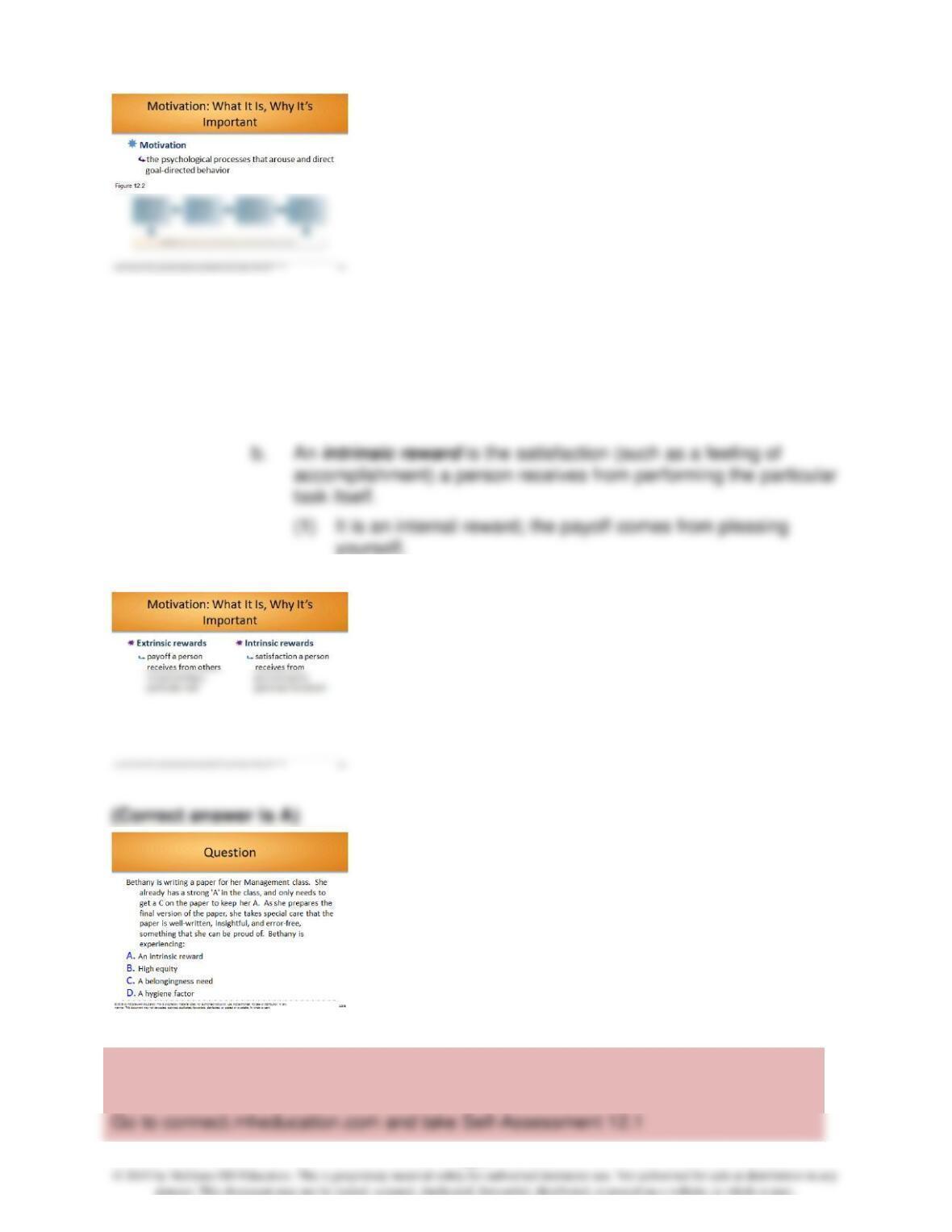
4. Rewards are of two types: extrinsic and intrinsic.
a. An extrinsic reward is the payoff (such as money) a person
receives from others for performing a particular task.
(1) It is an external reward; the payoff comes from pleasing
others.
SELF-ASSESSMENT 12.1 (p. 378)
Are You More Interested in Extrinsic or Intrinsic Rewards?
Chapter 12 – Motivating Employees: Achieving Superior Performance in the Workplace
12-8
Student Questions:
1. What is more important to you, extrinsic or intrinsic rewards? Are you
surprised by the results?
Students may be surprised at how important intrinsic rewards are for them.
2. How can you use the results to increase your motivation to obtain good
grades in your classes?
Students should not only look at factors such as grade point averages when
rewards for himself or herself for obtaining good grades in classes.
3. If you were managing someone like yourself, what would you do to increase
the individual’s motivation?
Additional Activities:
You can also consult the Connect Instructors Manual for the post-assessment activity
and corresponding PowerPoint slides used for this Self-Assessment in Connect. In
this activity, students should be put into groups based on their Self-Assessment
5. Organizations want to motivate their employees to be more productive.
As a manager, you want to motivate people to:
Chapter 12 – Motivating Employees: Achieving Superior Performance in the Workplace
12-9
C. The Four Major Perspectives on Motivation: Overview
1. There is no theory accepted by everyone as to what motivates people.
Group Exercise #1: Using Extrinsic and Intrinsic Rewards to Motivate Student
Achievement?
There is a group exercise available at the end of this manual that provides students
with the opportunity to better understand extrinsic and intrinsic rewards.
Exercise Objectives
• To identify extrinsic and intrinsic rewards that motivate student achievement.
Section 12.2 discusses content perspectives on employee motivation. Content
12.2 Content Perspectives on Employee Motivation (pp.
379-385)
What kinds of needs motivate employees?
Chapter 12 – Motivating Employees: Achieving Superior Performance in the Workplace
12–10
One way that you could begin your coverage of these topics is to assign teams of 4-5
students one of the content or process theories of motivation described in the chapter,
Possible Topics for Discussion:
• Of the various needs described in the content theories, which ones seem to be
the most insightful in explaining what motivates you?
Major Idea Outline:
A. Content perspectives, also known as need-based perspectives, are
theories that emphasize the needs that motivate people.
1. Needs are defined as physiological or psychological deficiencies that
arouse behavior.
2. Needs are influenced by environmental factors; they can vary over
time and from place to place.
B. Maslow’s Hierarchy of Needs Theory: Five Levels of Human Needs
1. The hierarchy of needs theory, developed by Abraham Maslow,
proposes that people are motivated by five levels of needs:
a. physiological
Chapter 12 – Motivating Employees: Achieving Superior Performance in the Workplace
3. Maslow suggested that needs are never completely satisfied.
4. Our actions are aimed at fulfilling the “deprived” needs, those that
remain unsatisfied at any point in time.
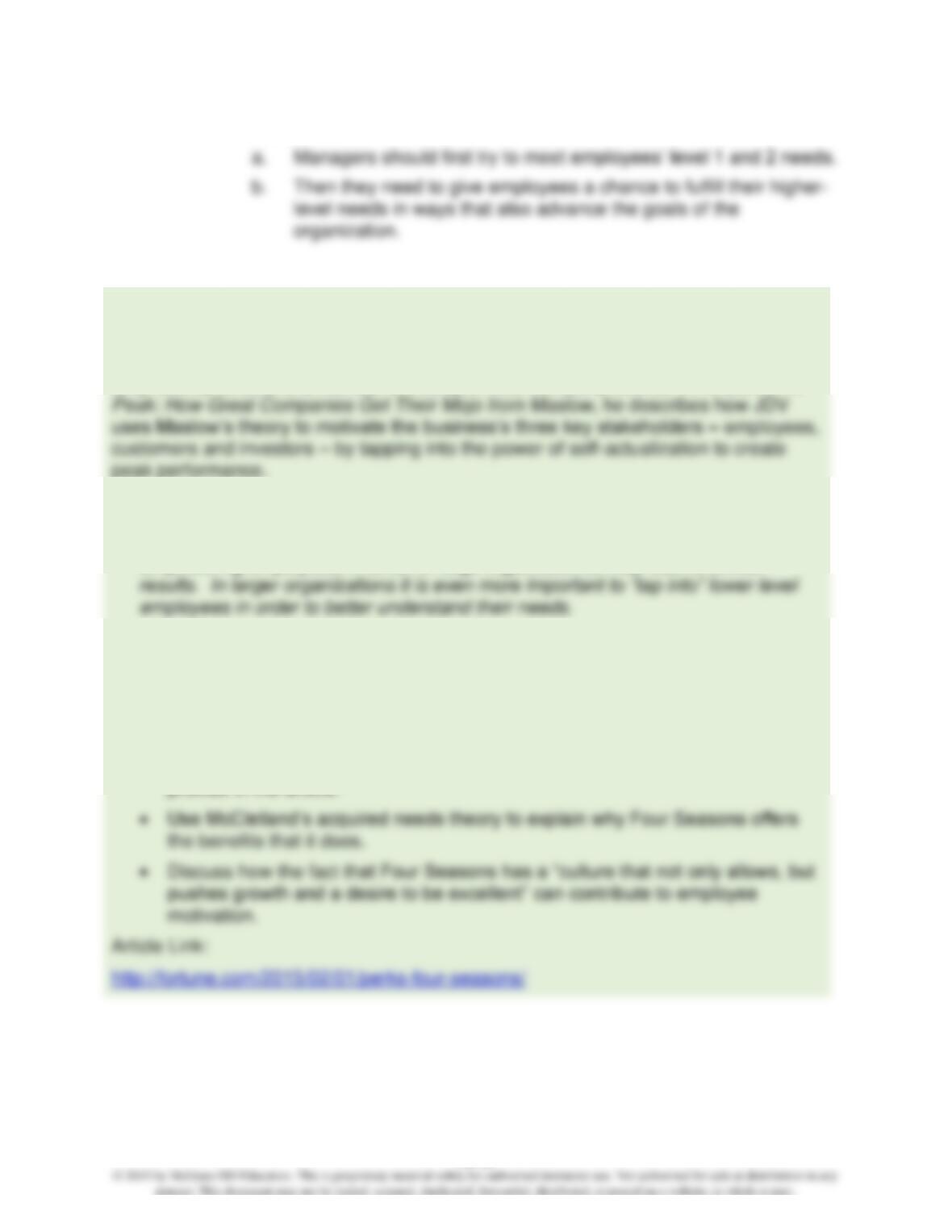
5. In order of ascendance, from bottom to top, the five levels of needs
are:
a. Physiological needs. These are basic human needs, such as
food, clothing, shelter and comfort, as well as self-preservation.
6. Research does not clearly support Maslow’s theory, although it
remains popular among managers.
Chapter 12 – Motivating Employees: Achieving Superior Performance in the Workplace
12–12
7. Maslow showed that workers have needs beyond that of just earning a
paycheck.
Interactive Classroom Material:
EXAMPLE: Looking for Peak Performance: A Hotel CEO Applies Maslow’s
Hierarchy to Employees, Customers, & Investors (p. 380)
Chip Conley is CEO and founder of boutique hotel company Joie de Vivre (JDV). In
YOUR CALL
To what extent can Chip Conley’s ideas be used in larger organizations?
Empowering employees, in small or large organizations, may lead to similar
Additional Activities:
One way to build on this Example is to have the students read the Fortune online
article “5 Great Reasons to Work for Four Seasons.” This article profiles how another
luxury hotel, Four Seasons, motivates its dedicated workforce with top-notch benefits
programs. Consider using the following discussion questions:
• Use Maslow’s theory to classify the various benefits offered by Four Seasons
profiled in the article.
Chapter 12 – Motivating Employees: Achieving Superior Performance in the Workplace
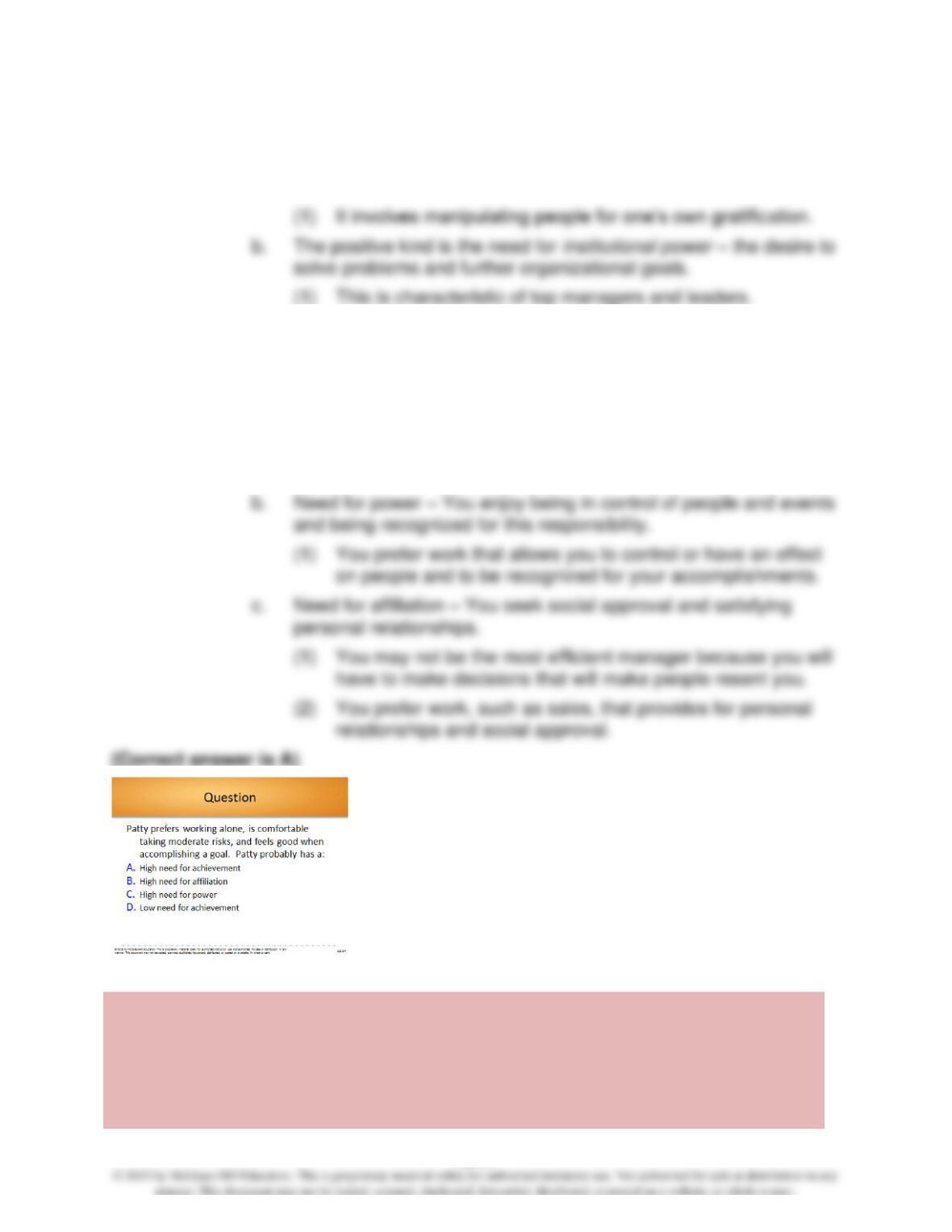
C. McClelland’s Acquired Needs Theory: Achievement, Affiliation and Power
1. The acquired needs theory states that three needs – achievement,
affiliation, and power – are major motives determining people’s
3. The needs, one of which tends to be dominant in each of us, are:
a. Need for achievement – the desire to excel, to do something
Chapter 12 – Motivating Employees: Achieving Superior Performance in the Workplace
12–14
4. McClelland identifies two forms of the need for power:
a. The negative kind is the need for personal power – the desire to
dominate others.
5. McClelland associates the three needs with different sets of work
preferences:
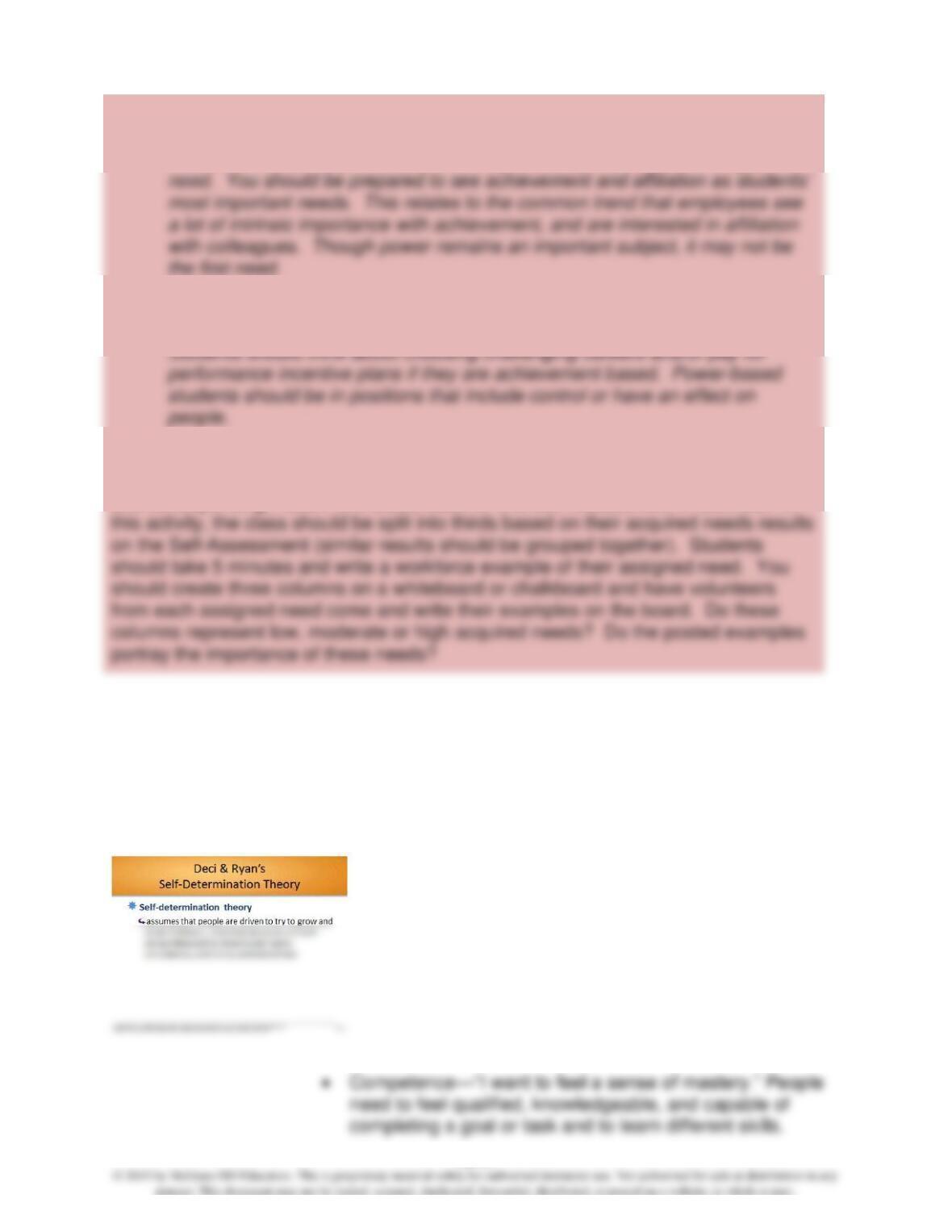
a. Need for achievement – You are happy with accomplishment of a
task being its own reward, don’t mind or even prefer working
alone, and are willing to take moderate risks.
(1) People high in need for achievement tend to advance in
technical fields requiring creativity and individual skills.
SELF-ASSESSMENT 12.2 (p. 381)
Assessing Your Acquired Needs
Go to connect.mheducation.com and take Self-Assessment 12.2.
Student Questions:
Chapter 12 – Motivating Employees: Achieving Superior Performance in the Workplace
12–15
1. What is the order of your most important needs? Are you surprised by this
result?
Students may be surprised to learn that power may not be their strongest
2. Given that achievement and power needs are associated with career
advancement, how might you increase these two need states?
Additional Activities:
You can also consult the Connect Instructors Manual for the post-assessment activity
and corresponding PowerPoint slides used for this Self-Assessment in Connect. In
D. Deci & Ryan’s Self-Determination Theory: Competence, Autonomy, &
Relatedness
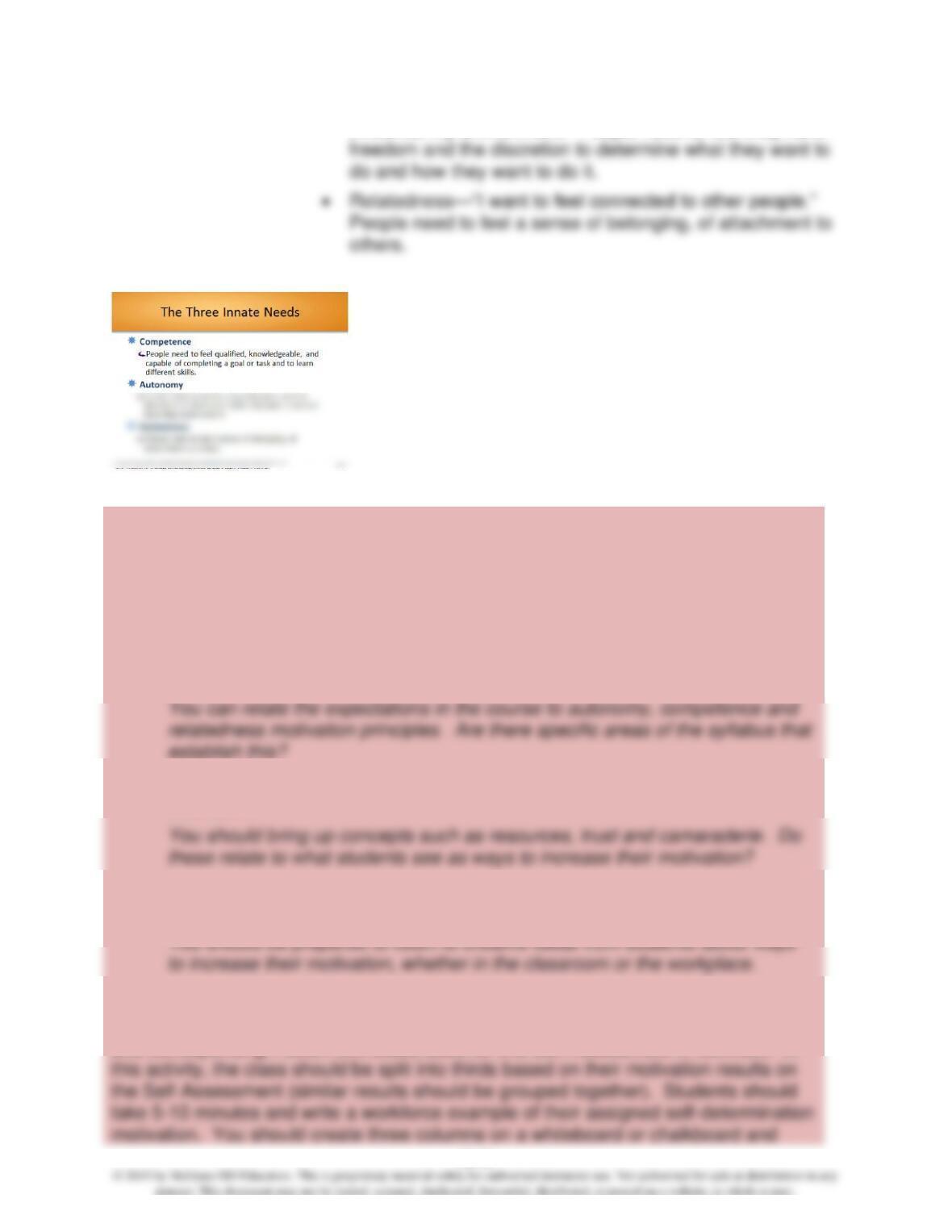
1. Assumes that people are driven to try to grow and attain fulfillment,
with their behavior and well-being influenced by three innate needs:
competence, autonomy, and relatedness.
Chapter 12 – Motivating Employees: Achieving Superior Performance in the Workplace
12–16
• Autonomy—“I want to feel independent and able to
influence my environment.” People need to feel they have
SELF-ASSESSMENT 12.3 (p. 383)
Assessing Your Needs for Self-Determination
Go to connect.mheducation.com and take Self-Assessment 12.3.
Student Questions:
1. Are your needs being met? Do the results make sense in terms of your level
of motivation in this course?
2. Based on the results, identify two things you might do to increase your
motivation.
3. Based on the results, identify two things your instructor might do to increase
your motivation.
Additional Activities:
You can also consult the Connect Instructors Manual for the post-assessment activity
and corresponding PowerPoint slides used for this Self-Assessment in Connect. In
Chapter 12 – Motivating Employees: Achieving Superior Performance in the Workplace
12–17
E. Herzberg’s Two-Factor Theory: From Dissatisfying Factors to Satisfying
Factors
1. Herzberg’s theory was the result of a landmark study of 203
accountants and engineers who were interviewed to determine factors
responsible for job satisfaction and dissatisfaction.
a. Job satisfaction was associated with achievement, recognition,
2. The two-factor theory proposed that work satisfaction and
dissatisfaction arise from two different factors:
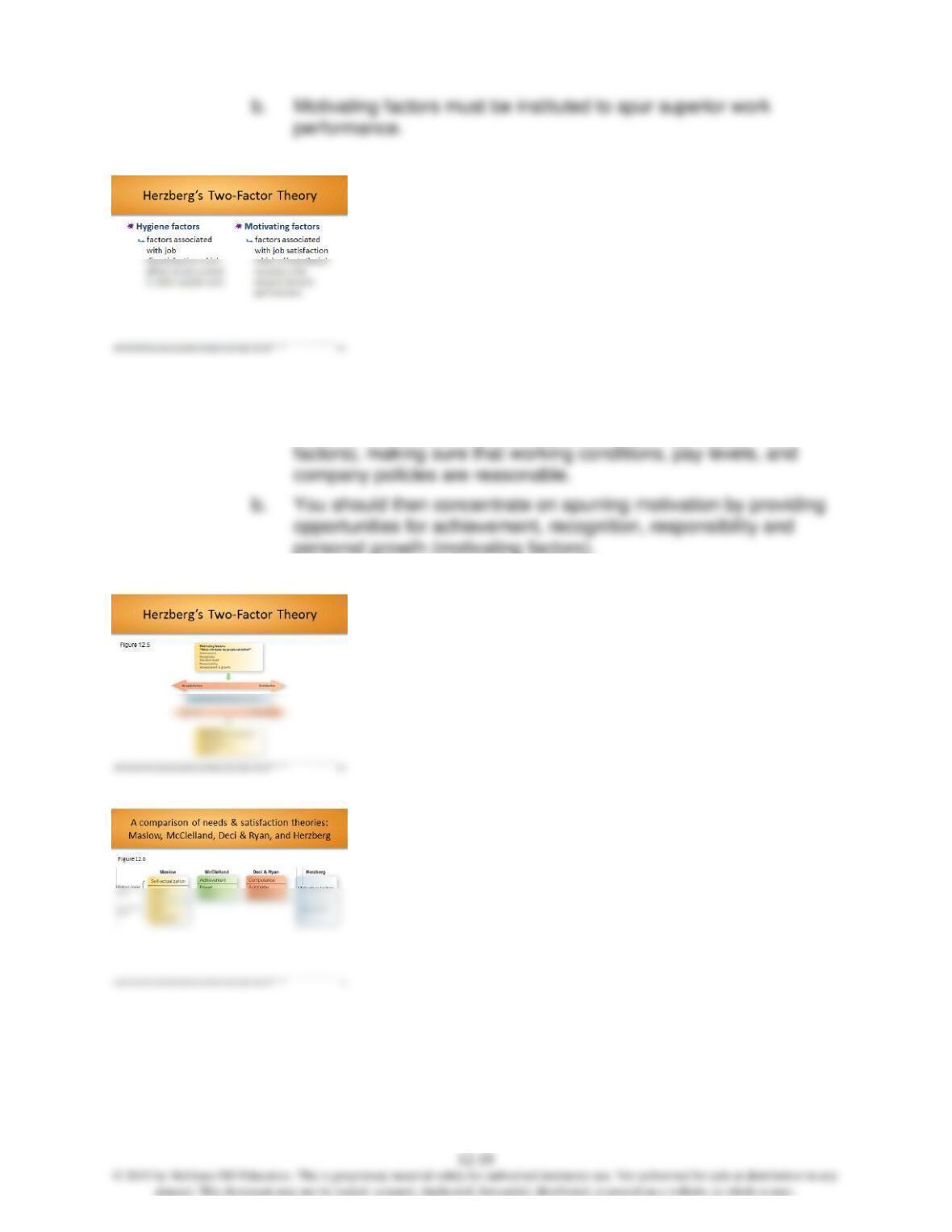
3. Hygiene factors are lower-level needs; motivating factors are higher-
level needs.
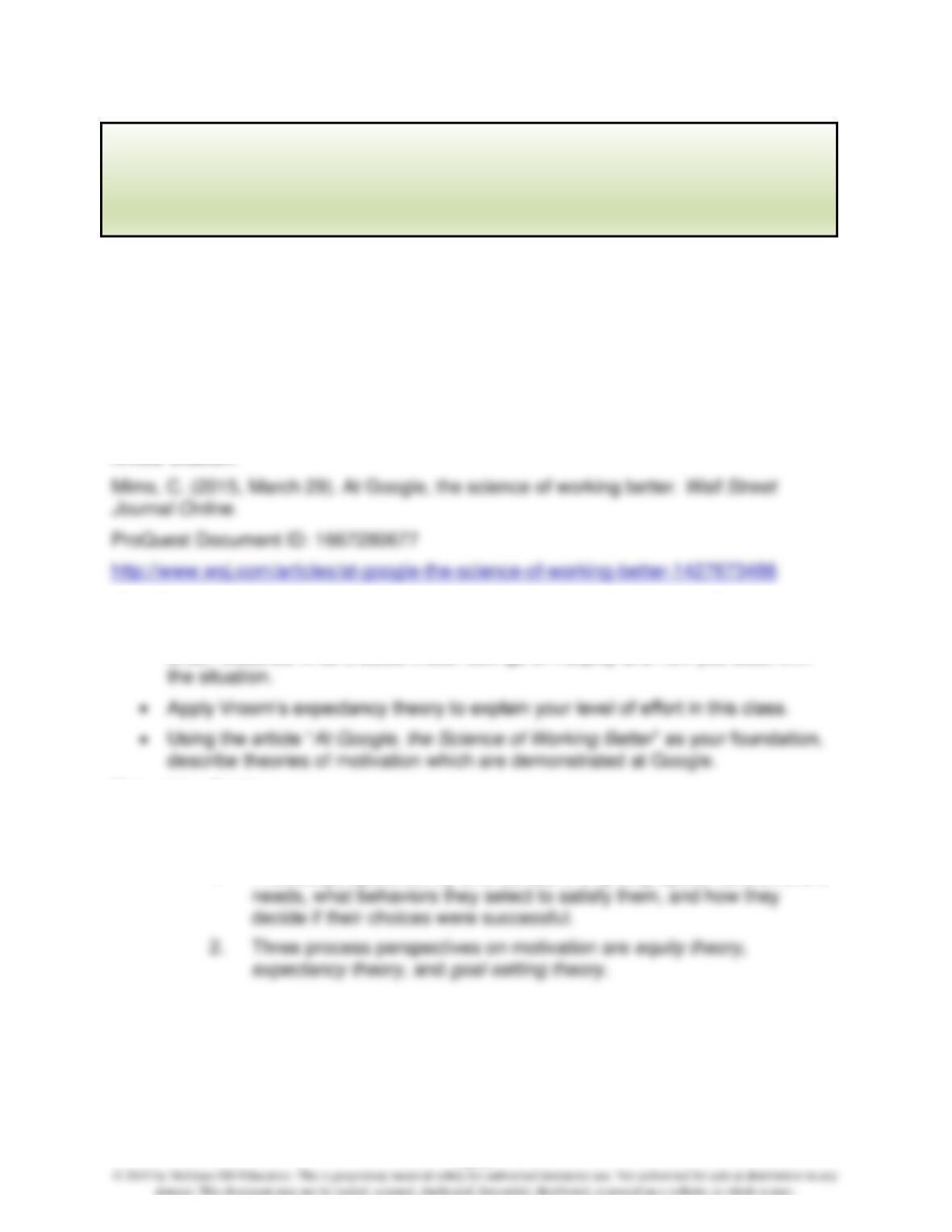
a. The two areas are separated by a zone in which employees are
neither satisfied nor dissatisfied. (Figure 12.5)
4. Hygiene factors are factors associated with job dissatisfaction, such
as salary, working conditions, interpersonal relationships, and
Chapter 12 – Motivating Employees: Achieving Superior Performance in the Workplace
6. Using Two-Factor Theory to Motivate Employees
a. You should first eliminate dissatisfaction (through hygiene
Chapter 12 – Motivating Employees: Achieving Superior Performance in the Workplace
12–19
Section 12.3 discusses process perspectives of motivation, which are concerned with
the thought processes by which people decide how to act. Process theories have three
viewpoints: equity theory, expectancy theory, and goal-setting theory.
One way that you could begin your coverage of these topics is to have the students
read the Wall Street Journal article “At Google, the Science of Working Better.” In this
article, Google’s head of human resources, Laszlo Bock, discusses lessons he has
learned in the course of taking Google from 3,000 to 53,000 employees.
Article Citation:
Possible Topics for Discussion:
• Describe time that you experienced inequity at your company (or a previous
one). Describe what created these feelings of inequity and how you dealt with
Major Idea Outline:
A. Process perspectives are concerned with the thought processes by which
people decide how to act.
1. Process perspectives try to understand why employees have different
12.3 Process Perspectives on Employee Motivation (pp.
386-391)
Is a good reward good enough? How do other factors affect motivation?
Chapter 12 – Motivating Employees: Achieving Superior Performance in the Workplace
B. Equity Theory: How Fairly Do You Think You’re Being Treated in Relation to
Others?
1. Equity theory, developed by J. Stacy Adams, focuses on employee
injustice.
C. The Elements of Equity Theory: Comparing Your Inputs and Outputs with
Those of Others
1. Inputs that people perceive they give to an organization are their time,
effort, training, experience, status, and so on.
2. Outputs or rewards are the rewards that people receive from an
organization, including pay, benefits, praise, recognition, promotions,
perquisites, and so on.
3. Comparison. Equity theory suggests that people compare the ratio of
their outcomes to inputs against the ratio of someone else’s outcomes