21
e. If you change to a fixed period system (FPS) and all other information remains the same,
what is the review period (T)?
Using Equation 12.13, T = Q/D = 147/650 = 0.22615 years or (0.22615)(52) = 11.76
weeks or 12 weeks
f. What is the replenishment level (M) with safety stock for this FPS?
47. JAZ Medical Supplies is implementing a new economic order quality (EOQ) inventory-
control system and needs a good estimate of the cost to process a purchase order (PO),
that is, the order cost, Co. It takes four total labor hours to process a PO. The average
number of SKUs on a PO is four. The average wage for people working in the purchasing
department is $22 per hour plus employee benefits of $3 per hour. Fixed costs for the
purchasing department are $300,000 per year assuming 2,000 hours per employee per
year work week. Given this information what is a good estimate of Co per SKU to use in an
EOQ model?
As noted in Section 12-4a, fixed costs are irrelevant for the EOQ; only variable costs are
48. Bishop Manufacturing is implementing an economic order quality (EOQ) inventory-control
system and needs a good estimate of the cost to process a purchase order (PO). It takes 5
total labor hours to process a PO. The average number of stock keeping units (SKUs) on a
PO is 2.2. The average wage for people working in the purchasing department is $22 per
hour plus employee benefits of $3 per hour. Fixed-costs for the purchasing department
are $250,000 per year assuming a 2,000 hour per employee per year work week. What is a
good estimate of the cost to order one SKU?
As noted in Section 12-4a, fixed costs are irrelevant for the EOQ; only variable costs are used
in this marginal cost model.
22
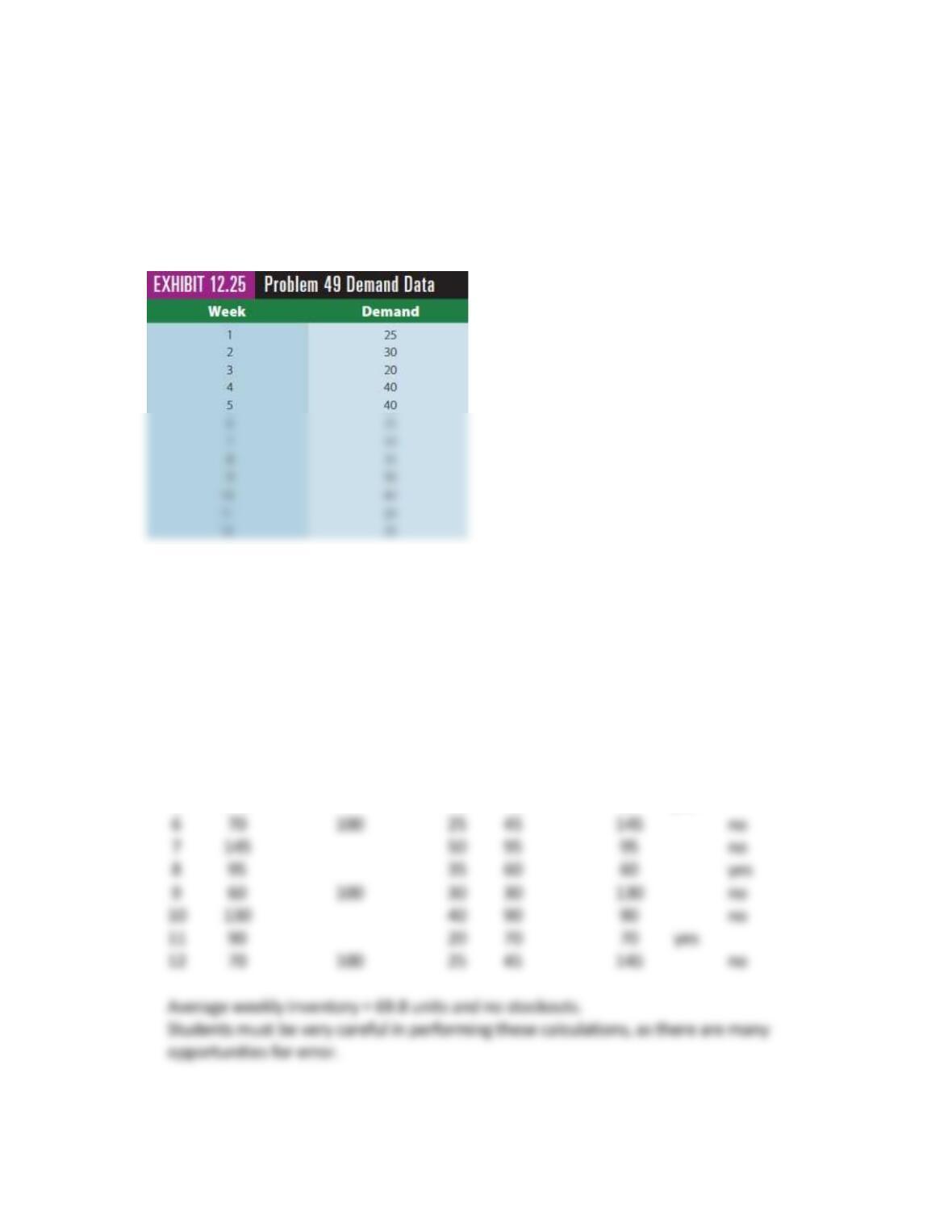
49. Given the weekly demand data in Exhibit 12.25 illustrate the operation of a fixed-order-
quantity inventory system with a reorder point of 75, an order quantity of 100, and a
beginning inventory of 125. Lead time is one week. All orders are placed at the end of the
week. Using Equation 12.1, what is the average inventory and number of stockouts?
Order Decision Rule: Place a new order for 100 units when the inventory position drops to
or past the reorder point of 75 units.
Beginning Quantity Ending Inventory
Week Inventory on order Demand Inventory Position Order?
———— –——-—— —————— –——-—– —————– —-——-— ———-—-—–
1 125 25 100 100 no
2 100 30 70 70 yes
3 70 100 20 50 150 no
4 150 40 110 110 no
5 110 40 70 70 yes
23
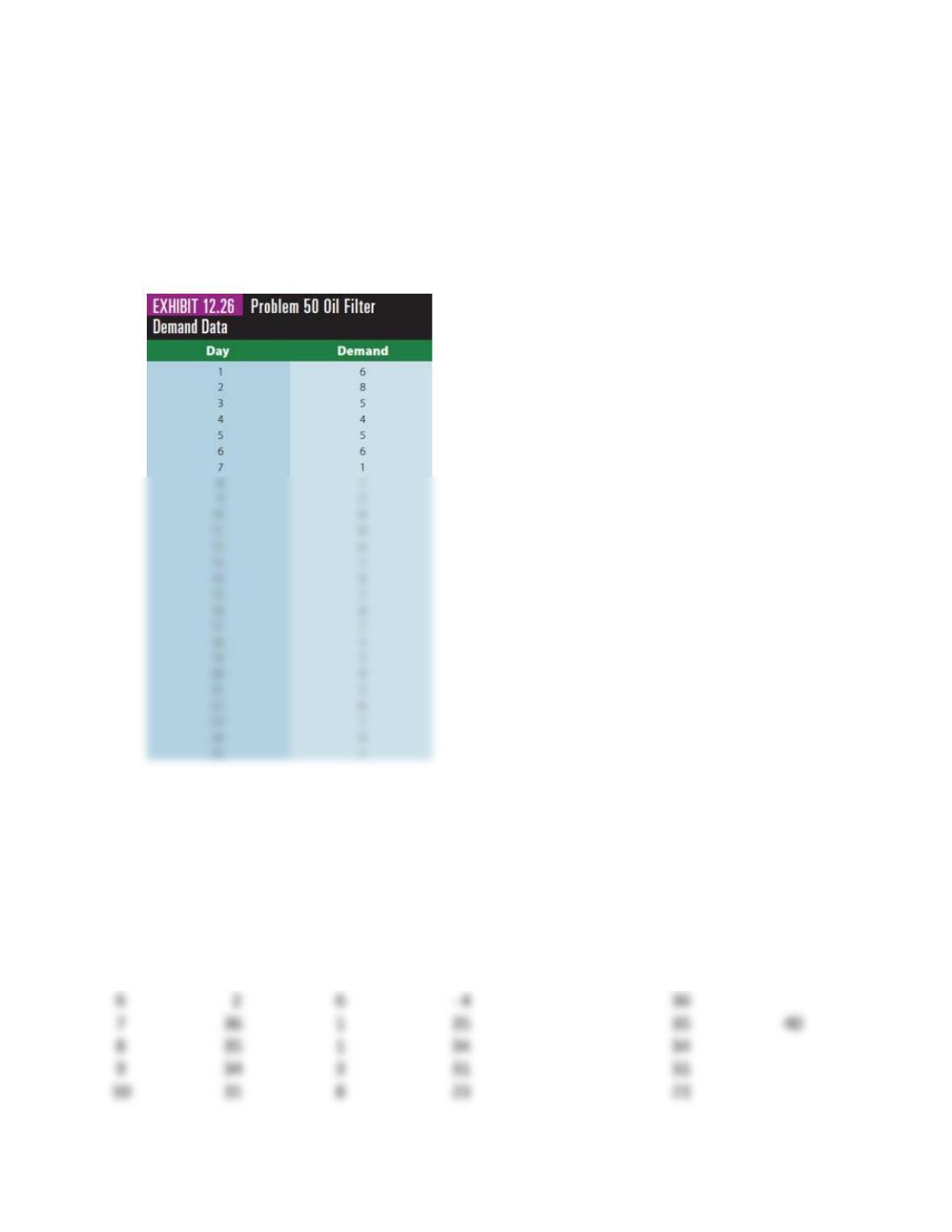
50. Exhibit 12.26 gives the daily demand of a certain oil filter at an auto supply store. Illustrate
the operation of a fixed-order-quantity inventory system by graphing the inventory level
versus time if Q = 40, R = 15, and the lead time is three days. The beginning inventory on
day one is 30 units. Assume that orders are placed at the end of the day and that they
arrive at the beginning of the day. Therefore, if an order is placed at the end of day five, it
will arrive at the beginning of day nine. Assume that 30 items are on hand at the start of
day one. Use Equation 12.1 to evaluate the inventory position and when to place orders.
BEGINNING ENDING ORDER INVENTORY ORDER
DAY INVENTORY DEMAND INVENTORY PLACED POSITION RECEIVED
——– ——-—-——-— ———-—- —-———-– –—-—-— ——-—-—- ——-——-—-
1 30 6 24 24
2 24 8 16 16
3 16 5 11 40 11
4 11 4 7 47
5 7 5 2 42
24
11 23 8 15 40 15
12 15 6 9 49
13 9 7 2 42
14 2 0 2 42
15 42 2 40 40 40 40
16 40 4 36 36
51. The reorder point is defined as the demand during the lead time for the item. In cases of
long lead times, the lead-time demand and thus the reorder point may exceed the
economic order quantity, Q*. In such cases the inventory position will not equal the
inventory on hand when an order is placed, and the reorder point may be expressed in
terms of either inventory position or inventory on hand. Consider the EOQ model with D
= 5,000, Co = $32, Ch = $2, and 250 working days per year. Identify the reorder point in
terms of inventory position and in terms of inventory on hand for each of these lead
times.
a. 5 days.
b. 15 days.
This question helps students understand the difference between inventory position and
on-hand inventory, which are often confused.
a. Reorder point = daily demand times lead time = 20(5) = 100. Since the reorder point is
less than EOQ, then both the inventory position and inventory on hand equal 100.
c. Reorder point = daily demand times lead time = 20(25) = 500. In this case, one order of
EOQ = 400 is outstanding. Therefore, the on-hand inventory reorder point is 500 – 400
52. The XYZ Company purchases a component used in the manufacture of automobile
generators directly from the supplier. XYZ’s generator production, which is operated at a
constant rate, will require 1,200 components per month throughout the year. Assume
ordering-costs are $25 per order, item cost is $2.00 per component, and annual inventory-
holding costs are charged at 20 percent. The company operates 250 days per year, and the
lead time is five days.
a. Compute the EOQ, total annual inventory-holding and ordering costs, and the reorder
point.
Q* = 2DCO/Ch = 2(14400)(25)/[0.2(2)] = 1341.64, or 1,342 generators
b. Suppose XYZ’s managers like the operational efficiency of ordering in quantities of
1,200 items and ordering once each month. How much more expensive would this
policy be than your EOQ recommendation? Would you recommend in favor of the
1,200-item order quantity? Explain. What would the reorder point be if the 1,200–
item quantity were acceptable?
In other words, rather than adopting the order quantity specified by EOQ, the managers
are considering modifying the EOQ recommendation to order a quantity equal to the
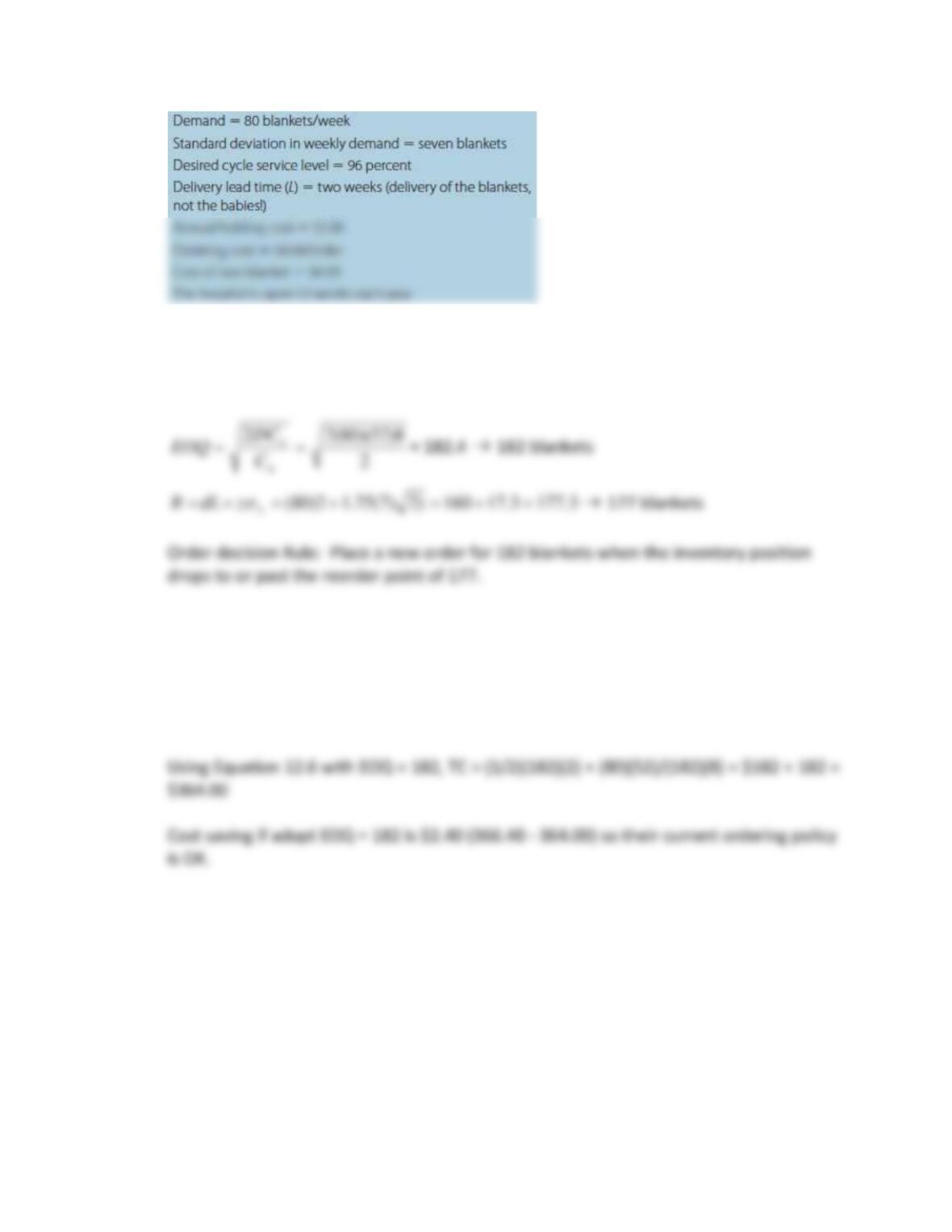
53. The maternity ward of a hospital sends one baby blanket home with each newborn baby.
The following information is available for the baby blankets:
26
a. As the new maternity ward manager, you decide to improve the current ordering
methods used for items which are stocked in the maternity ward. Calculate the
economic order quantity for baby blankets.
b. Baby blankets are currently ordered in quantities of 200. How much would the
maternity ward save in total annual relevant costs by changing to the EOQ?
Using Equation 12.6 with Q = 200, TC = (1/2)(200)(2) + (80)(52)/(200)(8) = $200 + 166.4 =
$366.40
c. You decide that a fixed-order quantity system will be used for ordering the blankets.
Describe and calculate what must be known for implementing such a system.
Answer is in part (a)
54. Nation-Wide Bus Lines is proud of the six-week driver-training program it conducts for
all new Nation-Wide drivers. The program costs Nation-Wide $22,000 for instructors,
equipment, and so on, and is independent of the number of new drivers in the class as
long as the class size remains less than or equal to 35. The program must provide the
27
company with approximately five new fully trained drivers per month. After completing
the training program, new drivers are paid $1,800 per month but do not work until a
full-time driver position is open. Nation-Wide views the $1,800 as a holding cost
necessary to maintain a supply of newly trained drivers available for immediate service.
Viewing new drivers as inventory SKUs, how large should the training classes be in order
to minimize Nation-Wide’s total annual training and new-driver idle-time costs? How
many training classes should the company hold each year? What is the total annual cost
of your recommendation?
Annual demand D = (5/month)(12 months) = 60 drivers
Ordering cost = fixed cost/class = $22,000
Inventory holding cost = ($1800/month)(12 months) = $21,600 per year for one driver
55. A product with an annual demand of 1,000 SKUs has C0 = $30 and Ch = $8. The demand
exhibits some variability such that the lead-time demand follows a normal distribution,
with a mean of 25 and a standard deviation of 5.
a. What is the recommended order quantity?
b. What is the reorder point and safety-stock level if the firm desires at most a 2-percent
probability of a stockout on any given order cycle?
Using a normal distribution with a right hand tail area of 0.02, the standardized z–
c. If the manager sets the reorder point at 30, what is the probability of a stockout on
any given order cycle? How many times would you expect to stockout during the year
if this reorder point was used?
If R = 30, the standardized z-value is (30 – 25)/5 = 1, giving a tail area under the normal
28
56. The B&S Novelty and Craft Shop in Bennington, Vermont, sells a variety of quality handmade
items to tourists. It will sell 300 hand carved miniature replicas of a colonial soldier each
year, but the demand pattern during the year is uncertain. The replicas sell for $20 each,
and B&S uses a 15-percent annual inventory-holding cost rate. Ordering costs are $5 per
order, and demand during the lead time follows a normal distribution, with a mean of 15
and a standard deviation of 6.
a. What is the recommended order quantity?
b. If B&S is willing to accept a stockout roughly twice a year, what reorder point would you
recommend? What is the probability that B&S will have a stockout in any one order cycle?
c. What is the safety-stock level and annual safety-stock costs for this product?
a.
62.31
)20)(15(.
)5)(300(2
2===
h
o
C
DC
EOQ
57. Apply the EOQ model to the quantity-discount situation shown in the data below:
Assume that D = 500 units per year, Co = $40, and the annual inventory-holding cost is 20
percent. What order quantity do you recommend?
58. Allen’s Shoe Stores carries a basic black dress shoe for men that sells at an approximate
constant rate of 500 pairs of shoes every three months. Allen’s current buying policy is to
29
order 500 pairs each time an order is placed. It costs $30 to place an order, and inventory-
carrying costs have an annual rate of 20 percent. With the order quantity of 500, Allen’s
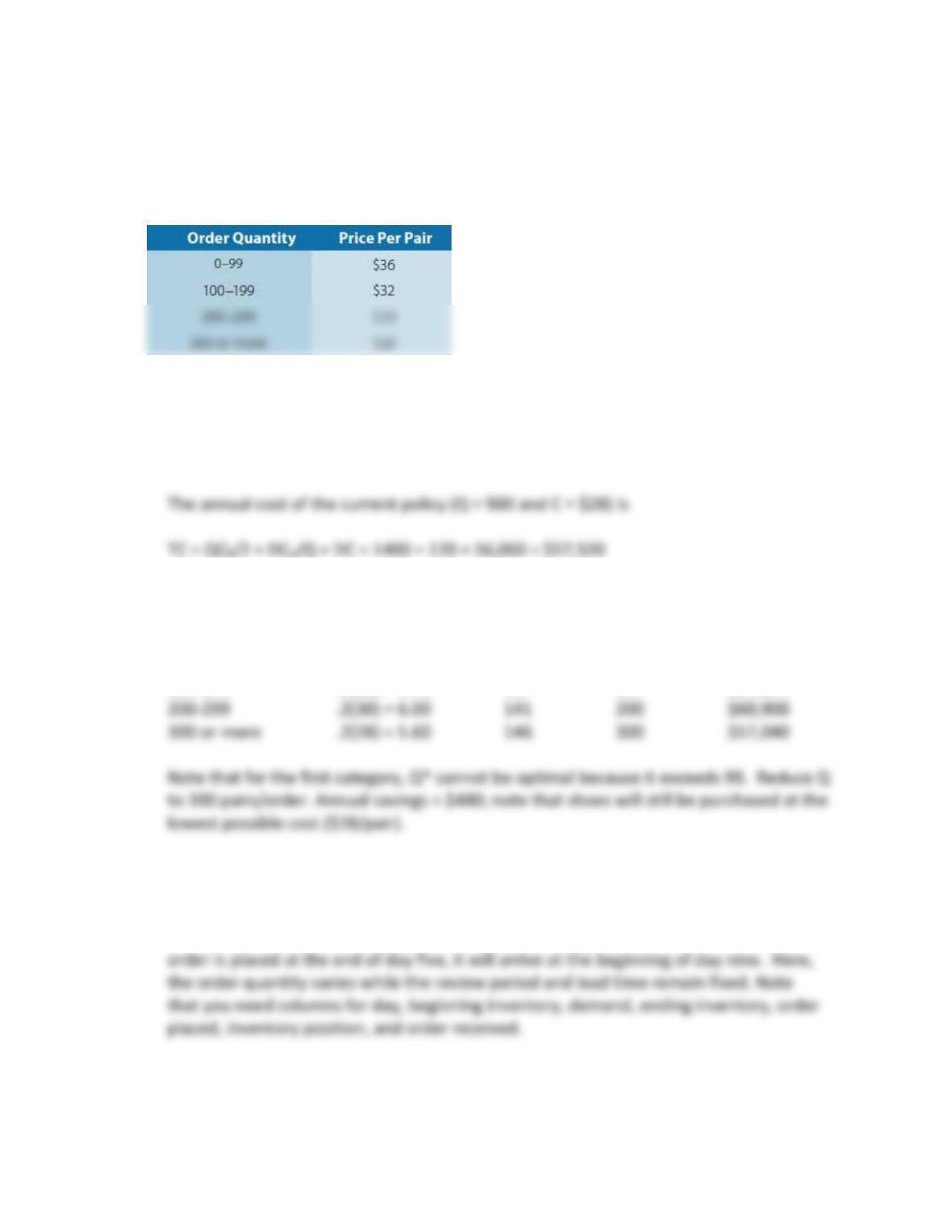
obtains the shoes at the lowest possible unit cost of $28 per pair. Other quantity discounts
offered by the manufacturer are listed below:
What is the minimum-cost order quantity for the shoes? What are the annual savings of
your inventory policy over the policy currently being used?
D = 4(500) = 2,00 per year; Co = $30; I = .20 and C = $28, thus Ch = 5.6.
Evaluation of quantity discounts:
Order Quantity Holding cost Q* Q to obtain discount Total Cost
0-99 .2(36) = 7.20 129 — —
100–199 .2(32) = 6.40 137 137 $64,876
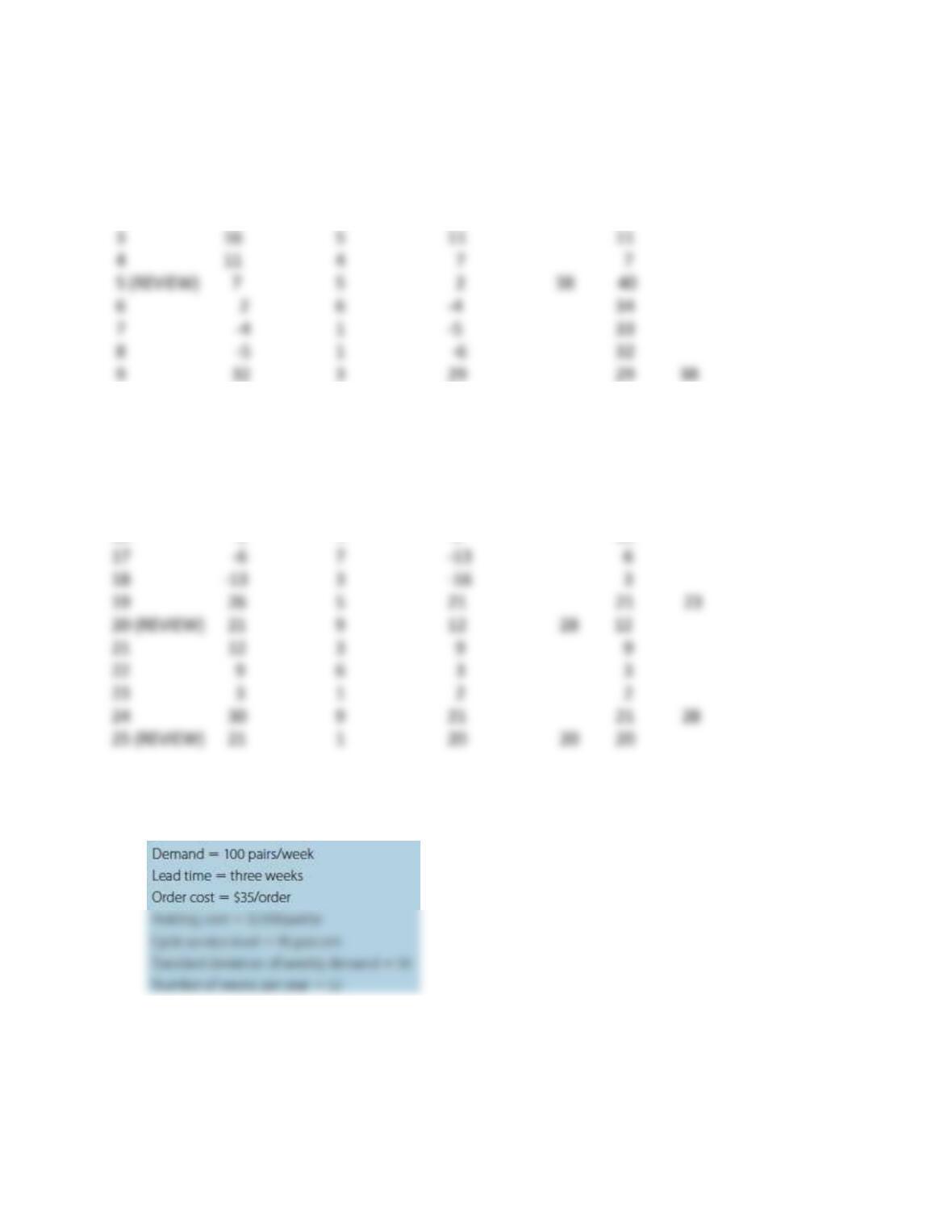
59. For the data given in Exhibit 12.26 for problem 50, illustrate the operation of a fixed–
period-inventory system with a replenishment (M) level of 40, a review period of five
days, a lead time of 3 days, and use Equation 12.1. Assume that orders are placed at
the end of the day and that they arrive at the beginning of the day. Therefore, if an
30
BEGINNING ENDING ORDER INVENTORY ORDER
DAY INVENTORY DEMAND INVENTORY PLACED POSITION RECEIVED
——– ——-—-—— —-———— —-—-——– ——-—-— –————-— —-———-—
1 30 6 24 24
2 24 8 16 16
10 (REVIEW) 29 8 21 19 21
11 21 8 13 13
12 13 6 7 7
13 7 7 0 0
14 0 0 0 19 19
15 (REVIEW) 0 2 -2 23 17
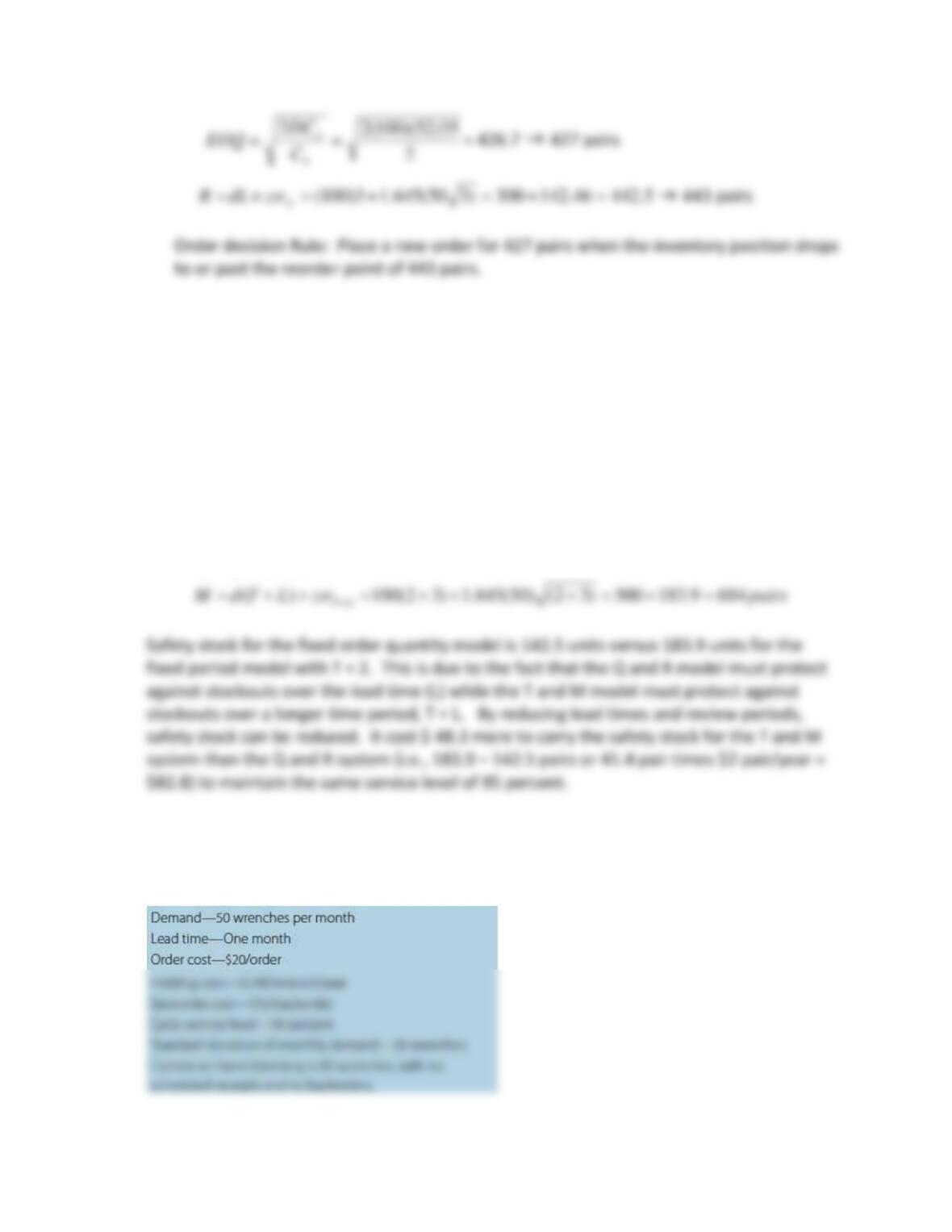
60. Crew Soccer Shoes Company is considering a change of their current inventory-control
system for soccer shoes. The information regarding the shoes is given below.
a. The company decides to use a fixed order quantity system. What would be the reorder
point and the economic order quantity?
31
b. In this system, at the beginning of the current week, the materials manager, Luke
Thomas, checked the inventory level of shoes and found 300 pairs. There were no
scheduled receipts and no back orders. Should he place an order? Explain your
answer.
Using Equation 12.1 IP = OH + SR – BO = 300 + 0 – 0 = 300 pairs. Yes Emily should place
an order.
c. If the company changes to a fixedf-period system and reviews the inventory every two
weeks (T = 2), how much safety stock is required?
weeksT 00.2=
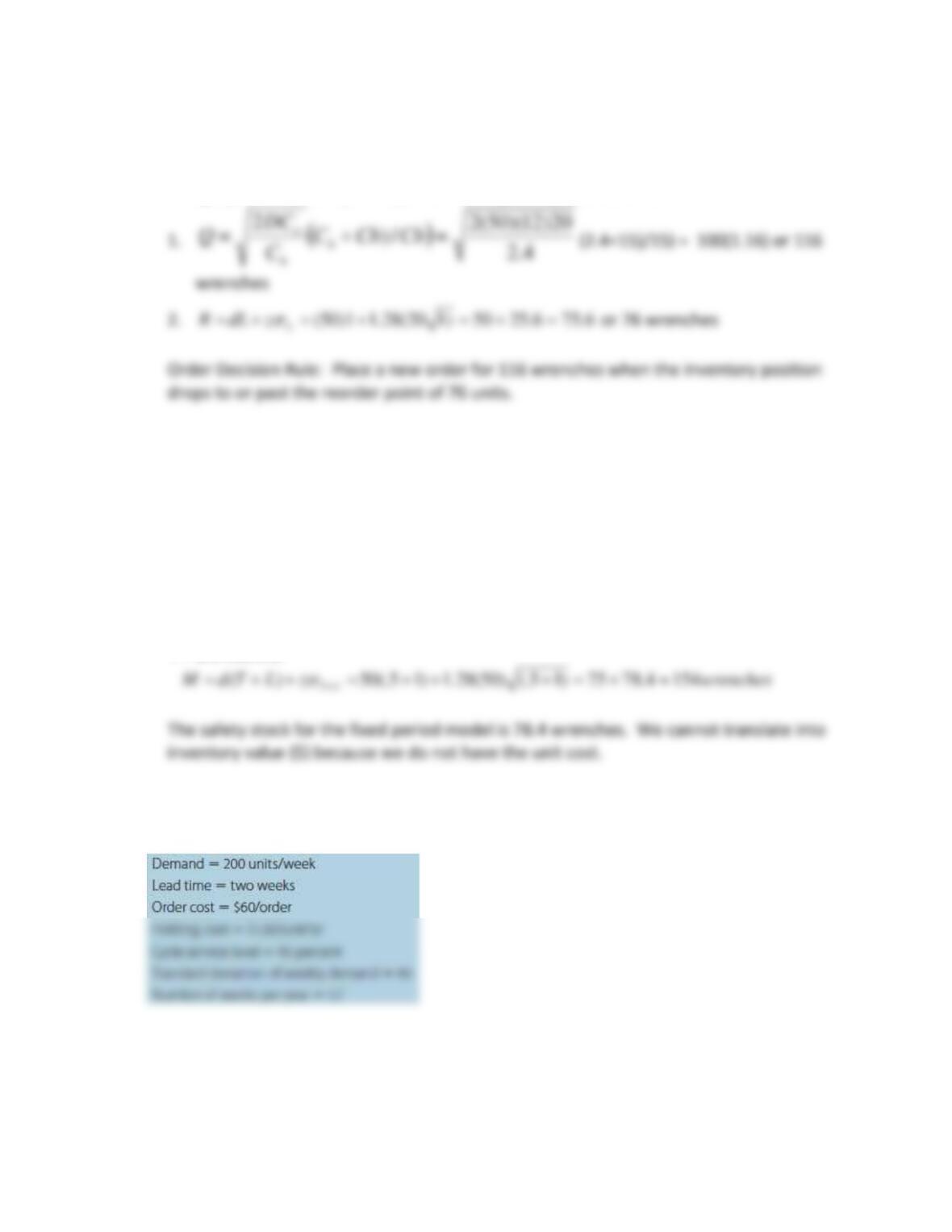
61. Wildcat Tools is a distributor of hardware and electronics equipment. Their socket wrench
inventory needs better management. The information regarding the wrenches is given
below.
32
a. The company decides to use a continuous review system. What is the recommended
reorder point, safety stock, and the economic order quantity?
Using Equations [12.17], the optimal order quantity, Q*, becomes
b. Based on the information calculated in (a), should an order be placed? If yes, how much
should be ordered?
Using Equation 12.1 IP = OH + SR – BO = 65 + 0 – 0 = 65 wrenches. Yes, place an order
for Q* = 116 wrenches.
c. The company wants to investigate the fixed-period system with a twice-per-month
review (T = 2 weeks or 0.5 months), how much safety stock is required?
62. Tune Football Helmets Company is considering changing the current inventory-control
system for football helmets. The information regarding the helmets is given below:
a. The firm decides to use a fixed-period system to control the inventory, and to review
the inventory every two weeks. At the beginning of the current week, D. J. Jones, the
materials manager, checked the inventory level of helmets and found 450 units. There
were no scheduled receipts and no back orders. How many units should be ordered?
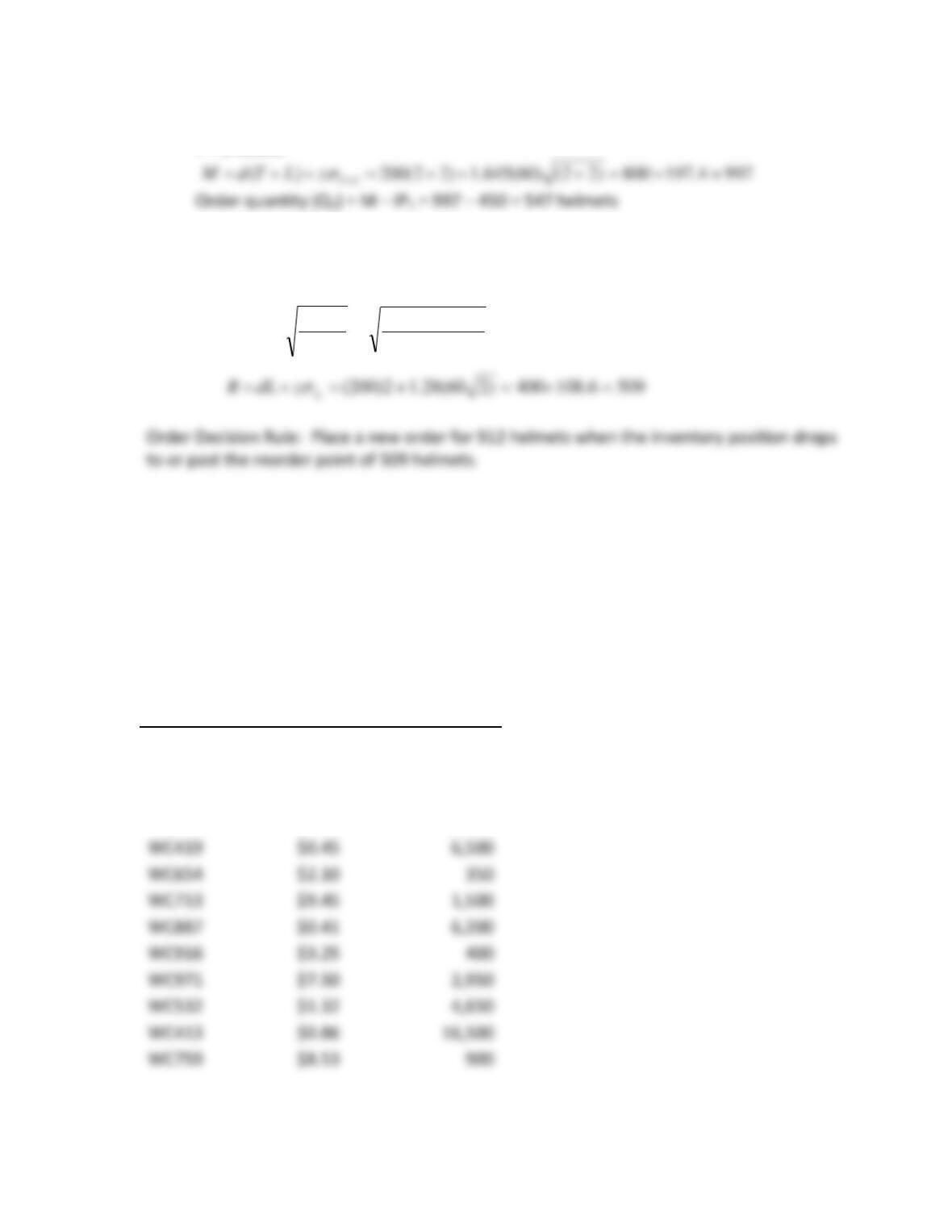
33
b. If the firm changes to a fixed-quantity system, what would the reorder point and the
economic order quantity be?
5.1
60)52)(200(2
2==
h
o
C
DC
EOQ
= 912.1
→
912 helmets
EXCEL-BASED PROBLEMS
For these problems, you may use Excel or the spreadsheet templates available in MindTap to
assist in your analysis.
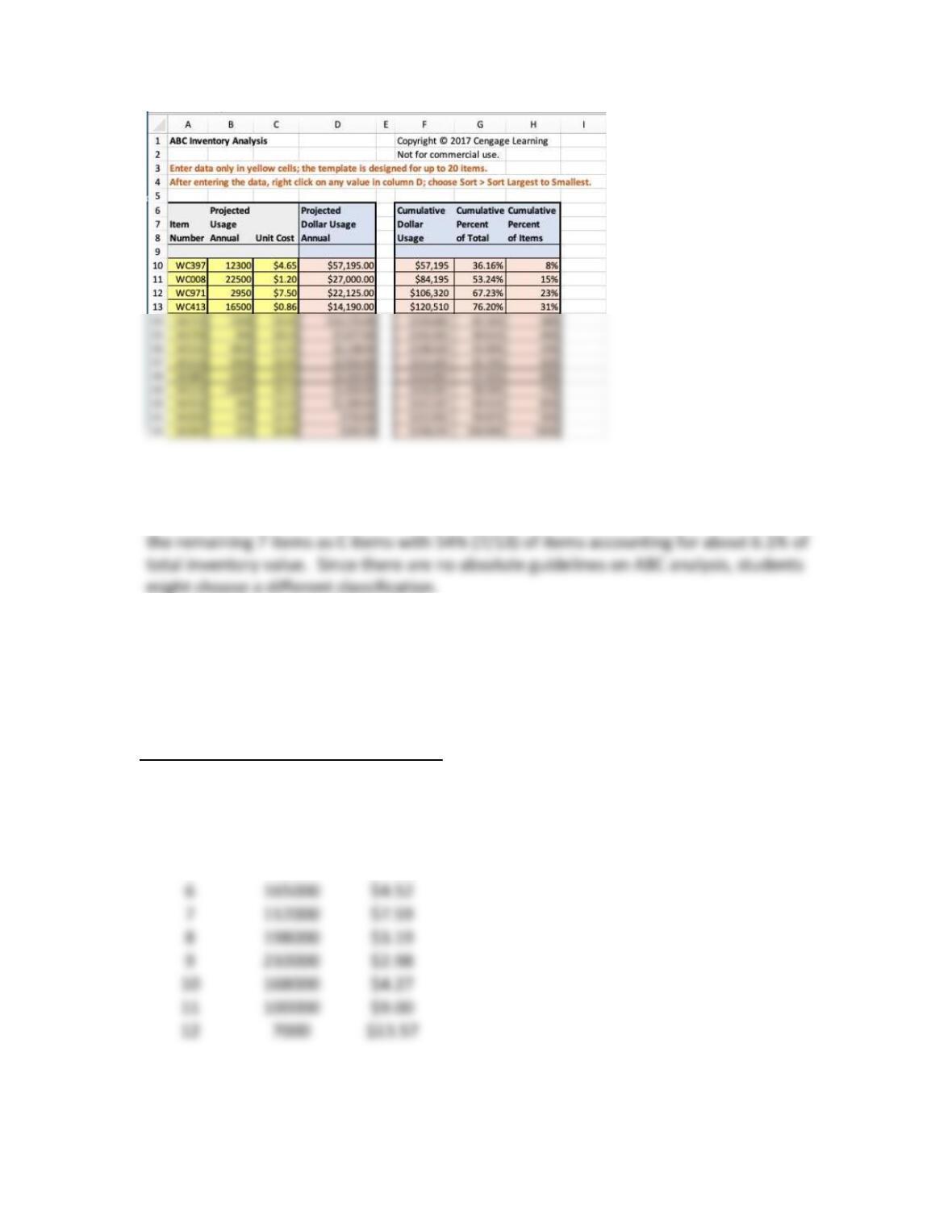
63. The Welsh Corporation uses 13 key components in one of its manufacturing plants. The
data are provided in the worksheet C12 Excel P63 Data in MindTap. Use the ABC Excel
template in MindTap to perform an ABC analysis. Explain your decisions and logic.
SKU
Item Cost
Annual Demand
WC007
$0.90
225
WC008
$1.20
22,500
WC219
$0.15
13,000
WC397
$4.65
12,300
WC419
$0.45
WC654
$2.10
350
WC887
$0.41
WC916
$3.25
400
WC971
$7.50
WC532
$1.32
WC413
$0.86
16,500
WC759
$8.53
900
34
One possible ABC classification scheme is A items (WC397, WC008, WC971, WC413) with
23% (4/13) of items accounting for about 76.2% of total inventory value; B items (WC713,
WC759) with 15% (2/13) of items accounting for about 14% of total inventory value; and
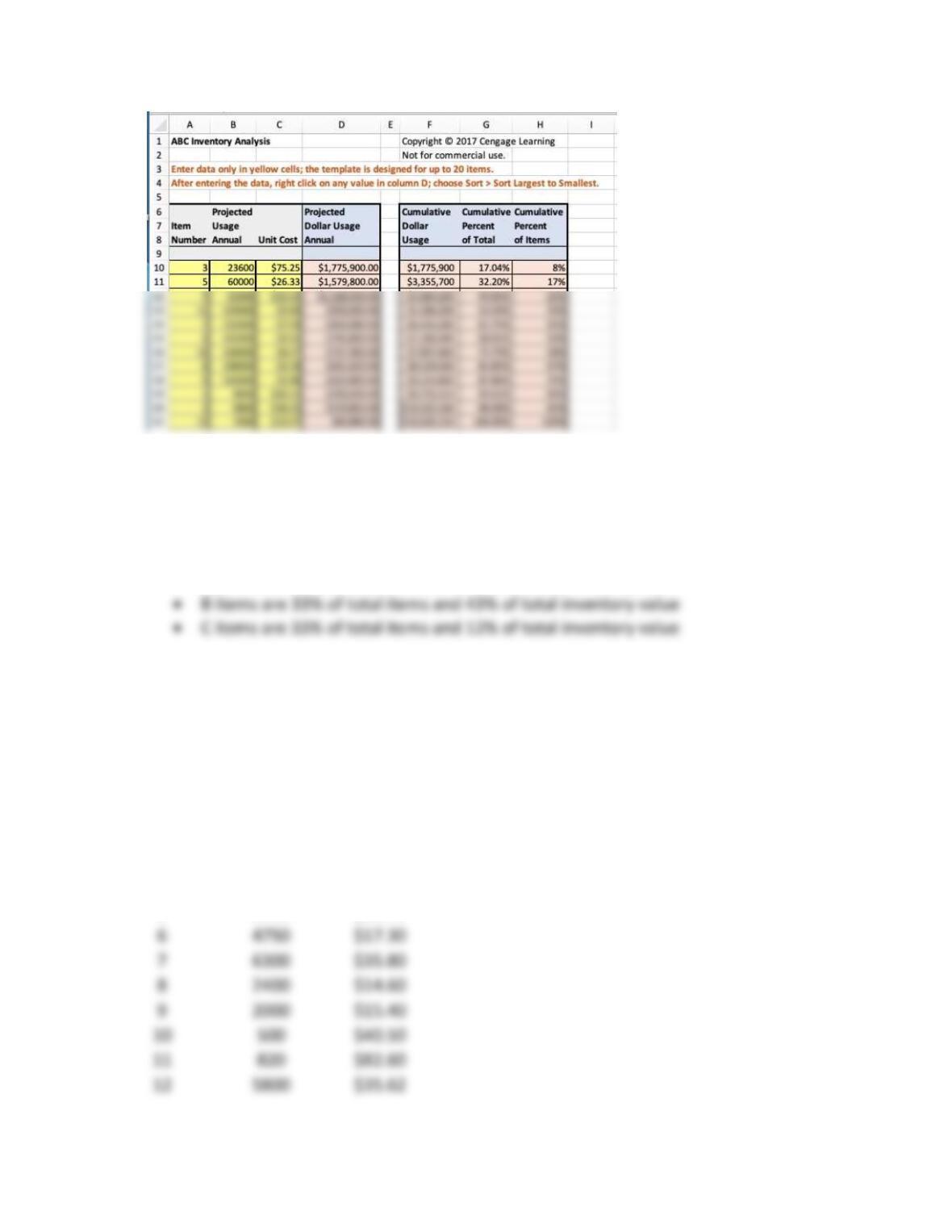
64. Use the ABC Excel template in MindTap to perform an ABC analysis for the data provided in
the worksheet C12 Excel P64 Data in MindTap. Clearly explain why you classified items as
A, B, or C.
Annual
Unit
Item
Usage
Value
1
8800
$68.12
2
9800
$58.25
3
23600
$75.25
4
25000
$53.14
5
60000
$26.33
6
7
8
9
7000
$13.57
35
One might argue that since the first four items (33% of items) account for almost 45% of
the total dollar usage, they could be classified as A items; while the last four items,
accounting for 33% (4/12) of the items but only about 12% of dollar value could be C items.
B items would be the middle 4 items. So, one example ABC profile would be as follows:
• A items are 33% of total items and 45% of total inventory value
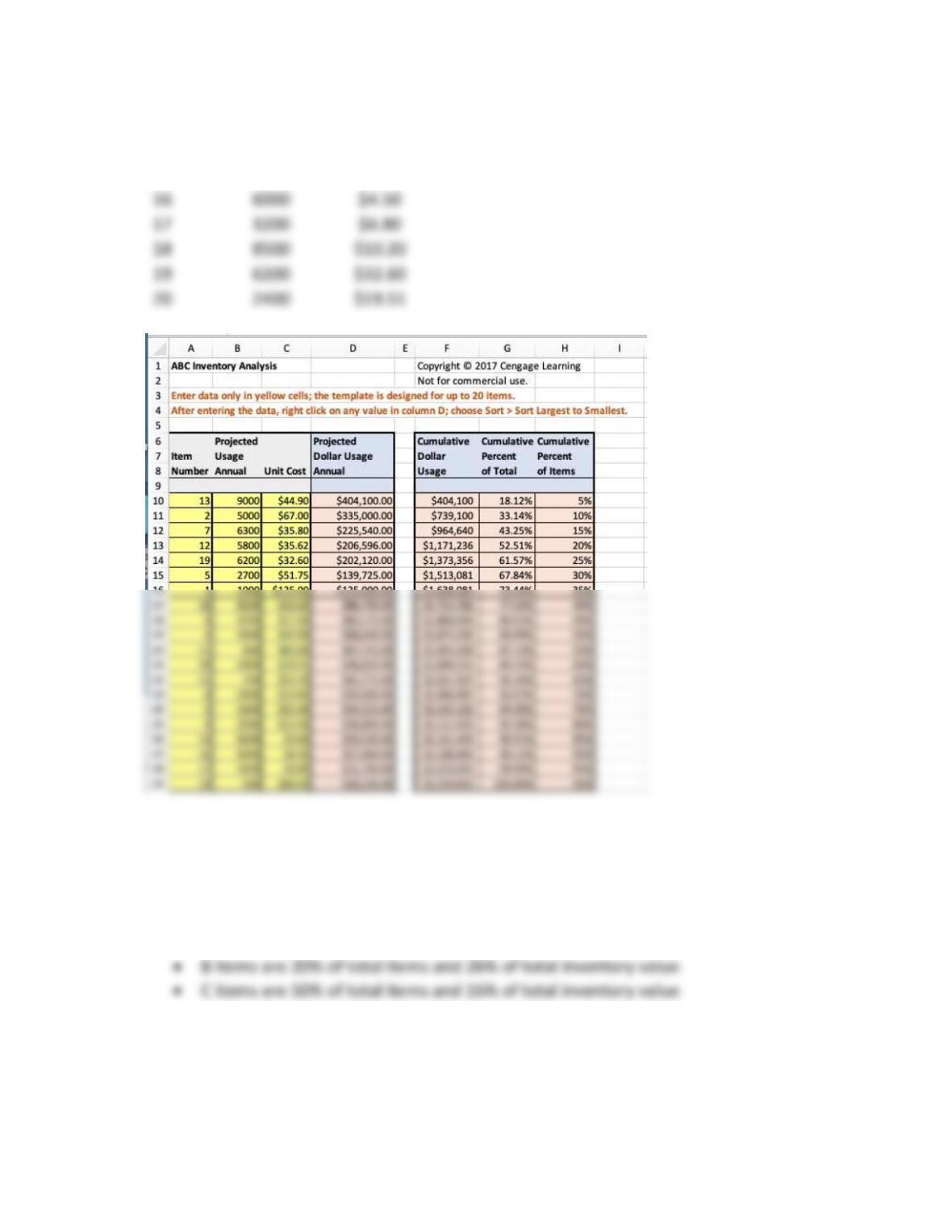
65. Use the ABC Excel template in MindTap to perform an ABC analysis for the data provided in
the worksheet C12 Excel P65 Data in MindTap. Clearly explain why you classified items as
A, B, or C.
Item
Annual
Usage
Unit Cost
1
1000
$125.00
2
5000
$67.00
3
1350
$25.30
4
1600
$42.90
5
2700
$51.75
6
4750
$17.30
7
6300
$35.80
8
2400
$14.60
9
2000
$15.40
$40.50
$82.60
36
13
9000
$44.90
14
8200
$3.60
15
750
$55.70
16
6000
17
3200
$6.80
18
8500
$10.20
19
6200
$32.60
20
2400
$19.51
We might classify the first six items, which account for 30% of items and about 68% of
dollar usage as A items, and the last 10 items as C items. Again, there is no strict rule and
students will have differing opinions on how to classify them. So, one example ABC profile
would be as follows:
• A items are 30% of total items and 68% of total inventory value
66. A&M Industrial Products purchases a variety of parts used in small industrial tools. Inventory
has not been tightly controlled, and managers think that costs can be substantially reduced.
The items in the worksheet C12 Excel P66 in MindTap comprise the inventory of one product
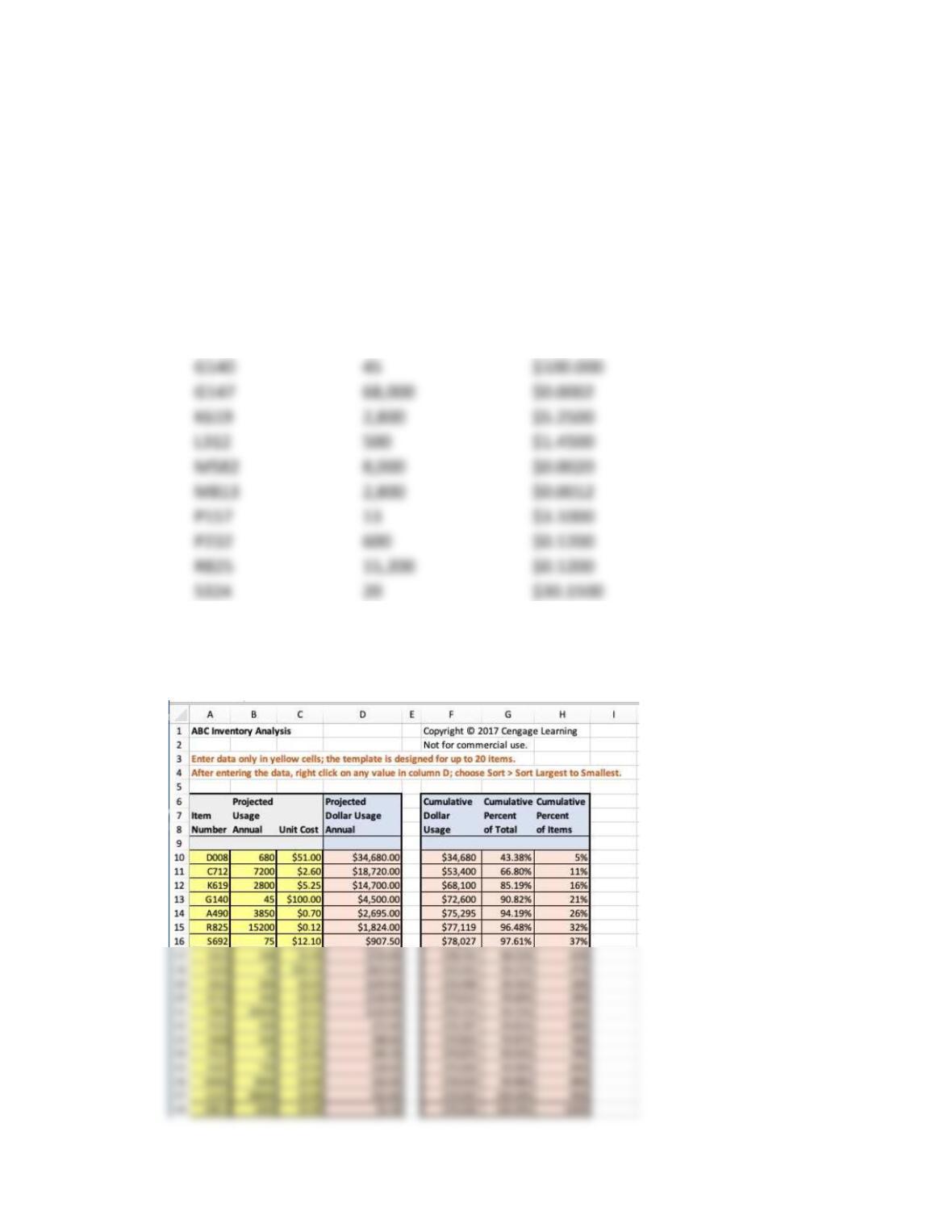
37
line. Use the ABC Excel template in MindTap to perform an ABC analysis of this inventory
situation.
Part Number
Demand
Item Cost
A367
700
$0.0400
A490
3,850
$0.7000
B710
400
$0.2900
C615
600
$0.2400
C712
7,200
$2.6000
D008
680
$51.000
G140
45
$100.000
G147
68,000
$0.0002
K619
2,800
$5.2500
L312
500
$1.4500
M582
8,000
$0.0020
M813
2,800
$0.0012
P157
13
$3.1000
P232
600
$0.1200
R825
15,200
$0.1200
S324
20
$30.1500
S404
400
$0.1200
S692
75
$12.1000
T001
20,000
$0.0050
38
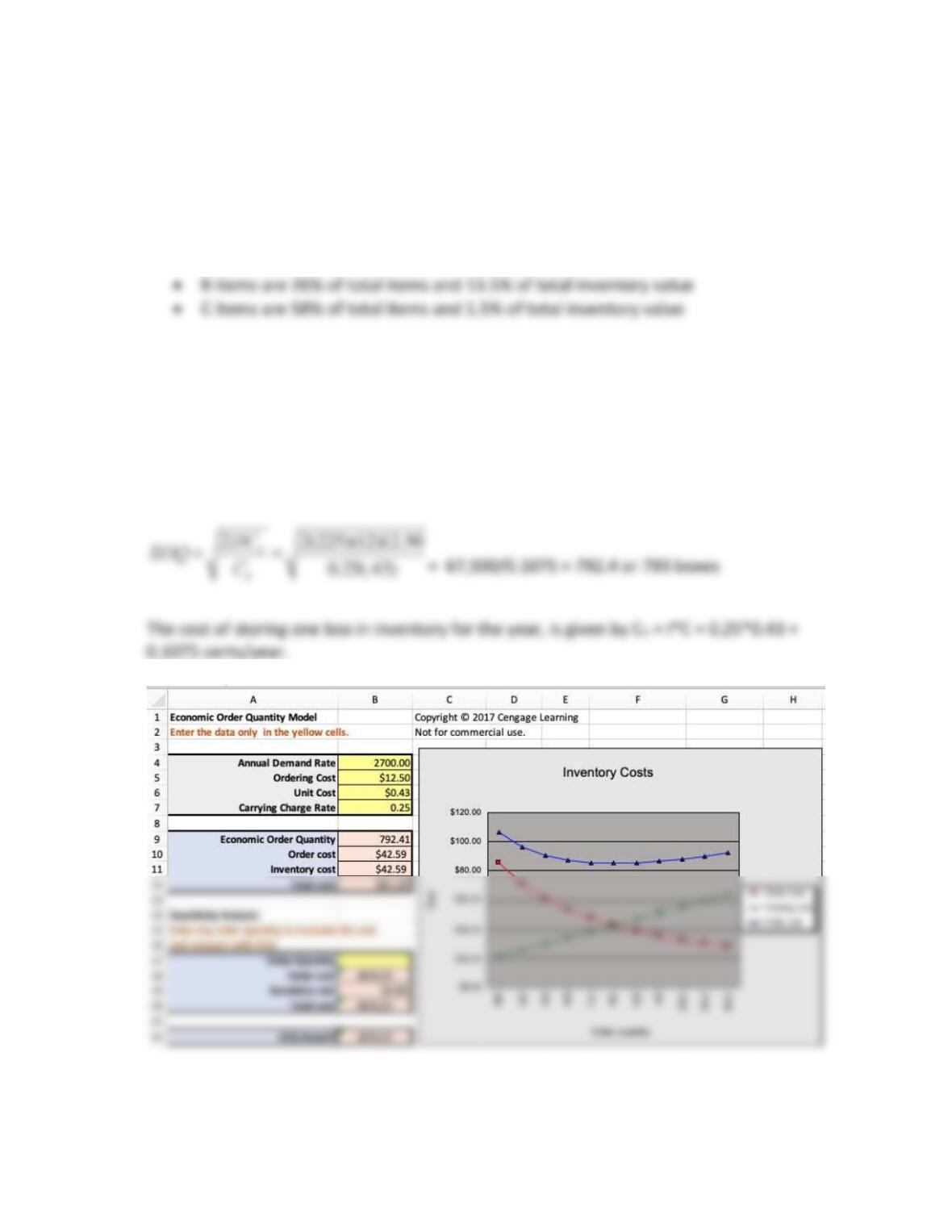
We might classify the first 3 items, which account for 16% of items and about 85% of dollar
usage as A items, and the last 11 items as C items. Again, there is no strict rule and
students will have differing opinions on how to classify them. So, one example ABC profile
would be as follows:
• A items are 16% of total items and 85% of total inventory value
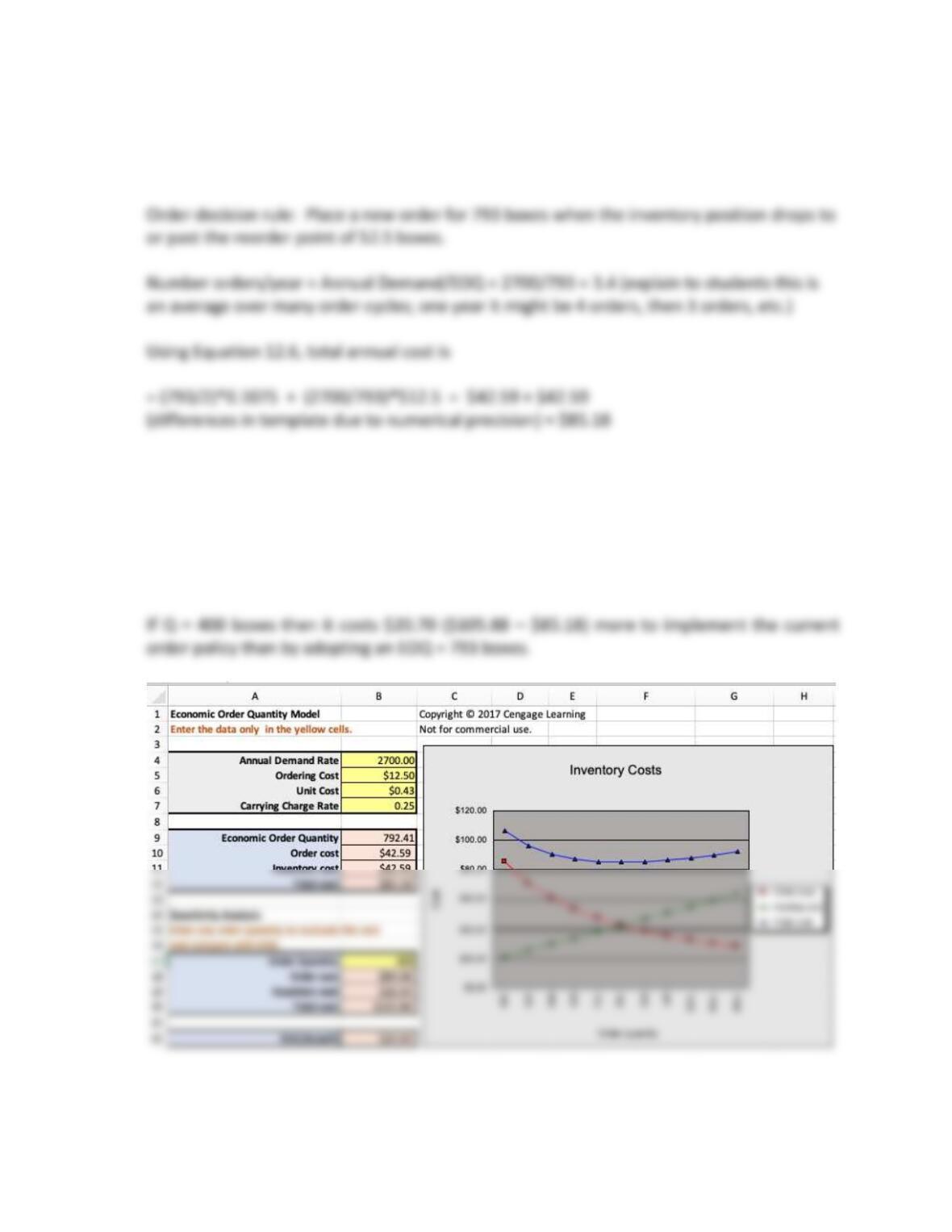
67. Mama Mia’s Pizza purchases its pizza delivery boxes from a printing supplier. Mama Mia’s
delivers on-average 225 pizzas each month (assume deterministic demand). Boxes cost 43
cents each, and each order costs $12.50 to process. Because of limited storage space, the
manager wants to charge inventory holding at 25 percent of the cost. The lead time is 7
days, and the restaurant is open 360 days per year, assuming 30 days per month. Use the
EOQ Model Excel template in MindTap to determine the economic order quantity, reorder
point assuming no safety stock, number of orders per year, and total annual cost.
39
Reorder point is one week’s demand or (225 boxes/month)/(30 days/month) = 7.5
boxes/day times 7 days a week = 52.5 boxes. Note the problem says 360 days per year so
most students try to work the problem out in days.
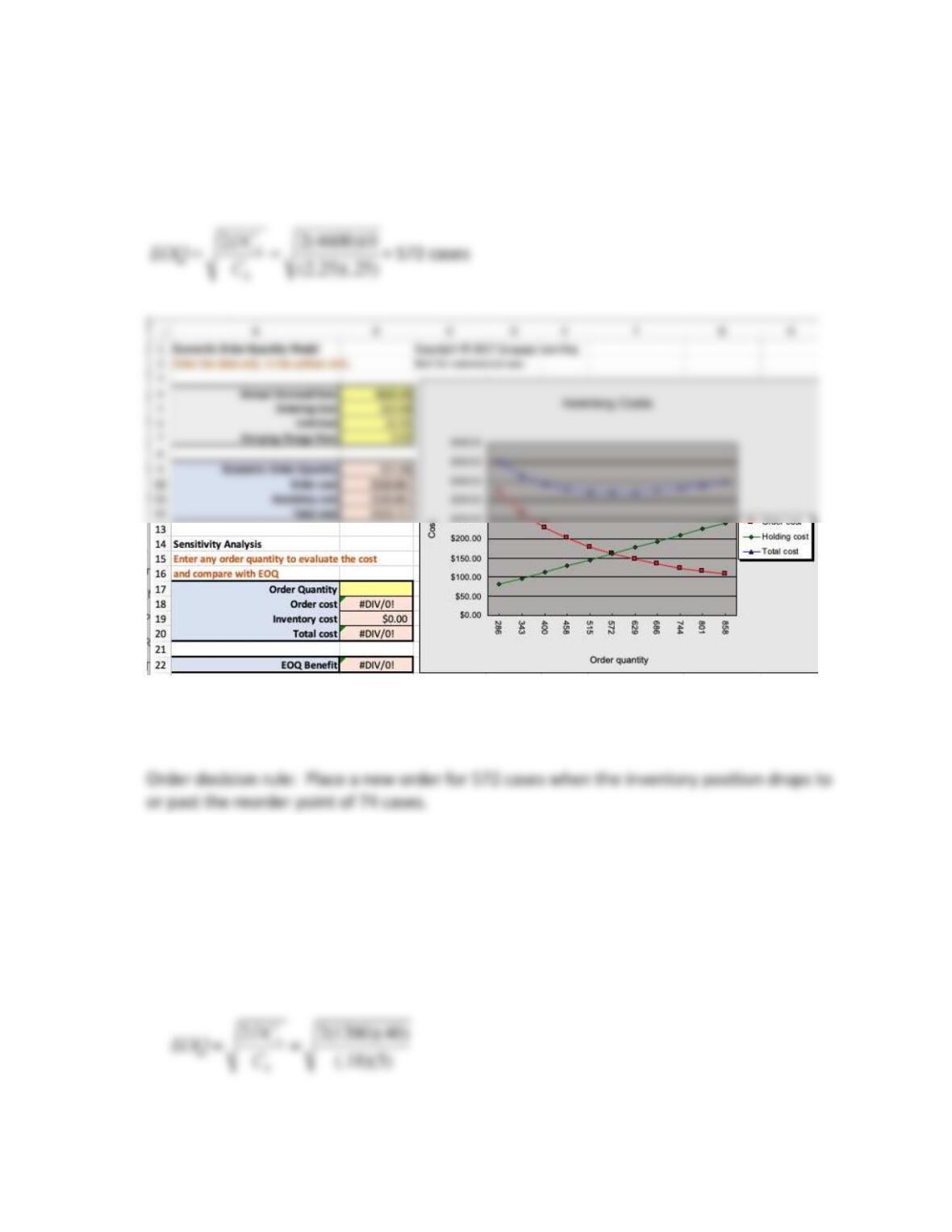
68. Refer to the situation in problem 67. Suppose the manager of Mama Mia’s current order
quantity is 400 boxes. How much can be saved by adopting an EOQ versus their current Q =
400? Use the EOQ Model Excel template in MindTap to find your answer.
Using Equation 12.6, total annual cost for the current order quantity of 400 =
(400/2)*.1075 + (2700/400)*$12.5 = $21.50 + $84.38 = $105.88
69. Super K Beverage Company distributes a soft drink that has a constant annual demand rate
of 4,600 cases. A 12-pack case of the soft drink costs Super K $2.25. Ordering costs are $20
40
per order, and inventory-holding costs are charged at 25 percent of the cost per unit.
There are 250 working days per year, and the lead time is four days. Use the EOQ Model
Excel template in MindTap to find the economic order quantity and total annual cost and
compute the reorder point.
Reorder point is four days’ demand or (4600/250)(4) = 73.6 or 74 cases. Note the problem
says 250 days per year so most students try to work the problem out in days.
70. Environmental considerations, material losses, and waste disposal can be included in the
EOQ model to improve inventory-management decisions. Assume that the annual demand
for an industrial chemical is 1,200 lb, item cost is $5/lb, order cost is $40, inventory-holding
cost rate (percent of item cost) is 18 percent. Use the EOQ Model Excel template in
MindTap to answer the following:
a. Find the EOQ and total cost assuming no waste disposal.